Pelícia K1
Garcia EA2
Scherer M RS3
M óri C1
Dalanezi JA1
Fait arone ABG1
M olino AB4
Berto DA3
* Research project carried out in the Animal Sci en ce Po st - Gr ad u at i o n Pr o g r am o f Facu l d ad e d e M ed i ci n a Vet er i n ár i a e Zoot ecnia, UNESP, Bot ucat u campus.
1 Ph.D. students of the Animal Science
Post-Gr ad u at i o n Pr o g r am , FM VZ- UNESP, Bot ucat u campus, SP.
2 Professor of the Department of Animal
Pro-duct ion, FM VZ-UNESP, Bot ucat u cam pus, SP.
3 M . Sc. students of the Animal Science
Post-Gr ad u at i o n Pr o g r am , FM VZ- UNESP, Bot ucat u campus, SP.
4 Undergraduate student of Animal Science,
FM VZ-UNESP, Bot ucat u campus, SP.
K Pelícia
Rua Dr João Candido Villas Boas, 351 Vl. Pinheiro
18609-690. Botucatu, SP, Brazil.
E-mail: f olkleber@f ca.unesp.br
Alt ernat ive calcium source, eggshell qualit y, limestone replacement, marine algae, marine calcium.
Alternative Calcium Source Effects on
Commercial Egg Production and Quality*
Mail Address
Keywords Author(s)
Arrived: August / 2006 Approved: July / 2007
ABSTRACT
This st udy aimed at verif ying t he possibilit y of replacing calcit ic limestone by marine calcium in the diet of layers. A total number of 321 Hi-sex hens, w ith 40 w eeks of age at the beginning of the experiment, w as used. A completely randomized experimental design w as applied, w it h 5 t reat m ent s (0, 15, 30, 45, and 60 % of calcit ic lim est one replacement by marine calcium source) and eight replicates of eight birds each. Treatments significantly affected specific gravity (p<0.05), w ith the inclusion of 60% marine calcium (T5) presenting the w orst result as compared t o T1, w hich included only calcit ic limest one as calcium source. It w as concluded that marine calcium can replace up to 45% of calcitic limestone w ith no effects on performance or egg quality.
INTRODUCTION
Calcium is very important for layers, as eggshell consists of 90% mineral matter, out of w hich 98% is composed of calcium carbonate (M endonça Junior, 1993). Losses caused by eggshell defects vary from 6 to 8% of laid eggs (Roland, 1977).In Brazil, Vicenzi (1996) estimated that losses due to cracked and/or broken eggs reach 6.0 to 12.3% annually.
According to Leeson & Summers (1997), the use of medullar bones for eggshell formation results in sudden loss of 2g of body calcium, and therefore, a calcium bone reserve must be build up before the production period.
Calcium source, as w ell as particle size, solubility, and inclusion level influence eggshell quality (Faria 2002).
Calcium absorption is related to several factors, such as vitamin D, protein, phosphates, free fatty acids, and zinc levels. Calcium source solubilization in the digestive tract is of utmost importance as, according to Bronner (1993), is essential, as calcium needs to solubilized in the digestive tract before being nutritionally used.
When evaluating the effects of limestone beating different solubilities on eggshell quality and performance. Thim & Craig (1990) concluded t hat , w hen replacing limest one by oyst er shell, or a highly soluble limestone by a low solubility limestone and vice-versa, there w ere no significant differences on eggshell quality and egg production.
The relationship among calcium level, source, particle size, in vivo and in vitro solubility, and calcium retention in the gizzard w as studied by Zhang & Coon (1997), w ho found that limestone retention in the gizzard increased w hen in vit ro solubilit y w as low er, or w hen high calcium levels w ere f ed. In t his st udy, lim est one in vivo solubilit y decreased as dietary calcium level increased.
calcium level, w hich seems to act on the hypothalamus, i n d u ci n g t h e r el ease o f n o r ep i n ep h r i n e, a neurot ransm it t er t hat act s in t he cent ral nervous system, stimulating feed intake (Borges, 1999).
Eggshell w orks as a “ package” of egg contents and protects the embryo, and must be sufficiently strong to resist egg laying, collection, grading, and transport, until it reaches the final consumer. Eggshell quality is also co m m ercially im p o rt an t , as co n su m ers are increasingly concerned w it h f ood saf et y, and poor eg g sh el l q u al i t y p r esen t s p o t en t i al b act er i al contamination (Kussakaw a et al., 1998).
Calcium may be supplied by different sources, such as limestone, calcium sulfate, calcite, oyster shell meal, aragonite, eggshells, etc., the most commonly used in layer diets are calcitic limestone and oyster shell meal (Kussakaw a et al., 1998).
Due to the high calcium requirements of commercial layers and of layer and broiler breeders, the know ledge on calcium sources t hat can replace or be used in association w ith calcitic limestone or oyster shell meal is essen t ial in o rd er t o im p ro ve o r t o m ain t ain perf orm ance and eggshell qualit y w it h t he use of renew able calcium sources.
This study aimed at evaluating the possibility of the replacement of calcitic limestone by “ marine calcium” in commercial layer diets.
MATERIAL AND METHODS
The experiment w as carried out at the experimental poultry house of FM VZ-UNESP, Botucatu, SP, Brazil, and took three periods of 28 days. A total number of 320 Hi-sex Brow n layers, w ith initial age of 40 w eeks, w as used. Birds w ere housed in 40 metal cages (100-cm long x 45-(100-cm high x 45-(100-cm deep), w ith eight birds per cage, resulting in a density of 562.5cm2/bird. Five treatments (0, 15, 30, 45, and 60 % inclusion of marine calcium replacing calcitic limestone) w ere applied.
M arin e calciu m d erives f ro m t h e m arin e alg a Lithothamnium sp., w hich is abundant in the northeast coast of Brazil. After collection, the algae w ere dried in oven at 70 ºC for 24 hours, after w hich they w ere ground. This product contains 42 % calcium, 0.04 %
phosphorus, 90.5 % CaCO3, 47.79 % CaO, 5.58 %
M gO, 2.99 M g, 0.75 % SiO2, 0.16 % Al2O3, 0.20 % Fe2O3, 0.17 Na2O, 0.03 % K2O, 0.08 % P3O9, 0.02 % M n, 0.25 % de S, 1.5 ppm Cu, 16.5 ppm Zn, 8.5 ppm Co, 30.5 ppm Ti, 11.5 ppm Ni, 9.5 ppm Cr, 9.5 ppm B, 10.5 ppm Se, 11.5 ppm V, 9.5 ppm M o, and 16.5 ppm Cl. The product does not contain toxic factors, such as
Water and feed w ere offered “ ad libitum” , and feed intake and egg w eight w ere w eekly determined. Birds w ere submitted to 17 hours of light daily. Eggs w ere collected daily, in the morning.
Performance w as evaluated applying a completely randomized experimental design w ith 5 treatments (0, 15, 30, 45, and 60% ) inclusion of marine calcium, w ith 8 replicates (cages) of 8 birds per experimental unit, including a total number of 320 birds and 40 cages.
Th e f o llo w in g p erf o rm an ce p aram et ers w ere evaluated: mortality, egg production, individual feed lead, cadm ium , and arsenic. Product part icle size, according to ABNT 0502/95, is mesh 0.4mm, passage 99% , ret ained 1% , and it is not soluble in w at er. Chem ical analyses w ere carried out according t o A OA C (1 9 9 7 ) m et h o d o lo g y. Pro d u ct co m m ercial availability is enough to supply the market, and the product is also used in cattle diets.
Calcit ic limest one includes 38% calcium, w it h a p art icle size o f 0 .1 8 m m GM D (g eo m et ric m ean diamet er).
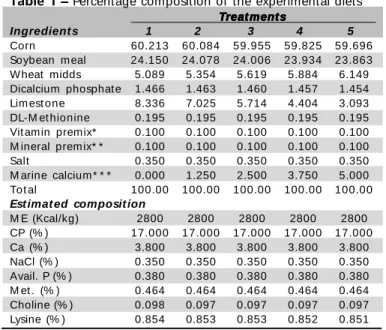
Feeds w ere formulated on corn and soybean meal basis, and supplemented w ith vitamins and minerals, in order to supply the requirements as determined by Rostagno et al. (2000). Feeds are show n in Table 1.
Table 1 – – – – – Percentage composition of the experimental diets Treat ment s
Treat ment s Treat ment s Treat ment s Treat ment s
Ingredient s 1 2 3 4 5
Corn 60.213 60.084 59.955 59.825 59.696
Soybean m eal 24.150 24.078 24.006 23.934 23.863 Wheat midds 5.089 5.354 5.619 5.884 6.149 Dicalcium phosphat e 1.466 1.463 1.460 1.457 1.454
Lim est one 8.336 7.025 5.714 4.404 3.093
DL-M et hionine 0.195 0.195 0.195 0.195 0.195 Vit am in prem ix* 0.100 0.100 0.100 0.100 0.100 M ineral prem ix* * 0.100 0.100 0.100 0.100 0.100
Salt 0.350 0.350 0.350 0.350 0.350
M arine calcium * * * 0.000 1.250 2.500 3.750 5.000
Tot al 100.00 100.00 100.00 100.00 100.00
Est imat ed composit ion
M E (Kcal/kg) 2800 2800 2800 2800 2800
CP (% ) 17.000 17.000 17.000 17.000 17.000
Ca (% ) 3.800 3.800 3.800 3.800 3.800
NaCl (% ) 0.350 0.350 0.350 0.350 0.350
Avail. P (% ) 0.380 0.380 0.380 0.380 0.380
M et . (% ) 0.464 0.464 0.464 0.464 0.464
Choline (% ) 0.098 0.097 0.097 0.097 0.097
Lysine (% ) 0.854 0.853 0.853 0.852 0.851
* Vitamin premix, kg product per M T feed: Vit. A – 7000000 UI;
Vit . D3 – 2000000 UI; Vit . E – 5000 mg; Ribof lavin – 3000 mg; Vit . K3 – 1600 mg – Vit . B12 – 8000 µg; Niacin – 20000 mg; Pant ot henic acid – 5000 mg; Ant ioxidant – 15000 mg; Vehicle Q.S.P. – 1000 g.
* * M ineral, premix, kg product per M T feed: Fe – 50000 mg; Cu
intake, mean egg w eight, egg mass, feed conversion ratio (per dozen eggs and per kg eggs).
In order t o m easure egg qualit y, t w o eggs per rep licat e w ere co llect ed every 2 8 d ays f o r t h ree consecut ive days f or a t ot al period of 84 days. A co m p let ely ran d o m ized exp erim en t al d esig n w as applied, w ith 5 treatments (0, 15, 30, 45, and 60% ) inclusion of marine calcium, w ith 8 replicates (cages) of 16 eggs per experiment al unit , including a t ot al number of 144 eggs per treatment, and a total number of 720 eggs. The f ollow ing egg qualit y paramet ers w ere evaluated: eggshell percentage, yolk color, yolk percentage, albumen percentage, albumen height, egg w eight, and Haugh units. Haugh unit w as calculate using the formula: UH = 100 log (H + 7.57 – 1.7 W 0.37), w here H = albumen height (mm) and W = egg w eight (g).
Dat a w ere submit t ed t o analysis of variance f or com plet ely random ized experim ent s, and pairs of means w ere compared by the test of Tukey (p<0.05), using SAS (1999) statistical package.
RESULTS AND DISCUSSION
Performance results are show n in Table 2. There w ere n o st at ist ical d if f eren ces (p > 0 .0 5 ) am o n g
treatments as to mortality, egg production, egg w eight, egg mass, feed intake, feed conversion ratio per dozen eggs and per kg eggs, and percentage of broken eggs, w h ich are co n sist en t w it h t h e resu lt s f o u n d b y Kussakaw a et al. (1998), w ho did not find any effect of different combination of calcium sources on egg production, feed intake, or feed conversion ratio (kg/ kg or kg/dozen eggs). The positive effect on calcium use, and consequent better feed conversion ratio, is associated to its mechanics, stimulating the propagation enzymes through the feed in the upper part of the digestive tract, promoting the action of digestive juices (Tort uero & Cent eno 1973). How ever t his w as not observed in the present study, w ith the association of calcitic limestone w ith marine calcium.
There w ere no st at ist ically signif icant dif f erences (p>0.05) among treatment effects on yolk color and percentage, albumen percentage, eggshell thickness, and Haugh units (Table 3). How ever, treatments had a significant effect on specific gravity (p<0.05), w ith t reat ment T5 (60% marine calcium + 40% calcit ic limestone) presented the w orst result (1.0923 b) as compared to the control treatment T1 (1.0952 a), but these results w ere not different from T2 (1.0933 ab), w hich presented 15% marine calcium and 85% calcitic limest one in t he diet ; T3 (1.0949 ab), w it h diet ary
Table 2 – Performance parameters of 40 to 84-w eek-old layers fed different calcium combinations.
Parameters Treatment s* * CV (% )
T1 T2 T3 T4 T5
Lay (% /hen/day)* 90.60 91.80 93.20 92.90 91.50 5.24
Egg mass (g)* 59.70 62.20 59.80 60.00 61.20 6.04
Feed int ake (g/hen/day)* 120 120 121 119 117 3.71
f eed conversion rat io (kg f eed /kg eggs)* 2.01 2.01 1.95 1.97 1.98 6.20
Feed conversion rat io (kg f eed /dozen eggs)* 1.57 1.57 1.57 1.54 1.54 6.21
Broken eggs (% )* 1.30 1.30 1.60 1.60 1.30 30.59
* P>0.05. * * T 1: 0% inclusion marine calcium replacing calcit ic limest one, T 2: 15% inclusion marine calcium replacing calcit ic limest one, T3: 30% inclusion marine calcium replacing calcit ic limest one, T4: 45% inclusion marine calcium replacing calcit ic limest one; T5: 60% inclusion marine calcium replacing calcit ic limest one.
Table 3 – Egg quality parameters of 40 to 84-w eek-old layers fed different calcium combinations.
Parameters Treatment s* * CV (% )
T1 T2 T3 T4 T5
M ean egg w eight (g) 66.0 65.0 65.0 66.0 66.0 3.45
Yolk color* 6 6 6 6 6 4.96
Eggshell (% )* * 9.70 9.70 9.80 9.50 9.50 3.49
Albumen (% ) 65.20 64.60 64.40 65.40 65.20 1.80
Yolk (% ) 25.10 25.70 25.70 25.10 25.30 4.26
Eggshell t hickness (mm) 0.396 0.390 0.399 0.388 0.388 3.86
Specif ic gravit y 1.0952a 1.0933ab 1.0949ab 1.0941ab 1.0923b 0.26
Haugh unit s 87.62 85.84 85.46 86.52 86.48 4.29
M eans f ollow ed by dif f erent let t ers in t he same row are signif icant ly dif f erent by t he t est of Tukey (p<0.05); T 1: 0% inclusion marine calcium replacing calcit ic limest one, T 2: 15% inclusion marine calcium replacing calcit ic limest one, T3: 30% inclusion marine calcium replacing calcit ic limest one, T4: 45% inclusion marine calcium replacing calcit ic limest one; T5: 60% inclusion marine calcium replacing calcit ic limest one. * Yolk color w as det ermined using Roche Colorimet ric Fan, w it h color scores ranging f rom 1 t o 15.
inclusion of 30% marine calcium and 70% calcit ic limestone; and T4 (1.0941 ab) w ith 45% marine calcium and 65% calcitic limestone. These egg quality results are different from those found by Kussakaw a et al. (1998), w ho observed differences in egg w eight and eggshell percentage, but no effect on specific gravity w hen providing different calcium source combinations in layer diets. On the other hand, M akled & Charlés (1987) found improved apparent egg density due to the association of calcium sources.
The dif f erent result s f ound in ot her st udies are related to the chemical composition and to the physical characteristics of different calcium sources (Fassani et al. 2004).
Roland (1986), Rao et al. (1992), and Cheng & Coon (1990) carried out studies to evaluate optimal particle size of calcium sources in terms of performance and egg quality. Rabon Junior & Roland (1985) evaluated 44 calcium sources and found 63% variation in calcium solubility in vitro. Leeson & Summer (1997) observed t h at calciu m so u rces w it h larg er p art icles w ere ret ain ed f o r lo n g er in t h e u p p er d ig est ive t ract , releasin g calciu m slo w ly an d co n sist en t ly d u rin g eggshell formation period.
Th e p resen t exp erim en t sh o w ed t h at , f o r all analyzed perf ormance and egg qualit y paramet ers, except f or specif ic gravit y, t reat m ent s cont aining m arine calcium prom ot ed sim ilar result s as t o t he co n t ro l t reat m en t , w h ich co n t ain ed o n ly calcit ic limestone.
Calcit ic lim est one GM D w as 0.18m m , w hereas marine calcium GM D w as 0.4mm, and therefore it w as expected that limestone w ould promote better results, particularly as to egg w eight and eggshell w eight, as demonstrated by Guinote & Nys (1991). How ever, our results are consistent w ith those of Fassani et al. (2004), w ho w orked w ith limestone GM Ds betw een 0.15 and 0.60 mm, and did not observe differences in limestone int ake, lim est one int est inal ret ent ion, or in vit ro solubility. It must be noted that the limestone particle sizes used by Fassani et al. (2004) are similar to those found for calcitic limestone and marine calcium used in the present study. This is important as limestone w ith low er solubility, w hich is found in limestone w ith larger particles, increases calcium intestinal retention, thereby improving eggshell quality, as observed by Guinote & Nys (1991). On the other hand, Fassani et al. (2004), w orking w ith particle sizes of 2.00-4.00 mm found d if f er en t lim est o n e in t ak e, lim est o n e in t est in al retention, and in vitro solubility.
CONCLUSIONS
Based on the results obtained under the conditions of the present study, it w as concluded that it is possible to include up to 45% of the product containing calcium of marine origin in layer diets in substitution of calcitic limestone w ith no harmful effects on performance or egg quality.
REFERENCES
AOAC. Association of Official Analytical Chemists. Official M ethods of Analysis of AOAC International. 16th ed. Washington, 1997. v.2.
Borges A LCC. Cont role da ingest ão de alim ent os. Cadernos Técnicos da Escola de Veterinária da UFM G, v.27, p.67-79, 1999.
Bronner F. Nutrient biovailabaty w ith a special reference to calcium. Journal Nutrition 1993; 123(5):797-802.
Cheng TK, Coon CN. Effect on layer performance and shell quality of sw itching limestones w ith differrent solubilities. Poultry Science, 69(12):2199-2203, 1990
Faria LV de. Granulometria do calcário calcítico e níveis de cálcio p ar a p o ed eiras co m erciais em seg u n d o ciclo d e p ro d u ção . [Dissertação]. Lavras (M G): Universidade Federal de Lavras; 2002, 61p.
Fassani JE, Bertechini AG, Kato RK, Fialho ET, Geraldo A. Composição e solubilidade “ in vitro” de calcário calcítico de M inas Gerais. Ciência Agrotecnológica 2004; 28(4):913-918.
Geraldo A, Bertecheni AG, Brito JAG, Kato RK, Fassani EJ. Níveis de calcio e granulometria do calcário para frangas de reposição no período de 3 a 12 semanas de idade. Revista Brasileira de Zootecnia 2006; 35(1):113-118.
Kussakaw a KCK, M urakami AE, Furlan AC. Combinações de fontes de cálcio em rações de poedeiras na fase final de produção e após muda forçada. Revista Brasileira de Zootecnia 1998; 27(3):572-578.
Leeson S, Summers JD. Commercial poultry nutricion. 2.ed. Ontario: Book University, 1997. 350p.
M akled M N, Charles OW. Eggshell quality as influenced by sodium bircabonat e, calcium source, and phot operiod. Poult ry Science 1987; 66(2):705-712.
M endonça Júnior CX de. Fat ores nut ricionais envolvidos na qualidade do ovo. In: Simpósio Técnico de Produção de Ovos; 1993; São Paulo. Brasil. São Paulo: APA; 1993. p. 29-51.
Rao KS, Roland DA, Adams JL. et al. Improved limestone retention in the gizzard of commercial leghorn hens. Journal Applied of Poultry Research 1992; 1(1):6-10.
Roland D. Eggshell quality IV: oystershell versus limestone and the importance of particle size or solubility of calcium source. World´s Poultry Science Journal 1986; 42(2):166-171.
Roland DA. The extent of uncollected eggs due to inadequate Shell. Poultry Science 1977; 56(5):1517-1521.
Rostagno HS. Composição de alimentos e exigência nutricionais. Tables Brasileiras para Aves e Suínos; 2.ed. M G: Viçosa, 2000, 186p.
STATISTICAL ANALYSES SYSTEM - SAS. User’s guide. Cary. 1 CD ROM , 1999.
Thim K, Craig NC. Effect on layer performance and shell quality of sw iching limestone w ith different solubilities. Poultry Science 1990; 69(12):2199-2203.
Tortuero F, Centeno C. Studies of the use of calcium carbonate in the feeding of laying hens during summer months. Poultry Science 1973; 52(3):866-872.
Vicenzi E. Fadiga de gaiola e qualidade da casca do ovo – aspectos nutricionais. In: SIM PÓSIO TÉCNICO DE PRODUÇÃO DE OVOS, 6, 1996, São Paulo, SP. Anais...São Paulo: APA, 1996, p. 77-91.