/ J of IMAB. 2014, vol. 20, issue 3/ http://www.journal-imab-bg.org 533
COMPARATIVE EVALUATION OF THE
EFFECTIVE-NESS OF FIVE METHODS FOR EARLY DIAGNOSIS
OF OCCLUSAL CARIES LESIONS – in vitro study
Mirela Marinova-Takorova1, Radostina Anastasova2 , Vladimir E. Panov2
1) Department of Conservative Dentistry, Faculty of Dental medicine, Medical University - Sofia,
2) Department of Conservative Dentistry and Oral pathology, Faculty of Dental medicine, Medical University - Varna, Bulgaria
Journal of IMAB - Annual Proceeding (Scientific Papers)2014, vol. 20, issue 3 Journal of IMAB
ISSN: 1312-773X (Online) http://www.journal-imab-bg.org
SUMMARY:
Purpose: The aimof the presented in vitro study was to evaluate the effectiveness of the device DIAGNOcam and the laser fluorescence device DIAGNOdent for early diag-nosis of occlusal caries and to compare it with three tradi-tional methods – visual and tactile, dye and radiographic examination.
Material and methods: The sample consisted of 60 extracted human teeth. Three clinicians diagnosed independ-ently the presence or absence of early occlusal surface car-ies with the visible tactile method, DIAGNOcam and DIAGNOdent. Then X-rays were taken and the dentists viewed them separately, without magnification. Fuchsine was applied for 30 sec. and then washed under running wa-ter for 20 min. Places where dye was present were regis-tered. Statistical analysis was performed with SPSS pack-age of Windows.
Results: The results showed high level of corre-spondence between the authors for all the diagnostic meth-ods. Concerning different methods applied for caries di-agnosis there was a correlation between the methods, but it was diverging for the different methods. No correlation be-tween radiographic exam and data obtained with DIAGNOdent and dye staining was observed.
Conclusions: Based on the obtained results we may conclude that the least sensitive method for fissure caries diagnosis was the dye staining, followed by the radiographic exam. The results, obtained by DIAGNOdent and DIAGNOcam were very close, but DIAGNOcams’ data was better correlating with the clinical results. DIAGNOcam procedure can be judged as equivalent in the detection of occlusal dentine lesions when compared to clinical results.
Key words: early caries diagnosis, laser fluorescence,
INTRODUCTION:
The aim of minimally invasive dentistry is to keep sound tooth structure as long as possible [1]. An important
point of this concept is the paradigm that dental caries is a dynamic disease that could be reversed if diagnosed at the level of early caries lesion [2, 3]. The awareness of people of their oral hygiene and the extensive use of fluoride has lead to a delay in the development and progression of car-ies, thus giving the dentist the chance to detect the devel-oping lesion and reverse the process by dietary changes, personal preventive actions and professional application of remineralizing agents [4] thus sparing the patient from the continuous re-restoration cycle that could eventually com-promise the long term functionality of the respective tooth [1, 6]. Unfortunately the excessive use of fluorides could lead to the so-called “hidden” caries or “fluoride syndrome” – the strengthened by the fluorides sound enamel masks relatively large dentinal lesion [5].
The classical methods for caries detection – visual and radiographic inspection have proved to be sensitive enough only in cases with substantial lesions, involving both enamel and dentin, which could be treated only operatively [6]. That is why a variety of new methods for early caries detection have been developed in the last decade [4, 7, 8].
The aim of the presented in vitro study was to evalu-ate the effectiveness of the device DIAGNOcam and the la-ser fluorescence device DIAGNOdent for early diagnosis of occlusal caries and to compare it with three traditional meth-ods – visual and tactile, dye and radiographic examination.
MATERIAL AND METHODS:
The sample consisted of 60 extracted human teeth. Prior to examination the teeth were cleaned from plaque and calculus. The study was performed in the following order:
1. Three clinicians diagnosed independently the pres-ence or abspres-ence of early occlusal surface caries with the vis-ible tactile method.
2. The teeth were photographed with DIAGNOcam and independent diagnose of the presence/absence of car-ies was performed (fig. 1, 2, 3).
534 http://www.journal-imab-bg.org / J of IMAB. 2014, vol. 20, issue 3/ Fig. 1. Image of a sound fissure (DIAGNOcam)
Fig. 3. Caries on the occlusal surface (DIAGNOcam)
3. Laser fluorescence was measured with DIAGNOdent. The presence of caries was diagnosed when values above 15 were measured.
4. X rays were taken – the clinicians viewed them separately, without magnification.
5. Fuchsine was applied for 30 sec. and then washed under running water for 20 min. places where dye was present were registered.
Statistical analysis was performed with SPSS pack-age of Windows.
RESULTS:
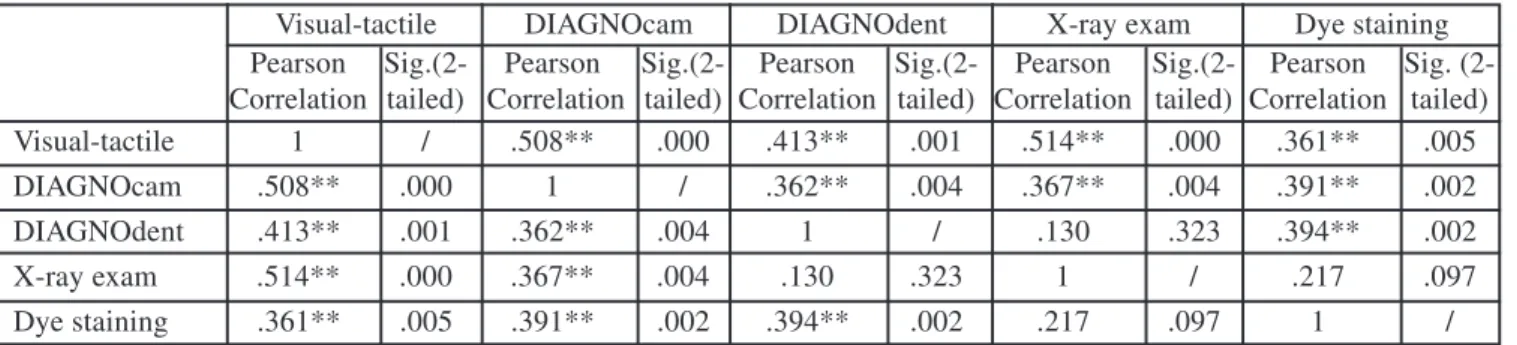
The results showed high level of correspondence be-tween the authors for all the diagnostic methods (table 1). Comparing the different methods, applied for caries diag-nosis there was a correlation between the methods, but it was diverging for the different methods (table 2). Compar-ing the results for DIAGNOcam and the clinical examina-tion the level of correlaexamina-tion was .508 – correlaexamina-tion being sig-nificant at 0.01 level. Compar ing the results for DIAGNOcam, DIAGNOdent and the radiographic exam and the dye staining the level of correlation was a little lower -.367, .362 and .391 respectively. The correlation of the re-sults obtained with DIAGNOdentwas most pronounced with clinical exam data, while no correlation with the radio-graphic exam was observed. The results obtained with the fuchsine correlated with DIAGNOcam, DIAGNOdent and the visual tactile method, but also did not correlate with the X-ray exam.
/ J of IMAB. 2014, vol. 20, issue 3/ http://www.journal-imab-bg.org 535 DISCUSSION:
The tested in the presented study devices use the dif-ferences in the optical properties of sound and carious tis-sue.
DIAGNOdent measures laser fluorescence within the mineral structure of the tooth. At the wavelength that DIAGNOdent laser operates (655nm), healthy tooth struc-ture exhibits little or no fluorescence, resulting in very low scale readings on the display (less than 15). Decayed tooth tissue exhibits fluorescence at longer wavelengths, propor-tional to the degree of lost tooth structure, resulting in el-evated scale readings on the display of the DIAGNOdent. There are two theories concerning the mechanism of fluo-rescence. According to the first one the reason for the emis-sion of fluorescent light with different wavelength are the porosities presented in decayed and demineralized dental tissues. The second theory presumes that the changes in DIAGNOdent readings are due to metabolic products of cariogenic bacteria [4]. A number of in vitro studies have claimed the device to be effective in measuring demineralized tooth structures [9, 10, 11]. In the meantime Astvaldsdóttir et al. found out that demineralization of enamel did not affect the DIAGNOdent measurements and changes in measurements are due to bacteria, but they are dependent on bacterial metabolites rather than the type of bacteria [12]. In a review of the data presented in the lit-erature Rickets found out that DIAGNOdent demonstrated greater sensitivity but poorer specificity compared with visual caries diagnosis [13]. False positive results were measured. Based on his study he recommends the device to be used as an adjunct method [13]. In our study the data obtained with DIAGNOdent did not correlated only with the data from the radiographic exam. It could be speculated that
this is due to the fact that X-rays could give false negative results if the lesion is not advanced enough, while DIAGNOdent is more likely to give false positive readings. DIAGNOcam uses laser diode with wavelength 780nm for transillumination of the tooth. Carious tissue scatters and absorbs more light than surrounding healthy tis-sue. A camera digitally images the light emerging from the opposite surface. The images are displayed on a monitor and stored. Affected by caries areas appear like dark spots. Con-cerning this method high level of correlation with all inves-tigated methods was observed. As a shortcoming of this method as occlusal caries diagnostic tool, compared with X-ray exam it could be pointed out that the depth of the car-ies lesion could not be pointed exactly.
The dye staining method proved to be the least ef-fective by often giving false positive results, due to the re-tention of dye in fissures.
CONCLUSIONS:
Based on the obtained results we may conclude: 1. The least sensitive method for fissure caries diag-nosis was the dye staining, followed by the radiographic exam.
2. The results, obtained by DIAGNOdent and DIAGNOcam were very close, but DIAGNOcam’s data was better correlating with the clinical results.
3. DIAGNOcam procedure can be judged as equiva-lent in the detection of occlusal dentine lesions when com-pared to clinical results.
4. We recommend both tested devices to be used as an adjunct method to visual inspection for obtaining better results in early caries diagnosis.
Examiners Examiner I Examiner II Examiner III
Pearson Sig. Pearson Sig. Pearson Sig.
Correlation (2-tailed) N Correlation (2-tailed) N Correlation (2-tailed) N
Examiner I 1 - 60 0,796** 0,000 60 0,561** 0,000 60
Examiner II 0,796** 0,000 60 1 - 60 0,577** 0,000 60
Examiner III 0,561** 0,000 60 0,577** 0,000 60 1 0,000 60
Table 1. Inter-examiner level of correspondence
Visual-tactile DIAGNOcam DIAGNOdent X-ray exam Dye staining Pearson Sig.(2- Pearson Sig.(2- Pearson Sig.(2- Pearson Sig.(2- Pearson Sig. (2-Correlation tailed) (2-Correlation tailed) (2-Correlation tailed) (2-Correlation tailed) (2-Correlation tailed)
Visual-tactile 1 / .508** .000 .413** .001 .514** .000 .361** .005
DIAGNOcam .508** .000 1 / .362** .004 .367** .004 .391** .002
DIAGNOdent .413** .001 .362** .004 1 / .130 .323 .394** .002
X-ray exam .514** .000 .367** .004 .130 .323 1 / .217 .097
Dye staining .361** .005 .391** .002 .394** .002 .217 .097 1 /
536 http://www.journal-imab-bg.org / J of IMAB. 2014, vol. 20, issue 3/ 1. Frencken JE, Peters MS, Manton
DJ, Leal SC, Gordan VV, Eden E. Mini-mal intervention dentistry (MID) for managing dental caries - a review: re-port of a FDI task group. Int Dent J. 2012 Oct;62(5):223-43. [PubMed] [CrossRef]
2. Kudiyirickal MG, Ivanèaková R. Early enamel lesion. Part I. Classifica-tion and detecClassifica-tion. ActaMedica (Hradec Kralove). 2008; 51(3):145-149. [PubMed]
3. Kudiyirickal MG, Ivanèaková R. Early enamel lesion. Part II. Histo-mor-phology and prevention. ActaMedica (Hradec Kralove). 2008 Mar;51(3):151-6. [PubMed]
4. Amaechi BT. Emerging technolo-gies for diagnosis of dental caries: The road so far. J Appl Phys. 2009 May; 105:102047. [CrossRef]
5. Weerheijm KL, Kidd EA, Groen HJ. The effect of fluoridation on the oc-currence of hidden caries in clinically
Address for correspondence: D-r. Mirela Marinova-Takorova,
Department of Conservative dentistry, Faculty of Dental medicine, Medical University - Sofia
1 GeorgySofiyskiblvd, 1431 Sofia, Bulgaria e-mail: [email protected]
REFERENCES:
sound occlusal surfaces. Car Res. 1997; 31(1):30-34. [PubMed]
6. McComb D, Tam LE. Diagnosis of occlusal caries: Part I. Conventional methods. J Can Dent Assoc. 2001 Sep; 67(8):454-457. [PubMed]
7. Karlsson L. Caries detection methods based on changes in optical properties between healthy and carious tissue. Int J Dent. 2010; 2010:270729. [PubMed] [CrossRef]
8. Stookey GK, Gonzalez-Cabezas C. Emerging methods of caries diagno-sis. J Dent Educ. 2001 Oct; 65(10): 1001-6. [PubMed]
9. Bahrololoomi Z, Musavi SA, Kabudan M. In vitro evaluation of the efficacy of laser fluorescence (DIAGNO dent) to detect demineralization and remineralization of smooth enamel le-sions. J Conserv Dent. 2013 Jul; 16(4):362-366. [PubMed] [CrossRef].
10. Mendes FM, Nicolau J, Duarte DA. Evaluation of the effectiveness of
laser fluorescence in monitoring in vitro remineralization of incipient caries le-sions in primary teeth. Car Res. 2003 Nov-Dec;37(6):442-444. [PubMed] [CrossRef]
11. Diniz MB, Paes Leme AF, Kardoso KdeS, Rodrigues JdeA, Corderio RdeC. The efficacy of laser fluorescence system to detect in vitro demineralization and remineralization of smooth enamel surfaces. Photomed Laser Surg 2009 Feb;27(1):57-61. [PubMed] [CrossRef]
12. Astvaldsdóttir A, Tranæus S, Karisson L, Peter Holbrook W. DIAGNOdent measurements of cultures of selected oral bacteria and deminera-lized enamel. Acta Odontil Scand. 2010 May;68(3):148-153. [PubMed] [CrossRef]
13. Ricketts D. The eyes have it. How good is DIAGNOdent at detecting caries? Evid Based Dent. 2005; 6(3):64-65. [PubMed] [CrossRef]
Please cite this article as: Marinova-Takorova M, Anastasova R, Panov VE. Comparative evaluation of the effec-tiveness of five methods for early diagnosis of occlusal caries lesions - in vitro study. J of IMAB. 2014 Jul-Sep;20(3):533-536. doi: http://dx.doi.org/10.5272/jimab.2014203.533.