Vaccine
Sven Le´tourneau1¤a, Eung-Jun Im1, Tumelo Mashishi1, Choechoe Brereton1¤b, Anne Bridgeman1, Hongbing Yang1, Lucy Dorrell1, Tao Dong1, Bette Korber2,3, Andrew J. McMichael1, Toma´sˇ Hanke1
*
1Medical Research Council Human Immunology Unit, Weatherall Institute of Molecular Medicine, University of Oxford, The John Radcliffe, Oxford, United Kingdom,2Los Alamo National Laboratory, Theoretical Biology and Biophysics, Los Alamos, New Mexico, United States of America,3The Santa Fe Institute, Santa Fe, New Mexico, United States of America
Background.One of the big roadblocks in development of HIV-1/AIDS vaccines is the enormous diversity of HIV-1, which could limit the value of any HIV-1 vaccine candidate currently under test.Methodology and Findings.To address the HIV-1 variation, we designed a novel T cell immunogen, designated HIVCONSV, by assembling the 14 most conserved regions of the
HIV-1 proteome into one chimaeric protein. Each segment is a consensus sequence from one of the four major HIV-1 clades A, B, C and D, which alternate to ensure equal clade coverage. The gene coding for the HIVCONSVprotein was inserted into the
three most studied vaccine vectors, plasmid DNA, human adenovirus serotype 5 and modified vaccine virus Ankara (MVA), and induced HIV-1-specific T cell responses in mice. We also demonstrated that these conserved regions prime CD8+and CD4+T
cell to highly conserved epitopes in humans and that these epitopes, although usually subdominant, generate memory T cells in patients during natural HIV-1 infection.Significance.Therefore, this vaccine approach provides an attractive and testable alternative for overcoming the HIV-1 variability, while focusing T cell responses on regions of the virus that are less likely to mutate and escape. Furthermore, this approach has merit in the simplicity of design and delivery, requiring only a single immunogen to provide extensive coverage of global HIV-1 population diversity.
Citation: Le´tourneau S, Im E-J, Mashishi T, Brereton C, Bridgeman A, et al (2007) Design and Pre-Clinical Evaluation of a Universal HIV-1 Vaccine. PLoS ONE 2(10): e984. doi:10.1371/journal.pone.0000984
INTRODUCTION
Despite twenty-five years of global effort, an effective vaccine against the human immunodeficiency virus type 1 (HIV-1) remains elusive. Induction of broadly neutralizing antibodies against HIV-1 is very difficult, yet it is the key to all other protective anti-viral vaccines[1]. Therefore consideration of HIV-1 vaccine candidates that stimulate cellular immunity has been the focus of many recent vaccines[2]. Although recent advances in vector design have generated optimism in this field[3,4], these technologies still need to address the extreme variability of HIV-1, whereby co-circulating viruses may differ in over 20% of their proteome[5,6]. Thus, while novel vectors and heterologous prime-boost combinations are getting better at in-ducing higher frequencies of HIV-1-specific T cells, less attention has been paid to how these vaccines can elicit T cells capable of recognizing multiple HIV-1 variants.
There are several approaches for dealing with the HIV-1 diversity. One optimistic view is that a single clade may induce sufficiently cross-reactive T-cell responses to protect against other variants of both the same and heterologous clades. The choice of a natural isolate can be based on having the closest sequence to all others, or picking a strain derived from acute infection and arguing that there is a convergence of viral sequences during transmission[7]. However, even if a single variant elicits responses that confer some cross-reactive protection, such protection is likely to be only partial and thus it is well worth attempting to design vaccine immunogens with enhanced cross-reactive potential. Although there are numerous reports of cross-clade reactive HIV-1-specific CD8+
T cell responses[8–12], use of unphysiologically high concentrations of variant peptides make the biological relevance of many of these results uncertain. In contrast, there are ample examples of highly specific T cell receptors sensitive to single amino acid (aa) changes[13–19], as well as compelling evidence of HIV-1 variants escaping existing T cell responses in infected individuals by single mutations in epitopes[2,20–22]. In vitro, systematic studies employ-ing all possible semploy-ingle aa substitutions in each position of an MHC
class I epitope indicated that as few as one third of such epitope variants were recognized by a given T cell receptor[13,19]. These results are in agreement with theoretical predictions proposed for cross-recognition of MHC class I-presented peptides by T cell receptors[23]. Thus the use of a single natural isolate for a vaccine has a high risk of not protecting against a different clade, nor against many variants of the same clade.
A second approach to HIV-1 diversity derives vaccine immuno-gens from ‘centralized’ sequences, which employ consensus/average, or centre-of-the-tree[24] sequences or extrapolated aa to a common clade or group ancestor[5]. Centralized sequences are designed to minimize the sequence differences between a vaccine immunogen and circulating viruses[5,24–26]. So far they have proven immuno-genic and able to elicit T cell responses in small animal studies[24,27–29] and clinical trials[30–32], providing experimental
Academic Editor:Douglas Nixon, University of California at San Francisco, United
States of America
ReceivedSeptember 5, 2007;AcceptedSeptember 13, 2007;PublishedOctober
3, 2007
Copyright:ß2007 Le´tourneau et al. This is an open-access article distributed
under the terms of the Creative Commons Attribution License, which permits unrestricted use, distribution, and reproduction in any medium, provided the original author and source are credited.
Funding:TH is the Jenner Institute Investigator. The work was supported by MRC
UK.
Competing Interests:The authors have declared that no competing interests
exist.
* To whom correspondence should be addressed.E-mail: [email protected].
ac.uk
¤aCurrent address:Department of Immunology and Allergy, University Hospital
of Lausanne (CHUV), Lausanne, Switzerland,
¤bCurrent address: Immunovirology and Pathogenesis Program, National
support for their further development. Early results for centralized immunogens for the entire group M are promising in that initial immunogenicity studies in mice yielded T-cell responses that were comparable to within-clade responses for many clades[29], however, this strategy may be stretched too far for optimal coverage of CD8+ T cell epitope variants of the whole group M[18,19,33].
In a third approach, vaccines deliver a cocktail of immunogens derived from different clades[34–36]. While initial results have been encouraging and responses to each antigen in the cocktail were observed[36], attention still needs be paid to possible immune interference, such as epitope antagonism, between different, but closely related peptide sequences in the vaccine, which may be limiting responses to some epitopes. Antagonism of T cell responses by altered epitope peptide ligands has been demonstrated both in vitro[37,38] and in vivo[18,39–42]. It can occur when a host capable of mounting a response to an agonist epitope is simultaneously exposed to an antagonist epitope variant, which interferes with the induction of the T cell response to the agonist epitope and leads to a defective response. Thus, the breadth of responses induced by cocktail approaches should be carefully monitored when such vaccines are used[18].
A fourth approach uses computational methods for assembling a polyvalent vaccine candidate that optimize the coverage of T cell epitopes. ‘Mosaic’ immunogens[43] are based on intact proteins and retain the probability for natural processing and presentation of T cell epitopes. Their potential problems are similar to those of other cocktails of natural proteins, i.e. immune interference and inclusion of both variable and conserved regions, whereby responses to variable regions may draw attention away from potentially more useful conserved targets. The impact of these processes will be only resolved in vaccine studies. An alternative means of designing immunogens contending with the HIV-1 variation is the COT+
method[44], which combines a central sequence with a set protein fragments designed to help cover diversity.
Here, we describe a further alternative that may have considerable advantages. We describe the construction and experimental testing in mice and humans of a novel multi-clade immunogen derived only from highly conserved regions of the HIV-1 consensus proteome, which was designed to provide extensive coverage of the principle HIV-1 clades A, B, C and D, while minimizing the possible occurrence of the epitope in-terference. It has the potential considerable advantage of focusing the T cell responses on the most conserved parts of the virus and thus overcoming the usual patterns of immunodominance, while making it difficult for the virus to escape without a likely significant cost to its fitness. This approach has also merit in the simplicity of design and delivery, requiring only a single immunogen to provide extensive coverage of global HIV-1 population diversity.
METHODS
Preparation of the pTH.HIVCONSV
and
pTH.HIVCONSVdH DNA vaccines
The synthetic gene coding for HIVCONSV(GeneArt) was subcloned
into plasmid pTH [45] and the codons coding for the H epitope were deleted using a PCR assembly to generate pTH.HIVCONSVdH. The
plasmid DNA for immunizations was prepared using the Endo-Free Gigaprep (Qiagen) and stored at220uC until use.
Preparation of the AdHu5.HIV
CONSVand
AdHu5.HIV
CONSVdH vaccines
Recombinant adenoviruses were obtained using the AdEasyTM Adenoviral Vector System (Stratagene), following the
manufac-turer’s instructions. Both adenoviruses expressed the green fluorescent protein as a marker.
Preparation of the MVA.HIVCONSV
and
MVA.HIVCONSVdH vaccines
Recombinant MVAs (rMVAs) were made as described previously [46]. Briefly, chicken embryo fibroblast (CEF) cells grown in Dulbeco’s Modified Eagle’s Medium supplemented with 10% FBS, penicillin/streptomycin and glutamine (DMEM 10) were infected with parental MVA at MOI 1 and transfected using Superfectin (Qiagen) with 3mg of pSC11.HIVCONSV or
pSC11.HIVCONSVdH carrying also the b-galactosidase gene as
a marker. Two days later, the total virus was harvested and used to re-infect CEF cells. rMVAs were subjected to five rounds of plaque purification, after which a master virus stock was grown, purified on a 36% sucrose cushion, titered and stored at –80uC until use.
Immunofluorescence
Six-well tissue culture plates containing sterile microscope cover-slips treated with 0.01% poly-L-lysine (Sigma) were seeded with 16105cells/well of HEK293T. After 12–24 h, cells reached 80% confluency and were transfected with 5mg of a selected plasmid using the Superfectin (Qiagen), according to the manufacturer’s recommendations, or infected with a selected recombinant viral vector at MOI 1 or 10. Cells were then incubated for 18–24 h, fixed with 0.5% formaldehyde, washed with PBS, their mem-branes perforated with 50% ethanol for 5 min, 70% ethanol for 10 min, and 50% ethanol for 3 min. Cells were washed again and blocked overnight with 2% FCS in PBS (FCS/PBS) at 4uC. The FCS/PBS solution was replaced by a 1/200 working dilution of a primary mouse monoclonal antibody against the Pk tag (Serotec) in FCS/PBS and incubated for 3–18 h at 4uC. Cells were subsequently washed three times with PBS, and incubated with a 1/500 dilution of the Alexa fluor 594-conjugated secondary chicken anti-mouse monoclonal antibody (Molecular Probes) in FCS/PBS for 2 h at room temperature or for 3–18 h at 4uC. Alternatively, a FITC-conjugated mouse monoclonal antibody against the Pk tag was used at a 1/500 dilution in FCS/PBS, and incubated for 2 h at room temperature or 3–18 h at 4uC. The cells were then washed three times with PBS, mounted on a microscope slide with Vectashield DAPI nuclear stain (Vector Laboratories) and photographed on a Zeiss fluorescence microscope.
Mice
For all animal experiments, groups of four 5- to 8-week-old female BALB/c or HHD mice were used. All animal procedures and care were approved by a local Ethical Committee and strictly conformed to the UK Home Office Guidelines.
Mouse immunizations and preparation of
splenocytes
Under general anaesthesia, mice were immunized i.m. with 100mg of pTH.HIVCONSVDNA, or 106 PFU of AdHu5.HIVCONSVor
106 PFU of MVA.HIVCONSV. On the day of sacrifice, spleens
Peptides and peptide pools
HPLC-purified, overlapping 15- by 11-mer peptides spanning the entire HIVCONSV protein were obtained from Sigma Genosys.
Peptides were at least 80% pure as verified by mass spectrometry. Individual peptides corresponding to epitopes were synthesised in an in-house facility (Weatherall Institute of Molecular Medicine, Oxford). All peptides were dissolved in DMSO (Sigma) at a concentration of 50 mg/ml, and stored at280uC.
Murine intracellular cytokine staining
Two million splenocytes were added to each well of a 96-well round-bottomed plate (Falcon) and pulsed with peptides or peptide pools and kept at 37uC, 5% CO2for 90 min, followed by the addition of
GolgiStopTM (BD Biosciences). After a further 5-h incubation, reaction was terminated, the cells washed with FACS wash buffer (PBS, 2% FCS, 0.01% Azide) and blocked with anti-CD16/32 (BD Biosciences) at 4uC for 30 min. All subsequent antibody stains were performed using the same conditions. Cells were then washed and stained with anti-CD8-PerCP or anti-CD4-PerCP (BD Biosciences), washed again and permeablized using the Cytofix/CytopermTMkit
(BD Biosciences). Perm/Wash buffer (BD Biosciences) was used to wash cells before staining with anti-IL-2-FITC, anti-TNF-a-PE and anti-IFN-c-APC (BD Biosciences). Cells were fixed with CellFIXTM (BD) and stored at 4uC until analysis.
Murine ELISPOT assay
The ELISPOT assay was performed using the Becton Dickinson IFN-cELISPOT kit according to the manufacturer’s instructions. The membranes of the ELISPOT plates (BD ImmunospotTM ELISPOT Plates) were coated with purified anti-mouse IFN-c
antibody diluted in PBS to a final concentration of 5mg/ml at 4uC overnight, washed once in R-10, and blocked for 2 h with R-10. A total of 2.56105 splenocytes were added to each well, stimulated with or without peptide for 16 h at 37uC, 5% CO2and
lysed by incubating 2x with deionized water for 5 min. Wells were then washed 3x with PBS 0.05% Tween-20, incubated for 2 h with a biotinylated anti-IFN-cantibody diluted in PBS 2% FCS to a final concentration of 2mg/ml, washed 3x in PBS 0.005% Tween-20 and incubated with 50 mg/ml horseradish peroxidase-conjugated to avidin in PBS 2% FCS. Wells were washed 4x with PBS 0.005% Tween-20 and 2x with PBS before incubating with an AEC substrate solution [3-amino-9-ethyl-carbazole (Sigma) dissolved at 10 mg/ml in Dimethyl formaldehyde and diluted to 0.333 mg/ml in 0.1 M acetate solution (148 ml 0.2 M acetic acid and 352 ml 0.2 M sodium acetate in 1 liter pH 5.0) with 0.005% H2O2]. After 5–10 min, the plates were washed with tap water,
dried and the resulting spots counted using an ELISPOT reader (Autoimmune Diagnostika GmbH).
51
Chromium-release assay
Isolated mouse splenocytes were restimulatedin vitrowith 2mg/ml of peptide in the Lymphocyte Medium for 5 days, at 37uC 5% CO2. On day 5 the cells were washed three times in R-0 and
diluted two-fold in a 96-well U-bottom plate (Nunc) to yield the different effector to target ratios. ELA A2-Kdor JK A2-Kdtarget cells were labelled with51Chromium at 37uC 5% CO2for 90 min
with or without appropriate peptide, washed three times with R-0, added to the effector cells at 56103 target cells per well, and incubated at 37uC 5% CO2for 4–6 h. The percentage of
peptide-specific lysis was calculated as [(sample release-spontaneous release)/(total release-spontaneous release)]6100. The spontane-ous release was less than 10% of the maximum release.
Human PBMC samples
For healthy lab subjects, PBMC separation was performed within 2 h of blood receipt. Blood was layered onto Ficoll (Sigma-Aldrich) and centrifuged (40 min, 400g, without brake) at room temperature. Following centrifugation, the cellular interface was removed, diluted in Hanks buffer (Sigma-Aldrich), and re-centrifuged. Cryopreserved PBMC samples from vaccine clinical trial participants in Oxford and African patients were used for detection of HIV-1-specific effectors. Cells were washed once more with 50 ml RPMI (Sigma-Aldrich) and then suspended in 10 ml RPMI for counting. Cells were counted using a Coulter Z1 Counter (Beckman-Coulter). Trypan blue exclusion (Sigma-Aldrich) was used to estimate the percentage of viable cells. All studies involving human samples were approved by local Ethical Review Panels and all patients gave an informed consent for donation of blood samples.
Short-term culture of PBMC
Short-term cell lines were set up as described previously[31]. Briefly, on day 0, fresh or frozen PBMCs were washed three times in R-0 and resuspended at 26106 cells/ml in RAB-10 (RPMI 1640, 10% human AB serum) supplemented with 25 ng/ml of IL-7 (R&D Systems). Twelve-well tissue culture plates (Nunc) were seeded with 0.9 ml of the PBMC suspension. Hundred ml of either Pool 1-3, Pool 4-6, or the FEC Pool (positive control of Flu-EBV-CMV CD8 epitopes) was added to each well for a final con-centration of 1.5mg/ml for each individual peptide. On day 3 and 7, 1800 IU of IL-2 (Chiron) were added to each well, as well as 1 ml of RAB-10 on day 7. On day 10, cells are washed twice in PBS, resuspended in fresh RAB-10 and rested for 26 to 30 h. Cells were subsequently tested for IFN-cproduction in an ELISPOT assay with or without CD8+
cell depletion as described below.
CD8
+cell depletion
CD8+cells were depleted using the Dynabead Depletion Kit (Dynal) following the manufacturer’s recommendation. Briefly, PBMCs were resuspended in a small volume with biotinylated anti-CD8 monoclonal antibody (BD Biosciences), incubated for 20 min at 4uC, the excess antibody was then washed off, cells were incubated with Dynabeads for 20 min at room temperature on an orbital shaker, and separated by a magnet. The depleted cells were collected and washed twice.
IFN-c
ELISPOT assay
PVDF membrane ELISPOT 96-well plates (Nunc) were pre-wet by dispensing 50ml of 70% ethanol, incubating at room temperature for 5 min and washing three times with endotoxin free PBS (Sigma). Plates were then coated overnight at 4uC with 50ml of a 10mg/ml purified anti-human IFN-cantibody solution in PBS. Plates were blocked with R-10 for 2 h, 80,000 cells/wells in 50ml of R-10 were added to each well (40,000 cells for FEC lines), as well as the appropriate peptide pool in 50ml of R-0 (final concentration of 1.5mg/ml or each individual peptide) or relevant controls from pre-aliquoted peptide plates. Plates were incubated at 37uC, 5% CO2for 14 to 18 h. Wells were then washed six times
formaldehyde and diluted to 0.333 mg/ml in 0.1 M acetate buffer [148 ml 0.2 M acetic acid and 352 ml 0.2 M sodium acetate in 1l of distilled water, pH 5] with 0.005% H2O2). Wells were finally
washed three to five times with tap water to stop the reaction, dried, and spots were counted on an ELISPOT reader (Autoimmune Diagnostika). Results were expressed as Spot Forming Units per million cells (SFU/106cells). Responses were considered positive if they were four times higher than background (no peptide) and if the background was less than 100 SFU/106cells.
Statistical analysis
An unpaired student t-test was used to determine significant difference between the averages of mock-stimulated splenocytes and splenocytes restimulated with a particular peptide in ICS assays in BALB/c mice, and between the averages of mock-stimulated splenocytes and splenocytes remock-stimulated with a partic-ular peptide pool in IFN-cELISPOT assays in HHD mice, PBMC unpulsed and peptide-pulsed, and was performed using the program available at http://www.physics.csbsju.edu/stats/t-test. html. Responses were defined as positive if p,0.05.
RESULTS
Design of the HIVCONSV
immunogen
A novel immunogen, termed HIVCONSV (for conserved), was
designed as a chimaeric protein and assembled from the most highly conserved domains among the HIV-1 clade A, B, C and D proteomes. First, a decision was taken that the HIVCONSV gene
should be approximately 2.5 kbp in size, which makes it suitable for most currently used genetic vaccine vectors and is likely to support a high protein expression. Two and a half thousand nucleotides translated into fourteen, 27- to 128-aa-long, most conserved regions of the HIV-1 proteins (Fig. 1A). The centralized sequence method was employed and the HIVCONSVimmunogen
was assembled from segments derived from one of the four within-clade consensus sequences (Fig. 1B) to reflect the fact that even the most conserved regions of HIV-1 are somewhat variable. It should be noted that because these regions are so highly conserved, often the consensus for one clade perfectly matched the consensus sequences of the other clades or indeed the group M (Fig. 1C), enhancing the potential for eliciting globally relevant cross-reactive responses. To keep the vaccine simple and minimize occurrence of
immune interference of T cell responses while ensuring a good coverage of all the four major clades, we alternated the clades of individual segments in the ‘string’ (Fig. 1C and D). Epitopes recognized by rhesus macaque and mouse CD8+ T cells, and a mAb[47–49] were added to the C-terminus of the HIVCONSV
immunogen (Fig. 1B–D), to facilitate the vaccine pre-clinical development.
Alignments of the HIVCONSVimmunogen with the global
HIV-1 sequences of group M including recombinant forms revealed that at least half of the sequences in the Los Alamos database are identical to fragments 6 and 8 (the median distance = 0), while fragments 2, 3, 10, 11, and 12 differ in less than 3% of their aa positions when compared to half of the sequences (median,0.03). The largest distance from the circulating global sequences displayed fragment 9 with differences in just over 7% aa positions. Conserved HIV-1 protein regions were included into the HIVCONSV immunogen irrespective of whether of not they
contained known T cell epitopes, however, every conserved fragment in the HIVCONSV contains at least one known human
epitope (Fig. 1F). In fact, 270 (24%) of the 1112 distinct published CD8+
T cell epitopes smaller than 12 aa described in the Los Alamos HIV-1 database are embedded in these fragments. Even though most epitopes in the literature have been defined using clade B reagents and the HIVCONSVimmunogen is an assemblage
of HIV-1 clade A, B, C, and D consensus fragments, still 192 (71%) of these 270 HIVCONSV epitopes are identical to an
experimentally defined epitopes and additional 59 (22%) differ by only one aa, so that 251 (93%) epitopes differ by no more than a single-aa difference from a known epitope and thus may elicit a cross-reactive response.
Vaccine construction and basic immunogenicity
TheHIVCONSVgene was made synthetically using ‘humanized’ aacodons[50] and its open-reading frame was preceded by a consensus Kozak sequence to -12 nucleotides[51] to maximize protein expression. A Met start codon was added to the first fragment. For initial studies, the gene was inserted into plasmid pTH DNA, human adenovirus serotype 5 (AdHu5) and modified vaccinia virus Ankara (MVA) vectors described previously[52] to yield pTH.HIVCONSV, AdHu5.HIVCONSVand MVA.HIVCONSV
vaccines, respectively. The HIVCONSV protein expression was
demonstrated by immunofluorescence of transiently transfected or
r
Figure 1. The HIVCONSVimmunogen.(A) Localization of the 14 most highly conserved regions of the HIV-1 proteome. The numbers written vertically under each fragment boundary indicate the first and last aa positions using the HXB2 reference strain numbering (http://www.hiv.lanl.gov/content/ hiv-db/LOCATE/locate.html).(B)Predicted aa sequence of the the HIVCONSVimmunogen with indicated fragment numbers.(C)Summary of the fragments including: the fragment number; the protein in which it was embedded; the clade of the consensus sequence selected for inclusion in the immunogen, alternating between clades A–D; additional clades that have identical HIVCONSV; and position numbers in the chimeric vaccine. The number of additional clades with identical consensus sequences to selected clade reflects the high level of conservation in these regions, and is encouraging in terms of the global potential of the vaccine. The consensus sequences compared were to the M group consensus, clades A–K, and three very common recombinant circulating forms CRF01 (common in Asia and Africa), CRF02 (common Africa), CRF08 (common in China) retrieved from the Los Alamos database 2004 consensus alignment (http://www.hiv.lanl.gov/content/hiv-db/CONSENSUS/M_GROUP/Consensus.html). (D) Schematic representation of the HIVCONSVimmunogen (not drawn to scale) indicating clade anternation (above), overlapping peptide pool derivation and protein origin by colour coding.(E) Hamming distances between the HIVCONSVantigen fragments and the global circulating viral sequences. The full M group alignment, including recombinant sequences, was used for the comparison. The Los Alamos database alignment contains only one sequence person, and contains sequences from between 600 and 1000 individuals in these proteins. The Hamming distance range for 95% of the sequences relative to the vaccine immunogen is given by the vertical lines. The distances between the full length natural proteins were then calculated relative to HXB2 reference strain Env, Vif, Gag and Pol sequences for comparison. Distance measures are minimal estimates, as gaps inserted in regions where insertions and deletions occur were not counted.(F)Numbers of known CD8+T cell epitopes (defined to within 12 aa or
less in the Los Alamos HIV-1 database) in each of the 14 conserved protein fragments included in the HIVCONSVimmunogen are shown. When more than one HLA class I presenting molecules can present the same HIV-1 epitope, then each is counted as a distinct epitope; if more than one sequence variant has been described as an epitope presented by the same class I molecule, then these are counted as a distinct epitopes; however, if an HLA serotype and genotype that are potentially the same are each described as presenting the same epitope (likeA2andA*0201) they are scored as a single epitope.
infected human embryonic kidney cells 293T using the mAb C-terminal tag (Fig. 2A–D). Using immunodominant epitope H, also known as P18-I10[49] and restricted by H-2Dd and Ld, the immunogenicities of individual vaccines and their heterologous prime-boost combinations were confirmed in the BALB/c mice. This demonstrated a strong priming with the pTH.HIVCONSV
DNA and ability to boost responses by heterologous vaccine vectors measured byex vivointerferon (IFN)-cELISPOT (Fig. 2E) and51Cr-release (not shown) assays. Particularly strong responses were elicited by the pTH DNA-rAdHu5-rMVA regimen (further designated DAM) delivering HIVCONSVreaching a mean of 3375
spot-forming units (SFU)/106of freshly isolated splenocytes.
Breadth of HIV
CONSVvaccine-induced immune
responses in the BALB/c mice
The HIVCONSVchimaeric protein is not a natural protein, and the
new context resulting from concatenating the fragments may impact the processing of intact epitopes that are embedded within the fragments. It was therefore important to demonstrate that
HIVCONSVcan induce T cell responses in mice and that epitopes
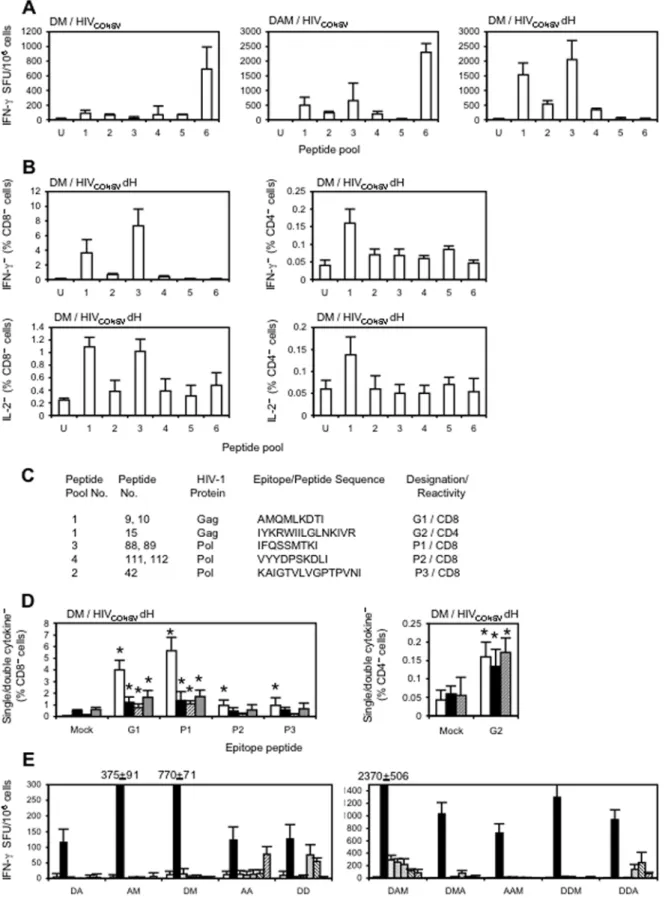
recognized by human HLA-restricted T cells can be generated. We noted, as previously, that the response to the added H epitope dominated the T cell response in BALB/c mice (Fig. 3A). To avoid the H epitope domination of the T cell responses in the BALB/c mice[18,53], vaccines expressing HIVCONSVdH immunogen with
the H epitope deleted were constructed. Groups of BALB/c mice were immunized using the two strongest heterologous regimens from the previous experiment and the breadth of induced T cells was assessed using six pools of 32 peptides (15-mer overlapping by 11 amino-acid residues) corresponding to the whole HIVCONSV
protein (Fig. 1D). While weak responses were observed following the DM regimen, higher frequencies of T cells recognizing at least 5 peptide pools were elicited by the DAM regimen (Fig. 3A, left and middle panels). In both instances, responses to pools 1–4 were dominated by the H epitope in pool 6 and were much stronger when the HIVCONSVdH immunogen was used (Fig. 3A, right
panel). Next, we showed that the DM regimen of the HIVCONSVdH vaccines induced both CD8+and CD4+T cells,
which could produce IFN-c and IL-2 in response to antigenic stimuli (Fig. 3B). Following identification of the individual pool peptides, minimal previously identified peptides were confirmed for some responses minimal epitopes[53] (Fig. 3C). Further analysis demonstrated elicitation of high quality T cells capable of production of IFN-c, IL-2 and TNF-a(Fig. 3D) and killing of targets sensitized with MHC class I-restricted peptides (not shown). Finally, using the HIVCONSVvaccines and the one CD4+and five
CD8+
T-cell epitopes, various dual and triple heterologous regimens were directly compared. This indicated that at the doses used, triple schedules were more immunogenic than the dual ones and indicated the superiority of DAM (Fig. 3E).
HIVCONSV
vaccine-induced HLA-A2-restricted
responses in transgenic mice
As a prelude to experiments in humans, we used genetically modified mouse strain HHD, which expresses as the only MHC class I molecule chimaeric human (a-1 anda-2) and mouse (a-3)
HLA-A*0201 heavy chain covalently linked to the human b2m
light chain. We used the most potent DAM regimen of the HIVCONSVvaccines for induction ofHLA-A*0201-restricted T cells
and detected responses inex vivoIFN-cELISPOT assay recognizing two peptide pools (Fig. 4A). Using the same assay, the fine specificities of these responses were mapped to two previously described[54,55] although relatively uncommon, minimal epitopes (Fig. 4B), which were confirmed in a51Cr-release assay on murine and human target cell lines expressing the HLA-A*0201 molecule. The epitopes were fully conserved in three out of the four consensus clade sequences, but the one aa substitution of the one outlier clade did not affect the killing (Fig. 4C). Note that the VIYQYMDDLY epitope encompasses the reverse transcription active site.
Generation of HIV
CONSV-specific responses in natural
HIV-1 infection
Next, we demonstrated that natural HIV-1 infection generally leads to generation of HIVCONSV-specific T cell responses, although these
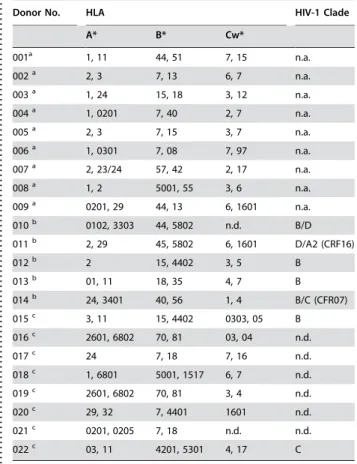
are usually smaller than the commonly seen immunodominant responses to epitopes in the more variable regions of HIV-1 and required in vitro expansions. All blood donors were tissue typed and where possible, the clade of their virus was identified (Table 1). In order to maximize sensitivity, PBMCs from infected patients were expanded in culture in the presence of HIVCONSV-derived peptide
pools prior to the IFN-c ELISPOT assay as described previous-ly[31]. In this highly sensitive assay, 0 of 9 healthy HIV-1/2-Figure 2. HIVCONSV protein expression in human cells and basic
immunogenicity. A histochemical and DAPI staining of 293T cells transiently transfected with pTH.HIVCONSV DNA (A), or infected with MVA.HIVCONSV (B) or AdHu5.HIVCONSV (C and D). HIVCONSV protein expression was detected using mAb tag Pk at the C-terminus of the immunogen and a primary anti-Pk mAb followed by secondary FITC- (A andB) or AlexaFluor584- (CandD) conjugated detection antibodies. The AdHu5.HIVCONSVvaccine also expressed GFP, which co-localized with the HIVCONSVexpression (D). (E) BALB/c mice were immunized using the regimen indicated below, and the HIVCONSV-induced T cell responses were assessed in an ELISPOT assay using the H epitope. Results are shown as a mean6SD (n = 4). U–unimmunized; D– pTH.HIVCONSVDNA; A–AdHu5.HIVCONSV; and M–MVA.HIVCONSV. For doses and timing, see Methods.
Figure 3. Breadth of HIVCONSV-induced T cell responses in BALB/c mice.Mice were immunized using the regimen and immunogen indicated above (A,BandC) or below (D) the graphs and the HIVCONSV-specific responses were determined inex vivoELISPOT (AandE) or ICS (BandD) assays detecting the indicated cytokines and using for restimulation overlapping peptide pools schematically shown in Fig. 1D (AandB) or individual epitope peptides (DandE). (C) Identified peptides or epitope sequences and their origin, name and T cell reactivity. In (D): white–IFN-c; black–IL-2; stripy-IFN-c+IL-2; and grey–TNF-a; *-responses significantly above the no-peptide background (p,0.05). In (E): white–no peptide followed from left to
uninfected lab volunteers had detectable responses to HIVCONSV
peptides, while 13 of 13 HIV-1-infected patients had HIVCONSV
-specific memory T cells (Fig. 5A). In all five tested patients for whom we had sufficient frozen PBMC, depletion of CD8+
cells
demon-strated that these responses were mediated by CD8+
T cells (Fig. 5B). These responses were broad and the median magnitude of all the HIV-1-infected patients for each peptide pool ranged between 1,000 and 3,500 SFU per 106cells in the cultured IFN-cELISPOT assay (Fig. 5C). With the exception of patient 020, twelve HIV-1-infected individuals responded to at least two peptide pools and 6 to three or more (Fig. 5D). Thus, conserved regions of the HIV-1 proteome included in the HIVCONSV immunogen served as a source of
T cell epitopes immunogenic during the course of natural HIV-1 infection.
DISCUSSION
A critical and contentious issue in HIV-1 vaccinology is how the vaccine-induced T cell responses will cope with both the intra- and inter-clade virus variabilities. Here, we describe a design and pre-clinical evaluation of vaccine immunogen HIVCONSV, which is
based on the 14 most conserved regions of the HIV-1 proteome. These regions are well populated with known though less dominant CD8+
T cell epitopes, which are highly conserved. We demonstrated in BALB/c and HLA-A*0201-transgenic mouse strains that this vaccine immunogen can serve as a source of immunogenic epitopes. Furthermore, we detected HIV-1-specific memory T cells that could recognize HIVCONSV-derived peptides in 13/13 HIV-1-infected
patients proving that HIVCONSV-specific responses are commonly
generated during natural HIV-1 infection. Figure 4. HIVCONSV-induced T cell responses in
HLA-A*0201-trans-genic mice, strain HHD. (A) Mice were immunized using the DAM regimen and the vaccine-induced responses were detected in anex vivo
ELISPOT assay. Results are shown as a mean6SD (n = 4). For doses and timing, see Methods. (B) Identified epitope peptides and their origin. (C) Killing of murine EL4 A2-Kd(top) and human JK A2-Kd(bottom) target cells sensitized with the shown peptides in a51Cr-release assay after a 5-dayin vitropeptide re-stimulation. Black, grey and white bars indicated effector to target ratios of 100, 50 and 25 to 1, respectively.
doi:10.1371/journal.pone.0000984.g004
Table 1.Tissue types and infecting viruses of human blood donors
. . . .
Donor No. HLA HIV-1 Clade
A* B* Cw*
001a 1, 11 44, 51 7, 15 n.a.
002a 2, 3 7, 13 6, 7 n.a.
003a 1, 24 15, 18 3, 12 n.a.
004a 1, 0201 7, 40 2, 7 n.a.
005a 2, 3 7, 15 3, 7 n.a.
006a 1, 0301 7, 08 7, 97 n.a.
007a 2, 23/24 57, 42 2, 17 n.a.
008a 1, 2 5001, 55 3, 6 n.a.
009a 0201, 29 44, 13 6, 1601 n.a.
010b 0102, 3303 44, 5802 n.d. B/D
011b 2, 29 45, 5802 6, 1601 D/A2 (CRF16)
012b 2 15, 4402 3, 5 B
013b 01, 11 18, 35 4, 7 B
014b 24, 3401 40, 56 1, 4 B/C (CFR07)
015c 3, 11 15, 4402 0303, 05 B
016c 2601, 6802 70, 81 03, 04 n.d.
017c 24 7, 18 7, 16 n.d.
018c 1, 6801 5001, 1517 6, 7 n.d.
019c 2601, 6802 70, 81 3, 4 n.d.
020c 29, 32 7, 4401 1601 n.d.
021c 0201, 0205 7, 18 n.d. n.d.
022c 03, 11 4201, 5301 4, 17 C
aHIV-1/2-uninfected subjects
bUK HIV-1-infected patients vaccinated with HIVA vaccines cPatients infected with HIV-1 in Africa [4]
n.a. – not applicable; n.d. not done doi:10.1371/journal.pone.0000984.t001
...
...
....
...
...
....
...
...
....
...
...
....
...
...
....
...
...
....
...
...
....
...
...
....
...
...
....
...
...
....
...
...
....
...
Pathogens such as HIV-1 with highly variable genomes still have relatively conserved regions of the proteome, which are structurally or functionally important. Some of these regions might reflect a lack of a selective immunological pressure, i.e. absence of immunodominant or any epitopes that select out escape muta-tions, although one would expect to see some background synonymous and non-synonymous variability if there were no fitness cost to substitutions in such regions. Here, we confirm both in mice and humans that the conserved HIVCONSVregions are not
generally immunologically inert and contain T cell epitopes that are often recognized, although these tend to be less immunodo-minant than more variable epitopes in natural infection. This subdominance may be an advantage for the vaccine strategy, because it would allow elicitation of a T cell response that is different from that normally stimulated by HIV-1 (which fails to control the virus). The subdominance of many HIVCONSV
epitopes and influence of immunodominance was clearly demon-strated in the series of BALB/c mouse immunizations using the HIVCONSVand HIVCONSVdH immunogens where a deletion of
a single dominant ‘H’ epitope tripled the frequencies to several previously subdominant epitopes. Although 37 HLA-A2-restricted epitopes have been described, most patients only respond to the same two or three of these, which are immunodominant, but absent from the HIVCONSV immunogen [56]. Therefore, it was
encouraging that the HLA-A*0201-transgenic mice nevertheless generated responses to 2 conserved subdominant epitopes, one of which include the reverse transcriptase active site. It is noteworthy that responses to some subdominant epitopes have been shown to be more protective than that those recognizing their immunodo-minant companions [57–59]. In natural HIV-1 infection, many of the conserved epitopes present in this construct are subdominant as implied by the need for expansion of patients’ PBMC prior to the response detection. In contrast the more variable escapable epitopes dominate to the extent that HLA type imprints changes in
virus sequence in the patient populations [60,61]. Our approach offers the possibility of changing the natural immunodominance by pre-infection vaccination, focusing the responses on highly conserved epitopes more like those seen by long term non-progressors with HLA B27 or B57 (ref. [62]).
In this work, we also directly compared various heterologous two- or three-component vaccination regimens and found that the most potent at the vaccine doses used was a combination of the three employed vectors in a DNA priming followed by sequential boosts with rHAdV-5 and rMVA, or the DAM regimen. Although this may depend of the doses used and be immunogen specific[63], triple prime-boost regimens were superior to the dual deliveries and merit testing in clinical trials.
A theoretical problem with this vaccine construct, a consequence of the chimaeric nature of the immunogen, is the possibility that unnatural stretches of aa at the boundaries of the fragments could also elicit T cell responses. In the work here, we did not identify any response to a junctional epitope, although we cannot exclude this happening with some HLA types and when the vaccine is tested in humans these responses should be sought to ensure there are no cases of immunodominance weakening the true anti-HIV-1 responses.
Although T cell epitopes in conserved regions of HIV-1 proteins were identified previously[64–72] and their value for vaccine development has been recognized[71,72], the HIVCONSV
immu-nogen has a number of unique features. The HIVCONSV
immunogen is a chimaeric protein assembled from protein regions rather than epitopes, which enables broader coverage overlapping epitopes presented by multiple HLA proteins; it uses consensus sequences of the four major HIV-1 clades, which are in many segments identical to consensus sequences from multiple clades and this should allow a geographically broad deployment of the HIVCONSV vaccines; it employs artificial clade consensus
sequences designed to deal with the intra-clade variability; it Figure 5. Recognition of HIVCONSV-derived peptides by PBMC from HIV-1-infected patients.The HIVCONSV-specific memory T cells were assessed in healthy and HIV-1-infected subjects using an IFN-cELISPOT assay after a 10-day peptide and cytokine culture. (A) Summed frequencies of HIVCONSV -specific cells detected in healthy (n = 9) and HIV-1-infected (n = 13) subjects. The bars show the group medians of 578 SFU/106and 8,092 SFU/106cells for the healthy and infected subjects, respectively. (B) In five subjects indicated below, cultured PBMC were left undepleted (grey) or depleted of CD8+ cells (black) prior to the ELISPOT assay. The difference between undepleted (median = 8,092 SFU/106 cells) and CD8-depleted samples (median = 550 SFU/106cells) was statistically significant (p= 0.0313). (C) Responses to individual HIV
CONSV-derived peptide pools as shown in Fig. 1D determined for the infected (grey) and healthy (black) subjects shown as medians. (D) Responses to individual peptides pools for each HIV-1-infected patient indicated below. Bars show a mean6SD of three assay wells and ‘*’ indicates a positive response according to criteria set in Methods. Due to sample shortage, subject 021 was not tested.
combines sequences of the four clades sequentially rather than in parallel, which avoids epitope antagonism; and through the lower frequency of immunodominant epitopes, it favours induction of broader T cell responses. Our initial results indicate that human T cell responses to epitopes embedded in the chimaeric immunogen are common, although further study is needed to indicate how generalizable this is to other epitopes of HIVCONSV, and if the
junction regions between fragments can stimulate problematic responses in humans. Finally, the theoretical global epitope coverage by the HIVCONSV immunogen is narrower compared
to the considerably more complex ‘‘mosaic’’ gene strategy, but the balance between optimizing epitope coverage and vaccine simplicity perhaps favours our HIVCONSVapproach.
The desirable, but not critical non-human primates studies with the HIVCONSVimmunogen are underway. Although the
advan-tages and disadvanadvan-tages of the HIVCONSVvaccines or any of the
other methods addressing the HIV-1 diversity discussed above can be argued theoretically and in model situations, whether or not any of them can induce broad enough anti-HIV-1 responses to decrease the transmission and/or reduce virus load in HIV-1-infected vaccine recipients will be only proven in clinical trials.
ACKNOWLEDGMENTS
Author Contributions
Conceived and designed the experiments: TH AM. Performed the experiments: SL EI TM CB. Analyzed the data: TH BK SL. Contributed reagents/materials/analysis tools: TH LD TD AB HY. Wrote the paper: TH BK AM.
REFERENCES
1. Burton DR, Desrosiers RC, Doms RW, Koff WC, Kwong PD, et al. (2004) HIV vaccine design and the neutralizing antibody problem Nat Immunol 5: 233–236. 2. McMichael AJ (2006) HIV vaccines Annu Rev Immunol 24: 227–255. 3. Duerr A, Wasserheit JN, Corey L (2006) HIV vaccines: new frontiers in vaccine
development Clin Infect Dis 43: 500–511.
4. Hanke T, McMichael AJ, Dorrell L (2007) Clinical experience with plasmid DNA- and modified vaccinia vaccine Ankara (MVA)-vectored HIV-1 clade A vaccine inducing T cells J Gen Virol 88: 1–12.
5. Gaschen B, Taylor J, Yusim K, Foley B, Gao F, et al. (2002) Diversity considerations in HIV-1 vaccine selection Science 296: 2354–2360. 6. Korber B, Gaschen B, Yusim K, Thakallapally R, Kesmir C, et al. (2001)
Evolutionary and immunological implications of contemporary HIV-1 variation Br Med Bull 58: 19–42.
7. Williamson C, Morris L, Maughan MF, Ping LH, Dryga SA, et al. (2003) Characterization and selection of HIV-1 subtype C isolates for use in vaccine development AIDS Res Hum Retroviruses 19: 133–144.
8. Amara RR, Sharma S, Patel M, Smith JM, Chennareddi L, et al. (2005) Studies on the cross-clade and cross-species conservation of HIV-1 Gag-specific CD8 and CD4 T cell responses elicited by a clade B DNA/MVA vaccine in macaques Virology 334: 124–133.
9. Betts MR, Krowka J, Santamaria C, Balsamo K, Gao F, et al. (1997) Cross-clade human immunodeficiency virus (HIV)-specific cytotoxic T-lymphocyte re-sponses in HIV-infected Zambians. J Virol 71: 8908–8911.
10. Buseyne F, Chaix ML, Fleury B, Manigard O, Burgard M, et al. (1998) Cross-clade-specific cytotoxic T lymphocytes in HIV-1-infected children. Virology 250: 316–324.
11. Cao H, Kanki P, Sankale JL, Dieng-Sarr A, Mazzara GP, et al. (1997) Cytotoxic T lymphocyte cross-reactivity among different human immunodeficiency virus type 1 clades: implications for vaccine development. J Virol 71: 8615–8623. 12. Ferrari G, Humphrey W, McElrath MJ, Excler JL, Duliege AM, et al. (1997)
Clade B-based HIV-1 vaccines elicit cross-clade cytotoxic T lymphocyte reactivities in uninfected volunteers. Proc Natl Acad Sci USA 94: 1396–1401. 13. Burrows SR, Silins SL, Moss DJ, Khanna R, Misko IS, et al. (1995) T cell
receptor repertoire for a viral epitope in humans is diversified by tolerance to a background major histocompatibility complex antigen J Exp Med 182: 1703–1715.
14. Dorrell L, Dong T, Ogg GS, McAdam S, Anzala o, et al. (1999) Distinct recognition of clade A HIV-1 epitopes by cytotoxic T lymphocytes generated from donors infected in Africa J Virol 73: 1708–1714.
15. Dorrell L, Willcox BE, Jones EY, Gillespie G, Njai H, et al. (2001) Cytotoxic T lymphocytes recognize structurally diverse, clade-specific and cross-reactive peptides in human immunodeficiency virus type-1 gag through HLA-B53 Eur J Immunol 31: 1747–1756.
16. Gotch F, McMichael A, Rothbard J (1988) Recognition of influenza A matrix protein by HLA-A2-restricted cytotoxic T lymphocytes. Use of analogues to orientate the matrix peptide in the HLA-A2 binding site J Exp Med 168: 2045–2057.
17. Hausmann S, Biddison WE, Smith KJ, Ding YH, Garboczi DN, et al. (1999) Peptide recognition by two HLA-A2/Tax11-19-specific T cell clones in relationship to their MHC/peptide/TCR crystal structures J Immunol 162: 5389–5397.
18. Larke N, Im E-J, Wagner R, Williamson C, Williamson A-L, et al. (2007) Combined single-clade candidate HIV-1 vaccines induce T cell responses limited by multiple forms ofin vivoimmune interference Eur J Immunol 37: 566–577.
19. Lee JK, Stewart-Jones G, Dong T, Harlos K, Di Gleria K, et al. (2004) T cell cross-reactivity and conformational changes during TCR engagement J Exp Med 200: 1455–1466.
20. Goulder PJ, Watkins DI (2004) HIV and SIV CTL escape: implications for vaccine design Nat Rev Immunol 4: 630–640.
21. Klenerman P, Wu Y, Phillips R (2002) HIV: current opinion in escapology Curr Opin Microbiol 5: 408–413.
22. Walker BD, Goulder PJ (2000) AIDS. Escape from the immune system. Nature 407: 313–314.
23. McMichael A, Mwau M, Hanke T (2002) HIV T cell vaccines, the importance of clades. Vaccine 20: 1918–1921.
24. Blay WM, Gnanakaran S, Foley B, Doria-Rose NA, Korber BT, et al. (2006) Consistent patterns of change during the divergence of human immunodefi-ciency virus type 1 envelope from that of the inoculated virus in simian/human immunodeficiency virus-infected macaques J Virol 80: 999–1014.
25. Gao F, Korber BT, Weaver E, Liao HX, Hahn BH, et al. (2004) Centralized immunogens as a vaccine strategy to overcome HIV-1 diversity Expert Rev Vaccines 3: S161–168.
26. Gao F, Weaver EA, Lu Z, Li Y, Liao HX, et al. (2005) Antigenicity and immunogenicity of a synthetic human immunodeficiency virus type 1 group m consensus envelope glycoprotein J Virol 79: 1154–1163.
27. Kothe DL, Decker JM, Li Y, Weng Z, Bibollet-Ruche F, et al. (2007) Antigenicity and immunogenicity of HIV-1 consensus subtype B envelope glycoproteins Virology 360: 218–234.
28. Kothe DL, Li Y, Decker JM, Bibollet-Ruche F, Zammit KP, et al. (2006) Ancestral and consensus envelope immunogens for HIV-1 subtype C Virology 352: 438–449.
29. Weaver EA, Lu Z, Camacho ZT, Moukdar F, Liao HX, et al. (2006) Cross-subtype T-cell immune responses induced by a human immunodeficiency virus type 1 group m consensus env immunogen J Virol 80: 6745–6756.
30. Dorrell L, Yang H, Ondondo B, Dong T, di Gleria K, et al. (2006) Expansion and diversification of specific T cells following immunisation of HIV-1-infected individuals with a recombinant modified vaccinia virus Ankara/HIV-1 gag vaccine. J Virol 80: 4705–4716.
31. Goonetilleke N, Moore S, Dally L, Winstone N, Mahmoud N, et al. (2006) Prime-boost vaccination with recombinant DNA and MVA expressing HIV-1 Clade A gag and immunodominant CTL epitopes induces multi-functional HIV-1-specific T cells in healthy subjects J Virol 80: 4717–4728.
32. Slyker JA, Lohman BL, Mbori-Ngacha DA, Reilly M, Wee EG, et al. (2005) Modified vaccinia Ankara expressing HIVA antigen stimulates HIV-1-specific CD8 T cells in ELISpot assays of HIV-1 exposed infants Vaccine 23: 4711–4719.
33. Altfeld M, Addo MM, Shankarappa R, Lee PK, Allen TM, et al. (2003) Enhanced detection of human immunodeficiency virus type 1-specific T-cell responses to highly variable regions by using peptides based on autologous virus sequences J Virol 77: 7330–7340.
34. Catanzaro AT, Koup RA, Roederer M, Bailer RT, Enama ME, et al. (2006) Phase 1 safety and immunogenicity evaluation of a multiclade HIV-1 candidate vaccine delivered by a replication-defective recombinant adenovirus vector J Infect Dis 194: 1638–1649.
35. Graham BS, Koup RA, Roederer M, Bailer RT, Enama ME, et al. (2006) Phase 1 safety and immunogenicity evaluation of a multiclade HIV-1 DNA candidate vaccine J Infect Dis 194: 1650–1660.
36. Seaman MS, Xu L, Beaudry K, Martin KL, Beddall MH, et al. (2005) Multiclade human immunodeficiency virus type 1 envelope immunogens elicit broad cellular and humoral immunity in rhesus monkeys J Virol 79: 2956–2963. 37. Bertoletti A, Sette A, Chisari FV, Penna A, Levrero M, et al. (1994) Natural variants of cytotoxic epitopes are T-cell receptor antagonists for antiviral cytotoxic T cells Nature 369: 407–410.
38. Klenerman P, Rowland-Jones S, McAdam S, Edwards J, Daenke S, et al. (1994) Cytotoxic T-cell activity antagonized by naturally occurring HIV-1 Gag variants Nature 369: 403–407.
40. Gilbert SC, Plebanski M, Gupta S, Morris J, Cox M, et al. (1998) Association of malaria parasite population structure, HLA, and immunological antagonism Science 279: 1173–1177.
41. Lau LL, Jiang J, Shen H (2005) In vivo modulation of T cell responses and protective immunity by TCR antagonism during infection J Immunol 174: 7970–7976.
42. Plebanski M, Lee EA, Hannan CM, Flanagan KL, Gilbert SC, et al. (1999) Altered peptide ligands narrow the repertoire of cellular immune responses by interfering with T-cell priming Nat Med 5: 565–571.
43. Fischer W, Perkins S, Theiler J, Bhattacharya T, Yusim K, et al. (2007) Polyvalent vaccines for optimal coverage of potential T-cell epitopes in global HIV-1 variants Nat Med 13: 100–106.
44. Rolland M, Jensen MA, Nickle DC, Yan J, Learn GH, et al. (2007) Reconstruction and function of Ancestral Center-Of-Tree (COT) HIV-I Proteins J Virol.
45. Hanke T, Schneider J, Gilbert SC, Hill AVS, McMichael A (1998) DNA multi-CTL epitope vaccines for HIV andPlasmodium falciparum: Immunogenicity in mice. Vaccine 16: 426–435.
46. Nkolola JP, Wee EG-T, Im E-J, Jewell CP, Chen N, et al. (2004) Engineering RENTA, a DNA prime-MVA boost HIV vaccine tailored for Eastern and Central Africa Gene Ther 11: 1068–1080.
47. Allen TM, Sidney J, del Guercio M-F, Glickman RL, Lensmeyer GL, et al. (1998) Characterization of the peptide-binding motif of a rhesus MHC class I molecule (Mamu-A*01) that binds an immunodominant CTL epitope from SIV. J Immunol 160: 6062–6071.
48. Hanke T, Szawlowski P, Randall RE (1992) Construction of solid matrix-antibody-antigen complexes containing simian immunodeficiency virus p27 using tag-specific monoclonal antibody and tag-linked antigen J-Gen-Virol 73: 653–660.
49. Takahashi H, Cohen J, Hosmalin A, Cease KB, Houghten R, et al. (1988) An immunodominant epitope of the human immunodeficiency virus envelope glycoprotein gp160 recognized by class I major histocompatibility molecule-restricted murine cytotoxic T lymphocytes. Proc Natl Acad Sci USA 85: 3105–3109.
50. Andre S, Seed B, Eberle J, Schraut W, Bultmann A, et al. (1998) Increased immune response elicited by DNA vaccination with a synthetic gp120 sequence with optimized codon usage. J Virol 72: 1497–1503.
51. Kozak M (1987) An analysis of 59-noncoding sequences from 699 vertebrate messenger RNAs. Nucleic Acids Res 15: 8125–8148.
52. Hanke T, McMichael AJ (2000) Design and construction of an experimental HIV-1 vaccine for a year-2000 clinical trial in Kenya. Nat Med 6: 951–955. 53. Im E-J, Hanke T (2007) Pre-clinical evaluation of candidate HIV type 1 vaccines
in inbred strains and an outbred stock of mice AIDS Res Hum Retroviruses 23: 857–862.
54. Hanke T, Blanchard TJ, Schneider J, Ogg GS, Tan R, et al. (1998) Immunogenicities of intravenous and intramuscular administrations of MVA-based multi-CTL epitope vaccine for HIV in mice. J Gen Virol 79: 83–90. 55. Kmieciak D, Bednarek I, Takiguchi M, Wasik TJ, Bratosiewicz J, et al. (1998)
The effect of epitope variation on the profile of cytotoxic T lymphocyte responses to the HIV envelope glycoprotein Int Immunol 10: 1789–1799. 56. Goulder PJ, Altfeld MA, Rosenberg ES, Nguyen T, Tang Y, et al. (2001)
Substantial differences in specificity of HIV-specific cytotoxic T cells in acute and chronic HIV infection J Exp Med 193: 181–194.
57. Frahm N, Kiepiela P, Adams S, Linde CH, Hewitt HS, et al. (2006) Control of human immunodeficiency virus replication by cytotoxic T lymphocytes targeting subdominant epitopes Nat Immunol 7: 173–178.
58. Gallimore A, Dumrese T, Hengartner H, Zinkernagel RM, Rammensee HG (1998) Protective immunity does not correlate with the hierarchy of virus-specific cytotoxic T cell responses to naturally processed peptides. J Exp Med 187: 1647–1657.
59. Makki A, Weidt G, Blachere NE, Lefrancois L, Srivastava PK (2002) Immunization against a dominant tumor antigen abrogates immunogenicity of the tumor Cancer Immun 2: 4.
60. Bhattacharya T, Daniels M, Heckerman D, Foley B, Frahm N, et al. (2007) Founder effects in the assessment of HIV polymorphisms and HLA allele associations Science 315: 1583–1586.
61. Moore CB, John M, James IR, Christiansen FT, Witt CS, et al. (2002) Evidence of HIV-1 adaptation to HLA-restricted immune responses at a population level Science 296: 1439–1443.
62. Streeck H, Lichterfeld M, Alter G, Meier A, Teigen N, et al. (2007) Recognition of a defined region within p24 Gag by CD8+T cells during primary HIV-1 infection in individuals expressing protective HLA class I alleles J Virol. 63. Gilbert SC, Schneider J, Hannan CM, Hu JT, Plebanski M, et al. (2002)
Enhanced CD8 T cell immunogenicity and protective efficacy in a mouse malaria model using a recombinant adenoviral vaccine in heterologous prime-boost immunisation regimes Vaccine 20: 1039–1045.
64. Johnson RP, Hammond SA, Trocha A, Siliciano RF, Walker BD (1994) Induction of a major histocompatibility complex class I-restricted cytotoxic T-lymphocyte response to a highly conserved region of human immunodeficiency virus type 1 (HIV-1) gp120 in seronegative humans immunized with a candidate HIV-1 vaccine J Virol 68: 3145–3153.
65. Johnson RP, Trocha A, Buchanan TM, Walker BD (1992) Identification of overlapping HLA class I-restricted cytotoxic T cell epitopes in a conserved region of the human immunodeficiency virus type 1 envelope glycoprotein: definition of minimum epitopes and analysis of the effects of sequence variation J Exp Med 175: 961–971.
66. Johnson RP, Trocha A, Yang L, Mazzara GP, Panicali DL, et al. (1991) HIV-1 gag-specific cytotoxic T lymphocytes recognize multiple highly conserved epitopes. Fine specificity of the gag-specific response defined by using unstimulated peripheral blood mononuclear cells and cloned effector cells J Immunol 147: 1512–1521.
67. Harrer E, Harrer T, Barbosa P, Feinberg M, Johnson RP, et al. (1996) Recognition of the highly conserved YMDD region in the human immunode-ficiency virus type 1 reverse transcriptase by HLA-A2-restricted cytotoxic T lymphocytes from an asymptomatic long-term nonprogressor J Infect Dis 173: 476–479.
68. Johnson RP, Trocha A, Buchanan TM, Walker BD (1993) Recognition of a highly conserved region of human immunodeficiency virus type 1 gp120 by an HLA-Cw4-restricted cytotoxic T-lymphocyte clone J Virol 67: 438–445. 69. Rowland-Jones SL, Dong T, Fowke KR, Kimani J, Krausa P, et al. (1998)
Cytotoxic T cell responses to multiple conserved epitopes in HIV-resistant prostitutes in Nairobi J Clin Inv 102: 1758–1765.
70. Wilson CC, Palmer B, Southwood S, Sidney J, Higashimoto Y, et al. (2001) Identification and antigenicity of broadly cross-reactive and conserved human immunodeficiency virus type 1-derived helper T-lymphocyte epitopes J Virol 75: 4195–4207.