Testing color evaporation in photon-photon production of J
Õ
c
at CERN LEP II
O. J. P. E´ boli,1,*E. M. Gregores,2,† and J. K. Mizukoshi1,‡
1Instituto de Fı´sica, Universidade de Sa˜o Paulo, Sa˜o Paulo, SP, Brazil 2Instituto de Fı´sica Teo´rica, Universidade Estadual Paulista, Sa˜o Paulo, SP, Brazil
~Received 18 August 2003; published 11 November 2003!
The DELPHI Collaboration has recently reported the measurement of J/c production in photon-photon
collisions at CERN LEP II. These newly available data provide additional proof of the importance of colored
cc¯ pairs for the production of charmonium, because these data can be explained only by considering resolved
photon processes. We show here that the inclusion of color octet contributions to J/c production in the
framework of the color evaporation model is able to reproduce these data. In particular, the
transverse-momentum distribution of the J/c mesons is well described by this model.
DOI: 10.1103/PhysRevD.68.094009 PACS number~s!: 13.60.Le, 14.40.Gx
I. INTRODUCTION
The DELPHI Collaboration recently released preliminary measurements of the transverse-momentum spectrum of J/c mesons produced in gg collisions at the CERN e1e2 col-lider LEP@1,2#. These new data allow further tests of models for charmonium production. We show here that the color evaporation model ~CEM! reproduces these new results us-ing the same sus-ingle nonperturbative parameter that has been obtained from previous analysis of charmonium photo- and hadroproduction. These newly available data provide
addi-tional proof of the importance of colored cc¯ pairs for the production of charmonium, as the data in this region can be explained only by considering resolved photon processes, which form colored cc¯ pairs in the leading order. The CEM for charmonium production incorporates these colored pairs into the total yield of charmonium in a very simple and eco-nomical way.
The Fermilab Tevatron data@3,4#on charmonium produc-tion at high pT have changed the way we understand
char-monium production. The presently successful models are based on two key considerations:~i!quarkonium production is a two-step process in which a heavy quark pair is produced first, followed by the nonperturbative formation of the asymptotic states, and ~ii! color octet as well as singlet cc¯ states contribute to the production of charmonia. These fea-tures are incorporated in the nonrelativistic QCD~NRQCD!
factorization approach @5,6#, the color evaporation model
@7–9#and the soft color interaction model@10#.
The color evaporation model simply states that charmo-nium production is described by the same dynamics as DD¯ production, i.e., by the formation of a cc¯ pair in any color configuration. Rather than imposing that the cc¯ pair is in a color singlet state in the short distance perturbative pro-cesses, it is argued that the appearance of color singlet asymptotic states solely depends on the outcome of
nonper-turbative large distance fluctuations of quarks and gluons. These large distance fluctuations are considered to be com-plex enough for the occupation of different color states to approximately respect statistical counting. In fact, it is in-deed hard to imagine that a color singlet state formed at a range mc21 would survive to form a c at a range LQCD21 . Although far more restrictive than other proposals, the CEM successfully accommodates all features of charmonium pro-duction@11–13#.
The CEM predicts that the sum of the production cross sections of all quarkonium and open charm states is de-scribed by
squarkonium5 1
9
E
2mc 2mDd Mcc¯
dscc¯
d Mcc¯
~1!
and
sopen5 8 9
E
2mc2mD
d Mcc¯
dscc¯
d Mcc¯ 1
E
2mD
d Mcc¯
dscc¯
d Mcc¯
, ~2!
where Mcc¯is the invariant mass of the cc¯ pair. The factor 1/9
stands for the probability that a pair of charm quarks formed at a typical time scale 1/Mc ends up as a color singlet state after exchanging an uncountable number of soft gluons with the reaction remnants; for further details see@7#. One attrac-tive feature of this model is the relation between the produc-tion of charmonium and open charm, which allows us to use the open charm data to normalize the perturbative QCD cal-culation, and consequently to constrain the CEM predictions. Up to this point, the model has no free parameter in ad-dition to the usual QCD ones. In order to predict the produc-tion rate of a particular charmonium state, let us say a J/c
meson, we must also know the fraction rc of produced
quarkonium states that materialize as this state (J/c),
sc5rcsquarkonium. ~3!
In its simplest version, the CEM assumes thatrc is energy and process independent, which is in agreement with the low energy measurements@14,15#. Notice thatrc is the only free parameter of the CEM, making this a very restrictive
frame-*Electronic address: [email protected]
†Electronic address: [email protected]
work. From charmonium photoproduction, we determined that rc50.43–0.5 @8#, a value that can be accounted for by statistical counting of final states@10#: the fraction of a given quarkonium state X with angular momentum JX can be
writ-ten as rX5GX/(YGY withGX5(2JX11)/nX. Notice that a
suppression factor for radially excited states with principal quantum number nxhas been introduced; for further details
see Ref. @10#. The fact that all c production data are de-scribed in terms of this single parameter, fixed by J/c pho-toproduction, leads to parameter-free predictions for the Z boson decay rate intoc @16#, and to charmonium production cross sections at the Tevatron@17#and the DESY ep collider HERA@18,19#, as well as in neutrino initiated reactions@20#.
II. RESULTS
The differential cross section for the inclusive process
e1e2→e1e2gg→J/cX is
d2s
d pT25
(
A,BE E E E
d y1d y2dx
AdxBfg/e1~y1!
3fg/e2~y2!FA/g~xA!FB/g~xB!
d2sˆ~AB→cY!
d pT2 ,
~4!
where fg/e6 is the bremsstrahlung photon distribution from
an electron or positron. We denoted the parton distribution function of the photon by FA[B]/g(xA[B]), where xA[B] is the
fraction of the photon momentum carried by the parton
A@B#. For direct photon interactions (A@B#[g), we have
FA[B]/g(xA[B])5d(xA[B]21). We considered an average
electron-positron center-of-mass energy 2Ee5197 GeV. We also applied the experimental J/c rapidity cut 22,hc ,2, and imposed that theggcenter-of-mass energy satisfies
Wgg,35 GeV, where Wgg52Ee
A
y1y2.In our calculation, we employed the Weiza¨cker-Williams approximation for the photon distribution,
fg/e6~y!5
ae.m.
2p
F
11~12y!2
y log
S
Qmax2Qmin2
D
12me2y
S
1 Qmax2 21
Qmin2
D
G
, ~5!with Qmin2 5me2y2/(12y ), and Qmax2 5(Eeu)2(12y ) 1Qmin2 . Here, the fraction of the parent e6 energy (E
e)
carried by the photons is y (5Eg/Ee), andu is the angular cut that guarantees that the photons are real. We used u
50.032 rad, as determined by the experiment.
The inclusive subprocess cross sectionsˆ (AB→cY ) was
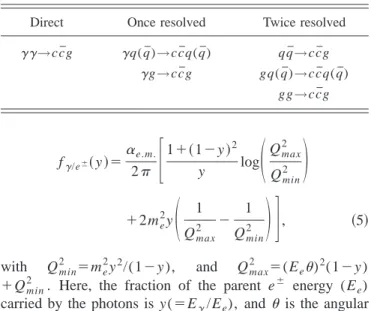
calculated using the CEM; see Eqs.~1!and~3!. The partonic subprocesses contributing to J/c production are depicted in Table I. Notice that both direct and resolved photons contrib-ute to charmonium production in the CEM. We evaluated numerically the tree level helicity amplitudes of the subpro-cesses displayed in Table I using the MADGRAPH @21# and
HELAS @22# packages. The adaptive Monte Carlo program
VEGAS @23#was employed to perform the phase space
inte-gration.
In the framework of the CEM, the evaluation of the photon-photon production cross section contains only the free parameters appearing in the perturbative QCD calcula-tion of the subprocesses presented in Table I, since the CEM free parameter rc can be fixed at the value extracted from the photoproduction of J/c, i.e.,rc50.5 @8#. We used the leading order GRV-G @24# and GRS-G @25# parton density functions as provided by the CERNPDFLIBpackage with the partonic subprocess center-of-mass energy as the
factoriza-TABLE I. Subprocesses contributing to J/c production in gg
collisions. Here q stands for the light quark flavors u,d,s.
Direct Once resolved Twice resolved
gg→cc¯ g gq(q¯ )→cc¯ q(q¯) qq¯→cc¯ g
gg→cc¯ g gq(q¯ )→cc¯ q(q¯)
gg→cc¯ g
TABLE II. Cross sections for direct, once resolved, and twice resolved production processes for pT2
.0.25 GeV2using different sets of parton distribution functions~PDF!, charm masses, and renormalization
scalesmR5j
Am
c2 1bpT2.
Parameters Cross sections~pb!
PDF mc j b Direct Once resolved Twice resolved Total
GRV-G 1.3 1.0 0 1.72 13.3 1.00 16.1
GRS-G 1.3 1.0 0 1.72 13.0 0.94 15.7
GRS-G 1.2 1.0 0 2.75 21.8 1.73 26.3
GRS-G 1.4 1.0 0 1.02 7.5 0.51 9.07
GRS-G 1.3 0.5 0 3.26 46.8 6.42 56.4
GRS-G 1.3 0.5 1 2.42 28.4 3.15 34.0
GRS-G 1.3 1.0 1 1.44 9.65 0.61 11.7
GRS-G 1.3 2.0 0 1.17 5.99 0.29 7.45
tion scale mF5
A
sˆ. We verified that our predictions do notvary significantly (&10%) for other choices of the factoriza-tion scales, e.g.,mF512
A
sˆ, mF52A
sˆ, ormF5mR. We alsoverified that the results are very similar for the GRV-G and GRS-G parton distributions ~see Table II!. The strong cou-pling constant was evolved in leading order considering four active flavors andLQCD(4) 5300 MeV, while the charm quark mass was varied between 1.2 and 1.4 GeV.
In order to access the theoretical uncertainties in the low-est order CEM calculations, we analyzed the predicted J/c transverse-momentum spectrum for different choices of the renormalization scale (mR). We present in Fig. 1~a!the
pre-dicted pT2 spectrum obtained formR5jmcwith 1
2,j,2 and
mc51.3 GeV, as well as the DELPHI experimental results
@1,27#. We can see from this figure that the CEM describes well the shape of the distribution, despite the large uncer-tainty in the absolute value of the differential cross section. Notice that we are only changing a global factor (aS) for this
choice of mR when we vary j. Figure 1~b!displays the pT 2
spectrum for mR5j
A
mc21pT2 with 12,j,2 and mc 51.3 GeV. For this choice ofmR the uncertainties in the pT 2
distribution are smaller than for the previous choice of mR.
However, the shape of the pT2 spectrum changes and the CEM prediction seems to diminish faster than the data at large pT2.
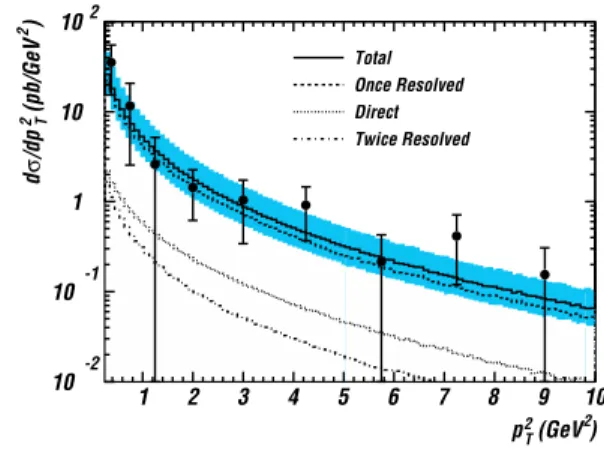
In Fig. 2 we display the contributions to the J/c pT2 spec-trum arising from direct, once resolved, and twice resolved processes. These distributions were obtained using the
GRS-G photon parton densities, mR5mc, and mc
51.3 GeV. As we can see, the once resolved processes are responsible for the majority of the events (.85%), while direct and twice resolved processes account for less than 15% of the total cross section. The most important process is gg→cc¯ g. We also present in this figure the uncertainties
associated with the charm quark mass; the shaded band
rep-resents the sum of all contributions taking mc51.3
60.1 GeV. Notice that the largest uncertainties in the CEM prediction originate from the choice of the renormalization scale. This is quite as expected since we are performing our calculation in lowest order perturbative QCD. In fact, the
charmonium production in gg collisions is dominated by once resolved photon processes; therefore it is similar to the photoproduction of charm quark pairs. In this case, it is well known that the K factor is of the order of 2–3 @26#, and consequently we can anticipate that the next-to-leading order corrections to our results should be of this magnitude. We summarize our results for the total cross section in Table II. In order to further compare our results with the recently published DELPHI results @2,27#, we evaluated the depen-dence of the total J/c yield on the minimum transverse mo-mentum for
A
s5197 GeV. The result is presented in Fig. 3~a!. As can be seen from this figure, the choice of QCD parameters we used in this analysis provides a very good description of the existing data, reinforcing our confidence in the predictive power of the color evaporation model. Figure 3~b! displays the CEM predictions for the J/c production cross section as a function of the e1e2 center-of-mass en-ergy (A
s). Here we assumed that pT2.0.25 GeV2, mR5mcwith mc51.360.1 GeV, and we used the GRS-G set of par-ton distribution functions. As expected, the total cross sec-tion grows with the center-of-mass energy due to the increase in
10 -2 10 -1 1 10
1 2 3 4 5 6 7 8 9 10 pT2 (GeV2)
d
σ
/dp
T
2 (pb/GeV 2)
µR = ξ mc
1/2 <ξ< 2
(a)
10-2 10-1 1 10
1 2 3 4 5 6 7 8 9 10 pT2 (GeV2)
d
σ
/dp
T
2 (pb/GeV 2 )
µR = ξ (mc2 + pT2) 1/2
1/2 <ξ< 2
(b)
FIG. 1. Uncertainty in the pT
2
differential cross section originating from different choices of the renormalization scalemR. In~a!we chose
mR5jmcwhile in~b!mR5j
Am
c2 1pT
2
. The shaded band was obtained by varying 1/2,j,2 and the solid line stands forj51. We fixed
mc51.3 GeV, and used the GRS-G parton density function in both figures.
10 -2 10 -1 1 10 102
1 2 3 4 5 6 7 8 9 10 pT2 (GeV2)
d
σ
/dp
T
2 (pb/GeV 2 )
Total Once Resolved Direct Twice Resolved
FIG. 2. Differential cross section as a function of the squared
transverse momentum of the J/c. The shaded band shows the
the-oretical prediction obtained by varying the charm mass (mc51.3
60.1 GeV). We explicitly show the direct, once resolved, and
twice resolved contributions as well as the total cross section for
the photon-photon luminosity. We verified that contributions of direct, once resolved, and twice resolved, processes are in the same proportion as for the results presented for
A
s5197 GeV; see Fig. 2. Taking into account the planned lu-minosity of the future e1e2colliders, we can easily foresee that it will be possible to extract very precise data on the photon-photon charmonium production in these machines.
III. CONCLUSION
In this paper we showed that the color evaporation model for quarkonium production correctly describes DELPHI data on J/c via photon-photon collisions. Because of the rather large uncertainties in the data, it is not possible to use them to discriminate between the different proposed mechanisms for charmonium production. As far as the DELPHI data are considered, the NRQCD @27#and CEM frameworks present equivalent results.
Considering that the CEM is also successful in describing the photo- and hadroproduction of charmonium, we conclude that this model gives a robust and simple parameterization of all charmonium physics. Moreover, gg reactions provide a
clear proof of the importance of colored cc¯ pairs in the pro-duction of charmonium, since the data on this reaction can be explained only by considering resolved photon processes, which lead to colored cc¯ pairs.
ACKNOWLEDGMENTS
This research was supported in part by Fundac¸a˜o de Am-paro a` Pesquisa do Estado de Sa˜o Paulo~FAPESP!, by Con-selho Nacional de Desenvolvimento Cientı´fico e Tecnolo´gico
~CNPq!, and by Programa de Apoio a Nu´cleos de Exceleˆncia
~PRONEX!.
@1#S. Todorova-Nova, in Proceedings of the 31st International
Symposium on Multiparticle Dynamics~ISMD 2001!, Datong,
China, 2001, edited by B. Yuting, Y. Meiling, and W. Yuan-fang, eConf C010901, 2001.
@2#DELPHI Collaboration, J. Abdallah et al., Phys. Lett. B 565,
76~2003!.
@3#CDF Collaboration, F. Abe et al., Phys. Rev. Lett. 69, 3704
~1992!; 79, 572~1997!; 79, 578~1997!.
@4#DO” Collaboration, S. Abachi et al., Phys. Lett. B 370, 239
~1996!.
@5#G.T. Bodwin, E. Braaten, and G.P. Lepage, Phys. Rev. D 51,
1125~1995!; 55, 5853~E! ~1997!.
@6#E. Braaten, S. Fleming, and T.C. Yuan, Annu. Rev. Nucl. Part.
Sci. 46, 197~1996!.
@7#J.F. Amundson, O.J.P. E´ boli, E.M. Gregores, and F. Halzen,
Phys. Lett. B 372, 127~1996!.
@8#J.F. Amundson, O.J.P. E´ boli, E.M. Gregores, and F. Halzen,
Phys. Lett. B 390, 323~1997!.
@9#O.J.P. E´ boli, E.M. Gregores, and F. Halzen, in Proceedings of
the 26th International Symposium on Multiparticle Dynamics (ISMD 96), Faro, Portugal, 1996, edited by J. Dias de Deus et al.~World Scientific, Singapore, 1997!.
@10#A. Edin, G. Ingelman, and J. Rathsman, Phys. Rev. D 56, 7317
~1997!.
@11#C.B. Mariotto, M.B. Gay Ducati, and G. Ingelman, Eur. Phys.
J. C 23, 527~2002!.
@12#M. Kramer, Prog. Part. Nucl. Phys. 47, 141~2001!.
@13#G.A. Schuler and R. Vogt, Phys. Lett. B 387, 181~1996!.
@14#R. Gavai, D. Kharzeev, H. Satz, G.A. Schuler, K. Sridhar, and
R. Vogt, Int. J. Mod. Phys. A 10, 3043~1995!.
@15#G.A. Schuler, hep-ph/9403387.
@16#O.J.P. E´ boli, E.M. Gregores, and F. Halzen, Phys. Lett. B 395,
113~1997!.
@17#O.J.P. E´ boli, E.M. Gregores, and F. Halzen, Phys. Rev. D 60,
117501~1999!.
1 10 102
0 0.5 1 1.5 2 2.5 3 3.5 4 Minimum pT2 (GeV2)
Cross Section (pb)
√s = 197 GeV
1.2 GeV < Mc< 1.4 GeV
(a)
10 102
100 200 300 400 500 600 700 800 900 1000 Energy (GeV)
Cross Section (pb)
pT2> 0.25 GeV
2
1.2 GeV < Mc< 1.4 GeV
(b)
FIG. 3. Total cross section as function of the minimum squared transverse momentum~a!and the e1e2center-of-mass energy~b!. In~a!
the arrow stands for the DELPHI measured total cross section while the dotted lines indicate the experimental error of this quantity. We
varied the charm quark mass as mc51.360.1 GeV to estimate the theoretical uncertainties. We used
A
s5197 GeV for the minimumtransverse-momentum dependence~a!and imposed pT
2
.0.25 GeV2for the center-of-mass energy dependence~b!. The remaining parameters
@18#O.J.P. E´ boli, E.M. Gregores, and F. Halzen, Phys. Lett. B 451,
241~1999!.
@19#O.J.P. E´ boli, E.M. Gregores, and F. Halzen, Phys. Rev. D 67,
054002~2003!.
@20#O.J.P. E´ boli, E.M. Gregores, and F. Halzen, Phys. Rev. D 64,
093015~2001!.
@21#T. Stelzer and W.F. Long, Comput. Phys. Commun. 81, 357
~1994!.
@22#H. Murayama, I. Watanabe, and K. Hagiwara, Report No.
KEK-91-11.
@23#G.P. Lepage, Report No. CLNS-80/447.
@24#M. Gluck, E. Reya, and A. Vogt, Phys. Rev. D 46, 1973
~1992!; 45, 3986~1992!.
@25#M. Gluck, E. Reya, and M. Stratmann, Phys. Rev. D 51, 3220
~1995!.
@26#S. Frixione, M.L. Mangano, P. Nason, and G. Ridolfi, Nucl.
Phys. B412, 225~1994!.
@27#M. Klasen, B.A. Kniehl, L.N. Mihaila, and M. Steinhauser,