AbstrAct
Introduction. Different biological samples (blood, gall-stone, teeth, hair) serve as a biomarker of exposure to metals for many years. This method appeared to be useful not only in clinical medicine, but also in the studies on the environment. Aim. The study is to compare the amount of selected metals in children’s hair residing in industrial and rural areas. Material and methods. Re-search of occurrence of 12 metals in children’s hair at the age of 7, 10 and 14 living in an industrial (Nowy Bytom town ) and a rural (Strumień town) areas has been pre-sented. Determination of Pb, Cd, Ni, Co Na, K, Mg, Zn, Cu, Mn, Fe and Ca was carried out by atomic absorption spectrophotometry (AAS) using a spectrometer Perkin-Elmer 400. Results. In the case of seven-year old children, regardless of gender a common mechanism of co-occur-rence was noticed for manganese and calcium, manganese and magnesium, calcium and magnesium, sodium and potassium. Apart from the correlation of metals for the seven-year-old-children mentioned, in case of ten-year old children, an additional correlation between calcium and zinc appears. Conclusion: The amount of some metals in the hair with the diversified possibility of interaction between the metals themselves and their relation to gen-der and age of children revealed different environmental exposure.
Keywords: hair, children, industrial area, agricultural area, interaction
strEszczENiE
Wstęp. Materiał biologiczny (krew, złogi pęcherzyka żółciowego, zęby, włosy) służy od lat jako biomarker eks-pozycji na metale. Metoda ta okazała się być przydatna nie tylko w medycynie klinicznej ale również w badaniach nad środowiskiem. Cel pracy.Porównanie zawartości wy-branych metali we włosach dzieci zamieszkałych na tere-nach przemysłowym i rolniczym. Materiał i metody. Za-prezentowano wyniki występowania 12 metali we wło-sach dzieci w wieku lat 7, 10 i 14, zamieszkujących tereny przemysłowy (Nowy Bytom) i rolniczy (Strumień). W celu dokonania oznaczeń Pb, Cd, Ni, Co, Na, K, Mg, Zn, Cu, Mn, Fe i Ca zastosowano absorpcyjną spektrometrię ato-mową. Wykorzystano spektrometr Perkin-Elmer 400. Wyniki. W przypadku dzieci 7- i 10-letnich dostrzeżono mechanizmy współwystępowania bez względu na płeć dla Mn i Ca, Mg i Mn, Ca i Mg, Na i K. Przy czym u dzieci 10 letnich dodatkowo wystąpiła współzależność pomiędzy Ca i Zn. Wnioski. Zawartość niektórych metali we włosach dzieci determinowana jest różną ekspozycją środowiskową, płcią i wiekiem badanych. Możliwa jest interakcja pomiędzy różnymi metalami.
Słowa kluczowe: włosy, dzieci, teren przemysłowy, te-ren rolniczy, interakcja
Nadesłano: 25.09.2013
Zatwierdzono do druku: 1.03.2014
Metals interaction tested in children’s hair originating from industrial and rural areas
Interakcja metali badana we włosach dzieci
zamieszkałych na terenach przemysłowym i rolniczym
Jerzy Kwapulinski1 (a, e, f), Jerzy Ciba2 (a, e, f), Agata Trzcionka2 (b, c), Jolanta Kluczka2 (c), Piotr Z. Brewczynski1 (d, f), Michal Swoboda3 (b, c), Tomasz Fulczyk1 (b, d), Blazej Szady1 (b, c), Ewelina Stykowska1 (b, c), Janina Trzcionka2 (a, c, e)
1Institute of Occupational Medicine and Environmental Health, Sosnowiec (Poland). Director: P.Z. Brewczyński, MD, PhD. 2Institute of Inorganic Chemistry, Technology and Electrochemistry, Silesian Technical University, Gliwice (Poland).
Head of Institute: prof. dr M. Turek, PhD.
3Institute of Diagnostic Laboratory,, Hospital Piekary (Poland): Director: B. Koczy, MD, PhD
(a)concept
(b)collection of material for research (c)chemical analyses
(d)statistics
(e)working on text and references (f)interpretation
iNtroductioN ANd AiMs
Content of various heavy metals is a frequent in-dicator of environmental exposure. Their concen-trations have been identified in the foregoing litera-ture primarily in occupational health protection.
Concentrations of lead were determined in the hair of 478 school children living in an industrial area and rural region of Spain. The average lead amount was higher in the industrial area (9.38 µg/g) [1].
Concentration of metals was also determined in the scalps of children living in an industrialized area and a rural region of Germany. The content of met-als was as follows: Pb 2.7 µg/g, Cd 90.0 µg/g, Cu 10.6 µg/g and Zn 108.0 µg/g [2]. The lead content in hair of the gas station workers being 48.7±17.5 µg/g was significantly higher than that of the con-trols 17.2±8.1 µg/g [3].
In the hair of children living in the urban region of Mexico (close to the smelter plant complex) the range of cadmium in hair was 0.25–3.5 µg/g [4].
Further, in three Russian cities daily cadmium intake and health concerns of the working popula-tion and the children who resided close to the sources of contamination were assessed . In the sur-veyed workers of a storage battery factory the aver-age cadmium content in hair was 99.3 µg/g; an av-erage cadmium level in the hair of workers in a cad-mium containing dyes plant was 25.1 µg/g [5].
In contrast to urine, blond hair serves as a record of exposure to heavy metals formed in a relatively short time and isolated from the general metabolic processes of the organism [6]. The co-occurrence of metals in the hair is a complex problem and de-pends on a number of factors. The presence of heavy metals in the hair may, to a certain extent, reflect environmental as well as biochemical characteristics of a given individual [7, 8].
Wright et al. [9] studied the potential associations between the hair metal levels and the neuropsycho-logical function and behaviour of school-aged chil-dren. The mean hair metal levels were following: Mn: 471.5 µg/g, As: 17.8 µg/g, Cd: 57.70 µg/g. Chil-dren’s general intelligence scores, particularly verbal IQ scores, were significantly related, inversely, to hair Mn and As levels, as were scores on tests of memory for stories and a word list. In some cases, a significant relation between Mn and As was found. More detailed analysis confirmed low scores for children for whom both Mn and As levels in the sample were above the median values. These results suggest further need for studies on neuropsycholog-ical consequences of developmental exposure to Mn
and As particularly if they appear in the form of a mixture [9].
Khalique et al. (2005) investigated levels of 10 metals (Ca, Mg, Fe, Zn, Cu, Mn, Cd, Co, Cr and Ni) in the scalp hair of male and female donors. Calcium showed the highest concentration of 462 g/g in the hair of males and 870 µg/g in the hair of females followed by Zn. Content of Zn was almost equal 208 µg/g for boys and 251 µg/g for girls. For male donors Cd showed the lowest concentration (1.15 µg/g), for female donors from Chile country Co was at minimum level (0.92 µg/g). The order of decreasing metal concentration in the hair of male donors was: Ca > Zn > Mg > Fe > Cu > Mn > Ni > Cr > Co > Cd that for female donor sit was: Ca > Zn > Mg > Fe > Cu > Mn > Cr > Ni > Cd > Co. The female group exhibited in their hair enhanced levels of small quantity of selected metals except for Fe and Co as compared with the male counterparts. For the hair samples from males in Chile country a strong bivariate positive correlation was found be-tween Fe and Zn (r = 0.841). As to Chilean females, strong positive relationship was observed for Ca–Mg (r = 0.617), Ca–Zn (r = 0.569), Ca–Mn (r = 0.565), Mg–Mn (r = 0.655), Cr-Cu (r = 0.655) and Cr-Ni (r = 0.685). The distribution of metals in the hair of donors with respect to different age groups was also investigated for both genders. The study showed that in the case of males, the concentration of all selected metals decreased with increasing age except for Cu, Co and Cr. However, for females the hair metal levels increased with age, except for Co for which the concentration decreased with age [10].
Knowledge on normal levels of concentration of trace elements (Cd, Cr, Cu, Hg, Pb, Se and Zn) in the population serve, among other things, in the designing of regulations of exposure limits and pre-vention of diseases caused by deficiency in essential trace elements. Values of trace elements concentra-tions in children’s hair were: Cd 0.14 µg/g, Cr 0.22 µg/g, Cu 12 g/g, Hg 22 g/g, Pb 1.6 µg/g, Se 0.22 µg/g, and Zn 124 µg/g (in medians). Statistically significant differences correspond to the published values for non-exposed population [11].
Concentration of Cu, Zn, Cr and Br increase from birth to 8 years of age and then decrease. Fe, Mn and Sr strongly decrease up to 8 years of age and then remains almost constant. Concentration of elements depends on gender. In case of children the elements are: Fe, Zn and Br; in case of adolescents the elements are: Cu, Cr, and Br [12].
tent of several metals [14, 15, 16]. The problem, es-pecially in the area of complex environmental ex-posure to selected heavy metals, may be tackled by means of bioindicating analysis in selected biologi-cal samples [17–21].
Present routine laboratory techniques concerning total metal content do not allow to distinguish which metals in hair samples are of endogenous and exogenous origin. Because of that, it is impor-tant to start research on the content of 12 metals in the hair of children who live in the area impacted by a steel plant (Nowy Bytom town) located in the center of the industrial region of South-West Poland (n = 83) and in the hair of children who live in Stru-mień town – 60 km away from the above industrial town (n = 70). Strumień town is situated near the Beskidy mountains and represents the rural region.
MAtEriAls ANd MEthods
Hair samples were cut from the back of the head according to the methodology published in the lit-erature. 1 g of hair was taken for the analysis, then weighed with an accuracy of 0.0001 g and miner-alized with spectrally pure concentrated nitric acid. After mineralization, the solution was introduced into a measuring flask (V = 25 cm3) and filled with
redistilled water to a level mark.
Measurements were carried out on 153 children by atomic absorption spectrophotometry (AAS) us-ing a spectrometer Perkin-Elmer 400. The content of Na, K, Mg, Zn, Cu, Mn, Fe, Ca was measured by means of emission method and the content of Pb,
racy of measurements was controlled by standard GBW 09101 Human Hair. The results differed among themselves maximum by 7% depending on an element.
The set of results obtained on the basis of a Stu-dent’s test made it possible to define coefficients with a value higher than 0.45 and p0.03 as sig-nificant correlations.
rEsults
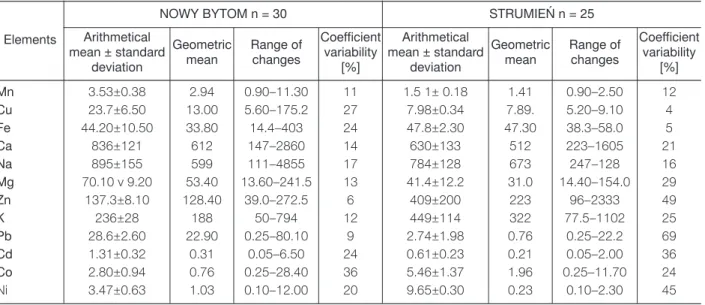
Occurrence of metals in the hair of 7, 10 and 14 years old children constituted the subject of the re-search. Statistical analyses results of heavy metals con-tent are shown in tables I–III. Moreover the co-occur-rence of that relation between selected pairs of metals for children living in Nowy Bytom town (industrial area) was following: 7 years, 10 years and 14 years.
7 years old:
Mn–Ca {r0.57}, Mn–Mg {r0.60}, Ca–Mg {r0.84}, Na–K {r0.63}, Mn–Na {r0.48}, Mn–K {r0.54}, Cu–Ca {r0.48}, Cu–Fe {r0.66}, Ca–Zn {r0.46};
10 years old:
Mn–Ca {r0.62}, Mn–Mg {r0.53}, Ca–Mg {r0.63}, Ca–Zn {r0.54}; Na–K {r0.58}, Mn–Na {r0.51}, Mn–Pb {r0.53}, Ca–Pb {r0.63};
14 years old:
Fe–K {r0.62}, Ca–Mg {r0.77}, Na–K {r0.87}, Mn–Fe {r0.70}, Mn–K {r0.60}, F–Na {r0.57}, Cd–Co {r0.46}.
Table I.Characteristic of occurrence of selected metals in 7 year old children’s hair (µg/g)
Tabela I.Charakterystyka występowania wybranych metali we włosach 7-letnich dzieci (µg/g)
Coefficient variability
[%] Range of
changes Geometric
mean Arithmetical
mean ± standard deviation
STRUMIEŃ n = 25 Coefficient
variability [%] Range of
changes Geometric
mean Arithmetical
mean ± standard deviation
NOWY BYTOM n = 30
Elements
Mn Cu Fe Ca Na Mg Zn K Pb Cd Co
Ni
3.53±0.38 23.7±6.50 44.20±10.50
836±121 895±155 70.10 v 9.20
137.3±8.10 236±28 28.6±2.60 1.31±0.32 2.80±0.94 3.47±0.63
2.94 13.00 33.80 612 599 53.40 128.40
188 22.90
0.31 0.76 1.03
0.90–11.30 5.60–175.2 14.4–403 147–2860 111–4855 13.60–241.5
39.0–272.5 50–794 0.25–80.10
0.05–6.50 0.25–28.40 0.10–12.00
11 27 24 14 17 13 6 12
9 24 36 20
1.5 1± 0.18 7.98±0.34 47.8±2.30 630±133 784±128 41.4±12.2
409±200 449±114 2.74±1.98 0.61±0.23 5.46±1.37 9.65±0.30
1.41 7.89. 47.30 512 673 31.0 223 322 0.76 0.21 1.96 0.23
0.90–2.50 5.20–9.10 38.3–58.0 223–1605 247–128 14.40–154.0
96–2333 77.5–1102
0.25–22.2 0.05–2.00 0.25–11.70
0.10–2.30 12
For comparison – children living in the rural area: 7 years old
Mn–Ca {r0.88}, Mn–Mg {r0.73}, Ca–Mg {r0.93}, Na–K {r0.79}, Fe–Ni {r0.48}, Fe–Zn {r0.47}, Cu–Ca {r0.48}, Zn–Ni {r0.51}, Zn–K {r0.52}, K–Co {r0.68}, Pb–Ni {r0.56}, Na–Co {r0.47};
10 years old
Mn–Ca {r0.93}, Mn–Mg {r0.98}, Ca–Mg {r0.96}, Ca–Zn {r0.59}, Na–K {r0.98}, Mn–Zn {r0.66}, Fe–Na {r0.64}, Fe–Pb {r0.49}, Fe–K
{r0.57}, Fe–Co {r0.49}, Mg–Zn {r0.58}, Cd–Co {r0.49}, Cd–Ni {r0.58};
14 years old
Fe–K {r0.55}, Ca–Mg {r0.51}, Na–K {r0.71}, Zn–Cd {r0.56}, Mg–Pb {r0.69}, Fe–Pb {r0.47}, Cu–Zn {r0.46}, Mn–Ca {r0.78}, Pb–Ni {r0.48}.
The tables I–III include common relations of oc-currence of particular metals in both towns. Because the towns differ in the degree of air pollution one can conclude that the presented algebraic
expres-Table II.Characteristic of occurrence of selected metals in 10 year old children’s hair (µg/g)
Tabela II.Charakterystyka występowania wybranych metali we włosach 10-letnich dzieci (µg/g)
Coefficient variability [%] Range of changes Geometric mean Arithmetical
mean ± standard deviation
STRUMIEŃ n = 25 Coefficient variability [%] Range of changes Geometric mean Arithmetical
mean ± standard deviation
NOWY BYTOM n = 30
Elements Mn Cu Fe Ca Na Mg Zn K Pb Cd Co Ni 4.56±0.60 26.00±7.80 43.79 ±3.40 558 ±91 698 ±115 57.9 ±12.0 162 ±13 217 ±31 37.40v11.00 2.27 ±0.68 1.17 ±0.23 6.07 ±0.92 3.63 15.20 40.10 399 479 38.30 152 160 25.60 0.77 0.66 2.87 0.90–15.60 5.90–243 19.40–103 151–2287 63–3219 11.40–394 86–522 40–741 2.30–402 0.05–22.90 0.25–4.70 0.10–19.30 13 30 8 16 17 21 8 14 30 30 20 15 1.98 ±0.54 11.90 ±3.10 26.30 ±5.60 685 ±150 492 ±227 50.50 ±15.40 216 ±32 209 ±123 19.10 ±4.80 1.89 ±0.68 10.20 ±2.10 3.35 ±1.32 1.52 10.10 21.00 555 264 37.00 196 95 8.01 0.47 4.78 0.59 0.50–7.60 7.40–46.20 6.60–71.20 188–2050 70–2919 13.60–208 119–459 27–1548 0.27–54.0 0.05–7.10 0.25–20.50 0.10–12.10 27 26 21 22 46 31 15 59 25 36 20 39
Table III.Characteristic of occurrence of selected metals in 14 year old children’s hair (µg/g)
Tabela III.Charakterystyka występowania wybranych metali we włosach 14-letnich dzieci (µg/g)
Coefficient variability [%] Range of changes Geometric mean Arithmetical
mean ± standard deviation
STRUMIEŃ n = 25 Coefficient variability [%] Range of changes Geometric mean Arithmetical
mean ± standard deviation
NOWY BYTOM n = 30
tent of these metals as a result of characteristic me-tabolism of the metals in the examined children. It is possible to state that the mentioned relations do not include the effect of chemopressure. In the case of seven-year old children, regardless of gender, there is a common phenomenon of co-occurrence for: manganese and calcium; manganese and magne-sium altogether. The content of calcium depends on the changing content of magnesium sodium and potassium. In the background of the above relation there are proportional changes between the men-tioned elements. In the case of ten-year old children, apart from the correlations of metals presented for seven-year-old-children, an additional correlation between calcium and zinc appears. The comparison of expressions which describe the co-occurrence of these metals suggest that the content of these ele-ments depends upon physiology and biochemical condition of calcium, magnesium, sodium, potas-sium and zinc.
discussioN
In the case of older children (14 years old), rela-tions between calcium and magnesium, sodium and potassium remain the same and additional correla-tion between iron and potassium appears. Charac-teristic feature for metal correlations is high corre-lation coefficient and in some cases these correla-tions are stronger for children living in the area not impacted by the steel plant (Strumień). It should be pointed out that 9 out of 12 correlations which occur in nature have much higher correlation coef-ficient to those appearing in the case of children living in the industrial town Nowy Bytom. Although metabolic activity of calcium, sodium, potassium, magnesium and zinc is similar in children’s body additional interactions with other metals are still possible in the area of strong chemopressure. These metals may cause reduction of a physiological cor-relation coefficient of the above elements. High val-ues of correlation coefficient justify the regression equations. Established regression equations confirm similar trends of common changes in the content: Na and K; Ca and Mg; Mn and Mg; Mn and Ca The significant coefficient correlation is within 0.63–0.87 in Nowy Bytom town and within 0.71–0.93 in Strumień town. For example, the ten-dency of changing the content of sodium in relation to potassium, in the children from Nowy Bytom town is described by the coefficient which increases 3.5 times for seven-year-old, 2.1 times for
ten-year-Children living outside the range of the steel plant’s impact are characterized by the following coeffi-cients: 0.98, 1.82, 1.51 respectively. Coefficients de-scribing the change of calcium content in the func-tion of the changes of magnesium content in hair, which amount to 4.8 in the case of ten-year-old children and 11.1 for seven-year-old children, may be another illustration of the problem. Relations of changes of manganese with calcium and manganese with magnesium are characterized by the following coefficient 102– 103.
On the basis of previous research and interpreta-tion of the absolute term – b in the expression y = ax + b, the value of the factor “b” may be inter-preted as a physiological level of content for a given metal. For example, changes of calcium content in relation to magnesium in the case of fourteen year-old children from Strumien town is described by the expression Ca = 5.32 Mg + 636.3. Value 636.3 can be a statistical level of calcium content in the hair of population. The range of changes of calcium content among children from Strumien town is within 310–2124 µg Ca/g of hair, whereas the geo-metric mean of calcium content amounts to 828 µg Ca/g of hair, and arithmetic mean of calcium content is 940 ± 113 µg Ca/g of hair.
Another illustration characterizing the population of children from Strumien town is data concerning sodium and potassium. Value for Na 124.8 g /g of hair is assumed as a physiological level of sodium. The range of changes of sodium is within 35–575 µg Na/g of hair and arithmetic means of the content are 200 and 250 µg Na/g of hair respectively.
7 years old – manganese and sodium, manganese and potassium, magnesium and zinc, copper and iron, calcium;
10 years old – manganese and magnesium, man-ganese and lead, calcium and lead;
14 years old – manganese and iron, manganese and potassium manganese and potassium, iron and sodium, cadmium and cobalt;
In the case of children living 60 km from the steel plant Strumien town, the correlation is as fol-lows:
7 old year – lead and nickel, potassium and cobalt, zinc and potassium, zinc and nickel, copper and calcium, iron and zinc, manganese and zinc;
10 old year – cadmium and nickel, cadmium and cobalt, magnesium and zinc, iron and cobalt, iron and potassium, iron and lead, iron and sodium, iron and nickel;
14 old year – lead and nickel, manganese and calcium, copper and zinc, iron and lead, magnesium and lead, zinc and cadmium.
The co-occurrence of these metals is characterized by high correlation coefficients. Therefore the in-terpretation of the absolute term may be similar i.e. absolute numbers present a statistical level of con-tent of a given metal above which an orderly inter-action between selected metals take place. Obtained results and their comparison, taking into consider-ation the age and the place of living, indicate that in the area of high chemopressure a shorter list of characteristic effects may be expected. In the case of the rural area which is 60 km away from the plant, hair can be used as a bioindicator (biomarker) of long-range emission effects of particular metals. Lower correlation between the content of one metal parallel to the changes of another metal in the hair of children living close to the plant is a result of much bigger range of changes of these metals in hair and their lower coefficient of variation. Lower variation coefficients of occurrence of 12 metals in the hair of children from Nowy Bytom town point to a high permanent environmental hazard. With the observed levels of metal content in the air and consequently in hair, a specific type of interaction between given metals is not sufficiently explained, both in their antagonistic and synergetic interac-tion.
Therefore, the statistical analysis and dependen-cies noted for children at different ages living in the industrial areas defined corresponding average en-vironmental exposure. The above mentioned con-clusions are of regional importance. Characteristic way of changes which is a result of interaction and chemopressure of particular metals is limited to the
areas with similar environmental hazard. This spe-cific way of metal co-occurrence in hair is very often observed in the case of other elements in a number of ecosystems. In the light of the above presentation it is reasonable to claim that the use of hair as a biomarker of contamination of natural environ-ment with metals requires a pilot study for a given element. Other research projects take into the con-sideration the age and content of bioavailable metals in the air [22, 23, 24].
coNclusioN
1. Hair is recommendable to use as a biomarker for a given metal. The range of application relates from the possibility of various interactions between elements and discrimination processes.
2. Only the case of 7 year old children was ex-ceptional because the content of many biologically important metals was compatible, for example, (Mn–Ca, Mg, Na, K; Cu–Ca, Fe).
3. The region with varied chemopressure com-pounds of metals shows characteristic levels of con-tent in the hair.
Diversified possibility of interaction between the metals and relation to the gender and age of children can decrease or increase metals content.
Funding: Foundation “Electricity Supply Industry for the benefit of Southern Poland”, Jaworzno (Poland) and the In-stitute of Occupational Medicine and Environmental Health, Sosnowiec (Poland).
rEFErENcEs
1. Schumacher M., Domningo J.L., Llobet J.M., Corbella J.: Lead in children’s hair as related to exposure in Tarragona Provin-ce, Spain. Sci Total Environ 1991; 104: 167-173.
2. Wilhelm M., Hafner D., Lombeck I., Ohnesorge F.K.: Moni-toring of cadmium, copper, lead and zinc in young children using toenails: comparison with scalp hair. Sci Total Environ 1991; 103: 199-207.
3. Burguera M., Rondom C.E., Rivas C., Burguera J.A., Alarcon O.M.: determination of lead in hair of exposed gas station workers and in unexposed adults by microwave-aided disso-lution of samples and flow injection/atomic spectrometry. J Trace Elem Electrolytes Health Dis 1987; 1: 21-26. 4. Diaz-barriga F., Santos M.A., Mejia J.J., Batres I., Yanez L.,
Carrizales L., Vera E., delRazo L.M., Cebrian M.E.: Arsenic and cadmium exposure in children living near a smelter com-plex in San Luis Potosi, mMxico. Environ Res 1993; 62: 242-250.
A.M., Tavares T.M.: Cadmium in hair of children living near a lead smelter in Brazil. Sci Total Envion 1989; 84: 119-128. 7. Wolfsperger M., Hauser G., Gassler W., Schlagenhaufen C.: Heavy metals in human hair samples from Austria and Italy. Sci Total Environ 1994; 156: 235-242.
8. Pan TC, Lin TH, Tseng CL, Yang MH, Huang CW.: Trace ele-ments in hair of blackfoot disease. Biol Trace Elem Res 1993; 39: 117-128.
9. Wright R.O., Amarasiriwarden C., Woolf A.D., Jim R., Bellin-ger D.C.: Neuropsychological correlates of hair arsenic, man-ganese and cadmium levels in school-age children residing near a hazardous waste site. Neurotoxicology 2006; 27: 210-216.
10. Khalique A., Ahmad S., Anjum T., Jaffar M., Shah M.H., Sha-heen N., Tariq S.R., Manzoor S.: A comparative study based on gender age dependence of selected metals in scalp hair. Environ Monit Assess 2005; 104: 45-57.
11. Benes B., Sladka J., Spevackova V., Smid J.: Determination of normal concentration levels of Cd, Cr, Cu, Hg, Pb, Se and Zn in hair of child population in the Czech Republic. Cent Eur J Public Health 2003; 11: 184-186.
12. Perrone L., Moro R., Caroli M., Di-Toro R., Gialanella G.: Trace elements in hair of healthy children sampled by age and sex. Biol Trace Elem Res 1996; 51: 71-76.
13. Katz S.A., Chatt A.: Hair analysis applications in the biome-dical and environmental sciences, VSH, Weinheim 1988. 14. Wang C.T., Chang W.T., Huang C.W., Chou S.S., Lin C.T., Liau
S.J., Wang R.T.: Studies on the concentrations of arsenic, se-lenium, copper, zinc and iron in the hair of blackfoot disease patients in different clinical stages. Eur J Clin Chem Clin Biochem 1994; 32: 107-111.
15. Wilhelm M., Lombeck I., Ohnesorge F.K.: Cadmium, copper, lead and zinc concentration in hair and toenails of young children and family members. Sci Total Environ 1994; 141: 275-280.
16. Sturato A., Parvoli G., Doretti L., Allegri G., Costa C.: The in-fluence of color, age and sex on the content of zinc, copper, nickiel and leads in human hair. Biol trace Elem Res 1994; 40: 1-8.
termining zinc in hair. Microchem J 1993; 47: 28-32. 18. Gurgoze M.K., Olcucu A., Aygun A.D., Taskin K., Killic M.:
Serrum and hair levels zinc, selenium, iron and cooper in childrenwith iron – deficiency anemia. Biol Trace Elem Res 2006; 111: 23-29.
19. Sakali T., Wariishi M., Nishiyama K.: Changes in trace ele-ment concentrations in hair growing children. Biol Trace Elem Res 2000; 77: 43-51.
20. Lach T.: Calcium and magnesium content in hair as predictor of diseases in children. Trace Elem Electr 2001; 18: 112-121. 21. Lach T.: Lead, cooper, zinc and magnesium content in hair of children and yuang people with some neurological disea-ses. Biol Trace El Res 2002; 85: 111-126.
22. Szynkowska N.I., Pawlaczyk E., Wojciechowska S.: Human hair as a biomarker in assessing exposure to toxic metals. Polish J of Environ Stud 2009; 18: 6, 1151.
23. Chojnacka K., Górecka H., Chojnacki A.: Inter-element in-teractions in human hair. Environ Toxicol Pharmacol 2005; 20: 368-374.
24. Krejpdo Z., Olejnik D., Wójciak R.W., Gawęcki J.: Compari-son of trace elements in the hair of children inhabiting areas in different environmental pollutions types. Polish J of En-viron Stud. 1999; 8: 227-229.
Address for correspondence:
Jerzy Kwapulinski, Ph.D, full profesor Institute of Occupational Medicine and Environmental Heath 41-200 Sosnowiec, 13 Koscielna Str. phl: +48 502 606 612