CYCLICAL DEVELOPMENT OF EMPIRES
- AN APPLICATION OF KRUGMAN’S THEORY
Viktor Eszterhai
c/o Eötvös Loránd University Budapest, Hungary
Regular paper Received: 15. September 2006. Accepted: 22. June 2007.
SUMMARY
The study of empires’ development has prided itself on great traditions in historical sciences. However, understanding the development courses meets difficulties if the geographical environment is disregarded. In my opinion, with the help of studying the geographical environment and also Krugman’s economic geographical theory, a more complex understanding of empires’ history can be obtained.
KEY WORDS
empire, centre, periphery, trading periphery, cyclical development
CLASSIFICATION
INTRODUCTION
If we want to define empires, usually we turn to geography. Empires are characterized by huge territories, often occupied from other countries, but they are also considered as regions with strong political influence, great military power, etc. The country, which places some of its subsystems (economy, army, bureaucracy, religion, culture) outside its border, becomes an empire [1]. This definition makes distinction between three geographical categories. The first, where the centres of the subsystem can be found, are called centres in the model. The second category is where subsystems of the centre can be placed for a longer time; these are called surroundings. The last category refers to, what the centre cannot reach or where its subsystems are not permanently present. It is called periphery. The territory of Europe can also be divided into these categories. Centres and surroundings are coherent geographical units, while the borders of these units are the periphery.
In this article I am going to introduce the above mentioned categories, then integrate Krugman’s theory into these categories, and finally examine how the so-formed model can be applied to the classical empire theories.
PARTS OF THE GEOGRAPHICAL UNIT
CENTRES
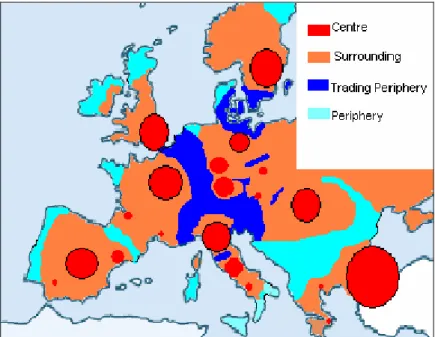
It is evidence that all the European empires have (see Figure 1.) and used to have centres [1]. These centres evolved on the most advantageous geographical territory of each geographical unit. This is where most of the population can live (mainly plains and basins). Krugman’s theory about the connection between demography and economy says that bigger population induces more intensive economic activities, i.e. bigger investments. As a consequence of this process the centre attracts the population from the surroundings [2]. Therefore a self-generating process starts, implying an increasing concentration of the economic activities and the population. If one of these factors changes drastically (for example, the population changes because of plague, war, or the economy because of war, lack of resources), this self-generating process collapses. However, the geographical factors change very slowly, and the human resources is not mobile enough to move, as result, it gives the chance to restart the self-generating process again and again.
SURROUNDINGS
The other part of the geographical unit is the surroundings (see Figure 1) which each centre possesses. These are the places where the subsystems are placed by the centre. The self-generating process of the centre needs more and more resources and the surroundings are able to satisfy the growing demands of the population. Therefore the inhabitants of the surrounding are interested in this conquest. The subordination of the surroundings to the centre changes in time, depending on the power of the centre. When the power collapses, the surroundings can become free, which is mainly realised by the strongest person or the strongest alliance of the surroundings. However, the centre can revitalise fast so the freedom of the surroundings takes only a short time.
PERIPHERIES
of the centre, too. Generally, the periphery is independent of the centres. But while the centre has enough power, the peripheries sometimes lose their independence, which cannot take long, because geography does not give the chance for a long conquest (at given level of technology).
Having a closer look at peripheries, we can differentiate between two types. The first one is when geographical factors are too severe for trade. This territory must be poor, and unable to hold a large population, for example the Balkan. The other type’s main characteristic is, when the geography is severe for a longer conquest, but enough suitable for trade (for example, fords, mountain passes). These territories, here called “trading peripheries”, are in a much more advantageous position, because they trade between the units’ centres; for example, Austria, Switzerland, Netherlands and Denmark. This provides capital for the local people which they invest into infrastructure (for bigger trade) and into industry. Trading resources and other goods towards the periphery leads to the birth of industry. The abundance of goods determines that the only competitive form is the highly-specialised industry, i.e. producing goods which are not easy to be substituted by producers of other areas. According to Krugman’s theory the self-generating process starts with the growth of economy and population. Thus these peripheries become some kind of centres.
Figure 1. The geographical categories of Europe in the 20th century.
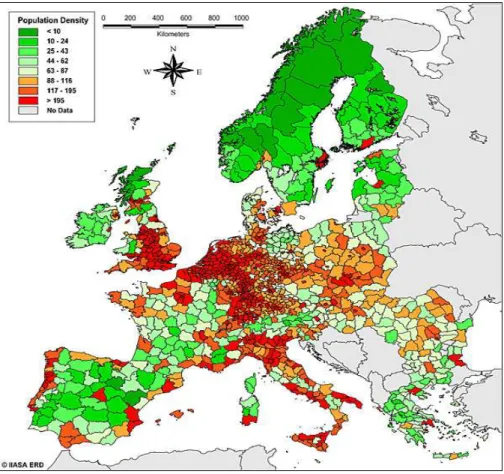
This model implies that there must be a connection between population and economy. On the basis of Figure 2 and 3, the concentration of the population and the economy seems to be connected to centres and trading peripheries. The surroundings and mainly the periphery are poorer and have smaller population.
Since the geographical territory changes very slowly and the population of the regions is highly immobile, the structure seems to be constant in time [3]. It provides the answer to the question why the centres of the empires are the same for hundreds of years.
THE LIFE OF EMPIRES
Figure 2. The population of Europe in 2005., (from
http://www.iiasa.ac.at/Research/ERD/DB/mapdb/map_9.htm).
trading peripheries can become empires. That is the reason why the history of empires seems to be connected to centres and to trading peripheries.
BUILDING THE BASIS: THE DEFENSIVE STAGE (STAGE 1)
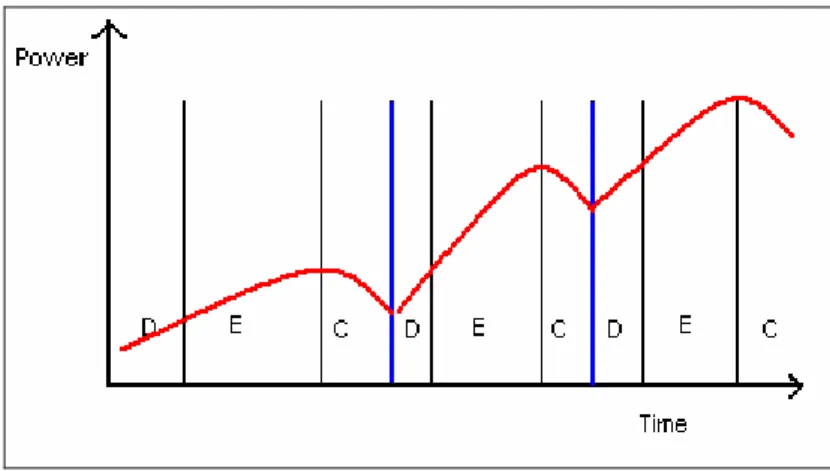
The starting point of the process is chaos. The economic and religious elite is willing to do everything to preserve their positions, thus they need political stability. They make use of a political group to serve their own needs. With their supporting this political group gets into power. The reason for this alliance is that the political elite needs social and pecuniary assistance. After affirming their stability, the political elite can provide financial support to the religious and economic elite. With the alliance the political elite has the possibility to build a bureaucracy and an army whose leaders will later be part of the elite too. The elite also needs a culture to legalise their power (see Figure 4) [5].
As a result of the state’s stability investments launch. It seems to be demographically proved that after the critical periods the growth of the population starts. On the basis of Krugman’s theory the self-generating process comes into existence. The high incomes and the large number of people make the army, the bureaucracy and the culture stronger [6].
THE OFFENSIVE STAGE (STAGE 2)
When this background is strong enough, the centre or the trading periphery starts to conquer the surroundings. This is necessary because this self-generating process needs more and more resources. The military conquest is not the only form of expansion: every subsystem can be placed outside the border [1]. At this stage the whole elite is interested in conquest, thus there is no conflict between the participants; the expansion is unbroken (see Figure 4).
As far as the surroundings are concerned, at this stage their leading elite has two options: resistance or integration. They have no good chance to resist for a long time, because the centre has more power. But integrating the surroundings’ elite to the empire’s elite is more successful, because being the member of the empire’s leading elite gives larger possibilities.
THE COLLAPSE (STAGE 3)
Geography restricts the conquest because geographical circumstances constrain the speed of information flow and the transport of recourses. When the centre reaches the periphery, the political elite cannot organise the defence and the bureaucracy here and further away, assuming a given level of technology. After some defeats the political elite recognises that any further expansion is an illusion, which breaks the unity within the elite and generates conflicts. The economic and social basis of the empire is shaken. The result of these crisis’s that the empire collapses leading to chaos and civil war. The centre losts the periphery and sometimes also parts of the surroundings (see Figure 4) [7].
REVITALISATION (STAGE 1 OR 4)
Figure 4. Cyclical development of empires.
THE IMPORTANCE OF TECHNOLOGICAL CHANGE
So far a given level of technology has been assumed, but technological development has a vital role [3]. New technology gives the chance for a dynamic improvement of the centres. In a fortunate situation a new technology makes them able to conquer and to keep further territories and peripheries as well. With a new technology the information flow and the transport of resources can be assured. From the view of the centre, the enlargement of the geographical field is the result of technological evolution (Figure 5)1.
Figure 5. The result of the technological changing.
APPLYING THE MODEL IN HISTORY
Nowadays Europe’s geographical units are independent and mainly national countries. The time needed for the development of these countries was different in each case. In England the integration finished in the 11th century, in France and Spain in the in the 15th century, but in Italy and Germany only in the 19th century, which depends on the homogeneity of the geographical territory [8]. In countries with homogeneous geographical units the centre was able to conquer the surroundings fast just like in England, or in Sweden [9]. In these countries the geographical circumstances were also advantageous to unify different dialects, which led to the early integration of the language.
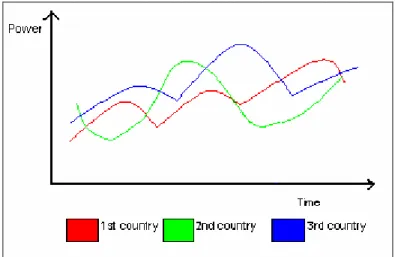
In Germany and in Italy the small geographical units were nearly equal concerning territory and population so that is the reason why the integration took longer time. In these cases only a drastic technological change (the industrial revolution) gave the chance for integration [10]. The centres could expand only step by step because of the systematical change of power. However, the expansion was not untroubled. Europe (like Italy and Germany) consists of nearly equal units so the border between the units gives the maximal line of the conquest. Still, each centre has its own progress line, which results in the fact that the centres are not at the same level of progress. While one centre is at an offensive stage, the other can be at a defensive one, which modifies the development of the life cycles (Figure 6).
Figure 6. The development course of empires in reality.
CIVILISATIONS
If we accept the theory that a continent can be separated into units and peripheries, it is worth examining the theory at a higher level as well. We assume that the units are civilisations [11], while the borders, such as oceans, mountain ranges, deserts are stricter dividing lines. These units must have centres such as the Blue-Banana in Europe, the Chinese-plain in China, the Ganges-Basin in India. If the centre exists, the civilisations must have rhythmical changes in their life cycles. When the centre is at an offensive stage, the leading elite tries to place the subsystems outside the border of the civilisation. It can be exemplified by colonisation and crusades. It also means that those territories that are in the advantageous situation to trade between the civilisations become trading peripheries. This explanation can provide the solution of the problem why some countries such as England, Japan or nowadays Ireland have been able to achieve a magnificent economic growth.
CONCLUSION
On the basis of geographical aspects, a region can be divided into a centre, surroundings a periphery and a trading periphery. These categories determine various kinds of development. I have attempted to integrate into one model the categories of a region, Krugman’s theory and the classical empire theories. The so-formed model justifies 1. the capital concentration and modernization ability of trade 2. the economic efficiency of certain regions, which can help to decide which regions should be preferred in case of subsidy allocation.
This model also draws the attention to the fact that historical processes are much more determined by geography than it is usually assumed.
REMARK
1
It seems that the only fix point in the model is the economic elite. However, the technological change destroys its stable position. A new invention always results in a new elite, that recognises the importance of the new technique. The old economic elite must revitalise, otherwise they lose their power. The new elite of the economy is often interested in changing of the political system, because a new group can serve their needs more efficiently.
REFERENCES
[1] Komoróczy, G.: Arany fej, agyaglábú szobron.
In.: Bezárkózás a nemzeti hagyományokba), Századvég Kiadó, Budapest, pp. 108-182, 1992,
[2] Krugman, P.: Földrakz és kereskedelem.
Nemzeti Tankönyvkiadó, Budapest, 2003, (Krugman, P.: Geography and trade Trade. MTI Press, Cambridge, Massasachusetts, 1991.)
[3] Pounds, N.J.G.: Európa történeti földrajza.
Osiris, Budapest, 2003, (Pounds, N.J.G.: Political geography McGraw-Hill, New York 1972.) [4] Renfrew, C.: Approaches to Social Archaeology.
Harvard University Press, Cambridge, pp. 366-389, 1984, [5] Toynbee, A.J.: Válogatott tanulmányok.
Gondolat, Budapest, 1971, (Selection of Toynbee’s works)
[6] White, L.A.: The Evolution of Culture. The Development of Civilization to the Fall of Rome.
McGraw-Hill, New York, 1959,
[7] Eisenstadt, S.N.: The Political Systems of Empires.
Free Press, New York, 1963,
[8] Embleton-King, C.W., ed.: Geomorphology of Europe.
Akadémiai Kiadó, Budapest, 1959,
[9] Nemerkényi, A.: Európa természeti viszonyai, Európai nagytájak.
In.: Európa regionális földrajza, ELTE Eötvös Kiadó, Budapest, pp. 7-81, 2000, [10] Davies, N.: Europe: A History. In Hungarian.
Osiris, Budapest, 2001,
[11] Hungtington, S.P.: Clash of the Civilizations and the Remarking of the World Order. In Hungarian.
Európa Könyvkiadó, Budapest, 2002.
CIKLI
Č
KI RAZVOJ CARSTAVA – PRIMJENA
KRUGMANOVE TEORIJE
V. Eszterhai
Sveučilište Eötvös Loránd Budimpešta, Madžarska
SAŽETAK
Proučavanje razvoja carstava duge je tradicije u povijesnim znanostima. Međutim, razumijevanje smjerova
razvoja nailazi na poteškoće ako se zanemari zemljopisno okruženje. Smatram kako se do kompleksnijeg
razumijevanja povijesti carstava može doći proučavanjem zemljopisnog okruženja i Krugmanove
ekonomsko-zemljopisne teorije.
KLJUČNE RIJEČI