
Electron-Phonon Coupling in MgB
2
-like Materials:
Its Magnitude and Its Limits
W. E. Pickett
Department of Physics, University of California, Davis, CA 95616, USA
Received on 23 May, 2003.
That very strong coupling of the B-B bond-stretching E2gbranch of phonons to the B2pσbonding hole states
is responsible for the remarkable superconductivity in MgB2is well established. This entirely new manner of driving the superconducting Tcto high levels requires additional analysis. Here recent findings, such as how
this strong coupling is related to possible structural instability, are discussed, and investigation into the practical limits of such coupling is initiated.
1
Introduction
Although several aspects of the superconductivity near 40 K in MgB2discovered by Akmitsu’s group[1] are now under-stood, there remain several puzzles, which include the fol-lowing. (1) To what extent is the extremely strong coupling between the B σ band holes and the B-B bond-stretching modes really understood? This type of coupling is entirely new, as regards its microscopic origin and its strength. (2) Is the two-band character an intrinsic feature of this sort of superconductor, or a value-added item to provide added ex-citement in the field? (3) Is MgB2simply one of a kind (so far, it is), or can the operating principles be used to suggest other superconductors in this class? All of these questions have been attracting strong interest.
In this paper two specific questions will be addressed. First, we review recent analysis of electron-phonon (EP) coupling in MgB2-like materials that reveals how remark-ably strongly the bond-stretching modes are coupled. This brings up the questions of whether the theory remains valid, and whether such coupling can be increased, and by how much, and still retain crystal stability (a primary limiting mechanism for EP coupling). We focus on the implications for the validity of EP couping theory as it is presently being applied in MgB2.
2
Consequences of Two
Dimensional-ity of the
σ
Bands
Since the earliest theoretical work[2, 3] it has been clear that the covalent B-B bond that is driven to be metallic by the chemistry of MgB2is at the root of the remarkable super-conductivity of MgB2. The very large deformation potential Dof the Bpσband for stretching of the B-B bond was iden-tified early on,[2] and several calculations[4, 5, 6, 7, 8] of the electron-phonon spectral function α2
F(ω) have made
this coupliing quite evident: this spectral density is domi-nated by a huge peak at the calculated frequency of theE2g (bond stretching) mode.
Consideration of the Fermi surfaces (FSs) begins to clarify the degree to which the strong coupling is spread through, or rather focussed, in the phonon spectrum. The FS consists of two types: slightly fluted cylinders surround-ing theΓ-A line (two of them), arising from B2px, py(σ) states, and a more complicated, three dimensional sheet arising from the B2pz(π)orbitals. These Fermi surfaces, with calculations presented in most detail by Mazin and Kortus,[9] Rosner et al.[10], and Harima,[11] have been ver-ified in detail by Carrington et al.[12] In fact, shifts of the σandπbands by no more than∼100 meV would make the correspondence exact.[10] The strong coupling involves the bond-stretching phonons withQ < 2kF that can scatter a hole from a cylinder, to a cylinder. Here and below,kF is the average radius of the cylinders, andQ=qQ2
x+Q2yis
the in-plane wavevector. Detailed analysis, which involves in a central way the two dimensionality of the σ bands, shows[13] that all the bond stretching modes withQ <2kF are renormalized by the same amount (a feature of the 2D susceptibilityχ(Q)[13]): the Kohn anomaly is not a down-ward cusp as in 3D, but rather an inverted plateau.
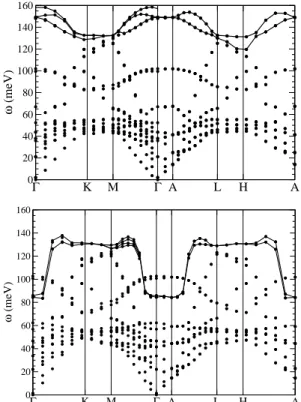
Γ K M Γ A L H A 0 20 40 60 80 100 120 140 160 ω (meV)
Γ K M Γ A L H A
0 20 40 60 80 100 120 140 160 ω (meV)
Figure 1. Calculated phonon dispersion curves for (top) semi-conducting LiBC and (bottom) hole doping corresponding to Li0.75BC. The B bond-stretching modes are connected by heavy lines, to emphasize the extremely strong downward renormaliza-tion forQ <2kF (ω
2
Qdecreases by∼60%). The sharp and very
strong Kohn anomalies at2kF along the various directions are
ap-parent. See Ref. 14.
A. Li1−xBC
It is appropriate to digress briefly. There has been much interest in possible other members of a “MgB2class” of su-perconductors that would share similar characteristics of EP coupling and also a high Tc. Hole-doped LiBC has been suggested as a serious possibility.[15] Its semiconducting electronic structure seems susceptible to hole-doping by Li depletion, and the broad band nature of all the bands in LiBC suggests that the doped-in holes, which would be partlyσin character, would be itinerant. Moreover, Li1−xBC had al-ready been reported by W¨orle et al.[16] to be synthesizable, with conductivity increasing with hole doping. A number of groups have synthesized and begun to characterize LiBC. [17, 18, 21, 19, 20, 22] There are two reports of deintercala-tion of Li. Zhao, Klavins, and Liu reported evaporadeintercala-tion of Li upon vacuum annealing, with no sign of superconductivity in the annealed samples.[22] Fogg et al. have reported[23] synthesis of Li-deficient Li1−xBC by high temperature an-nealing and also report no evidence of superconductivity in the susceptibility. The full story on the LiBC system remains uncertain.
B. Return to consequences of 2D character
The mode coupling strengthλQ,ν, whose average over
the zone and over the Nνbranchesνgivesλ, is[24] λQ,ν~ =
2Nν ωQ,ν~ N(0)
X
k
|Mk,k+Q|2δ(εk)δ(εk+Q).(1)
The more usual picture for λ is the electron viewpoint, where it is given by the Fermi surface average of λk, ex-pressing it as the weighted average of its values over the individual types of Fermi surface,
λ=< λk >F S= Nσ(0)
N(0)λσ+
Nπ(0)
N(0)λπ. (2)
For MgB2in particular, it is important to consider both de-compositions, as we now demonstrate.
For the E2g branch that has very large EP matrix el-ements M, the contribution from the σ bands (with their cylindrical Fermi surfaces) is
λE2g ~
Q = 4
2NνN2D(0) ωQν
42 |M|2ˆ
ξ(Q),|Q|<2kF (3)
where4 = 22accounts for the twoσFermi surfaces, the 2D phase space for electron-hole excitations is
ˆ
ξ(Q) = X
k
δ(εk)δ(εk+Q)/ hX
k δ(εk)
i2
= 1
Q 2kF
q
1−(2QkF) 2
, (4)
andN2D(0)is the 2D DOS per spin for a singleσ band. These modeλQ,ν~ values are related to the phonon linewidth γQ,ν~ by (for MgB2)
γQ/ωQ =
1
Nν λQ
π
2N(0)ωQ
≈ λQ×
1.6
9 ×0.35eV
−1
×0.07eV
≈ 0.004λQ (5)
With usual values ofλQ ≤1, this relation gives the stan-dard small linewidthγQ<< ωQ. Due to the 2D FS nesting, bothγQandλQ are stronglyQdependent in MgB2(which may have experimental consequences), but because they are very large only in a limited region ofQspace (see below), an average is not representative and is insufficient for an un-derstanding and even for reasonable quantitative estimates.
To apply these relations in detail to MgB2, the analy-sis goes as follows. On theσsurfaces, calculated and de-rived values (dHvA data [12] compared with theory) cluster aroundλσ =1 – 1.2, here the conservative valueλσ = 1 will be used. This total value arises from both the strongly coupled E2g modes (λEσ2g), and all of the other modes
(λother
E2gmodes. The fraction of phonon modes from which this arises is 2/9 of the branches, and – according to the latest de Haas-van Alphen data[12], and averaging the areas of the two σcylinders – only 12.4% (≈ 1
8) of the Brillouin zone lies in the region Q < 2kF. These values imply that the value of < λE2g
Q > ×(2/9)×(1/8) = λ
E2g
σ ≈ 0.8
im-plies< λE2g
Q >∼38. Then Eq. (5) gives the full linewidth 2γE2g ∼0.3−0.4ωE2g!
This number is remarkably large for a reasonably high frequency phonon. The point is clear: theE2g modes with Q < 2kF are extremely strongly coupled, more strongly than anything that has been seen in other superconductors. This fact is clear also for the similar material Li0.75BC in the calculated phonon dispersion curves of Fig. 1, where it can be seen thatω2
E2g (which is what arises naturally in the theory) is decreased by nearly 2/3 from its unrenormalized value. There is information on the linewidths from Raman scattering data, whereγE2g ∼0.3−0.4ωE2g is found,[25] and from inelastic xray scattering where a similar result was obtained.[26]
0 0.2 0.4 0.6 0.8 1
Q/QZB 0
10 20 30 40 50
λ
λQν for E 2g Phonons
Figure 2. Behavior ofλQk(Qk≡ p
(Q2
x+Q
2
y)). The dotted line
gives the behavior for two concentric 2D cylinder Fermi surfaces such as in MgB2, with (integrable) divergences atQk→0as well as forQk = 2kF for each of the two cylindrical Fermi surfaces.
The full line shows the effect ofkzdispersion that is representative
of MgB2.
3
Validity of Migdal-Eliashberg
The-ory in MgB
2Occurrence of the prediction of overdamped modes from the theory indicates that use of the theory is invalid: for such strong coupling, the E2g modes are not well-defined phonons. Even worse, since those modes are not phonons, then one can’t be sure the others are, because harmonic phonon theory is a solution to the lattice dynamics problem only if every phonon is well defined. Although there is no reason to suspect that the situation is so bad as to have no well defined phonon at all, it should be kept in mind that, so
far, the experimental evidence for any well defined phonon is not strong. The main evidence is from inelastic xray scat-tering, where it can only be said that some linewidths are less than the 8 meV energy resolution.[26]
0 20 40 60 80 100 120 140
Phonon Energy (meV) 0
1 2 3 4
Spectrum (Arb. Units)
As Calculated
Broadened Peak Total
Figure 3. The upper panel shows theα2
F(ω)spectral function that was calculated by An et al.[14, 13] The lower panel shows the effect of broadening the contributions of the strongly coupled phonons (those within the peak near 85 meV) by a Lorentzian with a width equal to about 40% of the peak frequency (γ=35 meV): notice that the peak vanishes. A proper theory would probably not give the simple Lorentzian broadening that arises in conventional Migdal-Eliashberg theory.
Migdal theory for the coupled electron-phonon system therefore is not valid for MgB2; the analysis we have been using in fact is not consistent because of this fact. It fol-lows that the standard Migdal-Eliashberg theory that is be-ing used to calculate the superconductbe-ing behavior of MgB2 is unjustified. Eq. (5) has assumed very specifically that γQ << ωQ, but leads to a conclusion that violates this con-dition. The application of this theory to MgB2 has been challenged on other grounds as well. Using careful frozen-phonon studies, Boeri and collaborators[27] have shown that the “anharmonicity” of theE2g(B-B bond stretching) poten-tial, which had been noticed by several groups, arises from the proximity ofσband edge to the Fermi level. As such, it is a “non-adiabatic” effect, but not in the usual sense be-cause~ωE
2g is not really so close to the value of EF. It is, rather, a combination of a relatively low Fermi energy, to-gether with the extremely strongσ-band deformation poten-tial for bond-stretching distortions. Thus it is an independent and new aspect of MgB2, in which the extremely strong EP coupling is destroying the validity of Midgal theory. An ad
hoc correction of this problem, treating this bond-stretching
extremely strong as it is, has not approached the limits of such coupling.
4
How Strong Can Mode Coupling
Become?
These developments raise questions about the limits of crys-tal stability, and how much stronger the coupling could pos-sibly be. The recent investigation of the EP coupling in quasi-2D bands such as in these materials revealed that the contribution from the 2D-like σ bands is independent of doping level, except indirectly due to changes in effective mass, or due to changes in the deformation potential aris-ing from changes in screenaris-ing. (Non-adiabatic effects of course depend on doping level.) Finally, there is no reason to exclude the possibility of “MgB2-like” system with even higher Tc.
The dependence of EP coupling strength is given by
λσ∝ mω2∗D 2
= m∗|D|
2
Ω2−Bm∗|D|2 (6)
wherem∗ is proportional to the 2D density of states,ω is the frequency of the bond-stretching modes (subscript is suppressed) withQ < 2kF,Ωis a reference, unrenormal-ized frequency, andDis the deformation potential for theσ bands atEF. The constantBincludes material independent quantities. Note especially the independence on 2D phase space (i.e. the value ofkF).[14] The dependence onDis leveraged by phonon softening in the denominator, but of course is finally limited by phonon softening as the mode is driven unstable. Then, of course, one must address the problem of the optimal value ofλ: ifλis very large due to coupling to very low frequency modes, it does not lead to a high superconducting transition temperature. It is not fruit-ful to follow these relationships in more detail with these equations, because as pointed out in the previous sections, the theory has limited quantitative validity.
The numerator of Eq. (6) was at the root of the pre-diction that Li1−xBC (x= 0.2-0.5, say) should be a better superconductor than MgB2:DLiBC≈√2DM gB2.[15] For-tunately, the value ofΩis larger for LiBC because the B-C bond is stronger than the B-B bond, which is also the under-lying reason that the square of the deformation potential is almost a factor of two higher in Li1−xBC. As noted earlier in this paper, the predictions for Li1−xBC have not yet been confirmed.
5
Summary
Clearly EP theory needs to be extended for the case of MgB2. There seems to be little doubt that the origin of the coupling is understood, and the electronic structure is de-scribed well, and that the EP coupling strength is quite dif-ferent on theσandπsheets of Fermi surface, making this
a beautiful example of a two-band (or two-gap) supercon-ductor. Both quantitative determinations of the properties of MgB2, and a real understanding of what is happening in this bond-stretching-mode –σ-hole dynamical soup, remains to be sorted out using some extension of the theory.
Acknowledgments
I am indebted to close collaboration on this area of re-search with J. M. An, H. Rosner, and S. Y. Savrasov, and I thank K.-W. Lee for a critical reading of the manuscript. This work was supported by National Science Foundation Grant No. DMR-0114818.
References
[1] J. Nagamitsu et al., Nature 410, 63 (2001).
[2] J.M. An and W.E. Pickett, Phys. Rev. Lett. 86, 4366 (2001)
[3] J. Kortus et al., Phys. Rev. Lett. 86, 4656 (2001).
[4] Y. Kong et al., Phys. Rev. B 64, 020501 (2001).
[5] K.-P. Bohnen, R. Heid, and B. Renker, Phys. Rev. Lett. 86, 5771 (2001).
[6] T. Yildirim et al., Phys. Rev. Lett. 87, 037001 (2001).
[7] A. Liu, I. I. Mazin, and J. Kortus, Phys. Rev. Lett. 87, 087005 (2001).
[8] H. J. Choi et al., Phys. Rev. B 66, 020513 (2002); Nature 418, 758 (2002).
[9] I. I. Mazin and J. Kortus, Phys. Rev. B 65, 180510 (2002).
[10] H. Rosner, J. M. An, W. E. Pickett, and S. L. Drechsler, Phys. Rev. B 66, 024521 (2002).
[11] H. Harima, Physica C 378-381, 18 (2002).
[12] E. A. Yelland et al., Phys. Rev. Lett. 88, 217002 (2002); A. Carrington et al., Phys. Rev. Lett. 91, 037003 (2003).
[13] W. E. Pickett, J. M. An, H. Rosner, and S. Y. Savrasov, Phys-ica C 387, 117 (2003).
[14] J. M. An, S. Y. Savrasov, H. Rosner, and W. E. Pickett, Phys. Rev. B 66, 220502 (2002).
[15] H. Rosner, A. Kitaigorodsky, and W. E. Pickett, Phys. Rev. Lett. 88, 127001 (2002).
[16] M. W¨orle, R. Nesper, G. Mair, M. Schwarz, and H. G. von Schnering, Z. Anorg. Allg. Chem. 621, 1153 (1995).
[17] A. Bharathi, S. J. Balaselvi, M. Premila, T. N. Sairam, G. L. N. Reddy, C. S. Sundar, and Y. Hariharan, Solid State Com-mun. 124, 423 (2002).
[18] J. Hlinka, I. Gregora, J. Pokorny, A. V. Pronin, and A. Loidl, Phys. Rev. B 67, 020504 (2003).
[19] B. Renker, H. Schober, P. Adelmann, P. Schweiss, K.-P. Bohnen, and R. Heid, cond-mat/0302036.
[20] D. Souptel, Z. Hossain, G. Behr, W. L ¨oser, and C. Geibel, Solid State Commun. 125, 17 (2003).
[21] A. V. Pronin, K. Pucher, P. Lunkenheimer, A. Krimmel, and A. Loidl, Phys. Rev. B 67, 132502 (2003).
[23] A. M. Fogg, J. B. Claridge, G. R. Darling, and M. J. Rossein-sky, Chem. Comm. (2003, in press).
[24] P. B. Allen, Phys. Rev. B 6, 2577 (1972); P. B. Allen and M. L. Cohen, Phys. Rev. Lett. 29, 1593 (1972). A numerical correction is given in Eq. (4.27) of P. B. Allen, in Dynamical
Properties of Solids, Ch. 2, edited by G. K. Horton and A. A.
Maradudin (North-Holland, Amsterdam, 1980).
[25] J. W. Quilty et al., Phys. Rev. Lett. 88, 087001 (2002); H.
Martinho et al., cond-mat/0105204.
[26] A. Skukla et al., Phys. Rev. Lett. 90, 095506 (2003).
[27] L. Boeri, G. B. Bachelet, E. Cappelluti, and L. Pietronero, Phys. Rev. B 65, 214501 (2002); Supercond. Sci. Technol. 16, 143 (2003).
![Figure 3. The upper panel shows the α 2 F (ω) spectral function that was calculated by An et al.[14, 13] The lower panel shows the effect of broadening the contributions of the strongly coupled phonons (those within the peak near 85 meV) by a Lorentzian wi](https://thumb-eu.123doks.com/thumbv2/123dok_br/18979736.456593/3.892.502.802.172.427/figure-spectral-function-calculated-broadening-contributions-strongly-lorentzian.webp)
