Search for Supersymmetry at the LHC
P. G. Mercadante
Instituto de F´ısica, Universidade de S˜ao Paulo, CP:66.318
S˜ao Paulo, SP, CEP:05389-970, Brazil
Received on 18 December, 2003
It is generally accepted that the LHC is the accelerator facility at which weak scale supersymmetry will either be discovered or definitely excluded. I give a brief introduction to weak scale supersymmetry presenting the general argument that limit the supersymmetrical spectrum to be below TeV energies. We will see that the LHC is able to search for supersymmetry in several of its realization far above the expected spectrum masses. However, in the last section we will see some well motivated scenarios where supersymmetric sparticles might be very heavy, thus beyond the LHC reach. Such scenarios deserve a more detailed study to push the LHC reach.
1
Introduction
Weak scale supersymmetry (SUSY) [1] provides a highly motivated framework for physics beyond the standard mo-del (SM). The search for its predicted new particles is one of the primary tasks for collider experiments. In particular the large hadron collider (LHC), which is going to operate at the large electron positron collider (LEP) ring, is going to improve considerably the reach. In fact, it is common lore that the LHC is going to discover supersymmetry if it is re-levant to electroweak (EW) interaction [2]. In this paper we are going to put in perspective this last statement reviewing the motivations for SUSY at the electroweak scale and some of the strategies for SUSY search at the LHC.
The particular signature of SUSY at hadron colliders are model dependent; in fact the minimal supersymmetric ex-tension of the standard model (MSSM) has more than 100 new free parameters. Before we continue in this task that se-ems hopeless (looking for a particular signature in a model with more than 100 free parameters), let us review the mo-tivation for Supersymmetry, the construction of the MSSM and the frameworks that make it possible to constrain the parameters.
2
Motivation for Supersymmetry
There are many excellent reviews for the motivation of SUSY at electroweak scale and the building of the MSSM [1]. In this work I will just point some few points that are more relevant for what we are going to see.
The standard model is able to explain all experimental results in high energy physics so far, with the exception of
neutrino masses. In this talk I am not going to investigate neutrino physics, it is sufficient to mention that neutrino masses can be accommodated extending the SM1
. The only sector that still need experimental confirmation is the Higgs scalar sector, which is responsible for breaking the EW sym-metry and generating mass.
Despite its enormous success the SM of the electroweak interactions has many features that lead us to believe it is not the ultimate fundamental theory: we don’t know why there are three families, we don’t know why the mixing and the masses of all fermions are the way they are, in resume, it has too many input parameters which is not very attractive in a fundamental theory. Besides all this features, the SM does not include gravity, thus we know that it can not des-cribe nature at such high scales as the Planck scale. In this way we view the SM as an effective theory good only up to some energy scale (maybe the Planck scale?).
If we believe the SM is valid up to the Planck scale2
one first problem arises: there is an enormous mass hie-rarchy between the electroweak scale (TeV) and the Planck scale (1019
GeV). The problem that motivates SUSY at elec-troweak scale is the fine tuning problem that is a conse-quence of this big hierarchy: if we treat the SM as an effec-tive theory and extrapolate it to very high energy the Higgs mass receives quadratic corrections. In order to keep its mass at the EW scale an enormous fine tuning would be re-quired, making the theory very sensitive to the high energy theory. It is very suggestive that the scalar sector which pre-sents this sensitivity to the high energy theory is also the one that still lacks experimental confirmation.
To solve this problem there are two possibilities: a) The existence of a fundamental scale near the EW scale; b) A theory that contains a fundamental Higgs boson but can be 1
The neutrino sector might provide some clues to the physics beyond the standard model, including SUSY motivated frameworks, but we will not explore this avenue here.
2
extrapolated perturbatively to very high energy. In such a theory there is the need to cancel the quadratic divergen-ces that appears in the Higgs boson mass corrections. Su-persymmetry provides a way to ensure such cancellation: it has been noted that fermions and bosons contributes with opposite sign in the loop diagrams; if the theory predicts that each fermion has its boson partner the quadratic divergences is canceled out. This is exactly what supersymmetry does.
In order to build a supersymmetric theory for the funda-mental interactions the first thing is to note that at the scale where we have experiments, nature is not supersymmetric (we do not see the supersymmetric partner of the electron, for example). Thus, if supersymmetry exist it must be bro-ken. The mechanism for SUSY breaking is not yet fully understood, the best we can do is to parametrize the effects of SUSY-breaking. In order to do that we are guided by the principle that the breaking terms should not destabilize the scalar sector by reintroducing quadratic divergences. This is done by the introduction of the so called soft supersymme-tric breaking (SSB) terms.
3
The MSSM
The MSSM is the most direct phenomenologically viable supersymmetric extension of the SM. It contains all SM par-ticles plus its supersymmetric partners, which has spin dif-fering by1/2but with same internal quantum numbers. The only sector of the SM that need to be extended (besides, of course, introducing superpartners) is the Higgs scalar sector: to give mass to both up and down type of quarks we need to introduce two Higgs doublets. In the SM the Higgs doublet gives mass to the up fermions while its complex conjugates gives mass to down type fermions, however in a supersym-metric theory Yukawa interactions comes from a superpo-tential that cannot depend on a field as well as its complex conjugates, thus the need for two doublets. It is remarkable that the two Higgs doublets is also necessary for a different reason: it keeps the supersymmetric theory anomaly free.
The interactions of matter and Higgs fields (and their superpartners) with gauge bosons (and their superpart-ners) are determined by the gauge symmetry, being model-independent. Given the particle content of the MSSM, mo-del dependence arises in the choice of the superpotential, which is taken to be:
W = µHdHu+flLHdE¯+fdQHdD¯ +fuQHuU¯
+ λLLE¯+λ′LQD¯ +λ′′U¯D¯D¯ +ǫLHu. (1)
The objectsHd, Hu, LandQare left-chiral superfields
which are doublets under SU(2)L, whileU ,¯ D,¯ E¯ are
sin-glets underSU(2)L. The Yukawa coupling parametersfl,
fu,fdare3×3matrix in family space.
We note that the second line in eq. (1) represents interac-tions that violates lepton or baryon number. In the MSSM all terms in the second line are set to zero, in this framework we assume that there are no renormalizable baryon or lepton number violating operators in the superpotential.
Instead of postulating that the MSSM should respect baryon and lepton number conservation we can add a new symmetry,R-parity, defined as,
PR= (−1)3B+L+2s, (2)
whereBandLare the baryonic and leptonic numbers ands
is the spin of each particle. With this assignment, each parti-cle in the SM hasPR= 1while its supersymmetric partner
hasPR =−1. One can verify that terms in the second line
of eq. (1) violate this symmetry, while those from the first line don’t3
.
The advantage of introducing this new symmetry is that we know that baryon and lepton number are violated by non perturbative electroweak effects, so it can hardly be consi-dered a fundamental symmetry. On the other hand, if the MSSM respect exactR-parity conservation it does not have renormalizable interactions that violate B or L but those symmetries can, in principle, be violated in a small amount by non renormalizable interactions. For the model pheno-menology the assumption of R-parity conservation has a profound impact: supersymmetric particles (the ones with
RP =−1) are produced in pairs and the lightest
supersym-metric particle (LSP) is stable!
With these assumptions and the particle content chosen to be the SM with a two doublet Higgs, the Superpotential is completely defined by the SM measured parameters with the exception of the mass termµfor the Higgs fields. Howe-ver, we need to introduce soft breaking terms that parame-trize SUSY breaking. The most general soft SUSY breaking operators consist of,
• Explicit masses for the scalar members of chiral mul-tiplet: In the MSSM this represents soft masses for the squarks, sleptons and Higgs bosons.
• Independent gaugino masses for each gauge group: In the MSSM this corresponds toM1,M2,M3given to
theU(1)Y,SU(2)L, andSU(3)C.
• For each term allowed in the superpotential we can assign a correspondent soft term: In the MSSM this corresponds to trilinear A terms corresponding to each Yukawa interaction (see first line of eq. (1)) and a bi-linear B term corresponding to the Higgs boson mass term.
With this field content the MSSM has 30 new parameters if we ignore inter-generation mixing for the soft terms and more than 100 parameters if we allow mixing. In the next section we are going to see what assumptions can be made to reduce the number of free parameters.
Before we go on, let us comment on the EW symmetry breaking sector of the two Higgs doublet model. After the Higgs mechanism there are five physical spin zero Higgs particle: two neutral CP even (h and H), one neutral CP odd A, and a pair of charged particlesH±. Supersymme-try requires that the lightest Higgs (h) should be very light,
Mh < 130−180 GeV (in fact the bound is much more
3
strict at tree level: Mh < MZ) [1, 3]. The existence of a
light Higgs boson is favored by EW data and is possible to be confirmed at the LHC [2].
4
Mechanisms for SUSY breaking:
The SUGRA paradigm
In the last section we noted that supersymmetry (actually, supersymmetry breaking) introduces more than a 100 new free parameters in the MSSM. In a hadron collider as the LHC, there are many particles being produced and the decay pattern can be very complicated: it is possible that the signal will depend on many of those free parameters! It is not just desirable but almost necessary to have a way in reducing the number of parameters in order to be able to predict anything at the LHC.
Almost all free parameters come from our ignorance of how SUSY is broken, in the form of soft breaking terms. We are going to see that some assumptions on how SUSY breaking is transmitted to the EW sector constrains the soft parameters, providing very predictive frameworks. But first let us see how some experimental constraints give us some hints of how to implement this program.
One thing that we note from the soft terms is that most of them introduces new sources of flavor neutral currents (FCNC) and charge parity (CP) violation process. For exam-ple, if the mass matrix for the right handed slepton soft term (m2
e) is not diagonal in a basis of sleptons whose
superpart-ners are mass eigenstates of standard model leptons, slepton mixing occurs and it can lead to dangerous contributions, via loop diagrams, to process likeµ→eγ. The same arguments can be made to the squark masses.
All of this potentially dangerous FCNC effects in the MSSM can be evaded if one assumes that the soft breaking terms are universal. In particular, we can suppose that the soft terms are flavor blind, ie, they are each proportional to the3×3identity matrix in flavor space. One should note that this program implicit assumes that there is some mechanism that naturally would explain the pattern for the soft breaking terms. The new physics that gives rise to such terms can be assumed to reside in a high energy scale.
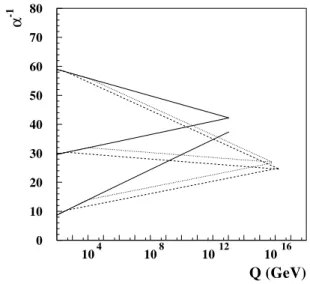
The particle content of the MSSM by itself provides a very nice hint for the scale of new physics: the unification of gauge couplings. Grand unification theories (GUT) emer-ged in the supposition that the three gauge couplings of the SM unifies when extrapolated to very high energy. Fig. 1 shows the running of gauge couplings using ISAJET [4], which includes two loop corrections to the RGE. The solid line shows the SM running. The supersymmetric content of the model is turned on once an arbitrary threshold is rea-ched: we take it to be 0.45 (11) TeV for the dashed (dotted) line.
There are two basic problems with GUT theory within the SM: the unification scale is not high enough to prevent proton decay and the coupling does not really unifies in the SM context. As we can see from Fig. 1, in the MSSM con-text both of this problems are solved: the couplings unifies with a much better degree and at a higher energy scale when
compared with the SM. It is important to emphasize that the unification of couplings is a quite general feature of the MSSM, does not depend much at which scale we include the superpartners or the details of the superpartners masses. It depends only on the particle content of the model. (A more refined discussion can be found in the SUGRA wor-king group [5].)
0 10 20 30 40 50 60 70 80
104 108 1012 1016
Q (GeV)
α
-1
Figure 1. Gauge coupling running as a function of energy. The solid line is the SM, the dotted (dashed) line is for MSSM with 1 TeV (10 TeV) SUSY mass scale.
4.1
mSUGRA
The first successfully economic framework for SUSY phe-nomenology, which have incorporated this idea of unifica-tion, is the so called SUGRA (or mSUGRA) framework [6]. In this picture SUSY is supposed to be broken in a hidden sector and the information of this breaking is transmitted via gravity interaction to the MSSM at the Planck scale. If supersymmetry is broken in the hidden sector by a VEV
< F >the soft terms in the visible sector are typically of ordermsof t ∼ <F >MP . To havemsof t ∼300GeV as requi-red to stabilize the scalar sector we need√< F > ∼1011
GeV. In this picture the gravitino (graviton’s superpartner) gets a mass at the order of soft terms,m3/2 ∼ √<F >3M
P, and does not play any role in collider physics.
With some special assumptions (hence the m for mini-mal SUGRA) the scalar masses and the trilinear couplings are all unified at this high scale. To be consistent with GUT unification the gauginos masses are also unified at this scale. The soft terms are completed determined by just four para-meters: the gauginos mass,m1/2; the scalars massm0; the
trilinear termA0 and the bilinear termB0. The other free
SUGRA models4. In order to compute process at the TeV scale the best thing to do is to evolve this parameters to the EW scale using the RGE equation. Once we get the soft bre-aking terms at the EW scale we can generate all the MSSM spectrum and verify if it is consistent phenomenologically. In particular the Higgs sector should give the right pattern of EW breaking, which means that we should have, at tree level:
1 2m
2
Z=
m2
Hd−m
2
Hutan
2
β tan2
β−1 − |µ|
2
, (3)
wheremHd andmHu are soft breaking terms of down and up Higgs doublets andµis the (supersymmetric) Higgs mass term, evaluated at the EW scale. We have eliminatedB0in
favor of tanβ = vu
vd, the ratio of vacuum expected values of the two Higgs doublets. Considering soft terms as input values at GUT scale and mZ fixed by its measured value
we can adjust|µ|to satisfy this relation, fixing its absolute value.
A more detailed look at eq. (3) tells us that it is not always possible to satisfy it. This looks like a very strong constraint: we need to choose the soft parametersmHdand
mHu very carefully in order to be consistent to EW data. In particular, for positive values ofm2
Hd, the unified choice of
mHd=mHu is not valid.
-1500 -1000 -500 0 500 1000 1500 2000 2500 x 102
104 108 1012 1016
Q (GeV)
M
2(GeV 2)
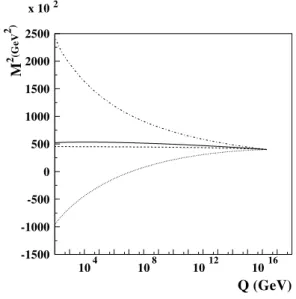
Figure 2. Running of soft scalar masses as a function of energy. The solid (dotted) line is form2
Hd(m 2
Hu). The dashed (dot-dashed) line showsm2
er(m
2
dr).
Fortunately, the unification relation is valid at the GUT scale, we need to run down the soft parameters to the EW scale in order to use eq. (3). More generally, one can check that ifm2
Hd>0the requirement ofmHu <0is sufficient to satisfy eq. (3). In Fig. 2 we show the running of the scalar soft masses using the RGE equation. The solid curve is for
mHd while the dotted curve is formHu. The dashed (dot-dashed) line showsmer(mdr) for reference. Because of the
large Yukawa top coupling,mHu is pushed to negative va-lues which is just what is necessary to trigger EW symmetry. This mechanism is called radiatively electroweak symmetry breaking. The fact that a large top mass is needed for this mechanism to work is very suggestive.
Another important issue that could have consequences on the phenomenology is the nature of the lightest su-persymmetric particle. In models whereR-parity is conser-ved this particle is stable and should be neutral for cosmo-logical reasons [7]. Within the MSSM the only candidates would be the lightest neutralino, the sneutrino or (in a super-gravity theory) the gravitino (the supersymmetric partner of the graviton) if it is extremely light (as it happens in gauge mediated models with a low SUSY breaking scale). Again, mSUGRA provides a large region of parameter space where the neutralino is the LSP. Gauge interactions give positive contribution for the soft terms when they are run down to EW scale. Starting with universal soft terms for gaugino masses the gluino massm3 gets the higher value because
of the strongerSU(3)interaction whilem1(the mass terms
corresponding to theU(1)group) gets the smaller value, in the ratio3m1
5α1 =
m2
α2 =
m3
α3. After diagonalizing the neutral
mass matrix and the charged matrix the lightest neutralino is usually the LSP. This neutralino LSP is a good candidate for Dark Matter, which is now strongly constrained by the Wilkinson Microwave Anisotropy Probe (WMAP) data.
In brief, mSUGRA provides a very predictive model for Supersymmetry: the model is completely specified by the sign ofµplus the four parameter set,
m0, m1/2, A0,tanβ. (4)
4.2
Gauge Mediated Models
Although mSUGRA is a very attractive model it is hard to believe that it is the only possible answer and that nature should be described by its minimal version. If we want to explore SUSY phenomenology we need to consider alterna-tive scenarios. One of the weakest points of the mSUGRA is the fact that unification of scalar masses (thus a mecha-nism for solving the FCNC problem that arises if we allow arbitrary soft terms) is an assumption without a strong justi-fication (from the theoretical point of view, of course).
Gauge mediated supersymmetry breaking models (GMSB) [8] solve this problem from start. The assumption here is that there is a intermediate sector that shares gauge interactions with the MSSM and also knows of SUSY bre-aking from the Hidden sector. The information of SUSY breaking is thus transmitted to the MSSM sector by me-ans of ordinarySU(3)c×SU(2)L×U(1)Y gauge
interac-tion. There is still gravitational communication between the MSSM and the hidden sector but it is much smaller com-pared with the gauge communication in theories where the intermediate scale is much smaller than the Planck scale. Because soft terms are proportional to gauge quantum num-4
bers, squarks and sleptons with same quantum numbers are degenerate in mass leading to a suppression of FCNC ef-fects.
In this picture there is an intermediate mass scaleMmess
where the boundary conditions for the soft terms must be fi-xed. Soft mass terms are proportional to a mass scale Λ
which signalizes the breakdown of SUSY. Considering that the messenger sector consists ofn5 sets of quark and
lep-ton superfields in a 5 + ¯5 representation of SU(5) (having the messenger sector in a complete representation of SU(5) keeps the successful prediction for the gauge coupling uni-fication) the gaugino masses are determined by,
mi=n5Λ
αi
4π, (5)
while soft scalar masses are given by,
m2
scalar= 2n5Λ2
· C3(
α3
4π) +C2( α2
4π) + 3 5(
Y 2)
2
(α1 4π)
¸ ,
(6) withC3 = 43 for color triplet and zero for color singlet,
C2=34for weak doublets and zero for singlets andY is the
hypercharge. The A terms and B terms are induced only at two loop order and are negligible. The model is thus deter-mined by just few parameters:
Mmess,Λ, n5,tanβ, sgn(µ), Cgrav, (7)
whereCgrav is a constant larger than 1 which will set the
gravitino mass. Astanβis interchangeable withB0and we
have argued thatB0should be small one might consider that
tanβshould be fixed, however details in the generation ofµ
would change this relation, thus it is common to havetanβ
as an input parameter.
The general implementation of this model is very similar to mSUGRA: There is a set of boundary conditions for the soft terms at some high scale, RGE equations are used to run down this terms to the EW scale where the complete MSSM spectrum is calculated. In particular, the Higgs mechanism should be triggered by this evolution.
It is clear that the different assumptions for soft brea-king terms will give different relations for sparticle masses. But the most important difference from mSUGRA models is that in GMSB the gravitino can be very light. Generically, the gravitino mass is given by,
m3/2∼
< F > √
3MP
, (8)
where< F >is a supersymmetric breaking VEV. In order to give soft terms at the EW scale order√< F > ∼ 1011
GeV is required in SUGRA models leading tom3/2∼TeV.
However, in gauge mediated models the soft terms are esti-mated to bemsof t∼ M<F >mess. AsMmesscan be much smal-ler thanMP, it is possible to have
√
< F > ∼104
GeV in this scenario. As we can see from eq. (8) this would give a very light gravitino; this gravitino would be the LSP and if it is really light (order of eV) the next lightest supersymmetric particle (NLSP) decays in a gravitino plus its SM partner within the detector. This very light gravitino does not make
a good candidate for cold dark matter which is a definite disadvantage of this model when compared with SUGRA.
Direct decay of other supersymmetric particles to the gravitino has a very small BR, in this picture there is going to be at least two NLSP particle in each event. The nature of the NLSP is thus very important for phenomenology. We note that the NLSP does not have the same constraints that the LSP have, in particular, it is possible for the NLSP to be a slepton and, indeed, in a large region of parameter space this is the case.
5
Search for Supersymmetry at the
LHC
We have seen that the MSSM provides a quite general fra-mework for supersymmetry. However, it has too many free parameters and most of its parameter space gives rise to pro-cess that violated FCNC, being ruled out by experiment. With some assumptions on the nature of the soft SUSY bre-aking terms, consistent frameworks are developed with few parameters and very predictive power. In this section we are going to see the predicted reach of the LHC in this fra-meworks.
5.1
mSUGRA
In the mSUGRA framework the complete supersymmetric spectrum is determined by the parameter set,
m0, m1/2, A0,tanβ, sign(µ).
From this parameters,m0andm1/2set the scale for scalars
and gaugino masses whileA0is relevant mostly for the third
generation sfermions. We expect thattanβandsign(µ)are relevant to the decay patterns. It is very common to present the reach in mSUGRA framework in the planem0×m1/2,
fixing the other parameters.
At the Tevatron p¯p collider, in most of mSUGRA re-levant parameter space (and not already ruled out by LEP constraint on the lightest chargino) the gluinos are too he-avy, so charginos pair and charginos/neutralinos associated productions dominates. The golden plate channel would be the trilepton signal from charginos product decay [5]. In a recent evaluation [9] the reach of Tevatron RUN 2 was esti-mated in aboutm1/2 <190GeV, depending on the others
parameters, which represents a gluino mass of about 575
GeV.
At the LHC gluino pair production dominates in a large fraction of space parameter. For lowm0values squarks are
also light so thatg˜g,˜ g˜q,˜ q˜˜qall have large rates. For very high
m1/2gluinos are too heavy and chargino-neutralino
associ-ated production dominates. It is usual to classify the signal in several channels containing many hard jets and leptons plus missing ET. The reach of the LHC has been
evalua-ted in mSUGRA [10]. In Fig. 3, taken from ref. [11], it is shown the reach fortanβ = 10,A0= 0andµ >0in
seve-ral channels. We can see that the best reach is given by the inclusivejets+Emiss
T and extend tom1/2as large as1400
TeV. We also see that it covers gluino mass of2TeV up to
m0 = 3000GeV. As a comparison, the Tevatron reach lies
below the m1/2 = 200GeV line, it is clear that the LHC
will extend considerably the reach!
mSugra with tanβ = 10, A0 = 0, µ> 0
m0 (GeV)
m1/2
(GeV) missET
0l 1l
2l SS 2l OS
3l Z→l+l
-≥4l
γ
m(g~)=2 TeV
m(u~L)=2 TeV
100 200 300 400 500 600 700 800 900 1000 1100 1200 1300 1400 1500
0 1000 2000 3000 4000 5000
Figure 3. LHC reach for several channels extract from ref. [11]. TheET missing inclusive channel is the upper solid line. Also
shown is gluino mass contour of 2 TeV.
5.2
GMSB
In the GMSB framework the complete supersymmetric spectrum is determined by the parameter set, given at eq.(7):
Mmess,Λ, n5,tanβ, sgn(µ), Cgrav.
From this parameter the most important isΛwhich set the scale for the soft mass terms. Mmess just set the scale
where the boundary condition is valid, in other words it just tells how much it is needed to run down to the EW scale. In GMSB the search strategy depends on the nature of the NLSP. It is common to define regions of parameter space according to the nature of the NLSP [12]. n5 alters the
relations of gauginos and scalar soft masses being impor-tant to determine the identity of the NLSP. tanβ is also important to determine the nature of the NLSP. In the stu-dies of reference [13, 14] Cgrav is set to1, which permits
the prompt decay of the NLSP, neglecting possible handles coming from tracks or displaced vertices, so this reach pro-jections are conservatives.
In a given region the studies can be presented as a func-tion of Λ, which sets the mass scale of the model. Seve-ral cases have been studied: A U(1) gaugino like NLSP (which gives two photons in the final state), a stau NLSP (which gives two taus in the final state), a co-NLSP scenario (which gives a signal with several isolated leptons), a Higg-sino NLSP (which might giveZ bosons or Higgs boson in the final state).
The most difficult scenario is the stau NLSP where Teva-tron reach would correspond to a gluino mass of about800
GeV while in the most favorable scenario (co-NLSP) the re-ach will extend up to gluino mass of 1000GeV [13]. In
similar studies for the LHC [14] it was found that the LHC will have a reach ofmg˜∼3TeV in the favorable scenario
of co-NLSP andmg˜ ∼2TeV in the stau NLSP scenarios.
Generally the LHC reach is better then in mSUGRA fra-mework.
5.3
Anomaly Mediated, Gaugino Mediated
There are other compelling models for SUSY breaking, including anomaly mediated supersymmetry breaking [15] and gaugino mediation models [16], but it is beyond the scope of this work to introduce them here. The LHC reach was also evaluated for such models [17, 18], given a reach of about2TeV for the gluino mass.
6
The flavor problem and the
decou-pling solution: is the LHC going to
see it?
We come back here to the central point for SUSY at the electroweak scale. As it was pointed out, supersymmetry provides a way to protect the scalar sector against quadra-tic divergences which permits the supersymmetric version of the SM to be extended to very high energy scale without the need for large cancellation. In order to remain coherent with this view, it is supposed that sparticles should have their masses at the EW scale, otherwise the need for fine tuning reappear in the scalar sector. (In particular, looking at eq. (3), if the Higgs mass parameters andµare very large it is evident that a large fine tuning is needed to keepmZ at its
measured value.) In the previous section we saw that the LHC is able to find supersymmetry, in many of its realiza-tions, for gluinos as heavy as 2 TeV, so if supersymmetry solves the fine tuning problem it will be found at the LHC.
avoid constraints from low energy process such as FCNC, rare decays and CP violation.
We are going to explore two scenarios with large sfermi-ons masses: inverted mass hierarchy models and focus point models. In both scenarios we are guided by the construction of models with large scalar masses trying, at the same time, to address the fine tuning problem.
6.1
Inverted Mass Hierarchy
The problem posed above, sub-TeV particles required by naturalness arguments and multi-TeV particles required by FCNC and CP violation low energy experimental cons-traints, can be reconciled by the following consideration: low energy constraints comes mainly from processes in-volving first and second generation of fermions, while the Higgs scalar sector couples mainly to the third generation [20]. Thus, an inverted mass hierarchy (IMH) spectrum is desirable: third generation sfermions with sub-TeV masses while first and second generations gets multi-TeV masses.
It is possible that the IMH is generated already at the GUT scale (GSIMH). Because sfermions soft terms from first and second generations are very large and they contri-bute to the evolution of third generation at two loop order, it is very important to consider two loop contributions to the renormalization group. This contributions tends to drive third generation masses to negative values, breaking color or electric charge symmetry, unless the GUT scale third gene-ration mass is very high, so there is a limited range of para-meter space where a viable spectrum is generated [21]. Re-gions of parameter space where first and second generation scalar masses are in the 5-20 TeV range and third generation in the sub-TeV range are mapped out in ref. [22].
An intriguing feature of this type of models is that it is going to be very hard to find it at the LHC. In ref. [22] our preliminar study with a particular point where this IMH is achieved shows that the general search strategy is not going to work. A more dedicated search, perhaps looking for third generation fermions, is needed.
In resume, in GSIMH type of models it is possible to achieve a significant hierarchy which poses challenges in the search for this models. The task in theoretical developments would be to explain the origin of the peculiar choice of SSB parameters at the GUT scale.
An attractive alternative where IMH can occur has been suggested in a series of papers [23]. The idea is to start with multi-TeV masses for all scalar particles at the GUT scale and generate the IMH radiatively. It has been noted that for simple forms of the soft breaking terms, third generations soft terms is driven to small values while first and second generation soft terms remain at the multi-TeV range. The beauty of this scenario is that the boundary conditions that soft terms need to satisfy is consistent withSO(10)grand unification.
In order to have a realistic spectrum from this model we have to implement Yukawa unification as expected in
SO(10)grand unified models. Yukawa unification occurs only at a very high value oftanβ, a region of parameter space where it is very difficult to implement REWSB. It has
been noted, however, that the introduction of D −term, that occur when spontaneous gauge symmetry breaking le-ads to a reduction in rank of the gauge group [24] (in this case fromSO(10)to theSU(3)×SU(2)×U(1)), can help to get the REWSB mechanism [25]. A second problem ari-ses: the introduction of D-term and the full implementation of the RGE equations (with two loop effects, TeV masses contributions, non unification of Yukawa couplings below GUT scale) perturb the simple exact solution that drives the third generation masses to small values. Moreover, the Yu-kawa coupling values allowed by the top quark mass mea-surements is not as large as the ones used in ref. [23]. As a result the amount of hierarchy obtained is rather limited.
In reference [26] realistic models were generated in this scenario. It is possible to get sub TeV third generation mas-ses while keeping first and second generation at the order of 3-5 TeV. This is enough to decouple the first and second ge-neration from the LHC searches. In this scenario the mSU-GRA strategy has a limited reach in the LHC. This preli-minary study shows that b-tag jets can help to improve the reach [26].
In both scenarios of IMH it is clear that the LHC capa-city to find it must be explored in more detail. In particular, the capacity forb−tagwould be crucial in this scenarios. A more detailed study for scenarios where third generation squarks might be the only sparticle produced at the LHC with particular emphasis onb−tagis in order.
6.2
Focus Point
An intriguing region in the mSUGRA parameter space is the largem0region. In this region all scalar sparticles are
he-avy, which helps to ameliorate the FCNC and CP violation problems. Naively, large scalar masses would require very large cancellations in the scalar potential to keep the EW scale at its experimental value, rendering the model unatu-ral. For this reason, this region of parameter space have been neglected in phenomenological studies.
-200 0 200 400 600 800 1000 1200 1400 1600 x 104
104 108 1012 1016
Q (GeV)
M
2(GeV 2 )
4000
3000
2000
1000
Figure 4. Running of the up Higgs soft mass (mHu) in the focus point region. In this plot,A0=0,tanβ = 10,m1/2 = 300GeV, µ >0and the values ofm0are shown in GeV for each line. This figure was inspired in ref. [27].
However, it has been noted that in the region wherem1/2
is not so large there is an interesting focus point behavior for the soft Higgs masses, as is shown in Fig. 4 the soft Higgs masses is run down to the same value at the EW scale, in-dependently of the GUT scale value ofm0[27]. One could
say that big m0values are as natural as the small ones, as
it naturally leads to the same EW values. In fact, from the minimization condition in the scalar potential,
1 2m
2
Z =
m2
Hd−m
2
Hutan
2β
tan2β
−1 − |µ|
2
∼ −m2
Hu− |µ|
2
, (9)
we see that, for largetanβ(where the last approximation is valid), the value ofµ2
is sensitive only tom2
Huwhich, by its turn, is insensitive to the value ofm0due to the focus point
behavior.
Moreover, as it can be seen from Fig. 4, themHu va-lues obtained in this solutions are small, leading to a very small µ. This region of smallµhappens for largem0 and
form1/2, just above the theoretically excluded limit where
no REWSB is achieved (we should note that this region is very sensitive to the value of the top quark mass). We will refer to it by the focus point (FP) region. The main conse-quence of the small value ofµis that the lightest two neutra-linos and the lightest chargino are mainly a Higgsino, which enhances its coupling to third generation fermions. This has important consequences in dark matter prediction as well as direct searches in collider.
This FP region has received renewed attention due to ex-perimental data on CDM as well improved neutralino relic density evaluations [28]. As we have pointed out, a very attractive feature of R-parity conserving models is that the LSP is stable, providing a natural candidate for dark mat-ter. In mSUGRA the LSP is the lightest neutralino and its contribution to dark matter is calculable.
Recent analyses from the WMAP and other experiments set the physical matter and baryon densities to be [29]
Ωmh2 = 0.135+0−0..008009andΩbh
2 = 0.0224
±0.0009, res-pectively, where his the Hubble constant in units of 100 km/s/Mpc. The excess of non-baryonic matter results in
ΩCDMh2 = 0.1126+0−0..008009. The upper limit derived from
this is a true constraint on any stable relic from the Big Bang, such as the NLSP of the mSUGRA model5
, while the lower limit does not present a true constraint as there could be other sources of cold dark matter in the model.
Promising regions for CDM includes the focus point re-gion, where the large Higgs component of the LSP allows for efficient annihilation into vector boson pairs, keeping the amount of CDM compatible with WMAP results. Others re-gions that might be consistent with WMAP results are the stau co-annihilation region and the axial Higgs A annihila-tion corridor at largetanβ. The so called bulk region at low
m0andm1/2was advocated as an indication that the LHC
would discover mSUGRA as it points to smallm1/2andm0
but now this region has been practically ruled out.
Recently Baer et al. [11] attempted to set bounds on the neutralino relic density constraint in mSUGRA model, along with other indirect experimental constraints, namely rare decaysb → sγ or Bs → µ+µ− and the muon
ano-malous magnetic moment. These low energy data favora-ble regions were confronted with direct search of SUSY at the CERN LHC collider for an integrated luminosity of 100 fb−1
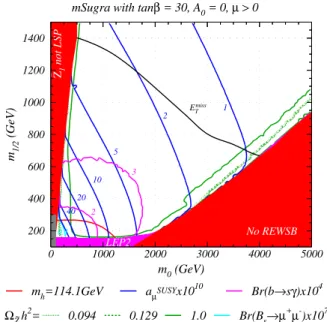
. In Fig. 5 we shown their results for tanβ = 30,
A0 = 0 andµ > 0. We see that the bulk region is
diffi-cult to reconcile with LEP2 limits on the Higgs mass, as it extend up to onlym1/2 < 100GeV (as opposed to about
200GeV in pre WMAP results [30]). The region very close to the left-hand side of the figure where stau mass is similar to the LSP mass is the co-annihilation region. The FP region is the narrow band just above the region labeled No REWSB in the right-hand side.
mSugra with tanβ = 30, A0 = 0, µ> 0
200 400 600 800 1000 1200 1400
0 1000 2000 3000 4000 5000
0.1
40 20
10 5
2 1
2 3
ET miss
No REWSB
Ζ
~ 1
not LSP
LEP2
m0 (GeV)
m1/2
(GeV)
mh=114.1GeV aµSUSYx1010 Br(b→sγ)x104
ΩZ ~h2=
1 0.094 0.129 1.0 Br(Bs→µ +µ-)x107
Figure 5. Neutralino relic density constraint on the mSUGRA pa-rameter space fortanβ= 30,A0= 0andµ >0along with LHC maximal reach and contours of several low energy observables ob-tained from Ref. [11].
The very interesting feature about the FP region is that it extend far away from the expected reach of the LHC via missing ET plus jets channel (the line with the labelEmiss
T
in Fig. 5), posing a challenge to its discovery.
Motivated by the fact that in this portion of parameter space the LSP has a substantial higgsino component, thus gluino decay predominantly into third generation quarks, we expect that SUSY signature will be very rich in multiple hardb jets. Therefore an efficient b-tagging may improve the discovery reach of supersymmetry over the canonical se-arch.
AlthoughWf1Ze1,fW1Ze2cross section dominates in this
region, those particles are degenerated in mass so their visi-ble decay are quite soft. The gluino production will be the 5
main source for hard visible activity that can be singled out from the background. In Fig. 6 we present the gluino cross section as a function of its mass. Because its cross section is rather small we are going to work with rate limited sig-nal, thus the efficiency of detectors will be crucial. In the region we are considering, gluino decays predominantly via
f W+
1 b¯t, Wf1−¯bt, Ze1,2b¯b, Ze1,2t¯t, leading to a final state with
many very hardb’s. Our preliminary results were presented in this congress by Kenichi Mizukoshi [31].
1
10
10
210
3800 1000 1200 1400 1600 1800
m(gluino) (GeV)
σ
(fb)
Figure 6. Gluino pair production cross section as a function of its mass at the LHC.
7
Summary and Discussions
I have presented here some of the frameworks where su-persymmetry is realized and the potentiality of the LHC to find it. It is clear that the LHC is going to extend the pre-sent reach considerably. For most of the scenarios, the LHC is going to probe sparticles as heavy as500GeV. Even for R-parity violation models [32], not discussed here, the LHC is able to cover most of the sub-TeV region [2].
We have seen that the main motivation of electroweak supersymmetry is the solution of the fine tuning problem. This generally would require sparticles of sub-TeV masses, leading to a strong confidence that the LHC is going to find supersymmetry if it is relevant to the electroweak scale.
We have stressed here, however, that the present bounds and the success of the SM in explain all the low energy re-sults pushes the supersymmetric masses to higher values. To reconcile the need for respecting the low energy constraint in mSUGRA we propose some scenarios with very high mas-ses6for supersymmetric particles that might respect some fine tuning criteria (though we stay away from the discus-sion of quantifying fine tuning). The focus point region, in addition to that, is a favored region from cold dark matter constraints.
It would be a real challenge for the LHC to search for the scenarios proposed here. In particular, the capacity for the LHC to identify b jets will be crucial to extend the reach in such scenarios. A more refined work in this direction is under perform.
Acknowledgments
The author is much in debt with Xerxes Tata for valuable discussions. I am also in debt with Howard Baer for sugges-ting to explore the IHM framework in depth. Yili Wang, Csaba Bal´az and Michal Brhlik have colaborated in most of the works concerned here. Kenichi Mizukoshi and Roger Kadala are collaborating in the exploration of the b-jet sce-nario in the LHC. Finally, I thank the organizing comitee of the Brazilian conference for inviting me and the audience of our section for lively discussion. This work is supported by FAPESP.
References
[1] For reviews in SUSY see Stephen P. MartinA Supersymmetry Primerhep-ph/9709356; X. TataWhat is supersymmetry and how do we find it, presented at IX J. Swiec Summer School, hep-ph/9706307; N. PolonskySupersymmetry: Structure and Phenomena. Extensions of the Standard ModelLect. Notes Phys.M68, 1 (2001).
[2] Scientific note: the Atlas and CMS collaborations, hep-ph/0110021
[3] J. Gunion and H. Haber, Nucl. Phys.B278, 449 (1986).
[4] H. Baer, F. Paige, S. Protopopescu and X. Tata, hep-ph/0001086
[5] S. Abeet al.(SUGRA working group collaboration), hep-ph/0003154.
[6] A. Chamseddine, R. Arnowitt and P. Nath, Phys. Rev. Lett.
49, 970 (1982); R. Barbieri, S. Ferrara and C. Savoy, Phys. Lett.B119, 343 (1982); L.J. Hall, J. Lykken and S. Weinberg, Phys. Rev. D27, 2359 (1983); for a review, see H. P. Nilles, Phys. Rep.110, 1 (1984).
[7] S. Wolfram, Phys. Lett.B82, 65 (1979); C. B. Dover, T. Gais-ser and G. Steigman, Phys. Rev. Lett.42, 1117 (1979).
[8] M. Dine, A. Nelson, Y. Nir and Y. Shirman, Phys. Rev.D53, 2658 (1996).
[9] H. Baer, T. Krupovnickas and X. Tata, hep-ph/0305325.
[10] S. Abdullinet al. (CMS Collaboration), hep-ph/9806366
[11] H. Baer, C. Bal´azs, A. Belyaev, T. Krupovnickas and X. Tata, hep-ph/0304303.
[12] R. Culbertsonet al. (SUSY working group collaboration), hep-ph/0008070.
[13] H. Baer, P. G. Mercadante, X. Tata and Y. Wang, Phys. Rev. D60, 055001 (1999).
[14] H. Baer, P. G. Mercadante, F. Paige, X. Tata and Y. Wang, Phys. Lett.B435, 109 (1998) ; H. Baer, P. G. Mercadante, X. Tata and Y. Wang, Phys. Rev. D62, 095007 (2000)
[15] L. Randall and R. Sundrum, Nucl. Phys. B557, 79 (1996); G. Giudice, M. Luty, H. Murayama, and R. Rattazzi, JHEP
9812, 027 (1998).
[16] M. Schmaltz and W. Skiba, Phys. Rev. D62, 095005 (2000). .
6
[17] H. Baer, J. K. Mizukoshi and X. Tata, Phys. Lett.B488, 367 (2000).
[18] H. Baer, A. Belyaev, T. Krupovnickas, and X. Tata, Phys. Rev. D65, 075024 (2002).
[19] G. F. Giudice, hep-ph/9912279.
[20] M. Drees, Phys. Rev. D33, 1468 (1986); A. Pomarol and D. Tommasini, Nucl. Phys.B466, 3 (1996); A.G. Cohen, D.B. Kaplan, and A.E. Nelson, Phys. Lett. B388, 588 (1996); J. Hisano, K. Kurosawa, and Y. Nomura, Phys. Lett. B445, 316 (1999); V. Barger, C. Kao, and R-J. Zhang, Phys. Lett. B483, 184 (2000); for an overview, see H. Baer, M. Diaz, P. Quin-tana, and X. Tata, JHEP0004, 016 (2000).
[21] N. Arkani-Hamed and H. Murayama, Phys. Rev. D56, R6733 (1997); K. Agashe and M. Graesser, Phys. Rev. D59, 015007 (1999).
[22] H. Baer, C. Bal´azs, P. Mercadante, X. Tata, and Y. Wang, Phys. Rev. D63, 015011 (2000).
[23] J. Feng, C. Kolda, and N. Polonsky, Nucl. Phys. B546, 3 (1999); J. Bagger, J. Feng, and N. Polonsky, Nucl. Phys. B563, 3 (1999); J. Bagger, J. Feng, N. Polonsky, and R. Zhang, Phys. Lett. B473, 264 (2000).
[24] M. Drees, Phys. Lett. B181, 279 (1986); C. Kolda and S. Martin, Phys. Rev. D53, 3871 (1996).
[25] H. Baer, M. Diaz, J. Ferrandis, and X. Tata, Phys. Rev. D61, 111701 (2000); H. Baer, M. Brhlik, M. Diaz, J. Ferrandis, P. Mercadante, P. Quintana, and X. Tata, Phys. Rev. D63, 015007 (2001).
[26] H. Baer. P. Mercadante and X. Tata, Phys. Lett.B475, 289 (2000); H. Baer, C. Bal´azs, M. Brhlik, P. Mercadante, X. Tata, and Y. Wang, Phys. Rev. D64, 015002 (2001).
[27] J. Feng, K. Matchev, and T. Moroi, Phys. Rev. Lett.84, 2322 (2000) and Phys. Rev. D61075005 (2000).
[28] J. Ellis, T. Falk, K. Olive, and M. Srednicki, Astropart. Phys.
13 181, (2000); H. Baer and M. Brhlik, Phys. Rev. D57, 567 (1998); J. Feng, K. Matchev, and F. Wilczek, Phys. Lett. B482, 388 (2000).
[29] C. L. Bennettet al., hep-ph/0302207; D. N. Spergelet al., hep-ph/0302209.
[30] K. A. Olive, hep-ph/030835
[31] P. G. Mercadante and J. K. Mizukoshi, Prepared for XXIV Brazilian National meeting on Particles and Fields.
![Figure 3. LHC reach for several channels extract from ref. [11].](https://thumb-eu.123doks.com/thumbv2/123dok_br/18980411.456812/6.892.105.426.182.467/figure-lhc-reach-channels-extract-ref.webp)