www.epjournal.net – 2015. 13(1): 266-282 ¯ ¯ ¯ ¯ ¯ ¯ ¯ ¯ ¯ ¯ ¯ ¯ ¯ ¯ ¯ ¯ ¯ ¯ ¯ ¯ ¯ ¯ ¯ ¯ ¯ ¯ ¯ ¯
Original Article
Creativity and Aggression as Ornament and Armament: Intersexual and
Intrasexual Selection on Men’s Mating Behaviors
Bin-Bin Chen, Department of Psychology, Fudan University, Shanghai, China.
Lei Chang, Department of Psychological Studies, Hong Kong Institute of Education, Hong Kong, China; Department of Social Psychology, Nankai University, Tianjin, China. Email: [email protected] (Corresponding author).
Abstract: In three studies, we tested the hypothesis that men respond to intersexual and
intrasexual selection by facultatively choosing between weapon-like and ornament-like behaviors. In the first two studies, we manipulated intersexual and intrasexual selection by having male participants take part in a simulated dating game (Study 1) or imagine having a date (Study 2). In both studies, participants were told either that the target female would choose her date (intersexual) or that male suitors would nominate one another (intrasexual). Under the intersexual selection condition, men demonstrated increased creativity levels and decreased aggression levels, whereas the opposite pattern was observed under the intrasexual selection condition. Study 3 showed that individual differences in creativity and aggression as personality traits similarly predicted intrasexual and intersexual mating strategies, respectively. These extend existing evolutionary mating research by specifying the mechanism of intrasexual or intersexual selection in shaping men’s weapon-like or ornament-like situational response and personality development.
Keywords: sexual selection, ornament, weapon, creativity, aggression, mating
¯ ¯ ¯ ¯ ¯ ¯ ¯ ¯ ¯ ¯ ¯ ¯ ¯ ¯ ¯ ¯ ¯ ¯ ¯ ¯ ¯ ¯ ¯ ¯ ¯ ¯ ¯ ¯ ¯ ¯ ¯ ¯ ¯ ¯ ¯ ¯ ¯ ¯ ¯ ¯ ¯ ¯ ¯ ¯ ¯ ¯ ¯ ¯ ¯ ¯ ¯ ¯ ¯ ¯ ¯ ¯ ¯ ¯ ¯ ¯ ¯ ¯ ¯ ¯ ¯ ¯ ¯ ¯ ¯ ¯ ¯ ¯ ¯ Introduction
(Miller, 2000). Certain polygynous species, such as the elephant seal, become weapon specialists, relying primarily on intrasexual combat to achieve reproductive success. Other species, such as the peacock and numerous birds of paradise, specialize in intersexual selection to produce extravagant male ornaments. Humans are versatile animals who rely on a large brain to facilitate amassing and facultatively employing a large repertoire of survival and reproductive strategies, including weapons and ornaments.
Even though ancestral men may have used intrasexual combat more than intersexual ornaments in acquiring mates (Puts, 2010) and much human female choice may also have derived from male contests (Berglund et al., 1996), modern men use both intrasexual and intersexual mating strategies as evidenced by much research showing a clear association between mating motivation and various behaviors that constitute weapons and ornaments in men. Specific weapon-like behaviors under mating investigation include physical or direct aggression in response to provocation (Daly and Wilson, 1988; Griskevicius et al., 2009; Kirkpatrick, Waugh, Valencia, and Webster, 2002; Terrell, Patock-Peckham, and Nagoshi, 2009), throwing darts at humanoid rather than inanimate object targets (Mussweiler and Forster, 2000), social dominance and status (Li et al., 2013; Valentine, Li, Penke, and Perrett, 2014), endorsing warring attitudes (Chang, Lu, Li, and Li, 2011), and producing a low voice pitch (Puts, Doll, and Hill, 2014). The studied ornament-like behaviors include conspicuous material consumption (Griskevicius et al., 2007; Sundie et al., 2011), risk taking (Baker and Maner, 2008; Frankenhuis, Dotsch, Karremans, and Wigboldus, 2010; Pawlowski, Atwal, and Dunbar, 2008; Ronay and von Hippel, 2010), humor (Greengross and Miller, 2011), being unique and non-conforming (Griskevicius, Goldstein, Mortensen, Cialdini, and Kenrick, 2006), becoming loss averse (Li, Kenrick, Griskevicius, and Neuberg, 2012), making generous financial donations (Iredale, Van Vugt, and Dunbar, 2008), and exhibiting heroic altruism (Griskevicius et al., 2007), all of which are preferred by women.
Some studies using the general mating motivation approach have obtained results similar to mapping intrasexual or intersexual conditions with weapon-like or ornament-like behaviors, but have not included both selection conditions or both behavioral outcomes in the same study. For example, Frankenhuis et al. (2010) had male participants walk across a rope bridge toward a female or male target in a 3D, virtual reality setting. A female or male experimenter guided the participants to cross the bridge. Although it was not the intention of the study, the design yielded intrasexual (i.e., male target and female experimenter or female target and male experimenter) and intersexual conditions (i.e., female target and female experimenter) for the male participants. Frankenhuis et al. (2010) examined risk taking, which is an ornament-like behavior, based on the speed at which the male participants crossed the bridge. As expected, the participants moved the fastest under the intersexual condition (M = .62 m/s) and slowest under the intrasexual condition (M = .46 m/s), but the
study did not include weapon-like behavior.
In another example, Griskevicius et al. (2009) induced a general mating motivation by having male participants envision a romantic scenario and examined their physical aggression toward imagined insults from a same-sex stranger. However, the focus of this study was the audience effect of either a male or a female spectator witnessing the insult. The general mating motivation and the spectator manipulation together generated the additional intrasexual (male witness) and intersexual (female witness) conditions. The results indicated that when the witness was male (intrasexual), the general mating motivation affected direct aggression of the male participants, whereas when the witness was female (intersexual), mating motivation did not influence aggression. The study did not include ornament-like behavior to assess the possibility of facultative switching between the two mating strategies. Finally, Hodges-Simeon, Gaulin, and Puts (2011; also see Puts, Gaulin, and Verdolini, 2006) showed that voice pitch as a weapon was related to intrasexual competition. In this study, male participants introduced themselves to a female date (intersexual condition) and then addressed a male suitor of that date (intrasexual condition). The participants’ speech was recorded during both conditions. The results showed that a monotone voice, representing intrasexual dominance or a weapon-like strategy, was exhibited during the intrasexual but not the intersexual condition. Again, the contrasting effect on ornament-like behavior was not investigated. Together, these studies suggest that men potentially use weapons and ornaments facultatively in response to intrasexual and intersexual selection conditions, even though no study has explicitly manipulated both sexual selection conditions or has investigated both weapon-like and ornament-like behavioral outcomes.
weapon-like behavior (Puts, 2010). Aggression and war have been associated with mating success in both prehistoric and modern societies (Chagnon, 1988; Daly and Wilson, 1988; Puts, 2010). For example, in the hunter-gatherer Hadza tribes in Tanzania, the courtship of a woman by multiple male suitors could cause aggressive or even fatal combat among men (Marlowe, 2004). These studies confirm the validity of aggression and creativity as weapon-like and ornament-weapon-like mating strategies.
We conducted three studies. In the first two studies, we manipulated two dating situations relevant to intrasexual and intersexual selection, and examined how they influenced aggression (as a weapon) and creativity (as an ornament). In Study 3, we conducted a questionnaire investigation to examine whether being creative and aggressive as personality traits were also associated with intersexual courtship and intrasexual competition, respectively.
Study 1
In Study 1, we tested the hypothesis that men demonstrated weapon-like as opposed to ornament-like behaviors when motivated by intrasexual rather than intersexual competition. However, the same effect was not expected from women because men are more likely to experience sexual selection pressures than women are (Archer, 2009; Buss, 1989; Daly and Wilson, 1988; Miller, 2000; Puts, 2010). Intersexual and intrasexual selection were manipulated during a simulated dating game, and creativity and aggression tasks were used to represent ornament-like and weapon-like behaviors, respectively.
Materials and Methods
The sample consisted of 132 Chinese undergraduate students (average age = 20.11 years, SD = 1.01; 66 men) who received a moderate monetary incentive for their
participation. A 2 (participant gender) x 3 (sexual selection situations: intersexual vs. intrasexual vs. control, between participants) x 2 (mating strategies: creativity vs. aggression, within participants) mixed design was used.
Griskevicius et al., 2009). Finally, they were thanked and debriefed. The control group, which received no mating instructions, simply participated in the creativity and aggression tasks. Their performances served as a baseline to confirm that the expected differences between the intrasexual and intersexual groups were obtained because the hypothesized group exhibited a superior performance, but not because the opposite group exhibited an inferior performance compared with the control group.
Creativity task
Creative performance was measured using a category inclusion task (Isen and Daubman, 1984) that has been widely used in creativity research (e.g., De Dreu and Nijstad, 2008; Friedman and Forster, 2000). This task is used to test cognitive flexibility and ideational originality based on the breadth of inclusion of items atypical of a category (Murray, Sujan, Hirt, and Sujan, 1990) and has been found to correlate with associative thoughts, cognitive flexibility, and originality of ideas (Gasper and Middlewood, 2014; Miron-Spektor, Gino, and Argote, 2011; Nijstad, De Dreu, Rietzschel, and Baas, 2010). The participants were given three categories (furniture, vegetables, and clothing), each containing nine exemplar items. Three of these items were strong exemplars, three were moderate exemplars, and three were poor exemplars of the category. The nine items within each category were individually presented in a fixed order that differed in typicality from most (e.g., sofa for the furniture category), to moderately (e.g., bookcase for the furniture category), to least typical (e.g., telephone for the furniture category). The participants indicated how typical each item was for the named category on a 10-point scale ranging from 1 (atypical) to 10 (typical). Using highly and moderately typical exemplars (e.g., sofa and
bookcase for the furniture category) as representatives of a category is not presumed to require cognitive flexibility (Isen and Daubman, 1984) because such exemplars clearly belong to a specific category. Using atypical exemplars (e.g., telephone) in the category requires seeing these exemplars in unusual ways. Therefore, the extent to which these exemplars are used reflects cognitive flexibility and creativity. Based on relevant literature (Carnevale and Probst, 1998; Friedman and Forster, 2000; Isen and Daubman, 1984) we aggregated the typicality ratings of the nine atypical exemplars for each category, forming a creativity index. The internal consistency reliability estimate was .75.
Aggression task
The task comprised nine trials, and the initial trial was not provoked. The participant heard noises during half of the trials (randomly determined). Previous studies (e.g., Bushman and Baumeister, 1998; Twenge, Baumeister, Tice, and Stucke, 2001) have shown that the first trial yields the optimal measure of unprovoked aggression because the participants have not yet experienced aversive blasts of white noise from the opponent. Based on this literature, we used the blast intensity and duration selected in the first trial as measures of aggression. The two variables (intensity and duration) were converted into z-scores and summed to generate a composite aggression score.
Results and Discussion
No statistical differences existed between the intrasexual and intersexual selection conditions regarding positive (F[1, 86] = 1.24, p = .27) or negative mood states (F[1, 84] = 0.36, p = .55). This suggests that the aggression derived from intrasexual competition is not
associated with negative arousal (i.e., anger and frustration).
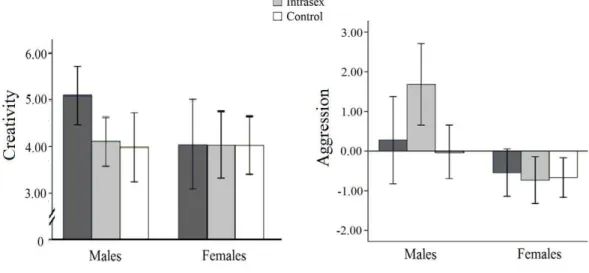
Consistent with predictions, an ANOVA of the 2 (participant gender) x 3 (intersexual selection vs. intrasexual selection vs. control) x 2 (creativity vs. aggression) mixed design yielded a significant three-way interaction (F[2, 126] = 3.13, p < .001, η2 = .05). To examine
the specific study hypotheses, we performed a series of planned comparisons of creativity and aggression (Figure 1).
Figure 1. Intersexual and intrasexual effect on creativity and aggression in Study 1
Note. Error bars indicate ± SE
Regarding creativity, we predicted that intersexual selection motives would enhance male creativity. The men in the intersexual selection condition exhibited higher creativity levels (M = 5.09, SD = 1.42) than did those in the intrasexual (M = 4.11, SD = 1.19; t[63] =
2.27, p = .03, d = 0.77) and control conditions (M = 3.98, SD =1.67; t[63] = 2.55, p = .01, d
= 0.73). There was no difference between the intrasexual and control conditions (t[63] = 0.28, p = .78). The female participants exhibited no differences regarding creativity levels between
1.41; t[63] = 0.03, p = .98), and between the intrasexual and control conditions (t[63] = 0.01,
p = .99).
Concerning aggression, we predicted that intrasexual selection motives would enhance male aggression. The men in the intrasexual selection condition exhibited higher aggression levels (M = 1.68, SD = 2.32) than did those in the intersexual (M = 0.28, SD =
2.48; t[63] = 2.17, p = .03, d = 0.60) and control conditions (M = -0.02, SD = 1.52; t[63] =
2.63, p = .01, d = 0.89). There was no difference between the intersexual and control conditions (t[63] = 0.46, p = .65). The women exhibited no differences regarding aggression
levels between the intrasexual (M = -.73, SD = 1.33) and intersexual selection conditions (M
= -.54, SD = 1.35; t[63] = .49, p = .63), between intrasexual and control conditions (M = -.67, SD = 1.12; t[63] = -0.17, p = .87), or between intersexual and control conditions (t[63] = 0.32, p = .75). These results suggest that, as explicated by sexual selection theory,
intersexual and intrasexual selection conditions elicit distinct male mating strategies. Similar to other animals that specialize in ornamental or weapon strategies, men respond to the two sexual selections by exhibiting corresponding ornament-like and weapon-like behaviors.
Study 2
In Study 1, one photograph of an attractive person of the opposite sex was used to establish mating motivation. Although a single photograph has been widely used (e.g., Baker and Maner, 2009), allowing the participants to choose from multiple photographs may more effectively activate mating motivation. Thus, in Study 2, the participants chose their mates. We also altered the intrasexual and intersexual selection manipulations by asking the participants to imagine real dating situations. The same aggression task was used as in Study 1, but a different creativity task was used that relies on independent judges to assess the originality of novel ideas. We also eliminated the control group and only compared intrasexual with intersexual conditions because Study 1 had already shown that the expected change in aggression and creativity was due to the relevant experimental groups. With these changes, we expected Study 2 to replicate the results of Study 1.
Materials and Methods
The sample consisted of 100 Chinese undergraduate students (average age = 20.37 years, SD = 0.86; 50 men) who received a moderate payment for their participation.
The experiment design was a 2 (participant gender) x 2 (sexual selection situations: intersexual vs. intrasexual) x 2 (mating strategies: creativity vs. aggression) mixed-factorial design. Gender and selection situation were the between-participants factors and mating strategy was a within-participant factor.
The Unusual Uses Task (Friedman and Forster, 2000) was implemented as the creativity measure in Study 2. During this task, the participants listed as many creative uses of a tin can as possible in 1 minute. This yielded 130 unique uses, which four independent judges rated for originality by using a 9-point scale. The interrater reliability was .86. The creativity score represented the average originality rating for all uses proposed by a participant.
Results and Discussion
No statistical differences existed between the intrasexual and intersexual selection conditions regarding positive (F[1, 98] = 0.16, p = .69) or negative mood states (F[1, 98] = 1.66, p = .20). An ANOVA of the 2 (participant gender) x 2 (intrasexual vs. intersexual selection conditions, between participants) x 2 (creativity, aggression, within participants) mixed design exhibited a significant three-way interaction (F[1, 96] = 5.26, p = .02, η2 = .05).
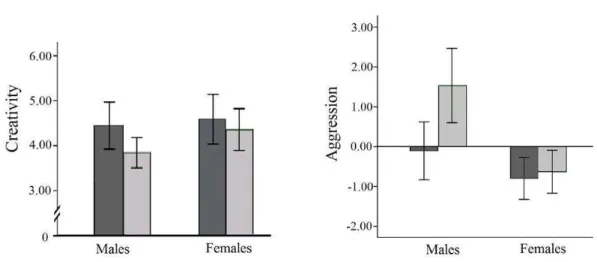
The results are shown in Figure 2. Men in the intersexual selection condition demonstrated higher originality levels (M = 4.45, SD = 1.26) than men in the intrasexual selection condition
did (M = 3.84, SD = 0.82; t[48] = 2.01, p = .05, d = 0.58), whereas men in the intrasexual
selection condition showed higher aggression levels (M = 1.53, SD = 2.26) than men in the intersexual selection condition did (M = -0.11, SD = 1.76; t[48] = -2.86, p = .006, d = 0.83).
Figure 2. Intersexual and intrasexual effect on creativity and aggression in Study 2
Note. Error bars indicate ± SE
Regarding the female participants, there were no significant differences in creativity between intersexual (M = 4.59, SD = 1.33) and intrasexual conditions (M = 4.36, SD = 1.12,
t [48] = 0. 67, p = .51), and there were no significant differences in aggression between
intersexual (M = -0.80, SD = 1.28) and intrasexual conditions (M = -0.63, SD = 1.31; t[48] =
men but not women, intersexual selection yielded ideational originality (an ornamental display) and intrasexual selection yielded aggression (a weapon-like behavior).
Study 3
The first two studies showed that male behavioral response to intrasexual and intersexual selection pressures was weapon-like (e.g., aggressive) or ornament-like (e.g., creative). Over time, varying environmental pressures can select people who specialize in one survival and reproductive strategy slightly more compared with others, generating personality and individual differences (Tooby and Cosmides, 1990). In this study, we examined how individual differences among men regarding aggression and creativity were associated with the ways by which men respond to intrasexual and intersexual mating competition. We developed a questionnaire to measure male preferences regarding using intrasexual competition or intersexual courtship to compete for mates. We hypothesized that creative men would engage in intersexual courtship more than aggressive men would, whereas aggressive men would engage in intrasexual competition more than creative men would.
Materials and Methods
Participants and procedures
Because sexual selection conditions yielded no effect on female mating behaviors in Studies 1 and 2, only Chinese male university students participated in Study 3 (n = 118;
average age = 19.39 years, SD = 1.25). The participants were asked about their current partner status, completed a short questionnaire, and were assured of their confidentiality and anonymity. Forty percent of the participants were currently in a romantic relationship.
Measures
Creative personality was measured using the Creative Personality Scale (CPS) developed by Gough (1979). It comprises 20 adjectives that are self-rated on a 5-point Likert-type scale ranging from 1 (strongly disagree) to 5 (strongly agree). Sample items included “insightful,” “inventive,” and “conventional” (reverse-coded). As a measure of creative personality, the CPS has been shown to relate to other-rated creativity (e.g., Silvia, Wigert, Reiter-Palmon, and Kaufman, 2012). The internal consistency reliability estimate was .76.
Aggressive personality was assessed using the Buss-Perry Aggression Questionnaire (Buss and Perry, 1992). The questionnaire comprises 29 items, forming four subscales: physical aggression (e.g., “I have threatened people I know”), verbal aggression (e.g., “I often find myself disagreeing with people”), anger (e.g., “I have difficulty controlling my temper”), andhostility (e.g., “I know that my ‘friends’ talk about me behind my back”). The participants evaluated the extent to which these statements were characteristic or uncharacteristic of themselves, using a 5-point scale ranging from 1 (extremely uncharacteristic of me) to 5 (extremely characteristic of me). Based on the original intention
of the scale, a general trait aggression score was calculated by averaging the scores across all items. The internal consistency reliability estimate was .84.
a 6-point scale ranging from most unlikely to most likely, the men indicated what they would do to pursue their mate choice. Twelve questions represented intersexual courtship (e.g., “I would appeal to her;” “I would work hard to show her that I am worth her love”) and 14 questions represented intrasexual competition (e.g., “I would prevent other men from getting too close to her;” “I would make sure I am respected by other guys in front of my girl”). A principle component factor analysis using eigenvalues larger than 1.0 extracted two factors corresponding to intersexual courtship and intrasexual competition. The two factors accounted for 53.33% of the variance. Factor loadings ranged between .56 and .83. The English translation of the Chinese items and factor loadings are reported in Appendix 1. We averaged the relevant items to form the two mating strategy variables. The internal consistency reliability estimates were .89 for intersexual courtship and .93 for intrasexual competition.
Results and Discussion
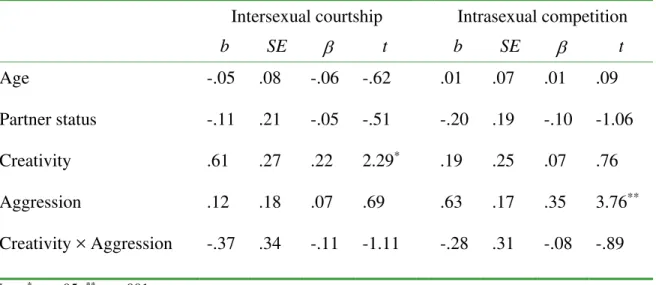
We conducted multiple regression analyses using each of the two mating strategies as a dependent variable and using, by simultaneous entry, age, partner status, and creative and aggressive personality as predictors. To exclude the possible effect of an interaction between creativity and aggression, we generated an interaction term by multiplying the standardized aggression and creativity scores and entering the interaction variable in the regression. Table 1 lists the results of these analyses.
Table 1. Regression of intersexual courtship and intrasexual competition on creativity and aggression
Intersexual courtship Intrasexual competition
b SE t b SE t
Age -.05 .08 -.06 -.62 .01 .07 .01 .09
Partner status -.11 .21 -.05 -.51 -.20 .19 -.10 -1.06
Creativity .61 .27 .22 2.29* .19 .25 .07 .76
Aggression .12 .18 .07 .69 .63 .17 .35 3.76**
Creativity × Aggression -.37 .34 -.11 -1.11 -.28 .31 -.08 -.89
Note.*p < .05; **p < .001
as personality traits may also have been shaped by sexual selection in response to intersexual and intrasexual competitions. Finally, the correlation between intersexual courtship and intrasexual competition was .21. Like other weapon-like and ornament-like behaviors, these mating strategies or styles are distinct, but they also show moderate overlapping, reflecting an overall mating motivation as well as the possibility that some ornaments may have been derived from weapons (Puts, 2010).
General Discussion
We tested the hypothesis that men respond to intersexual and intrasexual selection by performing weapon-like and ornament-like behaviors, respectively. This facultative response of men contrasts with other male animals that specialize either in weapons or ornaments as nearly exclusive mating strategies. The findings obtained by manipulating the modes of sexual selection in Studies 1 and 2 yielded converging support for the prediction that men would respond to intrasexual selection with elevated aggression and to intersexual selection with enhanced creativity. During the simulated dating games, male aggression, but not creativity, was elevated when the right to date a mate was decided by other male suitors. By contrast, an elevated level of creativity, but not aggression, was exhibited when the female dating targets chose a suitor. Thus, men facultatively employ weapons or ornaments as a mating strategy based on situational demands. Similarly, we showed in Study 3 that individual differences in creativity and aggression as personality traits were also associated with men’s mating strategies. Based on the mating strategy questionnaire, aggression significantly predicted a preference for intrasexual mating strategies and creativity significantly predicted a preference for intersexual mating strategies. These findings suggest that intersexual and intrasexual selection pressure over time may select some men to specialize in one reproductive strategy slightly more compared to other men, adding to the vast personality and individual differences along a weapon-ornament dimension.
Although some of these findings seem self-evident within the framework of sexual selection theory, this research is among the first to empirically manipulate both intersexual and intrasexual selection conditions to study the corresponding weapon-like and ornament-like behaviors. The findings confirm the power of sexual selection, which has shaped most animal species, including currently monogamous species such as human beings, after millions of years of intrasexual and intersexual competition. Because of a large brain and parental investment, monogamous human males do not show the same level of biological intensity in building and using weapons or ornaments compared with certain polygynous male animals. However, humans compensate for a lack of biological enhancements with extended phenotypes. Weapons and ornaments are extended throughout human culture in wars and the military (Chang et al., 2011) and in art, music, and literature (Miller, 2000). Employing these culturally extended weapons and ornaments is also facultative. Men’s artistic creativity was shown to increase when performing for women compared with men (Griskevicius, Cialdini, et al., 2006). Preindustrial tribesmen fought wars to compete for women (Manson and Wrangham, 1991), and such competitions continued within the contemporary military (Nikolić-Ristanović, 2000). Culturally extended weapons and ornaments are also widely depicted in literary works and are often embodied in the lives of their writers. A fitting example is the 19th century Russian poet, Pushkin, who wrote
of women. More often, however, are warriors and poets “played out” by disparate men, representing personality differences in using weapons and ornaments. Large human brains enable humans to amass and culturally extend a substantial repertoire of survival and reproductive strategies, including weapons and ornaments. Thus, humans are facultative and flexible, using various strategies to solve specific survival and reproductive challenges, and displaying substantial personality and individual differences when selecting relevant strategies.
Several limitations affected the present study. First, the developed mating strategy questionnaire used in Study 3 lacked sufficient evidence of validity. We conducted focus groups to determine items for inclusion and conducted a factor analysis to confirm that these items conformed to the expected two-factor structure. However, the questionnaire was not correlated with other constructs to provide external, rather than merely internal, evidence of construct validity. Second, we used a between-subjects design to manipulate the intrasexual and intersexual selection conditions among two groups of men. Future studies should use a within-subjects design to examine how a single group of male participants facultatively switches between weapons and ornaments. Third, we used aggression and creativity to represent weapon-like and ornament-like behaviors. Because our aggression task involved blasting white noise against a same-gender opponent, using such a task as the dependent variable could introduce an additional intrasexual competition component that was not counterbalanced by an additional intersexual component with the creativity task. Future research could use other weapon-like variables that do not directly involve intrasexual competition.
showed that, similar to other male animals, men both show off using conspicuous social ornaments (e.g., creativity) to appeal to potential mates, and arm themselves using aggression to compete with male suitors.
Received 23 November 2014; Final Revision Submitted 31 January 2015; Accepted 02 February 2015
References
Andersson, M. B. (1994). Sexual selection. Princeton, NJ: Princeton University Press. Archer, J. (2009). Does sexual selection explain human sex differences in aggression?
Behavioral and Brain Sciences, 32, 249–266.
Baker, M. D., and Maner, J. K. (2008). Risk-taking as a situationally sensitive male mating strategy. Evolution and Human Behavior, 29, 391–395.
Baker, M. D., and Maner, J. K. (2009). Male risk-taking as a context-sensitive signaling device. Journal of Experimental Social Psychology, 45, 1136–1139.
Berglund, A., Bisazza, A., and Pilastro, A. (1996). Armaments and ornaments: An
evolutionary explanation of traits of dual utility. Biological Journal of the Linnean Society, 58, 385–399.
Bushman, B. J. (2002). Does venting anger feed or extinguish the flame? Catharsis, rumination, distraction, anger, and aggressive responding. Personality and Social Psychology Bulletin, 28, 724–731.
Bushman, B. J., and Baumeister, R. F. (1998). Threatened egotism, narcissism, self-esteem, and direct and displaced aggression: Does self-love or self-hate lead to violence?
Journal of Personality and Social Psychology, 75, 219–229.
Buss, A. H., and Perry, M. (1992). The aggression questionnaire. Journal of Personality and Social Psychology, 63, 452-459.
Buss, D. M. (1989). Sex differences in human mate preferences: Evolutionary hypotheses tested in 37 cultures. Behavioral and Brain Sciences, 12, 1–14.
Carnevale, P. J., and Probst, T. M. (1998). Social values and social conflict in creative problem solving and categorization. Journal of Personality and Social Psychology, 74, 1300–1309.
Chagnon, N. A. (1988). Life histories, blood revenge, and warfare in a tribal population.
Science, 239, 985–992.
Chang, L., Lu, H. J., Li, H., and Li, T. (2011). The face that launched a thousand ships: The mating-warring association in men. Personality and Social Psychology Bulletin, 37, 976–984.
Daly, M., and Wilson, M. (1988). Homicide. New York: Aldine.
Darwin, C. (1859). The origin of species. London: John Murray.
De Dreu, C. K. W., and Nijstad, B. A. (2008). Mental set and creative thought in social conflict: Threat rigidity versus motivated focus. Journal of Personality and Social Psychology, 95, 648–661.
Fisher, R. A. (1930). The genetical theory of natural selection. Oxford: Clarendon Press. Förster, J., Epstude, K., and Özelsel, A. (2009). Why love has wings and sex has not: How
reminders of love and sex influence creative and analytic thinking. Personality and Social Psychology Bulletin, 35, 1479–1491.
Förster, J., Friedman, R. S., and Liberman, N. (2004). Temporal construal effects on abstract and concrete thinking: Consequences for insight and creative cognition. Journal of Personality and Social Psychology, 87, 177–189.
Frankenhuis, W. E., Dotsch, R., Karremans, J. C., and Wigboldus, D. H. J. (2010). Male physical risk taking in a virtual environment. Journal of Evolutionary Psychology, 8,
75–86.
Friedman, R. S., and Forster, J. (2000). The effects of approach and avoidance motor actions on the elements of creative insight. Journal of Personality and Social Psychology, 79, 477–492.
Gasper, K., and Middlewood, B. L. (2014). Approaching novel thoughts: Understanding why elation and boredom promote associative thought more than distress and relaxation.
Journal of Experimental Social Psychology, 52, 50–57.
Gough, H. G. (1979). A creative personality scale for the adjective check list. Journal of Personality and Social Psychology, 37, 1398–1405.
Greengross, G., and Miller, G. F. (2011). Humor ability reveals intelligence, predicts mating success, and is higher in males. Intelligence, 39, 188–192.
Griskevicius, V., Cialdini, R. B., and Kenrick, D. T. (2006). Peacocks, Picasso, and parental investment: The effects of romantic motives on creativity. Journal of Personality and Social Psychology, 91, 63–76.
Griskevicius, V., Goldstein, N. J., Mortensen, C. R., Cialdini, R. B., and Kenrick, D. T. (2006). Going along versus going alone: When fundamental motives facilitate strategic (non) conformity. Journal of Personality and Social Psychology, 91, 281–
294.
Griskevicius, V., Tybur, J. M., Gangestad, S. W., Perea, E. F., Shapiro, J. R., and Kenrick, D. T. (2009). Aggress to impress: Hostility as an evolved context-dependent strategy.
Journal of Personality and Social Psychology, 96, 980–994.
Griskevicius, V., Tybur, J. M., Sundie, J. M., Cialdini, R. B., Miller, G. F., and Kenrick, D. T. (2007). Blatant benevolence and conspicuous consumption: When romantic motives elicit strategic costly signals. Journal of Personality and Social Psychology, 93, 85–102.
Haselton, M. G., and Miller, G. (2006). Women’s fertility across the cycle increases the short-term attractiveness of creative intelligence. Human Nature, 17, 50–73.
Henrich, J., Heine, S. J., and Norenzayan, A. (2010). The weirdest people in the world?
Behavioral and Brain Sciences, 33, 61–83.
Hodges-Simeon, C., Gaulin, S., and Puts, D. (2011). Voice correlates of mating success in men: Examining “contests” versus “mate choice” modes of sexual selection. Archives of Sexual Behavior, 40, 551–557.
Iredale, W., Van Vugt, M., and Dunbar, R. (2008). Showing off in humans: Male generosity as a mating signal. Evolutionary Psychology, 6, 386–392.
Kirkpatrick, L. A., Waugh, C. E., Valencia, A., and Webster, G. D. (2002). The functional domain specificity of self-esteem and the differential prediction of aggression.
Journal of Personality and Social Psychology, 82, 756–767.
Lassek, W. D., and Gaulin, S. J. (2009). Costs and benefits of fat-free muscle mass in men: Relationship to mating success, dietary requirements, and native immunity. Evolution and Human Behavior, 30, 322–328.
Li, N. P., Griskevicius, V., Durante, K. M., Jonason, P. K., Pasisz, D. J., and Aumer, K. (2009). An evolutionary perspective on humor: Sexual selection or interest indication? Personality and Social Psychology Bulletin, 35, 923–936.
Li, N. P., Valentine, K. A., and Patel, L. (2011). Mate preferences in the US and Singapore: A cross-cultural test of the mate preference priority model. Personality and Individual Differences, 50, 291–294.
Li, N. P., Yong, J. C., Tov, W., Sng, O., Fletcher, G. J., Valentine, K. A., . . . Balliet, D. (2013). Mate preferences do predict attraction and choices in the early stages of mate selection. Journal of Personality and Social Psychology, 105, 757–776.
Li, Y. J., Kenrick, D. T., Griskevicius, V., and Neuberg, S. L. (2012). Economic decision biases and fundamental motivations: How mating and self-protection motives alter loss aversions. Journal of Personality and Social Psychology, 102, 550–561.
Low, B. S. (2005). Women’s lives there, here, then, now: A review of women’s ecological and demographic constraints cross-culturally. Evolution and Human Behavior, 26, 64–87.
Lu, H. J., and Chang, L. (2012). Automatic attention towards face or body as a function of mating motivation. Evolutionary Psychology, 10, 120–135.
Lu, H. J., Zhu, X., and Chang, L. (in press). Good genes, good providers, and good fathers: Economic development involved in how women select a mate. Evolutionary Behavioral Sciences.
Manson, J. H., and Wrangham, R. W. (1991). Intergroup aggression in chimpanzees and humans. Current Anthropology, 32, 369–390.
Marlowe, F. (2004). Mate preferences among Hadza hunter-gatherers. Human Nature, 15,
365–376.
Miller, G. F. (2000). The mating mind: How sexual choice shaped the evolution of human nature. New York: Doubleday.
Miron-Spektor, E., Gino, F., and Argote, L. (2011). Paradoxical frames and creative sparks: Enhancing individual creativity through conflict and integration. Organizational Behavior and Human Decision Processes, 116, 229–240.
Murray, N., Sujan, H., Hirt, E. R., and Sujan, M. (1990). The influence of mood on categorization: A cognitive flexibility interpretation. Journal of Personality and Social Psychology, 59, 411–425.
Mussweiler, T., and Forster, J. (2000). The sex-->aggression link: A perception-behavior dissociation. Journal of Personality and Social Psychology, 79, 507–520.
Nijstad, B. A., De Dreu, C. K. W., Rietzschel, E. F., and Baas, M. (2010). The dual pathway to creativity model: Creative ideation as a function of flexibility and persistence.
European Review of Social Psychology, 21, 34–77.
Pawlowski, B., Atwal, R., and Dunbar, R. I. M. (2008). Sex differences in everyday risk-taking behavior in humans. Evolutionary Psychology, 6, 29–42.
Puts, D. A. (2010). Beauty and the beast: Mechanisms of sexual selection in humans.
Evolution and Human Behavior, 31, 157–175.
Puts, D. A., Doll, L. M., and Hill, A. K. (2014). Sexual selection on human voices. In V. A. Weekes-Shackelford and T. K. Shackelford (Eds.), Evolutionary perspectives on human sexual psychology and behavior (pp. 69–86). New York: Springer.
Puts, D. A., Gaulin, S. J. C., and Verdolini, K. (2006). Dominance and the evolution of sexual dimorphism in human voice pitch. Evolution and Human Behavior, 27, 283–296.
Ronay, R., and von Hippel, W. (2010). The presence of an attractive woman elevates testosterone and physical risk taking in young men. Social Psychological and Personality Science, 1, 57–64.
Silvia, P. J., Wigert, B., Reiter-Palmon, R., and Kaufman, J. C. (2012). Assessing creativity with self-report scales: A review and empirical evaluation. Psychology of Aesthetics, Creativity, and the Arts, 6, 19–34.
Sundie, J. M., Kenrick, D. T., Griskevicius, V., Tybur, J. M., Vohs, K. D., and Beal, D. J. (2011). Peacocks, Porsches, and Thorstein Veblen: Conspicuous consumption as a sexual signaling system. Journal of Personality and Social Psychology, 100, 664–
680.
Terrell, H. K., Patock-Peckham, J. A., and Nagoshi, C. T. (2009). Effects of sex, status, and mating cues on expected aggressive responses. Aggressive Behavior, 35, 259–273.
Tooby, J., and Cosmides, L. (1990). On the universality of human nature and the uniqueness of the individual: The role of genetics and adaptation. Journal of Personality, 58, 17–
67.
Trivers, R. L. (1972). Parental investment and sexual selection. In B. Campbell (Ed.), Sexual selection and the descent of man (pp. 136–179). New York: Aldine de Gruyter.
Twenge, J. M., Baumeister, R. F., Tice, D. M., and Stucke, T. S. (2001). If you can’t join them, beat them: Effects of social exclusion on aggressive behavior. Journal of Personality and Social Psychology, 81, 1058–1069.
Appendix A
Table A1.English translation of the Men’s Mating Strategy Scale
Factor Loadings
Intersexual courtship
1 I would do everything to attract the girl I like. .16 .56
2 I would put on good behavior in front of her. .01 .65
3 I would talk to her more. .26 .64
4 I would make her to show interest in me. -.21 .63
5 I would work hard to accommodate her. .33 .61
6 I would show her how good I am. -.20 .80
7 I would work hard to show her that I am worth her love. -.28 .76
8 I would do what she likes. .02 .75
9 I would learn to play music instruments for her. .07 .61
10 I would try every means to make her like me. .19 .76
11 I would learn special skills to attract her. .22 .66
12 I would appeal to her. -.14 .80
Intrasexual competition
1 I would compete with other guys for the girl I like. .60 .16
2 I would tease other guys’ physical appearance in front of her. .74 -.23
3 I would tell her that other guys are dumb. .71 -.28
4 I would fight anyone who covets the girl I like. .67 .09
5 I would badmouth other guys interested in her. .76 -.17
6 I would challenge anyone who shows an interest in the girl I like. .75 .03
7 I would retaliate if anyone tries to steal her. .65 .17
8 I would threaten anyone who dares to think about her. .80 .08
9 I would prevent other men from getting too close to her. .71 .20
10 I would not let her talk to other guys. .75 .23
11 I would show her off with my friends. .63 .20
12 I would humiliate other guys in front of her. .83 -.06
13 I would make sure I am respected by other guys in front her. .77 -.17