Fatigue among nursing undergraduate
students
*FADIGA ENTRE ESTUDANTES DE GRADUAÇÃO EM ENFERMAGEM
LA FATIGA ENTRE LOS ESTUDIANTES DE ENFERMERÍA
O
RIGINAL
A
R
TICLE
RESUMO
A fadiga entre os estudantes pode prejudi-car a aprendizagem. Avaliou-se a fadiga de graduandos de enfermagem e as relações com o ano de graduação, a participação em atividades extracurriculares, com quem o aluno reside, com a depressão e o índice de massa corporal (IMC). Participaram 189 (60,2%) estudantes da EEUSP, sendo 96,2% de mulheres com idade média de 21,6 anos, 80,9% residiam com os pais, 43,9% realiza-vam atividades extracurriculares, 24,8% ti-nham IMC alterado e 22,2% apresentaram disforia ou depressão (Inventário de De-pressão de Beck). A fadiga foi moderada/ intensa para 83,5% dos estudantes (Escala de Fadiga de Piper Revisada e Pictograma de Fadiga) e 59,8% relataram prejuízo mo-derado/intenso nas atividades habituais. A fadiga apresentou correlação positiva com ano de graduação, com o IMC e a depres-são (p<0,001). A atividade acadêmica foi a principal causa de fadiga, enquanto o sono e o lazer foram as estratégias mais utiliza-das para seu manejo. A fadiga foi significa-tiva e intensa, todavia observou-se descom-passo entre freqüência, magnitude e impac-to da fadiga nas atividades da vida diária.
DESCRITORES
Fadiga.
Estudantes de enfermagem. Aprendizagem.
Atividades cotidianas.
Camila de Moraes Amaducci1, Dálete Delalibera Faria de Correa Mota2, Cibele Andrucioli de Mattos Pimenta3
ABSTRACT
Fatigue among students may harm their learning. This study evaluated the fatigue of nursing undergraduate students and its re-lations to their graduation year, participation in extracurricular activities, people with whom they lived, depression and their body mass index (BMI)). The study had the par-ticipation of 189 (60.2%) students from the EEUSP, from which 96.2% were women with the average age of 21.6 years old, 80.9% lived with their parents, 43.9% performed extra-curricular activities, 24.8% had varied BMI and 22.2% presented dysphoria or depres-sion (Beck Depresdepres-sion Inventory). Fatigue was moderate/intense for 83.5% of the stu-dents (Piper Fatigue Scale - Revised and Fa-tigue Pictogram) and 59.8% reported mod-erate/intense impairment in their habitual activities. Fatigue presented a positive cor-relation to the graduation year, to the BMI and to depression (p<0.001). The academic activity was the main cause of fatigue, whereas sleep and leisure were the most frequent strategies to handle it. Fatigue was significant and intense, but there was an irregularity between its frequency, magni-tude and impact in the daily life activities.
KEY WORDS
Fatigue.
Students, nursing. Learning.
Activities of daily living.
RESUMEN
La fatiga en los estudiantes puede ser perju-dicial para el aprendizaje. Se evaluó la fatiga en estudiantes de enfermería y sus relacio-nes con el año de estudio, participación en actividades extracurriculares, personas con las que el alumno reside, depresión e índice de masa corporal (IMC). Participaron 189 (60,2%) estudiantes de la EEUSP; 96,2% mujeres, edad media de 21,6 años, 80,9% residía con sus padres, 43,9% realizaba acti-vidades extracurriculares, 24,8% exhibía al-teraciones en su IMC y 22,2% presentaban disforia o depresión (Inventario de Depre-sión de Beck). La fatiga fue moderada/inten-sa para el 83,5% de los estudiantes (Escala de Fatiga de Piper Revisada y Pictograma de Fatiga), y 59,8% refirieron perjuicio mode-rado/intenso en las actividades habituales. La fatiga presentó correlación positiva con el año de estudio, con el IMC y con la depre-sión (p < 0,001). La actividad académica fue la principal causa de fatiga, sueño y recrea-ción fueron las estrategias más utilizadas en su control. La fatiga fue significativa e intsa, aunque se observaron divergencias en-tre frecuencia, magnitud e impacto de la fa-tiga en las actividades de la vida diaria.
DESCRIPTORES
Fatiga.
Estudiantes de enfermería. Aprendizaje.
INTRODUCTION
Fatigue is a universal phenomenon experienced by both healthy and sick people. Despite differences in definitions of fatigue, a consensus exists that it is a subjective, multifacto-rial and multidimensional phenomenon. It is considered an
unpleasant physical sensation, with cognitive and emotional components, described as tiredness that is not relieved with common strategies to restore energy. Its duration and intensity vary and it reduces, to different extents, the ability to perform usual activities(1).
This definition covers the three relevant aspects of the fatigue concept: the verbalization of tiredness or exhaus-tion, decreased ability to perform habitual activities and lack of relief for these manifestations obtained by common strategies to restore energy.
Fatigue prevalence varies according to the popula-tion group. Studies of fatigue in healthy people are in-cipient. In an epidemiological study in Norway, 11.4% of people showed considerable fatigue(2). This percentage is high, considering that fatigue interferes
in people’s ability to perform normal activi-ties. In a Brazilian research involving work-ers at a printing company, prevalence lev-els were 37.5% for severe and 7% for chronic fatigue, and higher among women in both cases(3).
Data on prevalence, impact and fatigue-related factors among healthy people can contribute to comparisons with sick popu-lations and distinctions between preventive and curative actions. There are signs that fatigue in healthy people may be closely as-sociated with emotional state, while fatigue
in people with somatic diseases is a symptom more re-lated with organic causes and a strong predictor of physi-cal impairment(4).
Despite the small number of studies involving college students, particularly in nursing, some suggest that fa-tigue may exist and that, in this population, it can limit the learning process, impair professional education and quality of life. A study on stress in nursing students ob-served symptoms of mental stress, sleep disorders and other physically expressed symptoms(5). A preliminary study on moral abuse among nursing students observed that a large part (76.8%) complained of excessive tired-ness(6). And a study of nursing students at a private col-lege showed that colcol-lege experiences can promote good quality of life or not(7).
A study among medical students found that 27.8% of the sample presented mild to moderate depression symp-toms, 10.7% moderate to severe and 2.1% severe(8). This
finding, associated with countless studies that indicate the relation between fatigue and depression, aroused the re-searchers’ interest to assess depression among nursing students.
Depression affects about 6% of the general population and is twice as frequent in women. Fifty percent of patients are between 20 and 50 years of age (mean 40 years) and, generally, it occurs among people without intimate personal relations, divorced or separated(9).
Besides depression, different mood disorders and other factors can cause or aggravate fatigue. Doing too much ac-tivity or for too long can produce both physical and mental exhaustion. It is known that many undergraduate nursing courses, like at the School of Nursing at the University of São Paulo, are full-time and demand the students’ dedica-tion to different course subjects, generating physical and psychological exhaustion. In addition, many of these stu-dents are involved in extracurricular activities, demanding extra efforts, or live alone, which implies the obligation of housekeeping.
To identify the presence of fatigue and its impact, an assessment is needed that comprises the symptom’s different dimen-sions. Various multidimensional and self-re-port fatigue instruments exist, which is an important characteristic in the assessment of subjective phenomena. Among these, the Revised - Piper Fatigue Scale stands out, which is easy to understand and used in dif-ferent population groups, in various coun-tries, permitting result comparisons. An-other interesting instrument is the Fatigue Pictogram, which assesses fatigue intensity and its impact on the ability to perform usual activities by choosing illustrations with subtitles. Both the Revised - Piper Fatigue Scale and the Fatigue Pictogram were used in this study. The validity and reliability of these instruments have been analyzed for healthy and ill Brazil-ian subjects(10-11).
In view of the small number of studies on fatigue in a healthy and young population, the researchers decided to analyze fatigue among nursing students and explore the relations between fatigue and sociodemographic, physical and emotional variables.
OBJECTIVES
•
Quantify and qualify fatigue among undergraduate nursing students at EEUSP;•
Analyze the relation between fatigue and gender, age, whom the student lives with, engagement in extracurricu-lar activity, BMI and depression.Despite the small number of studies involving college students, particularly in nursing, some suggest that fatigue may exist
METHOD
A cross-sectional, descriptive and exploratory research was undertaken. The population included students enrolled in the Undergraduate Nursing Program at the University of São Paulo. Data were collected in the first semester of 2006. After being informed on the research goals, students who agreed to participate signed two copies of the Informed Consent Term. Among all enrolled students (N=314), 189 (60.2%) answered the instruments. Losses referred to re-fusal to participate (n=18, 5.7%), absence from the class-room on the day of data collection (n=105, 33.4%) and the two students (0.6%) who collected the data.
Approval for the study was obtained from the Research Ethics Committee at the University of São Paulo School of Nursing (process No 21/2005/CPq/EEUSP).
Data were collected in class during the morning period. The group of participants received information on the study goals and doubts were clarified. The following instruments were used: Identification Form, the Revised - Piper Fatigue Scale(10), the Fatigue Pictogram(11) and the Beck Depression Inventory(12).
The dependent variable was fatigue and independent variables were gender, age, whom the student lives with, engagement in extracurricular activities, weight and height. These data were used to characterize the population and analyze their correlations with the fatigue variable.
The presence and intensity of the nursing students’ fa-tigue was analyzed through the Revised - Piper Fafa-tigue Scale and the Fatigue Pictogram.
The Revised - Piper Fatigue Scale is a multidimensional, self-report instrument, comprising 22 items, ranging from 0 to 10, which assess the following fatigue dimensions: be-havioral/intensity (6 items), cognitive/mood (6 items), af-fective (5 items) and sensory (5 items). Both a total score (0 to 10) and scores per domain (0 to 10) can be obtained. Higher scores indicate greater fatigue. The psychometric properties of the Piper Fatigue Scale were tested for the present study population(10). The reliability of the scale di-mensions, assessed through Cronbach’s alpha, ranged be-tween 0.86 and 0.88. Factorial analysis confirmed the four instrument dimensions and the items’ factors loaded be-tween 0.558 and 0.900. Besides these items, the scale con-tains four open-ended questions, not used to calculate the
scale score, so that respondents can provide further infor-mation on their fatigue experience.
The Fatigue Pictogram is a self-report instrument with two items that assess fatigue intensity and its impact on the development of activities. Each item is assessed through subtitled illustrations. Psychometric property tests in Bra-zilian individuals showed adequate stability (p<0.001) for this instrument and ability to distinguish between fatigued and healthy individuals(11).
The Beck Depression Inventory, validated for Portu-guese(12), comprises 21 items, with assertions ranging from 0 to 3. Total scores vary between 0 and 63 and the follow-ing cut scores are adopted for population without a previ-ous depression diagnosis: scores between 0 and 15, absence of depression; between 16 and 20, dysphoria, and above 20, compatible with depressive symptoms.
Data were organized in Microsoft Excel® worksheets and described as absolute and relative frequencies, mean, me-dian, standard deviations and variances. Spearman’s cor-relation test using the SPSS version 13.0 were performed to analyze relations between fatigue and depression, whom the student lives with, development of extracurricular ac-tivities, undergraduate course year and BMI.
RESULTS
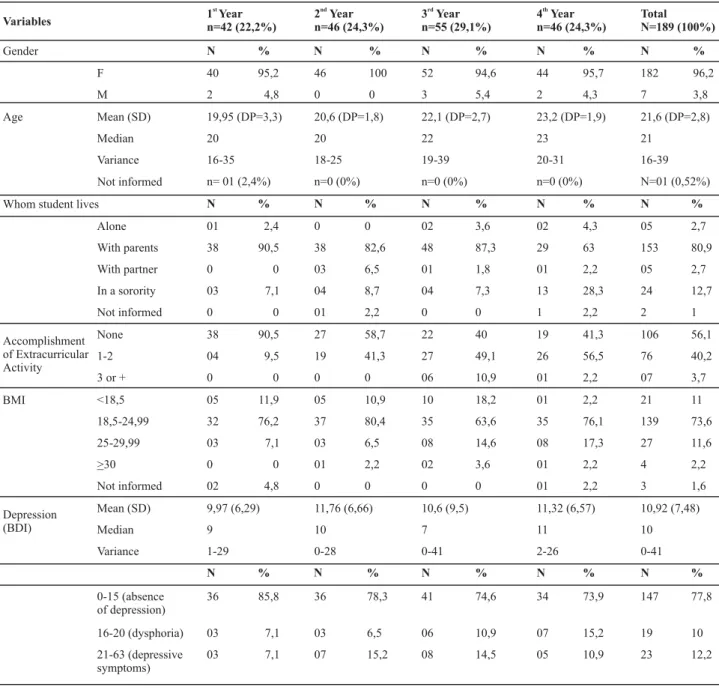
Table 1 summarizes data on gender, age, whom the student lives with, development of extracurricular activ-ity, BMI and depression according to undergraduate course year.
Most students were female and lived with their par-ents; the mean age was 21.6 years (SD=2.8), about 13% performed extracurricular activities, 11% were overweight and about 20% showed BDI scores indicating dysphoria or depression. Fatigue scores are presented in Tables 2 and 3.
Among the students, 158 (83.5%) referred feeling be-tween moderately and extremely tired and 113 (59.8%) referred that the fatigue caused moderate to severe im-pairment.
Table 1 - Characterization of nursing students, in total and per undergraduate course year - São Paulo - 2006
1 Yearst n=42 (22,2%)
2 Yearnd
n=46 (24,3%)
3 Yearrd
n=55 (29,1%)
4 Yearth
n=46 (24,3%)
Total N=189 (100%)
N % N % N % N % N %
F 40 95,2 46 100 52 94,6 44 95,7 182 96,2
Gender
M 2 4,8 0 0 3 5,4 2 4,3 7 3,8
Mean (SD) 19,95 (DP=3,3) 20,6 (DP=1,8) 22,1 (DP=2,7) 23,2 (DP=1,9) 21,6 (DP=2,8)
Median 20 20 22 23 21
Variance 16-35 18-25 19-39 20-31 16-39
Age
Not informed n= 01 (2,4%) n=0 (0%) n=0 (0%) n=0 (0%) N=01 (0,52%)
N % N % N % N % N %
Alone 01 2,4 0 0 02 3,6 02 4,3 05 2,7
With parents 38 90,5 38 82,6 48 87,3 29 63 153 80,9
With partner 0 0 03 6,5 01 1,8 01 2,2 05 2,7
In a sorority 03 7,1 04 8,7 04 7,3 13 28,3 24 12,7
Whom student lives
Not informed 0 0 01 2,2 0 0 1 2,2 2 1
None 38 90,5 27 58,7 22 40 19 41,3 106 56,1
1-2 04 9,5 19 41,3 27 49,1 26 56,5 76 40,2
Accomplishment of Extracurricular Activity
3 or + 0 0 0 0 06 10,9 01 2,2 07 3,7
<18,5 05 11,9 05 10,9 10 18,2 01 2,2 21 11
18,5-24,99 32 76,2 37 80,4 35 63,6 35 76,1 139 73,6
25-29,99 03 7,1 03 6,5 08 14,6 08 17,3 27 11,6
>30 0 0 01 2,2 02 3,6 01 2,2 4 2,2
BMI
Not informed 02 4,8 0 0 0 0 01 2,2 3 1,6
Mean (SD) 9,97 (6,29) 11,76 (6,66) 10,6 (9,5) 11,32 (6,57) 10,92 (7,48)
Median 9 10 7 11 10
Depression (BDI)
Variance 1-29 0-28 0-41 2-26 0-41
N % N % N % N % N %
0-15 (absence of depression)
36 85,8 36 78,3 41 74,6 34 73,9 147 77,8
16-20 (dysphoria) 03 7,1 03 6,5 06 10,9 07 15,2 19 10
21-63 (depressive symptoms)
03 7,1 07 15,2 08 14,5 05 10,9 23 12,2
Variables
Table 2 - Fatigue Pictogram - São Paulo - 2006
Tiredness Intensity N % Impact of tiredness on activities N %
Nothing 2 1.1 I do everything 11 5.8
A little 29 15.3 I do almost everything 65 34.4
Moderate 84 44.4 I do something 65 34.4
Very 60 31.7 I do only what I have to 43 22.8
Extremely 14 7.4 I do very little 5 2.6
Table 3 - Piper Fatigue Scale scores per undergraduate course year - São Paulo - 2006
Year 1st
2nd
3rd
4th
Total
Mean 4.5 4.9 4.7 5.1 4.8
Median 4.8 5 4.2 5.3 5
SD 1.9 2 2.3 2.1 2.1
Behavioral Domain
Variation 0-7.8 0-8.3 0.7-9.2 0-8.8 0-9.2
Mean 4.8 5.4 5.3 5.5 5.2
Median 4.8 5.4 5.2 5.4 5.4
SD 1.9 1.9 2.3 2.1 2
Affective Domain
Variation 0-8.2 0-9.2 0-9.2 0-.94 0-9.4
Mean 5.2 5.1 5.2 5.3 5.2
Median 5.4 5.2 5.6 5.4 5.4
SD 1.7 1.7 2.6 2.1 2
Sensory Domain
Variation 0-8.8 0-8.2 0.4-9.4 0-9.8 0-9.8
Mean 4.9 5 5.2 5.5 5.1
Median 4.7 5 5.2 5.8 5.2
SD 1.8 1.6 2.4 2.2 2
Cognitive Domain/ Mood
Variation 0-9.2 0-8 0.3-9.3 0-9.7 0-9.7
Median 4.8 5.1 5.1 5.3 5.1
Median 4.8 5.3 5.1 5.6 5.3
SD 1.5 1.5 2.2 1.9 1.8
Total Score
Variation 0-7.9 0-7.7 0.8-9 0-8.2 0-9
For 44.4% of the students, the main cause of fatigue is related to the characteristics of the nursing course, such as the great study load, excessive number of disciplines, papers, tests, and tiresome and long classes. In addition, 31.2% of the students mentioned daily activity overload and lack of time to perform them. Other causes of fatigue were: sleep disorders (26.4%); distance between home and college and public transport conditions (22.2%); emotional burden
(19.6%); health or financial problems, inadequate diet, physi-cal effort, lack of physiphysi-cal activity and sleeping too much (9%); lack of leisure and relaxation (6.3%); extracurricular activi-ties or activiactivi-ties not related with professional education (5.8%); family problems or conflicting interpersonal relation-ship (5.3%) and change in routine (2.6%). Some answers (5.3%) could not be categorized. The mean number of an-swers per student was approximately 1.8 and only one stu-dent did not answer the question on the cause of fatigue.
Regarding fatigue management, the strategies the stu-dents most used were sleep with quality (64.5%) and lei-sure (63.5%). Other mealei-sures mentioned to relieve the state of fatigue were resting or relaxing (14.3%); sports (7.4%); taking a shower (3.2%), and others such as religious prac-tices, cleaning one’s room, not studying, solving problems and decreasing worries, not losing class, using medication, contact with nature and massage (7.9%). One answer ap-pointed that the adopted strategy depends on the irritabil-ity level (0.5%). The mean number of answers per student was 1.6, and only one student did not give an opinion.
Fatigue showed a positive and statistically significant correlation with the variables course year, BMI and depres-sion, but the correlation was good with depression only (Table 4). These data indicate that the first year was de-scribed as less tiresome than the others and that a higher BMI and a higher depression score were correlated with more severe fatigue. Fatigue also showed a weak negative correlation with age and gender (men reported feeling more fatigue than women and younger students presented higher scores of fatigue). No significant correlation was found be-tween fatigue and extracurricular activity and bebe-tween fa-tigue and whom the student lived with (Table 4).
Table 4 - Correlation and significance between fatigue and sociodemographic variables, BMI and mood - São Paulo - 2006
Age Gender Course
year
Extracurricular activity
Whom student
lives with BMI Depression
Correlation (r) -0.043 -0.148 0.137 0.009 0.009 0.128 0.612
P-value 0.006 0.000 0.000 0.588 0.574 0.000 0.000
DISCUSSION
Data on the nursing students’ characteristics confirmed the expected profile of students in this undergraduate course. Female students prevailed, in line with the profession’s historical characteristics. Groups from differ-ent course years were homogeneous in terms of gender, age, whom they lived with, BMI and presence of depres-sion symptoms.
Deviations from normal BMI should be highlighted. As shown in Table 1, 55 (24.8%) students showed inadequate weight (overweight, obesity or low weight). It should be reminded that, although it is an easy and fast method to
differences should be taken into account for a reliable dis-tinction of overweight, obese and low-weight individuals. Nevertheless, the percentage of non-normal measures was remarkable.
lei-the fatigue concept at lei-the start of each instrument can be useful for a better understanding of the concept.
Despite the high frequency of moderate or severe fatigue (83.5%), 59.8% of the students mentioned moderate or se-vere interference in usual activities (Table 2). This indicates that, for 23.7% of the students, moderate and severe fatigue did not correspond to a moderate and severe impact. This supports the hypothesis that the concepts of fatigue and tiredness are not clear, considering the fact that the students referred good coping with fatigue, performing the habitual activities, which is not observed in fatigued individuals.
The students referred components of fatigue in all di-mensions of the instrument, but it was slightly less referred in the behavioral dimension (Table 3). This difference is small. Nevertheless, it can be inferred that, for the students, the affective, sensory and cognitive-mood components of fatigue are more relevant than the behavioral component.
Forty-four percent of the students mentioned the char-acteristics of the nursing course as the primary factor to cause fatigue, given the psychic, physical and mental ex-haustion due to curricular activities. This finding matches various literature reports that indicate a highly stressful environment in nursing education(13). The second cause the students described was excess of activities, and the third was sleep disorders. It is known that activities, when exces-sive or carried out for a long period, can contribute to the emergence of fatigue. A study of home caregivers appointed that sleep interruption increased the perception of fatigue and culminated in physical disorders and reduced mental energy when compared with uninterrupted sleep(14). The characteristics of the nursing course, excess of activities and sleep problems, besides other causes of fatigue the stu-dents mentioned, should be included in future research as variables that can be related with fatigue.
Although the reported fatigue severity is a source of con-cern, its impact was not so strong in the students’ lives. It is possible that, in some way, the students managed to develop effective coping strategies, which minimized the impairment, or that they overestimated the intensity of the symptom. According to the students, the most used techniques to cope with fatigue were the achievement of quality sleep (64.5%) and leisure (63.5%). Sleep results in a feeling of re-established physical, psychic and intellectual energy(15).Hence, good sleep quality is important to minimize fatigue, as the students af-firmed. Other strategies, such as aerobic activities and danc-ing, can be performed as leisure activities and be effective to manage fatigue and mental exhaustion(16).
Fatigue showed a positive correlation with the under-graduate course year, BMI and depression.
Teachers and students’ reports confirmed greater fa-tigue in the fourth year, perhaps associated with the higher hour load of training periods (greater than in other course years) and with the stress related to the future employ-ment status. Greater anxiety occurs at the start of the
train-ing period and, over time, the students develop coptrain-ing strat-egies and adapt to the routine(13). Fatigue related to future employment status is possibly due to selection processes, which are exhausting and demand study. The stress caused by the uncertainty of passing/failing these processes should also be considered.
Obese individuals tend to express greater fatigue than skinnier people. A study revealed a strong correlation be-tween fatigue and obesity, mainly in the physical dimen-sion of the symptom, when the depresdimen-sion variable was controlled(17).
Data found in this study, in which 42 (22%) students presented scores that indicate dysphoria, are in agreement with literature data. It should be highlighted that, although undergraduate course year, BMI, age and gender showed a statistical correlation with fatigue, only the fatigue-depres-sion correlation was high (r= 0.612 and p=0.000), as shown in Table 4. The positive correlation found in this study be-tween fatigue and depression converges with international and Brazilian studies(17). Depression has been described associated with all dimensions of fatigue(18), as well as the high prevalence of reduced energy complaints (97%) and impact on the development of usual activities among de-pressed patients(9). The fact that fatigue and depression were correlated does not clarify a relation of causality, and cohort studies could better investigate this relation.
Despite the negative correlations between fatigue and gender, it should be highlighted that the correlation was very low (-0.148) and that the number of men in the study is small (Table 1). Yet, plenty of literature exists on greater fatigue among women(2-3).
Like the gender analysis, a similar analysis is possible for age: the correlation was very low (r=-0.043), the mean and median age were very close (mean= 21.6, SD=2.8, me-dian=21), indicating a homogeneous sample with small variation (16-39 years). Young people are going through a phase of self-knowledge regarding how to cope with new situations, including fatigue. Coping skills depend on expe-rience and maturity(19). In this manner, the older, the more mature the person will be and the stronger to deal with new events. In this case, one can say that mature adults would mention less fatigue due to more effective coping with the symptom. Confirming this hypothesis would de-mand a representative group of mature adults though, which was not possible in this research.
CONCLUSION
Moderate and severe fatigue was frequent among un-dergraduate nursing students. In 20% of cases, however, the intensity of the symptom was greater than its impact on activities of daily living. Fatigue and tiredness may have been considered synonymous, although they are not. Stud-ies that refine the difference between tiredness and fatigue concepts and their impact in the undergraduate students’
daily lives are needed. Fatigue showed a positive correla-tion with undergraduate course year, BMI and depressive symptoms, and a negative correlation with gender and age. Exhaustion due to the nursing course was the main cause of fatigue and adequate sleep and leisure activities the most important management strategies. Future studies are nec-essary to assess the relation between the causal factors of fatigue the students appointed and the efficacy of man-agement strategies.
REFERENCES
1. Mota DDCF, Pimenta CAM. Self-report instruments for fatigue assessment: a systematic review. Res Theory Nurs Pract. 2006;20(1):49-78.
2. Loge JH, Ekeberg Ø, Kaasa S. Fatigue in the general Norwergian population: nomative data and associations. J Psychosom Res. 1998;45(1):53-65.
3. Queiroz MFF. Compreendendo o conceito de fadiga: estudo de caso dos trabalhadores em uma gráfica [tese]. São Paulo: Fa-culdade de Saúde Pública, Universidade de São Paulo; 2003.
4. Kaasa S, Loge JH, Knobel H, JordhØy MS, Brenne E. Fatigue: measures and relation to pain. Acta Anaesthesiol Scand. 1999;43(9):939-47.
5. Farah OGD. Stress e coping no estudante de graduação em en-fermagem: investigação e atuação [tese]. São Paulo: Escola de Enfermagem, Universidade de São Paulo; 2001.
6. Correa ABM, Pimenta CAM. Abuso do estudante de enferma-gem: turma de 2004 [relatório de pesquisa]. São Paulo: Escola de Enfermagem, Universidade de São Paulo; 2004.
7. Oliveira RA, Ciampone MHT. Qualidade de vida de estudantes de enfermagem: a construção de um processo e intervenções. Rev Esc Enferm USP. 2008;42(1):57-65.
8. Morol A, Valle JB, Lima LP. Sintomas depressivos nos estudan-tes de medicina da Universidade da Região de Joinville (SC). Rev Bras Educ Med (Rio de Janeiro). 2005; 29(2):97-102.
9. Kaplan HI, Sadock BJ. Compendio de psiquiatria: ciências com-portamentais e psiquiatria clínica. 6ª ed. Porto Alegre: Artes Médicas; 1993. p. 386-407.
10. Mota DDCF, Pimenta CAM, Piper B. Fatigue in Brazilian cancer patients, caregivers, and nursing students: a psychometric validation study of the Piper Fatigue Scale-Revised. Support Care Cancer. 2009;17(6):645-52.
11. Mota DDCF, Pimenta CAM, Fitch M I. Fatigue Pictogram: an easy to use self-report instrument to assess fatigue in oncology clinical practice. In: Proceedings of the 20th International Symporium Supportive Care in Cancer; 2007; St. Gallen. Heidelberg: Springer-Verlag; 2007. v. 15, p. 708-9.
12. Gorentein C, Andrade L. Validation of a Portuguese version of the Beck Depression Inventory and the State-Trait Anxiety Inventory in Brazilian subjects. Braz J Med Biol Res. 1996;29(4):453-7.
13. Farah OGD. Ansiedade e prática no processo ensino-aprendi-zagem de habilidades psicomotoras: técnica de preparo de medicação parenteral [tese]. São Paulo: Escola de Enferma-gem, Universidade de São Paulo; 1996.
14. Tsukasaki K, Kido T, Makimoto K, Naganuma K, Ohno M,
Sunaga K. The impact of sleep interruptions on vital measure-ments and chronic fatigue of female caregivers providing home care in Japan. Nurs Health Sci. 2006;8(1):2-9.
15. Friedman DB. Distúrbios do sono I. In: Phipps WJ. Enferma-gem médico-cirúrgica: conceitos e prática clínica. 2ª ed. Lis-boa: Lusodidacta; 1995. p. 1827-43.
16. Kim S, Kim J. Mood after various brief exercise and sport modes: aerobics, hip-hop dancing, ice skating, and body conditioning. Percept Mot Skills. 2007;104(3 Pt 2):1265-70.
17. Santos J, Mota DDCF, Pimenta CAM. Co-morbidade fadiga e depressão em pacientes com câncer colo-retal. Rev Esc Enferm USP. 2009;43(4):909-14.
18. LimW, Hong S, Nelesen R, Dimsdale JE. The association of obesity, cytokine levels, and depressive symptoms with diverse measures of fatigue in healthy subjects. Arch Intern Med. 2005;165(8):910-5.