37
Structure and Functioning of Microbial Community of Mineral Springs in
Central Asia
Namsaraev B.B.
1, Barkhutova D.D.
1, Danilova E.V.
1, Dagurova O.P.
1,
Namsaraev Z.B.
2, Balzhiin Tsetseg
3, Ayush Oyuntsetseg
41Institute of General and Experimental Biology, Siberian Branch of the Russian Academy of Sciences,
Ulan-Ude, Russia e-mail: [email protected]
2Institute of Microbiology, Russian Academy of Sciences, Moscow, Russia 3Institute of Biology, Mongolian Academy of Sciences, Ulaanbaatar, Mongolia
4Faculty of Biology, National University of Mongolia, Ulaanbaatar 210646, Mongolia, e-mail: oyun_a@
num.edu.mn
Abstract
The microbial mats of different types of springs in Central Asia (Zabaikalye and Mongolia) are described. The species diversity of mat-formed phototrophic bacteria was determined. The rates of microbial destruction processes (sulfate reduction and methane formation) were measured. An important role of bacteria and algae in the formation of mineral water composition was shown.
Key words: bacterial processes, Central Asia, microbial mats, mineral springs
Introduction
Functional diversity of microbial communities depends on chemical composition of waters and rocks. The electrons acceptor contents, biogenous elements and other substances influence microbial diversity and microbial activity (Zavarzin, 1984). At the same time microorganisms play an active part in formation of qualitative and quantitative composition of natural waters, as a result of their high biochemical potential and large numbers. Aerobic and anaerobic, autotrophic and heterotrophic bacteria, fungi and algae take part in biogeochemical processes taking place in underground and surface waters. Microorganisms are the main catalysts of multistage processes of production, destruction and transformation of organic material, formation and consumption of gases and synthesis of secondary metabolites.
Geological history, geo-structural peculiarities of territory, chemical composition of rocks, geothermal and climatic conditions cause widespread mineral waters in Central Asia where various types of mineral spring have been determined. They are subdivided into nitrogen, carbonaceous and methane springs as well as hot, warm and cool groups (Tkachuk et al, 1962; Pinneker, 1980). Nitric springs form as a result of heat occurrence with infiltrated waters from 2-3
kilometers of the deep kainozoii breaks. The origin of carbonated mineral springs is connected with carbonate and silicate rocks in zones of young volcanic activity.
Hydro-chemical and microbiological research has been conducted in the mineral springs of Zabaikalye and Mongolia (Barkhutova et al., 1998; Abidueva et al., 1999; Barkhutova et al., 2003). The location of springs is shown in Fig. 1. Particular attention in this research has been paid to estimation of geo-chemical activity of microorganisms, to determination of physiological group numbers, and to the study of species diversity of bacteria and algae.
Methods
Fig. 1. Location scheme of studied mineral springs (Zabaikalye and Mongolia regions) 1 – Alla, 2 – Kuchiger, 3 - Bolshaya Rechka, 4 – Garga, 5 – Seiya, 6 – Uro, 7 – Umkhei, 8 – Bakhlaita, 9 – Khalyuta, 10 – Gegetui, 11 – Zmeyinaya, 12 - Sukhaya Zagza, 13 - Khoito Gol, 14 – Shumak, 15 - Gadan Gembe, 16 – Zhoigon, 17 – Suduntui, 18 – Alkhanai, 19 – Erdenet, 20 – Khuzhirta, 21 - Devsen Bulag
carbonates, sulfides and sulfates were measured by colorimeter (Kuznetsov et al., 1989). Microbial process rate was determined by radioisotope method (Wainshtein et al., 1988).
Results
Water temperature in the springs under study was 1.2-76.20C (Table 1). Maximum water temperature was in Alla spring and minimum in Gegetui spring. Salinity of water in the springs was 0.1-1.55 g/l. Maximum salinity was measured in Zhoigan spring. The pH values varied from 2.8 (Erdenet spring) to 9.6 (Alla spring). Hydrogen sulfide concentration was 0.46-45.5 mg/l. The highest values were observed in water from Alla and Zmeinaya springs.
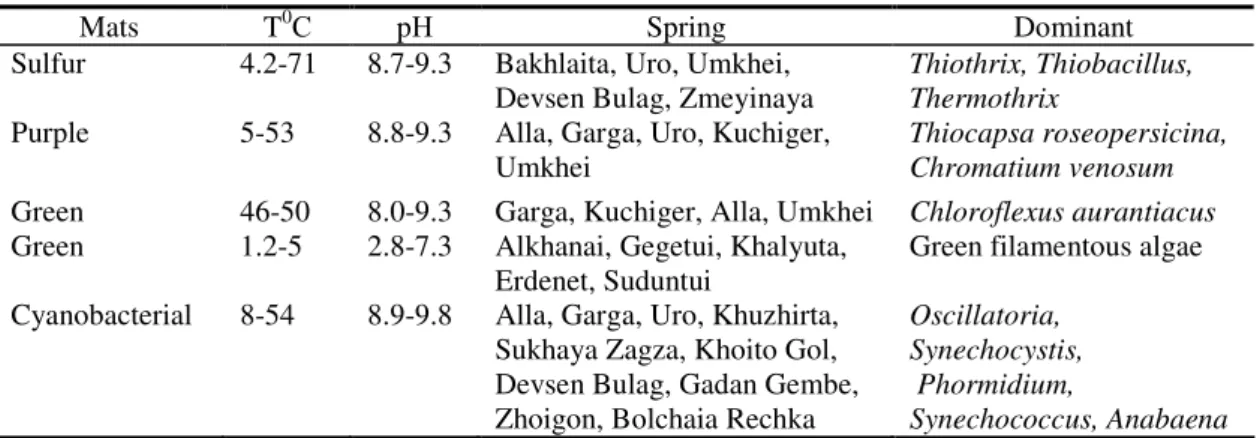
In spring outlets and brooks microbial mats have been noticed (Tables 2-3). Cyanobacterial, green and purple mats grow at temperatures below 60oC. Sulfur mats have been noticed in hot and cold
springs with a high concentration of sulfide, such as Alla, Umkhei, Zmeyinaya, Kuchiger, Devsen Bulag and Bakhlaita. High methane concentration of Sukhaya Zagza spring is favorable for activity of methanotrophic bacteria. Perennial thick mats with a thickness of 2-7 cm are found in hot brooks of Seiya, Garga, Alla and Khuzhirta springs. At the outlet of Alla spring, situated on the left side at 58oC microbial mat is not formed, on the bottom there is a thin brown film covering black sand and silt, which provides evidence of active sulfate-re-ducing bacteria.
At 49oC cyanobacterial mats grow and the color gradually changes from bright green to dark yel-low. When plating from the mat, Heliobacter sp., Chromatium sp., Thiocapsa sp. and Desulfobacter sp. were isolated. At 35oC Thiothrix sp. and Cyanobacteria (Phormidium sp.) develop, attach-ing to stones.
Table 1. Physical and chemical characteristics of mineral springs in Central Asia
Spring Situation T0C pH Salinity g/l Type
Alla Barguzin range, Buryatia 76.2 9.6 0.24 Nitric
Kuchiger -“- 43.0 9.8 0.6 Nitric
Bolshaya
Rechka -“- 74.5 10.2 0.39 Nitric
Garga Ikatskii range 72.7 7.9 1.0 Nitric
Seiya -“- 50.3 9.6 0.32 Nitric
Uro -“- 67.2 8.7 0.25 Nitric
Umkhei The upper Barguzin river 47.6 9.1 0.45 Nitric Bakhlaita
Valley of Kizhinga river 5.0 8.2 0.5 Sulfide-hydrogen Khalyuta Range Khamar Daban 4.2 6.8 0.15 Carbonated
Gegetui -“- 1.2 7.3 0.24 Carbonated
Zmeinaya Chivirkuiski Bay, Lake Baikal shore 52.3 8.9 0.43 Nitric Sukhaya Zagza Lake Baikal shore 48.0 8.4 0.51 Methane Khoito Gol The upper Sentsi river, Eastern Sayans 34.0 8.3 0.62 Carbonated Shumak The upper Shumak river, Eastern Sayans 34.0 7.2 0.56 Carbonated Gadan Gembe Mountain Tengesiin Dabaan, Eastern Sayans 20.8 6.5 0.56 Carbonated Zhoigon Valley of Arzham-Khem river, Tiva 38.5 8.2 1.55 Carbonated Suduntui The upper Suduntui river, Aginski region 3.7 6.0 0.25 Carbonated Alkhanai Spurs of the mountain Alkhanai, Aginski
region 3.0 6.7 0.34 Carbonated
Erdenet Range Burengiin nuruu, Orkhon aimak,
Mongolia 11.6 2.8 0.7
Acid without gas
Khuzhirta The upper Orkhon river, Uburkhangai
district, Mongolia 49.1 9.2 0.24 Nitric Devsen Bulag Erden Sant somon, Tov aimak, Mongolia 4.2 7.1 0.4
Sulfide-hydrogen
It can be explained by the combined influence of 3 environmental factors: high temperature, pH and sulfide existence. However, when plating sand sam-ples from this mat culture Chloroflexusaurantiacus was isolated. 70 cm downstream from the spring outlet a dark-brown mat is developing, formed by Chloroflexus aurantiacus and Termus ruber. At 590C a thick cyanobacterial mat grows, Chloroflexus dominating. Thickness of this mat reaches 3-4 cm. Under microscope Chloroflexus aurantiacus dominates in the upper layer of the mat; cyanobacteria have not been recorded. In deeper layers Synechococcus sp. appears. When temperature decreases cyanobacteria begin to dominate. At 40oC layers of purple bacteria appear. At 35oC the color of the mat changes. The surface becomes covered with a white layer of sulfur
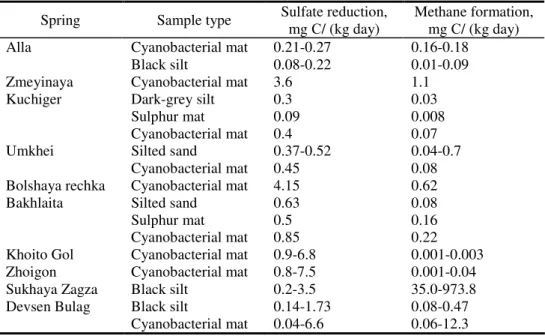
bac-have been found in the brook. Cyanobacterial communities appear at 13.5oC and pH 8.2 and decrease of hydrogen sulfide concentration to 5 mg/l. The total productivity of mat in thermal springs increases when temperature decreases. So, in Alla spring the total productivity increases from 360 mg C/ (m2 day) in the point BG-8 (temperature 65oC) to 840 mg C/(m2 day) (temperature 45oC). In Garga spring the rate of oxygenous photosynthesis is 203 mg C/(m2 day), while the rate of anoxygenous photosynthesis is 50 mg C/(m2 day). On terminal stages of organic matter destruction participates sulfate-reducing acetogens, methanogens and methanotrophs (Table 4). Their activities primarily depend on sulfate concentration in the spring water. In Alla, Zmeyinaya and Garga springs, sulfate concentration is not high and its maximum was
teria. Under this layer cyanobacteria and beneath this purple bacteria grow. At lower temperatures microbial mats are not found. For 20 m downstream colorless sulfuric bacteria Thiothrix develops (Barkhutova et al., 1998).
In the brook of the hydrogen sulfide spring Devsen Bulag the layer of elemental sulfide is seen as a yellowish film on stones and a white film is noticed on the water surface. Sulfur mats Thiothrix
Table 2. Characteristics of microbial mats of mineral springs
Spring Sample Probe type T p Dominant species
Seya Water body
Brook
Brook
Grey fine sand Low mat Floating mat Thin green mat
Thick green mat
49.7 - 47.2 46.3 9.6 - 9.6 9.7 - Phormidium,Oscillatoria Oscillatoria,Phormidium Phormidium, Chloroflexus Phormidium,Oscillatoria Chloroflexus
Uro Brook
Brook Brook Brook Giffon Brook Emerald-green mat Orange Cyanobacterial mat
Black Cyanobacterial mat Yellow-green
Cyanobacterial mat Mat with sand
Sulphur mat 46.5 47.6 38.5 33-40 64 63-61 8.8 9.1 9.7 9.2 8.7 8.8 Phormidium laminosum, Synechococcus elongatus S. elongatus,Ph. laminosum Oscillatoria limosa O.limosa, O. chalibea Ph. laminosum, Ph. fragile, G.minor Anabaena
Chloroflexus,
Purple bacteria
Thermothrix
Alla Brook
Brook Brook Brook
Brook
Green mat
Green cyanobacterial mat Green mat
Sulphur mat
Cyanobacterial green mat
56-45 30 55 35 40 9.0 7.0 - - 9.6 Chloroflexus Oscillatoria, Oscillochloris Chloroflexus Thiothrix, Oscillatoria Synechococcus, Chloroflexus Garga Giffon Brook Brook Brook Brook Dying mat Cyanobacterial mat Green mat Orange-olive-green mat 72.7 70 44 54-49 36.6 7.9 8.0 8.5 8.5 9.0 - - Phormidium, Oscillatoria Cloroflexus Oscillatoria Phormidium, Anabaena, loroflexus
Table 3. Dominant species of microbial mats of mineral springs
Mats T0 p Spring Dominant
Sulfur 4.2-71 8.7-9.3 Bakhlaita, Uro, Umkhei, Devsen Bulag, Zmeyinaya
Thiothrix, Thiobacillus, Thermothrix
Purple 5-53 8.8-9.3 Alla, Garga, Uro, Kuchiger, Umkhei
Thiocapsa roseopersicina, Chromatium venosum
Green 46-50 8.0-9.3 Garga, Kuchiger, Alla, Umkhei Chloroflexus aurantiacus
Green 1.2-5 2.8-7.3 Alkhanai, Gegetui, Khalyuta,
Erdenet, Suduntui Green filamentous algae Cyanobacterial 8-54 8.9-9.8 Alla, Garga, Uro, Khuzhirta,
Sukhaya Zagza, Khoito Gol, Devsen Bulag, Gadan Gembe, Zhoigon, Bolchaia Rechka
Oscillatoria, Synechocystis, Phormidium,
Synechococcus, Anabaena
mats on the left bank of Alla spring. Sulfate reduction in bottom sediments of Devsen Bulag spring occurred at a rate of 0.81mg S/ (kg day). In the brook in this spring the rate of sulfate reduction increased to 8.8 mg S/ (kg day). Methane formation rate in this spring varied from 32 to 5720.6 µl CH4/ (kg day). High rates of methane oxidation (up to 13708.2 µl CH4/ (kg day)) have been observed in sediments of Sukhaya Zagza spring. In this spring most of the organic matter (up to 973.8 mg C/ (kg day) is used for methane formation.
Discussion
Table 4. Consumption of organic matter in microbial processes in mineral springs
Spring Sample type Sulfate reduction, mg / (kg day) Methane formation, mg / (kg day) Alla Cyanobacterial mat
Black silt 0.21-0.27 0.08-0.22 0.16-0.18 0.01-0.09 Zmeyinaya Cyanobacterial mat 3.6 1.1 Kuchiger Dark-grey silt
Sulphur mat Cyanobacterial mat
0.3 0.09 0.4
0.03 0.008 0.07 Umkhei Silted sand
Cyanobacterial mat
0.37-0.52 0.45
0.04-0.7 0.08 Bolshaya rechka Cyanobacterial mat 4.15 0.62 Bakhlaita Silted sand
Sulphur mat Cyanobacterial mat
0.63 0.5 0.85
0.08 0.16 0.22 Khoito Gol Cyanobacterial mat 0.9-6.8 0.001-0.003 Zhoigon Cyanobacterial mat 0.8-7.5 0.001-0.04 Sukhaya Zagza Black silt 0.2-3.5 35.0-973.8 Devsen Bulag Black silt
Cyanobacterial mat 0.14-1.73 0.04-6.6 0.08-0.47 0.06-12.3
biologically active substances, have been identified. Synthesized by phototrophic and chemolithotrophic microorganisms, autochthonous and allochthonous organic matter is subjected to aerobic and anaerobic breakdown. As a result different substances and metabolites with medicinal effects are formed such as hydrogen sulfide, sulfides, vitamins, volatile organic acids and polysaccharides. Close trophic relationships between the different groups of microorganisms enable them to participate effectively in the transformation of organic and inorganic matters of underground waters. Functional activity of the microbial community depends on physical and chemical conditions in the springs. High temperature and presence of microbial substrates favor bacterial development of different physiological groups. In all the thermal springs of Barguzin valley, Eastern Sayans and Mongolia, development of microbial mats has been noticed. Microbial mats are found in hydrogen sulfide and methane, cold and thermal springs of Buryatia and Mongolia. Quantitative estimation of microorganism activity of thermal and cold mineral springs shows that bacteria and algae play an important role in formation processes of quantitative and qualitative composition of mineral waters and their medicinal factor in mineral springs of Central Asia.
Acknowledgements
The study was supported by Russian Fund for Basic Research (grant ¹ 03-04-48047,
01-05-97256), Siberian Branch of the Russian Academy of Sciences (grant ¹ 170) and the Ministry of Education of the Russian Federation (grant ¹ 02-6.0-294). Thanks also due to the anonymous referees and editors for their useful comments and suggestions.
References
Abidueva E.Yu., Danilova E.V., Namsaraev Z.B. & Namsaraev B.B. 1999. Microbial diversity
of mineral springs of Buryatia. Biodiversity of
Baikal, Siberia. Novosibirsk: Nauka. Siberian FERM, RAS, p. 49-60.
Barkhutova D.D., Danilova E.V., Namsaraev B.B., Gorlenko V.M. & Namsaraev Z.B. 2000. Microbial diversity of thermal springs of
Pribaikalye. In: Biodiversity and Dynamics of
Ecosystems in North Eurasia. Novosibirsk: IC&G., Vol. 5, p. 7-9.
Barkhutova D.D., Danilova E.V. & Namsaraev B.B. 1998. Microbial characteristic of water ecosys-tems of Zabaikalye. J. Scientific works. Chem-istry of biologically active substances. Ulan-Ude: ESSÒU, T.4, 75-83.
Barkhutova D.D., Dagurova O.P., Namsaraev B.B., Marzhangul N. & Oyuntsetseg A. 2003. Sulfate reduction process in the sulfide mineral spring
Devsen Bulag (Mongolia). In: Biodiversity and
Kuznetsov S.I. & Dubinina G.A. 1989. Methods of research of water microorganisms. Moscow, Nauka, 288 pp.
Pinneker E.V. (ed.). 1980. Geo-chemistry of water of the Mongolian People’s Republic. Novosibirsk: Nauka, 80 pp.
Tkachuk V.G., Tolstikhina N.I. (ed.). 1962. Min-eral springs of the Southern part Eastern Sibe-ria. Moscow, AS SU, 200 pp.
Wainshtein M.B. & Laurinavichus K.S. 1988. Consideration and cultivation of anaerobic bacteria. Pushino: DNTI NCBI AS SU, 64 pp. Zavarzin G.A. 1984. Bacteria and atmosphere
com-position. Moscow, Nauka, 199 pp.
Received: September 2003 Accepted: December 2003
Õóðààíãóé