www.clim-past.net/5/695/2009/
© Author(s) 2009. This work is distributed under the Creative Commons Attribution 3.0 License.
of the Past
Quantifying the roles of ocean circulation and biogeochemistry in
governing ocean carbon-13 and atmospheric carbon dioxide at the
last glacial maximum
A. Tagliabue1, L. Bopp1, D. M. Roche1,2, N. Bouttes1, J.-C. Dutay1, R. Alkama1,3, M. Kageyama1, E. Michel1, and D. Paillard1
1Laboratoire des Sciences du Climat et de l’Environnement, IPSL-CEA-CNRS-UVSQ, 91191 Gif sur Yvette, France 2Department of Palaeoclimatology and Geomorphology, Faculty of Earth and Life Sciences, Vrije Universiteit Amsterdam,
De Boelelaan 1085, 1081 HV Amsterdam, The Netherlands
3Centre National de Recherches M´et´eorologiques (CNRM), 42 Avenue Coriolis, 31057 Toulouse, France
Received: 14 May 2009 – Published in Clim. Past Discuss.: 20 May 2009
Revised: 28 September 2009 – Accepted: 19 October 2009 – Published: 18 November 2009
Abstract. We use a state-of-the-art ocean general circula-tion and biogeochemistry model to examine the impact of changes in ocean circulation and biogeochemistry in govern-ing the change in ocean carbon-13 and atmospheric CO2at
the last glacial maximum (LGM). We examine 5 different re-alisations of the ocean’s overturning circulation produced by a fully coupled atmosphere-ocean model under LGM forc-ing and suggested changes in the atmospheric deposition of iron and phytoplankton physiology at the LGM. Measured changes in carbon-13 and carbon-14, as well as a qualita-tive reconstruction of the change in ocean carbon export are used to evaluate the results. Overall, we find that while a reduction in ocean ventilation at the LGM is necessary to reproduce carbon-13 and carbon-14 observations, this cir-culation results in a low net sink for atmospheric CO2. In
contrast, while biogeochemical processes contribute little to carbon isotopes, we propose that most of the change in at-mospheric CO2was due to such factors. However, the lesser
role for circulation means that when all plausible factors are accounted for, most of the necessary CO2change remains to
be explained. This presents a serious challenge to our un-derstanding of the mechanisms behind changes in the global carbon cycle during the geologic past.
Correspondence to:A. Tagliabue ([email protected])
1 Introduction
Reproducing past changes in the global carbon cycle is a key test of our understanding of the Earth’s climate system and, as such, explaining the documented changes in atmospheric gases and geochemical proxies that occurred during the last glacial maximum (LGM) remains an enduring challenge. Since the carbon stored in the terrestrial biosphere likely de-clined (e.g., Bird, et al., 1994; Sigman and Boyle, 2000), the ocean is believed to be responsible for the 80ppm reduc-tion in atmospheric carbon dioxide (pCO2atm)measured in
ice cores (Petit et al., 1999) at the LGM. In reproducing this change, only∼50 ppm needs to be explained by a given hy-pothesis, as the remainder can be accounted for by subse-quent deep-ocean carbonate compensation (e.g., Brovkin et al., 2007). In parallel to reducedpCO2atm, sediment cores
have shown that the gradient inδ13CDICbetween upper and
deeper waters (as measured by benthic foraminifera) was 50% greater at the LGM (e.g., Duplessy et al., 1988; Curry and Oppo, 2005). Accordingly,pCO2atm and the δ13CDIC
gradient provide two constraints for hypotheses that seek to explain the processes that resulted in the LGM climate and
pCO2atm.
Since the LGM was typified by changes in both ocean cir-culation (Lynch-Stieglitz et al., 2007) and dust deposition of the micronutrient iron (Petit et al., 1999; Martin, 1990; Ma-howald et al., 2006), modifiedpCO2atmandδ13CDIC
would be manifested by changes in the ocean’s solubility and/or biological pumps (driven by physical and biological processes). Colder sea surface temperatures can increase the solubility of CO2in the ocean at the LGM, while ocean
pro-ductivity could be stimulated by additional iron from dust (Martin, 1990) or by changes in phytoplankton stoichiom-etry that more efficiently produce organic carbon per unit macronutrient (Broecker, 1982; Omta et al., 2006). The widely measured changes inδ13CDICare, thus, an important
additional constraint on hypotheses that seek to explain LGM
pCO2atm.
Most models that have investigated LGM pCO2atm and δ13CDIChave been box models or models of
intermediate-complexity (IC-models) (e.g., Toggweiler, 1999, 2006; Brovkin et al., 2007), which permit a wide exploration of parameter space, but sacrifice degrees of physical and/or bio-geochemical realism that preclude a detailed spatial compar-ison with observations. 3-D ocean-general-circulation and biogeochemistry models (OGCBMs) can represent the ef-fect of LGM climate on circulation and the subsequent im-pact on biogeochemistry in a more mechanistic sense (e.g., Bopp et al., 2003; Kurahashi-Nakamura et al., 2007) and can also simulate well-measured paleo-proxies such asδ13C and114C. Such a procedure permits a thorough spatial com-parison of theδ13CDIC distribution resulting from a given
LGM atmosphere-ocean scenario to observations and pro-vides confidence in model results.
Here we use a state-of-the-art OGCBM to examine how
pCO2atm and δ13CDIC respond to changes in ocean
circu-lation and dust deposition. We constrain the modelled LGM
1δ13CDICusing 133 observations from benthic foraminifera.
Our results allow us to delineate differing roles for circula-tion and biology in governing LGMδ13C andpCO2atm, but
highlight important shortcomings in capturing the required LGM change inpCO2atmusing existing hypotheses.
2 Methods
2.1 Ocean biogeochemical model
Our OGCBM PISCES (Aumont and Bopp, 2006) simulates nanophytoplankton and diatoms, meso-/micro-zooplankton, small/large detritus, 13, 14, calcium carbon-ate, biogenic silica, dissolved-inorganic-carbon, carboncarbon-ate, dissolved-organic-carbon, nitrate, phosphate, silicic acid and iron. Fixed organic matter production ratios are employed for nitrogen and phosphorous, while ratios of both silica, and iron, to carbon vary as a function of the phytoplankton group and environmental variables. The PISCES model has previ-ously been evaluated and used for a wide variety of studies concerning historical and future climate (e.g., Bopp et al., 2003; Aumont and Bopp, 2006; Tagliabue and Bopp, 2008; Tagliabue et al., 2008).
We explicitly resolve carbon-13 in the existing 3 dissolved and 7 particulate carbon pools, with fractionation occurring during photosynthesis, precipitation of calcite, gas exchange and carbonate chemistry (Tagliabue and Bopp, 2008). We pa-rameterize photosynthetic fractionation (‰) to be a function of the CO2(aq) concentration and the specific growth rate (µ)
of each phytoplankton group. In an attempt to account for the influence of cell size on photosynthetic fractionation, as well as the observed minimum at high values ofµ/CO2(aq),
we restrict the variation in photosynthetic fractionation to be-tween 5 and 20, and 10 and 26‰ for diatoms and nanophy-toplankton, respectively. Calcite formation has a fixed frac-tionation of 1‰. Fracfrac-tionation during gas exchange, and the conversion of CO2(aq) to DIC, are a function of
tempera-ture and the proportion of the DIC present as CO23−. We refer readers to Tagliabue and Bopp (2008) for a complete description of the model and an evaluation against obser-vations for the historical period (1860 to 2000). We note that we begin our simulations with the configuration from Tagliabue and Bopp (2008) that best matches modern deep oceanδ13CDIC(i.e., PISCES-D in the notation of Tagliabue
and Bopp (2008), see Supplementary Fig. 1: http://www. clim-past.net/5/695/2009/cp-5-695-2009-supplement.pdf).
14C simulations followed the OCMIP protocol (http:
//www.ipsl.jussieu.fr/OCMIP/) and were conducted for 3000 years, assuming LGM values forpCO2atm, salinity and
alkalinity and constant atmospheric14C production. 2.2 Physical model
The physical model coupled to PISCES is based on the ORCA2 global ocean model configuration of OPA ver-sion 8.2 (Madec et al., 1998) and also includes a dynamic-thermodynamic sea-ice model (Timmermann et al., 2003). The mean horizontal resolution is approximately 2◦ by 2◦ cos (latitude) and the meridional resolution is enhanced to 0.5◦at the Equator. The model has 30 vertical levels; with an increment that increases from 10 m at the surface to 500 m at depth (12 levels are located in the first 125 m). Our simulations were forced by the output from the IPSL cou-pled atmosphere-ocean climate model under LGM forcing in terms of the radiative properties of atmospheric gases and or-bital forcing, with a LGM land/ocean mask and LGM topog-raphy and ice sheets (see Sect. 2.4). As such, this produces changes in physical transport and temperature and salinity properties of the ocean that can be used to force PISCES of-fline.
0 0.2 0.4 0.6 0.8 1
-1 -0.8 -0.6 -0.4 -0.2
dD
13
C
DIC
(LGM-PI)
CircD ATL
CircDIND 40°S 0° 40°N 80°N
CircE ATL
CircE IND 40°S 0° 40°N 80°N CircC ATL
CircC IND 40°S 0° 40°N 80°N 80°N
D E F
A B C
Dust Only ATL
Dust Only IND
CircA ATL
CircA IND
CircB ATL
CircB IND 0
1 2 3 4 5 0 1 2 3 4 5
0 1 2 3 4 5 0 1 2 3 4 5
Depth (km)
Depth (km)
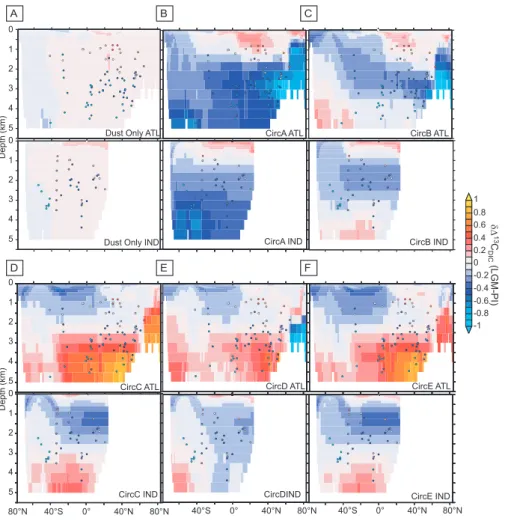
Fig. 1. Zonal changes inδ13CDIC(‰) between the pre-industrial and LGM periods (LGM-PI) for the Atlantic and Indian Ocean basins, with circles representing benthic foraminifera1δ13CDIC observations from the MOTIF database. We highlight the role of LGM dust deposition from Mahowald et al. (2006) and 5 different realisations of ocean circulation from the IPSL coupled model under LGM forcing that modify North Atlantic and Southern Ocean ventilation to varying degrees (Table 1). (A)LGM dust deposition under a pre-industrial ocean circulation,(B)CircA,(C)CircB,(D)CircC,(E)CircD, and(F)CircE. The PI state of the model for these basins is presented in Supplementary Fig. 1 (see http://www.clim-past.net/5/695/2009/cp-5-695-2009-supplement.pdf).
resolution and 20 uneven vertical levels, a sea-ice model and the carbon system (including carbon-13), as well as a sim-plistic representation of ocean biota. Due to its intermediate complexity, we decided to use CLIMBER-2 to examine the robustness of the major conclusions from our OGCBM with simulations of 20 000 years (i.e., to equilibrium). Ocean cir-culation in CLIMBER-2 was modified via additions of fresh-water, which permitted us to evaluate the impact of changes in ocean ventilation onδ13CDICin a similar fashion as for the
OGCBM.
2.4 Experimental strategy
We employed the OGCBM PISCES to prognostically simu-late ocean biogeochemistry, including 13 and carbon-14, when forced by a variety of LGM circulation schemes that arise from the fully coupled IPSL model (see: Sect. 2.2,
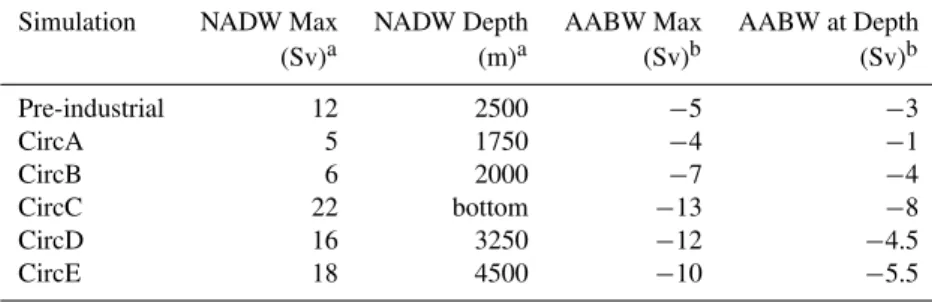
Table 1). In all LGM simulations, snow accumulates on the ice-sheets and this freshwater sink has to be compensated in order to obtain stable simulations. Therefore, simulations differ in the regions chosen for the redistribution of fresh-water (CircD and CircE) and different degrees of freshfresh-water forcing (CircA, CircB, CircC), which results in the variable overturning circulations summarized in Table 1 (Alkama et al., 2007; Arsouze et al., 2008; Kageyama et al., 2009).
Table 1.The major characteristics of the different representations of ocean circulation used during this study.
Simulation NADW Max NADW Depth AABW Max AABW at Depth
(Sv)a (m)a (Sv)b (Sv)b
Pre-industrial 12 2500 −5 −3
CircA 5 1750 −4 −1
CircB 6 2000 −7 −4
CircC 22 bottom −13 −8
CircD 16 3250 −12 −4.5
CircE 18 4500 −10 −5.5
a“NADW Max” is the maximum value of the meridional stream function between 500 and 1500 m and 30◦N to 50◦N. “NADW depth” is
the depth at which the stream function is zero.
b“AABW Max” is the minimum value of the meridional stream function between 55◦S to 75◦S (circumpolar), whereas “AABW at depth”
is minimum value of the stream function at 3000 m (also between 55◦S to 75◦S, to give an indication as to the depth of ventilation by AABW).
LGM climate, which results in a 12% increase in the mean phytoplankton C/N ratio (Omta et al., 2006).
OGCM LGM simulations using the IPSL model employ a modified land/sea mask, accounting for topography and ice sheets (Peltier, 2004). Atmospheric concentrations of CO2, CH4 and N2O for radiative forcing were 185 ppm,
350 ppb and 200 ppb, respectively, with orbital parameters from 21 kyr BP (following the PMIP2 protocol, http://pmip2. lsce.ipsl.fr) and this climate impacts the properties of the ocean (in terms of temperature and salinity). Our experi-ments are designed to test the impact of different LGM over-turning circulations on carbon isotopes, ocean biogeochem-istry andpCO2atm. While in this particular study, alternative
circulations are obtained via changes in surface freshwater forcing of the ocean, these could have arisen from a num-ber of climatic forcings, such as other freshwater fluxes or changes in winds. For example, the overturning circulations could also represent the postulated changes induced by latitu-dinal changes in southern hemisphere westerly winds, espe-cially with regards to the SO (e.g., Toggweiler et al., 2006). We used the resulting circulations (Table 1) to force PISCES offline (i.e., the circulations were constant for the duration of the experiments). Before running each simulation, we re-move 0.4‰ from oceanicδ13CDIC(by decreasing DI13C) and
add a further 1 psu to salinity (on top of LGM climate related changes) to account for changes in land biosphere carbon and sea level, respectively. We also increased nutrient stocks by 3% to account for the change in sea level in the first year of simulation (we note that we did not change DIC or alka-linity). We performed integrations of 500-years for each ex-periment (except those concerned with carbon-14, which ran for 3000 years), following a 3000-year spin-up under pre-industrial conditions (Tagliabue and Bopp, 2008). Initially, we ran PISCES with LGM dust under a pre-industrial (PI) circulation and then with each “LGM” circulation scheme (Table 1) in turn, evaluating the simulated1δ13CDIC
(LGM-PI) against 133 observations from benthic foraminifera, as
well as evaluating simulated114C against previously pub-lished data. Subsequently, we then examined the impact on ocean biogeochemistry andpCO2atm of the LGM
overturn-ing circulation that is able to reproduce carbon isotope obser-vations.
We also examined the relationship between ocean circu-lation and δ13CDIC using the IC-model CLIMBER-2 (see
Sect. 2.3). To that end, we made a number of idealised fresh-water additions to the Northern and Southern Hemispheres under LGM climate and examined the impact on ocean carbon-13 distributions after simulations of 20 000 years. This permits us to evaluate the robustness of our find-ings from the OGCBM, which, while more complex than CLIMBER-2 (in terms of its spatial resolution and biogeo-chemical processes), necessitates shorter simulation dura-tions.
LGM and pre-industrial δ13CDIC data from benthic
foraminifera are from the MOTIF database (http://motif.lsce. ipsl.fr). We removed data without a complete PI-LGM pair, leaving 133 paired observations to compare with our model results.
3 Results and discussion 3.1 LGM ocean carbon-13
While increasing dust iron supply under a pre-industrial cir-culation reduces deep-water δ13CDIC, due to an increased
export of organic matter with lightδ13C values, its impact remains too local and too slight to explain the observations alone (Fig. 1a, Table 2). Stimulation of carbon export (see Table 3 and Sect. 3.2) in the iron limited SO is responsible for a slight decrease in deep-waterδ13CDICin the SO and
Table 2. Statistical comparison of model simulation glacial-interglacial change in ocean δ13CDIC with observations from benthic foraminifera collated in the MOTIF database (values compared at the identical latitude, longitude and depth as the observations, see Ta-ble 1 for details on model simulations).
Entire Oceana >3 kma
Simulation Correlation (R) Slope Intercept Mean Mean
Data 1 1 0‰ −0.34±0.45‰ −0.64±0.33‰
PI+Dust 0.49 0.03 0.06‰ 0.05±0.03‰ 0.04±0.02‰
CircA 0.60 0.31 −0.19‰ −0.31±0.20‰ −0.42±0.13‰
CircB 0.28 −0.08 −0.12‰ −0.16±0.13‰ −0.14±0.13‰
CircC −0.48 −0.28 −0.03‰ 0.06±0.26‰ 0.27±0.28‰
CircD −0.31 −0.13 −0.04‰ −0.02±0.20‰ 0.06±0.25‰
CircE −0.38 −0.22 −0.05‰ 0.01±0.26‰ 0.20±0.28‰
aThere are 133 valid data points in the entire ocean, with 60 of these at or below 3 km.
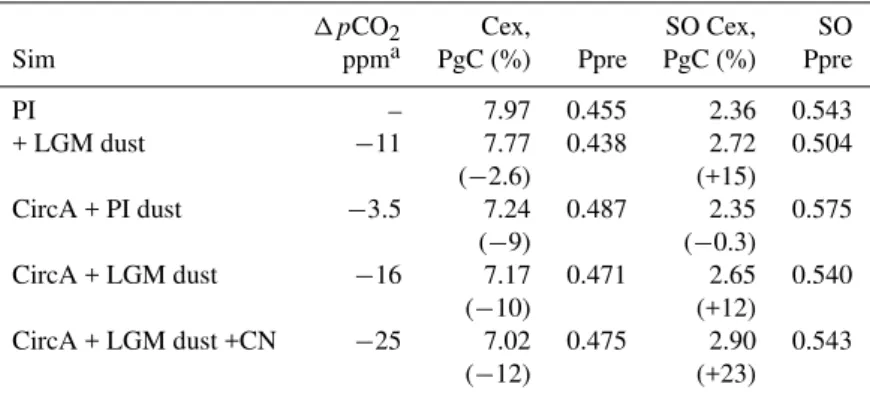
Table 3.The impact of modified ocean circulation and dust input (Sim) on the change in atmosphericpCO2(1pCO2, ppm), global annual carbon export (at 100 m, Cex, PgC) and the proportion of total PO4in the preformed pool (Ppre, assuming a P:O2ratio of 140), as well as for the Southern Ocean (SO, south of 40◦S). The proportion of total PO4in the regenerated pool (i.e., Preg) is 1-Ppre. We require a1pCO2 of 50 ppm (see text).
1pCO2 Cex, SO Cex, SO
Sim ppma PgC (%) Ppre PgC (%) Ppre
PI – 7.97 0.455 2.36 0.543
+ LGM dust −11 7.77 0.438 2.72 0.504
(−2.6) (+15)
CircA + PI dust −3.5 7.24 0.487 2.35 0.575
(−9) (−0.3)
CircA + LGM dust −16 7.17 0.471 2.65 0.540
(−10) (+12)
CircA + LGM dust +CN −25 7.02 0.475 2.90 0.543
(−12) (+23)
aPre industrial (PI) atmosphericpCO
2is 278 ppm.
surface waters with depleted deep waters results, the change is opposite to that observed (i.e., increased at depth, rela-tive to the surface, and vice-versa, Fig. 1d–f, Table 2). On the other hand, under diminished north Atlantic (NA) ven-tilation (CircA and CircB) an excellent regional agreement with NA1δ13CDICobservations results (Figs. 1b and c, 2,
Table 2, withR=0.73). The change in the NAδ13CDIC
gradi-ent is robustly related to changes in either the speed or depth of NA ventilation (across all simulations, Fig. 3). This rela-tionship is also remarkably consistent when examined with CLIMBER-2 (Fig. 3), which supports the statement from the OGCBM that NA ventilation is the dominant process govern-ing the NAδ13CDICvertical gradient (as reconstructed from
benthic foraminifera). Using the OGCBM relationship, the observed 0.49‰ increase in gradient requires a 59% or 68% reduction in overturning speed, or depth, respectively. Since simulations with different degrees of SO ventilation (CircA and CircB) both reproduce NA1δ13CDIC (Fig. 1b and c),
we suggest local (i.e., NA) forcings predominate and the role
of Antarctic processes are of second order. Unfortunately, in all the circulations tested in this study, increased NA ven-tilation speed was always accompanied by a deepening of ventilation (and vice-versa, Table 1), leaving us unable to isolate their separate effects. Nevertheless, assuming mod-ern overturning is 18 Sv and ventilates to 4000 m (Talley et al., 2003), a LGM NA ventilation of 7 Sv to 1300 m would satisfy1δ13CDICobservations.
Turning to the SO, deep-waterδ13CDICincreases when the
necessary reduction in NA ventilation is accompanied by in-creased SO ventilation (CircB), as suggested by some LGM studies, (Curry and Oppo, 2005; Brovkin et al., 2007), which is contrary to observations (Fig. 1c, Table 2). We find that only lesser SO ventilation (mostly in the Atlantic and Indian ocean sectors) at the LGM can reproduce the observed de-pletion in deepδ13CDIC(CircA, Fig. 1b). Furthermore,
sim-ulated bottom1δ13CDIC highlights the widespread impact
of elevated SO ventilation (CircB) on 1δ13CDIC (Fig. 2b)
CircB CircA
A) B)
180° 60°S
0° 60°N
60°E
120°E 0° 60°W 120°W 180° 120°E 60°E 0° 60°W 120°W 180°
0 0.2 0.4 0.6 0.8 1
-1 -0.8 -0.6 -0.4 -0.2
dD
13
C
DIC
(LGM-PI)
Fig. 2.The change inδ13CDIC(‰) between the pre-industrial and LGM periods (LGM-PI) from the bottom most model grid cell (i.e. at the sediment – water interface), with circles representing benthic foraminifera1δ13CDICobservations from the MOTIF database. In this figure, we highlight the role of decreased (A, CircA) and increased (B, CircB) Southern Ocean ventilation in conjunction with a reduction in North Atlantic ventilation. The scale is the same as for Fig. 1.
in deep-water δ13CDICdue to elevated SO export, see
fur-ther discussion of the export response in Sect. 3.2), confirms the necessity for reduced LGM SO ventilation (CircA) in order to satisfy the deep δ13CDIC observational constraint
(Fig. 2a). In contrast to previous IC-models (which assume increased SO ventilation, Brovkin et al., 2007), our OGCBM demonstrates the far-field effects of greater SO ventilation on
1δ13CDICand its discord with observations (CircB, Fig. 2b).
Indeed, additional tests with CLIMBER-2, show that when we reduce SO ventilation, the deep SOδ13CDICdeclines (by
0.03‰ Sv−1)in line with observations. Finally,114C
sim-ulations (performed offline for 3000 years) also demonstrate that only CircA captures the observed increase in deep wa-ter ages (Robinson et al., 2005; Sikes et al., 2000), with en-hanced SO ventilation (CircB) causing earlier ages for the deep ocean, in contrast to observations (Fig. 4). While CircA has reduced overall SO ventilation, we note that this response is heterogeneous in space, with a shift in ventilation sites and slight increases in ventilation in some places (such as the Ross Sea, which explains the weakerδ13CDICchange in
this region (Fig. 2a).
Overall, only reduced NA and SO ventilation, isolating the deep-ocean, can reproduce LGMδ13CDIC, as well as114C,
observations. The reduced SO ventilation at the LGM, that is necessitated by δ13CDIC and 114C observations, might
have arisen from the postulated equatorward shift in South-ern Hemisphere westerly winds (Toggweiler et al., 2006), al-though this is not the forcing which we have used in this study. Our results regarding the nature of the LGM overturn-ing circulation agree with earlier box model studies (Tog-gweiler, 1999), whereas previous CLIMBER-2 simulations with greater SO ventilation cannot replicate SOδ13CDIC
ob-servations (Brovkin et al., 2007). Similarly, a variety of other proxies (18O, Cd/Ca,15N/14N, and231Pa/230Th) sup-port a poorly ventilated LGM deep-ocean (e.g., Robinson et al., 2005; Sikes et al., 2000; Sigman et al., 2004; Francois et al., 1997; Adkins et al., 2005; Marchitto and Broecker,
-1 -0.8 -0.6 -0.4 -0.2 0 0.2 0.4 0.6 0.8 1
-1 -0.5 0 0.5 1 1.5 depth (OGCBM)
strength (OGCBM) CLIMBER2
Change in
d
13
CDIC
gradient
Change in NA ventilation
Fig. 3. The relationship between the fractional change in either the intensity (open squares), or depth (filled squares), of North Atlantic overturning (defined as for Table 1) and the change in the upper (0–2000 m) to deep (3000–5000 m) δ13CDIC gradient (‰, where a positive value implies an increase in the gradient at LGM) in the Atlantic between 30 and 80◦N for all simulations listed in Table 1. The relationships are described by1δ13CDIC gradient=−0.666(1NA-ventilation)−0.145 (R=−0.98) and
δ13CDIC gradient=−0.776(1NA-ventilation)+0.045 (R=−0.96) for ventilation strength and depth, respectively. Superimposed (in grey) is the impact of changes in NA ventilation on the
0
1000
2000
3000
4000
5000
0
1000
2000
3000
4000
5000
0
1000
2000
3000
4000
5000
-50
-100
-150
-200
-250
-300
-350 a) Pre-Industrial Circulation
b) CircA
c) CircB
∆
14
C (%
o
)
0o 40oN
40oS 80oN
Figure 4
Latitude
Depth (m)
Fig. 4. 114C (‰) for (a) the pre-industrial circulation, (b)
CircA and(c)CircB presented as an Atlantic zonal mean (Where
114C=1000*((DI14C/DIC)−1))). We include LGM 114C data collected from the western North Atlantic (Robinson et al., 2005) as circles for (b) and (c), which demonstrates that only CircA (which has reduced SO ventilation, Table 1) captures the increased deep-water ages present in the data. The GLODAP estimation (Key et al., 2004) of the pre-industrial114C for the Atlantic basin (zonal mean) is presented in Supplementary Fig. 2 (see http://www.clim-past.net/ 5/695/2009/cp-5-695-2009-supplement.pdf).
2006; Keigwin and Boyle, 2008). Surface waters were, thus, enriched with carbon-13 and deep waters more strongly reflected the light carbon introduced from organic matter remineralisation. Accordingly, CircA provides the best sta-tistical fit to the 133 1δ13CDIC observations from benthic
foraminifera (R=0.6,p<0.001) and reproduces the greater reduction inδ13CDICat depths greater than 3 km (Table 2).
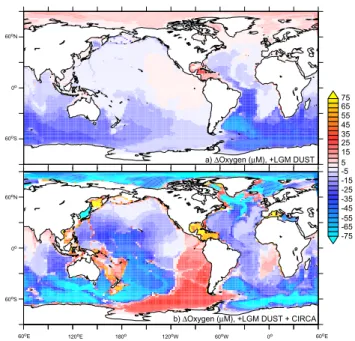
Deep-water oxygen responds to the changes in ocean cir-culation and biology. In response to LGM dust, the greater export of organic matter in the SO results in reduced deep-water oxygen (Fig. 5a), which are then transported northward and throughout the SO by the abyssal ocean circulation. The reduced ventilation present in CircA that is necessary to rec-oncileδ13CDICobservations elevates global suboxia when it
acts in conjunction with LGM dust (defined as O2<5µM)
3-fold, which should ostensibly increase denitrification rates and this depletes the oceanic fixed nitrogen inventory.
More-a) ∆Oxygen (µM), +LGM DUST
b) ∆Oxygen (µM), +LGM DUST + CIRCA
60oN
0o
60oS
60oN
0o
60oS
60oE 120oE 180o 120oW 60oW 0o 60oE
-75 -65 -55 -45 -35 -25 -15 -5 5 15 25 35 45 55 65 75
Fig. 5.The change in bottom water oxygen concentrations (µM O2, relative to the PI) in response to(a)LGM dust and(b)CircA+LGM dust (see Table 1).
over, the reduced overturning rate necessitated by carbon-13 and carbon-14 measurements might possibly also inhibit the degree of compensation (in terms of the oceanic fixed N in-ventory) by N2fixation (Tagliabue et al., 2008).
Neverthe-less, despite a sluggish PI circulation (Table 1) CircA and LGM dust did not drive total anoxia at depth in all places (Fig. 5b). In fact, colder temperatures, reduced subduction of oxygen-rich surface waters and shifts in SO ventilation sites associated with CircA and the LGM climate can ac-tually elevate deep oxygen in some regions. These include modern denitrification sites (e.g., eastern Pacific and Ara-bian Sea, Fig. 5b), consistent with observations of reduced LGM denitrification therein (Ganeshram et al., 2000). Over-all, oxygen declined in most all of the deep ocean during our experiments, but since a spatial reorganisation of deni-trification sites will likely follow modified LGM circulation (especially if it impacts deep water formation sites), a reduc-tion in denitrificareduc-tion at a modern denitrificareduc-tion site might not necessary imply reduced global LGM denitrification. 3.2 LGM atmospheric CO2
A circulation that reproduces LGMδ13CDIClowerspCO2atm
by 3.5 ppm (CircA alone, Table 3). Since the included temperature/salinity changes associated with LGM climate increase CO2 uptake and typically reduce pCO2atm by ∼15 ppm (e.g., Brovkin et al., 2007), this means that the
lesser ventilation necessary to reconcile δ13CDIC
observa-tions actually causes increased pCO2atm. This is because
export production declines, which increases preformed nu-trients (Table 3). Overall, the increased solubility pump that results from the LGM climate is almost entirely compensated for by a reduced biological pump and results in a net 3.5 ppm
pCO2atmreduction. Our OGCBM represents the spatial
vari-ability in CO2fluxes, as well as circulation-biogeochemistry
feedbacks and demonstrates that although δ13CDIC
obser-vations require less well-ventilated glacial ocean (which might have arisen from a northward redistribution of west-erly winds in the Southern Hemisphere), this cannot drive a significant portion of the LGMpCO2atm (Table 3). In
ad-dition, reduced SO ventilation also retards the vertical sup-ply of alkalinity to surface waters and this decreased surface alkalinity also contributes to the weak impact of CircA on
pCO2atm. The weak response in terms ofpCO2atmthat
re-sults from CircA is due to the counteracting effects of the oceanic solubility, carbonate and biological pumps that are represented by our OGCBM.
Despite contributing little toδ13CDIC, LGM dust does
re-duce pCO2atm. While iron fertilisation of SO export
el-evates local CO2 uptake, total global export declines due
to reduced low latitude nutrient supply (Dust+PI circula-tion, Table 3). Nevertheless, the SO is an effective con-trol of pCO2atm (Marinov et al., 2006) and the 15%
en-hancement of export therein and overall reduction in pre-formed nutrients reduces pCO2atm by 11 ppm (Table 3).
This is >3-fold lower than the 35 ppm found when IC-models are forced by arbitrary increases in SO productivity (Brovkin et al., 2007), highlighting the importance of explic-itly representing dust iron and other limiting factors (such as light/macronutrients/physiology) when appraising the im-pact of LGM dust.
Our OGCBM has a relatively low sensitivity to the large increase in dust iron supply, which results from phytoplank-ton physiological and ocean circulation processes. We find that the OGCBM primary productivity response to the ad-ditional dust iron is tempered by the 60% increase in the physiological (carbon specific) iron demand that follows el-evated iron supply (the Fe/C ratio). A greater iron demand results from the up regulation of iron requiring processes by the phytoplankton that increases the Fe/C ratio (Sunda and Hunstman, 1997). In addition, increasing dust deposi-tion of iron also promotes a floristic shift in phytoplankton species composition towards diatoms (by 25%, as seen dur-ing iron enrichment experiments, deBaar et al., 2005), which have a greater iron demand. Explicitly representing these 2 processes, as well as the role of macronutrients and light in limiting phytoplankton growth (in the northern and south-ern part of the Southsouth-ern Ocean, respectively) retards the re-sponse of ocean biology to LGM dust deposition. This ex-plains why our OGCBM has a lower sensitivity to dust than previous OGCBMs that did not include such effects (Bopp et al., 2003) or IC-models that do not explicitly account for iron (Brovkin et al., 2007). Compensatory changes in car-bon export at low latitudes that result from modified nutrient
utilization at high latitudes (Tagliabue et al., 2008) are also important in understanding the impact on the global carbon cycle.
In addition to the effects of the solubility and biological pumps, pCO2atm can be impacted by modifications to the
relative export of alkalinity that follow dust driven changes in high latitude utilization of silicic acid (e.g., Matsumoto and Sarmiento, 2008). We find that LGM dust reduces SO diatom silicification (the Si/C ratio) by 12% and silicic acid “leakage” to low latitudes does promote diatom productiv-ity (over calcifiers), which reduces the relative export of al-kalinity by 7% globally. As suggested by Matsumoto and Sarmiento (2008), this is despite a 6% reduction in abso-lute biogenic silica export at low latitudes (between 40◦S– 40◦N) that might be measured in a sediment core. However, since additional dust also increases SO diatom abundance (see above) and hence absolute silicic acid utilisation, low latitude supply is reduced (in absolute terms). This explains the small changes to relative alkalinity export that likely con-tribute <1 ppm to 1pCO2atm (Matsumoto and Sarmiento,
2008). Nevertheless, it should be noted that even our rel-atively complex OGCBM only describes 2 generic phyto-plankton (diatoms and nanophytophyto-plankton) and the potential for small diatoms (and possibly other species) to outcompete calcifiers in the nutrient-poor low latitudes might not be ade-quately represented.
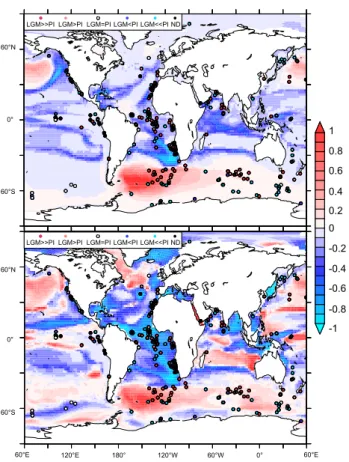
Figure 6 presents the spatial distribution of the propor-tional change in carbon export at 100 m from the OGCBM (LGM dust under PI circulation and LGM dust under CircA, Table 1) that is overlain with a qualitative appraisal of the change in carbon export at the LGM from a recent data-based compilation (Kohfeld et al., 2005). It should be borne in mind that the data compilation aggregates estimates from a variety of different proxies to assign ‘scores’ regarding LGM export (Kohfeld et al., 2005) and is thus necessarily quali-tative. On the other hand, the OGCBM presents export at 100 m, which is not a precise analogue to the data. The data presents some obvious trends: increased export in the LGM sub-Antarctic region, with lesser export in poleward latitudes and increased export in the north Atlantic. At low latitudes, the trend in the Pacific appears equivocal, while in the tropical Atlantic export increased at modern upwelling sites near Africa and probably increased throughout the trop-ical Atlantic basin, although some cores suggest reductions (Kohfeld et al., 2005).
60°N
0°
60°S
60°N
0°
60°S
60°E 120°E 180° 120°W 60°W 0° 60°E
0 0.2 0.4 0.6 0.8 1
-1 -0.8 -0.6 -0.4 -0.2 LGM>>PI LGM>PI LGM=PI LGM<PI LGM<<PI ND
LGM>>PI LGM>PI LGM=PI LGM<PI LGM<<PI ND
Fig. 6.The proportional change in organic carbon export (at 100 m) from the OGCBM (relative to the pre-industrial) for(a)LGM dust added to a PI circulation and(b)LGM dust added to CircA. Circles represent a data compilation of the qualitative change in export pro-duction at the LGM from Kohfeld et al. (2005). We plot the change in export at the LGM data on the same scale as the OGCBM results where (for the data points),−1=decrease,−0.5=slight decrease, 0=no trend,+0.5=slight increase and+1=increase (black circles represent data points where the LGM trend in export was equiv-ocal). Note that the OGCBM results represent the proportional change in organic carbon export at 100 m and can therefore only be compared with the data (which rely on a variety of methods) in a qualitative sense.
(LGM dust and CircA+LGM dust) suggest reduced export in the tropical Atlantic, the trend in the data is unclear with in-creased, slightly inin-creased, and decreased export all present in the data synthesis (Fig. 6). Reduced vertical nutrient sup-ply (during CircA) and increased nutrient utilization in the Southern Ocean (following LGM dust) both act to decrease the nutrient concentrations and, thus, carbon export in the tropics. This negative effect on nutrient supply to the trop-ics is only enhanced when LGM dust acts alongside CircA. If tropical LGM export did increase as suggested by Kohfeld et al. (2005), then additional processes (e.g., elevated nutri-ent supply from rivers, changes in stoichiometry or species composition) might be important in compensating for the de-cline in nutrients that results from dust (greater high latitude
macronutrient utilization) and circulation (less ocean venti-lation) changes that occurred at the LGM.
LGM dust causes a 16 ppm decline inpCO2atm if added
to CircA (Table 3), which is an additional 1.5 ppm (or 14%), relative to the separate effects of CircA (−3.5 ppm) and LGM
dust (−11 ppm). Although dust fertilizes SO export in CircA
less than for the pre-industrial circulation (12% instead of 15%, Table 3, due to reduced vertical nutrient supply), the deep-water sequestration of exported carbon is enhanced due its greater residence time at depth (illustrated by the impact on carbon-14 of CircA, Fig. 4). Consequently, while circula-tion changes might not explain LGMpCO2atm, the reduced
ventilation necessitated byδ13CDICcan potentially amplify
the impact of dust or other biogeochemical forcings. Includ-ing a 12% increase in LGM planktonic C/N ratios (Omta et al., 2006) in combination with LGM dust and CircA re-duces pCO2atm by another 9 ppm (by 25 ppm in total,
Ta-ble 3). Interestingly, adding modified stoichiometry to CircA with LGM dust causes preformed nutrients to change little, despite loweringpCO2atm further (Table 3), which
demon-strates that preformed nutrients are decoupled from changes inpCO2atmif the overall C/N stoichiometry is modified.
4 Synthesis
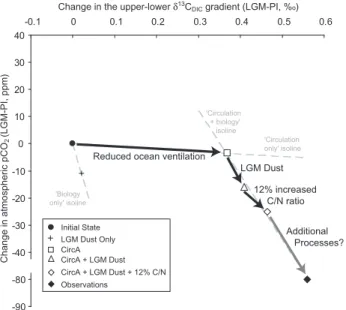
Overall, we capture 25 ppm of the required 50 ppmpCO2atm
decline (prior to carbonate compensation) and almost all of the necessary change in the δ13CDIC gradient (Fig. 7).
Using our results in combination with two observational constraints (pCO2atm and the δ13CDIC gradient), we
es-timate that ocean circulation (CircA) explains two-thirds of the LGM δ13CDIC gradient, but <10% of the
neces-sary pCO2atm change (Fig. 7, “LGM-circulation” isoline, −9.48 ppm‰−1). In contrast, biogeochemical processes only explain one-third of the LGM δ13CDIC gradient, but
would have to account for >90% of the pCO2atm decline
(Fig. 7, “LGM-biology” isoline,−238 ppm ‰−1).
Because our shortfall of 25 ppm, or 45 ppm, considering reduced terrestrial carbon storage (Sigman and Boyle, 2000), lies along the “LGM-biology” isoline in Fig. 7, we suggest it reflects additional biogeochemical processes, which can be amplified by the LGM ocean circulation. Ocean venti-lation must have declined at the LGM in order to satisfy geo-chemical proxy constraints (in particularδ13CDICand114C),
but due to the reduced biological pump, our OGCBM sug-gests a lesser role for circulation changes in governing LGM
pCO2atm. Accordingly, the integrated impact of all plausible
changes tested in this study (circulation, dust and stoichiom-etry) cannot account for the entire amplitude of the observed LGM changes inpCO2atm. This presents a challenge to our
prevailing understanding of the mechanisms behind LGM changes inpCO2atmand the global carbon cycle and
-90 -80 -40 -30 -20 -10 0 10 20 30 40
-0.1 0 0.1 0.2 0.3 0.4 0.5 0.6
Change in the upper-lower δ13C
DIC gradient (LGM-PI, %o)
Change in atmospheric pCO
2
(LGM-PI, ppm)
Reduced ocean ventilation
LGM Dust
12% increased C/N ratio
Additional Processes?
'Circulation only' isoline 'Circulation
+ biology' isoline
'Biology only' isoline
CircA LGM Dust Only Initial State
CircA + LGM Dust
CircA + LGM Dust + 12% C/N Observations
Fig. 7. A summary of the relationship between the globally av-eraged change in the upper (0–2000 m) to deep (3000–5000 m) gradient inδ13CDIC (‰) and the resulting change in pCO2atm (ppm) at the LGM for various OGCBM simulations. The black diamond denoted “observations” represents the observational con-straints on the change in theδ13CDICgradient andpCO2atm. Light grey dotted lines represent the “LGM-circulation”, “PI-biology” and “LGM- biology” isolines, which have slopes of−9.48,−529.4 and −237.68 ppm‰−1, respectively. Changes in circulation are necessary to shift the LGM δ13CDIC gradient to an appropriate value (x axis), but only changes in biological production (medi-ated by dust and/or changes in phytoplankton stoichiometry) can reducepCO2atmmarkedly (y axis). The amplification effect of re-duced ventilation on LGM dust is illustrated by the difference in the slopes of the “PI-biology” and “LGM-biology” isolines. Our short-fall reflects as yet unconstrained additional biogeochemical changes (see discussion in the text). We note that our depth ranges for the
δ13CDICgradient were chosen to examine the effect of circulation onδ13CDIC, rather than the biological pump.
such as changes in nutrient supply from land (which remain constant in our scenarios) or shifts in phytoplankton species composition/stoichiometry that impact the export of carbon and/or alkalinity (which are represented in a relatively sim-plistic fashion even by our complex OGCBM), could recon-cile tropical LGM export observations and lower pCO2atm
further. The spatial and mechanistic detail of our OGCBM is much greater than prior LGM studies using box models and IC-models. Nevertheless, we may require more complex OGCBMs that also represent additional biogeochemical pro-cesses (both biotic and abiotic), as well as those dominant at high latitudes (ocean ventilation and dust deposition) in order to explain LGMpCO2atm.
5 Conclusions
In conclusion, we useδ13CDIC,114C and models of differing
complexity to constrain LGM ocean circulation and while it can satisfy two-thirds of LGM δ13CDIC, biogeochemical
processes were responsible for >90% of the pCO2atm
re-duction (Fig. 3). We concur with previous studies that NA ventilation was reduced (Lynch-Stieglitz et al., 2007), but quantify its reduction. We also suggest that the impact of reduced NA ventilation was comparatively local and must have been accompanied by lesser SO ventilation to reconcile
1δ13CDICand114C observations. Such changes may have
been brought about by changes in freshwater input or west-erly wind patterns. Constraining the general nature of LGM circulation explainsδ13CDICobservations, but
biogeochem-ical changes (including increased dust deposition and mod-ified phytoplankton stoichiometry) loweredpCO2atm. More
work is required in understanding the biogeochemical mech-anisms (in addition to dust and stoichiometry) behind the fi-nal 25–45 ppm change inpCO2atm at the LGM that is
re-quired before carbonate compensation.
Acknowledgements. This work was supported by an ANR grant
(GOBAC) and an ANR-blanc grant (IDEGLACE), with computer time provided by CNRS/IDRIS and CEA/CCRT, France. We thank Kevin Arrigo and Andrew Lenton for their comments on an earlier version of this manuscript, as well as the MOTIF (http://motif.lsce.ipsl.fr) program.
Edited by: L. Beaufort
The publication of this article is financed by CNRS-INSU.
References
Adkins, J. F., Ingersoll, A. P., and Pasquero, C.: Rapid climate change and conditional instability of the glacial deep ocean from the thermobaric effect and geothermal heating, Quaternary Sci. Rev., 24, 581–594. 2005.
Alkama, R., Kageyama, M., Ramstein, G., et al.: Impact of a re-alistic river routing in coupled ocean-atmosphere simulations of the Last Glacial Maximum climate, Clim. Dynam., 30, 855–869, 2007.
Arsouze, T., Dutay, J.-C., Kageyama, M., Lacan, F., Alkama, R., Marti, O., and Jeandel, C.: A modeling sensitivity study of the influence of the Atlantic meridional overturning circulation on neodymium isotopic composition at the Last Glacial Maximum, Clim. Past, 4, 191–203, 2008,
Aumont, O. and Bopp, L.: Globalizing results from in situ iron fertilization studies, Global. Biogeochem. Cy., 20, GB2017, doi:10.1029/2005GB002591, 2006.
de Baar H. J. W., Boyd, P. W., Coale, K. H., et al.: Syn-thesis of iron fertilization experiments: From the iron age in the age of enlightenment, J. Geophys. Res, 110, C09S16, doi:10.1029/2004JC002601, 2005.
Bird, M. I., Lloyd, J., and Farquhar, G.: Terrestrial Carbon storage at the LGM, Nature 371, p. 566, 1994.
Bopp, L., Kohfeld, K. E., Le Qu´er´e, C., and Aumont, O.: Dust impact on marine biota and atmospheric CO2 during glacial periods, Paleoceanography, 18(2), 1046, doi:10.1029/2002PA000810, 2003.
Broecker, W. S.: Ocean geochemistry during glacial time, Geochim. Cosmochim. Acta, 46, 1689–1705, 1982.
Brovkin, V., Ganopolski, A., Archer, D., and Rahmstorf, S.: Lower-ing of glacial atmospheric CO2in response to changes in oceanic circulation and marine biogeochemistry, Paleoceanography, 22, PA4202, doi:10.1029/2006PA001380, 2007.
Curry, W. B. and Oppo, D. W.: Glacial water mass geometry and the distribution ofδ13C of6CO2in the western Atlantic Ocean, Paleoceanography, 20, PA1017, doi:10.1029/2004PA001021, 2005.
Duplessy, J. C., Shackleton, N. J., Fairbanks, R. G., Labeyrie, L., Oppo, D., and Kallel, N.: Deep water source variations during the last climatic cycle and their impact on the global deep water circulation, Paleoceanography, 3, 343–360, 1988.
Francois, R., Altabet, M. A., Yu, E. F., et al.: Contribution of South-ern Ocean stratification to low atmospheric CO2 concentrations during the last glacial maximum, Nature, 389, 929–935, 1997. Ganeshram, R., Pedersen, T., Calvert, S., McNeill, G., and
Fontugne, M.: Glacial-Interglacial Variability in Denitrification in the World’s Oceans: Causes and Consequences, Paleoceanog-raphy, 15, 361–376, 2000
Kageyama, M., Mignot, J., Swingedouw, D., Marzin, C., Alkama, R., and Marti, O.: Glacial climate sensitivity to different states of the Atlantic Meridional Overturning Circulation: results from the IPSL model, Clim. Past, 5, 551–570, 2009,
http://www.clim-past.net/5/551/2009/.
Keigwin, L. D. and Boyle, E. A.: Did North Atlantic overturn-ing halt 17000 years ago?, Paleoceanography, 23, PA1101, doi:10.1029/2007PA001500, 2008.
Key, R. M., Kozyr, A., Sabine, C. L., Lee, K., Wanninkhof, R., Bullister, J. L., Feely, R. A., Millero, F. J., Mordy, C., and Peng, T.-H.: A global ocean carbon climatology: Results from Global Data Analysis Project (GLODAP), Global Biogeochem. Cy., 18, GB4031, doi:10.1029/2004GB002247, 2004.
Kohfeld, K. E., Le Quere, C., Harrison, S. P., and Anderson, R. F.: Role of marine biology in glacial-interglacial CO2cycles, Science, 308, 74–78, 2005.
Kurahashi-Nakamura, T., Abe-Ouchi, A., Yamanaka, Y., and Mis-umi, K.: Compound effects of Antarctic sea ice on atmospheric
pCO2 change during glacial-interglacial cycle, Geophys. Res. Lett., 34, L20708, doi:10.1029/2007GL030898, 2007.
Lynch-Stieglitz, J., Adkins, J. F., Curry, W. B., et al.: Atlantic meridional overturning circulation during the Last Glacial Max-imum, Science, 316, 66–69, 2007.
Madec, G., Delecluse, P., Imbard, M., and L´evy, C.: OPA8.1 Ocean general circulation model reference manual, Notes Sci. Pole
Model Climate 11, Inst. Pierre-Simon Laplace, Paris, 91 pp., 1998.
Mahowald, N. M., Muhs, D. R., Levis, S., Rasch, P. J., Yoshioka, M., Zender, C. S., and Luo, C.: Change in atmospheric mineral aerosols in response to climate: Last glacial period, preindustrial, modern, and doubled carbon dioxide climates, J. Geophys. Res., 111(D10), D10202, doi:10.1029/2005JD006653, 2006. Marchitto, T. M. and Broecker, W. S.: Deep water mass
geome-try in the glacial Atlantic Ocean: A review of constraints from the paleonutrient proxy Cd/Ca, Geochem. Geophys. Geosyst., 7, Q12003, doi:10.1029/2006GC001323, 2006.
Marinov, I., Gnanadesikan, A., Toggweiler, J. R., and Sarmiento, J. L.: The Southern Ocean biogeochemical divide, Nature, 441, 964–967, 2006.
Martin, J. H.: Glacial-Interglacial CO2Change: the iron hypothe-sis, Paleoceanography, 5, 1–13, 1990.
Matsumoto, K. and Sarmiento, J. L.: A corollary to the sili-cic acid leakage hypothesis, Paleoceanography, 23, PA2203, doi:10.1029/2007PA001515, 2008.
Michel, E., Labeyrie, L., Duplessy, J.-C., Gorfti, N., Labracherie, M., and Turon, J.-L.: Could Deep Subantarctic Convection Feed the World Deep Basins during the Last Glacial Maximum?, Pa-leoceanography, 10(5), 927–941, 1995.
Omta, A. W., Bruggeman, J., Kooijman, S. A. L. M., and Dijkstra, H. A.: Biological carbon pump revisited: Feedback mechanisms between climate and the Redfield ratio, Geophys. Res. Lett., 33, L14613, doi:10.1029/2006GL026213, 2006.
Peltier, W. R.: Global glacial isostasy and the surface of the ice-age Earth: The ICE-5G (VM2) model and GRACE, Annu. Rev. Earth Planet. Sci., 32, 111–149, 2004.
Petit, J. R., Jouzel, J., Raynaud, D., et al.: Climate and atmo-spheric history of the past 420000 years from the Vostok ice core, Antarctica, Nature, 399, 429–436, 1999.
Petoukhov, V., Ganopolski, A., Brovkin, V., Claussen, M., Eliseev, A., Kubatzki, C., and Rahmstorf, S.: CLIMBER-2: A climate system model of intermediate complexity. part I: Model descrip-tion and performance for present climate, Clim. Dynam., 16, 1– 17, 2000.
Robinson, L. F., Adkins, J. F., Keigwin, L. D., Southon, J., Fernan-dez, D. P., Wang, S.-L., and Scheirer, D. S.: Radiocarbon Vari-ability in the Western North Atlantic During the Last Deglacia-tion, Science, 310, 1469–1473, 2005.
Sigman, D. M. and Boyle, E. A.: Glacial/interglacial variations in atmospheric carbon dioxide, Nature, 407, 859–869, 2000. Sigman, D. M., Jaccard, S. J., and Haug, G. H.: Polar ocean
strati-fication in a cold climate, Nature, 428, 59–63, 2004.
Sikes, E. L., Samson, C. R., Guilderson, T. P., and Howard, W. R: Old radiocarbon ages in the southwest Pacific at 11,900 years ago and the last glaciation, Nature, 405, 555–559, 2000. Sunda, W. G. and Huntsman, S. A.: Interrelated influence of iron,
light and cell size on marine phytoplankton growth, Nature, 390, 389–392, 1997.
Tagliabue, A. and Bopp, L.: Towards understanding global variabil-ity in ocean carbon-13, Global Biogeochem. Cy., 22, GB1025, doi:10.1029/2007GB003037, 2008.
Tagliabue, A., Bopp, L., and Aumont, O.: Ocean biogeochemistry exhibits contrasting responses to a large scale reduction in dust deposition, Biogeosciences, 5, 11–24, 2008,
Talley, L. D., Reid, J. L., and Robbins, P. E.: Data-based meridional overturning streamfunctions for the global ocean, J. Climate, 16, 3213–3226, 2003.
Timmermann, R., Goose, H., Madec, G., Fichefet, T., Eth´e, C., and Duli´ere, V.: On the respresentation of high latitude processes in the ORCALIM global coupled sea ice-ocean model, Ocean Modell., 8, 175–201, 2003.
Toggweiler, J. R.: Variation of atmospheric CO2 by ventilation of the ocean’s deepest water, Paleoceanography, 14, 571–588, 1999.