Transformed and Tax-Expressing Cells by Mass
Spectrometry
Prabhakar Sripadi1¤, Bindesh Shrestha1, Rebecca L. Easley2, Lawrence Carpio2, Kylene Kehn-Hall3, Sebastien Chevalier4, Renaud Mahieux5, Fatah Kashanchi3, Akos Vertes1*
1Department of Chemistry, W. M. Keck Institute of Proteomics Technology and Applications, The George Washington University, Washington, D. C., United States of America,2Department of Biochemistry and Molecular Biology, The George Washington University School of Medicine, Washington, D. C., United States of America, 3Department of Molecular and Microbiology, National Center for Biodefense and Infectious Diseases, George Mason University, Manassas, Virginia, United States of America,4Laboratory of Cellular Oncology, National Institutes of Health/National Cancer Institute, Bethesda, Maryland, United States of America,5Equipe Oncogene`se Re´trovirale, Ecole Normale Supe´rieure de Lyon, U758 INSERM, Lyon, France
Abstract
Background: Viral transformation of a cell starts at the genetic level, followed by changes in the proteome and the metabolome of the host. There is limited information on the broad metabolic changes in HTLV transformed cells.
Methods and Principal Findings:Here, we report the detection of key changes in metabolites and lipids directly from human T-lymphotropic virus type 1 and type 3 (HTLV1 and HTLV3) transformed, as well as Tax1 and Tax3 expressing cell lines by laser ablation electrospray ionization (LAESI) mass spectrometry (MS). Comparing LAESI-MS spectra of non-HTLV1 transformed and HTLV1 transformed cells revealed that glycerophosphocholine (PC) lipid components were dominant in the non-HTLV1 transformed cells, and PC(O-32:1) and PC(O-34:1) plasmalogens were displaced by PC(30:0) and PC(32:0) species in the HTLV1 transformed cells. In HTLV1 transformed cells, choline, phosphocholine, spermine and glutathione, among others, were downregulated, whereas creatine, dopamine, arginine and AMP were present at higher levels. When comparing metabolite levels between HTLV3 and Tax3 transfected 293T cells, there were a number of common changes observed, including decreased choline, phosphocholine, spermine, homovanillic acid, and glycerophosphocholine and increased spermidine and N-acetyl aspartic acid. These results indicate that the lipid metabolism pathway as well as the creatine and polyamine biosynthesis pathways are commonly deregulated after expression of HTLV3 and Tax3, indicating that the noted changes are likely due to Tax3 expression. N-acetyl aspartic acid is a novel metabolite that is upregulated in all cell types and all conditions tested.
Conclusions and Significance:We demonstrate the high throughput in situ metabolite profiling of HTLV transformed and Tax expressing cells, which facilitates the identification of virus-induced perturbations in the biochemical processes of the host cells. We found virus type-specific (HTLV1 vs. HTLV3), expression-specific (Tax1 vs. Tax3) and cell-type–specific (T lymphocytes vs. kidney epithelial cells) changes in the metabolite profiles. The new insight on the affected metabolic pathways can be used to better understand the molecular mechanisms of HTLV induced transformation, which in turn can result in new treatment strategies.
Citation:Sripadi P, Shrestha B, Easley RL, Carpio L, Kehn-Hall K, et al. (2010) Direct Detection of Diverse Metabolic Changes in Virally Transformed and Tax-Expressing Cells by Mass Spectrometry. PLoS ONE 5(9): e12590. doi:10.1371/journal.pone.0012590
Editor:Steven Jacobson, National Institutes of Health, United States of America
ReceivedDecember 7, 2009;AcceptedAugust 5, 2010;PublishedSeptember 7, 2010
Copyright:ß2010 Sripadi et al. This is an open-access article distributed under the terms of the Creative Commons Attribution License, which permits unrestricted use, distribution, and reproduction in any medium, provided the original author and source are credited.
Funding:This work was supported, in whole and in part, by the National Science Foundation (Grant 0719232), the W. M. Keck Foundation (Grant 041904), Protea Biosciences, Inc., and the George Washington University (GWU) Selective Excellence Funds. The opinions, findings, and conclusions or recommendations expressed in this material are those of the authors and do not necessarily reflect the views of the funding organizations. The funders had no role in study design, data collection and analysis, decision to publish, or preparation of the manuscript.
Competing Interests:Protea Biosciences Inc. has provided an unrestricted gift to the laboratory of AV. Some of the gift was used during this research. AV also serves as a Science Advisory Board member and a consultant to Protea Biosciences Inc. The George Washington University (GWU) has recently submitted a patent application related to the content of this article. AV confirms that these facts do not alter his adherence to all the PLoS ONE policies on sharing data and materials.
* E-mail: [email protected]
¤ Current address: National Centre for Mass Spectrometry, Indian Institute of Chemical Technology, Hyderabad, India
Introduction
Human T-lymphotropic virus type 1 (HTLV1), a member of the delta-retroviridae subfamily, was the first human pathogenic retrovirus discovered and found to contribute to cancer develop-ment [1,2]. Infection with HTLV1 has been shown to result in the
(HAM/TSP; [3]) and several inflammatory diseases including polymyositis [4], uveitis [5], and lymphocyte alveolitis [6]. The development of ATL from HTLV1 infection is thought to be a multi-hit occurrence with initial transformation due to the viral protein Tax1. Recent studies have indicated that the use of novel treatments, including monoclonal antibodies against the interleu-kin-2 receptor (IL-2R) and the combination therapy of interferon-alpha (IFN-a) and zidovudine (AZT), to be effective, but only in a
small percentage of ATL patients. Therefore, new therapies are needed for the treatment of ATL or more specifically, HTLV1 infection.
Viral-induced transformation causes extensive changes at the gene, protein and metabolite levels. These changes are usually followed by gene-expression profiling and proteomic analysis [7,8]. Exploring the metabolic consequences of viral transformation adds to the picture because the viruses rely on the metabolic network of their cellular hosts for survival and replication [9,10,11]. Genomic, proteomic and metabolomic technologies have not only provided the foundation for the enhanced understanding of cell biology, but they are also emerging as tools for identifying disease biomarkers and for drug development. When compared to the transcriptome and the proteome, monitoring of the metabolome is useful because the metabolic composition of a cell/tissue provides its actual biochemical condition. Although metabolic technologies have been applied to find biomarkers for a few cancerous and virally transformed cell types [9,12,13,14,15], these techniques need to be expanded for challenging viral transformations, such as human immunodeficiency virus (HIV) and HTLV1.
The insight gained by such studies depends on the target sample, the treatment procedures and the detection techniques used. Conventionally, biofluids such as blood and urine have been used to follow metabolic changes after infection, but in many cases they complicate the analysis due to the pooling of changes in different cell types and the variations between individuals [16,17,18]. Ultimately, direct analysis of cells/tissues is a more straightforward way to understand the actual disease-associated metabolic changes occurring. In such cases, a direct detection technique offers key advantages.
Metabolites are small molecules of diverse physico-chemical properties with greatly different abundance levels that make their analysis challenging. Typically optical (e.g., Fourier transform infrared spectrometry), nuclear magnetic resonance (NMR) [19,20,21] and mass spectrometric techniques in combination with separation techniques, such as gas chromatography, high performance liquid chromatography (HPLC) and capillary electrophoresis, have been used for metabolomic studies [22,23,24,25,26]. Mass spectrometry (MS) is a technology with high efficiency [14] that, combined with chromatographic separations, can provide qualitative and quantitative analyses of complex samples with high selectivity and sensitivity, as well as a broad dynamic range. Conventional mass spectrometric methods, e.g., matrix-assisted laser desorption ionization (MALDI) and electrospray ionization (ESI), however, are time consuming because they involve extensive sample preparation steps [27]. The application of direct sampling methods, such as flow injection ESI, can avoid chromatographic separation [28], but not extensive sample preparation that can affect sample integrity and, in some cases, may lead to metabolite degradation. Therefore, many of these techniques restrict the choice of samples and preclude their in situ analysis. Some of these problems can be mitigated by the use of atmospheric pressure ion sources.
Recent advances in atmospheric pressure ion sources, such as direct analysis in real time (DART) [29,30], desorption electro-spray ionization (DESI) [31], atmospheric pressure infrared
MALDI (AP IR-MALDI) [32,33,34,35] and laser ablation electrospray ionization (LAESI) [36,37,38] enabled direct analysis of tissues and cell samples without sample preparation. Analysis of cells, cell cultures and cell extracts using DART, DESI and MALDI techniques are known [39,40,41] but these methods have their own limitations, such as coverage of analytes, sampling of the surface only, and quantitation restrictions. The LAESI technique, developed for in situ tissue and cell analysis, samples the entire volume of the cells for metabolites and lipid components with tissue imaging and quantitation capabilities [42,43].
Through the analysis and molecular imaging of various tissue samples, we have demonstrated that with LAESI it is possible to simultaneously detect different classes of compounds, for example, acidic and basic compounds, lipids and fatty acids [44,45]. Relative quantitation of metabolites can be performed by directly comparing the LAESI signal from different samples [36], whereas absolute quantitation can be carried out using labeled internal standards [38]. A limitation of the LAESI technique is that it relies on the water content of the sample for analysis. Thus samples without intrinsic water can only be analyzed after wetting them. Similar to ESI, the LAESI technique is prone to matrix effects. Consequently, low-abundant metabolites can be missed or masked in the presence of matrix peaks or other highly abundant components.
In this contribution we aim to identify metabolic changes in HTLV1 transformed T lymphocytes by the direct application of the LAESI method that is rapid and eliminates the need for sample preparation. We focus on changes related to HTLV induced transformation or Tax expression that alter the metabolic profiles in different cell lines. Understanding the role of Tax in destabilizing key regulators, such as proteins in metabolism and cell cycle control, may help to identify molecular markers that contribute to ATL development and define new therapeutic strategies. We demonstrate that in situ metabolite profiling of HTLV1 transformed T lymphocytes facilitates the identification of virus-induced perturbations in the biochemical processes of the host cell. For comparison purposes, we performed similar experiments on cells transfected with either the HTLV3 molecular clone or Tax3 and compared these metabolic profiles with the results for HTLV1 transformed and Tax1 expressing cells.
Materials and Methods
Materials
The non-HTLV transformed T lymphocyte cells (CEM and H9) and kidney epithelial cells (293T) ), the HTLV1 transformed cells (C81 and HUT102), the H9 cells stably transfected with Tax1 of HTLV1 (H9-Tax1) and the 293T cells transfected with HTLV3 (293T-HTLV3) and expressing Tax3 (293T-Tax3) were main-tained in RPMI 1640 medium containing fetal bovine serum, L-glutamine (2 mM), penicillin (100 units/ml) and streptomycin (100mg/ml). All the medium solutions and buffers were procured from Quality Biological Inc. (Gaithersburg, MD). All solvents used for MS were HPLC grade from Acros Organics (Geel, Belgium). The glacial acetic acid was purchased from Fluka (Munich, Germany).
Laser Ablation Electrospray Ionization
150 mm focal length CaF2 lens (Infrared Optical Products,
Farmingdale, NY), respectively. At,5–6 mm downstream from the tip of the spray capillary, the laser beam with average output energy of 0.3 mJ/pulse was used to ablate the tissue sample at right angle. Optical microscopy of the burn pattern produced on a photographic paper indicated that the laser spot size had ,300mm diameter.
The electrospray system was similar to the one described in recent reports from our laboratory [36,37,38]. Briefly, a home-built electrospray system with a low-noise syringe pump (Physio 22, Harvard Apparatus, Holliston, MA) was used to feed the 50% methanol solution containing 0.1% (v/v) acetic acid through a stainless steel emitter with 320mm o.d. and a tapered tip of 50mm i.d. (MT320-50-5-5, New Objective Inc., Woburn, MA). Stable high voltage (2800 V) was generated by a regulated power supply (PS350, Stanford Research Systems, Inc., Sunnyvale, CA) and was directly applied to the emitter. The orifice of the sampling cone was on-axis with the electrospray emitter at a distance of 12 mm from its tip.
The cells of interest were grown to a similar population size (to produce ,106cells/pellet) before subjecting them to LAESI experiments. The cells were quickly washed twice with phosphate buffered saline (PBS) and pelleted by spindown (2000 rpm). The supernatant PBS was completely removed without disturbing the pellet and a ,10ml fraction of the pellet was loaded onto a microscope slide for direct LAESI analysis. Under our experi-mental conditions, the actual number of cells ablated during LAESI analysis is much lower (,2800 cells/laser shot). The microscope slide with the cell pellet was held at ambient temperature and was positioned 15 mm below the spray axis. The microscope slide was mounted on a computer-controlled stepper motor-driven three-axis precision flexure stage (Nanomax TS, Thorlabs, Newton, NY) for rastering and geometry optimi-zation.
The LAESI ion source was mounted on a Q-TOF Premier mass spectrometer (Waters, Milford, MA). Full scan mass spectra were recorded over the mass range of m/z 50–2,000 using a time-of-flight (TOF) analyzer at a resolution of 8,000 (FWHM). Individual measurements on the T-cells took a few seconds. For structure identification of the metabolites, collision induced dissociation spectra were recorded by selecting the precursor ion using a quadrupole analyzer (transmission window 2 Da) and the product ions were resolved by the TOF analyzer. Argon was used as the collision gas at a typical collision cell pressure of 461023mbar, and a collision energy set between 5 and 25 eV. Accurate masses were determined using the internal standard method. Glycine, methionine, N-acetyl phenylalanine, leucine enkephalin and glufibrinopeptide were dissolved at the appropriate concentrations (50–200mM) in the electrospray solution and used as internal standards. Averages of the LAESI spectra collected under similar experimental conditions for a fixed time window were considered so that the approximate number of cells used for obtaining LAESI spectra were the same for all the studied cell types.
The human metabolome database (HMDB; www.hmdb.ca), the MassBank high resolution mass spectral database (www.massbank. jp), the NIST/EPA/NIH mass spectral library, and the MetaCyc database (http://metacyc.org) were used with a mass tolerance ranging from 0.1 to 0.01 Da for the metabolite searches and identifications.
Enzyme assays
Arginase activity was measured using the QuantiChrom Arginase Assay Kit (BioAssay Systems, Hayward, CA) according to the manufacturer’s instructions. CEM and C81 cell lysates (10
and 100mg) were measured in triplicates. The concentration of cAMP was measured using the CatchPoint Cyclic-AMP Fluores-cent Assay Kit (Molecular Devices, Sunnyvale, CA) according to the manufacturer’s instructions. CEM and C81 cell lysates (10 and 100mg) were measured in triplicates. Glutathione reductase from CEM and C81 cell lysates (10 and 200mg) was measured utilizing the Glutathione Reductase Assay Kit (Sigma, St. Louis, MO) according to the manufacturer’s instructions.
Results
CEM and C81 cells
The initial experiments focused on populations of non-HTLV1 transformed (CEM) and HTLV1 transformed (C81) T lympho-cytes. These non-adherent cells were grown in RPMI medium composed of inorganic salts, sugar, amino acids, vitamins and antibiotics. To minimize the interfering peaks from the medium in the LAESI spectra, the cells were quickly washed with PBS and the cell pellet was loaded onto a microscope slide. The cells were directly ablated by multiple laser shots and the average LAESI spectra (10–15 scans) were used for studying the metabolic changes. The resulting positive ion spectra exhibited various cell related metabolite ions in the range of m/z 20–1500, but also included a few interfering peaks from the PBS and the medium left in the cell pellet. Typical LAESI spectra obtained from CEM and C81 cells are shown in Figure 1. The metabolite peaks observed in the spectra were identified based on the accurate masses, isotope distribution patterns and structural information obtained from tandem MS. The background corrected spectra recorded from the cells consisted of protonated, sodiated and potassiated species. The observed peaks were due to small metabolites (,m/z 500), lipids (between m/z 690 and 850) and multiply charged peaks between m/z 700 and 1300. Deconvolution of all multiply charged peaks (m/z 710, 828, 993 and 1241) revealed that they corresponded to a single species with a nominal molecular weight of 4960.6, probably related to a peptide.
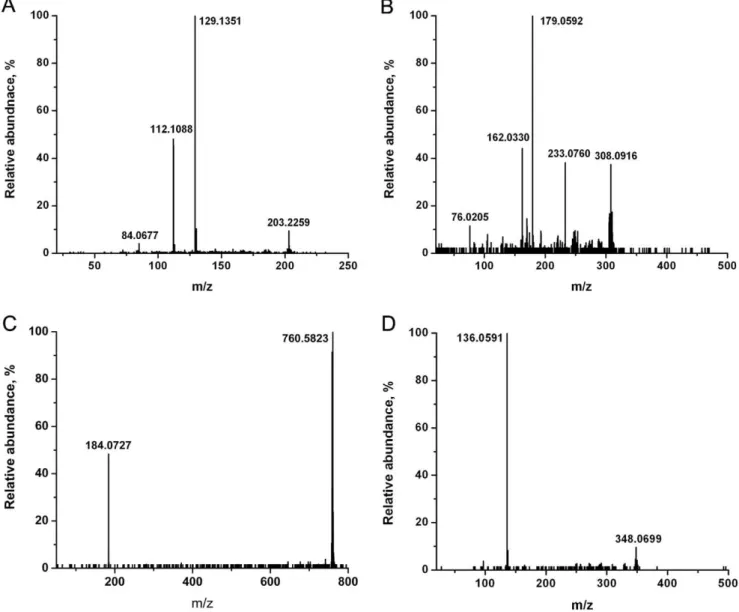
The spectra of CEM and C81 cells showed a similar set of ions, except for the lipid peaks, but consistent differences could be identified in their relative ion yields. The detected cell-specific metabolite ions and their peak assignments, based on accurate mass and tandem mass spectral data, are summarized in Table 1. All the key metabolites were confirmed by comparing their tandem mass spectra with the spectra of the corresponding standards or with spectra from tandem MS databases. The detected structure-specific fragment ions are listed in Table 1. Typical tandem mass spectra, used to identify spermine (m/z 203.2), glutathione (m/z 308.1), a phosphocholine lipid (PC(34:1), m/z 760.6) and adenosine monophosphate (m/z 348.1), are shown in Figure 2. Theoretically for the m/z 330.0738 ion two structures can be assigned, namely protonated cyclic AMP (cAMP) or sodiated glutathione. Even if both the ions are contributing to m/z 330 (as tested with standards), it is impossible to distinguish these two ions with the available mass resolution (m/Dm<10,000 compared to the necessary 25,000). Comparing
Degradation/fragmentation products of putrescine, spermidine and spermine (Figure 4) were observed in the spectra and designated as degradation products a, b and c in Table 1.
Formation of these products was confirmed based on the comparison of the LAESI data from standard polyamines with those detected in T lymphocytes at similar experimental conditions. The ion m/z 72 primarily results from putrescine, and m/z 129 and 112 can be formed from both spermidine and spermine, probably mostly from the latter due to its higher ion yields. The abundances of these degradation products between the non-HTLV1 transformed and HTLV1 transformed cells track those of their precursors.
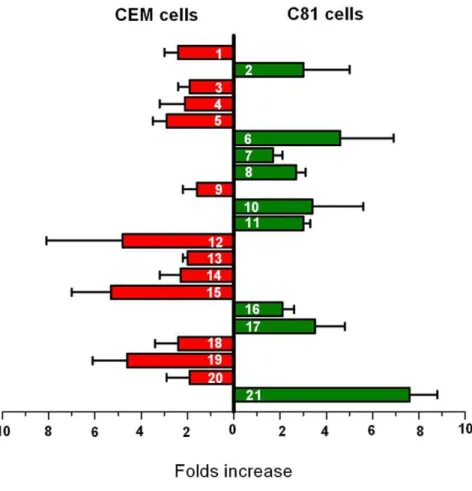
In previous reports, we had demonstrated that LAESI spectra provided relative quantitation in a wide dynamic range [36,38]. Hence, the relative abundances of the detected ions in the LAESI spectra of non-HTLV1 transformed and HTLV1 transformed cells were used to gauge the extent of metabolic changes between them. The background peaks from PBS/medium solution were used as internal standards to improve the accuracy of mass calibration. The relative abundance ratios for each ion detected in CEM and C81 are listed in Table 1. Some metabolites were detected as more than one ionic species (protonated, sodiated and potassiated). For example, glutathione was detected as six different ionic species. In such cases, the sum of the relative abundances of all the related species was used to calculate the abundance ratio. In case a particular peak was absent in a spectrum, the background (base line signal) was used to calculate the ratio. Upregulation was measured by the abundance ratio of ions from HTLV1 transformed over non-HTLV1 transformed cells, whereas down-regulation was measured by the inverse ratio. A ratio close to 1.0 signified no change. The changes in the levels of the detected metabolites between CEM and C81 cells from triplicate experiments are shown in Figure 5.
Traces of glucose (relative abundance ,3%), the major component of the medium (11 mM), appeared in the LAESI spectra of the T lymphocytes. The mass of protonated spermine (203.2236) was close to that of sodiated glucose species (203.059), but these two peaks were well separated. This, however, raised the issue of possible contribution of medium-related peaks to the
spectra detected from T lymphocytes. The LAESI spectrum of the medium alone showed arginine (m/z 175), choline (m/z 104) and glutathione (m/z 308) that potentially contributed to the signal from the related metabolites in T lymphocytes. The glutathione and choline peaks were less than,2% with respect to the glucose peak (m/z 203, base peak), whereas the arginine peak was approximately 25–30%. These ratios were consistent with values from diluted medium (100 times). The glucose peak appeared in both CEM and C81 cells (,3%) with an abundance ratio for m/z 203 close to unit value. The arginine peak that was found to be negligible in CEM cells was much higher than the glucose peak in C81 cells. This confirmed that the arginine interferences from the medium were negligible and the arginine levels were indeed upregulated in C81 cells.
Metabolic changes
Among the detected ions in the low mass region (,m/z 500), after correcting for the medium and electrospray related background peaks, there were about 43 ions exclusively related to T lymphocytes. Out of the 43 ions, 37 corresponded to 21 metabolites as seen in Table 1. The unassigned ions showing variations in their relative abundances between the non-HTLV1 transformed and the HTLV1 transformed cells are included in the footnote of Table 1. Many metabolites were downregulated in the HTLV1 transformed cells, e.g., spermine, choline, phosphocho-line, glycerophosphochophosphocho-line, and glutathione, whereas the levels of pyrrolidine, creatine, arginine, dopamine and adenosine mono-phosphate were upregulated.
Lipid levels
We detected several glycerophosphocholine (PC) lipids in the LAESI spectra of the T lymphocytes. Dramatic changes were observed in the lipid abundances and types between non-HTLV1 transformed and HTLV1 transformed cells (expanded spectra are shown in Figure 6). Tandem mass spectra of all major lipid peaks yielded a single product ion at m/z 184 (a typical spectrum of the m/z 760.6 ion is shown in Figure 2C) that confirmed that they belong to PC lipids. Based on tandem mass spectrometric and accurate mass information, the detected lipid peaks were Figure 1. Positive ion LAESI mass spectra of T lymphocytes.Peaks marked in A) non-HTLV1 transformed CEM T lymphocytes and B) HTLV1 transformed C81 T lymphocytes with an asterisk (*) indicate multiply charged ions of a peptide. Inset in panel A) shows the isotope pattern of the peak at m/z 993.5 with five charges.
Table 1.List of metabolites detected in non-HTLV1 transformed (CEM, H9), and HTLV1 transformed (C81) and Tax1 expressing (H9-Tax1) T cells.
No.
Metabolite
(chemical formula) Ion
Measured
mass* Error(mDa) Tandem MSfragment ions
Abundance Ratios* (CEM, C81)
Abundance Ratios (H9, H9-Tax1)
Up#
Down#
Up Down
1 Thioacetamide (C2H5NS) [M+H]+ 76.0236 1.5 - 2.4 (0.6) -
-2 Putrescine (C4H12N2) [M+H]+ 89.1103 2.4 3 (2) - 3.2
Pyrrolidine/Degradation product a, (C4H9N)
[M+H]+ 72.0798 21.5 2.1 (0.1)
3 Choline (C5H14NO) [M+H]+ 104.1087 1.2 60,58 - 1.9 (0.5) - 2.9
4 Proline (C5H9NO2) [M+H]+ 116.0709 20.3 70 - 2.1 (1.1) - 10.1
[M+Na]+ 138.0564 3.3
[M+K]+ 154.0299 2.9
5 Taurine (C2H7NO3S) [M+H]+ 126.0259 3.4 - 2.9 (0.6) - 1.7
[M+Na]+ 147.9997 24.7
6 Creatine (C4H9N3O2) [M+H]+ 132.0816 4.3 90 4.6 (2.3) - 2.3
-7 Spermidine (C7H19N3) [M+H[+ 146.1664 0.7 72,112,129 1.7 (0.4) - 1.0
-8 p-Aminobenzoic acid (C7H7NO2)
[M+Na]+ 160.039 1.6 2.7 (0.4) - - 1.7
9 Iminoaspartic acid (C4H5NO4)
[M+K]+ 169.9866 1 - 1.6 (0.6) - 6.0
10 Arginine (C6H14N4O2) [M+H]+ 175.1171 22.4 70,116 130,158 3.4 (2.2) - 1.2
-11 Dopamine (C8H11NO2) [M+Na]+ 176.074 5.3 3.0 (0.3) - - 1.4
[M+K]+ 192.0414 21.3
12 Phosphocholine (C5H14NO4P)
[M+H]+ 184.0767 2.8 86 - 4.8 (3.3) - 4.1
13 Carbamoyl-phosphate (CH4NO5P)
[M+2Na-H]+ 185.9544 1.4 - 2 (0.2) - 3.5
14 Spermine (C10H26N4) [M+H]+ 203.2259 2.3 112,129 - 2.3 (0.9) - 1.8
Degradation product c (C7H13N)
[M+H]+ 112.1068 24.0 84 1.7 (0.2)
Degradation product b (C7H16N2)
[M+H]+ 129.1422 3.0 112, 84 1.7 (0.4)
15 Methoxytyramine (C9H13NO2)
[M+K]+ 206.0537 24.6 - 5.3 (1.7) - 3.7
16 N-acetyl aspartic acid/ N-formyl glutamic acid (C6H9NO5)
[M+K]+ 214.0088 23 2.1 (0.5) - 1.7
-17 Homovanillic acid (C9H10O4) [M+K]+ 221.0208 20.8 3.5 (1.3) - 1.3
-18 Glycerophosphocholine (C8H20NO6P)
[M+H]+ 258.1124 1.7 104 - 2.4 (1) - 6.1
[M+Na]+ 280.0961 3.5
[M+K]+ 296.0724 5.9
19 Glutathione (C10H17N3O6S) [M+H]+ 308.0904 21.2 162,179, 233 - 4.6 (1.5) - 9.8
[M+Na]+ 330.0738 0.2
[M+2Na-H]+ 352.0518 23.7
[M+Na+K-H]+ 368.0315 2
[M+3Na-2H]+ 374.0388 1.3
[M+2Na+K-2H]+ 390.0125 1.1
20 8-Hydroxyguanosine (C10H13N5O6)
[M+K]+ 338.053 2.7 - 1.9 (1) -
-21 Adenosine monophosphate (C10H14N5O7P)
-tentatively assigned as listed in Table 2. The table includes diacyl glycerophosphocholines (PC(Cn:dbn), where Cn = the total
number of carbons and dbn = the total number of double bonds
in two fatty acid side chains, and alkylacyl/alkenylacyl glyceropho-sphocholines or plasmalogens, (PC(O-Cn:dbn)). The measured
relative abundance ratio values are also incorporated in Table 2. No.
Metabolite
(chemical formula) Ion
Measured
mass* Error(mDa) Tandem MSfragment ions
Abundance Ratios* (CEM, C81)
Abundance Ratios (H9, H9-Tax1)
Up#
Down#
Up Down
[M+Na]+ 370.0505 22.4 158
[M+2Na-H]+ 392.0298 25
Up and down regulation is followed by abundance ratios. #
The values in parentheses are standard deviation from triplicate experiments.
*Unassigned ions were detected at m/z 158.1572 (2.5), 228.0363 (2.6), 260.0298 (3.6), 311.9216 (1.5), 333.9604 (2.2), and 346.0616 (1.2), where the values in parenthesis were the abundance ratio C81/CEM.
doi:10.1371/journal.pone.0012590.t001 Table 1.Cont.
Figure 2. Tandem MS with collision induced dissociation for metabolite identification.A) protonated spermine (m/z 203.2), B) protonated glutathione (m/z 308.1) and C) protonated glycerophosphocholine lipid (PC(34:1), m/z 760.6) in CEM T lymphocytes, and of D) protonated adenosine monophosphate (AMP, m/z 348.1) in C81 T lymphocytes were directly analyzed by LAESI.
Most lipids detected in non-HTLV1 transformed were downreg-ulated in HTLV1 transformed cells. Only a few lipids were retained in the HTLV1 transformed cells, and the levels of PC(30:0), PC(O-31:2), PC(32:3), PC(32:0), and PC(O-33:3) were found to be higher compared to non-HTLV1 transformed cells.
As m/z 184 and 104 appeared in the LAESI spectra of the T lymphocytes and were also observed as collision induced dissociation (CID) products, the question of in-source fragmenta-tion/degradation of lipids arises. When the LAESI spectrum was recorded for a standard lipid (PC(16:0/18:1)) under similar experimental conditions, the fragment ions m/z 104 and 184 were marginally observed (,0.5%). This confirms that the detected choline peaks correspond to metabolites and not to CID artifacts.
Metabolite confirmation
The observed changes in metabolite levels between non-HTLV1 transformed and non-HTLV1 transformed T lymphocytes
Figure 3. Tandem MS of m/z 330 obtained from standards and T lymphocytes. A) cyclic AMP standard (protonated), B) glutathione standard (sodiated) and C) CEM T lymphocytes were analyzed by LAESI and CID. Panels A) and B) show that the fragment ion m/z 136 is specific to AMP, whereas the fragment ions m/z 313, 285, 201 and 152 are specific to the sodiated glutathione. Thus the m/z 330 ion produced from CEM T lymphocytes in panel C) can be attributed to sodiated glutathione.
doi:10.1371/journal.pone.0012590.g003
Figure 4. Degradation of putrescine, spermidine and spermine under LAESI experimental conditions.
were further verified at the protein level by quantifying the enzyme or protein involved in the related metabolic pathway. We measured the levels of cAMP, arginase, and glutathione reductase in CEM and C81 cells using biochemical assays. Arginase and cAMP levels were upregulated, whereas the
glutathione reductase levels were downregulated in the HTLV1 transformed C81 cells compared to the non-HTLV1 trans-formed CEM cells (Figure 7). Therefore, these assay results correlated with the detected changes in the corresponding metabolites.
Figure 5. Metabolic differences between CEM and C81 cells detected by LAESI-MS.
doi:10.1371/journal.pone.0012590.g005
Figure 6. Expanded positive ion LAESI mass spectra showing glycerophosphocholine lipid peaks.Peaks marked with an asterisk (*) in A) CEM T lymphocytes B) HTLV1 transformed C81 T lymphocytes indicate multiply charged ions of a peptide.
Table 2.Lipid peaks detected in the LAESI spectra of non-HTLV1 transformed (CEM), and HTLV1 transformed (C81) T cells.
Sl. No. Lipid* Chemical formula Ion Monoisotopic mass Observed mass Error (mDa) MS/MS Abundance ratio
C81/CEM CEM/C81
1 PC(29:1) C37H72NO8P [M+H]+ 690.5074 690.5145 7.1 7.4
2 PC(O-30:0) C38H78NO7P [M+H]+ 692.5594 692.5631 3.7 3.8
3 PC(O-31:2) C39H76NO7P [M+H]+ 702.5438 702.5402 23.6 7.7
4 PA O-37:1) C40H79O7P [M+H]+ 703.5642 703.5730 8.8 2.4
5 PC(O-31:1) C39H78NO7P [M+H]+ 704.5594 704.5579 21.5 2.6
6 PC(30:0) C38H76NO8P [M+H]+ 706.5387 706.5424 3.7 184 1.7
7 PC(O-30:0) C38H78NO7P [M+Na]+ 714.5414 714.5346 26.8 2.7
8 PC(O-32:1) C40H80NO7P [M+H]+ 718.5751 718.5652 29.9 184 18.9
9 PC(O-32:0) C40H82NO7P [M+H]+ 720.5907 720.5859 24.8 2.9
10 PC(O-31:2) C39H76NO7P [M+Na]+ 724.5257 724.5173 28.4 1.1
11 PA(O-37:1) C40H79O7P [M+Na]+ 725.5461 725.5467 0.6 1.6
12 PC(32:3) C40H74NO8P [M+H]+ 728.523 728.5212 21.8 1.5
13 PC(32:2) C40H76NO8P [M+H]+ 730.5387 730.5436 4.9 2.7
14 PC(32:1) C40H78NO8P [M+H]+ 732.5543 732.5537 20.6 1.8
15 PC(32:0) C40H80NO8P [M+H]+ 734.57 734.5748 4.8 184 2
16 PC(O-32:1) C40H80NO7P [M+Na]+ 740.5570 740.5496 27.4 8.3
PC(O-34:4) C42H78NO7P [M+H]+ 740.5594 740.5496 29.8
17 PC(33:3) C41H76NO8P [M+H]+ 742.5387 742.5509 12.2 2.2
18 PC(33:2) C41H78NO8P [M+H]+ 744.5543 744.5550 0.7 10.6
19 PC(O-34:1) C42H84NO7P [M+H]+ 746.6064 746.5976 28.8 184 15.2
20 PC(O-33:3) C41H78NO7P [M+Na]+ 750.5414 750.5430 1.6 1.1
21 PC(O-33:2) C41H80NO7P [M+H]+ 752.5570 752.5501 26.9 13
22 PC(34:4) C42H76NO8P [M+H]+ 754.5387 754.5388 0.1 1.3
23 PC(32:0) C40H80NO8P [M+Na]+ 756.5519 756.5451 26.8 2.4
PC(34:3) C42H78NO8P [M+H]+ 756.5543 756.5451 29.2
24 PC(34:2) C42H80NO8P [M+H]+ 758.57 758.5577 212.3 2.4
26 PC(34:1) C42H82NO8P [M+H]+ 760.5856 760.5847 20.9 184 2.1
27 PC(O-36:5) C44H80NO7P [M+H]+ 766.5751 766.5663 28.8 11.3
28 PC(O-34:1) C42H84NO7P [M+Na]+ 768.5883 768.5800 28.3 14.5
PC(O-36:4) C44H82NO7P [M+H]+ 768.5907 768.5800 210.7
29 PC(35:3) C43H80NO8P [M+H]+ 770.57 770.5699 20.1 3.7
30 PS(O-34:0) C40H80NO9P [M+Na]+ 772.5468 772.5480 1.2 5.4
31 PC(35:1) C43H84NO8P [M+H]+ 774.6013 774.6147 13.4 56.5
32 PC(36:5) C44H78NO8P [M+H]+ 780.5543 780.558 3.7 3.1
33 PC(36:4) C44H80NO8P [M+H]+ 782.57 782.5715 1.5 184 1.3
34 PC(36:3) C44H82NO8P [M+H]+ 784.5856 784.5753 210.3 3.4
35 PC(36:2) C44H84NO8P [M+H]+ 786.6013 786.6064 5.1 5
36 PC(36:1) C44H86NO8P [M+H]+ 788.6169 788.6153 21.6 8.9
37 PC(O-36:3) C44H84NO7P [M+Na]+ 792.5883 792.5933 5.0 7.4
38 PC(37:5) C45H80NO8P [M+H]+ 794.5700 794.5802 10.2 10.6
39 PC(37:4) C45H82NO8P [M+H]+ 796.5856 796.5962 10.6 184 36.8
40 PC(36:3) C44H82NO8P [M+Na]+ 806.5676 806.5585 29.1 4.1
PC(38:6) C46H80NO8P [M+H]+ 806.5700 806.5585 211.5
41 PC(38:5) C46H82NO8P [M+H]+ 808.5856 808.5864 0.8 5.8
42 PC(38:4) C46H84NO8P [M+H]+ 810.6013 810.5938 27.5 184 7.3
H9 vs. H9-Tax1 and HUT102 cells
To determine if our observations were cell line specific and to explore the role of Tax1 expression, the LAESI experiments were extended to other cell lines, e.g., non-HTLV1 transformed T lymphocytes (H9), their Tax1-transfected counterparts (H9-Tax1) and HTLV1-transformed cells (HUT102 cells). The detected metabolites in these cells were found to be similar to the CEM and C81 cells with minor variations in the ion yields. The metabolic changes upon transfection are listed in Table 3. The pattern of down- and upregulation of key metabolites, such as glutathione and adenosine monophosphate, respectively, remained similar to the CEM/C81 case. These results suggest that the metabolic changes observed in the HTLV1 transformed cells can, in part, be attributed to Tax1 expression.
293T vs. 293T-HTLV3 and 293T-Tax3 cells
To determine the specificity of the observed metabolite changes to HTLV1 transformation, we performed LAESI experiments on non-HTLV3 transformed 293T kidney epithelial cells, and on HTLV3 and Tax3 transfected 293T cells. Although the 293T cells showed a variety of ions that were not detected in the CEM, C81, H9 and HUT102 cells (see Table 4), there were some metabolites common to all these cells (see Table 3). The observed changes for HTLV3 and Tax3 transfected 293T cells did not match those found in HTLV1 transformed cells. For example, the lipid peaks that showed prominent changes in the HTLV1 transformed cells were found to be unaltered in HTLV3/Tax3 affected 293T cells (data not shown).
Discussion
In this study we detected the changes in various metabolite and lipid levels upon HTLV transformation and Tax expression in T lymphocytes and kidney epithelial cells. Among the metabolites identified, glutathione, spermine, choline, phosphocholine, glycer-ophosphocholine, thioacetamide, proline, taurine, carbamoyl phosphate, methoxytyramine and 8-hydroxy guanosine were downregulated in the C81 vs. CEM cells, whereas the levels of creatine, arginine, dopamine, homovanillic acid and AMP were upregulated. Some of the key metabolic changes detected in C81 cells were also observed in H9-Tax1 vs. H9 and HUT102 vs. H9 cells. These metabolites participate in several biochemical pathways, such as polyamine biosynthesis, creatine biosynthesis, AMP biosynthesis, dopamine metabolism, lipid metabolism, redox reactions etc. Their biological importance and relevance to transformation and/or Tax expression is discussed below.
HTLV1 transformation specific metabolites
There were a few metabolites, including putrescine, taurine, arginine, and adenosine monophosphate, that were differentially regulated in HTLV1 transformed cells. These metabolites were not detected in HTLV3 or Tax3 transfected cells, indicating that they were specific to HTLV1 induced transformation.
Putrescine, along with spermine and spermidine belong to the polycationic compounds named polyamines [46] present in all living cells. Due to electrostatic interactions between the positively charged ammonium groups of the polyamines and the negatively charged phosphates of nucleic acids, they often associate. They are involved in genetic processes such as DNA synthesis and gene expression and play a major role in cell proliferation, cell differentiation, and programmed cell death. The biosynthesis of polyamines is tightly regulated in cells, and ornithine in the urea cycle is their precursor (Figure 8). Therefore, the levels of each polyamine are linked to the actual status of the cell. In the present study, spermine levels were found to be somewhat lower in all the transformed cells (except for the case of HUT102), whereas the levels of putrescine and spermidine, the precursors of spermine, were upregulated in HTLV1 transformed cells. Spermidine was also upregulated in the 293T-HTLV3 and the 293T-Tax3 cell lines. This reveals that the expression of full length HTLV3 or just Tax3 affects the tightly regulated biosynthesis of polyamines in the cells, thereby causing disturbances in the genetic processes. Although the trends for individual amines were not completely consistent among HTLV1 transformed cells, the effect of viruses on the overall polyamine biosynthesis is clearly reflected. Further studies are required to explore whether the individual amine levels correlate with the stage of the viral transformation.
Interestingly, arginine that is converted into ornithine, the precursor of polyamines in the urea cycle, was also upregulated in Figure 7. Confirmation of metabolic changes using
Table 3.Metabolite abundance ratios indicating up or down regulation for HTLV1 transformed T cells (C81, HUT102), and HTLV3 transfected and Tax1 or Tax3 expressing cells (293-HTLV3, H9-Tax1, 293-Tax3, respectively).
No.a Metabolite (chemical formula) CEM vs. C81 H9 vs. H9-Tax1 H9 vs. HUT102
293T vs. 293T-HTLV3
293T vs. 293T-Tax3
Up Down Up Down Up Down Up Down Up Down
1 Thioacetamide (C2H5NS) - 2.4 - - -
-2 Putrescine (C4H12N2) 3 - 3.2 - 6.1 - - - -
-Pyrrolidine/Degradation producta, (C4H9N)
3 Choline (C5H14NO) - 1.9 - 2.9 2.4 - - 2.4 - 2.5
4 Proline (C5H9NO2) - 2.1 - 10.1 1.2 - - - -
-5 Taurine (C2H7NO3S) - 2.9 - 1.7 - 3.9 - - -
-6 Creatine (C4H9N3O2) 4.6 - 2.3 - - - - 2.0 1.6
-7 Spermidine (C7H19N3) 1.7 - 1.0 - 1.3 - 2.0 - 2.2
-8 p-Aminobenzoic acid (C7H7NO2) 2.7 - - 1.7 - 1.2 - 3.6 3.4
-9 Iminoaspartic acid (C4H5NO4) - 1.6 - 6.0 1.4 - - 2.4 1.9
-10 Arginine (C6H14N4O2) 3.4 - 1.2 - 22.7 - - - -
-11 Dopamine (C8H11NO2) 3.0 - - 1.4 2.5 - - - -
-12 Phosphocholine (C5H14NO4P) - 4.8 - 4.1 1.2 - - 4.0 - 1.5
13 Carbamoyl-phosphate CH4NO5P - 2 - 3.5 3.4 - - - -
-14 Spermine (C10H26N4) - 2.3 - 1.8 1.8 - - 2.0 - 1.2
Degradation productc(C7H13N)
Degradation productb(C7H16N2)
15 Methoxytyramine (C9H13NO2) - 5.3 - 3.7 - 4.7 - 5.0 2.9
-16 N-acetyl aspartic acid/N-formyl glutamic acid (C6H9NO5)
2.1 - 1.7 - 3.9 - 4.8 - 2.9
-17 Homovanillic acid (C9H10O4) 3.5 - 1.3 - - - - 16.5 - 6.8
18 Glycerophosphocholine (C8H20NO6P) - 2.4 - 6.1 25.6 - - 3.5 - 4.4
19 Glutathione (C10H17N3O6S) - 4.6 - 9.8 - 2.1 - 1.5 3.8
-20 8-Hydroxyguanosine (C10H13N5O6) - 1.9 - - -
-21 Adenosine monophosphate (C10H14N5O7P) 7.6 - 3.1 - 21.5 - - -
-aThe metabolite numbers are according to the list provided in Table 1. doi:10.1371/journal.pone.0012590.t003
Table 4.Additional metabolites detected in 293T, 293T-HTLV3 and 293T-Tax3 cells, and their abundance ratios indicating up and down regulation due to HTLV3 transfection or the presence of Tax3.
Additional metabolites detected in 293T, 293T-HTLV3 and 293T-Tax3 cells
293T vs. 293T-HTLV3
293T vs. 293T-Tax3
No. Metabolite Ion Measured mass Error (mDa) Up Down Up Down
22 5-Aminoimdazole (C3H5N3) [M+H]+ 84.0705 14.3 - 2.2 1.7
-23 Dimethyl sulfide (C2H6S) [M+Na]+ 85.0097 0.9 1.9 - 2.2
-24 Sarcosine/Alanine (C3H7NO2) [M+H]+ 90.0525 -3 - 2.5 - 1.1
25 Glycerol (C0H8O3) [M+Na]+ 115.021 216.1 8.0 - - 1.6
26 Glutarate semialdehyde (C5H8O3) [M+H]+ 117.0277 227.5 2.5 - 3.1
-27 Succinic acid (C4H6O4) [M+H]+ 119.0276 26.8 - 3.3 - 1.5
28 Amino malonic acid (C3H5NO4) [M+H]+ 120.0118 217.3 2.7 - 4.8
-29 Homoserine/threonine (C4H9NO3) [M+H]+ 120.0803 14.2 - 3.0 - 2.9
30 Creatinine (C4H7N3O) [M+Na]+ 136.0486 20.1 3.7 - 2.7
-31 Betaine (C5H11NO2) [M+K]+ 156.0464 3.7 - 3.2 2.2
-32 2-Aminomuconic acid semialdehyde (C6H7NO3) [M+Na]+ 164.0272 25.2 - 1.9 3.0
-33 Mannitol/Sorbitol (C6H14O6) [M+Na]+ 205.0655 23.3 - 36 - 20
HTLV1 transformed cells (quite dramatically for HUT102). Upregulation of arginase in transformed cells as detected by the enzyme assay (Figure 7B), is consistent with the elevated levels of arginine upon viral transformation. Deprivation of arginine causes serious disturbances in cellular function and enhances apoptosis [47]. The role of arginine in the survival of endothelial cells during oxidative stress has also been demonstrated [48]. A recent report shows regulation of T lymphocyte function in cancer by arginine availability [49]. Arginine is also a precursor in the biosynthesis of creatine (Figure 8), an important molecule in energy supply. Prevalence of abnormal creatine phosphokinase levels in the blood of HTLV2 infected patients has been reported [50]. Recently, it was shown that the enzymes related to creatine and arginine metabolism were found to be significantly upregulated in malignant cells [51]. Finding upregulation of arginine and putrescine in HTLV1 transformed cells highlights the importance of polyamine and creatine biosynthesis for energy production to support the high rates of cellular proliferation that is common for transformed cells.
Levels of phosphorylated adenosine nucleotides, including ATP, ADP and AMP, define the energy state in living cells. Quantitation of individual adenine nucleotides is frequently used for the assessment of the energy state of cells [52,53,54]. The level of exogenous ATP in the body may be increased in various inflammatory and shock conditions. The importance of extracel-lular ATP for cell-to-cell communication and in the immune system is known [55,56,57]. Classical HPLC based metabolomic technologies have been used to detect and quantify these molecules [13,54,58].
Here we detected AMP directly from cells using the LAESI technique. Significantly elevated AMP abundance was observed in HTLV1 and Tax1 transformed cells. AMP can be formed by the dephosphorylation of ATP/ADP or by the hydrolysis of cAMP (Figure 9A). Apart from being a degradation product of ATP, AMP is known to activate the AMP-activated kinase (AMPK) system that is ubiquitously expressed in mammalian cells. It is involved in the response to a variety of metabolic stresses that disturb the cellular energy homeostasis [59,60,61]. The cause of elevated AMP levels in HTLV1 and Tax1transformed cells requires further investigation.
cAMP is a second messenger and activates several protein kinases that are involved in significant biochemical processes. The amount of cAMP known to be present in T lymphocytes is ,6 pmol/107cells. We had difficulty in the detection of cAMP by LAESI-MS due to an overwhelming spectral interference from
glutathione. A mass spectrometer with better resolving power could separately detect these two species. We applied an alternative immunoassay method to measure the levels of cAMP (Figure 7). The cAMP levels (adenylyl cyclase activity, Figure 9A) were increased in HTLV1 transformed cells compared with non-HTLV1 transformed cells. Importantly, targeting of cAMP pathway has been explored as a potential therapeutic option for the treatment of leukemia/lymphoma and therefore, could also be useful for the treatment of ATL [62]
We identified dopamine, a neuromodulator, and its metabolites, methoxytyramine and homovanillic acid, in the studied T lymphocytes. Dopamine belongs to the group of catecholamines, and is involved in the neuroimmunological network [63]. T lymphocytes can be activated by neurotransmitters via neuro-transmitter receptors that can elicit crucial functions [64]. Synthesis of catecholamines in mouse lymphocytes, and their increased levels in the activated state was noticed earlier [63,65]. Dopamine can be biosynthesized in the body from tyrosine, and the related metabolic pathways are also well established (see, e. g., Figure 9B). In the present study we found upregulation of dopamine and homovanillic acid levels and downregulation of methoxytyramine in HTLV1 transformed cells. To our knowledge changes in these metabolites have never been documented for HTLV transformed cells. Considering their implications in neuronal processes, it would be interesting to determine if they were also deregulated in HAM/TSP patient samples and understanding how changes in their expression relate to this diseased state.
293T vs. 293T-HTLV3 metabolites
Transfection of 293T cells with HTLV3 molecular clone resulted in the downregulation of many of the metabolites detected in the HTLV1 transformed cells. In fact, only two metabolites (spermidine and N-acetyl aspartic acid) were upregu-lated in both HTLV1 transformed and HTLV3 transfected cells. There were additional metabolites detected (see Table 4), which are likely to be reflective of cell type differences, as they were only found in the 293T cell experiments.
One particularly interesting metabolite is glutathione. Glutathi-one was downregulated in HTLV3 transfected cells as well as HTLV1 transformed cells, indicating that downregulation of glutathione is a consequence of viral infection, not necessarily the transformation process. The reduced form of glutathione (GSH) is the most predominant thiol present in mammalian cells with concentrations up to 12 mM [66]. GSH serves several important Figure 8. Metabolites in the creatine and polyamine
biosyn-thesis pathways detected by LAESI-MS in T lymphocytes.
doi:10.1371/journal.pone.0012590.g008
Figure 9. Metabolites related to A) adenosine monophosphate (AMP) and B) dopamine detected by LAESI-MS in T lympho-cytes.
functions, such as antioxidant (protection against oxidative stress), cofactor in isomerization reactions, transport and storage form of cysteine, and regulator of intracellular redox status, cell prolifer-ation and apoptosis [67,68,69]. Biologically the oxidized glutathi-one (GSSG) is converted to GSH by the enzyme glutathiglutathi-one reductase. The ratio of GSH and GSSG serves as a representative marker of the antioxidative capacity of the cell [70]. Cellular GSH concentrations are markedly reduced in response to protein malnutrition, oxidative stress, and many pathological conditions and can sensitize cells to apoptosis. In fact, reducing GSH levels through buthionine sulfoximine treatment, resulted in increased sensitivity of HTLV1 transformed cells to 13-cis-retinoic acid induced cell death [71].
Metabolite changes due to Tax3 expression
When comparing metabolite levels between HTLV3 and Tax3 transfected 293T cells, there were a number of common changes observed, including decreased choline, phosphocholine, spermine, homovanillic acid, and glycerophosphocholine and increased spermidine and N-acetyl aspartic acid. These results indicate that the lipid metabolism pathway as well as the creatine and polyamine biosynthesis pathways are commonly deregulated after expression of HTLV3 and Tax3, indicating that the noted changes are likely due to Tax3 expression.
N-acetyl aspartic acid or N-acetylaspartate (NAA) is a novel metabolite that is upregulated in all cell types and all conditions tested. NAA levels are well known to be altered in diseases such as Alzheimer’s, epilepsy and schizophrenia [72]. In addition, the abundance of NAA in the urine is a marker for Canavan disease (CD), which is a leukodystrophy caused by deficiency of the enzyme aspartoacylase [73]. The expression of NAA is associated with neuronal processes and thus the detection in lymphocytes is unexpected. Interestingly, HTLV1 infection can result in the neurological disorder HAM/TSP. HAM/TSP is a demyelinating disorder and can results in the degradation of the cervical spinal cord and the brainstem [74]. Therefore, the upregulation of NAA may be reflective of viral induced changes that could have important implications for HAM/TSP.
Choline containing metabolites including lipids
We found choline containing metabolites, i.e., choline, phos-phocholine, glycerophosphos-phocholine, and several glycerophospho-choline lipids in the LAESI spectra of T lymphocytes and kidney epithelial cells. Except for the HUT102 case, when compared to non-transformed cells, all these metabolites were downregulated upon transformation by HTLV1, HTLV3, Tax1 or Tax3. The role of these metabolites in lipid metabolism is shown in Figure 10. Usually, choline containing metabolites are monitored byin vivo NMR spectroscopy, but with this technique it is difficult to determine which specific metabolites are altered [14]. Using LAESI MS enabled the direct monitoring of choline containing metabo-lites. The LAESI spectra of non-transformed and transformed cells provided information on both the precursors and lipid components simultaneously. We also found a decrease in the glyceropho-sphocholine lipid content in HTLV1 transformed cells confirming increased lipid catabolism to produce fatty acids. Apart from a few lipids (PC(30:0), PC(32:5), PC(32:3), PC(32:0), and PC(34:6) that remained at higher levels in HTLV1 transformed cells, most of the glycerophosphocholine lipids present in non-HTLV1 transformed cells were downregualated in the HTLV1 transformed ones.
Conclusions and future directions
We used the LAESI technique to identify metabolic changes in HTLV1 and Tax1 transformed T lymphocytes and in HTLV3
and Tax3 transfected kidney epithelial cells. We found virus type specific (HTLV1 vs. HTLV3), expression specific (Tax1 vs. Tax3) and cell type specific (T lymphocytes vs. kidney epithelial cells) changes in the metabolite profiles. We have identified a number of metabolites that are known in the literature to be deregulated in the viral transformation process (e. g., arginine, cAMP, glutathi-one) as well as multiple novel metabolites that may have implications in HTLV1-induced transformation (e. g., putrescine, N-acetyl aspartic acid, methoxytyramine). These new findings point to metabolic pathways that have a heretofore unexplored role in the viral transformation of host cells. Future studies will focus on the elucidation of the mechanism of metabolite deregulation and its consequences in terms of disease progression and treatment options.
Our results also demonstrate the application of a new tech-nique, LAESI-MS, which is capable of in situ detection of metabolites and lipid components from the entire volume of the cells. Because LAESI uses the native water content of the cells or tissue to couple the laser energy into the sample, it does not require extensive sample preparation or the application of a matrix material.
Although cell populations are used for this study, the technique can also be applied for analyzing intracellular metabolites from a single cell. The LAESI method has already been utilized for the analysis of metabolites from large single cells (e. g., sea urchin eggs of 90mm diameter) [43]. Since the T lymphocytes are significantly smaller in size (10–15mm), modifications in the sample handling, for example, the use of micromanipulators, and reduction in the laser spot size are required. Such advances are required to explore cell-to-cell metabolic variations, as well as cells at different stages of the cell cycle.
Acknowledgments
One of the authors (P. S.) thanks the Director of the Indian Institute of Chemical Technology, Hyderabad, and the Council of Scientific and Industrial Research, New Delhi, India for granting leave.
Author Contributions
Conceived and designed the experiments: FK AV. Performed the experiments: PS BS RE LC KKH SAC RM. Analyzed the data: PS KKH FK AV. Contributed reagents/materials/analysis tools: SAC RM. Wrote the paper: PS KKH AV.
Figure 10. Metabolites in the lipid metabolism pathway detected by LAESI-MS in T lymphocytes.
References
1. Matsuoka M, Jeang K-T (2007) Human T-cell leukaemia virus type 1 (HTLV-1) infectivity and cellular transformation. Nature Reviews Cancer 7: 270–280. 2. Yasunaga J-I, Matsuoka M (2007) Human T-Cell Leukemia Virus Type I
Induces adult T-Cell Leukemia: From Clinical Aspects to Molecular Mechanisms. Cancer Control 14: 133–140.
3. Gessain A, Barin F, Vernant JC, Gout O, Maurs L, et al. (1985) Antibodies to human T-lymphotropic virus type-I in patients with tropical spastic paraparesis. Lancet 2: 407–410.
4. Sherman MP, Amin RM, Rodgers-Johnson PE, Morgan OS, Char G, et al. (1995) Identification of human T cell leukemia/lymphoma virus type I antibodies, DNA, and protein in patients with polymyositis. Arthritis Rheum 38: 690–698.
5. Mochizuki M, Tajima K, Watanabe T, Yamaguchi K (1994) Human T lymphotropic virus type 1 uveitis. British Journal of Ophthalmology 78: 149–154.
6. Mattos K, Queiroz C, Pec¸anha-Martins AC, Publio L, Vinhas V, et al. (1993) Lymphocyte alveolitis in HAM/TSP patients. Preliminary report. Arquivos de Neuro-psiquiatria 51: 134–136.
7. Wherry EJ, Ha S-J, Kaech SM, Haining WN, Sarkar S, et al. (2007) Molecular Signature of CD8+T Cell Exhaustion during Chronic Viral Infection. Immunity 27: 670–684.
8. Ringrose JH, Jeeninga RE, Berkhout B, Speijer D (2008) Proteomic Studies Reveal Coordinated Changes in T-Cell Expression Patterns upon Infection with Human Immunodeficiency Virus Type 1. Journal of Virology 82: 4320–4330. 9. Munger J, Bennett BD, Parikh A, Feng X-J, McArdle J, et al. (2008) Systems-level metabolic flux profiling identifies fatty acid synthesis as a target for antiviral therapy. Nature Biotechnology 26: 1179–1186.
10. Rasheed S, Yan JS, Lau A, Chan AS (2008) HIV Replication Enhances Production of Free Fatty Acids, Low Density Lipoproteins and Many Key Proteins Involved in Lipid Metabolism: A Proteomics Study. PLoS ONE 3: e3003.
11. Go EP, Wikoff WR, Shen Z, O’Maille G, Morita H, et al. (2006) Mass Spectrometry Reveals Specific and Global Molecular Transformations during Viral Infection. Journal of Proteome Research 5: 2405–2416.
12. Sreekumar A, Poisson LM, Rajendiran TM, Khan AP, Cao Q, et al. (2009) Metabolomic profiles delineate potential role for sarcosine in prostate cancer progression. Nature 457: 910–914.
13. Munger J, Bajad SU, Coller HA, Shenk T, Rabinowitz JD (2006) Dynamics of the Cellular Metabolome during Human Cytomegalovirus Infection. PLoS Pathogens 2: e132.
14. Griffin JL, Shockcor JP (2004) Metabolic profiles of cancer cells. Nature Reviews Cancer 4: 551–561.
15. Denkert C, Budczies J, Weichert W, Wohlgemuth G, Scholz M, et al. (2008) Metabolite profiling of human colon carcinoma - deregulation of TCA cycle and amino acid turnover. Molecular Cancer 7: 72.
16. Kind T, Tolstikov V, Fiehn O, Weiss RH (2007) A comprehensive urinary metabolomic approach for identifying kidney cancer. Analytical Biochemistry 363: 185–195.
17. Wikoff WR, Gangoiti JA, Barshop BA, Siuzdak G (2007) Metabolomics Identifies Perturbations in Human Disorders of Propionate Metabolism. Clinical Chemistry 53: 2169–2176.
18. Sabatine MS, Liu E, Morrow DA, Heller E, McCarroll R, et al. (2005) Metabolomic Identification of Novel Biomarkers of Myocardial Ischemia. Circulation 112: 3868–3875.
19. Gazi E, Harvey TJ, Brown MD, Lockyer NP, Gardner P, et al. (2009) A FTIR microspectroscopic study of the uptake and metabolism of isotopically labelled fatty acids by metastatic prostate cancer. Vibrational Spectroscopy 50: 99–105. 20. Harrigan GG, LaPlante RH, Cosma GN, Cockerell G, Goodacre R, et al. (2004) Application of high-throughput Fourier-transform infrared spectroscopy in toxicology studies: contribution to a study on the development of an animal model for idiosyncratic toxicity. Toxicology Letters 146: 197–205.
21. Zulak KG, Weljie AM, Vogel HJ, Facchini PJ (2008) Quantitative 1H NMR metabolomics reveals extensive metabolic reprogramming of primary and secondary metabolism in elicitor-treated opium poppy cell cultures. BMC Plant Biology 8: 5.
22. Ramautar R, Somsen GW, Jong GJd (2009) CE-MS in metabolomics. Electrophoresis 30: 276–291.
23. Sidelmann UG, Bjørnsdottir I, Shockcor JP, Hansen SH, Lindon JC, et al. (2001) Directly coupled HPLC-NMR and HPLC-MS approaches for the rapid characterisation of drug metabolites in urine: application to the human metabolism of naproxen. Journal of Pharmaceutical and Biomedical Analysis 24: 569–579.
24. Vallejo M, Garcı´a A, Tun˜o´n J, Garcı´a-Martı´nez D, Angulo S, et al. (2009) Plasma fingerprinting with GC-MS in acute coronary syndrome. Analytical and Bioanalytical Chemistry 394: 1517–1524.
25. Xue R, Dong L, Wu H, Liu T, Wang J, et al. (2009) Gas chromatography/mass spectrometry screening of serum metabolomic biomarkers in hepatitis B virus infected cirrhosis patients. Clinical Chemistry and Laboratory Medicine 47: 305–310.
26. Hollywood K, Brison DR, Goodacre R (2006) Metabolomics: Current technologies and future trends. Proteomics 6: 4716–4723.
27. Dettmer K, Aronov PA, Hammock BD (2007) Mass spectrometry-based metabolomics. Mass Spectrometry Reviews 26: 51–78.
28. Beckmann M, Parker D, Enot DP, Duval E, Draper J (2008) High-throughput, nontargeted metabolite fingerprinting using nominal mass flow injection electrospray mass spectrometry. Nature Protocols 3: 486–504.
29. Cody RB, Laramee JA, Durst HD (2005) Versatile New Ion Source for the Analysis of Materials in Open Air under Ambient Conditions. Analytical Chemistry 77: 2297–2302.
30. Pierce CY, Barr JR, Cody RB, Massung RF, Woolfitt AR, et al. (2007) Ambient generation of fatty acid methyl ester ions from bacterial whole cells by direct analysis in real time (DART) mass spectrometry. Chemical Communications. pp 807–809.
31. Takats Z, Wiseman JM, Gologan B, Cooks RG (2004) Mass Spectrometry Sampling Under Ambient Conditions with Desorption Electrospray Ionization. Science 306: 471–473.
32. Li Y, Shrestha B, Vertes A (2007) Atmospheric Pressure Molecular Imaging by Infrared MALDI Mass Spectrometry. Analytical Chemistry 79: 523–532. 33. Li Y, Shrestha B, Vertes A (2008) Atmospheric Pressure Infrared MALDI
Imaging Mass Spectrometry for Plant Metabolomics. Analytical Chemistry 80: 407–420.
34. Shrestha B, Li Y, Vertes A (2008) Rapid analysis of pharmaceuticals and excreted xenobiotic and endogenous metabolites with atmospheric pressure infrared MALDI mass spectrometry. Metabolomics 4: 297–311.
35. Vertes A, Nemes P, Shrestha B, Barton A, Chen Z, et al. (2008) Molecular imaging by Mid-IR laser ablation mass spectrometry. Applied Physics A: Materials Science & Processing 93: 885–891.
36. Nemes P, Vertes A (2007) Laser Ablation Electrospray Ionization for Atmospheric Pressure, in Vivo, and Imaging Mass Spectrometry. Analytical Chemistry 79: 8098–8106.
37. Nemes P, Barton AA, Li Y, Vertes A (2008) Ambient Molecular Imaging and Depth Profiling of Live Tissue by Infrared Laser Ablation Electrospray Ionization Mass Spectrometry. Analytical Chemistry 80: 4575–4582. 38. Sripadi P, Nazarian J, Hathout Y, Hoffman EP, Vertes A (2009) In vitro analysis
of metabolites from the untreated tissue of Torpedo californica electric organ by mid-infrared laser ablation electrospray ionization mass spectrometry. Metabo-lomics 5: 263–276.
39. Shimizu M, Ojima N, Ohnishi H, Shingaki T, Hirakawa Y, et al. (2003) Development of the Single-Cell MALDI-TOF (Matrix-Assisted Laser Desorp-tion/Ionization Time-of-Flight) Mass-Spectroscopic Assay. Analytical Sciences 19: 49–53.
40. Banerjee S, Madhusudanan KP, Khanuja SPS, Chattopadhyay SK (2008) Analysis of cell cultures ofTaxus wallichianausing direct analysis in real-time mass spectrometric technique. Biomedical Chromatography 22: 250–253. 41. Song Y, Talaty N, Andy Tao W, Pan Z, Cooks RG (2007) Rapid ambient mass
spectrometric profiling of intact, untreated bacteria using desorption electro-spray ionization. Chemical Communications. pp 61–63.
42. Nemes P, Barton AA, Vertes A (2009) Three-Dimensional Imaging of Metabolites in Tissues under Ambient Conditions by Laser Ablation Electro-spray Ionization Mass Spectrometry. Analytical Chemistry 81: 6668–6675. 43. Shrestha B, Vertes A (2009) In Situ Metabolic Profiling of Single Cells by Laser
Ablation Electrospray Ionization Mass Spectrometry. Analytical Chemistry 81: 8265–8271.
44. Nemes P, Woods AS, Vertes A (2010) Simultaneous Imaging of Small Metabolites and Lipids in Rat Brain Tissues at Atmospheric Pressure by Laser Ablation Electrospray Ionization Mass Spectrometry. Analytical Chemistry 82: 982–988.
45. Shrestha B, Nemes P, Nazarian J, Hathout Y, Hoffman EP, et al. (2010) Direct analysis of lipids and small metabolites in mouse brain tissue by AP IR-MALDI and reactive LAESI mass spectrometry. Analyst 135: 751–758.
46. Tabor CW, Tabor H (1984) Polyamines. Annual Review of Biochemistry 53: 749–790.
47. Szende B, Tyihak E, Trezl L (2001) Role of arginine and its methylated derivatives in cancer biology and treatment. Cancer Cell International 1: 3. 48. Suschek CV, Schnorr O, Hemmrich K, Aust O, Klotz L-O, et al. (2003) Critical
Role of l-Arginine in Endothelial Cell Survival During Oxidative Stress. Circulation 107: 2607–2614.
49. Rodrı´guez PC, Ochoa AC (2008) Arginine Availability Regulates T-Cell Function in Cancer. Tumor-Induced Immune Suppression: Springer. pp 219–233.
50. Rosenblatt JD, Plaeger-Marshall S, Giorgi JV, Swanson P, Chen IS, et al. (1990) A clinical, hematologic, and immunologic analysis of 21 HTLV-II- infected intravenous drug users [published erratum appears in Blood (1990) 76: 1901]. Blood 76: 409–417.
51. Bera S, Wallimann T, Ray S, Ray M (2008) Enzymes of creatine biosynthesis, arginine and methionine metabolism in normal and malignant cells. FEBS Journal 275: 5899–5909.
52. Atkinson DE (1968) Energy charge of the adenylate pool as a regulatory parameter. Interaction with feedback modifiers. Biochemistry 7: 4030–4034. 53. Kammermeier H, Seymour A-ML (1993) Meaning of energetic parameters.
Basic Research in Cardiology 88: 380–384.
avoiding freeze-thaw degradation of ATP. Analytical Biochemistry 388: 108–114.
55. Baricordi OR, Ferrari D, Melchiorri L, Chiozzi P, Hanau S, et al. (1996) An ATP-activated channel is involved in mitogenic stimulation of human T lymphocytes. Blood 87: 682–690.
56. Schenk U, Westendorf AM, Radaelli E, Casati A, Ferro M, et al. (2008) Purinergic Control of T Cell Activation by ATP Released Through Pannexin-1 Hemichannels. Science Signaling 1: ra6.
57. Trautmann A (2009) Extracellular ATP in the Immune System: More Than Just a ‘‘Danger Signal’’. Science Signaling 2: pe6.
58. Manfredi G, Yang L, Gajewski CD, Mattiazzi M (2002) Measurements of ATP in mammalian cells. Methods 26: 317–326.
59. Yeh LA, Lee KH, Kim KH (1980) Regulation of rat liver acetyl-CoA carboxylase. Regulation of phosphorylation and inactivation of acetyl-CoA carboxylase by the adenylate energy charge. Journal of Biological Chemistry 255: 2308–2314.
60. Ferrer A, Caelles C, Massot N, Hegardt FG (1985) Activation of rat liver cytosolic 3-hydroxy-3-methylglutaryl Coenzyme A reductase kinase by adeno-sine 59-monophosphate. Biochemical and Biophysical Research Communica-tions 132: 497–504.
61. Towler MC, Hardie DG (2007) AMP-Activated Protein Kinase in Metabolic Control and Insulin Signaling. Circulation Research 100: 328–341. 62. Lerner A, Kim DH, Lee R (2000) The cAMP signaling pathway as a therapeutic
target in lymphoid malignancies. Leukemia and Lymphoma 37: 39–51. 63. Josefsson E, Bergquist J, Ekman R, Tarkowski A (1996) Catecholamines are
synthesized by mouse lymphocytes and regulate function of these cells by induction of apoptosis. Immunology 88: 140–146.
64. Levite M (2008) Neurotransmitters activate T-cells and elicit crucial functions via neurotransmitter receptors. Current Opinion in Pharmacology 8: 460–471.
65. Qiu Y-H, Peng Y-P, Jiang J-M, Wang J-J (2004) Expression of Tyrosine Hydroxylase in Lymphocytes and Effect of Endogenous Catecholamines on Lymphocyte Function. Neuroimmunomodulation 11: 75–83.
66. Dringen R, Gutterer JM, Hirrlinge J (2000) Glutathione metabolism in brain. European Journal of Biochemistry 267: 4912–4916.
67. Wu G, Fang Y-Z, Yang S, Lupton JR, Turner ND (2004) Glutathione Metabolism and Its Implications for Health. Journal of Nutrition 134: 489–492. 68. Hall (1999) The role of glutathione in the regulation of apoptosis. European
Journal of Clinical Investigation 29: 238–245.
69. Friesen C, Kiess Y, Debatin KM (2004) A critical role of glutathione in determining apoptosis sensitivity and resistance in leukemia cells. Cell Death & Differentiation 11: S73–S85.
70. Fraternale A, Paoletti MF, Casabianca A, Nencioni L, Garaci E, et al. (2009) GSH and analogs in antiviral therapy. Molecular Aspects of Medicine 30: 99–110.
71. Furuke K, Sasada T, Ueda-Taniguchi Y, Yamauchi A, Inamoto T, et al. (1997) Role of intracellular redox status in apoptosis induction of human T-cell leukemia virus type I-infected lymphocytes by 13-cis-retinoic acid. Cancer Research 57: 4916–4923.
72. Coyle JT (2006) A brief overview of N-acetylaspartate and N-acetylaspartylglu-tamate. Advances in Experimantal Medicine and Biology 576: 1–6; discussion 361–363.
73. Matalon R, Michals-Matalon K (2000) Spongy degeneration of the brain, Canavan disease: biochemical and molecular findings. Frontiers in Bioscience 5: D307–311.