_________________________________________ 1
Engo Agrícola, Doutor, Prof. Adjunto, Instituto de Ciências Agrárias e Ambientais, Universidade Federal de Mato Grosso, Câmpus Sinop - MT, Fone: (0xx66) 3531.6363, [email protected].
2
Físico, Doutor, Prof. Adjunto, Faculdade de Ciências Agronômicas, UNESP, Botucatu - SP, [email protected].
3
Físico, Doutor, Prof. Assistente, Faculdade de Tecnologia de Botucatu, FATEC, Botucatu - SP, [email protected].
4
Engo Agronômo, Prof. Assistente, UNESP, Câmpus de Registro - SP, [email protected]. Recebido pelo Conselho Editorial em: 9-12-2010
FRACTIONS IN TILTED SURFACES
ADILSON P. DE SOUZA1, JOÃO F. ESCOBEDO2, ALEXANDRE DAL PAI3,
EDUARDO N. GOMES4
ABSTRACT: It was evaluated the annual evolution of global, direct and diffuse components of
incident solar radiation on tilted surfaces to 12.85, 22.85 and 32.85°, facing north, in Botucatu, state of São Paulo, Brazil. The radiometric fractions were obtained for each component of the radiation in the aforementioned surfaces, through the ratio with the global and top of the atmosphere radiations. Seasonality was evaluated based on monthly averages of daily values. The measures occurred between 04/1998 and 07/2001 at 22.85º; 08/2001 and 02/2003 at 12.85°; and from 03/2003 to 12/2007 at 32.85°, with concomitant measures in the horizontal surface (reference). The levels of global and direct radiation on tilted surfaces were lower in summer and higher in the equinoxes when compared with the horizontal. The diffuse radiation on tilted surfaces was lower in most months, with losses of up to 65%. A trend of increasing differences occurred between horizontal and tilted surfaces with the increase of the angle in all the components and fractions of incident radiation. The annual evolution of rainfall and cloud cover ratio directly affected the atmospheric transmissivity of direct and diffuse components in the region.
KEYWORDS: solar energy, clearness index, atmospheric transmissivity, climatic conditions.
EVOLUÇÃO ANUAL DAS RADIAÇÕES E FRAÇÕES GLOBAL, DIRETA E DIFUSA EM SUPERFÍCIES INCLINADAS
RESUMO: Avaliou-se a evolução anual das componentes global, direta e difusa da radiação solar
incidente em superfícies inclinadas a 12,85; 22,85 e 32,85º, com face voltada ao Norte, em Botucatu-SP. Foram obtidas frações radiométricas para cada componente da radiação nas superfícies supracitadas, através de razões com a radiação global e a do topo da atmosfera. A sazonalidade foi avaliada através das médias mensais dos valores diários. As medidas ocorreram entre 04/1998 e 07/2001, em 22,85º; 08/2001 e 02/2003, em 12,85º; e de 03/2003 a 12/2007, em 32,85º, com medidas concomitantes no plano horizontal (referência). Os níveis das radiações global e direta nos planos inclinados foram inferiores no período de verão e superiores entre os equinócios, quando comparadas ao plano horizontal. A radiação difusa nas superfícies inclinadas foi inferior na maioria dos meses, com perdas de até 65%. Ocorreu uma tendência de aumento das diferenças entre as superfícies horizontal e inclinada com o incremento do ângulo em todas as componentes e frações da radiação incidente. A evolução anual das precipitações pluviométricas e da razão de nebulosidade afetou diretamente a transmissividade atmosférica das componentes direta e difusa na região.
PALAVRAS-CHAVE: energia solar, índice de claridade, transmissividade atmosférica, condições
climáticas.
The knowledge of the incidence levels of solar radiation on surfaces with different topographies may be used in a wide variety of applications, including engineering designs for solar collectors, architectural projects (thermal comfort), urban planning, agronomic studies of heatstroke on vegetation (connected to the physical properties and crop physiological), models to estimate plant development, and meteorological studies on local circulation (LI et al., 2008; NOORIAN et al., 2008; SILVA et al., 2010; SOUZA et al., 2010; EL-SEBAII et al., 2010).
The economic studies of energy conversion technologies depend directly on the equipment, operating costs, the percentage of solar radiation that may be converted into energy and instant availability and daily solar radiation. Any factor that modifies the amount of incident energy at a site affects directly or indirectly the levels of solar energy available. In this context, there is influence of topography according to the variability of altitude, inclination (slope), orientation (azimuth) and shading (DUBAYAH & RICH, 1995; WENXIAN et al., 1995; KAMALI et al., 2006).
The total of incident radiation on a tilted plane consists of three components: direct radiation, diffuse radiation and reflected radiation. The direct and reflected components may be obtained with good accuracy using simple algorithms, but the diffuse component requires isotropic and anisotropic corrections (IQBAL, 1983; VERTIAINEN, 2000; DIEZ-MEDIAVILLA et al., 2005; NOORIAN et al., 2008; PANDEY & KATYIAR, 2009; EL-SEBAII et al., 2010), dependent on atmospheric change.
The atmospheric transmissivity for solar radiation components may be expressed by the ratio between global and extraterrestrial solar irradiance (IQBAL, 1983; WENXIAN et al., 1995; SCOLAR et al., 2003; CODATO et al., 2008; SOUZA et al., 2010). Typically, these values for the global, direct and diffuse components of solar radiation are obtained on horizontal surfaces. These rates represent the amount of effective radiation reaching the earth's surface in relation to the amount existent on the top of the atmosphere, considering the effects of interaction with the local atmosphere. The use of radiometric fractions eliminates much of the dependence of the place, allowing the seasonality view of the components of solar radiation, since, by its use, geographical and astronomical dependencies are minimized (day and latitude), however, the climate dependence still remains (SOARES et al., 2004; POSADILLO & LUQUE, 2009; ESCOBEDO et al, 2009; BORGES et al., 2010; ESCOBEDO et al., 2011).
In this context, there is a great need to know the variation in the components of solar radiation on various inclinations and exhibitions, as measurements of global radiation, on hourly or daily values, are made at various locations in the horizontal plane, while on tilted surfaces in Brazil are few studies (BENINCASA, 1976; ALVES, 1981; ARAGON & TOLEDO PIZA, 1992; TURKISH et al., 1997; SCOLAR et al., 2003; TURKISH & RIZATTI, 2006; SOUZA et al., 2010).
The objective of this study was to evaluate the annual evolution of global, direct and diffuse components of incident solar radiation on horizontal surfaces and tilted surfaces at 12.85, 22.85 and 32.85°, facing north, on geographical and climatic conditions from Botucatu, state of São Paulo, Brazil.
MATERIAL AND METHODS
The study was conducted at the Laboratory of Solar Radiometry of FCA/UNESP, which is inserted in a rural area of Botucatu, state of São Paulo (22.85°S latitude, 48.45°W longitude, and 786m altitude). According to the climatic classification of Köppen, the climate of Botucatu is classified as Cwa, characterized as humid temperate, with dry winter and hot summer (CEPAGRI,
2010). On tilted surfaces, the monitoring of global (HG), direct (HB) and diffuse (HD) radiation
08/2001; 02/2003 and 12/ 2005, for angles of inclination of 12.85° 10º , 22.85º , and
32.85º 10º , respectively.
These measurements were performed every second and stored in a 5-minute mean values (considered as instantaneous values) in a Microlloger CAMPBELL SCIENTIFIC, INC. data acquisition system, Model CR23X, operating at a frequency of 1 Hz. In data transfer, it was employed a SM192memory module also of Campbell with a SC532 interface for PCs and operated by the software PC 208 W.
Instantaneous measurements of global radiation on a horizontal plane (IGH) were obtained
with the aid of an EPPLEY-PSP pyranometer, with the calibration factor of 7.45µV/Wm-2 and
linearity of ± 0.5% (0 to 2800 Wm-2). For the tilted global irradiance (IGβ), the pyranometer was
parallel positioned on tilted planes, facing north. The direct irradiance in the incidence (IBN) were
measured by an EPPLEY-NIP pireliometer coupled to a ST3 EPPLEY solar tracker, with
calibration factor of 7.59 μV/Wm-2 and linearity of ± 0.5% (0 to 1400 Wm-2). The projection of the
direct horizontal irradiance (IBH) was given by the product of (IBN) and the cosine of the zenith
angle (IQBAL, 1983). The diffuse horizontal irradiance (IDH) was found by the difference between
the global and direct radiation.
The values of daily global horizontal HdGH and tilted
d G
H radiation, direct horizontal
d BH
H and diffuse horizontal d
DH
H were obtained in MJ m-2 day-1, by integrating its respective
irradiance curves, between sunrise and sunset. The incident radiations on the top of the atmosphere
for horizontal Hd0H and tilted Hd0 surface were estimated according to IQBAL (1983).
Therefore, the daily value of direct radiation on tilted planes are estimated by the product of the
daily direct radiation on horizontal HdBH and the geometric factor RB, determined by the relation
between the incident radiation at the top of the atmosphere on a tilted surface and the incident on a horizontal surface, eq.(1) (LIU & JORDAN, 1960; IQBAL, 1983; WENXIAN et al., 1995; GUPTA & RALEGAONKAR, 2004; SOUZA et al., 2010).
s s' s '
s
sin φ cos δ cos φ sin δ sin π/180
sin β φ cos δ cos β φ sin δ sin π/180
B
R (1)
In which: is the local latitude; is the angle of inclination; is the solar declination, depending
on the number of days throughout the year (Julian day); s is the horizontal daily solar time angle;
's is the tilted daily solar time angle, both obtained as IQBAL (1983).
The mathematical treatments to obtain the solar radiation components are adjusted according
to the obtaining of the reflected component d
R
H , which, in this case, was computed based only on
the reflection isotropic, eq.(2) (Wenxian et al., 1995; KAMALI et al., 2006; Li et al., 2008; GUEYMARD, 2009).
) cos (1 ρ H 2 1
H dG
d
R (2)
In which: - surface albedo; The term [(1cos(β)/2] is the ratio of the incident irradiation on the
tilted surface of the radiation reflected by the soil.
The inclined daily diffuse radiations were estimated by the following difference: HdG –
d B
radiometric fractions: horizontal and tilted clearness index – KdTH = d GH
H / Hd0H ;
d T
K =
d G
H / Hd0 ; fraction of direct radiation on tilted and horizontal global radiation –
d BH
K =
d BH
H / HdGH ;
d B
K = HdB /
d G
H ; index of atmospheric transmissivity of direct radiation on
horizontal and tilted – K'dBH =
d BH
H / Hd0H ;
d B
'
K = HdB /
d 0
H ; fraction of diffuse
radiation on horizontal and tilted global radiation– KdDH =
d DH
H / HdGH ;
d D
K =
d D
H / HdG ; index of atmospheric transmissivity of diffuse radiation on horizontal and tilted –
d DH
'
K = HdDH /
d H 0
H ; K'dD =
d D
H / Hd0 . The analysis of annual radiation and radiometric
fractions was obtained by means of monthly mean of daily figures.
Among the factors that may affect the seasonality of annual radiation and radiometric fractions, it is observed that in periods in which measurements were taken at different inclinations, the annual trends of climate variables remained largely within the month of deviations from the overall mean of 1998 to 2005, indicating that the possible effects of radiation levels on tilted places are mainly from the effect of inclination angle of the surface (Figure 1).
J F M A M J J A S O N D 0,0 0,1 0,2 0,3 0,4 0,5 0,6 0,7 0,8 D C A R az ão d e n eb u lo si d ad e Meses
J F M A M J J A S O N D 0 40 80 120 160 200 240 280 320 360
400 B
P re ci p it aç ão p lu v ia l (m m ) Meses
J F M A M J J A S O N D 0,00 0,05 0,10 0,15 0,20 0,25 0,30 0,35 0,40 0,45 0,50 A O D Meses 80 120 160 200 240 280 320 360 400
01/98-12/07 09/01-02/03 04/98-08/01 03/03-01/07
In so la çã o ( h o ra s) Meses
J F M A M J J A S O N D 80 120 160 200 240 280 320 360 400 F o to p er ío d o ( h o ra s) FIGURE 1. Monthly means of the ratio of cloud cover (a), precipitation (b), aerosol optical density
obtained by the satellite AQUA-MIR between 2000 and 2007 (c), insolation and photoperiod (d) for different periods of action, in Botucatu, state of São Paulo.
Therefore, the ratio of cloud that refers to the fraction of the day when the sky was overcast, obtained by: 1 - (n / N), shows that the largest deviations occurred in April, May and June (Figure 1a) due to the inputs of cold fronts in the region, from the South region of the country.
R at io o f cl o u d c o v er P re ci p it at io n In so la ti o n ( h o u rs) P h o to p er io d ( h o u rs)
Months Months
For the climatological normal of the city, the highest rainfalls occur in January, with average accumulation of 224 mm, and the lowest in July with 37.7 mm (CEPAGRI, 2010). However, during the period of this study (1998-2007), it was found minimum and maximum monthly means of 321.2 ± 89.7 and 32.3 ± 28.8 mm, in January and June (Figure 1b), and the values accumulated between October and March were 1027.9 mm (76.95% of annual total). Between 1998 and 2007, the months with highest and lowest insolation mean were August and January, totaling respectively, 252.70 ± 30.72 and 147.03 ± 27.12 hours (Figure 1d). Therefore, as the photoperiod is dependent on the season, the astronomical variation and location, with the accumulated maximum and minimum values observed in the months of summer solstice (401.53 hours) and winter (320.35 hours) respectively.
Botucatu has 4% of its territorial area (1483 km²) for sugar cane yield, with approximate income of 420,000 tons per year and its surroundings (about 70 municipalities) have an estimated production of 36 million tons of sugarcane per year. The annual evolution of the optical density pattern (Figure 1c), showed that after the onset of sugar cane burning in June/July, the aerosol concentration increased significantly in August and September, reaching a maximum value of
AOD = 0.313 and which is equivalent to a concentration of PM10 of 70.0 μg m-3 (CODATO et al.,
2008). But from October to December, the aerosol concentration decreases gradually, taking values
between 0.14 and 20.0 μg m-3, with lower levels of concentration in May.
RESULTS AND DISCUSSION
The greatest variations in radiation at the top of the atmosphere occurred for horizontal
surfaces, with minimum and maximum peaks of 24.50 and 42.72 MJ m-2 d-1 in the winter and in the
summer solstices, respectively (Figure 2). The smaller amplitudes were observed in the inclination
of 22.85° with a minimum at the winter solstice (35.15 MJ m-2 d-1) and maximum of equal
intensities at the equinoxes (38.91 MJ m-2 d-1), with similarity of the behavior for latitudes close to
zero. At 32.85°, values of Hm0β were higher than 38.24 MJ m-2 d-1 between the equinox, with a
maximum in 04/22 (39.43 MJ m-2 d-1) and minimum at least 20.86% less than the maximum (in
12/15).
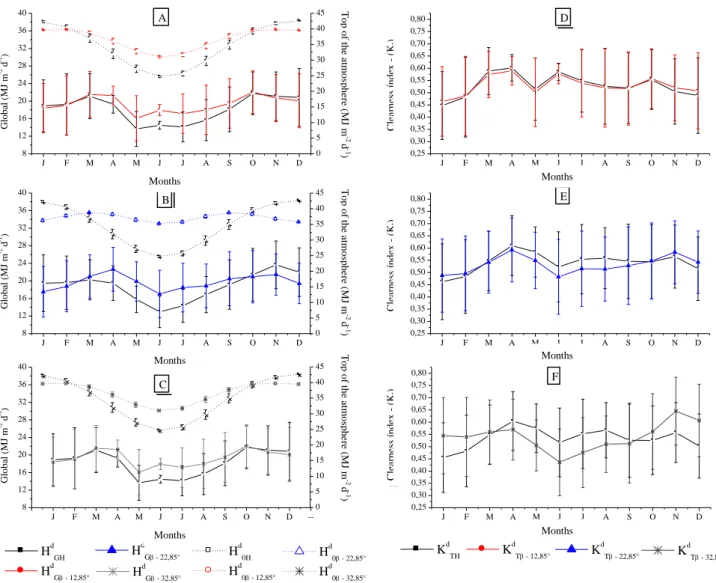
The global radiation received by the tilted plane at 12.85° (Figure 1a) was below the horizontal plane between November and February, and in December it was found lower levels, of
around 0.77 MJ m-2 d-1. In other months, the values HmGβ were higher than HmGH , with maximum
positive difference between the two surfaces in June (3.44 MJ m-2 d-1). In the measurements at
12.85 ° and horizontal surfaces, the lowest mean values of global radiation were recorded in May, due to the large inflow of cold fronts in the Botucatu region, which led to the increase of the ratio of cloud in 2002. On the surface tilted at 22.85° (local latitude), there was little variation throughout
the year, with a difference of 5.64 m-2 d-1 between the maximum peak (April) and minimum peak
(June). It was checked the global energy gains in May, June and July, superior than 4.06 MJ m-2 d-1
when compared to the horizontal surface. The values of tilted global radiation HmGβ in January
and February (17.53 and 18.75 MJ m-2 d-1) were similar to those seen in June, July and August. In
the plane tilted at 32.85° (Figure 2c), the maximum (August) and minimum (December) peaks were
around 21.82 and 14.38 MJ m-2 d-1. Between February and July, the values of HmGβ were stable,
J F M A M J J A S O N D 0,25 0,30 0,35 0,40 0,45 0,50 0,55 0,60 0,65 0,70 0,75 0,80
J F M A M J J A S O N D
0,25 0,30 0,35 0,40 0,45 0,50 0,55 0,60 0,65 0,70 0,75 0,80
J F M A M J J A S O N D
0,25 0,30 0,35 0,40 0,45 0,50 0,55 0,60 0,65 0,70 0,75 0,80
J F M A M J J A S O N D
8 12 16 20 24 28 32 36 40
HdGH HdG - 12,85°
A Meses G lob al ( MJ m
-2 d -1) 0 5 10 15 20 25 30 35 40 45
Hd0H Hd0 - 12,85°
T op o da a tm osf er a (MJ m -2 d -1 )
J F M A M J J A S O N D
8 12 16 20 24 28 32 36 40 B
HdG - 22,85° Meses G lob al ( MJ m
-2 d -1) 0 5 10 15 20 25 30 35 40 45
Hd0 - 22,85°
T op o da a tm osf er a (MJ m -2 d -1 )
J F M A M J J A S O N D
--8 12 16 20 24 28 32 36 40 C
HdG - 32,85° Meses G lob al ( MJ m
-2 d -1) 0 5 10 15 20 25 30 35 40 45
Hd0 - 32,85°
T op o da a tm osf er a (MJ m -2 d -1 ) D
KdTH KdT - 12,85°
Índ ice de cl ar ida de ( KT ) Meses
KdT - 22,85°
Índ ice de cl ar ida de ( KT ) Meses F E
KdT - 32,85°
Índ ice de cl ar ida de ( KT ) Meses
FIGURE 2. Annual evolution of global radiation and clearness index on horizontal surface and tilted surfaces at 12.85° (a, d), 22.85° (b, e) and 32.85° (c, f), facing north.
Among the equinoxes, the horizontal surfaces had KmTH higher than KmTβ with inversion
in the summer months. This behavior was the opposite of the global radiation, considering that the highest values of radiation at the top of the atmosphere of the tilted surfaces during the winter reduce the fractions, even with gains of global radiation on tilted planes.
The increase in tilt angle resulted in seasonality differences between KmTH and KmTβ . Mean
values of transmissivity may be established for global radiation for each season and for each inclination: summer - 0.48, 0.49, 0.51 and 0.56; autumn - 0.58, 0.56, 0.56 and 0.55; winter - 0.55, 0.55, 0.51 and 0.47; and spring - 0.54, 0.53, 0.55, and 0.57, for horizontal surfaces and tilted surfaces at 12.85, 22.85 and 32.85°, respectively.
In Jaboticabal, state of São Paulo, TURKISH & Rizzatti (2006) found that for a surface tilted at 20º North in the clear sky of autumn and winter, the mean global irradiation were around
22.80 MJ m-2 (five days), 20.52 MJ m-2 (6 days), 18.36 MJ m-2 (11 days) 19.24 MJ m-2 (12 days)
and 21.78 MJ m-2 (8 days) for April, May, June, July and August 2002. However, the analysis only
on days with clear skies was not reflected in the monthly means, especially for the low number of days each month that showed clear sky coverage. In Kowloon (Hong Kong), the largest gains occurred on surfaces facing south and 20° tilt, allowing throughout March and October, sums of
328.30 MJ m-2 day-1 and 615.20 MJ m-2 day-1, with daily means of 10.59 and 19.84 MJ m-2,
Months
Months Months
Months
Months Months
respectively (LI & LAM, 2007). Similar results, however, with the climatic and geographical influences were presented by LI et al. (2002) in Hong Kong, KAMALI et al. (2006) in Karaj, Iran, FORERO et al. (2007) in Bogota, Colombia, EL SEBAII et al. (2010) in Jeddah, Saudi Arabia, among others.
Between the equinoxes, horizontal surfaces had m
TH
K higher than m
β T
K with inversion in
the summer months. This behavior was the opposite of the global radiation (Fig. 2), for high values of the radiation at the top of the atmosphere of tilted surfaces during the winter period, reduces the fractions with the same global radiation gain on tilted planes in the winter. The increase in tilt angle
provided an increase in the seasonality difference between KmTH . The mean monthly evolutions of
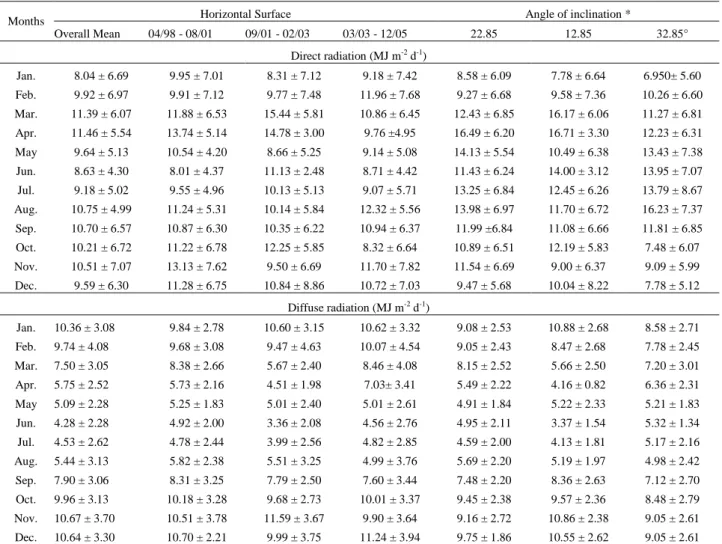
direct and diffuse radiation (Table 1) in horizontal and tilted planes, showed variations dependent on local weather conditions, especially cloudiness and precipitation, its seasonality was similar to the global radiation.
TABLE 1. Daily monthly means of direct and diffuse radiation on tilted and horizontal surfaces measured at different times, facing north.
Months Horizontal Surface Angle of inclination *
Overall Mean 04/98 - 08/01 09/01 - 02/03 03/03 - 12/05 22.85 12.85 32.85° Direct radiation (MJ m-2 d-1)
Jan. 8.04 ± 6.69 9.95 ± 7.01 8.31 ± 7.12 9.18 ± 7.42 8.58 ± 6.09 7.78 ± 6.64 6.950± 5.60 Feb. 9.92 ± 6.97 9.91 ± 7.12 9.77 ± 7.48 11.96 ± 7.68 9.27 ± 6.68 9.58 ± 7.36 10.26 ± 6.60 Mar. 11.39 ± 6.07 11.88 ± 6.53 15.44 ± 5.81 10.86 ± 6.45 12.43 ± 6.85 16.17 ± 6.06 11.27 ± 6.81 Apr. 11.46 ± 5.54 13.74 ± 5.14 14.78 ± 3.00 9.76 ±4.95 16.49 ± 6.20 16.71 ± 3.30 12.23 ± 6.31 May 9.64 ± 5.13 10.54 ± 4.20 8.66 ± 5.25 9.14 ± 5.08 14.13 ± 5.54 10.49 ± 6.38 13.43 ± 7.38 Jun. 8.63 ± 4.30 8.01 ± 4.37 11.13 ± 2.48 8.71 ± 4.42 11.43 ± 6.24 14.00 ± 3.12 13.95 ± 7.07 Jul. 9.18 ± 5.02 9.55 ± 4.96 10.13 ± 5.13 9.07 ± 5.71 13.25 ± 6.84 12.45 ± 6.26 13.79 ± 8.67 Aug. 10.75 ± 4.99 11.24 ± 5.31 10.14 ± 5.84 12.32 ± 5.56 13.98 ± 6.97 11.70 ± 6.72 16.23 ± 7.37 Sep. 10.70 ± 6.57 10.87 ± 6.30 10.35 ± 6.22 10.94 ± 6.37 11.99 ±6.84 11.08 ± 6.66 11.81 ± 6.85 Oct. 10.21 ± 6.72 11.22 ± 6.78 12.25 ± 5.85 8.32 ± 6.64 10.89 ± 6.51 12.19 ± 5.83 7.48 ± 6.07 Nov. 10.51 ± 7.07 13.13 ± 7.62 9.50 ± 6.69 11.70 ± 7.82 11.54 ± 6.69 9.00 ± 6.37 9.09 ± 5.99 Dec. 9.59 ± 6.30 11.28 ± 6.75 10.84 ± 8.86 10.72 ± 7.03 9.47 ± 5.68 10.04 ± 8.22 7.78 ± 5.12
Diffuse radiation (MJ m-2 d-1)
Jan. 10.36 ± 3.08 9.84 ± 2.78 10.60 ± 3.15 10.62 ± 3.32 9.08 ± 2.53 10.88 ± 2.68 8.58 ± 2.71 Feb. 9.74 ± 4.08 9.68 ± 3.08 9.47 ± 4.63 10.07 ± 4.54 9.05 ± 2.43 8.47 ± 2.68 7.78 ± 2.45 Mar. 7.50 ± 3.05 8.38 ± 2.66 5.67 ± 2.40 8.46 ± 4.08 8.15 ± 2.52 5.66 ± 2.50 7.20 ± 3.01 Apr. 5.75 ± 2.52 5.73 ± 2.16 4.51 ± 1.98 7.03± 3.41 5.49 ± 2.22 4.16 ± 0.82 6.36 ± 2.31 May 5.09 ± 2.28 5.25 ± 1.83 5.01 ± 2.40 5.01 ± 2.61 4.91 ± 1.84 5.22 ± 2.33 5.21 ± 1.83 Jun. 4.28 ± 2.28 4.92 ± 2.00 3.36 ± 2.08 4.56 ± 2.76 4.95 ± 2.11 3.37 ± 1.54 5.32 ± 1.34 Jul. 4.53 ± 2.62 4.78 ± 2.44 3.99 ± 2.56 4.82 ± 2.85 4.59 ± 2.00 4.13 ± 1.81 5.17 ± 2.16 Aug. 5.44 ± 3.13 5.82 ± 2.38 5.51 ± 3.25 4.99 ± 3.76 5.69 ± 2.20 5.19 ± 1.97 4.98 ± 2.42 Sep. 7.90 ± 3.06 8.31 ± 3.25 7.79 ± 2.50 7.60 ± 3.44 7.48 ± 2.20 8.36 ± 2.63 7.12 ± 2.70 Oct. 9.96 ± 3.13 10.18 ± 3.28 9.68 ± 2.73 10.01 ± 3.37 9.45 ± 2.38 9.57 ± 2.36 8.48 ± 2.79 Nov. 10.67 ± 3.70 10.51 ± 3.78 11.59 ± 3.67 9.90 ± 3.64 9.16 ± 2.72 10.86 ± 2.38 9.05 ± 2.61 Dec. 10.64 ± 3.30 10.70 ± 2.21 9.99 ± 3.75 11.24 ± 3.94 9.75 ± 1.86 10.55 ± 2.62 9.05 ± 2.61 *The periods of measures presented for the horizontal surface correspond to the periods of measures of tilted planes, respectively.
Between the equinoxes (March-September), the mean levels of HmBβ were higher than the
monthly values of HmBH , with mean daily gain in June (winter solstice) of 2.85, 3.42 and
5.24 MJ m-2 d-1 when inclined to 12.85, 22.85 and 32.85°, respectively. The maximum values of
m β B
H of 12.85° and 22.85° were observed in April (16.71 and 16.49 MJ m-2 d-1), while on the
values are similar, but with seasonality influenced by the ratio of cloudiness. These results corroborate the findings of GUPTA & RALEGAONKAR (2004), in six geographical conditions in India.
The variation of reflected radiation throughout the year followed the evolution of global
radiation, because the levels of d
β R
H trapped by a tilted surface depend on the surface albedo and
on the values of d
β G
H and in this case, in general, it was equivalent to 0.28, 0.94 and 1.97% of
total incident radiation at 12.85, 22.85 and 32.85°.
In most months, the tilted diffuse radiation HmDβ was less than the horizontal (Table 1). The
peak of diffuse radiation observed in May for both the tilted surface at 12.85° and horizontal were due to the increase of the ratio of cloudiness in Botucatu, during the year of 2002. In May, June and
July, in this inclination, it was observed levels of HmDβ equal to 5.22, 3.37 and 4.13 MJ m
-2
d-1. In
the winter months, at the angle of 22.85°, the values were similar to those seen in the horizontal
plane, with intensities of 4.95, 4.59 and 5.69 MJ m-2 d-1 in May, June and July. In November,
December and January, at the inclination of 22.85°, there were losses of 12.90, 8.93 and 7.77%, respectively, when compared to the horizontal. The increase of the inclination angle provided an
increase in the difference between the levels of m
β D
H and m
DH
H especially in the summer months,
with further loss of diffuse radiation on higher inclinations. In general, during the summer months the grounds of cloudiness are higher (Figure 1), the diffuse component of radiation increases and the direct component decreases, however, the increase in diffuse radiation levels recorded in September (the period with low precipitation) was a result of increased optical density pattern (aerosols) from the burning of sugar cane in the region (CODATO et al., 2008).
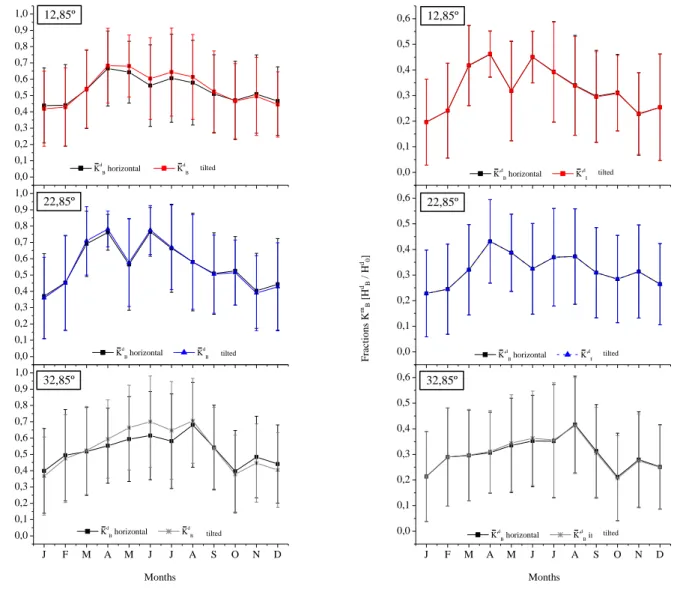
January was the month which presented the lowest ratios of direct and global radiation, m
BH
K , for horizontal surfaces, indicating that in this period around 37% of the total incident
radiation is provided by direct component (Figure 3). Regardless of the angle of inclination, the
highest mean values of KmBβ occurred between the equinoxes. In June, at the inclinations of
12.85° and 32.85°, the values of direct radiation were above 70% of the total incised on the surface. At 22.85°, the maximum values occurred in April and May, coinciding with the horizontal surface (68% of global radiation).
There were no differences in direct atmospheric transmissivity between the tilted and
horizontal surfaces, depending on the application of the geometric factor d
B
R for obtaining the
inclined direct radiation (Equation 1). The differences between the monthly mean values were due to climatic variations between the different periods of measures. These rates are also indicative of sky conditions, since the smaller the value, the lower the contribution of direct radiation in total of incident radiations. At angle 12.85° and on the corresponding horizontal, there were annual means
of K'mBH and
m β B '
K equivalent to 0.32 and 0.30, being able to reach up to 0.69 (Figure 3). The
lowest variations of K'mBβ over the year were observed at the inclination of 32.85°, with a peak in
August (0.41). In general, in this same tilted plane, from the total radiation incident on the top of the atmosphere, 26% was transmitted directly to the surface in spring and summer and around 31% and 37% in autumn and winter. These values do not differ significantly from the average percentages (between 1999 and 2005) for horizontal surfaces, with the exception of the autumn, which presented
0,0 0,1 0,2 0,3 0,4 0,5 0,6 0,7 0,8 0,9 1,0
0,0 0,1 0,2 0,3 0,4 0,5 0,6 0,7 0,8 0,9 1,0
J F M A M J J A S O N D
0,0 0,1 0,2 0,3 0,4 0,5 0,6 0,7 0,8 0,9 1,0
0,0 0,1 0,2 0,3 0,4 0,5 0,6
0,0 0,1 0,2 0,3 0,4 0,5 0,6
J F M A M J J A S O N D
0,0 0,1 0,2 0,3 0,4 0,5 0,6
Meses 12,85º
Fr
aç
ão
K
m B
[
H
d / H B d G
]
Kd
B horizontal K
d
B inclinada
22,85º
Kd
B horizontal K
d
B inclinada
32,85º
Kd
B horizontal K
d
B inclinada
12,85º
K'd
B horizontal K'
d
B inclinada
Fr
aç
ão
K
'
m B
[
H
d / H B d 0
] 22,85º
K'd
B horizontal K'
d
B inclinada
32,85º
K'd
B horizontal K'
d
B inclinada
Meses
FIGURE 3. Monthly mean fractions of direct radiation on tilted surfaces at 12.85, 22.85 and 32.85° facing north and on horizontal surface.
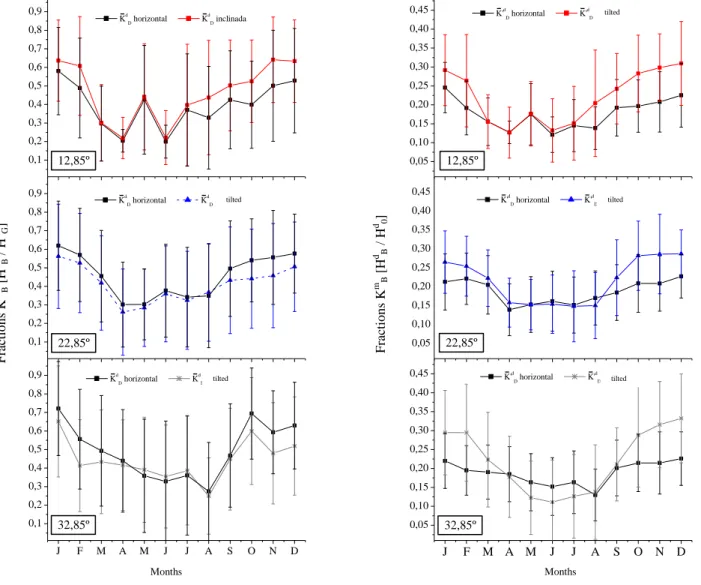
As the global radiation on tilted surfaces is dependent on the sum of the direct, diffuse and reflected incident radiation, the months in which direct radiation had the lowest mean values was an
increase of the mean values of diffuse radiation and consequently of the fraction KDm (Figure 4).
Between February and November, KmDH showed minimum of 0.440 ± 0.30 (November) and
maximum 0.699 ± 0.30 (January). Between the fall and spring equinoxes, the values of KmDH
ranged from 0.20 ± 0.09 (June) and 0.48 ± 0.27 (October). At the angle of 12.85°, independent of
the month, the values of KmDβ lower than
m DH
K , with minor differences in the winter. At this
inclination, the maximum diffuse fraction in relation to the global was of 64.12% in January and a minimum of 21.91% in June. The increase of the inclination angle increased diffuse fraction of global radiation on the horizontal compared to the tilted planes during the summer months (periods with higher ratios of cloudiness and rainfall).
Months Months
F
ra
cti
ons
K
m B
[H
d B
/
H
d G
]
F
ra
cti
ons
K
m B
[H
d B
/
H
d] 0
tilted tilted
tilted tilted tilted
0,1 0,2 0,3 0,4 0,5 0,6 0,7 0,8 0,9 0,1 0,2 0,3 0,4 0,5 0,6 0,7 0,8 0,9
J F M A M J J A S O N D
0,1 0,2 0,3 0,4 0,5 0,6 0,7 0,8 0,9 0,05 0,10 0,15 0,20 0,25 0,30 0,35 0,40 0,45 0,05 0,10 0,15 0,20 0,25 0,30 0,35 0,40 0,45
J F M A M J J A S O N D
0,05 0,10 0,15 0,20 0,25 0,30 0,35 0,40 0,45 Meses Fr aç ão K' m D [ H d D / H
d ] 0
Meses 12,85º Fr aç ão K m D [ H d D / H d G ] Kd
D horizontal K
d
D inclinada
22,85º
KdD horizontal K
d
D inclinada
32,85º
Kd
D horizontal K
d
D inclinada
12,85º
K'dD horizontal K'
d
D inclinada
22,85º
K'd
D horizontal K'
d
D inclinada
32,85º
K'd
D horizontal K'
d
D inclinada
FIGURE 4. Monthly mean fractions of direct radiation on tilted surfaces at 12.85, 22.85 and 32.85° facing north and on horizontal surface.
The same seasonal effects were observed for fractions m
DH
'
K and K'mDβ , with higher values
of m
β D
'
K in summer, with increasing differences with increasing of the tilt angle. In winter, higher
angles led to lower values of K'mDβ , depending on the significant increase of Hd0β (Figure 2)
together with the smaller contributions of diffuse radiation at that time. At 12.85º, the highest values
of K'mDH and K'mDβ were recorded in December (0.232) and lowest values in June (0.112). The
levels verified in May showed a rise in 12.85° and horizontal surfaces (0.1461 and 0.1751, respectively), according to the increasing cloudiness in May (0.44), when compared to the mean of 1999 to 2005 (0.33 ± 0.1), as shown in Figure 1. Therefore, low levels of diffuse radiation occurred in August, depending on the low ratios of cloudiness. Between October and February, during the
period of measurements at inclination 22.85°, the values of K'mDβ were above 0.23 and the mean
was 12% higher than the values of K'mDH .
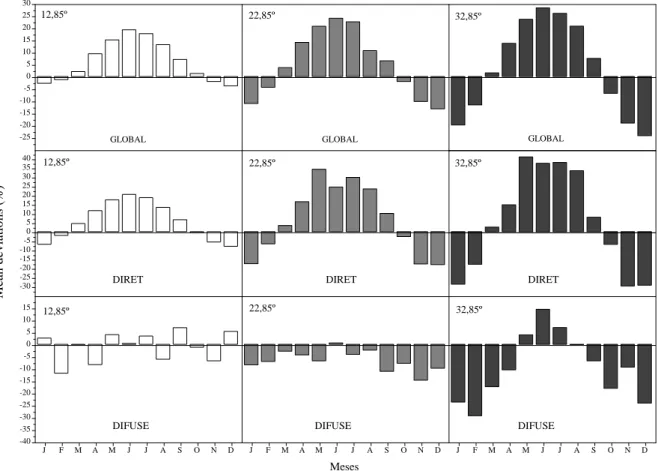
The daily monthly mean relative deviations showed that the gains in the three radiations studied on tilted surfaces occurred in autumn and winter, and the losses in the spring and summer (Figure 5), depending on the angle of inclination. The maximum gains of global radiation were 19.20, 23.91 and 28.20%, and the maximum losses were -3.80%, -13.05% and -24.30%, equivalent
in energy terms to 4.00; 6.50 and 7.00 MJ m-2 d-1 and -2.00; -4.50 and -6.00 MJ m-2 d-1 to 12.85, 22.85 and 32,85°, respectively.
-25 -20 -15 -10 -5 0 5 10 15 20 25 30
GLOBAL 12,85º
GLOBAL 22,85º
GLOBAL 32,85º
-30 -25 -20 -15 -10 -5 0 5 10 15 20 25 30 35 40
12,85º
DIRETA
D
es
vi
os
re
la
tiv
os
(%)
22,85º
DIRETA
32,85º
DIRETA
J F M A M J J A S O N D
-40 -35 -30 -25 -20 -15 -10 -5 0 5 10 15 12,85º
DIFUSA
J F M A M J J A S O N D
22,85º
DIFUSA
Meses
J F M A M J J A S O N D
32,85º
DIFUSA
FIGURE 5. Monthly mean deviations of global, direct and diffuse radiations on surfaces tilted at 12.85, 22.85 e 32.85º.
In all inclinations, the maximum gains and losses of direct radiation were observed in June and December, with values ranging from 20.40, 29.90 and 37.50% for the positive deviations and -8.0, -19.10 and -37.80% for the negative deviations at 12.85, 22.85 and 32.85°, respectively. The greatest losses of diffuse radiation occurred on tilted plane at 32.85°, with deviations of up to -29.37% (in February), -24.12% (in December) and -23.73% (in January). The maximum positive deviations were observed at inclination of 22.85º in March and June (30.35% and 32.15%).
CONCLUSIONS
The tilted surfaces led to gains on incident global radiation of 23.75, 31.42 and 39.24% in winter/autumn and losses of 3.69, 11.70 and 19.55% in spring/summer at 12.85, 22.85 and 32.85°. The gains of direct radiation on tilted surfaces were 25.63, 42.65 and 60.08% and losses of 1.87, 11.32 and 20.80%, following the same seasonal variation of global radiation. The diffuse radiation of tilted surfaces was less than in the horizontal plane in most months, with losses estimated at 65%.
The values of d
TH
K were higher than those of KdT between the equinoxes, with the
increase of the difference with the increase of tilt angle. The conditions of sky coverage affected directly the annual evolution of the direct and diffuse atmospheric transmissivity for horizontal and tilted surfaces. The radiometric fractions showed the reverse annual evolution to the solar radiation components.
M
ea
n
d
ev
iati
o
n
s (
%
)
DIFUSE DIFUSE DIFUSE
LIST OF SYMBOLS
β Angle of inclination
I Instantaneous radiation (W m-2)
Hd Integrated radiation in the daily partition (MJ m-2 day-1) Kd Daily radiometric fraction
Hm Monthly mean radiation of daily values (MJ m-2 day-1) Km Monthly mean radiometric fraction of daily values
IGH Instantaneous global radiation on horizontal surface (W m-2)
IGβ Instantaneous global radiation on tilted surface (W m-2) IBN Instantaneous direct radiation on incidence (W m-2)
IBH Instantaneous direct radiation on a horizontal surface (W m -2
)
IBβ Instantaneous direct radiation on tilted surface (W m-2) d
H 0
H Daily extraterrestrial radiation for horizontal surface (MJ m-2 day-1) d
0
H Daily extraterrestrial radiation for tilted surface (MJ m-2 day-1)
d GH
H Daily global radiation on horizontal surface (MJ m-2 day-1)
d G
H Daily global radiation on tilted surface (MJ m-2 day-1) d
BH
H Daily direct radiation on a horizontal surface (MJ m-2 day-1)
d B
H Daily direct radiation on tilted surface (MJ m-2 day-1)
d DH
H Daily diffuse radiation on tilted surface (MJ m -2
day-1)
d D
H Daily diffuse radiation on tilted surface (MJ m
-2 day-1)
d R
H Daily reflected radiation on titled surface (MJ m
-2
day-1)
d TH
K Coefficient of atmospheric transmissivity of global radiation on horizontal
d T
K Coefficient of atmospheric transmissivity of global radiation on tilted surface
d BH
K Daily direct fraction of global radiation on horizontal surface
d B
K Daily direct fraction of global radiation on tilted surface
d BH
'
K Daily direct fraction of extraterrestrial radiation on horizontal surface
d B
'
K Daily direct fraction of extraterrestrial radiation on tilted surface
d DH
K Daily diffuse fraction of global radiation on horizontal surface
d D
K Daily diffuse fraction of global radiation on tilted surface
d DH
'
K Daily diffuse fraction of extraterrestrial radiation on horizontal surface
d D
'
K Daily diffuse fraction of extraterrestrial radiation on tilted surface
REFERENCES
ARAGON, F.F.; TOLEDO PIZA, J.A.N. Avaliação global da incidência de radiação solar em superfícies topográficas. Energia na Agricultura, Botucatu, v.7, n.1, p.26-40, 1992.
BENINCASA, M. Efeitos de rampas com diferentes declividades e exposições norte e sul de uma bacia hidrográfica sobre o microclima e produtividade biológica do Sorghum bicolor (L) Moench. 1976. 109 f. Tese (Livre Docência) - Universidade Estadual Paulista, Faculdade de Ciências Agrárias e Veterinárias, Jaboticabal, 1976.
BORGES, V.P.; OLIVEIRA, A.S.; COELHO FILHO, M.A.; SILVA, T.S.M.; PAMPONET, B.M. Avaliação de modelos de estimativa da radiação solar incidente em Cruz das Almas, Bahia. Revista Brasileira de Engenharia Agrícola e Ambiental, Campina Grande, v.14, n.1, p.74-80, 2010.
CEPAGRI. CENTRO DE PESQUISAS METEOROLÓGICAS E CLIMÁTICAS APLICADAS A AGRICULTURA. Clima dos municípios paulistas. Disponível em: <http://www.cpa.unicamp.br>. Acesso em: 30 jun. 2009.
CODATO, G.; OLIVEIRA, A.P.; SOARES, J.; ESCOBEDO, J.F.; GOMES, E.N.; DAL PAI, A. Global and diffuse solar irradiance in urban and rural areas in Southeast Brazil. Theoretical and Applied Climatology, Vienna, v.93, n.1, p.57-73, 2008.
DIEZ-MEDIAVILLA, M.; MIGUEL, A.; BILBAO, J. Measurement and comparison of diffuse solar irradiance models on inclined surfaces in Valladolid (Spain). Energy Conversion and Management, Oxford, v.46, n.8, p.2075-2092, 2005.
DUBAYAH, R.; RICH, P.M. Topographic solar radiation model for GIS. International Journal of Geographical Information Science, London, v.9, n.4, p.405-419, 1995.
EL-SEBAII, A.A.; AL-HAZMI, F.S.; AL-GHAMDI, A.A.; YAGHMOUR, S.J. Global, direct and diffuse solar radiation on horizontal and tilted surfaces in Yeddah, Saudi Arabia. Applied Energy, London, v.87, p.568-576, 2010.
ESCOBEDO, J.F.; GOMES, E.N.; OLIVEIRA, A.P.; SOARES, J. Modeling hourly and daily fractions of UV, PAT and NIR to global solar radiation under various Sky conditions at Botucatu, Brazil. Applied Energy, London, v.86, n.2, p.299-309, 2009.
ESCOBEDO, J.F.; GOMES, E.N.; OLIVEIRA, A.P.; SOARES, J. Ratios of UV, PAR and NIR components to global solar radiation measured at Botucatu site in Brazil. Renewable Energy, Oxford, v.36, n.1, p.169-178, 2011.
FORERO, N.; CAICEDO, L.; GORDILLO, G. Correlation of global solar radiation values estimated and measured on an inclined surface for clear days in Bogotá. Renewable Energy, Oxford, v.32, p.2590-2602, 2007.
GUEYMARD, C.A. Direct and indirect uncertainties in the prediction of tilted irradiance for solar engineering applications. Solar Energy, Kidlinton, v.83, n.3, p.432-444, 2009.
GUPTA, R.; RALEGAONKAR, R.V. Estimation of beam radiation for optimal orientation and shape decision of buildings in India. Journal of the Institution of Engineers, Calcuta, v.85, n.1, p.27-32, 2004.
IQBAL, M. An introduction to solar radiation. Ottawa: Academic Press, 1983. 389 p.
KAMALI, G.A.; MORADI, I.; KHALILI, A. Estimating solar radiation on tilted surfaces with various orientations: a study case in Karaj (Iran). Theoretical and Applied Climatology, Vienna, v.84, n.4, p.235-241, 2006.
LI, D.H.W.; LAM, T.N.T. Determining the optimum tilt angle and orientation for solar energy collection based on measured solar radiance data. International Journal of Photoenergy, Washington, v.8, n.1, p.1-9, 2007.
LI, D.H.W.; LAM, T.N.T.; CHU, V.W.C. Relationship between the total solar radiation on tilted surfaces and the sunshine hours in Hong Kong. Solar Energy, Kidlinton, v.82, p.1220-1228, 2008
LIU, B.Y.H.; JORDAN, R.C. The interrelationship and characteristic distribution of direct, diffuse and total solar radiation. Solar Energy, Kidlington, v.4, n.1, p.1-19, 1960.
NOORIAN, A.M.; MORADI, I.; KAMALI, G.A. Evaluation of 12 models to estimate hourly diffuse irradiation on inclined surfaces. Renewable Energy, Oxford, v.33, n.6, p.1406-1412, 2008.
PANDEY, C.K.; KATIYAR, A.K. A note on diffuse solar radiation on a tilted surface. Energy, Oxford, v.34, n.11, p.1764-1769, 2009.
POSADILLO, R.; LUQUE, R.L. Hourly distributions of the diffuse fraction of global solar
irradiation in Córdoba (Spain). Energy Conversion and Management, Oxford, v.50, n.2, p.223-231, 2009.
SCOLAR, J.; MARTINS, D.; ESCOBEDO, J.F. Estimativa da irradiação total sobre uma superfície inclinada a partir da irradiação global na horizontal. Revista Brasileira de Geofísica, São Paulo, v.21, n.3, p.249-258, 2003.
SILVA, R.A.; SILVA, V.P.R.; CAVALCANTI, E.P.; SANTOS, D.N. Estudo da variabilidade da radiação solar no Nordeste do Brasil. Revista Brasileira de Engenharia Agrícola e Ambiental, Campina Grande, v.14, n.5, p.501-509, 2010.
SOARES, J.; OLIVEIRA, A.P.; BOZNAR, M.Z.; MLAKAR, P.; ESCOBEDO, J.F.; MACHADO, A.J. Modeling hourly diffuse solar-radiation in the city of Sao Paulo using a neural-network technique. Applied Energy, London, v.79, n.2, p.201-204, 2004.
SOUZA, A.P.; ESCOBEDO, A.P.; DAL PAI, A.; GOMES, E.N. Estimativa da radiação global incidente em superfícies inclinadas por modelos isotrópicos e índice de claridade. Pesquisa Agropecuária Brasileira, Brasília, v.45, n.4, p.339-350, 2010.
TURCO, J.E.P.; PINOTTI JÚNIOR, M.; RODRIGUES, T.J.D.; FERNANDES, E.J. Desenvolvimento da cultura da soja em diferentes terrenos com diferentes exposições e declividades. Engenharia Agrícola, Jaboticabal, v.17, n.2, p.21-28, 1997.
TURCO, J.E.P.; RIZZATTI, G.S. Avaliação de modelo matemático para estimar a radiação solar incidente sobre superfícies com diferentes exposições e declividades. Engenharia Agrícola, Jaboticabal, v.26, n.2, p.257-267, 2006.
VARTIAINEN, E. A new approach to estimating the diffuse irradiance on inclined surfaces. Renewable Energy, Oxford, v.20, n.1, p.45-64, 2000.