Failure to Use and Sustain Male Condom
Usage: Lessons Learned from a Prospective
Study among Men Attending STI Clinic in
Pune, India
Seema Sahay1, Swapna Deshpande2, Shilpa Bembalkar1, Mahesh Kharat1, Aparna Parkhe1, Radhika G. Brahme1, Ramesh Paranjape1, Robert C. Bollinger3, Sanjay M. Mehendale4*
1National AIDS Research Institute, Pune, India,2CYTEL, Pune, India,3Johns Hopkins University, Baltimore, Maryland, United States of America,4National Institute of Epidemiology, Chennai, India
Abstract
Background
Sustained or consistent use of condoms by men remains a challenge. A study was carried out to identify factors associated with failure to use condoms consistently by men attending STD clinics in Pune, India.
Method
Among 14137 STI clinic attendees, 8360 HIV sero-negative men were enrolled in a cohort study. The changes in condom usage behavior were studied among 1284 men who returned for first scheduled quarterly follow up, 309 reported consistent condom use at the time of enrollment in the cohort. Data pertaining to heterosexual men practicing high risk behavior were analyzed to identify factors associated with change in condom use behavior using logistic regression model. Demographic, behavioral and biological factors observed to be associated with condom use were fitted in five Cox proportional hazards models to cal-culate hazard ratios and their 95% confidence intervals to identify independent predictors of failure to sustain condom use behavior.
Results
The univariate analysis showed that men who were 30 years or older in age (p = 0.002) and those who did not have contact female sex worker (FSW) were more likely to fail to sustain consistent condom use. However both these factors did not show significant association in multivariable analysis. Marital status and contact with Hijra (eunuch) in lifetime were associ-ated with failure to change in their condom use behavior [AOR 0.33 (CI 0.13–0.82; p = 0.017)]. During the follow up of 2 years, 61 events (15.5 per 100 person years, 95% CI 12.3–19.5 years) of‘failure of condom use’were recorded despite counseling. Older age,
OPEN ACCESS
Citation:Sahay S, Deshpande S, Bembalkar S,
Kharat M, Parkhe A, Brahme RG, et al. (2015) Failure to Use and Sustain Male Condom Usage: Lessons Learned from a Prospective Study among Men Attending STI Clinic in Pune, India. PLoS ONE 10(8): e0135071. doi:10.1371/journal.pone.0135071
Editor:Dhayendre Moodley, University of
Kwazulu-Natal, SOUTH AFRICA
Received:December 22, 2014
Accepted:July 16, 2015
Published:August 13, 2015
Copyright:This is an open access article, free of all copyright, and may be freely reproduced, distributed, transmitted, modified, built upon, or otherwise used by anyone for any lawful purpose. The work is made available under theCreative Commons CC0public domain dedication.
Data Availability Statement:Third-party data is from the HIVNET study and can be made available upon request to the Director, National AIDS Research Institute, Pune, India ([email protected]).
Funding:The study was supported by National
Institutes of Health (NIH) AI-33879, NIH AI-47968 and RR-00722. The funders had no role in study design, data collection and analysis, decision to publish, or preparation of the manuscript.
Competing Interests:The authors have declared
contact with non CSW partner and presence of genital ulcer disease / discharge syndrome were significant predictors of failure to sustain condom use.
Discussion
Married monogamous older men, who report contact with sex worker and present with geni-tal ulcer disease are at risk of failure to use condom after first exposure to voluntary HIV counseling and testing. This is a scenario of primary prevention program. Condom promo-tion and counseling needs to be reinforced through follow up counseling among this population.
Introduction
In developed countries [1,2] and India, the bacterial sexually transmitted infections (STI) like chancroids and gonorrhea are declining, while viral STI like HPV and herpes genitalis are com-monly prevalent. According to National AIDS Control Program of India, approximately 30% of core group populations practicing high risk behavior such as female sex workers (FSW), men having sex with men (MSM) and injecting drug users (IDU) suffer from some reproduc-tive tract infections (RTI) or STI in a calendar year [3]. Men having multiple sex partners and those presenting with sexually transmitted infections (STI) act as an important bridge popula-tion for spread of HIV from core groups to the general populapopula-tion [4]. Decline in HIV among sex workers has been attributed to sustained targeted interventions [5,6,7]. India has the third largest number of people living with HIV in the world: 2.1 million at the end of 2013 with an adult prevalence of 0.3%-which accounts for about 4 out of 10 people living with HIV in the region [8,9]. Of all HIV infections, 39% (930,000) are among women. In India, sexual trans-mission is responsible for 87.4 percent of reported HIV cases [10].
Although condoms are known to be effective in preventing sexually transmitted infections (STIs) including HIV; consistent condom use has remained a challenge. In 1987, almost one hundred years after the invention of the male rubber condoms, the US Surgeon General recom-mended their use for HIV prevention and they have proved to be efficacious in preventing HIV transmission [11]. However, their effectiveness at the population level is affected by less acceptability and inconsistent usage which can be partner-dependent [12,13]. A recent study among 16–25 years old Australian youth reported the predictors of STI history in participants who had sexual intercourse ever, was associated with‘never’or sometimes’condom use [95% CI AOR 1.48 (1.02, 2.16) P 0.04] [14]. A systematic review of 34 studies showed condom non-use to be one of the common barriers to HIV testing in both low and high income countries [15]. Another review highlights the need for behavioral risk reduction and adherence as essen-tial components of any biomedical approach including condom use [16]. India’s National AIDS Control Program emphasizes on promoting condom use during commercial sex [4]. However, despite vulnerability and advocacy, condom use in the marital setting has remained sub-optimal [17]. Non-use of condom among women in India has been linked to socio-cultural context where emphasis needs to be more on family health rather than contraception [18]. A survey among 2408 young men revealed low condom use among men (27%) and women (7%) during premarital sex settings in India [19].
sexual intercourse itself [20,21]. Since the year 2000, several studies have shown that con-doms are effective in preventing STIs among men and women[22]. Following introduction of 100% condom use programme in sex work settings in Thailand, a 95% drop in common curable STIs during the 1990s was reported [23]. In an African study, consistent condom use showed significant reduction in HIV, syphilis and gonorrhea/ chlamydial infections [24]. There is paucity of literature regarding factors affecting the sustainability of consistent condom usage. Changing human behavior is a challenge especially when behavior modifica-tions are required for disease prevention [25]. Condom use by people and the strategies to promote condom use have not changed in the last few decades [26,27]. Recent evidence of non-adherence to various prevention options reported in clinical trials conducted world-wide has led to our interest in analyzing STI cohort data set to learn about non adherence to condom usage as a prevention option. Our study remains pertinent even today as condom use continues to be a challenge [28] and needs to be appropriately positioned even with emergence of newer technologies like vaccine, vaginal microbicides and prophylaxis. It could be a function of two primary components: a) Accepting the advice regarding condom use and actually use them [positive behavior change] and b) Continuing to use condoms at all times even with STIs [sustaining positive behavioral change]. We investigated these two dimensions of condom use among men attending STI clinics in Pune, India. We feel that findings of this study may guide in formulating appropriate guidelines and strategies to increase condom use as well as ensure its consistent use for prevention and control of STI and HIV in India. In a cohort of men attending STI clinics in Pune, India, we assessed the change and sustenance of condom use behavior and studied the predictors of failure to sus-tain consistent condom use during peno-vaginal sex.
Methods
Ethics
The study and informed consent form was approved by the Ethics Committee of the National AIDS Research Institute and Institutional Review Board of Johns Hopkins University Joint Committee on Clinical Investigation. Written informed consent was obtained from all study participants. The consent was in local language and it was administered by trained counselors. For the participants who were illiterate, the consent was read out and was explained in the pres-ence of an impartial witness. The consent was either signed by the participant or thumb impression was obtained in case of illiterate participant in the presence of witness. The copy of informed consent was offered to all participants. The informed consents were kept in a separate file under lock and key. Participants who refused to take the copy of informed consent form; their consent form was also filed separately and stored under lock and key.
Study Design
Prospective, clinic-based, cohort study.
Study Population and Period
Study Procedure and Instruments
Individuals aged 18 years or older, and willing to provide informed consents were enrolled. According to the lead counselors of the study, there were no refusals for participation. A struc-tured interviewer-administered questionnaire was used to obtain data on demographics, medi-cal history, sexual and other risk behaviors, knowledge of HIV and condom use practices at baseline and at each quarterly follow up visit for a period of two years. Participants underwent physical examination and were tested for HIV and STI [29]. All participants received HIV pre and post-test counseling by trained and qualified counselors. Risk reduction counseling and condom demonstration were done. The participants were counseled about importance of receiving test reports and follow up. There was no consent for home visit; hence home visits for retention were not done. Clinical and laboratory diagnoses of STIs were made following the national guidelines and standard treatment was provided [30]. For the purpose of this analysis, HIV sero-negative men who reported having heterosexual partners at enrollment at the STD clinic were considered.
Operational definitions used in the study
Condom use with regular or non-regular partners has been used as indicator in several surveys [31]. In this study, reported condom use during sex with regular or irregular partner was stud-ied. The question asked was‘Since your last visit did you have any sexual partners who were female; eunuch or male- non eunuch? Type of sex (vaginal, oral, and anal) with each partner, frequency of condom use (never, sometimes, and always) and type of partner (commercial sex worker, non-commercial regular or casual sex partner or HIV + partner) was explored.
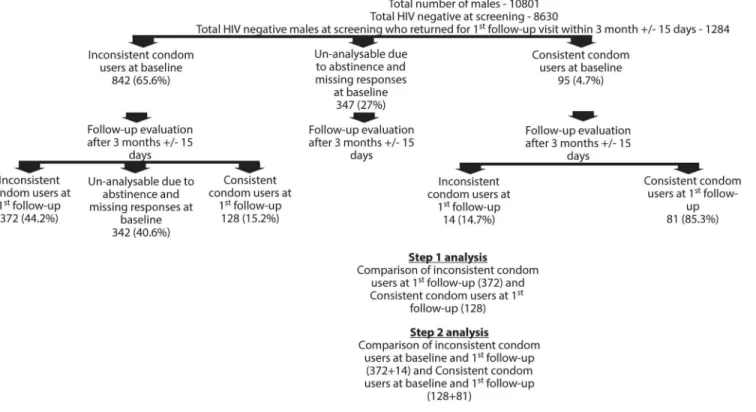
Defining the study variables pertaining to condom use. Three groups of men came at baseline as shown in the schema (Fig 1):
1. Men who reported inconsistent condom use
2. Men who reported consistent (always) condom use
3. Men who reported to be abstinent or non-responders [no response]
At enrollment, i.e. at first follow up after 3 months, all the men who reported always / con-sistent condom use were considered as concon-sistent condom users and analysis was done to understand the sustainability of condom use behavior among these men. Therefore at first fol-low up, we had men who were inconsistent condom users, abstinent/ non responders and men who were consistent condom users. The operational definitions for condom use are as follows:
Consistent condom use. Using condoms‘always’within a period of 3 months ±15 days from the enrollment visit or continuing to‘always’use condoms until the first follow-up visit among those who reported using condoms‘always’at baseline. The question was asked about frequency of condom use (never, sometimes, always) with sex partner with in the last 3 months.
Inconsistent condom use. Using condoms‘never or sometimes’within a period of 3 months ±15 days from the enrollment visit or using condoms‘never or sometimes’until the first follow-up visit.
Positive condom use behavior. Change from inconsistent condom use (never/ some-times) to consistent condom use.
Failure of condom use. Change of condom use behavior from‘consistent condom use’to
‘inconsistent condom use’.
Study population
All STI patients enrolled in the study who returned for 1stfollow-up visit were included in the analysis to get clue on the outcome primary prevention which was HIV counseling and testing and treatment of current STI. Of the total of 14137 men and women attending STI clinics dur-ing the study period, 10801 (76.4%) were men. All were screened for HIV. Of the total men, 8630 were HIV sero-negative and 1284 of them returned for their first three monthly follow-up visit. These 1284 men were considered for the present study. All of them received primary prevention counseling and HIV testing at baseline and they were called for the next follow up scheduled after 3 months±15 days.
Statistical Analysis: Analysis was performed in two steps as summarized inFig 1: Showing the study participant characteristics in step 1 and step 2 analysis.
We performed two different types of analyses as follows:
Step 1 analysis.For step 1 analysis, comparison of characteristics of inconsistent condom users (372/842) and consistent condom users at 1st follow-up (128/842) was made. Data on rest of the individuals’was not included because of non-response, missing data or reported abstinence. Demographic, behavioral, biological and clinical variables were used in the uni-variate and multivariable logistic models to identify predictors of failing to change to posi-tive condom behavior. Rationale of covariates selected was based on researcher’s interest and opinions of expert clinicians in the field, epidemiologist and social scientist. The enter Fig 1. Showing the study participant characteristics in step 1 and step 2 analysis
method by self-selection was used for univariate and multivariable logistic regression. Cox and Snell R square method was used to check model adequacy.
Step 2 analysis.In addition to 128 patients who changed to positive condom behavior in step A; men (who already had positive condom use behavior at baseline (were using condoms
‘always’) and continued to sustain positive condom behavior until the first follow-up 81/95) were considered for step 2 analysis. We analyzed data on condom use and associated factors among these 209 to identify‘those who sustained consistent condom use’and 386 who
‘failed to sustain condom use’for the total duration of follow up of 2 years (Fig 1). We employed Cox proportional hazards models with time dependent covariates [32] to calcu-late hazard ratios with their 95% confidence intervals to identify predictors of failure to sus-tain consistent condom use. The proportional hazards assumption was checked using Schoenfeld residuals [33].
We hypothesized that demographic factors, sexual behavior and biological factors could affect condom use differentially and hence we used multiple models to verify the predictors of lack of condom use in our study population. In all, 7 models were constructed using baseline values of various covariates [29,30,34,35,36] as follows:
Model 1—Four demographic variables, viz. age, education, employment, religion
Model 2—Variables used in Model 1 and marital status
Model 3—Variables used in Model 2 and history of alcohol consumption
Model 4—Variables used in Model 2 and 3
Model 5—Variables used in Model 4 and two variables reflecting sexual behavior that might influence condom use [contact with non-CSW partners in last 3 months and contact with Hijras or CSW partners in last 3 months]
Model 6—Variables used in Model 4 and two variables reflecting biological factors that might influence condom use [Presence of Genital Ulcer Diseases (GUDs), Genital Discharge Dis-eases (GDs) or GUDs / GDs in last 3 months]
Model 7—Variables used in Model 5 and 6.
Two sided probability values<0.05 were considered statistically significant. All statistical
analyses were conducted using STATA 10.0 (StataCorp, College Station, Texas) and SPSS 15.0 statistical software (SPSS Inc., USA)
Results
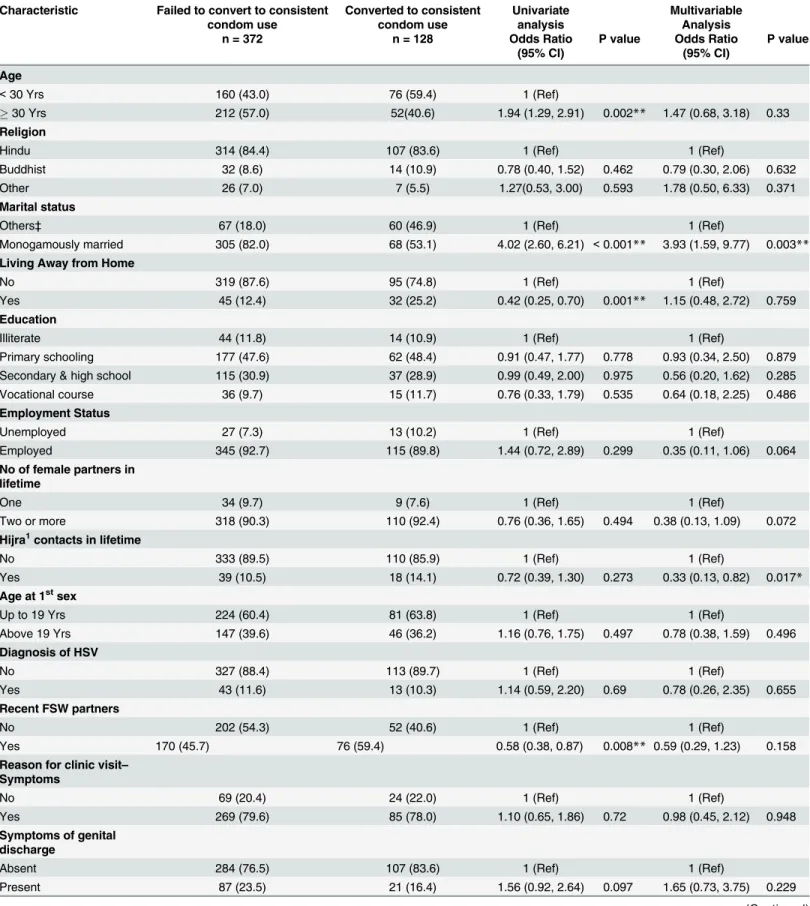
In step 1 analysis, comparison of 128 men who adopted positive condom use behavior and 372 who did not was made.“Table 1”shows that in univariate analysis, men who were 30 years or older and who were monogamously married were more likely to fail to change to positive con-dom behavior [OR: 1.94 (CI: 1.29–2.91; p = 0.002)] and [OR: 4.02 (CI: 2.60–6.21; p<0.001)]
respectively.
Table 1. Factors associated with failure to change from inconsistent condom use to‘positive’condom use behavior among male STD patients.
Characteristic Failed to convert to consistent condom use
Converted to consistent condom use
Univariate analysis
Multivariable Analysis
n = 372 n = 128 Odds Ratio
(95% CI)
P value Odds Ratio (95% CI)
P value
Age
<30 Yrs 160 (43.0) 76 (59.4) 1 (Ref)
30 Yrs 212 (57.0) 52(40.6) 1.94 (1.29, 2.91) 0.002** 1.47 (0.68, 3.18) 0.33
Religion
Hindu 314 (84.4) 107 (83.6) 1 (Ref) 1 (Ref)
Buddhist 32 (8.6) 14 (10.9) 0.78 (0.40, 1.52) 0.462 0.79 (0.30, 2.06) 0.632
Other 26 (7.0) 7 (5.5) 1.27(0.53, 3.00) 0.593 1.78 (0.50, 6.33) 0.371
Marital status
Others‡ 67 (18.0) 60 (46.9) 1 (Ref) 1 (Ref)
Monogamously married 305 (82.0) 68 (53.1) 4.02 (2.60, 6.21) <0.001** 3.93 (1.59, 9.77) 0.003**
Living Away from Home
No 319 (87.6) 95 (74.8) 1 (Ref) 1 (Ref)
Yes 45 (12.4) 32 (25.2) 0.42 (0.25, 0.70) 0.001** 1.15 (0.48, 2.72) 0.759
Education
Illiterate 44 (11.8) 14 (10.9) 1 (Ref) 1 (Ref)
Primary schooling 177 (47.6) 62 (48.4) 0.91 (0.47, 1.77) 0.778 0.93 (0.34, 2.50) 0.879 Secondary & high school 115 (30.9) 37 (28.9) 0.99 (0.49, 2.00) 0.975 0.56 (0.20, 1.62) 0.285
Vocational course 36 (9.7) 15 (11.7) 0.76 (0.33, 1.79) 0.535 0.64 (0.18, 2.25) 0.486
Employment Status
Unemployed 27 (7.3) 13 (10.2) 1 (Ref) 1 (Ref)
Employed 345 (92.7) 115 (89.8) 1.44 (0.72, 2.89) 0.299 0.35 (0.11, 1.06) 0.064
No of female partners in lifetime
One 34 (9.7) 9 (7.6) 1 (Ref) 1 (Ref)
Two or more 318 (90.3) 110 (92.4) 0.76 (0.36, 1.65) 0.494 0.38 (0.13, 1.09) 0.072
Hijra1contacts in lifetime
No 333 (89.5) 110 (85.9) 1 (Ref) 1 (Ref)
Yes 39 (10.5) 18 (14.1) 0.72 (0.39, 1.30) 0.273 0.33 (0.13, 0.82) 0.017*
Age at 1stsex
Up to 19 Yrs 224 (60.4) 81 (63.8) 1 (Ref) 1 (Ref)
Above 19 Yrs 147 (39.6) 46 (36.2) 1.16 (0.76, 1.75) 0.497 0.78 (0.38, 1.59) 0.496
Diagnosis of HSV
No 327 (88.4) 113 (89.7) 1 (Ref) 1 (Ref)
Yes 43 (11.6) 13 (10.3) 1.14 (0.59, 2.20) 0.69 0.78 (0.26, 2.35) 0.655
Recent FSW partners
No 202 (54.3) 52 (40.6) 1 (Ref) 1 (Ref)
Yes 170 (45.7) 76 (59.4) 0.58 (0.38, 0.87) 0.008** 0.59 (0.29, 1.23) 0.158
Reason for clinic visit– Symptoms
No 69 (20.4) 24 (22.0) 1 (Ref) 1 (Ref)
Yes 269 (79.6) 85 (78.0) 1.10 (0.65, 1.86) 0.72 0.98 (0.45, 2.12) 0.948
Symptoms of genital discharge
Absent 284 (76.5) 107 (83.6) 1 (Ref) 1 (Ref)
Present 87 (23.5) 21 (16.4) 1.56 (0.92, 2.64) 0.097 1.65 (0.73, 3.75) 0.229
[AOR 0.33 (CI 0.13–0.82; p = 0.017)], the number of respondents having such a behavior was very small.
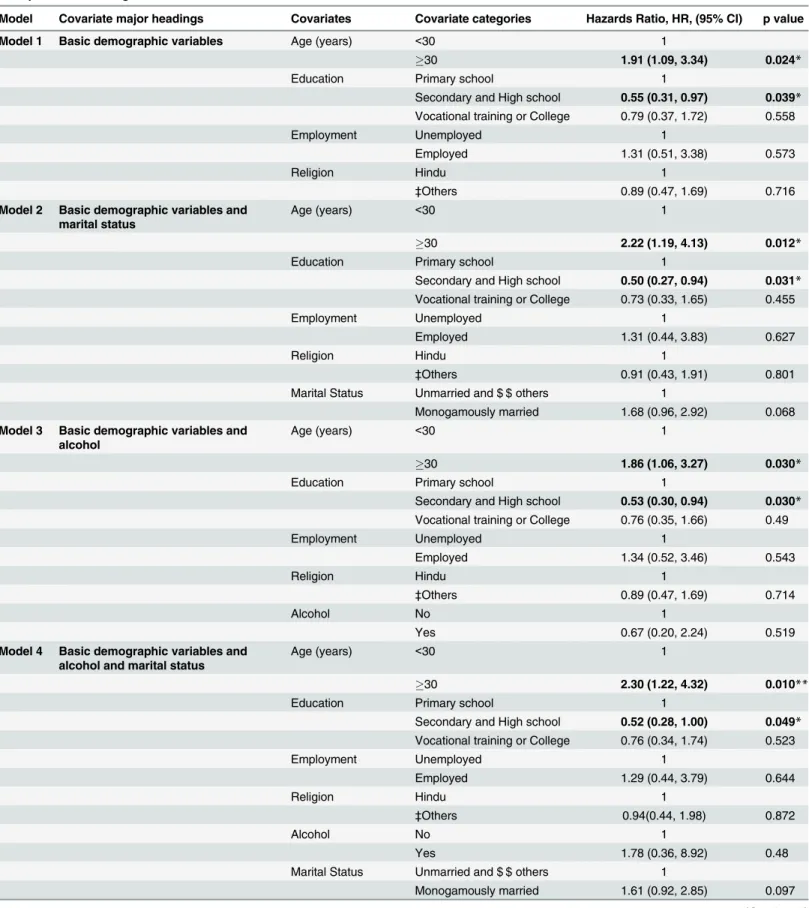
In step 2 analysis follow-up data on 209 men who reported positive condom use behavior at first follow up visit was analyzed to determine the predictors of sustained consistent condom use behavior. Sixty-one events of‘failure of condom use’during the study period of two years were recorded. The incident rate for failure of consistent condom use was 15.5 per 100 person years (95% CI 12.3–19.5 years).“Table 2”summarizes hazard ratios and their 95% confidence intervals as well as p values for failure to sustain positive condom behavior in case of various models studied.
Multiple models were used to understand effects of absence/ presence of various risk factors on inconsistent condom use behavior to demonstrate a comparative impact of factors under the respective domains of demographic, behavioral, sexual behavioral and biological covariates respectively. In the first four models, men, who were 30 years or older were more likely to fail to sustain positive condom use behavior. As the covariates were added to models, the hazard ratio of age kept increasing for model no. 1 to model no.4 and model no. 6 showed a steady increase from 1.9 to 2.41 indicating older age as a predictor for inconsistent condom use. Those who were educated at the level of secondary school or high school were more likely to sustain consistent condom use behavior during the follow-up period of 2 years. Interestingly, both these variables lost significant relationship with sustained condom use behavior when additional variables related to sexual behavior were added in models 5 and 7.
STI patients who had primarily non-commercial sex worker contacts during the past 3 months were nearly 9 times likely to fail to sustain positive condom use behavior [Model 5]. Age of more than 30 years was found to be associated with failure to sustain positive condom use behavior [Model 6].
Table 1. (Continued)
Characteristic Failed to convert to consistent condom use
Converted to consistent condom use
Univariate analysis
Multivariable Analysis
n = 372 n = 128 Odds Ratio
(95% CI)
P value Odds Ratio (95% CI)
P value
Symptoms of genital warts
Absent 213 (96.8) 92 (93.9) 1 (Ref) 1 (Ref)
Present 7 (3.2) 6 (6.1) 0.50 (0.17, 1.54) 0.229 0.63 (0.14, 2.90) 0.557
Symptoms of genital ulcer
Absent 221 (59.6) 85 (66.4) 1 (Ref) 1 (Ref)
Present 150 (40.4) 43 (33.6) 1.34 (0.88, 2.05) 0.172 0.66 (0.34, 1.28) 0.215
GUD
No 270 (72.6) 97 (75.8) 1 (Ref) 1 (Ref)
Yes 102 (27.4) 31 (24.2) 1.18 (0.74, 1.88) 0.48 1.59 (0.72, 3.52) 0.253
GD
No 326 (87.6) 116 (90.6) 1 (Ref) 1 (Ref)
Yes 46 (12.4) 12 (9.4) 1.36 (0.70, 2.67) 0.364 2.00 (0.64, 6.26) 0.232
‡
Others include unmarried, divorced, widower and separated. GUD: Genital ulcer disease, GD: Genital discharge
*Significant at p value<0.05, **Significant at p value<0.01
1Hijra is local term for éunuch
Table 2. Cox professional hazards analysis showing risk factors and hazards of inconsistent condom use during follow-up of two years among male patients attending STD clinics.
Model Covariate major headings Covariates Covariate categories Hazards Ratio, HR, (95% CI) p value
Model 1 Basic demographic variables Age (years) <30 1
30 1.91 (1.09, 3.34) 0.024*
Education Primary school 1
Secondary and High school 0.55 (0.31, 0.97) 0.039* Vocational training or College 0.79 (0.37, 1.72) 0.558
Employment Unemployed 1
Employed 1.31 (0.51, 3.38) 0.573
Religion Hindu 1
‡Others 0.89 (0.47, 1.69) 0.716
Model 2 Basic demographic variables and marital status
Age (years) <30 1
30 2.22 (1.19, 4.13) 0.012*
Education Primary school 1
Secondary and High school 0.50 (0.27, 0.94) 0.031* Vocational training or College 0.73 (0.33, 1.65) 0.455
Employment Unemployed 1
Employed 1.31 (0.44, 3.83) 0.627
Religion Hindu 1
‡Others 0.91 (0.43, 1.91) 0.801
Marital Status Unmarried and $ $ others 1
Monogamously married 1.68 (0.96, 2.92) 0.068
Model 3 Basic demographic variables and alcohol
Age (years) <30 1
30 1.86 (1.06, 3.27) 0.030*
Education Primary school 1
Secondary and High school 0.53 (0.30, 0.94) 0.030* Vocational training or College 0.76 (0.35, 1.66) 0.49
Employment Unemployed 1
Employed 1.34 (0.52, 3.46) 0.543
Religion Hindu 1
‡Others 0.89 (0.47, 1.69) 0.714
Alcohol No 1
Yes 0.67 (0.20, 2.24) 0.519
Model 4 Basic demographic variables and alcohol and marital status
Age (years) <30 1
30 2.30 (1.22, 4.32) 0.010**
Education Primary school 1
Secondary and High school 0.52 (0.28, 1.00) 0.049* Vocational training or College 0.76 (0.34, 1.74) 0.523
Employment Unemployed 1
Employed 1.29 (0.44, 3.79) 0.644
Religion Hindu 1
‡Others 0.94(0.44, 1.98) 0.872
Alcohol No 1
Yes 1.78 (0.36, 8.92) 0.48
Marital Status Unmarried and $ $ others 1
Table 2. (Continued)
Model Covariate major headings Covariates Covariate categories Hazards Ratio, HR, (95% CI) p value
Model 5 Basic demographic variables and alcohol and marital status and sexual behavior
Age (years) <30 1
30 1.66 (0.86, 3.20) 0.133
Education Primary school 1
Secondary and High school 0.65 (0.33, 1.27) 0.21 Vocational training or College 1.06 (0.43, 2.63) 0.894
Employment Unemployed 1
Employed 0.93 (0.30, 2.94) 0.906
Religion Hindu 1
‡Others 0.54 (0.24, 1.21) 0.134
Alcohol No 1
Yes 0.59 (0.11, 3.34) 0.554
Marital Status Unmarried and $ $ others 1
Monogamously married 1.55(0.88, 2.73) 0.132 Contact with
Non-CSW partners in last 3 months
No 1
Yes 9.09 (4.45,18.57) <0.001**
Contact with Hijra or CSW in last 3 months
No 1
Yes 1.89 (0.94, 3.81) 0.076
Model 6 Demographic variables and alcohol and marital Status and biological variables
Age (years) <30 1
30 2.42 (1.27, 4.62) 0.007**
Education Primary school 1
Secondary and High school 0.56 (0.29, 1.08) 0.085 Vocational training or College 0.87 (0.38, 2.03) 0.757
Employment Unemployed 1
Employed 1.22 (0.41, 3.64) 0.721
Religion Hindu 1
‡Others 0.94 (0.43, 2.04) 0.88
Alcohol No 1
Yes 1.46(0.16, 13.29) 0.738
Marital Status Unmarried and $ $ others 1
Monogamously married 1.63 (0.91, 2.95) 0.102
Circumcision No 1
Yes 0.84 (0.19, 3.72) 0.817
Presence of GUDs in last 3 months
No 1
Yes 1.77 (0.69, 4.53) 0.234
Presence of GDs in last 3 months
No 1
Yes 0.67 (0.08, 5.93) 0.722
Presence of GUDs / GDs in last 3 months
No 1
Yes 2.00 (0.88, 4.53) 0.098
The final model [model 7] inclusive of all the demographic, sexual behavior related and bio-logical variables showed that STI patients who had primarily non-commercial sex worker con-tacts (probably their regular partners) during the past 3 months or who suffered from genital ulcer diseases or genital disease (GUD/ GD) in the past 3 months were more likely to fail to sustain positive condom use behavior.
Table 2. (Continued)
Model Covariate major headings Covariates Covariate categories Hazards Ratio, HR, (95% CI) p value
Model 7 Demographic variables and alcohol and marital Status and sexual behavior and biological variables
Age (years) <30 1
30 1.82 (0.91, 3.61) 0.088
Education Primary school 1
Secondary and High school 0.62 (0.31, 1.24) 0.176 Vocational training or College 0.99 (0.39, 2.52) 0.985
Employment Unemployed 1
Employed 0.86 (0.27, 2.76) 0.795
Religion Hindu 1
‡Others 0.54 (0.23 1.26) 0.153
Alcohol No 1
Yes 0.51 (0.04, 6.26) 0.602
Marital Status Unmarried and $ $ others 1
Monogamously married 1.62 (0.89, 2.96) 0.118 Contact with
Non-CSW partners in last 3 months
No 1
Yes 10.09(4.78, 21.28) <0.001**
Contact with Hijra or CSW in last 3 months
No 1
Yes 1.64 (0.77, 3.51) 0.201
Circumcision No 1
Yes 0.96 (0.21, 4.48) 0.962
Presence of GUDs in last 3 months
No 1
Yes 2.47 (0.97, 6.27) 0.057
Presence of GDs in last 3 months
No 1
Yes 0.27 (0.03, 2.53) 0.251
Presence of GUDs / GDs in last 3 months
No 1
Yes 2.31 (1.00, 5.38) 0.051*
‡Buddhist, Christian, Muslims and Others $ $Widowed, divorced and separated.
NA: Not applicable
Discussion
This study reports predictors of failure to use condom consistently among men attending STI clinics in Pune, India in a primary prevention setting of voluntary HIV counseling and testing. Rate of return for follow-up for clinical evaluation and consistent condom use were observed to be low in the study population as reported earlier [37] Low retention could be attributed either to patients’choice, inadequacy in motivational counseling and existing stigma and dis-crimination during the study period. Owing to extreme stigma existing during that period in India [38], study had limitation of having no provision for home visit. Retention among male patients is reported to be a challenge [39]. Strategies such home visit or telephonic contact for ensuring adequate follow-up need to be stressed. Better follow-up provide more opportunities for counseling interventions which might result in overall improvement and retention in pri-mary prevention programs. Use of multiple models in this study provides an opportunity to target patients with specific demographic and other characteristics to implement appropriate interventions that could improve condom use in similar populations.
Several studies have reported protective role of condom use against HIV acquisition. There is paucity of literature about situations and reasons for failure to use condom consistently. The set-ting of a prospective cohort study helped us to compute hazards ratios and predictors of sus-tained positive condom use behavior. Older men failed to sustain consistent use of condom. World over, similar observations regarding risky behavior with increasing age have been reported [40,41,42,43]. This finding has programmatic implications for HIV and STI prevention at Inte-grated Counseling and Testing Centers (ICTCs) and other clinical set ups where HIV/ STI risk reduction counseling is being routinely undertaken. Additional efforts, such as periodic rein-forcement counseling and ensuring sustainability of condom use among older men are recom-mended. In the 2 years’follow up data, higher education, presence of GUD and reported contacts with commercial sex workers were the risk factor for inconsistent condom use among the study participants. This revelation highlights the existing condom use programs that are targeted towards key populations whereas sex workers’client centered approach of condom promotion emerges critical. Sex workers in Africa have reported that men do not want to use condoms [44]. A recent study among gay men, female sex workers and clients have shown that condom use behaviors among high risk groups is contextual decision and it is not a planned behavior [45].
Men having extramarital and multi-partner sex are exposed to risk of acquiring HIV and STI [46]. Men tend to use condoms during commercial sex, but this behavior is inconsistent [5,29]. Condoms are also often regarded as irrelevant in long-term relationships due to lack of percep-tion of risk among monogamous married men who prefer not to use condoms consistently with their regular partners [47]. Heterosexual transmission is the major mode of HIV transmission in India [48] with most married women living with HIV having acquired it from their spouses [49,50]. Being married and monogamous was another factor of failure to sustain consistent condom use behavior among these men who were attending STI clinics in India. A large study in Britain also reported that 80% of sexually active, never married respondents used condoms
‘to protect against HIV and other STI’in contrast to 1.8% of married respondents [51]. The neg-ative condom use behavior among married monogamous men finding reinforces the need for targeting married monogamous men attending STI clinics to inculcate‘condom use habit’
matter of concern today also because the current Indian HIV epidemic has diversity of risks wherein currently the HIV epidemic is driven by MSM [53]. Owing to socio cultural reasons
‘men’get married despite different sexual orientation [54,55]. In order to remain hidden in the current social and political setting in India, married MSM often indulge in hurried covert increasing their risk and risk to their regular married partners [56]. The primary reason driving condom use in India is preventing unwanted pregnancy and despite high awareness of STDs/ HIV/ AIDS in India, condom use as a means of protection against STI and HIV/ AIDS is still low [57]. Men should also be made to clearly understand the risk they may pose risk to their marital partners and the need to use condoms during each act of sex whether in personal marital or commercial setting. Prevention program needs to develop newer strategies for condom pro-motion among men especially targeting men who present themselves with genital diseases and those who are married and monogamous. Focused efforts to create awareness regarding efficacy of consistent condom use in HIV and STI prevention are necessary. Interventions need to focus on combined behavioral and structural approaches and the program needs to sensitize the bridge populations coming in sexual contract with the high risk populations on condom use.
The limitation of our study was our inability to analytically explore the relationship between presence of GUD/ GD and failure to sustain consistent condom use. Despite consistent con-dom use at baseline, these men were attending STI clinic. This could indicate either concon-dom use failure, social desirability bias in reporting condom use or failure to use condom due to dis-comfort while using condoms in presence of STI. National data on genital ulcers from the 2007 Zambia Demographic and Health Survey showed that 57% respondents reported sex after onset of symptoms and only 15% reported consistent condom use [58]. Sexual behavior among men presenting with STI including GUD/ GD needs to be explored in India. Another limita-tion was that this study was conducted among men attending STI clinics; this populalimita-tion may not be comparable to the overall male population of Pune, Maharashtra, or India. The follow up rate of male STI clinic attendees was 15%. This has a limitation of the study. However, those who returned provide us adequate sample size to study the predictors of lack of condom use and more realistically reflect the real life situation.
Conclusions
Condoms are inexpensive, easy to store, carry and use and do not require medical consultation. The target should be to emphasize correct and consistent usage of condom. Behavior change especially pertaining to consistent condom use has been a challenge and sustaining such a behavior is an additional challenge. Only one time voluntary counseling and testing might fail in case of men who are married monogamous, older men reporting contact with female sex worker/ s, Hijras and/ or presenting with GUD as this may lead to condoms non-use. This calls for continuum of prevention care by instituting follow-ups in the HIV prevention programs. In the STI clinics, reinforcement of educational messages and condom promotion through fol-low ups among this group of men is essential for sustained behavior change. Programs have focused on condom use among sex workers, it would be more relevant to also review the medi-ating mechanism of condom use variables among men especially the client of sex workers. These could be the men who do not use condoms with non FSW sex partner owing to false sense of security, but the program focuses mainly on key high risk populations. The message should be to acquire condom use habit irrespective of the partner.
Author Contributions
Contributed reagents/materials/analysis tools: SS SD SB MK AP RGB RP RCB SMM. Wrote the paper: SS SD SB MK AP RGB RP RCB SMM.
References
1. Thappa DM K S (2007) Sexually transmitted infections in India: Current status (except human immuno-deficiency virus/acquired immunoimmuno-deficiency syndrome). Indian Journal of Dermatology 52: 5.
2. Narayanan B (2005) A retrospective study of the pattern of sexually transmitted diseases during a ten-year period. Indian J Dermatol Venereol Leprol 71: 5.
3. NACO DoAC (2011–12) Annual Report. New Delhi: National AIDS Control Organisation. 11 p.
4. NACO (2012) NACO Technical Report India HIV Estimates-2012.
5. Brahme RG, Sahay S, Malhotra-Kohli R, Divekar AD, Gangakhedkar RR, Parkhe A et al. (2005) High-risk behaviour in young men attending sexually transmitted disease clinics in Pune, India. AIDS Care 17: 377–385. PMID:15832886
6. Godbole S, Mehendale S (2005) HIV/AIDS epidemic in India: risk factors, risk behaviour & strategies for prevention & control. Indian J Med Res 121: 356–368. PMID:15817949
7. Brahme R, Mehta S, Sahay S, Joglekar N, Ghate M, Joshi S et al. (2006) Correlates and trend of HIV prevalence among female sex workers attending sexually transmitted disease clinics in Pune, India (1993–2002). J Acquir Immune Defic Syndr 41: 107–113. PMID:16340482
8. UNAIDS (2013) Global Report: UNAIDS report on global epidemic (2013). Joint United Nations Pro-gramme on HIV/AIDS (UNAIDS). ISBN 978-92-9253-032-7 ISBN 978-92-9253-032-7
9. NACO (2012–13) Annual Report. New Delhi: Department of AIDS Control, Ministry of Health and Fam-ily Welfare.
10. NACO (2010–11) Annual Report.
11. Mercer CH C A, Sonnenberg P, Johnson AM, McManus S, Erens B, Cassell JA. (1993) The history of the condom. Journal of the Royal Society of Medicine 86: 2.
12. Mayaud P M D (2001) Interventions against sexually transmitted infections (STI) to prevent HIV infec-tion. British Medical Bulletin 58.
13. Parker W N Z, Birdsall K, Hajiyiannis H (2004) Breaking the Barriers: An Analysis of Condom-related Calls to the National AIDS Helpline. CENTRE FOR AIDS DEVELOPMENT, RESEARCH AND EVALUATION. pp. 1–12.
14. Kang M, Rochford A, Skinner SR, Mindel A, Webb M, Peat J et al. (2014) Sexual behaviour, sexually transmitted infections and attitudes to chlamydia testing among a unique national sample of young Aus-tralians: baseline data from a randomised controlled trial. BMC Public Health 14: 12. doi:10.1186/ 1471-2458-14-12PMID:24400743
15. Gari S, Doig-Acuna C, Smail T, Malungo JR, Martin-Hilber A et al. (2013) Access to HIV/AIDS care: a systematic review of socio-cultural determinants in low and high income countries. BMC Health Serv Res 13: 198. doi:10.1186/1472-6963-13-198PMID:23714167
16. Vermund SH, Tique JA, Cassell HM, Pask ME, Ciampa PJ, Audet CM (2013) Translation of biomedical prevention strategies for HIV: prospects and pitfalls. J Acquir Immune Defic Syndr 63 Suppl 1: S12–25. doi:10.1097/QAI.0b013e31829202a2PMID:23673881
17. Mohamed M. Ali JC, Shah IH (2004) Condom use within marriage: a neglected HIV intervention. Bulle-tin of the World Health Organization 82: 180–186. PMID:15112006
18. Bhattacharya G (2004) Sociocultural and behavioral contexts of condom use in heterosexual married couples in India: challenges to the HIV prevention program. Health education & behavior: the official publication of the Society for Public Health Education 31: 101–117.
19. Santhya KG, Acharya R, Jejeebhoy SJ (2011) Condom use before marriage and its correlates: evi-dence from India. International perspectives on sexual and reproductive health 37: 170–180. doi:10. 1363/3717011PMID:22227624
20. de Vincenzi I (1994) A longitudinal study of human immunodeficiency virus transmission by heterosex-ual partners. European Study Group on Heterosexheterosex-ual Transmission of HIV. N Engl J Med 331: 341–
346. PMID:8028613
21. Nicolosi A, Correa Leite ML, Musicco M, Arici C, Gavazzeni G, Lazzarin A. (1994) The efficiency of male-to-female and female-to-male sexual transmission of the human immunodeficiency virus: a study of 730 stable couples. Italian Study Group on HIV Heterosexual Transmission. Epidemiology 5: 570–
575. PMID:7841237
23. Chitwarakorn A (2004) HIV/AIDS and sexually-transmitted infections in Thailand: Lessons learned and challenges ahead; JP N, editor. Delhi: Sage Publications India.
24. Ahmed S, Lutalo T, Wawer M, Serwadda D, Sewankambo NK, Nelson k, et al. (2001) HIV incidence and sexually transmitted disease prevalence associated with condom use: a population study in Rakai, Uganda. AIDS 15: 2171–2179. PMID:11684937
25. DiClemente RJ, editor (1999) The Importance of Health Promotion and Disease Prevention: Springer. 7 p.
26. Weiss HA W J, Barnabas RV, Hayes RJ, Abu-Raddad LJ (2008) Analytic perspective Open Access Persisting with prevention: The importance of adherence for HIV prevention. Emerging Themes in Epi-demiology 5.
27. Sarkar NN (2008) Barriers to condom use. Eur J Contracept Reprod Health Care 13: 114–122. doi:10. 1080/13625180802011302PMID:18465472
28. Beksinska ME, Smit JA, Mantell JE (2012) Progress and challenges to male and female condom use in South Africa. Sex Health 9: 51–58. doi:10.1071/SH11011PMID:22348633
29. Mehendale SM, Rodrigues JJ, Brookmeyer RS, Gangakhedkar RR, Divekar AD, Gokhale MR, et al. (1995) Incidence and predictors of human immunodeficiency virus type 1 seroconversion in patients attending sexually transmitted disease clinics in India. J Infect Dis 172: 1486–1491. PMID:7594707 30. Rodrigues JJ, Mehendale SM, Shepherd ME, Divekar AD, Gangakhedkar RR, Quin TC, et al. (1995) Risk factors for HIV infection in people attending clinics for sexually transmitted diseases in India. BMJ 311: 283–286. PMID:7633230
31. Family_Health_International (2000) Behavioral surveillance surveys: GUIDELINES FOR REPEATED BEHAVIORAL SURVEYS IN POPULATIONS AT RISK OF HIV. In: FHI, editor. Arlington.
32. Cox DR (1972) Regression models and life tables. J R Stat Soc B 34: 187–220.
33. Therneau TM, G PM (2000) Modelling Survival data: Extending the COX Model. New York: Springer.31.
34. Cameron DW, Simonsen JN, D'Costa LJ, Ronald AR, Maitha GM, Gakinya MN, et al. (1989) Female to male transmission of human immunodeficiency virus type 1: risk factors for seroconversion in men. Lancet 2: 403–407. PMID:2569597
35. Madhivanan P, Hernandez A, Gogate A, Stein E, Gregorich S, Setia M, et al. (2005) Alcohol use by men is a risk factor for the acquisition of sexually transmitted infections and human immunodeficiency virus from female sex workers in Mumbai, India. Sexually transmitted diseases 32: 685–690. PMID: 16254543
36. Sahastrabuddhe S, Gupta A, Stuart E, Godbole S, Ghate M, Sahay S, et al. (2012) Sexually transmitted infections and risk behaviors among transgender persons (Hijras) of Pune, India. Journal of acquired immune deficiency syndromes 59: 72–78. doi:10.1097/QAI.0b013e318236bd6fPMID:21937924 37. Sahay S, Gupte N, Brahme RG, Nirmalkar A, Bembalkar S,Bollinger R, et al. (2011) Predictors of
reten-tion among men attending STI clinics in HIV prevenreten-tion programs and research: a case control study in Pune, India. PLoS One 6: e17448 doi:10.1371/journal.pone.0017448PMID:21412414
38. Nambiar D (2012) HIV-related stigma and NGO-isation in India: a historico-empirical analysis. Sociol-ogy of health & illness 34: 714–729.
39. Coleman S, Boehmer U, Kanaya F, Grasso C, Tan J, Bradford J. (2007) Retention challenges for a community-based HIV primary care clinic and implications for intervention. AIDS Patient Care STDS 21: 691–701. PMID:17919096
40. Foster VC, Holstad PC, Burgess E (2012) Factors associated with risky sexual behaviors in older adults. J Assoc Nurses AIDS Care 23 487–499. doi:10.1016/j.jana.2011.12.008PMID:22721926 41. Peltzer K (2000) Factors affecting condom use among South African University students. East African
Medical Journal 77.
42. Grunbaum JA, Kann L, Kinchen SA, Williams B, Ross JG, Lowry R, et al. (2002) Youth risk behavior surveillance–United States, 2001. MMWR Surveill Summ 51: 1–62.
43. Dunne MPD M. Lucke J. Nilsson R. Ballard R. Raphael B. (1994) Age-related increase in sexual behav-iours and decrease in regular condom use among adolescents in Australia. Int J STD AIDS 5 41–47. PMID:8142527
44. Bisika I (2013) Malawi: Sex Workers Bemoan Men's Self-Centeredness On Condom Use. Malawi News Agency. Liliomgwe.
46. Newmann S, Sarin P, Kumarasamy N, Amalraj E, Rogers M, Madhivana P, et al. (2000) Marriage, monogamy and HIV: a profile of HIV-infected women in south India. Int J STD AIDS 11: 250–253. PMID:10772089
47. Bentley ME S K, Shepherd ME, Gangakhedkar RR, Thilikavathi S, Bollinger RC, Mehendale SM. (1998) HIV testing and counseling among men attending sexually transmitted disease clinics in Pune, India: changes in condom use and sexual behavior over time. AIDS 12: 1869–1877. PMID:9792388 48. NACO (2010) UNGASS Country Progress Report—India. New Delhi, India: NACO.
49. Chatterjee N, Hosain GM (2006) Perceptions of risk and behaviour change for prevention of HIV among married women in Mumbai, India. J Health Popul Nutr 24: 81–88. PMID:16796154
50. Gangakhedkar RR, Divekar AD, Gadkari D, Mehendale SM, Shepherd ME, Bollinger RC et al. (1997) Spread of HIV infection in married monogamous women in India. JAMA 278: 2.
51. Erens B F, McManus S, Prescott A (2001) National Survey of Sexual Attitudes and Lifestyles 1990 and 2000. London: National Centre for Social Research
52. Copas AJ, Mercer C H, Farewell V T, Nanchahal K, Johnson A M. (2009) C. Recent Heterosexual Part-nerships and Patterns of Condom Use: A Weighted Analysis. Epidemiology 20 (1): 44–51 doi:10. 1097/EDE.0b013e318187ac81PMID:18813022
53. Solomon SS, Mehta SH, Srikrishnan AK, Vasudevan CK, McFall AM, Balakrishnan P, et al. (2015) High HIV prevalence and incidence among MSM across 12 cities in India. AIDS 29: 723–731. doi:10. 1097/QAD.0000000000000602PMID:25849835
54. Mimiaga MJ, Closson EF, Thomas B, Mayer KH, Betancourt T, Menon S, et al. (2014) Garnering an In-depth Understanding of Men Who Have Sex with Men in Chennai, India: A Qualitative Analysis of Sex-ual Minority Status and Psychological Distress. Arch Sex Behav.
55. Solomon SS, Mehta SH, Latimore A, Srikrishnan AK, Celentano DD (2010) The impact of HIV and high-risk behaviours on the wives of married men who have sex with men and injection drug users: implications for HIV prevention. J Int AIDS Soc 13 Suppl 2: S7. doi:10.1186/1758-2652-13-S2-S7 PMID:20573289
56. Setia MS, B P, Jerajani HR, Bharat S, Gogate A, Kumta S, Row-Kavi A, et al. (2008) Men who have sex with men in India: a systematic review of the literature. J LGBT Health Res 4: 51–70. PMID:19856739 57. Sogarwal R, Bachani D (2009) AWARENESS OF WOMEN ABOUT STDs, HIV/AIDS AND CONDOM
USE IN INDIA: LESSONS FOR PREVENTIVE PROGRAMMES. Health and Population: Perspectives and Issues 32: 148–158.