Zbornik Matice srpske za prirodne nauke/ Proceedings for Natural Sciences, Matica Srpska Novi Sad,¥ 104, 11—21, 2003
UDC 631.416:669.88
M i o d r a g D . J a k o v l j e v i ã , N i k o l a M . K o s t i ã , S v e t l a n a B . A n t i ã - M l a d e n o v i ã
University of Belgrade, Faculty of Agriculture, Zemun
THE AVAILABILITY OF BASE ELEMENTS
(CA, MG, NA, K) IN SOME IMPORTANT SOIL TYPES
IN SERBIA
ABSTRACT: In this paper results are presented of agrochemical and mineralogical analyses of 14 types of important soils in Serbia (Vojvodina and Central Serbia) and total content and availability of base alkali elements (Ca, Mg, Na, K) are determined. Total ele-ment content was as follows: Ca 2.22%; K 1.77%; Na 0.85% and Mg 0.61%. Total content of alkali metals in the soils investigated and their variations within and between the soil types, is in very good/close correlation with contents of primary and secondary minerals as well as their rates of weathering. Taking in account the average availabilities the most abun-dant is calcium with 947 mg/100 g, whilst the averages of the other elements (Mg, K and Na) are quite similar and are about of 40 mg/100 g of soil. The results obtained have shown that the soils investigated are well to moderate provided with K, Ca and Mg and that their deficit could not be expected in plant nutrition, apart for some plants/cultures in the case of magnesium due to occasionally higher Ca/Mg and K/Mg ratios.
KEY WORDS: soil, alkali metals, total and available contents
INTRODUCTION
Total content of potassium in soils varies within wide limits from 0.01% up to 4%, with most common values of about 1% and an average content be-tween 1—2% (W i l d, 1988). In soils and many rocks, potassium occurs as major constituent of many rock-forming primary minerals, particularly in the alkali feldspars group: orthoclase and microcline, also as mica group: musco-vite and biotite as well as secondary minerals, particularly illite. Principal so-urce of available potassium in soils is its concentration in soils solution, which could be refreshed by cation exchange with adsorbed potassium ions, and which is also affected by content of fixed potassium (strongly bonded and non-exchangeable).
As with potassium, other three alkali metals (Ca, Mg and Na) are also present in silicate rock-forming minerals and later are transferred into mineral fraction of soils. Their contents depend on the rate of mineral weathering and the rate of leaching of weathered products. Principal source of Ca and Na are plagioclase group minerals: anortite and albite, whilst Mg is present in a few silicate minerals ouch as: biotite, pyroxenes and amphiboles. All mentioned minerals are weathered faster than potassium minerals. Beside that magnesium is also present in many secondary minerals (hydrobiotite, vermiculite and montmorillonite). Available forms of Ca, Mg and Na, as with potassium, are their exchangeable cations and various salts in soil solution.
With respect to content and state of potassium in our soils, during the last twenty years (decades) large number of papers was published, but the most of them were dealing with potassium availability and only a few were related to its state and chemical speciation in soils. With regards to the problems of the other three alkali elements there are much less available data and it is occa-sionally said they seam as ignored elements in soil chemistry investigations. All available data are presented as general chemical soil properties as well as in CEC analyses or in soil solution analyses (B o g d a n o v i c et al. 1973; J a k o v l j e v i c and B l a g o j e v i c, 1997). However, up to now there was no data dealing with spatial distribution of alkali metals in our soils, apart from a comprehensive/extensive paper by K o s t i c et al. (2001), about con-tent, concentrations, spatial distribution and chemical speciation as well as mineralogy of magnesium in our soils.
MATERIAL AND METHODS
During a large scale sample collecting for the project, financed by the Ministry of Science and technology and Fund for Land Use, Protection and Organisation of the Republic of Serbia, an orthogonal regular grid was used to avoid bias in site location. For financial reasons sample collection was restric-ted to the layer 0—20 cm depth. Sampling was based on a 5 x 5 km cell and samples were collected. From this set of samples a selection of samples from Vojvodina, Šumadija and Northern Pomoravlje was taken to represent the most important (14) soil types and the number of 100 samples was obtained.
digest-ing it in a mixture of aqua regia and HF in Pt crucible. Ca and Mg contents, after taken into solution and addition of lanthanum, were determined by AAS, whilst the K and Na contents were determined by a flame-photometric hod. The available contents of alkali metals were determined by the same met-hods, but after the 1M NH4OAc (pH 7.0) extraction.
Histograms of the frequency distribution and summary consisting of the mean, quartiles and range in a normal distribution of the concentrations of each element were made using STATISTICA for Windows 4.3b program. Ex-perience in geochemical research has shown that analysing and mapping data by using the box-plot provide the best realization. The classes used to repre-sent the data on the map were chosen from the box and wiskers analysis, as proposed by K u e r z l (1986). So, the map has the 5 classes. Raster map showing the distribution of the elements was drawn by computer, by using UNIRAS subroutine. Each square on the map represents the result from one 10 km grid scale.
RESULTS AND DISCUSSION
The results obtained during this investigation are given in the Table 1., where they are presented as total and available contents of analyzed alkali ele-ments as well as average values and range of minimum and maximum arran-ged according to various soil types and as summary for all soils. In the soils investigated calcium is the most abundant alkali element with the average con-tent of 2.25%, which is much higher value than the average (1.37%) for the soils in the world. The highest total calcium content is found in chernozem and semigley (3.4%), and the lowest in soil types: pseudogley, luvisol, dystric cambisol and vertisol (about 0.5%). This result have shown that soil types with higher calcium content have a very good correlation with soil mineral composition of primary and secondary minerals bearing calcium, such as: cal-cite, dolomite, plagioclas, smectite and mixed-layer-silicates (MSS 10—14). The soil types with low calcium content have mineral composition with domi-nant quartz, and lower content of calcium bearing minerals, particularly calcite and dolomite, as presented in the Table 2.
The average content of available calcium in our soil types is 947 mg/100 g, but it is present in very wide range limits between 93 and 2000 mg/100 g. However, only a limited number of samples of very acid pseudogley soil types have available calcium below 100 mg/100 g, when they could show signs of calcium deficit in plant nutrition, whilst the majority of soil types investigated have shown high contents of available calcium of about 1000 mg/100 g. In acid soil types content of available calcium is lower, but very close to the ave-rage contents of available calcium in soils investigated with about 300 mg/100 g. With regards to the afore mentioned, it imply that our soils contain am-ple/adequate supply of both total and available calcium for plant nutrition, which is evenly distributed over the area investigated, as could be seen from the map presented in Figure 1.
Table 1 — Total (%) and available (mg/100 gr) contents of alkali elements in the investigated soils
Magnesium Calcium Potassium Sodium
Soil type Total available Total available Total available Total available Chernozem 0.67* (0.25–1.00) 42 (27–65) 3.41 (0.87–7.90) 1475 (478–2000) 1.68 (0.84–2.20) 49 (17–90) 0.87 (0.71–1.04) 40 (30–51) Semigley 0.74 (0.26–1.25) 43 (20–75) 3.29 (0.54–10.40) 1132 (333–1925) 1.77 (1.37–2.14) 45 (17–113) 0.83 (0.43–1.19) 40 (26–54) Humogley
and eugley (0.20–1.00)0.61 58 (22–93) 2.40 (0.25–6.00) 984 (225–1950) 1.84 (1.02–2.26) 56 (21–115) 0.94 (0.40–1.58) 43 (32–57) Halomorphic
Soils (0.35–0.85)0.57 37 (25–53) 2.05 (0.96–3.30) 1060 (390–1775) 1.85 (1.44–2.22) 83 (36–122) 0.97 (0.34–1.29) 33 (28–42) Fluvisol 0.75 (0.44–1.00) 51 (32–80) 2.14 (0.61–7.50) 832 (308–1900) 1.81 (0.86–2.30) 26 (14–46) 0.92 (0.60–1.47) 51 (34–130) Pseudogley 0.42 (0.25–0.57) 32 (10–45) 0.55 (0.17–1.17) 334 (93–703) 1.80 (1.58–2.00) 26 (23–32) 0.69 (0.42–0.81) 32 (18–39) Eutric
Cambisol (0.26–1.25)0.48 43 (20–75) 1.07 (0.42–3.51) 592 (275–1908) 1.74 (1.14–2.09) 32 (21–56) 0.76 (0.36–1.26) 37 (23–45) Vertisol 0.35 (0.20–0.52) 27 (15–38) 0.68 (0.30–0.91) 340 (175–570) 1.94 (1.60–2.85) 31 (22–40) 0.91 (0.34–1.29) 33 (28–47) Luvisol and Distr. Cambisol 0.36 (0.32–0.43) 30 (22–40) 0.51 (0.40–0.65) 274 (180–378) 1.69 (1.51–1.96) 28 (26–30) 0.75 (0.50–0.91) 36 (33–39) Ranker and
regosol (0.39–1.26)0.65 23 (12–38) 1.86 (0.20–4.05) 963 (160–1685) 1.72 (0.95–2.60) 23 (18–26) 0.80 (0.44–1.07) 36 (22–44)
All soils 0.60
(0.20–1.26) 41 (10–93) 2.25 (0.17–10.40) 947 (93–2000) 1.76 (0.84–2.85) 41 (14–122) 0.85 (0.34–1.58) 40 (18–130)
N. B. * Average (min-max)
Table 2 — Average mineral composition (%) of the bulk samples of the soils investigated
Quartz Plagio clase Ortho clase Chlorite Mica + Illite Smectite + Verm. Mixed Layers Kaoli-nite Calcite Dolo-mite Goetite
Chernozem 53.8 8.7 0.7 6.0 19.0 0.9 0.3 1.0 4.5 4.9 0.2
Halomorphic
soils 57.3 10.4 0.7 4.7 20.6 0.5 0.4 1.1 1.2 2.3 0.2
Semigley 52.5 8.5 0.6 5.4 19.8 1.8 0.2 1.5 4.3 5.1 0.2
Humo- +
Eugley 52.9 11.2 0.7 5.3 21.7 2.6 0.3 1.7 1.7 1.5 0.3
Fluvisol 51.2 10.4 0.6 5.7 22.4 3.3 0.2 2.2 2.3 1.7 0.2
Pseudogley 67.6 6.4 0.5 4.6 16.5 1.3 1.3 1.1 0.1 0.1 0.1
Eutric
Cambisol 63.5 8.9 0.8 3.7 16.5 2.3 0.2 2.3 0.8 0.2 0.3
Vertisol 70.3 8.8 1.4 2.5 10.8 4.0 0.3 1.1 0.2 0.0 0.3
Distric Cambisol +
Luvisol 69.1 7.4 0.8 4.7 13.5 2.3 0.3 1.3 0.3 0.0 0.4
Regosol +
Ranker 58.9 6.9 0.8 4.7 18.9 2.5 0.4 1.9 2.5 2.1 0.4
smaller variations between than within the soil types. In general, magnesium total content varies in wide range limits between 0.20 to 1.26%. Its total con-tent averages are quite low (0.35—0.48%) in the following soil types: vertisol, luvisol, dystric cambisol, pseudogley and eutric cambisol. These are more weathered and more acid soils, with progressive transformation of mica and il-lite to clay minerals with subsequent leaching of magnesium as well as other base elements.
The average content of available magnesium in soils investigated is 41 mg/100 g, with interval from 10 to 93 mg/100 g, as could be seen from the
map presented in Figure 2. The average contents of available magnesium show good correlation with its total content as could be seen for vertisol, pseudogley and luvisol from the Table 1. In general, all investigated soils are on average quite well supplied with available magnesium for plant nutrition, with only two soil types (pseudogley and ranker) approaching the upper limits of magne-sium deficit (10 mg/100 g) in soils.
Since the Ca/Mg and K/Mg ratios are limiting factor for available magne-sium in plant nutrition, its averages, standard deviation and ranges are presen-ted in the Table 3. With respect to plant nutrition Ca/Mg ratio has beneficial
effects in the range from 1:1 to 5:1. Ratios lower than 5:1 are detected in abo-ut 10% of soils investigated, whilst the bulk of soils have shown the ratio be-tween 5:1 and 20:1. The average value for all soils is 15.4:1. Lower Ca/Mg ra-tio values are limited to some areas in Sumadija and Pomoravlje, whilst the higher values could be associated to far northern areas of Backa, where total content of magnesium is connected to high contents of magnesium bearing mi-nerals (dolomite and chlorite) in soils. On average, even our acid soils have shown Ca/Mg ratio higher then 5:1, whilst chernozem has shown 22:1 and ranker, regosol and rendzina have even 29.9:1. Maximum values were detected
mostly about 30:1, with some extreme values of 50.4:1 in eutric cambisol and 78.8:1 in rendzina developed on marly limestone. With regards to the afore mentioned, it imply that our soils have slightly higher Ca/Mg ratio, which co-uld affect some sensitive plants to magnesium deficits in their nutrition. Beca-use of this it would be necessary to continue with such, but detailed investiga-tion in future.
Another important factor in magnesium plant nutrition is the K/Mg ratio. The obtained results presented in the Table 3., have shown that the rations for the bulk of samples and soil types are below 1:1, which is adequate/agreeable
for the most arable and vegetable crops. Only in more acid soils the K/Mg ra-tios are over 2:1, which could lead to reduced uptake of magnesium in some plants.
Table 3 — Ca/Mg and K/Mg ratios in the soils investigated (mean, standard deviation and interval)
Soil type and number of samples Ca/Mg K/Mg
m.e./100 g Fluvisol
(n = 8) 3.9—28.912.3±9.2 0.2—0.50.3±0.1
Eutric cambisol
(n = 14) 11.1±12.03.3—50.4 0.3—1.00.6±0.2
Pseudogley
(n = 5) 4.8—9.56.0±2.0 0.4—1.40.6±0.4
Semigley
(n = 20) 5.6—30.815.8±7.1 0.3—1.20.6±0.2
Humogley and eugley
(n = 12) 2.5—31.511.2±7.8 1.2—1.90.7±0.5
Regosol, Ranker, Rendzina
(n = 6) 29.9±28.75.3—78.8 0.4—0.90.7±0.2
Chernozem
(n = 20) 5.6—36.622.1±8.7 0.3—1.50.7±0.3
Vertisol, Luvisol, Distric cambisol
(n = 10) 4.0—17.36.8±2.9 0.4—1.20.8±0.3
Halomorphic soils
(n = 5) 7.2—30.017.1±9.2 0.9—2.51.2±0.3
All soils
(n = 100) 15.4±12.42.5—78.8 0.1—2.51.5±0.8
The average total content of potassium in soils investigated is slightly higher (1.76%) then the average (1.36%) for the world soils. The results pre-sented in the Table 1., have shown only slight variation (1.68—1.98%) in the average values of total potassium content for soils investigated. This could be only explained with an even and uniform distribution of potassium bearing mi-nerals (orthoclase, micas and illite) in the soils. However, these variations be-tween investigated soil types could be quite significant, within wider limits (0.84—2.85%) or even within the same soil type e.g. fluvisol (0.86—2.30%).
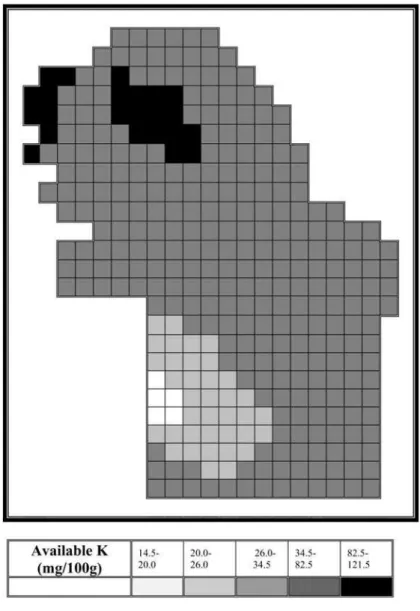
The average content of available potassium is 41 mg/100 g, and accord-ing to the map in the Figure 3. the most of soils comprise of over 20 mg/100 g of available potassium, which could purport that our soils are quite well sup-plied with this important plant nutrient. It is necessary to emphasize that the range limits for available potassium are quite wide, between 14 and 122 mg/100 g. The highest values and the averages are observed in halomorphic soils, eugleys, humogleys and smigleys. Only a limited number of samples ha-ve shown values below 20 mg/100 g, which could be considered as moderate contents in supply of this important plant nutrient.
plagioc-lase and has shown similar average values of soils investigated, but the variati-ons within the soil types are quite significant and range between 0.34 to 1.58%.
The average content of available sodium is 40mg/100 g, with uniform and slight variations between the soil types, which are between 32 and 51 mg/100 g. However, these variations within the samples are in much wider in-terval between 18 and 130 mg/100 g. Maximum content of available sodium is determined in fluvisols, which could be an effect of high concentration of sol-uble salts. Content of available sodium in soils investigated is almost the same as for potassium and magnesium, so it could be concluded that our soils are well supplied with available sodium, but its limits are not determined, since there is no published data for this element, which is considered as an no-es-sential in plant nutrition.
CONCLUSIONS
The comprehensive investigation of soils from Vojvodina, Sumadija and Northern Pomoravlje, of our main arable regions, has showed a wide range of base alkali metals concentrations. Based on the results the following conclusi-ons could be presented:
Total contents of all investigated alkali metals in our soils and their varia-tions between and within various soil types are in close correlation with con-centrations of primary and secondary minerals and their rate of weathering in soils.
The averages of total content of Ca, Mg and K in our soils are slightly higher than their averages in world soils, whilst sodium content is similar to the world average.
Taking in account average values of available K, Ca Mg and Na, our so-ils could be considered as well supplied for the plant nutrition. Only a limited number of samples has shown lower values and are considered as deficient in base alkali metals.
However, in the case of deficit of available magnesium in soils with high ratios of Ca/Mg and K/Mg, it could be a limiting factor in available magnesi-um uptake and utilisation by plants, particularly to the sensitive plants with higher demand for magnesium as well as favourable ratios of available cations such as: Ca, K, Na, and H.
This paper has shown a need for the wider investigation of chemistry and mineralogy of soils in Serbia, which are considered in general as well supplied with base alkali metals.
REFERENCES
A n k e r m a n, D., L a r g e, R. (1977): Minor Elements. In: Soil and Plant Analysis. Ed.: Soil Science Society of America, Inc. pp. 34—45.
Jugoslaviji i smjernicama daljih istraÿivanja. U:Razvoj i aktuelni problemi u pro-uåavanju zemljišta Jugoslavije, Jugoslovensko drušvo za prouåavanje zemljišta, 43—56.
H a b y, V. A., R u s s e l l e, M. P., S k o g l e y, E a r l O. (1990): Soil Testing for Potassium, Calcium and Magnesium. In: R. L. Westerman ed. Soil Testing and Plant Analysis, third ed., Soil Sci. Soc. Am., Inc., Madison, Wisconsin, USA, 181—228.
J a k o v l j e v i ã, M., P a n t o v i ã, M., P e t r o v i ã, M. (1983): Dosadašnja prouåa-vanja i naredni zadaci u oblasti hemije zemljišta, Poljoprivreda i šumarstvo, XXIX, 3—4, 17—47.
J a k o v l j e v i ã, M. i B l a g o j e v i ã, S. (1997): Dosadašnja prouåavanja i naredni zadaci u oblasti hemije zemljišta. U knj.: Ureðenje, korišãenje i oåuvanje zemlji-šta. Ured. Dragoviã, S., Jugoslovensko drušvo za prouåavanje zemljišta, 139— 149.
K o s t i ã, N., J a k o v l j e v i ã, M., H a d ÿ i ã, V., P r o t i ã, N. (2001): Mineralogy and Agrochemistry of Magnesium in Soils Vojvodina, Šumadija and Northern Po-moravlje. Proceedings of Matica srpska for Natural Sciences, Novi Sad. No. 100, p. 115—126.
W i l d, A. (1988): Potasssium, sodium, calcium, magnesium, sulphur, silicon. In: Alan Wild ed. Russell's Soil Conditions & Plant Growth(eleventh ed.), Longman Gro-up UK Lim., 743—779.
SNABDEVENOST VAŸNIJIH TIPOVA ZEMQIŠTA SRBIJE
OSNOVNIM ALKALNIM ELEMENTIMA (Ca, Mg, K i Na)
Miodrag D. Jakovqeviã, Nikola M. Kostiã, Svetlana B. Antiã-Mladenoviã Poqoprivredni fakultet, Beograd
Rezime
U ovom radu je ispitivano 100 reprezentativnih uzoraka 14 tipova zemqi-šta Srbije (Vojvodina, Šumadija i Severno Pomoravqe) u pogledu ukupnog i pristupaånog sadrÿaja osnovnih alkalnih metala (Ca, Mg, K i Na). Takoðe je prikazan i proseåan mineraloški sastav ispitivanih zemqišta. Naðeni su
sledeãi sredwi ukupni sadrÿaji ispitivanih elemenata: Ca — 2,25%; K —