HVM Bioflux, 2011, Volume 3, Issue 1.
http://www.hvm.bioflux.com.ro
14
HVM BIOFLUX
Human & Veterinary Medicine
International Journal of the Bioflux Society
Lithiasic cholecystitis in children - a clinical case
Daciana N. Chirilă, Tudor R. Pop, and Nicolae A. Constantea
“Iuliu Haţieganu” University of Medicine and Pharmacy, Cluj-Napoca, County Clinic Hospital, 5th Surgical Clinic, Cluj-Napoca, Romania, European Union.
Corresponding author: D. N. Chirilă, [email protected].
Abstract. Objective: We present the clinical case of a girl suffering for a chronic lithiasic cholecystitis, discussing the indication for surgical treatment. Material and Methods: The patient was a thirteen years old girl who suffered of an abdominal dyspeptic syndrome for two years, the diagnosis of chronic lithiasic cholecystitis being delayed because of ultrasonographic difficulties to visualize biliary stones of little dimensions. As an associate pathology, the patient was diagnosed two years before with a cortical right renal cyst, which was considered to be responsible for the right quadrant pain. The patient underwent a laparoscopic retrograde cholecystectomy, and then she was treated with gastric antisecretory drugs. Results: At 18 months after the surgery, she is free of symptoms. Conclusion: surgery is the treatment of choice even for children when they present symptomatic lithiasic cholecystitis.
Key Words: child, lithiasic cholecystitis, laparoscopic cholecystectomy.
Rezumat.Obiectiv: Prezentăm cazul clinic al unei fetiţe cu colecistită cronică litiazică, luând în discuţie indicaţia terapiei chirurgicale. Material si metoda: Pacienta, în vârstă de 13 ani, suferea pentru un sindrom dispeptic abdominal de doi ani, diagnosticul de colecistită litiazică fiind întârziat datorită dificultăţilor de vizualizare ultrasonografică a calculilor de mici dimensiuni. Ca patologie asociată a fost diagnosticată cu doi ani înainte cu un chist cortical renal drept, considerat răspunzător de durerea din hipocondrul drept. Pacienta a fost colecistectomizată laparoscopic, urmând ulterior şi un tratament antisecretor gastric. Rezultate: Postoperator, la 18 luni după intervenţie, pacienta este asimptomatică. Concluzii: chirurgia este tratamentul adecvat chiar şi pentru copii în cazul unei colecistite litiazice simptomatice.
Cuvinte cheie: copil, colecistită litiazică, colecistectomie laparoscopică.
Introduction. In Cluj-Napoca County Hospital cholecystectomy is a common procedure for gall bladder diseases and it is performed usually by laparoscopic approach or open surgery and lately also by robotic surgery using a “da Vinci” surgical robot.
A 13 years old female child, I. M., was admitted in our hospital in December 2007. She has been suffering for two years of a dyspeptic syndrome localized in upper abdomen. The clinical syndrome was characterized by moderate-intensity pain located in the right hypochondrium, nausea, rare vomiting, loss of appetite, postprandial distension and a discrete growth delay. In all this time she was treated for gastritis (antacid drugs) and functional gall bladder disorder (choleretic drugs). Her father had also a lithiasic cholecystitis and he underwent cholecystectomy.
Multiple abdominal ultrasonographies that have been made in all these years showed only a right kidney cortical cyst of 4 cm diameter.
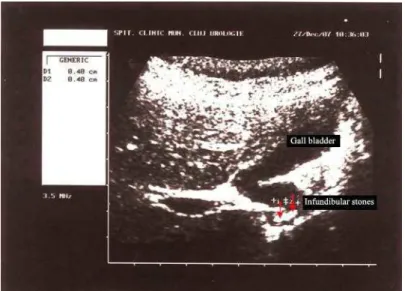
The clinical examination of the abdomen found a slight sensibility at deep palpation of the right hypochondrium. The lab data showed no biological abnormalities. The upper digestive endoscopy revealed a chronic antral gastritis with no Helicobacter pylori infection. The ultrasonography performed with an Esaote Megas GPX ultrasound scanner, using a convex transducer with a frequency of 3.5 Mhz. It showed two mobile biliary calculi, described as echogenous images with acoustic posterior shadow, of 4 mm in diameter, located in the gall bladder infundibulum, as it is visible in the Fig. 1. The common bile duct and all the other internal organs had no modifications, exception being the 3/2 cm right kidney cortical cyst.
HVM Bioflux, 2011, Volume 3, Issue 1.
http://www.hvm.bioflux.com.ro
15
Figure 1. The ultrasonographic image of the folded gall bladder with the stones of 4 mm each in the bladder infundibulum.
We performed retrograde laparoscopic cholecystectomy using a traditional multiport laparoscopic approach (Stryker 2002), with peritoneal drainage, under a general anesthesia. The gall bladder examination revealed the two biliary stones, measuring 4 mm each (Fig. 2). There were no complications during or after surgery. In the first day after surgery the digestive transit has been restored and the drainage tube was also removed. The total hospitalization lasted for a period of 3 days. She received a gastric antisecretory treatment at discharge form hospital. Complete recovery was achieved after 7-8 days and the patient was able to go to school. The histopathological finding of the excised gall bladder showed large mucosal erosions, submucosal diffuse fibrosis and a moderate inflammatory infiltrate with round nuclei.
The patient came for clinical control at one month and then after 3 months having no problems with the operation or dyspeptic symptoms. In the present moment the patient is three years after surgery with no complaints, no symptoms, being able to maintain a normal diet and the general status is very good. She still have the right cortical kidney cyst.
Figure 2. The biliary stones, after they have been removed from the gall bladder.
HVM Bioflux, 2011, Volume 3, Issue 1.
http://www.hvm.bioflux.com.ro
16
Bogue et al suggested a conservative treatment for clinically silent, uncomplicated gallstones in children and infants because they are associated with low rates of complications, but patients with sickle cell disease, spherocytosis, and elliptocytosis had high complication rates and required surgery more often (Bogue et al 2010).
As for adults, the laparoscopic surgery is feasible, sure and well tolerated (Newman et al 1991; Vinograd et al 1993; Holcomb et al 1999; Oak et al 2005), even if the technique must be adapted to smaller dimensions. Our patient underwent conservative medical treatment (choleretic drugs: Fiobilin, Colebil) but with no effect. We consider that the persistence of biliary symptoms, also the multiple absences at school and lack of efficiency of medical treatment for dyspeptic symptoms, represent even for this age an indication for surgery.
At this time there are also other possibilities to perform cholecystectomy: traditional open surgery; mini cholecystectomy (traditional surgery through a small cut, which is suitable in some patients who are thin and have an early disease); mini/micro laparoscopic cholecystectomy (is a further advancement of the laparoscopic technique using even smaller holes and narrower instruments and telescopes, with no stitches on the skin, with less pain and a slightly faster recovery); NOTES (Natural orifice transluminal endoscopic surgery) - an experimental surgical technique whereby "scarless" abdominal operations can be performed with an endoscope passed through a natural orifice (mouth, urethra, anus, vagina etc.) then through an internal incision in the stomach, vagina, bladder or colon, thus avoiding any external incisions or scars, but the procedure has not gained popularity due to the risks of complications; and SILS (Single incision laparoscopic surgery) - an advanced minimally invasive surgical procedure in which the surgeon operates almost exclusively through a single entry point, that in most cases is hidden in the umbilicus. In our clinic robotic cholecystectomy can be also performed using a Da Vinci surgical robot.
Conclusions. The laparoscopic cholecystectomy of this young girl resolved very well the dyspeptic problems she faced for two years. There were no complications during and after surgery and now she is in a good health status. The surgical treatment (cholecystectomy) is recommended even for such young patients when the gall bladder lithiasis is symptomatic, like for adult patients. If there is no complications it should be performed a laparoscopic cholecystectomy rather than open cholecystectomy.
References
Bogue C. O., Murphy A. J., Gerstle J. T., Moineddin R., Daneman A., 2010 Risk factors, complications, and outcomes of gallstones in children: a single-center review. J Pediatr Gastroenterol Nutr 50(3):303-308.
Holcomb G. W., Morgan W. M., Neblett W. W., Pietsch J. B., O’Neill J. A. Jr., Shyr Y., 1999 Laparoscopic cholecystectomy in children: lessons learned from the first 100 patients. J Pediatr Surg 34(8):1236-1240.
Miltenburg D. M., Schaffer III R., Breslin T., Brandt M. L., 2000 Changing indications for pediatric Cholecystectomy. Pediatrics 105(6):1250-1253.
Newman K. D., Marmon L. M., Attorri R., Evans S., 1991 Laparoscopic cholecystectomy in pediatric patients. J Pediatr Surg 26(10):1145-1147.
Oak S. N., Parelkar S. V., Akhtar T., Pathak R., Vishwanath N., 2005 Role of laparoscopic cholecystectomy in children. J Indian Assoc Pediatr Surg 10:92-94.
Papandreou E., Gentimi F., Baltogiannis N., Livaditi E., Loukas I., Christopoulos-Geroulanos G., 2008 Laparoscopic cholecystectomy in children: A 5-year experience. Pediatrics 121(Suppl 2):163-164.
Vinograd I., Halevy A., 1992 Laparoscopic cholecystectomy in children. Harefuah 123 (3-4):89-91.
HVM Bioflux, 2011, Volume 3, Issue 1.
http://www.hvm.bioflux.com.ro
17
Received: 01 January 2011. Accepted: 26 January 2011. Published online: 27 January 2011. Authors:
Daciana N. Chirilă: „Iuliu Haţieganu” University of Medicine and Pharmacy, Cluj-Napoca, Department of Surgery, 5th Surgical Clinic, 11th Tăbăcarilor Street, 400139, Romania, EU, e-mail: [email protected] Tudor R. Pop: „Iuliu Haţieganu” University of Medicine and Pharmacy, Cluj-Napoca, Department of Surgery, 5th Surgical Clinic, 11th Tăbăcarilor Street, 400139, Romania, EU, e-mail: [email protected]
Nicolae A. Constantea: „Iuliu Haţieganu” University of Medicine and Pharmacy, Cluj-Napoca, Department of Surgery, 5th Surgical Clinic, 11th Tăbăcarilor Street, 400139, Romania, EU, e-mail: [email protected] How to cite this article:
Chirilă D. N., Pop T. R., Constantea N. A., 2011 Lithiasic cholecystitis in children - a clinical case. HVM Bioflux