Universidad Autónoma Metropolitana Unidad Iztapalapa
México
Dutra-Molino, J.V.; Araujo Feitosa, V.; de Lencastre-Novaes, L. C.; de Carvalho Santos-Ebinuma, V.; Moreni Lopes, A.; Faustino Jozala, A.; de Araújo Viana Marques, D.; Pellegrini Malpiedi, L.; Pessoa
Júnior, A.
BIOMOLECULES EXTRACTED BY ATPS: PRACTICAL EXAMPLES Revista Mexicana de Ingeniería Química, vol. 13, núm. 2, 2014, pp. 359-377
Universidad Autónoma Metropolitana Unidad Iztapalapa Distrito Federal, México
Available in: http://www.redalyc.org/articulo.oa?id=62031508001
How to cite Complete issue
Vol. 13, No. 2 (2014) 359-377
BIOMOLECULES EXTRACTED BY ATPS: PRACTICAL EXAMPLES
BIOMOL ´
ECULAS EXTRA´IDAS POR SBAS: EJEMPLOS PR ´
ACTICOS
J.V. Dutra-Molino1, V. Araujo Feitosa1, L. C. de Lencastre-Novaes1, V. de Carvalho Santos-Ebinuma2, A. Moreni Lopes1, A. Faustino Jozala1, D. de Ara´ujo Viana Marques3, L. Pellegrini Malpiedi1,4and A. Pessoa J´unior1∗
1Department of Biochemical and Pharmaceutical Technology, Faculty of Pharmaceutical Sciences, University of
S˜ao Paulo - USP, Brazil.
2Department of Bioprocess and Biotechnology, Faculty of Pharmaceutical Sciences, S˜ao Paulo State University
-UNESP, Brazil.
3Department of Animal Morphology and Physiology, Federal Rural University of Pernambuco- UFRPE, Brazil.
3Department of Chemical-Physic, Faculty of Biochemical and Pharmaceutical Sciences, National University of
Rosario - UNR, Argentina.
Received June 14, 2013; Accepted March 30, 2014
Abstract
The actual biotechnology industry demands fast and economic upstream and downstream processes to purify biomolecules. In this context, different purification techniques, that offer both high recovery and purity to the final product, have been assayed by different research groups. Liquid-liquid extraction with aqueous two-phase systems is one of the most studied methodologies for bio-separation. This technique presents several advantages such as mild conditions of working, cost-effectiveness, short-time consumption and high recovery percentage of the final product. With the aim to present a comparison of liquid-liquid extractions with other techniques, several aqueous two-phase extraction processes of biomolecules are presented in this review. We presented the advantages and disadvantages of them as of the compared systems. In general, the highest final product purities are achieved when different methodologies are combine, being the chromatographic ones the most applied in the last stages for the high purification factor obtained after them. Alternative methodologies, such as aqueous two-phase systems (ATPS),i.e., PEG/salts or ionic liquids; aqueous two-phase micellar systems, using solvents and surfactants; and extractive fermentation with ATPS, are relevant for both cost-effectiveness and time-saving of the purification process.
Keywords:liquid-liquid extraction, downstream processing, biomolecules, polymers, surfactant.
Resumen
La industria biotecnol´ogica actual exige procesos r´apidos y econ´omicos para la producci´on y la purificaci´on de biomol´eculas. En este contexto, diferentes t´ecnicas separativas que ofrezcan un alto rendimiento y una alta pureza del producto final han sido evaluadas por diferentes grupos de investigaci´on. La extracci´on l´ıquido-l´ıquido con sistemas bif´asicos acuosos (SBAs) es una de las metodolog´ıas m´as estudiadas para bio-separaci´on. Esta t´ecnica presenta varias ventajas, tales como condiciones suaves de trabajo, alta relaci´on costo-beneficio, cortos tiempos de consumo y alto porcentaje de recuperaci´on del producto final. Con el objetivo de comparar extracciones l´ıquido-l´ıquido con otras t´ecnicas de separaci´on, diferentes procesos de extracci´on de biomoleculas ser´an presentados en este trabajo de revisi´on. Adicionalmente, se presentaran las ventajas y desventajas de cada uno de ellos. En general, los m´as altos grados de pureza del producto final fueron obtenidos al combinar diferentes metodolog´ıas, siendo las cromatogr´aficas las m´as aplicados en las ´ultimas etapas debido a los elevados factores de purificaci´on obtenidos despu´es de ellas. Metodolog´ıas alternativas como por ejemplo, SBAs basados en mezclas de PEG/sal o liqu´ıdos i´onicos/sal, sistemas micelares de dos fases acuosas (SMDFAs) formados por solventes o surfactantes; fermentaci´on extractiva utilizando SBA, tambi´en resultan ser relevantes debido a sus bajos costos y cortos tiempo en sus procesos de purificaci´on.
Palabras clave: extracci´on l´ıquido-l´ıquido, procesos de purificaci´on, biomol´eculas, pol´ımeros, surfactante.
∗
Corresponding author. E-mail:[email protected]
1
Introduction
The wide variety and combinations of production processes employed to purify biomolecules from different biological sources are known as bioseparation or downstream processing (Shukla et al., 2007). As it comprises a key point for the commercial development of biotechnological products (Kelley 2009), bioseparation protocols should be designed in order to reach the best cost/benefit ratio. A conventional downstream process includes an initial clarification step (removal of cells and enrichment of the target molecule), an intermediary purification (first capture of target molecule) and a polishing (final product with high degree of purity) (Shukla et al., 2007). Each step may even comprise several unit operations depending on the biological source complexity and/or the final purity degree required. Unfortunately, the use of a multi-step procedure generally leads to low recovery yields, thus impacting in the final product costs (Low et al., 2007; Kurasawa et al., 2013). For large-scale purification, the drawbacks of employing several purification steps is even more significant due to the large space and buffer volumes required for downstream operations (Aldington & Bonnerjea 2007). As a result, alternative methodologies that allow several purification steps to be integrated, offering simple procedures, are being evaluated (Lowet al., 2007). Important candidates include precipitation, aqueous two-phase systems (ATPS) and expanded bed chromatography. These techniques present the advantage of integrating clarification and intermediary purification, avoiding the use of a multi-step protocol (Lanet al., 2011; Rosaet al., 2013). On the other hand, liquid-liquid extraction and expanded bed adsorption can even integrate upstream and downstream processes. These last methodologies are currently known as extractive bioconversion.
In this review, we discuss and compare different downstream processing methodologies based mainly on liquid-liquid extraction. Additionally, we offer our point of view on which one of them is the most suitable. The text is structured with a briefly explanation of polymeric, micellar, reverse micelle and ionic liquid-based aqueous two phase system, followed by the comparison of ATPS biomolecules purification examples with other techniques. It should be noticed that most of the examples cited in this paper are based on previous works developed by our research group.
2
Liquid-liquid extraction
Liquid-liquid extraction (LLE) is a purification technique, which consists of the transfer of certain components from one phase to another when immiscible or partly soluble liquid phases are brought into contact with each other (Mazzolaet al., 2008). The conventional process of LLE uses water-organic solvent two-phase systems. However, it is known that there are some limitations to use of organic solvents particularly in large-scale applications,
due to solvents toxicity, their cost, their impact on the environment, and due to the fact that organic solvents may lead to irreversible product degradation (Dermiki et al., 2009). In this respect, the liquid-liquid extraction by aqueous two-phase systems (ATPS) has been proved to be a valuable technique for separating and purifying biomolecules, organelles, membranes, as well as whole cells, from complex media. In comparison to other separation techniques, aqueous two-phase extraction offers many advantages, such as a short processing time, low energy consumption, environmentally friendly and it is relatively ease to scale-up (Liuet al., 2011). Furthermore, the high water concentration (between 80-90%) in such systems favors the stability of biologically active molecules during the separation process, in comparison to the two-phase systems with organic solvents (Hatti-Kaul 2001). On the other hand, extractive bioconversion using aqueous two-phase systems (ATPS) seems to be a very attractive method for the integration of fermentation and downstream processing of extracellular proteins (Pandey & Banik 2011). Several ATPS formats have been studied since the first report announced by Beijerinck in 1896, which showed that the combination of gelatin, agar and water in certain proportions forms two immiscible aqueous rich phases (Beijerick 1896). Nonetheless, it was only in 1958 that Albertsson (1958) reported the ability of ATPS formed by polyethylene glycol (PEG) and dextran to separate biomolecules from aqueous media. Among the ATPS studied, we can mention: polymeric (ATPS-P), micellar (ATPS-M), reverse micellar (ATPS-RM) and ionic liquid-based (ATPS-IL). The next section will summarize each ATPS technique.
2.1
Liquid-liquid extraction in polymeric
aqueous two-phase systems
2.2
Liquid-liquid extraction in micellar
aqueous two-phase systems
Surfactants solution can form micellar aqueous two-phase systems (ATPS-M). Surfactants are amphiphilic molecules composed of a hydrophilic or polar moiety, known as head, and a hydrophobic or nonpolar moiety, known as tail. The surfactant head can be charged (anionic or cationic), dipolar (zwitterionic), or non-charged (nonionic) (Rangel-Yaguiet al., 2005). Surfactants can form micelles solutions and these systems are based on the property that some micelle solutions present to phase separate into a micelle-rich and a micelle-poor phase, under certain conditions such as temperature, pH and ionic strength (Liu et al., 1996). Hence they offer hydrophobic and hydrophilic environments at the same time, allowing selectivity on the partitioning of molecules and contaminants according to their hydrophobicity (Nikas et al., 1992; Rangel-Yaguiet al., 2003; Andradeet al., 2011). Further information about the basis of this technique can be found in the literature (Mazzolaet al., 2008).
2.3
Liquid-liquid
extraction
in
reverse
aqueous two-phase micellar systems
As the aqueous two-phase micellar systems, the reverse systems (ATPS-RM) are surfactants-based. However, reverse micelles form spontaneously reversible spherical aggregates of amphiphilic molecules in non-polar liquids (Hasmannet al., 2007). Nanometer-sized water pools are formed by a monolayer of surfactants molecules entrapping water (Li & Cao 2014). In this way, reverse micelles are formed in organic solutions and depending on the water content of the system, may have a small or large water core for hosting molecules. These aggregates can be used to solubilize different molecules according to their hydrophobicity, size and charge (Stormet al., 2014). Additional information about the technique can be found in the literature (Mazzolaet al., 2008).
2.4
Liquid-liquid extraction in ionic
liquid-based aqueous two-phase systems
Ionic liquids, designed also as green solvents, comprise a group of novel molecules which are widely studied due to their characteristics such as negligible volatility, large liquid range, high thermal capacity, chemical stability and strong solvent property (Pramaniket al., 2011). Ionic liquids have been already applied in biocatalysis, electrochemistry, and bio-separations (Yu et al., 2011). In recent years ionic liquids have been investigated as novel aqueous two-phase systems (ATPS-IL) (Li et al., 2012b). The ionic liquids are typically comprise inorganic or organic cations and organic anions, usually liquid at room temperature, low vapor pressure and present a great structural variety. Due to ionic liquids characteristics, the systems composed of them
do not suffer from high viscosity and from formation of opaque aqueous solutions or are limited to a narrow range of polarities (Venturaet al., 2013). Such extraction system has been successfully used to extract proteins, enzymes, antibiotics, spices, and drug molecules (Tanet al., 2012).
3
Biomolecules
extracted
by
ATPS
Different biomolecules and cellular components have been purified by ATPS. In this section it will be discussed and compared ATPS purification methods applied to extracted or purified biomolecules produced by biological systems. The section is divided, for organization purpose, in classes of biomolecules: enzymes, antibiotics, colorants, pDNA and LPS. It is worth noticed that LPS was included as extracted biomolecule, but it was studied as a contaminant removed from other biomolecules.
3.1
Enzymes
Several hydrolytic and non-hydrolytic enzymes have been successfully purified. In this sub-section we will discuss some practical examples of enzymes purification applying ATPS and to compare them with other techniques.
3.1.1 Bromelain
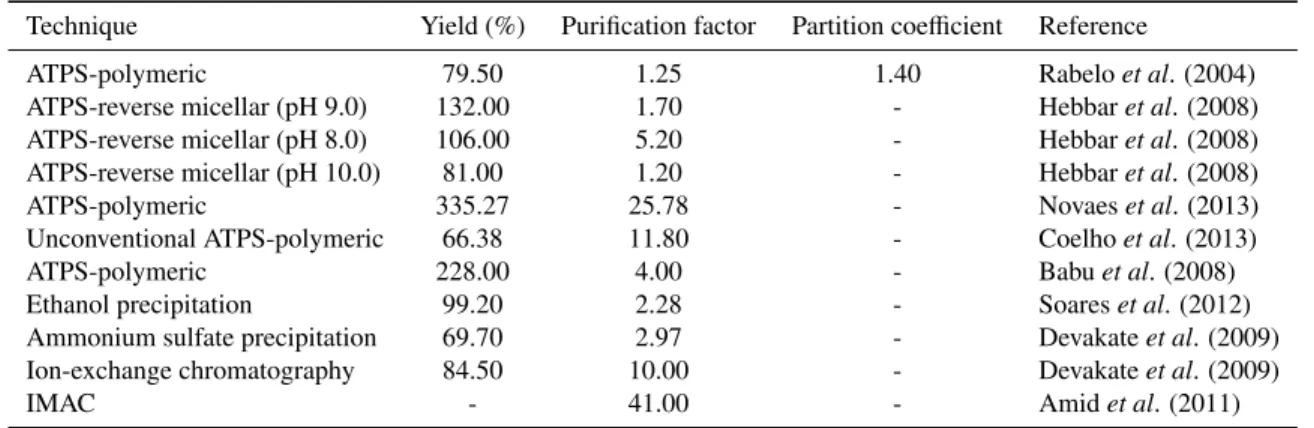
Bromelain is a mixture of proteolytic enzymes present in all tissues of the pineapple (Ananas comosus Merr.), and it is known for its clinical therapeutic applications, food processing, and as a dietary supplement (Novaeset al., 2013). Rabelo et al., (2004) evaluated bromelain purification with ATPS-P formed by poly(ethylene oxide) (PEO)-poly(propylene oxide) (PPO)-poly(ethylene oxide) (PEO) block copolymers. The best result showed 79.5% enzyme activity recovery, a purification factor of 1.25 in the top phase and 1.4 partition coefficient.
Hebbar et al. (2008) used reverse micellar system composed of cationic surfactant n-hexadecyltrimethyl-ammonium (CTAB) to recovery bromelain. The extraction was performed at different pHs, the results were as follow: pH 9.0 - activity recovery of 132%, purification factor of 1.7-fold; pH 8.0 - activity recovery of 106%, purification factor of 5.2-fold and 45% forward extraction efficiency; pH 10.0 -activity recovery of 81% and purification factor of 1.2-fold.
Novaeset al. (2013) extracted bromelain of pineapple waste employing ATPS-P formed by PEG and poly(acrylic acid) (PAA). In this work, bromelain partitioned preferentially to the top/PEG-rich phase and, in the best condition [8% of PEG and PAA, PEG 2,000 g/mol, PAA 15,000 g/mol, and 6% of Na2SO4at 30ºC] achieved a yield of 335.27% with a purification factor of 25.78.
purified bromelain through an unconventional ATPS-P which integrates fractional precipitation by ammonium sulfate. With this new technique, the authors obtained a purification factor of 11.80 with a 66.38% activity yield, in a system composed by PEG concentration of 10.86% and 36.21% ammonium sulfate saturation. ATPS formed by PEG/phosphate buffer was evaluated by Babuet al., (2008) and a bromelain activity recovery of 228% and a purification factor of 4.0 was achieved.
Bromelain was also extracted by precipitation techniques. Soares et al., (2012) studied bromelain purification through ethanol precipitation method. Employing two-step precipitation, 30-70% (v/v) ethanol, it was possible to purify bromelain with a purification factor of 2.28 with a 99.2% recovery yield. Devakateet al., (2009) studied the purification applying ammonium sulfate precipitation and ion-exchange chromatography. The group obtained the best precipitation results using 40-70% of ammonium sulfate, achieving 2.97 purification factor and recovering 69.7% of the enzyme from crude extract. Cation-exchange chromatography presented better results than precipitation with a purification factor of 10 and 84.5% recovery.
Amidet al. (2011) expressed bromelain in the BL21-AI Escherichia colistrain. The recombinant bromelain was then purified in a single step using immobilized metal affinity chromatography (IMAC), specifically a nickel-NTA column. This single step purification method increased bromelain preparation purity by about 41-fold. Table 1 summarizes the results obtained for bromelain as shown in this section.
3.1.2 Collagenase
Collagenase is an enzyme traditionally produced by microorganisms in the extracellular matrix. In this way, it takes one step to separate the target biomolecule from the cells and other step to purify it from other contaminants presented in the fermented broth. A variety of methods and strategy were applied to collagenase purification.
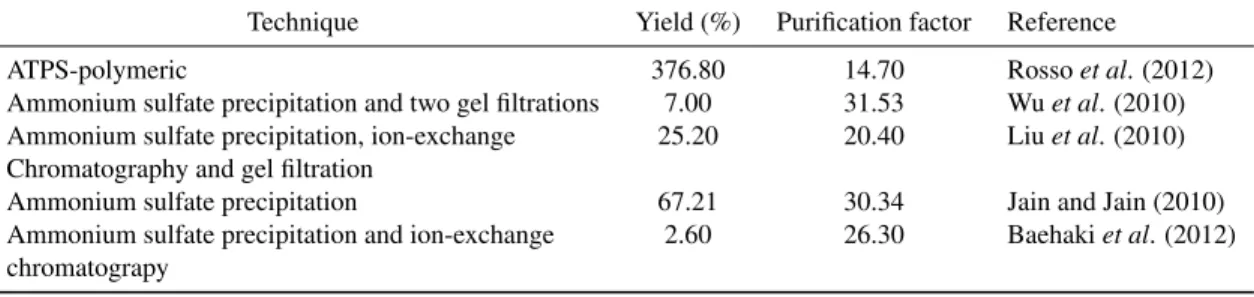
Collagenase from Penicillium aurantiogriseum was purified by Rosso et al. (2012) using ATPS-P formed by PEG/phosphate, which obtained a 376.8% yield in the top phase with a 14.7 purification factor. Wu et al. (2010) employed the strategy of three-step procedure (ammonium sulfate precipitation, and two gel filtrations) and achieved a 31.53-fold purity with a 7% yield from crude extract. Liu et al. (2010), using a combination of ammonium sulfate precipitation, ion-exchange chromatography and gel filtration, obtained a lower result of purification factor (20.4) but a higher yield (25.2%), when compared with the values obtained by Wuet al. (2010). On the other hand, higher values to both parameters, yield (67.21%) and purification factor (30.34), were obtained by Jain and Jain (2010), whom used only ammonium sulfate precipitation as a purification method. Baehakiet al. (2012), combined ammonium sulfate precipitation and ion-exchange chromatograpy to improve the collagenase purification, but lower results were achieved, purification factor of 26.3, with a 2.6% yield from the crude extract. Moreover, liquid-liquid extraction with use of polymer (ATPS) achieved interesting results, since it is a simple and easy method to work with and presented the best results as the results obtained by Rossoet al. (2012). Table 2 summarizes the results obtained for collagenase as shown in this section.
3.1.3 Lysozyme
Lysozyme (muramidase, EC 3.2.1.17) is widely distributed in animal tissues and secretions. Apart from that, lysozyme exists abundantly in hen egg white constituting 3.5% of the total egg white proteins. Due to its antimicrobial activity this enzyme is utilized as a food preservative, and some pharmaceutical applications (Dembczynski et al., 2012). Lysozyme is another example of enzyme that is widely employed to ATPS extraction assays. Lu et al. (2013) assessed lysozyme purification from hen egg using PEG 4,000/potassium citrate aqueous two-phase system (ATPS), observing an increase in lysozyme recovery with higher salts concentration.
Table 1. Bromelain extraction/purification results from different techniques Technique Yield (%) Purification factor Partition coefficient Reference
ATPS-polymeric 79.50 1.25 1.40 Rabeloet al. (2004)
ATPS-reverse micellar (pH 9.0) 132.00 1.70 - Hebbaret al. (2008)
ATPS-reverse micellar (pH 8.0) 106.00 5.20 - Hebbaret al. (2008)
ATPS-reverse micellar (pH 10.0) 81.00 1.20 - Hebbaret al. (2008)
ATPS-polymeric 335.27 25.78 - Novaeset al. (2013)
Unconventional ATPS-polymeric 66.38 11.80 - Coelhoet al. (2013)
ATPS-polymeric 228.00 4.00 - Babuet al. (2008)
Ethanol precipitation 99.20 2.28 - Soareset al. (2012)
Ammonium sulfate precipitation 69.70 2.97 - Devakateet al. (2009)
Ion-exchange chromatography 84.50 10.00 - Devakateet al. (2009)
IMAC - 41.00 - Amidet al. (2011)
Table 2. Collagenase extraction/purification results from different techniques.
Technique Yield (%) Purification factor Reference
ATPS-polymeric 376.80 14.70 Rossoet al. (2012)
Ammonium sulfate precipitation and two gel filtrations 7.00 31.53 Wuet al. (2010) Ammonium sulfate precipitation, ion-exchange 25.20 20.40 Liuet al. (2010) Chromatography and gel filtration
Ammonium sulfate precipitation 67.21 30.34 Jain and Jain (2010)
Ammonium sulfate precipitation and ion-exchange 2.60 26.30 Baehakiet al. (2012) chromatograpy
ATPS: aqueous two-phase systems.
Table 3. Lysozyme extraction/purification results from different techniques.
Technique Yield (%) Purification factor Reference
ATPS-polymeric 103.0 21.11 Lu and co-workers (2013)
ATPS-polymeric 57.5 - Dembczynskiet al. (2012)
ATPS-polymeric 100.0 - Johanssonet al. (2008)
Affinity precipitation 80.0 28.00 Shen and Cao (2007)
Membrane-affinity chromatography 79.0 - Chianget al. (1993)
Dye ligand-immobilized composite membrane 82.0 25.40 Yilmazet al. (2005) ATPS: aqueous two-phase systems.
Furthermore, the purification factor and specific activity were increased to higher PEG 4,000 concentrations, achieving 21.1 and 103%. Dembczynski et al., (2012) studied an optimization method to identify the system composition for the most efficient separation conditions to lyzozyme from hen egg white in the aqueous two-phase system EO50PO50/potassium phosphate. The influence of phosphate, copolymers of ethylene oxide and propylene oxide (EO50PO50), NaCl concentration and pH on the partition coefficient and extraction yield of lysozyme were evaluated. The best results in lyzozyme partitions (45) and yield (57.5%) were found with EO50PO50, potassium phosphate and NaCl concentrations of 17.40, 22.67% and 0.85 M, respectively and for pH 9.0. Nevertheless, the most important factor analyzed was the NaCl concentration influencing the most on lysozyme partition and yield. Another polymeric system composed of PEG2,000/NaPA8,000 containing 6% Na2SO4, partitioned lysozyme to the PEG-rich top-phase (K equals 6.5), with a yield next to 100% (Johanssonet al., 2008).
Another technique used for lysozyme purification was affinity precipitation. Affinity precipitation technique has tremendous potential and is a powerful technique for protein purification (Kumar et al., 2008). One of the main advantages of affinity precipitation is its easy scalability (Royet al., 2005), and that it may provide a pure protein in a single step (Gawande & Kamat 1999). It is a cost-effective process, does not need special equipment and the consumption of polymer is minimal, as most of it can be recovered (Gawande and Kamat, 1999). Shen and Cao (2007) synthesized by radical polymerization a thermo-sensitive N-alkyl substituted polyacrylamide polymer which
was applied to affinity precipitation of lysozyme from egg white, wich purification factor of 28 and yield of 80%.
Other interesting techniques about lysozyme purification were also studied by other authors. Chianget al. (1993) studied the isolation and purification of lysozyme from hen egg white using two-step procedure. The egg white was processed by sequential dilution and diafiltration using a UF membrane (molecular weight cut-off300 kDa). The membrane process increased the specific activity of lysozyme 6-fold, and recovered 96% of lysozyme activity. The permeate from diafiltration was further purified by affinity chromatography using chitin as adsorbent, which yielded a product of specific activity of 70,400 U/mg protein, and the overall lysozyme recovery was 79%. This process used phosphate to help separation between lysozyme and other proteins, however the existence of phosphate in the residual egg white would limit its further uses. Nevertheless, the method provides a potential alternative in lysozyme separation.
of lysozyme from egg white in aqueous solution, and it could be used in large-scale applications. Table 3 summarizes the results obtained for lysozyme as shown in this section.
3.1.4 Xylanolytic complex
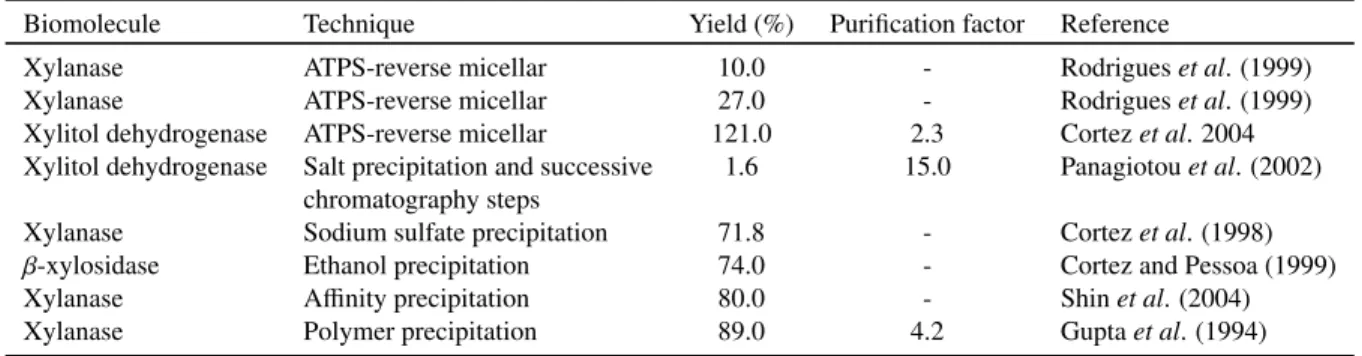
Xylanolytic complex are a discrete, multifuncional and multienzyme complex found in some xylan-degrating microorganisms. Rodrigues et al., (1999) described the transfer of an extracellular xylanase from Penicillium janthinellum by using reversed micellar two phase system of the anionic surfactant sodium bis(2ethylhexyl) sulfosuccinate (AOT) and the following factors influence: pH, temperature, surfactant concentration and buffer concentration. The highest enzyme recovery was around 10%, suggesting that for xylanase extraction by reversed micelles other type of surfactant, perhaps cationic, could be more appropriate (Rodrigues et al., 1999). Therefore, xylanase recovery by reversed micelles using cationic surfactant N-benzyl-N-dodecyl-N-bis(2-hydroxyethhyl)ammonium chloride (BDBAC) was evaluated under different experimental conditions and was obtained a 27% recovery (Rodrigues et al., 1999). The partition behavior ofP. janthinellumxylanase has also been studied in aqueous polymeric two-phase systems.
Xylitol dehydrogenase was extracted from crude extracts of Candida guilliermondii in BDBAC-reversed micelles in isooctane, by a two-step procedure, with recovery yield around 121% and 2.3 purification factor (Cortez et al., 2004). Another approach using a cationic surfactant evaluated the effectiveness of liquid-liquid extraction by CTAB reversed micelles in purifying xylitol dehydrogenase and xylose reductase in two different phases of the micellar system, with recovery yields around 100% for both enzymes, and 1.8 and 5.6 purification factor, respectively (Cortezet al., 2006).
Panagiotou et al., (2002), extracted xylitol dehydrogenase fromFusarium oxysporumwith 1.6% yields and a purity increase of 15-fold employing multi-step strategies which included salt precipitation and successive chromatography steps (Panagiotouet al., 2002).
Xylanolitic complex was also purified with other techniques as in the work of Cortez et al., (1998) which carried out precipitation assays of xylanase and total protein by using sodium sulfate. In the precipitations performed with sodium sulfate, the maximal xylanase recovery (71.8%) was attained at 25% concentration. At higher salt concentrations, the enzyme dissolved once more in the supernatant and the recovery yield decreased. The total protein precipitation curve showed a different behavior, in comparison to the xylanase. The highest recovery level (68%) was observed at 40% salt concentration.
Cortez and Pessoa (1999) carried out fractionated ethanol precipitations to separate β-xylosidase from the total proteins present in the fermented medium (xylanolitic complex). Results showed adequate selective separation of the xylanolitic enzymes. Some differences in solubility
between total xylanase andβ-xylosidase were observed. The highest β-xylosidase recovery yield and the highest total xylanase yield were achieved with ethanol concentrations of 60 and 80%, respectively. At 60% ethanol concentration, a slight decrease in the xylanase solubility was observed, and at 80% ethanol concentration, almost 100% of the total xylanase was precipitated. At pH 4.6 and 7.0, about 85% of the total xylanase was recovered, whereas at pH 5.9 and 6.3, about 95% of the total xylanase was recovered. The results obtained in this study (74% of β-xylosidase and 80% of total xylanase recovery) revealed that ethanol fractional precipitation is a proper technique for purify enzymes produced byPenicillium janthinellumfrom sugar cane bagasse. This technique does not affect the kinetic characteristic of the enzyme and provides a solution with low ionic strength, which is desirable for further purification steps.
Another method applied to xylanase is affinity precipitation. It can be selectively precipitated with a methyl methacrylate polymer like Eudragit S-100, which becomes insoluble below pH 5.0, its solubility change is reversible and can be used as an affinity ligand for number of enzymes (Gawande & Kamat 1999; Royet al., 2005). Roy et al., (2005) had a 95% recovery of xylanase activity with 42-fold purification.
The selective precipitation of xylanase from an aqueous phase containing mixtures of xylanase and cellulase was studied by Shinet al., (2004) using an ionic surfactant as precipitating ligand and a polar organic solvent as recovery solvent. From the four ionic surfactants tested, only sodium di-(2-ethylhexyl) sulfosuccinate (AOT) showed a complete removal of xylanase at pH 4.5. The recovery of xylanase from the xylanase-AOT complex was a strong function of the type and the volume of the polar solvent and of the concentration of sodium acetate buffer in the final aqueous solution used to solubilize the recovered xylanase. With ethanol as a recovery solvent, a recovery of about 80% was obtained. The cellulase activity in the recovered xylanase was below the detection limit. These authors demonstrated that an ionic surfactant can recover enzymes from aqueous solutions without loss in their activity.
Guptaet al., (1994) studied xylanase fromThricoderma. viride and purified 4.2 fold by precipitation with a commercially available enteric polymer Eudragit S-100. Electrophoretic analysis also indicated removal of contaminant proteins. The enzyme could be recovered in more than 89% yield and the binding of the enzyme to the polymer was predominantly by electrostatic interaction.
(Pandey & Banik 2011). Table 4 summarizes the results obtained for xylanolytic complex as shown in this section.
3.1.5 Glucose-6-phosphate dehydrogenase
Glucose-6-phosphate dehydrogenase (G6PD) is an enzyme, belonging to the important class of NADP+-dependent
dehydrogenases, which catalyzes the first step of the pentose phosphate pathway, i.e. the oxidation of glucose-6-phosphate (G6P) to gluconolactone glucose-6-phosphate, using NADP+ as hydrogen acceptor (Puchkaev et al., 2003).
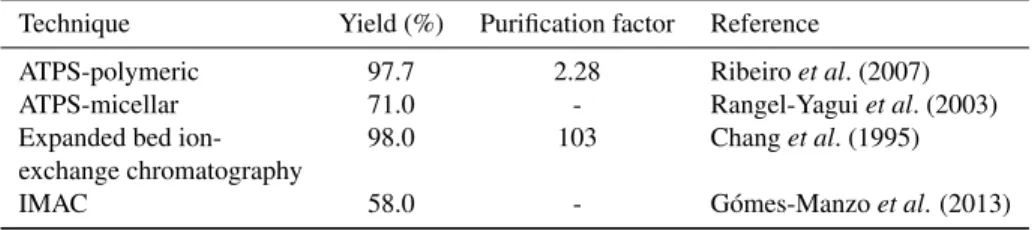
A system composed of PEG/phosphate, was able to recover 97.7% of G6PD from Saccharomyces cerevisiae cell homogenate, increasing purity by 2.28-fold (Ribeiro et al., 2007). Rangel-Yagui et al., (2003) demonstrated that the use of a two-phase aqueous mixed micellar system composed of the nonionic surfactant n-decyl tetra(ethylene oxide) (C10E4) and the cationic surfactant CnTAB (alkyltrimethylammonium bromide, n=8, 10, or 12) can improve significantly the partitioning behavior of the net-negatively charged enzyme G6PD on the one obtained in the two phase aqueous C10E4micellar system. Overall, the two-phase aqueous mixed (C10E4/C10TAB) micellar system yielded the highest G6PD partition coefficient (7.7), with a 71% yield in the top phase, providing the optimal balance between the denaturing effect and the electrostatic attractions for the three cationic surfactants examined.
G6PD industrial purification has been carried out through multiple-step processes based on chromatography technology. This technique provided recovery 98% yield and a purification factor of 103 in expanded bed ion-exchange chromatography (Changet al., 1995). G´omes-Manzoet al., (2013) produced a his-tagged human G6PD inE. coliand the purification was through in a single chromatographic step by immobilized metal affinity (Nickel Sepharose) with a 58% yield and specific activity of 224 IU/mg.
Tejedoret al., (1986) studied the precipitation profiles of G6PD, phosphofructokinase (PFK) and 6-phosphogluconate dehydrogenase (6PGD) in different PEG concentration and pHs. Precipitation generally occurred between narrow limits of polyethylene glycol. Particular conditions (%PEG and pH) for the selective enzyme enrichment have been
determined. For G6PD, all specific activities in precipitated obtained at pH 5.0 are higher than in the original hemolysate (10.7 ×10⁻² U/mg). In contrast, precipitates obtained at pH 6.0 or 7.0 have lower specific activities than the original hemolysate. This means that, at pH 6.0 and 7.0, the supernatants became enriched in G6PD. The highest G6PD enrichment (5-fold) in pellet corresponds to that of 90% yield (6% PEG and pH 5.0). Under these conditions the enzyme could also be separated from 6PGD and, therefore, this precipitate would be the most appropriate for a preliminary isolation of G6PD. Since such a precipitate also contains 80% of original PFK, a previous PFK precipitation would be necessary at 6% PEG pH 6.0, after which G6PD would be precipitated (6% PEG, pH 5) from the supernatant. According to these authors the enrichment degree of each enzyme by using the above mentioned conditions is adequate for an initial step of purification. Nevertheless, a more selective isolation of each enzyme can be expected through the manipulation of precipitation curves horizontally along the PEG axis by varying solution conditions.
As shown above, both liquid-liquid purification and precipitation may play an important role in G6PD purification, but it would be in the first step in the purification process to aid chromatography steps. Both techniques presented a high extraction yield and were able to partially purified G6PD. Table 5 summarizes the results obtained for glucose-6-phosphate dehydrogenase as shown in this section.
3.1.6 Glucose oxidase
Glucose Oxidase (GOX) is a flavoprotein which catalysis the oxidation of glucose to gluconic acid and hydrogen peroxide, using molecular oxygen as the electron acceptor (Chenet al., 2013). GOX by CTAB reversed micelles from raw and centrifuged cell homogenates of Aspergillus niger enriched with commercial enzyme was studied by Ferreira et al., (2005). The recovery yield obtained from centrifuged homogenate (92.7%) was compared with the one obtained from raw homogenate (94.3%), thus demonstrating that cell debris removal is not necessary to obtain satisfactory extraction performances (Ferreiraet al., 2005).
Table 4. Xylanolytic complex extraction/purification results from different techniques.
Biomolecule Technique Yield (%) Purification factor Reference
Xylanase ATPS-reverse micellar 10.0 - Rodrigueset al. (1999)
Xylanase ATPS-reverse micellar 27.0 - Rodrigueset al. (1999)
Xylitol dehydrogenase ATPS-reverse micellar 121.0 2.3 Cortezet al. 2004
Xylitol dehydrogenase Salt precipitation and successive 1.6 15.0 Panagiotouet al. (2002) chromatography steps
Xylanase Sodium sulfate precipitation 71.8 - Cortezet al. (1998)
β-xylosidase Ethanol precipitation 74.0 - Cortez and Pessoa (1999)
Xylanase Affinity precipitation 80.0 - Shinet al. (2004)
Xylanase Polymer precipitation 89.0 4.2 Guptaet al. (1994)
Table 5: Glucose-6-phosphate dehydrogenase extraction/purification results from different techniques.
Technique Yield (%) Purification factor Reference
ATPS-polymeric 97.7 2.28 Ribeiroet al. (2007)
ATPS-micellar 71.0 - Rangel-Yaguiet al. (2003)
Expanded bed ion- 98.0 103 Changet al. (1995)
exchange chromatography
IMAC 58.0 - G´omes-Manzoet al. (2013)
ATPS: aqueous two-phase systems; IMAC: immobilized metal affinity chromatography.
Table 6: Glucose oxidase extraction/purification results from different techniques.
Technique Yield (%) Purification factor Reference
ATPS-reverse micelle 94.3 - Ferreiraet al. (2005)
precipitations, ultrafiltration,
anion-exchange and size-exclusion 10.3 8.6 Simpsonet al. (2007)
chromatographies
Anion-exchange and gel filtration 9.0 89.3 Kelley and Reddy (1986) chromatographies
ATPS: aqueous two-phase systems.
Simpson et al. (2007) purified glucose oxidase from Penicillium sp. using many steps (precipitations, ultrafiltration, anion-exchange and size-exclusion chromatographics) with 10.3% yields and purification of 8.6-fold.
Kelley and Reddy (1986) studied the glucose oxidase purification fromPhanerochaete chrysosporiumcombininng anion-exchange and molecular size chromatographies. The authors achieved purification of about 90-fold. In the DEAE-Sephadex step, about 60% of the total glucose oxidase activity present in crude cell extracts was recovered in the 0.25 M NaCl eluate, giving about a 5-fold increase in specific activity. The next Sephacryl S-300 step produced 38-fold enrichment in specific activity and 41% recovery of total activity. The elution profile from the DEAE-Sepharose column showed that a single protein peak had all the glucose oxidase activity, with 89.3-fold enrichment in specific activity and enzyme recovery of 9%.
Since reversed micelles extraction can be conducted with homogenate, it may be applied as a clarification step. The results presented may indicate that combining techniques as reversed micelles extraction and a chromatographic step may possess the capacity to do purification of GOX. Table 6 summarizes the results obtained for glucose oxidase as shown in this section.
3.1.7 Inulinase
In one of the first investigations, the enzyme inulinase was extracted from Kluyveromyces marxianus into a reversed micelle phase of the cationic surfactant BDBAC in isooctane/hexanol with an 87% recovery yield of and a 2.8 purification factor (Pessoa Jr & Vitolo 1998).
In regard to inulinase purification, different methods of reaching this goal can be found in the Literature,
such as expanded bed (Pessoa Jr & Vitolo, 1998; Kalil, Maugeri-Filho & Rodrigues, 2005), liquid-liquid extraction by reversed micelles (Pessoa Jr & Vitolo, 1998), cation-exchange chromatography (Kalil et al., 2010), two-step approach based on precipitation with ethanol followed by ultrafiltration (Golunskiet al., 2011) and use of four steps: ultrafiltration, DEAE Sepharose fast flow anion-exchange column chromatography, gel filtration and filtration (Liet al., 2012). A comparison between the results obtained in all cited methods showed that liquid-liquid extraction promoted the worst results (20.4% enzyme activity recovery). All the other methods promoted enzyme activity recovery between 67.5 and 93%, and the ion-exchange expanded bed chromatography achieved the highest purification factor, of 10.4.
Using the anion-exchange expanded bed chromatography technique with diethylaminoethanol (DEAE), inulinase was recovered directly from the cultivated medium ofCandida kefyr. The highest enrichment factor obtained was 4.3, concentration factor of 2.8 and 93.1% enzyme recovery. The selectivity and specificity of the chromatographic technique were higher than those of the other techniques tested for this enzyme (Pessoa Jr & Vitolo 1998).
with 86.1% yield. Table 7 summarizes the results obtained for Inulinase as shown in this section.
3.2
Antimicrobials
3.2.1 Clavulanic acid
Clavulanic acid (CA) is a beta-lactamic molecule that presents weak antibiotic activity, but is a potent beta-lactamases inhibitor (Hagaet al., 2013). The first attempt on CA extraction employing aqueous two-phase systems was performed by Videira and Aires-Barros (1994). The authors studied the aqueous two-phase system composed of PEG and potassium phosphate. The results revealed that this molecule showed high affinity with the PEG-rich phase with partition coefficients ranging from 1.5 to 114 and high recoveries (75%). By increasing the tie-line length and pH, it raised the potassium clavulanate partition coefficient in all conditions tested and 99% of the clavulanate was recovered in the PEG phase. Silva et al., (2009) evaluated a similar system to that used for Videira and Aires-Barros (1994), to purify CA from fermented broth of Streptomyces clavuligerus, attaining a 100% yield and a 1.5-fold purification factor. Later on, the same authors, Silva et al., (2012), studied the strategy of combined methods for the purification of CA from fermented broth of amino acids: first, ATPS composed of PEG/potassium phosphate followed by an anion-exchange chromatography. As a result, a concentration factor of 2 and 100% of purification in relation to the amino acids lysine, proline, histidine and tyrosine was achieved. Viana-Marqueset al., (2011) studied the extractive fermentation of CA byS. clavuligerus using aqueous two-phase systems composed of PEG and phosphate salts. In that work, the CA extraction in stirred flasks was evaluated by a 24−1 fractional factorial design followed by a 22 central composite design. The variables
investigated were PEG molar mass, concentrations of PEG and phosphate salts and agitation intensity. The results revealed that agitation intensity and PEG molar mass were the most significant variables to the process. So, the authors optimized the process and the best results were showed in terms of partition coefficient (K=8.2), CA yield in the PEG-rich phase (η=93%) and productivity (P=5.3 mg/L.h). Furthermore, studies in the optimized condition to scale-up
the process, e.g. bench-scale fermenter, were carried out and revealed better results than the ones obtained in stirred flask. As an alternative to the aqueous two-phase systems based on polymers/salts, a novel inexpensive and stable ATPS composed of PEG and sodium polyacrylate (NaPA) supplemented with NaCl and Na2SO4was investigated by Pereiraet al., (2012) to extract CA from fermented broth. The authors evaluated the influence of PEG-molecular size and polymer concentrations on commercial CA partitioning at 25 °C. The data showed that commercial CA was preferentially partitioned for the PEG-rich phase with a partition coefficient varying from 1 to 12 depending on the system composition. The partition to the PEG phase was increased in the systems with high polymer concentrations. Moreover, the salt Na2SO4 caused higher CA preference for the PEG-phase than NaCl. The systems with a 10% of PEG 4,000, 20% of NaPA 8,000 and 6% of Na2SO4
composition were selected as the optimal ones in terms of recovery of CA from fermented broth ofS. clavuligerus. The partition coefficient (9.15) were competitive with commercial extraction methods of CA (11.91).
However, liquid-liquid extraction by micellar systems did not promote similar results to the ATPS ones. Santos et al. (2011) employed mixed micellar systems composed of Triton X-114 and AOT, achieving partition coefficient 1.48 and 86.3% recovery in the micelle-rich phase. Andradeet al. (2011) employed the surfactants C10E4and DDAO, with a 52% recovery and removal of 70% of the contaminant proteins. Further investigation was led by Haga et al. (2013), who used C10E4with the addition of CTAB or AOT surfactants. In these systems, a decrease in the partition coefficient value was achieved: 0.87, for the mixed micellar systems, 1.44 was obtained with CTAB/C10E4, while 0.78 was observed with AOT/C10E4.
3.2.2 Tetracicline
Another antibiotic molecule, tetracycline, was extracted from the fermented broth ofS. aureofaciensby Pereiraet al. (2013). The authors compared the conventional ATPS PEG/Na2SO4and [Ch]Cl/K3PO4with ATPS composed of PEG and cholinium-based salts, e.g. liquid ionic, which are very recent systems (Freireet al., 2012).
Table 7: Inulinase extraction/purification parameters from different techniques.
Technique Yield (%) Purification factor Reference
ATPS-micellar 90.0 3.0 Pessoa Jr and Vitolo (1998)
Anion-exchange expanded bed chromatography 93.1 05.8 Pessoa Jr and Vitolo (1998) Cation-exchange expanded-bed chromatography 74.0 10.4 Kalilet al. (2005)
Table 8: Antimicrobials extraction/purification results from different techniques.
Biomolecule Technique Yield (%) Purification factor Reference
Clavulanic acid ATPS-polymeric 75.0 - Videiraet al. (1994)
Clavulanic acid ATPS-polymeric and anion- 100.0 1.5 Silvaet al. (2009)
exchange chromatography
Clavulanic acid ATPS-polymeric 93.0 - Viana-Marqueset al., (2011)
(extractive fermentation)
Clavulanic acid ATPS-polymeric 55.0 - Pereiraet al. (2012)
Clavulanic acid ATPS-micellar 86.3 - Santoset al., (2011)
Clavulanic acid ATPS-micellar 52.0 - Andradeet al. (2011)
Clavulanic acid ATPS-micellar 21.5 - Hagaet al. (2013)
Tetracycline ATPS-ionic higher than 80.0 - Pereiraet al. (2013)
liquid-based
Nisin ATPS-micellar - 5.6 Jozalaet al. (2008)
ATPS: aqueous two-phase systems.
Both systems were efficient to extract tetracycline from the fermented broth. However, the latter promoted extraction efficiencies higher than 80%. The authors have observed that not only the nature of liquid ionic but also the pH of the medium had a significant influence on the partition of tetracycline, and the phase that the target biomolecule was recovered relied on the cholinium-based salt used. According to the authors, these systems are applicable to extract tetracycline from complex medium and can be envisaged as valuable platforms to be applied at industrial level by pharmaceutical companies.
3.2.3 Nisin
Nisin is an extracellular antimicrobial peptide that belongs to the class of bacteriocins and was discovered in 1928. It is produced by Lactococcus lactis, and it is used as a food preservative. Nisin use is approved by the Food and Drug Administration (FDA) and generally recognized as safe (GRAS), meeting the requirements of safe food with fewer chemical additives (Jozalaet al., 2012).
The partitioning behavior of nisin in ATPS-M was also investigated, and the results showed an effective separation of the biomolecule from other compounds present in the fermentation broth. The separation was attained using an ATPS-M formed of Triton X-114, and the separation method was capable of extracting nisin into the micelle-rich phase, while removing the majority of the impurities to the micelle-poor phase, obtaining a partition coefficient close to 2 (Jozala et al., 2008).
Jozala et al., (2012) studied the addition of salts in Triton X-114 ATPS-M to investigate nisin partitioning behavior, and the influence of electrolytes. In the presence of only buffer, partition coefficient values were around 3, nevertheless in the presence of Mg2SO4 and
(NH4)2SO4, nisin showed partition coefficient of 5.6 and 5.4, respectively. These results demonstrated that, aqueous two-phase system can be optimized, even with a simple addition of electrolytes. Table 8 summarizes the results obtained for antimicrobials as shown in this section.
3.3
Colorants
Ventura et al. (2013) evaluated the recovery of red natural colorants from the fermented broth ofPenicillium purpurogenumemploying aqueous two-phase systems based on ionic liquid, specifically imidazolium and quaternary ammonium using a potassium citrate buffer, as the salt component. In order to achieve optimum conditions, the authors used different pH, chemical structure and concentrations of liquid ionics and salt. The systems [N2,2,2,2]Br-based ATPS promoted a higher capacity of isolating the colorants from the proteins. Moreover, it was observed that the red colorants partitioning is favored using short tie-lines and higher pH. The authors achieved 24.4 partition coefficients and 96.6% yield.
Another natural dye carmine partitioning was studied by Mageste et al. (2009) employing aqueous two-phase systems prepared by mixing aqueous solutions of polymer (poly(ethylene oxide) - PEO) or copolymer (L35) with aqueous salt solutions (Na2SO4 and Li2SO4). The
experiments were carried out as a function of polymer molar mass, pH, hydrophobicity, system tie-line length and nature of the electrolyte. The authors observed that the partition of carmine dye was dependent not only on the electrolyte nature but also on the pH of the system; and it was achieved a partition coefficient of 300 in the best conditions, which is significantly high, demonstrating the potential of this technique to recover carmine dyes. The results of partition with the salt Li2SO4 was better
3.4
pDNA
Plamidial DNA (pDNA) as well as RNA recovery was also studied by using ATPS. Johansson et al., (2012) demonstrated a ATPS-polymeric that yield in the final salt phases is 60-70%. pDNA presented some attraction with polyacrylic polymer at pH 5.0-6.0, and a repulsive interaction above pH 6.0, probably due the formation greater charges both molecules.
Rahimpour et al., (2006) presented two different aqueous two-phase systems to be optimal for plasmid yield recovery (100% pDNA and 32% RNA) and one for RNA depletion (78% pDNA and 23% RNA), both using PEG 400/citrate. The best phase yield differences between pDNA and RNA were of 83%, achieved by Wiendahl et al., (2012), using PEG/PO4 system and the genetic algorithms. However, a better separation of pDNA and RNA (83%) was achieved by Wiendahlet al., (2012) using PEG/PO4system and genetic algorithms.
Ebrahimpour et al., (2010), used a chromatographic process of stable expanded beds which enables plasmid DNA isoforms such as supercoiled (sc) or open circular (oc) to be recovered directly from lysate with cell debris and key impurities such as chromosomal DNA, RNA, proteins and endotoxins, without the need for prior removal of suspended solids. He achieved 73.1% sc and 15.4% oc recoveries. The growth to full potential of applications for expanded bed technology in bioproduct recovery may be considered to be currently limited by the availability of suitable adsorbents and columns in terms of efficiency and cost (Oelmeieret al., 2011).
In contrast to labor and time-consuming chromatographic techniques, particulate adsorbents are a very promising alternative for rapid isolation of plasmid DNA from bacteria (Parilet al., 2009). To date, cationic micro and nanoparticle-based adsorbents with high binding capacity towards plasmid DNA have been developed (Chiang et al., 2005; Parilet al., 2009). However, such cationic adsorbents are intrinsically low-selective and readily adsorb other forms of nucleic acids along with plasmid DNA. Shakhmaeva et al., (2011), proposed an effective method of purifying supercoiled plasmid DNA from contaminating nucleic acids using water suspension of nanosized, negatively charged multi-layered CNTs (carbon nanotubes). The method is suitable for fine purification of supercoiled plasmid DNA preparations after chromatographic or particle-based isolation.
Recent developments in the field of pDNA vaccine research include an improved method for pDNA purification with a pre-column removal of impurities by selective metal cation-induced precipitation (Ongkudon & Danquah 2011). It has been found that addition of CaCl2into the bacterial
cell lysate can be used to selectively precipitate RNA from plasmid DNA but, at a reasonably high concentration, thus making it economically unattractive. Furthermore, an extra purification stage, such as chromatographic removal, needs to be integrated to remove a small proportion of
non-precipitated RNA (Eon-Duval, Gumbs & Ellett 2003). Endotoxins also show better interaction with free metal ions than pDNA, suggesting that there is a huge potential for selective removal of endotoxins using metal ions to be integrated into a commercial pDNA production line (Ongkudon & Danquah 2011). One of the major concerns on cation-induced pDNA purification is the binding of cations on pDNA molecules, which could affect its yield as well as its biological functionality. A study, however, has found that treatment with EDTA could potentially selectively resolubilise pDNA back into its native form, hence leading to high yield and enhancing further downstream processes (Tanet al., 2007).
3.5
LPS
Bacterial endotoxins are lipopolysaccharides (LPS) derived from the outer membranes of gram-negative bacteria. The highly pyrogenic nature of bacterial endotoxins made the terms of pyrogen, endotoxin, and LPS synonymous. Endotoxin is known to cause reactions in animals with symptoms of high fever, vasodilation, diarrhea, and in extreme cases, fatal shock (Erridgeet al., 2002; Ogikubo et al., 2004).
There is a possibility to remove endotoxins present in protein solutions using ATPS-M (Aida & Pabst 1990; Magalh˜aes et al., 2007). Above critical micellar concentration of surfactants (CMC), endotoxins can be accommodated in the micellar structure by non-polar interactions of alkyl chains of lipid A and the surfactant tail groups, and are consequently separated from the water phase (micelle-poor phase). By performing Triton X-114 phase separation, endotoxin levels in recombinant proteins derived fromE. colihave been reduced by as much as 98% of the original amount in a single step (Lopeset al., 2011).
The study led by Ongkudon and Danquah (2011) concluded that selective endotoxin removal can conveniently be carried out at a pH condition similar to that of alkaline-lysed cell lysate and at a low ZnSO4concentration. It was also reported that this method provided ease of subsequent plasmid DNA purification. Due to protein-endotoxin interactions, endotoxin removal from protein solutions requires techniques that result in strong interactions with endotoxin, such as affinity chromatography, which has proven to be one of the most effective methods (Anspach 2001; Wei et al., 2007; Sakata et al., 2011; Li et al., 2011); however, this method is not highly reproducible and may be followed by a significant loss of the product being purified. In addition, the adsorption capacity of adsorbents is generally low (Leeet al., 2003).
et al., 2008). However, the low concentration obtained and the thermal sensitivity of target proteins brings difficulties to the industrial purification of biomolecules, which usually involves high cost techniques. Lopeset al. (2011) employed ATPS-M to remove LPS from preparations, which contained recombinant protein of pharmaceutical interest (GFPuv). The mass balance results were of approximately 100% and recovery of the target protein in the dilute phase ended in approximately 100%. In condition with 4.0% (w/w) TX-114/buffer at 60.0°C, the partition coefficient for pure GFPuv (KGFPuv = 13.85) was lower than for cell homogenate
(KGFPuv =15.00). A purification factor (FP) of 10 fold of the target biomolecule was obtained. The removal of LPS in a single purification step to safe levels is extremely difficult, due to the complex chemical composition of these molecules.
Mercaldiet al., (2008) successfully employed ATPS-M containing Triton X-114 for LPS removal and hydrophobic proteins. Results showed a reduction of more than 90% of LPS, with final LPS concentration of 44.00 EU/mL in the product. Chenget al., (2008) showed that removing LPS by adding 1% Triton X-114 to the SP-Sepharose column washing buffer could reduce the final LPS level of purified hG31P protein (human G31P) from 13,500 EU/mg to 54.00 EU/mg. Rozkov et al., (2008) also reported the use of Triton X-114 to remove LPS from preparations containing plasmids expressed in cell cultures; these authors achieved 95% of LPS removal with two cycles and 99% with three extraction cycles. According to Sch¨adlich et al., (2009), LPS concentration per mg/L could be reduced by additional 99% to 15.00 EU (and 8.00 EU after two extraction cycles). In addition, 86% of L1N10 protein (vaccine against HPV infection) was recovered after one extraction using TX-114 and 83% of the protein in the second one. In order to reduce LPS molecules to a tolerable limit, the ATPS-M should be integrated, for instance, by using an affinity chromatography process. This process could ensure high-resolution removal of reminisce.
Lopeset al. (2012) applied IMAC with Ca+2-IDA to
remove most of the lipopolysaccharides (LPS) contaminants (higher than 90%) from the end product (rGFP), with a substantial advantage in time, effort, and production costs. The highest adsorption capacity obtained was 2,677,061 EU/mL. Factors such as pH and ionic strength were essential to reach an effective LPS removal for contaminant levels; this technique is recommended for the removal of contaminating LPS present in different steps of a purification process at concentrations between values lower than 100
EU/mL and 100,000 EU/mL.
On the other hand, several purification methods have been developed to remove LPS, such as ultrafiltration (Yamamoto & Kim 1996; Janget al., 2009), anion-exchange chromatography (Chen et al., 2009), cation-exchange chromatography (Kunioka & Choi 1995; Morimoto et al., 1995), affinity resins (Lowe et al., 2011), histidine (Matsumae et al., 1990), two phase micellar extraction (Liu et al., 1996; Nikas et al., 1992), and Polymyxin B (Karpluset al., 1987; Petsch & Anspach 2000). Ion-exchange chromatography uses the ability of charge titration to separate LPS from the protein of interest. Histidine and other affinity resins can also nonspecifically bind the LPS. Ultrafiltration does not scale well, due to relatively low flow rates, and often leads to large product loss. Polymyxin B is also not suitable for products destined for intravenous use, because the antibiotic is physiologically active in humans (Damais et al., 1987). Every protein presents different problems during purification and endotoxin removal, but Lowe et al., (2012) developed a general method that worked well in endotoxin reduction for several His-tagged proteins, even using the C41DE3 E. coli strain, which has an unusually thick cell wall and LPS layer (Chen et al., 2009). The authors found that pretreatment with deoxycholic acid and Triton-114, prior to loading onto the first affinity column, greatly reduce the endotoxin load of the protein preparation. Additionally, using a similar wash while the protein is bound to an immobilized metal affinity chromatography (IMAC) column eliminates most of the endotoxin, and levels can be reduced to below the limit of detection on an anion-exchange chromatography (AXC) column.
A more recent method is the use of magnetic particles to extract different biomolecules, with the potential to remove along-side LPS. This is a simple methodology that involves the addition of magnetic microspheres into complex biological feedstock in order to purify the target molecule (Safarik & Safarikova 2004). Moreover, the addition of specific ligands on the microsphere surfaces can largely improve the separation selectivity (Peteret al., 2009). Indeed, several magnetic microspheres are commercially available to capture tagged proteins (Malpiediet al., 2013). For example, Gray et al., (2010) used MagneHisT M
(Promega) Protein Purification System, from Promega, to purify His-tagged proteins directly fromE. colilysates. This methodology demonstrated high operational productivity, even for unclarified feedstock, achieving similar values with clarified medium (Lanet al., 2011).
Table 9: LPS removal results from different techniques.
Technique Product purified LPS removal (%) References
ATPS-M/Triton X-114 single step GFP 98 Lopeset al. (2011)
Chromatography with Triton X 114 in buffer hG31P protein 99.6 Chenget al. (2008)
ATPS-M/Triton X-114 - 2 steps pDNA 95 Rozkovet al. (2008)
IMAC GFP 90 Lopeset al. (2012)
Even though there is an extended use of magnetic separation at micro and preparative scale procedures, mainly as a consequence of its simplicity and the elimination of clarification steps, most of magnetic separation still has not been industrialized because presents limited capacity and more of them cannot work continuously (Lindner et al., 2010). Table 9 summarizes the results obtained for LPS removal as shown in this section.
Conclusion
The potential of purification processes has been studied during a long time and each one has its value. The mechanism of partitioning is complex and relates on knowledge of some physicochemical characteristics of both the purification system and the product of interest. In this review, the importance of some standard, simple and robust techniques of separation for recovery of biological products was highlighted. As it could be noticed, for the majority of biomolecules the separation purity increases when two, three or more combined purification techniques are used. Chromatographic methods still remain the most efficient, however, with different support types. New extraction methods, as aqueous two-phase systems of PEG-based salts and cholinium, i.e., liquid ionics; micellar aqueous two-phase systems using solvents and surfactants; extractive fermentation with ATPS are relevant for both their cost-effectiveness and time-saving of the purification process reducing the number of steps. In this case, the cost-benefit aspects are very important and should be taken into account in the biomolecules purification process. These extraction methods have more economic advantages, since the components used for the process are relatively low and quite available when compared to chromatographic methods, as polymers, salts, nonionic surfactants, among others constituents.
Among these advantages, ATPS can be employed for partitioning of whole cells and a different biomolecules types, such as: enzymes, antimicrobials, colorants, virus, nucleic acids, recombinant proteins, DNA plasmids, antibodies, antigens, growth factors, hormones, lipopolysaccharides and others. With simple operation, non-denaturing (70-80% w/w of water content), rapid mass transfer and selective separation aqueous two-phase system (ATPS) is an attractive technique to be used as the initial separation step of biomolecules, for it has presented high recovery yields (around 70-200%, in the case of enzyme activity recover) and even adequate purification factors (nearly 1.5 to 5.0), which could be improved with subsequent high-resolution steps. In addition, ATPS has a low intrinsically associated running cost, seeing that scale-up processing is readily obtainable from lab-scale experiments, beyond, can be an ecofriendly simple separation techniques that allows recycling all the components and so diminish environmental load.
Although, some biological products extracted through
scale-up process using ATPS were not successfully achieved. Failures were observed in polymer/polymer ATPS with high viscosity as well as slow segregation, low especially polyethyleneglycol (PEG)/salt system causing corrosion of equipment and precipitation of target product.
Acknowledgments
This work was supported by FAPESP grant 2012/ 12022-6, S˜ao Paulo Research Foundation (FAPESP), CAPES (National Council for the Improvement of Higher Education, Brazil) and CNPq (National Council for Scientific and Technological Development, Brazil). We would like to acknowledge the English revision of Flavius Chitto in our manuscript.
Abbreviations
BM, bone marrow; CD, cluster of differentiation; CFC, colony forming cell; EDTA, Ethylenediaminetetraacetic acid; EPO, erythropoietin; FBS, fetal bovine serum; Flt 3, flt3 ligand; G-CSF, granulocyte colony stimulating factor; GM-CSF, granulocyte-macrophage colony stimulating factor; HSC, hematopoietic stem cell; IMDM, Iscove’s modified Dulbecco’s medium; IL, interleukin; MNC, mononuclear cells; PBS, phosphate buffered saline; RB, roller bottle; RT, room temperature; SCF, stem cell factor; UCB, umbilical cord blood.
References
Adam, O., Vercellone, A., Paul, F., Monsan, P. & Puzo, G. (1995) A Nondegradative Route for the Removal of Endotoxin from Exopolysaccharides. Analytical Biochemistry 225, 321-327.
Aida, Y. & Pabst, M.J. (1990) Removal of endotoxin from protein solutions by phase separation using Triton X-114.J Immunol Methods 132, 191-195.
Albertsson, P.Å. (1958) Partition of Proteins in Liquid Polymer-Polymer two-phase systems. Nature 182, 709-711.
Aldington, S. & Bonnerjea, J. (2007) Scale-up of monoclonal antibody purification processes. J Chromatogr B 848, 64-78.
Amid, A., Ismail, N.A., Yusof, F. & Salleh, H.M. (2011) Expression, purification, and characterization of a recombinant stem bromelain fromAnanas comosus. Process Biochemistry 46, 2232-2239.
Anspach, F.B. (2001) Endotoxin removal by affinity sorbents. Journal of Biochemical and Biophysical Methods 49, 665-81.
Babu, B.R., Rastogi, N.K. & Raghavarao, K.S.M.S. (2008) Liquid-liquid extraction of bromelain and polyphenol oxidase using aqueous two-phase system. Chemical Engineering Process 47, 83-89.
Baehaki, A., Suhartono, M.T., Syah, D., Sitanggang, A.B., Setyahadi, S. & Meinhardt, F. (2012) Purification and characterization of collagenase from Bacillus licheniformis F11.4.African Journal of Microbiology Research 6, 2373-2379.
Beijerick, M.W. (1896) Parasiten und Infektionskrankenheiten. Zentralblatt fur Bakteriologie 2.
Benavides, J. & Rito-Palomares, M. (2008) Practical experiences from the development of aqueous two-phase processes for the recovery of high value biological products.Journal of Chemical Technology and Biotechnology 83, 133-142.
Chang, Y.K., McCreath, G.E. & Chaset, H. A. (1995) Development of an expanded bed technique for an affinity purification of G6PDH from unclarified yeast cell homogenates. Biotechnology and Bioengineering 48, 355-66.
Chen, R.H., Huang, C.-J., Newton, B.S., Ritter, G., Old, L.J. & Batt, C. A. (2009) Factors affecting endotoxin removal from recombinant therapeutic proteins by anion exchange chromatography. Protein Expression and Purification 64, 76-81.
Chen, C., Xie, Q., Yang, D., Xiao, H., Fu, Y., Tan, Y. & Yao, S. (2013) Recent advances in electrochemical glucose biosensors: a review.RSC Advances 3, 4473. Cheng, H.-T., Huang, K.C., Yu, H.Y., Gao, K.J., Zhao, X., Li, F., Town, J., Gordon, J.R. & Cheng, J.-W. (2008) A new protocol for high-yield purification of recombinant human CXCL8((3-72))K11R/G31P expressed in Escherichia coli. Protein Expression and Purification 61, 65-72.
Chethana, S., Rastogi, N.K. & Raghavarao, K.S.M.S. (2006) New aqueous two phase system comprising polyethylene glycol and xanthan. Biotechnology Letters 28, 25-8.
Chiang, B.H., Su, C.K., Tsai, G.J. & Tsao, G.T. (1993). Egg white lysozyme purification by ultrafiltration and Affinity Chromatography. Journal of Food Science 58, 303-306.
Chiang, C.L., Sung, C.S., Wu, T.F., Chen, C.Y. & Hsu, C.Y. (2005) Application of superparamagnetic nanoparticles in purification of plasmid DNA from bacterial cells. Journal of Chromatography B 822, 54-60.
Coelho, D.F., Silveira, E., Pessoa Junior, A. & Tambourgi, E.B. (2013) Bromelain purification
through unconventional aqueous two-phase system (PEG/ammonium sulphate). Bioprocess and Biosystems Engineering 36, 185-92.
Cortez, E. V. & Pessoa Jr, A. (1999) Xylanase and b-xylosidase separation by fractional precipitation. Process Biochemistry 35, 277-283.
Cortez, E.V., Pessoa Jr, A., Felipe, M.G.A., Roberto, I.C. & Vitolo, M. (2004) Liquid - liquid extraction of xylitol dehydrogenase fromCandida guilliermondii homogenate by reversed micelles. Journal of Chromatography B 807, 55-60.
Cortez, E.V., Pessoa-jr, A. & Assis, A.N. (1998). Xylanase recovery by ethanol and Na2S04 precipitation. Applied Biochemistry and Biotechnology 70, 661-666.
Cortez, E.V., Pessoa-jr, A., Felipe, M.G.A., Roberto, I.C. & Vitolo, M. (2006) Characterization of xylose reductase extracted by CTAB-reversed micelles from Candida guilliermondii homogenate. Brazilian Journal of Pharmaceutical Science 42, 251-257. Cotten, Ma., Baker, A., Saltik, M., Wagner, E. &
Buschle, M. (1994) Lipopolysaccharide is a frequent contaminant of plasmid DNA preparations and can be toxic to primary human cells in the presence of adenovirus.Gene Therapy 1, 239-246.
Damais, C., Jupin, C., Parant, M. & Chedid, L. (1987) Induction of human interleukin-1 production by polymyxin B.Journal of Immunology Methods 101, 51-6.
Dembczynski, R., Biaas, W. & Jankowski, T. (2012) Partitioning of lysozyme in aqueous two-phase systems containing ethylene oxide-propylene oxide copolymer and. Food Bioproducts Process 91, 292-302.
Dermiki, M., Gordon, M.H. & Jauregi, P. (2009) Recovery of astaxanthin using colloidal gas aphrons (CGA): A mechanistic study. Separation and Purification Technology 65, 54-64.
Devakate, R.V., Patil, V.V., Waje, S.S. & Thorat, B.N. (2009) Purification and drying of bromelain. Separation and Purification Technology 64, 259-264. Ebrahimpour, M., Jahanshahi, M. & Hosenian, A.H. (2010) Adsorption strategy of plasmid DNA nanoparticulate: Preparative purification by a simple custom expanded bed column.Chromatographia 72, 383-391. Eon-Duval, A., Gumbs, K. & Ellett, C. (2003) Precipitation
of RNA impurities with high salt in a plasmid DNA purification process: use of experimental design to determine reaction conditions. Biotechnology and Bioengineering 83, 544-553.
Espitia-Saloma, E., V´azquez-Villegas, P., Aguilar, O. & Rito-Palomares, M. (2013) Continuous aqueous two-phase systems devices for the recovery of biological products. Food and Bioproducts Processing 92, 101?112.
Ferreira, L.F.P., Taqueda, M.E., Vitolo, M. & Pessoa, A. (2005) Purification of glucose oxidase from Aspergillus niger by liquid-liquid cationic reversed micelles extraction.Biotechnology Progress 21, 868-874.
Freire, M.G., Pereira, J.F.B., Francisco, M., Rodr´ıguez, H., Rebelo, L.P.N., Rogers, R.D. & Coutinho, J. A.P. (2012) Insight into the interactions that control the phase behaviour of new aqueous biphasic systems composed of polyethylene glycol polymers and ionic liquids.Chem Eur J 18, 1831-1839.
Gawande, P. & Kamat, M. (1999) Purification of Aspergillus sp xylanase by precipitation with an anionic polymer Eudragit S100. Process Biochemistry 34, 577-580.
Golunski, S., Astolfi, V., Carniel, N., De Oliveira, D., Di Luccio, M., Mazutti, M. A. & Treichel, H. (2011) Ethanol precipitation and ultrafiltration of inulinases from Kluyveromyces marxianus. Separation and Purification Technology 78, 261-265.
G´omez-Manzo, S., Terr´on-Hern´andez, J., De la Mora-de la Mora, I., Garc´ıa-Torres, I., L´opez-Vel´azquez, G., Reyes-Vivas, H. & Oria-Hern´andez, J. (2013) Cloning, expression, purification and characterization of his-tagged human glucose-6-phosphate dehydrogenase: a simplified method for protein yield.The Protein Journal 32, 585-592. Gray, S.A., Weigel, K.M., Miller, K.D., Ndung, J.,
B¨uscher, P., Baird, C. & Cangelosi, G.A. (2010) Flow cytometry-based methods for assessing soluble scFv activities and detecting antigens in solution. Biotechnology and Bioengineering 105, 973-981. Gupta, M., Guoqiang, D., Kaul, R. & Mattiasson, B. (1994)
Purification of xylanase fromTrzchoderma virzdeby precipitation with an anionic polymer eudragit S 100. Biotechnology Techniques 8, 117-122.
Haga, R.B., Santos-Ebinuma, V.C., Silva, M. de S.C., Pessoa Jr, A. & Rangel-Yagui, C.O. (2013) Clavulanic acid partitioning in charged aqueous two-phase micellar systems. Separation and Purification Technology 103, 273-278.
Hasmann, F.A., Cortez, D. V, Gurpilhares, D.B., Roberto, C. & Pessoa Jr, A. (2007) Continuous counter-current purification of glucose-6-phosphate dehydrogenase using liquid - liquid extraction by reverse micelles. Biochemical Engineering Journal 34, 236-241. Hatti-Kaul, R. (2001) Aqueous two-phase systems: A
general overview.Molecular Biotechnology 19, 269-277.
Hebbar, H.U., Sumana, B. & Raghavarao, K.S.M.S. (2008) Use of reverse micellar systems for the extraction and purification of bromelain from pineapple wastes. Bioresources Technology 99, 4896-902.
Jain, R. & Jain, P. (2010) Production and partial characterization of collagenase of Streptomyces exfoliatus CFS 1068 using poultry feather. Indian Journal of Experimental Biology 48, 174-8.
Jang, H., Kim, H.S., Moon, S.-C., Lee, Y.-R., Yu, K.-Y., Lee, K., Youn, H.Z., Jeong, Y.-J., Kim, B.-S., Lee, S.-H. & Kim, J.-S. (2009) Effects of protein concentration and detergent on endotoxin reduction by ultrafiltration.BMB reports 42, 462-466. Jensen, L.B., Torp, A.M., Andersen, S.B., Skov, P.S.,
Poulsen, L.K., Knol, E.F. & Van Hoffen, E. (2008) The biological activity of a recombinantly expressed (His)(6)-tagged peanut allergen (rAra h 1) is unaffected by endotoxin removal. Journal of Immunological Methods 335, 116-120.
Johansson, H., Magaldi, F.M., Feitosa, E. & Pessoa Jr, A. (2008) Protein partitioning in poly (ethylene glycol)/ sodium polyacrylate aqueous two-phase systems. Journal of Chromatography A 1178, 145-153. Johansson, H.-O., Matos, T., Luz, J.S., Feitosa, E.,
Oliveira, C.C., Pessoa, A., B¨ulow, L. & Tjerneld, F. (2012) Plasmid DNA partitioning and separation using poly(ethylene glycol)/poly(acrylate)/salt aqueous two-phase systems. Journal of Chromatography A 1233, 30-35.
Jozala, A.F., Lopes, A.M., Lencastre Novaes, L.C., Mazzola, P.G., Penna, T.C.V. & J´unior, A.P. (2012) Aqueous two-phase micellar system for nisin extraction in the presence of electrolytes. Food and Bioprocess Technology, 1-6.
Jozala, A., Lopes, A., Mazzola, P., Magalh˜aes, P., Penna, T.V. & Pessoa Jr., A. (2008) Liquid-liquid extraction of commercial and biosynthesized nisin by aqueous two-phase micellar systems. Enzyme and Microbial Technology 42, 107-112.
Kalil, S.J., Maugeri-Filho, F. & Rodrigues, M.I. (2005) Ion exchange expanded bed chromatography for the purification of an extracelular inulinase from Kluyveromyces marxianus.Process Biochemistry 40, 581-586.
Kalil, S.J., Silveira, S.T., Maugeri-Filho, F. & Rodrigues, M.I. (2010) Evaluation of different parameters for the purification of inulinase using an ion exchange fixed bed. Biotechnology and Bioprocess Engineering 15, 676-679.