Vol-7, Special Issue-Number4, 2016, pp1075-1082 http://www.bipublication.com
Research Article
Image Encryption using chaos functions and fractal key
Houman Kashanian1, Masoud Davoudi2
and Hamed Khorramfar3
1
Electrical and Computer Engineering Faculty, Islamic Azad University, Ferdows, Iran,
2
MSc in Artificial Intelligence, Islamic Azad University of Ferdows,
3
MSc in Artificial Intelligence, Islamic Azad University of Ferdows
ABSTRACT
Many image in recent years are transmitted via internet and stored on it. Maintain the confidentiality of these data has become a major issue. So that encryption algorithms permit only authorized users to access data which is a proper solution to this problem.This paper presents a novel scheme for image encryption. At first, a two dimensional logistic mapping is applied to permutation relations between image pixels. We used a fractal image as an encryption key. Given that the chaotic mapping properties such as extreme sensitivity to initial values, random behavior, non-periodic, certainty and so on, we used theses mappings in order to select fractal key for encryption. Experimental results show that proposed algorithm to encrypt image has many features. Due to features such as large space key, low relations between the pixels of encrypted image, high sensitivity to key and high security, it can effectively protect the encrypted image security.
Keywords: image encryption, fractal, logistic mapping, Hennon mapping
1. INTRODUCTION
Since rapid growth of image transmission on computer networks and Internet, digital image security has been very critical. In order to image transmission, secure and fast algorithms are required for image encryption. Novel encryption schemes has been presented by researchers in recent years. Chaos system like logistic mapping [3] and Lorenz mapping designed for image encryption and researchers presented different encryption schemes based on chaos system [1-4]. Chaos system process has various features like high sensitivity to initial state, certainty, ergodic and etc. chaos sequence which are random sequences are generated by chaos mapping. These structures are very complex and their analysis and prediction is too difficult [5-7]. Wang et al. [8] presented a chaos based encryption algorithm. Teng et al. [9] proposed an encryption algorithm based on parity bit, chaos and self-adaptively. Chaos mapping
networks was employed for random numbers generation [10]. Zhang et al. [11] proposed an image encryption algorithm based on DNA sequence additionoperation and two Logistic maps. Wei et al. [12] presented a new color image encryption algorithm based on DNA sequence addition operation and the hyperchaotic system. In [13], a color image encryption algorithm was proposed based on DNA encoding and the Logistic map.
rules were employed to generate random numbers [15].
2. TOOLS AND METHODS 2.1 Fractal definition
The term “Fractal” was expressed by Mandelbrot in 1967 when he was studying patterns on England coastal line. Many works done by Hausdorff, Serpinski, Lyapunov, coach, Julia and louvi.Fractal geometry is an expression of a repeated pattern in objects and images means that each image or object which has this feature divided into small sections (on the basis of particular relevance), each of these subsections are a small copy of the original shape. Mathematically, Fractals are based on repeated replacements in a recursive mathematical formula which generate fractal geometry and pattern by several repeated times. Fractal have wide variety of usages such as compression (signal, image,…), graphic and computer games design, classification of any phenomenon, simulation, fantasy and artistic creation of two and three dimensional images, numerous applications in medical (blood vessels, airways in lunges, heartbeat, DNA, walking, etc.), meteorology and examine cloud
shapes, examine rivers networks and ocean waves, soil mechanics, seismic and so on.
2.2 fractal generation
Each fractal generation methods using several mathematic functions and formulas as a core and initial start point to create fractals. Fractal generation methods are in placed in the following general categories:
Repeated conversions via a simple mathematical formula and starting from an initial state, fractals with complex polynomials as a primary function (kernel) which have many usages, (Mandelbrot set, Julia set, etc.), generated fractals by IFS and generated fractals by L-System.
Mandelbrot set is a series of points on complex plane which form a fractal. This set due its beauty and complex structure which is derived only from some simple definitions is also known outside the world of mathematics. Mandelbrot set is consisting of complex “C-values” which the sequence of repeated combination of FC(Z)=Z2+C function with itself do not approach infinity at zero starting point. Figure 1 shows the MATLAB code for Mandelbrot set and its related known form and also set of fractals [16-18].
Figure 1: a set of different fractals
2.3 using fractal as a key in encryption
According to encryption procedure, a fractal image can be effectively used as a key in encryption. Breaking this type of key against attacks is very difficult. Generated Fractal image is changed in large amounts when a very small change occurred in one of the parameters of fractal image generation which shows that fractal image is very sensitive to initial values and also have considerable complexity. So fractal image can be used as a secure encryption
key. In this paper a color fractal image is used as a key for encryption.
2.4 logistic Mapping
A logistic mapping is a simple chaos function and defied as equation (1).
Xn+1=RXn(1 – Xn) (1)
) 2 (
Xn+1= µ1xn( 1 – xn ) + y1yn2
) 3 (
yn+1= µ2xn( 1 – yn ) + y2(xn2 + xnyn)
The two dimensional logistic mapping provides more security in system. This system has a
chaotic behavior when 2.75< µ1 ≤3.4, 2.7 < µ2 ≤ 3.45, 0.15 < y1 ≤0.21 and 0.13 < y2 ≤ 0.15
and x,y chaos sequences generation occur between (0,1) [19].
2.5 Hennon Mapping
Hennon mapping is a reversible two-dimensional chaotic mapping which was presented by Hennon in 1967. This mapping is
introduced as a method to generate pseudo-random sequences. This two-dimensional mapping is defined as follows.
This mapping is dependent to two parameters, α,
β. The Hennon mapping is in the chaotic state
When α=1.40 and β=0.2. The Hennon mapping
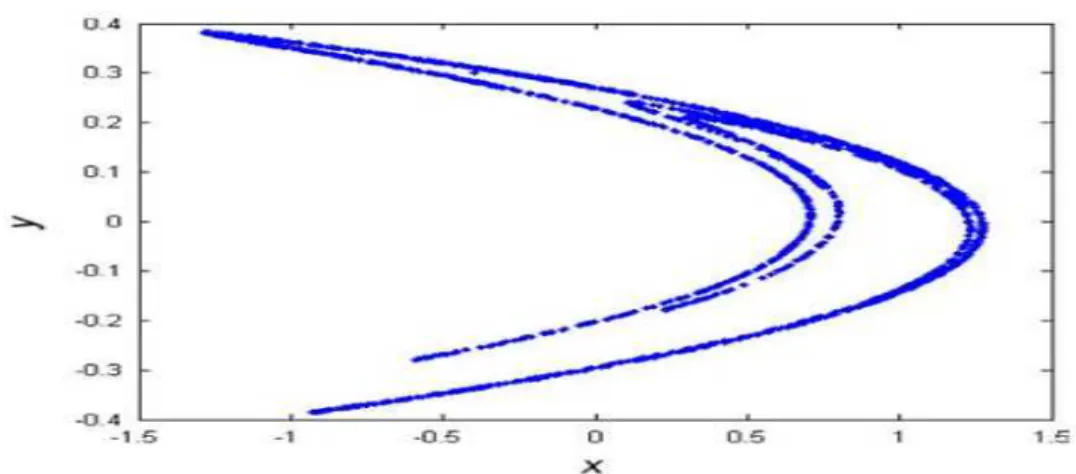
has a strange attractor. Figure 2 shows the space diagram for this mapping when it is in a chaotic
state [20].
Figure 2: The Hennon attractor
3. Proposed method
The chaos system has various features such a high sensitivity to initial state, certainty, ergodic and etc. chaos sequences which are random sequences are created by chaos mapping. These structures are very complicated and their analysis and prediction are difficult. General encryption based on chaos mapping could be divided into two steps: permutation and diffusion. In practical, researchers often make a
combination of permutation and diffusion to get high computational security.
To have a secure and reliable encryption algorithm, x0 and y0 values in equation (4) considered a p 128-bit key which is obtained by equations (5, 6, and 7).
Where Ki shows a group of
hexadecimalcharacters (A-F, 0-9). The initial value of X0 in Hennon mapping is calculated by the following equation:
Where Bi is a binary digit (0 or 1). For example if (K1)h=”AA”, then its decimal value will be (k1)d=170. Also y0 vlaue in Hennon mapping is obtained by the following equation:
3.1 Encryption
Basic structure of encryption is illustrated in figure 3. The proposed method procedures are as follows:
Step 1: the input is an image called p and has M × N dimension which M and N are rows and columns of the image, respectively. Also a color
fractal image with the same size is obtained by the input which is called k.
Step 2: two chaotic sequences, X, Y, under initial values with m × n length are built using two-dimensional logistic mapping.
Where [.,.]=sort(.) is the list of function sequence, Fx is the new sequence after Ascending sort of x and Lx is index value of Fx. Ly is the same as Lx.
Step 4: select (Lx,Ly) composition in order to change original location of the Original image pixels, P, according to equation (9) for row and equation (10) for columns:
Where i=1,2, … , M and j=1,2, …, N.
Step 5: we extract pixels’ positions of fractal key to do encryption using equation (14).
) 11 ( p1 = fix(mod(xi * 10 4), row_size)
p2 = fix(mod(yi * 10 4), column_size)
The mod(xi,m) function maps these numbers to integers in the range [0 m]. Therow_size and column_size value show the numbers of fractal key rows and columns, respectively. We can get the pixel position in fractal key image selection using Hennon map and equation (11). For
example, a pixel addressed by (p1,p2) is identified in fractal key and given that each fractal key is a color image and each of pixel of it have three values as red, blue and green then three pixel values are obtained in the range [0 255] using pixels of image. The output of chaos function is used to determine and select one of the three above values for each pixel in order to do encryption. This is done by the equation (12):
) 12 ( T= fix(mod(xi + yi) * 10 4), 3)
Step 6: we will access to one of the red, green or blue components in fractal key using equation (7) and T value. A pixel of fractal key is selected using hyper chaos system and then the XOR operator is used for encryption. The equation (13) shows this procedure:
C(i,j)= Original image(i,j) XOR Fractal_Key(Prow,n ,Pcolumn,n ,T), i=1,2, . . ., M, j=1, 2, . . . , N (13)
The above steps has been provided for image encryption. It is obvious that to decryption the image, these steps must be done inversely.
Figure 3: basic encryption structure for proposed method
4. Experimental Results
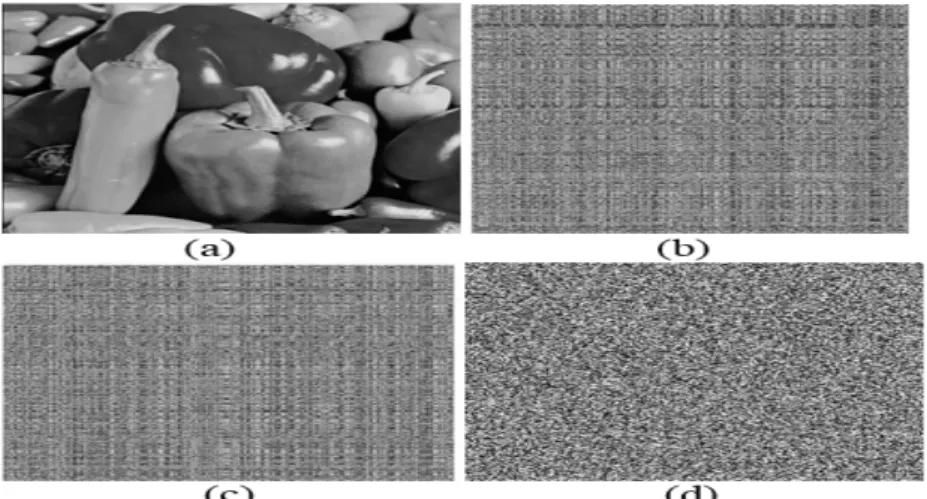
In this section different experiments that employed to prove proposed algorithm are considered. Different images with 256x256 sizes we used for testing purposes. As a result, the distorted and encrypted images are shown if figure 4.
4.1 Histogram Analysis
The Histogram shows the numbers of pixels per each gray level of the image. We used a “Peppers” image with 256x256 size as our testing purposes. The main “Peppers” image and its histogram are depicted in figure 5 and figure 6 shows histogram of the encrypted image. As shown in figure 6, it is observed that the histogram of masked image is a uniform histogram and is completely different to histogram of original image shown in figure 5. For example, distribution of gray values in encrypted image has a very good balance property. Thus the encrypted image does not provide any information about gray values distribution for attacker and as a result, the proposed algorithm can sustain any kind of statistical attack.
Figure 5: original image and its histogram
Figure 6: encrypted image and its histogram
4.2 Key Space Analysis
The key space is a set of different keys which could be used in an encryption system. An encryption system must be sensitive to all encryption keys. In this algorithm initial values of two dimensional logistic mapping system can be considered as key. Initial values in Hennon map are obtained by a 128-bit key which has a 2128 space size that is large enough to resist attacks.
4.3 Correlation Coefficient Analysis
(14)
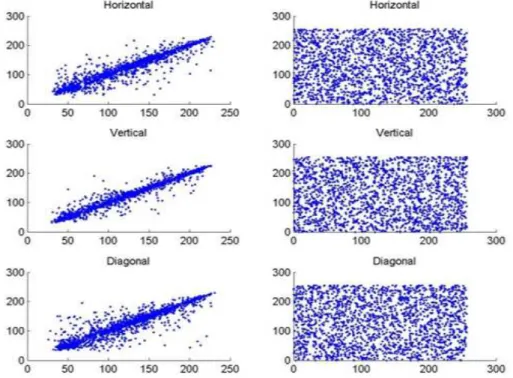
Where x, y are the gray values of two adjacent pixels in image, cove(x,y), D(x) and E(x) are covariance, variance and mean, respectively. Correlation coefficients are shown in table 1. As seen, the correlation of adjacent pixel is reduced in encrypted image. According to table 1 results, we can see that the Correlation coefficients of encrypted pixels in encrypted image are close to 0. In other words, the proposed image encryption algorithm is more robust against statistical attacks.
Table 1: correlation coefficients of plain image and ciphered image. Correlation Vertical Horizontal Diagonal
Lena -0.0103 0.0066 0.0014
Ref. [11] 0.0023 0.0036 0.0039
Ref. [13] -0.0042 0.0059 0.0180
Ref. [14] 0.0072 0.0058 0.0031
Ref. [15] 0.0021 0.0085 0.0012
4.4 information Entropy
Information entropy can be used as a criteria to obtain a measure of pixels gray levels disturbance. The entropy of an image is calculated as follows:
H(m)= log 2 (15)
Where p(mi) is the probability of gray level occurrence, mi, and N-1 is the number of gray levels. For
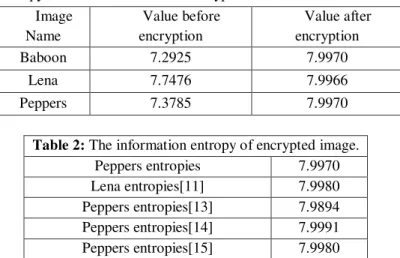
example, in a fully uniform image with 256 gray levels which the probability of all pixels are the same, the entropy would have its maximum value, i.e. 8, which means the most irregularities among image pixels. The proximity of the image entropy to 8 means the efficiency of proposed method in image encryption. Table 2 shows the entropy values of different images before and after encryption. Table 3 compares entropy with other encryption algorithms.
Table 2: comparison of entropy values before and after encryption.
Table 2: The information entropy of encrypted image. Peppers entropies 7.9970 Lena entropies[11] 7.9980 Peppers entropies[13] 7.9894 Peppers entropies[14] 7.9991 Peppers entropies[15] 7.9980
5. CONCLUSION
In this paper we have used capabilities and features of hyper chaos functions such as sensitivity to initial values, random behavior, non-periodic and certainty which lead to pseudo-random numbers and in order to shuffle the relations between pixels employed two-dimensional logistic mapping. We also used Hennon map to select pixel from fractal key. Using fractal key lead to increased key space and obtain more security and resistance. Experimental results on the basis of test data show that the proposed scheme has complexity in encryption algorithm and high space key.
REFERENCE
1. Pareek NK, Patidar V, Sun KK. Image encryption using chaotic logistic map. Image Vision Comput 2006;24(9):926–34. 2. Akhshani A, Behnia S, Akhavan A, Abu
Hassan H, Hassan Z. A novel scheme for image encryption based on 2D piecewise
chaotic maps. Opt Commun
2010;283(17):3259–66.
3. Kwok HS, Tang KS. A fast image encryption system based on chaotic maps with finite representation. Chaos SolitonFract 2007;32(4):1518–29.
4. Behnia S, Akhshani A, Mahmodi H, Akhavan A. A novel algorithm for image encryption based on mixture of chaotic maps. Chaos SolitonFract 2008;35(2):408– 19.
5. N.K. Pareek, V. Patidar, K.K. Sud, Image encryption using chaotic logistic map, Image Vis. Comput. 24 (9) (2006) 926–934. 6. C. Fu, Z.L. Zhu, A chaotic image
encryption scheme based on circular bit shift method, in: The 9th International Conference for Young Computer Scientists, 2008, pp. 3057–3061.
7. S.G. Lian, A block cipher based on chaotic neural networks, Neurocomputing 72 (2009) 1296–C1301.
8. X.Y. Wang, J.F. Zhao, H.J. Liu, A new image encryption algorithm based on chaos, Opt. Commun. 285 (5) (2012) 562–566. 9. L. Teng, X.Y. Wang, A bit-level image
encryption algorithm based on spatio-temporal chaotic system and self-adaptive, Opt. Commun. 285 (20) (2012) 4048–4054. 10. X.Y. Wang, X. Qin, A new pseudo-random
number generator based on CML and chaotic iteration, Nonlinear Dyn. 70 (2) (2012) 1589–1592.
11. Q. Zhang, L. Guo, X. Wei, Image encryption using DNA addition combining with chaotic maps, Math. Comput. Model. 52 (11-12) (2010) 2028–2035.
12. X. Wei, L. Guo, Q. Zhang, J. Zhang, S. Lian, A novel color image encryption algorithm based on DNA sequence operation and hyper-chaotic system, J. Syst. Softw. 85 (2) (2012) 290–299.
13. L. Liu, Q. Zhang, X. Wei, A RGB image encryption algorithm based on DNA
encoding and chaos map, Comput. Electr. Eng. 38 (5) (2012) 1240–1248.
14. R. Enayatifar, A.H. Abdullah, I.F. Isnin, “Chaos-based image encryption using a hybrid genetic algorithm and a DNA sequence”, Opt. Lasers Eng. 56 (2014) 83– 93.
15. R. Enayatifar, H.J. Sadaei, A.H. Abdullah , M. Lee, I.F. Isnin, “A novel chaotic based image encryption using a hybrid model of deoxyribonucleic acid and cellular automata”, Opt. Lasers Eng. 71(2015) 33– 41.
16. S.G. Lian, J.S. Sun, Z.Q. Wang, A block cipher based on a suitable use of the chaotic standard map, Int. J. Chaos Solitons Fractals 26 (2005) 117–129.
17. Mohammad Ahmad Alia and Azman Bin Samsudin, “New Key Exchange Protocol Based on Mandelbrot and Julia Fractal Sets”, IJCSNS International Journal of Computer Science and Network Security, VOL.7 No.2, February 2007.
18. Huang F, Guan Z-H A modified method of a class of recently presented cryptosystems. Chaos, Solitons& Fractals 2005;23:1893-9. 19. H.J. Liu, Z.L. Zhu, H.Y. Jiang, B.L. Wang,
A novel image encryption algorithm based on improved 3D chaotic cat map, in: The 9th International Conference for Young Computer Scientists, 2009, pp. 3016_3021 20. Hongjun Liu, AbdurahmanKadir,