ANNALS OF THE UNIVERSITY OF ORADEA FASCICLE OF TEXTILES, LEATHERWORK
COMPUTER ASSISTED LOOM IN THE REVIVAL OF
CONTEMPORARY MONUMENTAL TAPESTRY
PINTILIE Anca-Aurelia
11
University of Art and Design Cluj-Napoca, Faculty of Decorative Arts and Design, Textile Design Department,
31 Unirii Plaza, 400098 Cluj-Napoca, Romania, E-Mail: [email protected]
Corresponding author: Pintilie, Anca-Aurelia, E-mail: [email protected]
Abstract: The art of tapestry has its basics back in time, probably in the decorations of tent, the house of the nomad. Tapestry in its beginnings is the first wall of the nomad’s home and the decorative wall and canopy in the ancient Greek houses as architect Gottfried Semper stated in the nineteen century.
The architectural approach is not unusual even in the next centuries. Tapestry becomes popular as a form of monumental art during the Middle Ages when it is used as decorative architectural element, coating the walls of medieval castles.
During the next centuries dominated by decadent styles of baroque, rococo, the tapestry will lose its monumental spirit and architectural quality but at the middle of the XXth century a new approach will sustain the revival of the tapestry as monumental art.
Later, in the XXIst century, renowned multimedia artists will approach this medium and will use computer assisted looms in ambitious tapestry projects. This technique will allow them to realize complex and exquisite tapestries, sustaining in this way the revival of the tapestry in the contemporary art world.
The paper presents the importance of the architectural side of tapestry and the great achievement that computer assisted loom represents for this form of art.
The research activity is willing to inform Romanian textile designers about the possibilities to create tapestries on computer assisted looms. The research was made during the initial stage of a doctoral thesis consisting in a documentary study on monumental aspects of contemporary tapestry.
Key words: tapestry, computer assisted loom, textile, architectural, monumental art
1.
INTRODUCTION
The tapestry is a monumental art by excellence and this idea was stated by renowned architects who studied the way tapestry found its place in architecture through the ages. From its very beginnings, as the initial form of textile wall, tapestry was used in building the nomad tent, being a architectural object destined to enclothe the human habitat. During the Middle Ages, since when the most valuable tapestries were preserved, tapestry became the most valuable form of art, destined to be part of the architecture of medieval castles and churches. Since then the art of tapestry took many forms, till that of being coverings for furniture, until the middle of the XXth century when two artists, a painter and an architect, Jean Lurçat and Le Corbusier, decided to revival this art and to put it in the right place in the art world. Unfortunately the process of weaving a monumental tapestry was very difficult and took long time to finish. This led to another aesthetic collapse in the art of tapestry, until the computer assisted loom became the tool of the contemporary artist. Ambitious and high quality projects became possible since then and the amount of necessary time was reduced considerably.
The art of tapestry has its basics way back in time, probably in the decorations of the tent, the house of the nomad. Tapestry in its beginnings is the first wall of the nomad’s home and the decorative wall and canopy in the ancient Greek houses as XIXth century architect Gottfried Semper stated [1].
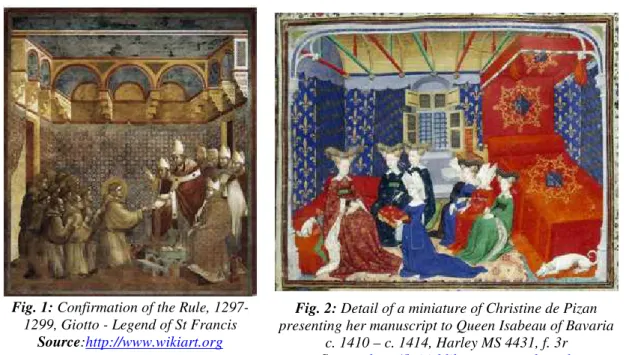
Tapestry becomes popular as a form of decorative art during the Middle Ages when it is used as decorative architectural element, coating the walls of medieval castles in aesthetic and utilitarian purposes. The most evocative proof of using tapestries in medieval castles relies in frescoes and the miniatures from medieval manuscripts which depicts beautiful upholstery covering the walls of castles and churches and adding sumptuosity to interiors. Most of them are decorated with simple patterns. Another major role of these tapestries was to ensure thermic comfort and phonic isolation.
Fig. 1: Confirmation of the Rule, 1297-1299, Giotto - Legend of St Francis
Source:http://www.wikiart.org
Fig. 2: Detail of a miniature of Christine de Pizan presenting her manuscript to Queen Isabeau of Bavaria
c. 1410 – c. 1414, Harley MS 4431, f. 3r Source:http://britishlibrary.typepad.co.uk
From this period dates the first important tapestries in textile art. The most renowned is the Apocalypse tapestry from Angers, a monumental ensemble of seven panels, 24 x 6 metres each which was weaved in five years, between 1377 and 1382 [2]. This is the tapestry which will mark the revival of tapestry in the XXth century which led, in the XXI century to technological approach by using computer assisted looms to weave monumental pieces.
Using a very restraint colour palette, in the medieval artistic way, these panels go together as an ensemble depicting religious scenes inspired by the story of the Apocalypse from the Book of Revelation by Saint John the Divine. The fact that weavers of the Apocalypse tapestry had optioned for the use of just a few colours, will have a tremendous impact in the almost scientific approach of artists in the XXth century as they will work also with just a few colours using the optical effect created by mixing
different colours together.
Being monumental was the most important aspect in the art of tapestry in the Middle Eve as the tapestries were considered more than a decorative panel but a mobile wall to follow its owner everywhere. That’s the idea developed by the architect Le Corbusier who patented in 1957 the term of muralnomad referring to the architectural characteristic of tapestry. [3]
Fig. 3: The Apocalypse tapestry, Angers, XIV century, Angers, France
ANNALS OF THE UNIVERSITY OF ORADEA FASCICLE OF TEXTILES, LEATHERWORK
When it comes to upholstery of the XXth century we cannot speak of an evolution of this art rather than a revolution manifested by the return to the aesthetic principles of medieval tapestry. This revolution, which follows a period of decadence of this art beginning in the Renaissance and lasts until near the end of the XIXth century, has begun to unfold in the early XXth century to its middle to take hold with the establishment of new rules and methods of weaving the tapestry designed by Jean Lurçat. Tapestry becomes a mural art again, unhooking from the likeness to the easel painting that it had acquired during its decay.
Jean Lurçat (1892-1966) inaugurates in the XXth century the revival of tapestry. Though starting to experiment in 1916, Lurçat’s art knows its peak in 1930 when, under the influence of the Gothic tapestry, he formulates the principles which would ensure its place as independent art. No longer an imitation of painting, tapestry exploits new raw textures and vivid colours but in a palette limited to a few colours, a characteristic aspect of medieval tapestries. [4]
Fig. 4: Jean Lurçat , Le Chant du monde, Contemporary Tapestry Museum Jean Lurçat, Angers Source: http://www.angersloiretourisme.com
Beginning with its apparition, architectural tapestry has been associated with being an active component of the environment to which it belongs. Evolution of tapestry occurred according to the architecture development. The tapestry has gained gradually sufficient autonomy being considered to have the value in itself and having the power to modify or even to establish an architectural area, being no longer just a decorative object.
Since the XXth century tapestry has regained the status of monumental art under the influence of Le Corbusier and has extended its scope of influence on architecture. In the second half of the 1950s Le Corbusier produced an important series of monumental tapestries to control the acoustics in the rooms of the public buildings in Chandigarh, India. He designed nine tapestries for the High Court with dimensions ranging between 65 and 144 m2 and three other tapestries for the Assembly lounge areas with dimensions ranging from 135 to 155 m2.
3.
USES OF COMPUTER ASSISTED LOOM IN CONTEMPORARY
MONUMENTAL TAPESTRY
From its emergence in industry, the Jacquard loom was intended for mass weaving of fabrics with sophisticated and detailed designs for decorations and fashion industry. This kind of loom precedes the emergence of computer assisted loom which, due to its technical possibilities to reproduce complicated designs with high fidelity, became in the XXIst century, the proper tool for artist willing to transpose their projects in textile medium. The time needed to realise such a project is shortened and the quality of the fabric is almost impeccable.
Thus the tapestry becomes a much more accessible artistic object with multiple applications such as: upholstery, carpet, decorative panel and even theatre curtain. Such an example is the use of
Fig. 5: Le Corbusier, tapestry at the High Court in Chandigarh, 120 m2
aluminium foil depicting the complexity of the surface, colours and gloss that such a surface implies. Pae White scanned the photo of a foil and the pixels of the image were transferred on a computer which controlled the loom.
Fig. 6: Pae White, Metafoil Source:http://www.operautsmykking.no
Fig. 7: Pae White Metafoil detail. Foto: Anne Knutsen
Source:http://www.operautsmykking.no
This large tapestry measures 29x11 metres and is made from wool, cotton and polyester. The project was weaved in 2005 on computer assisted loom in Flanders Tapestries workshop in Belgium. Manually weaving of such a complex and big image would have been almost imposible in a short time.
Another artist who exploits the technical possibilities offered by the computer assisted loom is the British artist Marc Quinn who uses this technique to realize some sort of photographic tapestries where the project is based on reportage photographies. Such an exemple is the tapestry entitled The Creation of History weaved in 2012 after a photo of a protester who fights in the streets during the 2011 UK riots [6].
The photographic tapestry is another example of the possibilities offered by the computer assisted loom to artists nowadays. Tapestry begins to be seen by artists and by public as a modern technique which can be integrated with success in the art field.
Tapestry is an artistic product enveloping the ambience; it cannot be an isolated artistic object but the environment becomes a decorative object itself. Computer assisted loom came to support artists and the art tapestry itself, allowing transposition of gigantic photographic images in a very short time and with maximum accuracy of detail.
In 2011, at the 54th edition of the Venice Biennale it was opened the exhibition entitled Penelope
's Labour - weaving words and images, a
commemorative exhibition of tapestry art in which there were displayed, along with manually woven antique tapestries, tapestry of contemporary artists woven on computer-assisted Jacquard loom. The exhibition highlighted the artistic practice, weaving, used to achieve tapestry of images and presented as one of the most vital and innovative methods of artistic expression used by contemporary artists [6].
Half computerized Jacquard loom was used in Romania by the textile artist Liliana Moraru. In her projects only the cards were made by computer and the project was draw by hand. She made a
Fig 8 Marc Quinn, The Creation of History, Jacquard tapestry, 250h x 160w cms Source:
ANNALS OF THE UNIVERSITY OF ORADEA FASCICLE OF TEXTILES, LEATHERWORK
series of tapestries depicting abstract designs on large surfaces which were presented for the public in 1993 in an exhibition. As she is currently a professor in the Textile Design Department at the University of Arts and Design from Cluj-Napoca, Liliana Moraru has promoted the new weaving technologies of the tapestry projects of the students by using the computer assisted loom in the transposal of the licence projects [7].
Fig. 8: Liliana Moraru, Abstract composition, 150x150 cm, wool and cotton,
Jacquard tapestry, 1995 Source: The artist
Fig. 9: Licence project coordinated by Ph.D professor Liliana Moraru, Jacquard tapestry, 2009
Author: Alexandra Herța Source: The artist
4.
CONCLUSIONS
Since the XXth century the textile artist is directly involved in the process of artistic creation and transposition. Now the perspective on textile arts changed. Due to the interpretation given by Le Corbusier to tapestry and tapestry art revival made by Jean Lurçat by applying scientific rigor in achieving its tapestries inspired by the tradition of the Middle Ages, textile art has got beyond the registry of applied arts.
Architecture, in its traditional form, cannot adapt itself to the fast changes of the human aesthetic needs. Here comes the need to operate and build in the indoor and outdoor environment with flexible, light materials that can change/transform a space and its function (relaxation area, study area, industrial area, playground, etc.) in a very short time. In a practical way, contemporary environment is a mise-en-scene, a temporary scenography created to be used for various purposes as required.
The fabric, natural or synthetic, is one of the favourite materials of modern artists, designers and architects in the configuration/reconfiguration of the environment. Processing techniques of fibre and textile yarn, as weaving, are increasingly being used for the utilitarian and decorative items that complement the living environment. Due to the great technical possibilities offered by the computer assisted loom, a new type of tapestry emerges: the photographic monumental tapestry. The computer assisted loom permits the depiction of the photography on huge weaved surfaces and helps the tapestry to be easily integrated in the contemporary art market.
[1] Semper,¸G. Style in the Technical and Tectonic Arts, Or, Practical Aesthetics, p. 279, Getty Publications, 2004
[2] Mariana Tomozei Cocoș, Angers – Spațiu magic al timpului recuperat [Online]. Available: http://www.artevizuale.ro/Tapiserie/Angers-Spatiu-magic-al-timpului-recuperat.html
[3] Roberto Gargiani, Anna Rosellini, Le Corbusier: Beton Brut and Ineffable Space (1940-1965): Surface Materials and Psychophysiology of Vision, EPFL Press, 2011
[4] Mussees d’Angers, Le Chant du monde de Jean Lurçat, Dossier enseignants, novembre 2008. [Online]. Available:
http://musees.angers.fr/fileadmin/plugin/tx_animuse/Lurcat_ChantMonde_05.pdf
[5] Fabric Architecture (March 2009), Opera house features award-winning design. Art and
architecture comingle in the new Oslo Opera. [Online]. Available:
http://fabricarchitecturemag.com/articles/0309_nw1_opera.html
[6] Amy Dawson, Artist Marc Quinn Makes London Riot Tapestry, [Online]. Available: http://metro.co.uk/2013/02/13/artist-marc-quinn-makes-london-riot-tapestry-3451193/
[7] Factum Arte, Penelopes Labour - Weaving Words and Images. Fondazione Giorgio Cini, 2011. [Online]. Available: http://www.factum-arte.com/pag/283/Penelopes-Labour---Weaving-Words-and-Images