THE EXPRESSIBILITY OF MODALITY IN REPRESENTATIONAL COMPLEMENT CLAUSES IN BRAZILIAN PORTUGUESE
Sandra D. Gasparini BASTOS1
Vânia C. Casseb GALVÃO2
Sebastião Carlos L. GONÇALVES1
Marize M. Dall’Aglio HATTNHER1
Kees HENGEVELD3
Gisele Cássia de SOUSA1
Valéria VENDRAME1
• ABSTRACT: This paper deals with the (im)possibility of expressing a variety of modal categories within the context of the layering approach to complementation in Functional Discourse Grammar (FDG).Our hypothesis is that modal expressions in complement clauses only pertain to operator or modifier classes of the highest layer relevant for that type of embedded construction and for all lower levels. In order to test this hypothesis, occurrences of complement clauses in two databases of spoken Brazilian Portuguese are analyzed. The investigation of this hypothesis is restricted to representational complement clauses.
• KEYWORDS: Complement clauses; representational level; modality; operator; modifier.
1 Introduction
This paper investigates the question to what extent the (im)possibility of expressing a variety of modal categories in complement clauses in Brazilian Portuguese may be explained in terms of the layering approach to complementation in Functional Discourse Grammar (FDG). The data used to answer this question derive from a corpus of oral language. After briefly discussing the corpus that was used for this study in section 2, we summarize the relevant parts of the theory of Functional Discourse Grammar, including its approach to complementation and to modality, in section 3. Section 4 then presents our hypotheses with respect to the distribution of modal elements in the main types
1 UNESP – Instituto de Biociências, Letras e Ciências Exatas – Grupo de Pesquisa em Gramática Funcional – CEP 15054-000 – São José do Rio Preto – SP – Brazil. E.mail addresses: [email protected], [email protected], [email protected], gisele_cá[email protected], [email protected] 2 UFG – Faculdade de Letras – Departamento de Estudos Lingüísticos e Literários – CEP 74001-970 – Goiânia –
Goiás – Brasil. E.mail address: [email protected]
of complement clause recognized within FDG. The parameters of analysis are established in section 5 and the systematic analysis of the corpus data is presented in section 6, where we also contrast the results of the corpus analysis with grammaticality judgments of constructed examples in order to show that the distribution encountered is not an artifact of the constitution of the corpus. In section 7 we expand the analysis to some phasal predicates. Conclusions are presented in section 8.
2 The corpus
The corpora analysed in this research constitute two databases of spoken Brazilian Portuguese: the NURC corpus and the IBORUNA corpus. NURC is a Corpus of the Spoken Portuguese Grammar Project. This project collected samples of spoken Brazilian Portuguese in five state capitals: São Paulo (SP). Rio de Janeiro (RJ), Porto Alegre (POA), Recife (REC) and Salvador (SSA). Three different types of samples were recorded in each of these cities: formal elocution (EF), dialogues between the speaker and the interviewer (DID) and dialogues between two speakers (D2). The speakers are men and women born in these state capitals with high level of education (completed undergraduation), whose parents are also Brazilian. In order to indicate the source of the examples we use the following coding convention: type of sample (EF, DID or D2), the city in which the data were collected (SP, RJ, POA, REC, SSA) and the number of recording.
IBORUNA is a corpus with samples of spoken Brazilian Portuguese collected in São José do Rio Preto and six adjoining cities. The speakers are men and women born in those cities or living there since they were 5 years old. Although this corpus includes speakers of different levels of education, we analyzed only samples of urban standard pattern, the same kind of data collected in NURC corpus. The coding convention for this corpus is: type of sample (AC – amostra censo, which means, personal interviews collected according to the linguistic census in the São José do Rio Preto area) and the recording number.
The data selected include all representational complements containing at least one modal expression (operators and modifiers). Examples with incomplete and/or unanalyzable propositional and predicational complements and parenthetical uses of complement taking predicates are excluded.
3 Functional Discourse Grammar
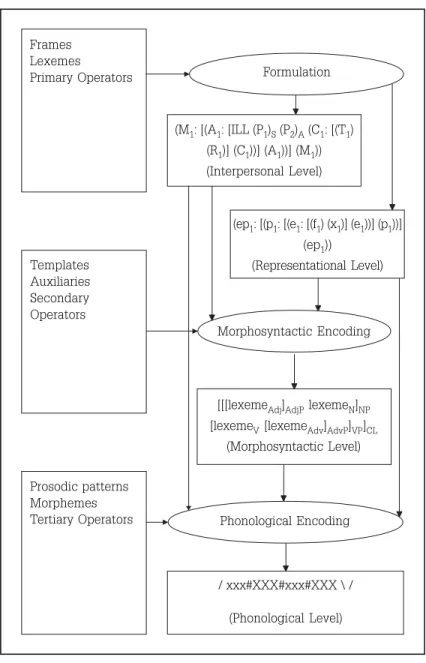
Hengeveld (2005) and Hengeveld and Mackenzie (2006); a full presentation of the model is given in Hengeveld and Mackenzie (2008, Forthcoming). A general overview of the FDG model is given in Figure 1, which shows that various levels of analysis are recognized within the grammar: the interpersonal, the representational, the morphosyntactic, and the phonological level. Each level consists of various hierarchically ordered layers.
3.1 Levels 3.1 Levels 3.1 Levels 3.1 Levels 3.1 Levels
At the interpersonal level the hierarchical structure given in (1) applies:
(1) (M1: (A1: [(FI) (P1)S (P2)A (C1: [...(T1) (R1)...] (C1))] (A1)) (M1))
The hierarchically highest unit of analysis given here is the move (M), which may contain one or more discourse acts (A). A discourse act is organized around a basic illocution (F), which combines with the speech act participants (P, the speaker S and the addressee A) and the communicated content C evoked by the speaker. The communicated content, in turn, contains a varying number of ascriptive (T) and referential (R) acts. Note that the latter two units are operative at the same layer, i.e. there is no hierarchical relation between them. In general, then, at the interpersonal level units are analysed in terms of their communicative function.
At the representational level the layers presented in (2) are relevant:
(2) (ep1: (p1: (e1: (f1: [(f2) (x1)] (f1)) (e1)) (p1)) (ep1-))
At this level of analysis linguistic units are described in terms of the entity type they designate. These entity types are of different orders: third-order entities or propositional contents (p); second-order entities or states of affairs (e); first-order entities or individuals (x); and zero-order entities or properties (f). Propositions may furthermore be joined into episodes (ep). Note that an (f) unit occurs both as a unit characterizing a states-of-affairs (f1) in (2), and as an independent constituent (f2) within the state of affairs. The units (f2) and (x1) in (2) belong to the same layer, i.e. there is no hierarchical relation between them.
Figure 1 – Outline of FDG
An important property of the model is that the interpersonal, representational, and morphosyntactic levels of linguistic organization are built up using different sets of primitives. The interpersonal and representational levels of organization are structured on the basis of pragmatic and semantic frames, into which lexemes and primary operators (i.e. operators that are defined in terms of their meaning)
Frames Lexemes
Primary Operators
Templates Auxiliaries Secondary Operators
Prosodic patterns Morphemes Tertiary Operators
Formulation
Morphosyntactic Encoding
Phonological Encoding
/ xxx#XXX#xxx#XXX \ /
(Phonological Level) [[[lexemeAdj]AdjP lexemeN]NP
[lexemeV [lexemeAdv]AdvP]VP]CL
(Morphosyntactic Level) (M1: [(A1: [ILL (P1)S (P2)A (C1: [(T1)
(R1)] (C1))] (A1))] (M1))
(Interpersonal Level)
(ep1: [(p1: [(e1: [(f1) (x1)] (e1))] (p1))]
(ep1))
are inserted. The morphosyntactic level is organized in terms of structural templates, into which, apart from lexical material from the preceding levels, grammatical words and morphosyntactic secondary operators (i.e. operators anticipating bound grammatical expressions) are inserted. The phonological level is organized in terms of prosodic patterns, into which the lexical material from the preceding levels is inserted, together with bound morphemes and possibly tertiary operators (i.e. operators anticipating the acoustic expression of the utterance).
Finally, it is important to note that levels are related to each other through operations, represented in circles in Figure 1. There is a fundamental distinction between FORMULATION on the one hand, and ENCODING on the other. The process of formulation is concerned with specifying those pragmatic and semantic configurations that are encoded within the language. In terms of formulation, languages may differ in e.g. the kind of pragmatic and semantic functions that are relevant for a description of their grammatical system. The process of encoding is concerned with the morphosyntactic and phonological form pragmatic/ semantic configurations take in the language. In terms of encoding, languages may differ in e.g. their word order, morphological types, phoneme inventory, etc.
3.2 Layering 3.2 Layering 3.2 Layering 3.2 Layering 3.2 Layering
Each level has a hierarchical organization consisting of several layers. Lower layers are contained within higher layers. Each layer at the interpersonal and representational level has the following internal structure, where á ranges over all variables:
(3) (πα1: (complex) head (α1)ϕ: σ(α1))ϕ
A unit may be built up using lexical and grammatical means. The lexical means can be subdivided into obligatory heads and optional modifiers (σ). The head is represented as the first restrictor, the modifier as a non-first restrictor. The grammatical means are subdivided into operators (π) and functions (ϕ). Operators capture non-relational properties expressed through grammatical means, functions capture relational properties expressed through grammatical means.
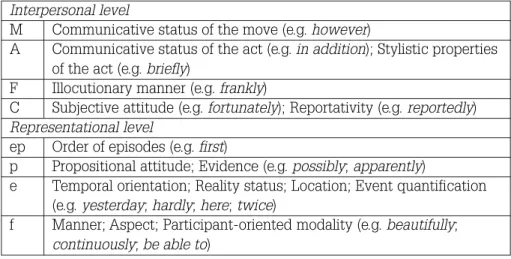
Table 1 – Semantic domains of operators and modifiers
By way of example, consider the interpersonal (5) and representational (6) formalization of example (4), adapted from Hengeveld and Wanders (Forthcoming):
(4) Reportedly a man was deliberately cutting himself with a knife yesterday.
(5) (AI: [(FI: DECL (FI)) (PI)S (PJ)A (CI: [(TI) (RI) (RJ) (RK)] (CI): reportedlyAdv (CI))] (AI))
(6) (pi: (past ei: (progr fi: [(fj: cutV (fj): deliberatelyAdv (fj)) (1 xi: manN (xi))Ag (xi)Pat] (fi): (1xj: knifeN (xj)Instr (fi)) (ei): yesterdayAdv (ei)) (pi))
The various lexical modifiers are represented at their respective layers: reportedly at the C-layer of the interpersonal level in (5), deliberately and yesterday at the fj- and ei-layer of the representational level in (6). The past progressive form of the verb is triggered by the combination of an aspectual and a temporal operator at the fi- and ei- layer in (6).
3.3 Complementation 3.3 Complementation 3.3 Complementation 3.3 Complementation 3.3 Complementation
Just as layers may be further specified by modifiers and operators, they may be turned into an argument of a complement-taking predicate. For a full discussion of complementation in FDG see Hengeveld and Mackenzie (Forthcoming, chapter 5-6).
Complement-taking verbs expressing the semantic domains listed in Table
1 for the INTERPERSONAL LEVEL,,,,, take arguments with decreasing internal
complexity the lower the layer they embed. The layers distinguished at the interpersonal and representational levels that may potentially underlie a subordinate clause are listed in (7) and (8):
Interpersonal level
M Communicative status of the move (e.g. however)
A Communicative status of the act (e.g. in addition); Stylistic properties of the act (e.g. briefly)
F Illocutionary manner (e.g. frankly)
C Subjective attitude (e.g. fortunately); Reportativity (e.g. reportedly) Representational level
ep Order of episodes (e.g. first)
p Propositional attitude; Evidence (e.g. possibly; apparently)
e Temporal orientation; Reality status; Location; Event quantification
(e.g. yesterday; hardly; here; twice)
f Manner; Aspect; Participant-oriented modality (e.g. beautifully;
(7) Interpersonal layers underlying subordinate clauses
a. (Π M1: (Π A1: [… (Π C1: [(T1) (R1)] (C1): Σ (C1))] (A1): Σ (A1)) (M1): Σ (M1))
b. (Π A1: [… (Π C1: [(T1) (R1)] (C1): Σ (C1))] (A1): Σ (A1))
c. (Π C1: [(T1) (R1)] (C1): Σ (C1))
(8) Representational layers underlying subordinate clauses
a. (π ep1/π p1: (π e1: (π f1: [(f2) (x1)] (f1): σ (f1)) (e1): σ (e1)) (ep1/p1): σ (ep1/ p1)
b. (π e1: (π f1: [(f2) (x1)] (f1): σ (f1)) (e1): σ (e1))
c. (π f1: [(f2) (x1)] (f1): σ (f1))
A higher layer generally contains all lower layers. As a result, subordinate constructions can be classified in terms of the highest layer they contain. Furthermore, since every layer brings along its own set of operators and modifiers, we can predict that operators and modifiers pertaining to the highest layer a subordinate clause contains, as well as all lower ones, can be expressed in that subordinate clause. Modifiers and operators pertaining to layers higher than the highest layer the subordinate clause contains, are barred from expression in that subordinate clause.
Consider the following examples and their underlying formalizations:
(9) I summarizethat both acts, which you have mentioned, are important. The choice depends upon the individual. Since he is well aware of the circumstances, you should communicate to him your concerns and then let him decide what he may. Be thankful for whatever your father does since both acts will bring reward to you as well in the Hereafter.(move)
(f1: summarizeV (f-1))
(x1)Φ
(M1: [(A1: [(F1) (P1)S (P2)A (C1: [...(T1) (R1)...] (C1))] (A1))Φ,
(A2: [(F2) (P1)S (P2)A (C2: [...(T2) (R2)...] (C2))] (A2))Φ, ... ] (M1))Φ
(10) I might add that, frankly speaking, you’re going to have bigger problems than just raising capital. (act)
(f1: addV (f-1))
(x1)Φ
(A1: [ILL (P1)S (P2)A (C1: [...(T1) (R1)...] (C1))] (A1))Φ
(11) He said that reportedly there was some history of threats of domestic abuse in the family. (communicated content)
(f1: sayV (f1))
(x1)Φ
The verb summarize in (9) introduces the summarizing move in an argumentative series. This move is represented as its argument M1 and consists of a series of acts. The verb add in (10) takes a single act A1 as its argument. And the verb say in (11) introduces the content C1 communicated in the original discourse act. Note that it is often hard to decide whether we are dealing with a move or with a discourse act acting as a complement, as is the case with modifiers operating at these levels.
Complement-taking verbs expressing the semantic domains listed in Table
1 for the REPRESENTATIONAL LEVEL, take arguments with decreasing internal
complexity the lower the layer they embed. Consider the following examples and their underlying formalizations:
(12) It ends with that he breaks up with her, and she runs crying out in the hall. (episode)
(f1: endV (f-1))
(ep1: [(p1: (e1: (f2: [(f3) ...] (f2)) (e1)) (p1)), (p2: (e2: (f4: [(f5) ...] (f4)) (e2)) (p2))] (ep1))Φ
(13) He believed that I had gone too far. (propositional content)
(f1: believeV (f1))
(x1)Φ
(p1: (e1: (f2: [(f3) ...] (f2)) (e1)) (p1))Φ
(14) He wanted me to be in charge. (state-of-affairs)
(f1: wantV (f1))
(x1)Φ
(e1: (f2: [(f3) ...] (f2)) (e1))Φ
(15) He continued to cry. (property) (f1: continue (f1))
(x1)Φ
(f2: [(f3) ...] (f2))Φ
representation contains. At the same time, the presence of a higher layer predicts the presence of all lower ones.
4 Hypotheses
In comparison with Functional Grammar (FG), Functional Discourse Grammar (FDG) offers a number of additional layers within the underlying representation of (combinations of) utterances. Since in FG the layers available within the underlying representation of full utterances constitute the possible types of complement clauses (see e.g. HENGEVELD, 1989; DIK; HENGEVELD, 1991; GENEE, 1998) the question is to what extent the layers used in FDG can similarly be used to provide a more comprehensive classification of complement clauses. Taking into account that our focus here is particularly on the specifications referring to the modal meanings occurring in complement constructions at the representational level, it is of particular interest to us to see how the episodes (ep) and properties of states-of-affairs (f) behave in relation to states-of-sffairs and propositional contents. The investigation of the hypothesis is restricted to complements of the representational level, since it is at this level that modal distinctions are most relevant and most diverse. With this restriction in mind, the hypothesis which we investigate may be summarized as:
Modal expressions in representational complement clauses only pertain to operator and modifier classes of the highest layer relevant for that type of embedded construction and of all lower levels.
The analyses thus refer to the complements of the specified subtypes containing one or more modal expressions in the form of modifiers and operators. With respect to the last ones, however, the verbal mood in the complement is not being considered as a modal operator, since its use may be imposed by the verbal mood of the matrix predicate rather than by the need to independently express a modal value. The only modal elements that represent operators in the selected data are modal verbs which function as auxiliary verbs, like poder, dever, ter que, querer.
5 Parameters of analysis
5.1 Semantic type of matrix predicate 5.1 Semantic type of matrix predicate 5.1 Semantic type of matrix predicate 5.1 Semantic type of matrix predicate 5.1 Semantic type of matrix predicate
The semantic classification of the matrix predicates (DIK, 1997) allows us to distinguish the semantic category of the complement, within which we observe the presence of modal operators and modifiers:
(i) Propositional attitude predicates: “specify the [intelectual or emotional] attitude of a person in relation to the possible fact designated by the propositional complement” (DIK, 1997, p.107).The CTPs occurred in the corpus are the following: achar (to think), parecer (to seem), pensar (to think), acreditar (to believe), crer (to believe), supor (to suppose), entender (to understand), admitir (to admit), ser evidente (to be evident), ser claro (to be
clear), ter impressão (to have the impression), estar convencido (to be
convinced).
(ii) Predicates of knowledge and acquisiton/loss of knowledge: “designate the mental acquisition, possession, or loss of the fact designated by the propositional complement” (Dik, 1997, p.107). The only CTP occurred in the corpus is saber (to know).
(iii) Predicates of mental perception: “designate ‘indirect perception’ of the fact designated by complement propositional term” (DIK, 1997, p.108). Examples of this kind of predicate are: ver (to see), perceber (to perceive), descobrir (to discover).
(iv) Predicates of practical manipulation: “designate that X does something in order to get Y to do SoA, without an intervening speech act” (DIK, 1997, p.111): Examples of this kind of predicate are: fazer (to manage) and levar (to lead).
(v) Phasal predicates: designate the development phase (begining, midle or end) of the SoA described in the complement. In Dik’s terms, “predicates of this class too take a predicational complement describing a SoA that necessarily occurs simultaneously with the SoA described in the main clause” (DIK, 1997, p.113) Examples of this kind of predicate are: começar (to begin), continuar (to continue), acabar (to finish).
A full description of all theses matrix predicate in Brazilian Portuguese can be found in Neves (2001, p. 31-53).
5.2 Semantic category of the complement 5.2 Semantic category of the complement 5.2 Semantic category of the complement 5.2 Semantic category of the complement 5.2 Semantic category of the complement
(i) ep-complement: episodes are combinations of clauses that represent a thematically coherent chunk of a narrative stretch, often with a series of events presented in chronological order and not involving any change of scene.
(16) Já as minhas [filhas] tinham um gato em casa... o gato é um bicho muito arisco... não é? ele tá sempre com aquela unhazinha querendo botar de fora quando a criança vai mexer... acabamos tendo que desfazer do gato tendo que desfazer do gato tendo que desfazer do gato tendo que desfazer do gato tendo que desfazer do gato... (D2/RJ/269: 4)
acaba-Ø-mos te-ndo que desfaze-r do gato
end-PAST.IND-1PL have-PROG that get_rid-INF of the cat
‘Now [my daughters] had a cat at home… the cat is a very suspicious animal, isn’t it? It always wants to put its nails out when a child comes to caress it … in the end, we had to get rid of the cat …’
(ii) p-complement: propositional contents are mental constructs that do not exist in space or time but rather exist in the mind of those entertaining them.
(17) eu acredito quequequequeque pode ser que:... a população ribeirinha venha sofrer um poucopode ser que:... a população ribeirinha venha sofrer um poucopode ser que:... a população ribeirinha venha sofrer um poucopode ser que:... a população ribeirinha venha sofrer um poucopode ser que:... a população ribeirinha venha sofrer um pouco... (DID REC 125)
Eu acredit-Ø-o que pode-Ø-Ø se-r que:
I believe-PRES.IND-1SG COMP may-PRES.IND-3SG be-INF COMP
‘I believe it may be that ... the marginal people will suffer a little ...’
(iii) e-complement: states-of-affairs are entities that develop in time and can be evaluated in terms of their reality status.
(18) e a indústria pesada...foi inclusive a que...fez com quequeque o Japão quequeo Japão o Japão o Japão o Japão pudessepudessepudessepudessepudesse...ser uma potência...ser uma potência...ser uma potência...ser uma potência...ser uma potência industrial
industrialindustrial industrial
industrial (EF RJ 379)
e a indústria pesada foi inclusive a
and the industry heavy was in fact the one
que fez-Ø-Ø com que o Japão
that make-PAST.PRF-3SG with COMP the Japan
pude-sse-Ø... ser uma potência industrial
can-PAST.IPF.SBJV-3SG be-INF a power industrial
‘And the heavy industry was the one that made that Japan could be an industrial power.’
(19) S1: ah é ( ) quando eu começo um regime geralmente... começo por necessidade... porque quando eu tô muito gorda caio muito...
S2: é lógico...
S1: porque meus pés são relativamente pequenos pro meu corpo... mas depois já começa a vaidade... aí eu começo a não querer engordar não querer engordar não querer engordar não querer engordar não querer engordar (D2/RJ/269: 13)
eu começ-Ø-o a não quere-r engorda-r
I start-PRES.IND-1SG to not want-INF get fat-INF
“S1: when I begin a diet I usually begin it due to a necessity because when I am very fat I fall very frequently…
S2: obviously…
S1: because my feet are a little small for my body… but after that vanity appears… then I start not wanting to get fat.”
5.3 Modal category 5.3 Modal category 5.3 Modal category 5.3 Modal category 5.3 Modal category
In Portuguese, modality can be expressed by modal operators (auxiliary verbs poder (may/can), dever (should/must), ter que (have to) and querer (want)) and modifiers (adverbs like realmente (really) and talvez (maybe)). Modal operators are presented in (16) to (19) and modifiers are presented in (20) and (21):
(20) eu acho que realmenterealmenterealmenterealmenterealmente é uma fase assim inesquecível. (AC-082)
eu ach-o que realmente é uma
I think-PRES.IND.1SG COMP really be.PRES.IND.3SG a
fase inesquecível
period unforgettable
‘I think that it is really an unforgettable period.’
(21) e acho que talveztalveztalveztalveztalvez tenha a ver com o lance do próprio mestrado. (D2 RE 340)
eu ach-o que talvez tenh-a-Ø
I think-PRES.IND.1SG COMP maybe have-PRES.SUBJV-3SG a ve-r com o lance do próprio mestrado
to see-INF with the whole thing of the itself M.A. programme ‘I think that maybe it has to do with the whole thing of the M.A. programme itself.’
5.4 Domain of modal evaluation 5.4 Domain of modal evaluation 5.4 Domain of modal evaluation 5.4 Domain of modal evaluation 5.4 Domain of modal evaluation
(i) FFFFacultative modality Facultative modality acultative modality acultative modality acultative modality is concerned with intrinsic or acquired capacities.
(22) eu acho que ela podepodepodepodepode competir e ser um profissional em qualquer tipo de profissão. (DID POA 08)
eu ach-o que ela pode-Ø competi-r
I think-PRES.IND.1SG COMP she may-PRES.IND.3SG compete-INF
e se-r um profissional em qualquer tipo de profissão and be-INF a professional in any kind of profession
‘I think she can compete and be a professional in any kind of profession.‘
(ii) Deontic modality Deontic modality Deontic modality Deontic modality is concerned with what is (legally, socially, morally)Deontic modality permissible.
(23) os sindicatos também devemdevemdevemdevemdevem levar... adiante... toda e qualquer... reivindicação... dos seus... associados... (DID REC 131)
os sindicatos também deve-m leva-r... adiante... the unions also should-PRES.IND.3PL put-INF forward
toda e qualquer... reivindicação... dos seus... associados... all and any claim of the its members
‘the unions should also put forward all its members’ claims.’
(iii) VVVVolitive modalityVolitive modalityolitive modalityolitive modalityolitive modality is concerned with what is desirable.
(24) eu acho que a gente naturalmente querquerquerquerquer ficar com as pessoas que...são ligadas pai mãe irmão e tudo sabe? (D2 REC 279)
eu ach-o que a_gente naturalmente quer---Ø
I think-PRES.IND.1SG COMP we naturally want-PRES.IND.3SG
fica-r com as pessoas que são ligadas
stay-INF with the people that be.PRES.IND.3PL close
‘I think we naturally want to stay with the people that are close father mother brother and all, you know?’
(iv) Epistemic modality Epistemic modality Epistemic modality Epistemic modality is concerned with what is known about the actual world.Epistemic modality
(25) ela ficou na sala de aula e o pessoal (...) desde o começo do ano pensou até que:: poderiapoderiapoderiapoderiapoderia ser uma aluna transferida... (AC-088)
o pessoal (...) desde o começo do ano penso-Ø-u
the people since the beginning of the year think-PAST.IND-3SG
até que pode-ria-Ø se-r uma aluna transferida... even COMP might-FUT.COND-3SG be-INF a student transferred
(v) Evidential modalityEvidential modalityEvidential modalityEvidential modality is concerned with the source of the informationEvidential modality contained in a sentence.
(26) a casa própria eu acredito que seria evidentementeevidentementeevidentementeevidentemente uma medida de larga repercussãoevidentemente social (DID REC 131)
a casa própria eu acredit-o que se-ria-Ø
the house own I believe-PRES.IND.1SG COMP be-FUT.COND-3SG
evidentemente uma medida de larga repercussão social
evidently a measure of wide impact social
‘one’s own house I believe would evidently be a measure of wide social impact.”
5.5 5.5 5.5 5.5
5.5 TTTTTarget of modal evaluationarget of modal evaluationarget of modal evaluationarget of modal evaluationarget of modal evaluation
By the target of evaluation (HENGEVELD, 2004b) of a modal distinction is meant the part of the utterance that is modalized. Along this parameter the following types of modality can be distinguished:
(i) Participant-oriented modalityParticipant-oriented modalityParticipant-oriented modalityParticipant-oriented modality. This type of modality affects the relationalParticipant-oriented modality part of the utterance as expressed by a predicate and concerns the relation between (properties of) a participant in an event and the potential realization of that event.
(27) e tem certas coisas que eu acho que nósnósnósnósnós devíamos aguardar mais um pouquinho. (DID POA 6)
e tem-Ø certas coisas que eu ach-o
and have-PRES.IND.3SG certain things that I think-PRES.IND.1SG
que nós dev-ía-mos aguarda-r mais um pouquinho
COMP we should-FUT.COND-1PL wait-INF more a little bit
‘and there are certain things for which I think we should wait a little bit more.’
(28) eu acho que qualquer pessoa deve sabersabersabersabersaber [cozinhar] [cozinhar] [cozinhar] [cozinhar] não é pelo sentido prático, mas pelo[cozinhar] prazer (D2 POA 37)
eu ach-o que qualquer pessoa deve---Ø
I think-PRES.IND.1SG COMP any person should-PRES.IND.3SG sabe-r cozinha-r
know-INF cook-INF
‘I think that every person should know [how to cook] not for the practical sense, but for the pleasure.’
(iii) Proposition-oriented modalityProposition-oriented modalityProposition-oriented modalityProposition-oriented modality. This type of modality affects the propositionalProposition-oriented modality content of an utterance, i.e. the part of the utterance representing the speaker’s views and beliefs, and concerns the specification of the degree of commitment of the speaker towards the proposition he is presenting.
(29) nós temos aqui já duas máquinas éh: antigas (...) todas duas máquinas acho que:: devem tá perto de cem anos játá perto de cem anos játá perto de cem anos játá perto de cem anos játá perto de cem anos já... (DID REC 04)
todas duas máquinas ach-o que deve-Ø-m
all two machines think-PRES.IND.1SG COMP must-PRES.IND-3PL
(es)ta-(r) perto de cem anos já...
be-INF near of a hundred years already
‘We have here two old machines (…) all of them I think they must already be near a hundred years old.’
According to our theoretical approach, the possible modalities within each kind of complement are the following:
Table 2 – Cross-classification of modality and complement types
6 Analysis and results
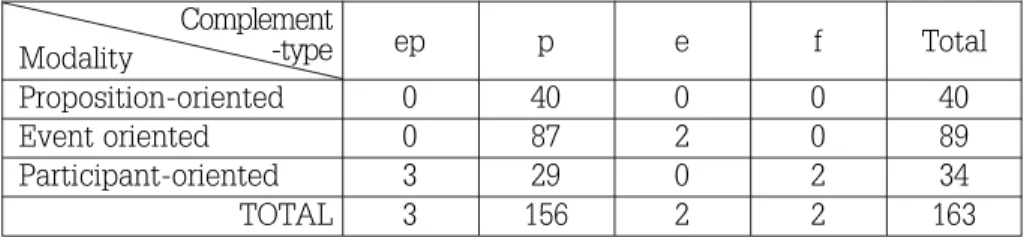
In the analyzed corpus, we found complements containing modal elements of all complement types discussed earlier. The distribution of the 163 occurrences of representational complements can be seen in Table 3:
Complement
Modality -type ep p e f
Proposition-oriented + + – –
Event oriented + + + –
Table 3 – Types of representational complements with modal expression
The quantitative analysis of these occurrences shows a high frequency of p-complements and a much lower frequency of ep-, e- and f-p-complements. Within all these complements the most frequent modal operators are the auxiliaries poder (may), dever (must) and ter que (have to), codifying the deontic domain of evaluation, whose target is an event. The number of occurrences of modal element in each kind of complement is presented in Table 4:
Table 4 – Occurrences of modal element and type of complement
The only two occurrences of f-complement with modal are (19), repeated here for convenience, and (30):
(19) S1: ah é ( ) quando eu começo um regime geralmente... começo por necessidade... porque quando eu tô muito gorda caio muito...
S2: é lógico...
S1: porque meus pés são relativamente pequenos pro meu corpo... mas depois já começa a vaidade... aí eu começo a não não não não não quererquererquererquererquerer engordar engordar engordar porque (aí a vaidade é que está engordar engordar falando né?) (D2 RJ 269)
eu começ-o a não quere-r engorda-r
I start-PRES.IND.1SG to not want-INF get fat-INF
‘S1: when I begin a diet I usually begin it due to a necessity because when I am very ‘S1: when I begin a diet I usually begin it due to a necessity because when I am very‘S1: when I begin a diet I usually begin it due to a necessity because when I am very ‘S1: when I begin a diet I usually begin it due to a necessity because when I am very ‘S1: when I begin a diet I usually begin it due to a necessity because when I am very fat I fall very frequently…
fat I fall very frequently…fat I fall very frequently… fat I fall very frequently… fat I fall very frequently… S2: it is obvious…
S1: because my feet are a little small for my body… but after that vanity appears … then I start not wanting to get fat.’
COMPLEMENT-TYPE N %
ep-complement 3 2
p-complement 156 96
e-complement 2 2
f-complement 2 2
TOTAL 163 100
Complement
Modality -type ep p e f Total
Proposition-oriented 0 40 0 0 40
Event oriented 0 87 2 0 89
Participant-oriented 3 29 0 2 34
(30) então a arte SURge (...) em função da necessidade de eu assegurar a caça e continuar
podendo podendopodendo podendo
podendo comer e me manter vivo comer e me manter vivo comer e me manter vivo comer e me manter vivo comer e me manter vivo (EF SP 405)
então a arte SURge—Ø em função da necessidade
then the art arise-PRES.IND-3SG in function of the necessity de eu assegura-r a caça e continua-r pod-endo of I secure-INF the hunting and continue- INF be able-PROG
come-r e me mante-r vivo
eat-INF and myself keep-INF alive
‘Then the art arises (...) due to the necessity to secure the hunting and continue to be able to eat and keeping myself alive.’
In (19), the property of ‘having a start’ is assigned to the complement embedded in ‘começar’ and in (30) the property of ‘to be continued’ is assigned to the complement embedded in ‘continuar‘. Both complements contain a participant-oriented modal element, as allowed by our prediction.
The two tokens of e-complementse-complementse-complementse-complements containing a modal element found in thee-complements corpus are restricted to practical manipulation predicates, represented by ‘fazer’ (31) and ‘levar‘ (32). The modal operator of the e-complement codifies in both cases facultative event-oriented modality using the verb ‘poder‘, expressing the conditions that enable its occurrence. This is again in conformity with our predictions.
(31) e a indústria pesada foi inclusive a que fez com quequequeque o Japão queo Japão o Japão o Japão o Japão pudessepudessepudessepudessepudesse ser uma potência ser uma potência ser uma potência ser uma potência ser uma potência industrial
industrialindustrial industrial
industrial (EF RJ 379)
e a indústria pesada foi inclusive a que
and the industry heavy was in fact the one that
fez-Ø com que o Japão pude-sse-Ø
make- PAST.PRF.3SG with COMP the Japan can-PAST.IPF.SBJV-3SG
ser uma potência industrial be-INF an power industrial
‘And the heavy industry was the one that made that Japan could be an industrial power.’
(32) então isso leva com quequequequeque nós... nós... nós... nós... nós... possamospossamospossamospossamospossamos compreender qual seria a visão de mundo compreender qual seria a visão de mundo compreender qual seria a visão de mundo compreender qual seria a visão de mundo compreender qual seria a visão de mundo implicada naquela vivência daquele sujeito
implicada naquela vivência daquele sujeitoimplicada naquela vivência daquele sujeito implicada naquela vivência daquele sujeito
implicada naquela vivência daquele sujeito (EF REC 339)
então isso leva-Ø com que nós... poss-a-mos
then this lead-PRES.IND.3SG with COMP we be able-PRES.SBJV-1PL
compreende-r qual se-ria-Ø a visão de mundo understand-INF what be-FUT.COND-3SG the view of world
implicada naquela vivência daquele sujeito
implied in that experience of life of that person
The p-complements p-complements p-complements p-complements p-complements occur with three types of matrix predicate: propositional attitude (33), knowledge (34) and mental perception (35) predicates:
(33) acho que os padres seriam mais...que os padres seriam mais...que os padres seriam mais...que os padres seriam mais...que os padres seriam mais...talveztalveztalveztalveztalvez mais humanos até mais humanos até mais humanos até mais humanos até mais humanos até, se eles conhecessem todos esses problemas que nós conhecemos (DID POA 6)
ach-o que os padres se-ria-m mais
think-PRES.IND-1SG COMP the priests be-FUT.COND-3PL more
talvez mais humanos até maybe more human even
‘I think that the priests would be more ... maybe even more human if they knew all of these problems we know.’
(34) sabemos também quequequeque... os sindicatos também que os sindicatos também os sindicatos também os sindicatos também os sindicatos também devemdevemdevemdevemdevem levar levar levar levar levar... adiante... adiante... adiante... adiante... adiante... toda e qualquer... toda e qualquer... toda e qualquer... toda e qualquer... toda e qualquer reivindicação... dos seus associados
reivindicação... dos seus associadosreivindicação... dos seus associados reivindicação... dos seus associados
reivindicação... dos seus associados... (DID REC 131)
os sindicatos também deve-Ø-m leva-r adiante
the unions also must-PRES.IND-3PL put-INF forward
toda e qualquer reivindicação... dos seus associados
all and any complaints of the its members
‘We know also that... the unions must solve... any complaints... from its members.’
(35) então você vê que eu: não que eu: não que eu: não que eu: não que eu: não possopossopossopossoposso falar nunca em construção falar nunca em construção falar nunca em construção falar nunca em construção falar nunca em construção (DID REC 04)
eu não poss-o. fala-r nunca em construção I not can-PRES.IND-1SG speak-INF never about building
‘So you see that I can never speak about building.’
Within the p-complements, the modifiers (e.g. ‘talvez‘) codify, in most of cases, epistemic proposition-oriented modality (33), expressing the speaker subjective attitude in relation to a propositional content, and the modal operators (e.g. ‘dever‘ and ‘poder‘) codify deontic event (34) or participant (35) oriented modality.
Among the three types of matrix predicate found in the corpus, the one with the highest frequency is the class of propositional attitude predicates, with high token frequency of the verb ‘achar‘ (to think), the preferred form to codify epistemic proposition-oriented modality in PB, as has been attested previously in other corpus-based research (GONÇALVES, 2003).
(36) aquilo se torna tão chato que a criança desiste... não pa/ acaba não não não não não podendo podendo podendo podendo podendo nem ver nem ver nem ver nem ver nem ver (D2 SP 360)
a criança desiste-Ø acaba-Ø não
the child give_up-PRES.IND.3SG end- PRES.IND.3SG not
pode-ndo nem ve-r
can-PROG not even see-INF
‘That becomes so boring that the child gives up... in the end she can’t even see it.’
(37) já as minhas [filhas] tinham um gato em casa... o gato é um bicho muito arisco... não é? ele tá sempre com aquela unhazinha querendo botar de fora quando a criança vai mexer... acabamos tendo quetendo quetendo quetendo quetendo que desfazer do gato desfazer do gato desfazer do gato desfazer do gato desfazer do gato (D2/RJ/269)
acaba-Ø-mos te-ndo que desfaze-r do gato
end-PAST.IND-1PL have-PROG that get rid-INF of the cat
‘Now [my daughters] had a cat at home… the cat is a very suspicious animal, isn’t it? It always wants to put its nails out when a child comes to caress it… in the end, we had to get rid of the cat.’
(38) Porque se ele pede muito pouco... depois vai acabar tendo quetendo quetendo quetendo quetendo que pagar pagar pagar pagar pagar... então... não... desconta cinqüenta por cento...
vai-Ø acaba-r te-ndo que paga-r...
AUX.FUT-PRES.IND.3SG end-INF have-PROG CONJ pay-INF
‘For if he asks too little ... afterwards he will end up having to pay … then … it does not… discounts fifty percent …‘
In all these occurrences, the predicate ‘acabar‘ introduces a final episode, constituted by a single event, related to the previous episode (constituted by a series of events), with which the final episode maintains the thematic unity.
Note that, although the predicate ‘acabar‘ retains its meaning of ‘to reach an end‘, what is ended in these examples is the series of events introduced by the speaker and not the single event embedded in the predicate, as would be the case in examples like:
(39) João acabo-Ø-u de lava-r o carro.
João finish-PAST.IND-3SG of wash-INF the car
‘João finished washing the car.’
(40) Em termos jornalísticos, ao interpretamos a matéria em questão, ficamos com a idéia de tratar-se de uma notícia tendencialmente informativa, porém muito comum, fria, e também bastante formal. Comum, pela evolução clássica da narrativa em formato lide, desenvolvida a partir da chamada do apresentador. Formal, pela ausência de elementos literários mais expressivos e conotativos, de maiores figuras de linguagem, impressões ideológicas, e também de elementos dramáticos – como já foi lembrado acima. E fria, ou atemporal, pela falta de factualidade da própria notícia, que acaba não podendoacaba não podendoacaba não podendoacaba não podendoacaba não podendo ser totalmente justificada – não estando pautada nem por um acontecimento “de momento”, nem tão pouco pela sua relevância informativa. A reportagem parece muito pouco ou quase nada nos acrescentar em termos de novidade sobre o assunto.
a notícia fria acaba-Ø não pode-ndo se-r
the news cold end-PRES.IND-3SG not can-PROG be-INF
totalmente justificada.
totally justified.
‘In journalistic terms, when we interpret the subject in discussion, we think it is a tendentiously informative piece of news, but a very ordinary, cold, and also a very formal one. Ordinary due to the classical evolution of the narrative in form of lead, developed from the presenter’s announcement. Formal due to the absence of more expressive and connotative literary elements, of greater figures of speech, ideological impressions, and also of dramatic elements – as it was said above. And cold, or timeless, due to the lack of factuality of the piece of news itself, which, at the end, can not be totally justified – being supported neither by a happening ‘of the moment’, nor by its informative relevance. The report seems to inform us very little or almost nothing in terms of the newness on the subject.’
In this example the verb poder is used as an event-oriented epistemic modal.
In all, then, we may conclude that our hypothesis is confirmed: there are no examples of complement types containing modal elements that pertain to a layer higher than the one defining the semantic type of the complement within FDG. Although the number of examples found for all but the propositional complements is low, the results coincide with native speaker intuitions about the combinability of certain complement types with certain modal categories. Our results furthermore confirm the applicability of the representational units Episode and Property of State of Affairs proposed in FDG.
7 Expanding the analysis: more on ‘phasal’ predicates
In the following example, two persons, S1 and S2, are talking about jobs. S2 says that, when a company needs a new employee, it uses the ‘head hunter‘ services. The interviewer, then, asks for the translation of the term ‘head hunter‘:
(41) Doc. Qual seria a tradução direta desse ‘headhunter’?
S2: éh, éh... seria um contato direto... é e/ eles telefonam... falam... com a pessoa... através de uma mensagem... que que de modo nenhum pode ser identificada porque que começacomeçacomeçacomeçacomeça que 1.[
que 1.[que 1.[ que 1.[
que 1.[a pessoa pode estar muitíssimo bem no lugar que está e de maneira nenhuma pensando em sair]]]]] 2. 2. 2. 2. 2. ... então...[[[[[o telefonema de alguém ah... intermediário de um concorrente pode complicar a situação da pessoa naquela empresa...]]]]]
S1: (certo)
S2: não é verdade? então 3.[3.[3.[3.[3.[eles têm que telefonar...de um modo que não seja... de jeito nenhum seja seja identificado para que que é...e conversar com a pessoa diretamente...]]]]] (D2 SP 360)
começa-Ø que a pessoa pode-Ø estar
start-PRES.IND.3SG COMP the person can-PRES.IND-3SG be-INF
muitíssimo bem no lugar que está-Ø e
very well in the place that be-PRES.IND-3SG and
de maneira nenhuma pensa-ndo em sai-r
of way any think-PROG in leave-INF
‘Doc. What would be the translation for ‘headhunter’?
S2: it would be a direct contact… they call... talk to the person... through a message... that can not be identified because it startsit startsit startsit starts thatit startsthatthatthatthat 1.[1.[1.[1.[1.[the person can be very well in the place s/he is working and is not thinking about leaving there]]]]] 2. 2. 2. 2. 2. ... then... [[[[[the call from someone, a intermediary from a concurrent company, can complicate the person’s situation in that company...]]]]]
S1: (right)
S2: isn’t it true? then 3.[3.[3.[3.[they have to call, in a way they can not be identified, to talk3.[ directly to the person]]]]] ‘
In (41), S1 explains the way in which a competing company would approach a manager from another company that they consider hiring. After saying that it is important that the headhunter cannot be identified in any way when he is making contact with the potential candidate, S1 presents a series of arguments which justify this need for secrecy. The first and most important of these arguments is introduced as the complement of the predicate ‘começar‘ (to begin), which can therefore be considered to take an A-complement. This Act is only one of the several Acts which integrate the major Move, which corresponds to S1’s answer to the interviewer’s question: ‘What would be the translation for ‘head hunter’?’ The verb começar can in this use thus be considered to be the complement-taking alternative to adverbial modifiers such as ‘firstly‘ and ‘in the first place‘.
neutralization of person and tense marking in favor of an unmarked form, e.g., third person present tense, indicative mood.
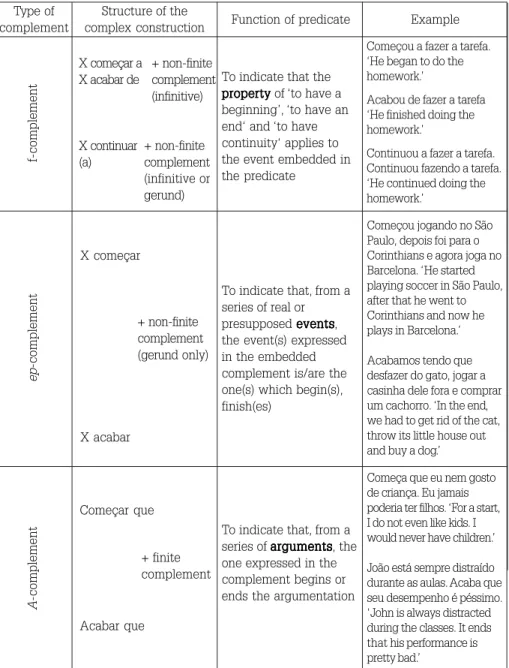
We summarize the different kinds of complements of verbs like ‘começar’, ‘acabar’ and ‘continuar’ in the following Table:
Table 5 – Behaviour of the predicates ‘começar’ (to start), ‘continuar’ (to continue) and ‘acabar’ (to end)
Type of complement
Structure of the
complex construction Function of predicate Example
f-complement
X começar a X acabar de
X continuar (a)
+ non-finite complement (infinitive)
To indicate that the property
propertyproperty
propertyproperty of ‘to have a beginning’, ‘to have an end‘ and ‘to have continuity‘ applies to the event embedded in the predicate
Começou a fazer a tarefa. ‘He began to do the homework.’
Acabou de fazer a tarefa ‘He finished doing the homework.’
Continuou a fazer a tarefa. Continuou fazendo a tarefa. ‘He continued doing the homework.’
ep
-complement
X começar
X acabar
To indicate that, from a series of real or presupposed eventseventseventseventsevents, the event(s) expressed in the embedded complement is/are the one(s) which begin(s), finish(es)
Começou jogando no São Paulo, depois foi para o Corinthians e agora joga no Barcelona. ‘He started playing soccer in São Paulo, after that he went to Corinthians and now he plays in Barcelona.’
Acabamos tendo que desfazer do gato, jogar a casinha dele fora e comprar um cachorro. ‘In the end, we had to get rid of the cat, throw its little house out and buy a dog.’ + non-finite
complement (gerund only)
Começa que eu nem gosto de criança. Eu jamais poderia ter filhos. ‘For a start, I do not even like kids. I would never have children.’
João está sempre distraído durante as aulas. Acaba que seu desempenho é péssimo. ‘John is always distracted during the classes. It ends that his performance is pretty bad.’ + non-finite complement (infinitive or gerund) A -complement Começar que Acabar que
To indicate that, from a series of argumentsargumentsargumentsarguments, thearguments one expressed in the complement begins or ends the argumentation + finite
8 Conclusion
Taking into account the unities of analysis proposed by the FDG, the hypothesis of this study is confirmed, since there were not occurrences of complement types containing modal elements that pertain to a layer higher than the one defining the semantic type of the complement within FDG. Besides, the behavior of the verbs começar and acabar demonstrates the relevance of the distinctions between the unities proposed by the FDG for the treatment of complement clauses.
BASTOS, S. D. G. et al. A expressão da modalidade em orações completivas do nível representacional no português brasileiro. Alfa, São Paulo, v.51, n.2, p.189-212, 2007
• RESUMO: Este trabalho trata da (im)possibilidade de expressão de um conjunto de categorias modais em orações completivas com base na abordagem em níveis do complemento prevista na Gramática Discursivo-Funcional (GDF). Nossa hipótese é a de que as expressões modais nas orações completivas pertencem apenas a classes de operadores ou modificadores do mais alto nível relevante para aquele tipo de construção encaixada e para todos os níveis mais baixos. Para testar essa hipótese, foram analisadas ocorrências de orações completivas em dois bancos de dados do português falado no Brasil. A investigação dessas hipóteses restringe-se às orações completivas do nível representacional.
• PALAVRAS-CHAVE: Orações completivas; nível representacional; modalidade; operadores; modificadores.
References
DIK, S. C. The theory of Functional Grammar. Part II: complex and derived constructions. Berlin: Mouton de Gruyter, 1997.
______; HENGEVELD, K. The hierarchical structure of the clause and the typology of perception verb complements. Linguistics, v.29, n.2, p.231-259, 1991.
GENEE, I. Sentential complementation in a functional grammar of Irish. Utrecht: LOT, 1998.
GONÇALVES, S. C. L. Gramaticalização, modalidade epistêmica e evidencialidade. 2003. 250 f. Tese (Doutorado em Lingüística) – Instituto de Estudos da Linguagem, Universidade Estadual de Campinas, Campinas, 2003.
______. The architecture of a Functional Discourse Grammar. In : MACKENZIE, J. L.; GÓMEZ-GONZÁLEZ, M. Á. (Ed.). A new architecture for Functional Grammar. Berlin: Mouton de Gruyter, 2004a. p.1-21.
______. Mood and modality. In: BOOIJ, G.; LEHMANN, C.; MUGDAN, J. (Ed). Morphology: a handbook on inflection and word formation. Berlin: Mouton de Gruyter, 2004b. p.1190-1202.
HENGEVELD, K., MACKENZIE, J. L. Functional Discourse Grammar. In: BROWN, K. (Ed.). Encyclopedia of language and linguistics. 2nd ed. Amsterdam: Elsevier, 2006. p.668-676.
______. Functional Discourse Grammar. Oxford: Oxford University Press, 2008. Forthcoming.
NEVES, M. H. M. N. Gramática de usos do português. São Paulo: Editora UNESP, 2001.