EAESP/FGV/NPP - NÚCLEODEPESQUISAS EPUBLICAÇÕES 1/140
RE L A T Ó R I O D E PE S Q U I S A Nº1 0/ 20 00
RESUMO
Este trabalho relata a primeira fase de um estudo mais amplo enfocado em estratégias emergentes (não planejadas) em organizações empresariais e formas de aproveitá-las. Um exame crítico da literatura pertinente a essa idéia é apresentado, é proposto um arcabouço conceitual para servir de base à parte empírica do estudo, a relevância da epistemologia para os administradores é salientada e são propostas perguntas a serem respondidas e metodologias de pesquisa para a segunda fase. A finalidade central do estudo todo é saber até que ponto as organizações podem preparar-se para usar estratégias emergentes com eficácia e assim aperfeiçoar seus processos estratégicos.
PALAVRAS-CHAVES
Estratégia empresarial; processo estratégico; estratégias emergentes.
ABSTRACT
This paper reports on the first phase of a larger study focused on the occurrence of emergent (unplanned) strategies in business organizations and ways to take advantage of them. A critical review of the most pertinent literature bearing on this idea is given an account, a conceptual framework is proposed to serve as a basis for the empirical part of the study, the relevance of epistemology to managers is pointed out, and research
questions and methods are proposed for the second phase. The pivotal purpose of the entire study is to know to what extent organizations can get ready to use emergent strategies effectively and thus improve their strategy processes.
KEY WORDS
EAESP/FGV/NPP - NÚCLEODEPESQUISAS EPUBLICAÇÕES 2/140
RE L A T Ó R I O D E PE S Q U I S A Nº1 0/ 20 00
TABLE OF CONTENTS
I. Formulation of the research problem...3
II. The spreading use of the term “emergent strategy” ...4
III. Origin and history of the concept of emergent strategy...7
1. Lindblom...7
2. Chandler ...12
3. Bower ...14
4. Quinn...17
5. Mintzberg ...19
6. Burgelman...36
IV. Other interpretations of strategy emergence...40
1. Emergent goals...42
2. Retrospective sense-making...46
3. Strategic learning ...54
4. Complexity theory...58
V. The role of planning ...66
VI. Three recent empirically grounded accounts of strategy emergence ...75
1. Eisenhardt...75
2. Osborn...79
3. Andersen ...88
VII. A useful classification of environmental factors conditioning strategy making...93
VIII. Proposed conceptual framework...105
IX. The managerial relevance of epistemology ...111
X. Proposed research questions and methodology for the second phase...118
XI. Conclusion ...122
XII. Bibliography ...127
Appendix I The hypotheses formulated in the research proposal...138
EAESP/FGV/NPP - NÚCLEODEPESQUISAS EPUBLICAÇÕES 3/140
RE L A T Ó R I O D E PE S Q U I S A Nº1 0/ 20 00
MOBILIZING EMERGENT STRATEGIES
Fabio L. Mariotto
I. FORMULATION OF THE RESEARCH PROBLEM
The research presented here is the first phase of a larger effort to study the phenomenon of strategy emergence, with the objective of integrating it to models of the strategic management process.
The larger project will consist of three phases. In the first one, reported here, a survey and critical review of the national1 and international literature on the subject has been carried out, to identify concepts, models and research methods pertinent to the idea of emergent strategy. The result of this phase is a proposed conceptual framework, a discussion of the relevance of epistemology to managers, and proposed research questions and methodology for the empirical study to be conducted in the second phase.
The second phase will be an empirical study, in which one or more actual cases of companies operating in Brazil will be examined, with the purpose of obtaining empirical results that shed light on the issues raised in the first phase. The number of cases to be studied will depend, on one hand, on the chosen paradigm and research methodology and, on the other hand, on the available resources and time.
The third and last phase will be the elaboration of a model of strategic management that incorporates the findings of the two previous phases.
EAESP/FGV/NPP - NÚCLEODEPESQUISAS EPUBLICAÇÕES 4/140
RE L A T Ó R I O D E PE S Q U I S A Nº1 0/ 20 00
II. THE SPREADING USE OF THE TERM “EMERGENT
STRATEGY”
“Emergent strategy” has become a fashionable term and it is used today with a variety of different meanings. Its popularity derives as much from the prestige of the word “strategy” as from the spreading use of the word “emergent” and its variants, as in the expressions “emerging markets,” “emerging industries,” and “emerging technologies.” But it is probably true that the word “emergent” in turn also owes much of its popularity to the idea of emergent strategy.
The term “emergent strategy” was coined by Henry Mintzberg in the 1970s [Mintzberg, 1978], to mean a pattern in a stream of (strategic) decisions actually made that was not consciously intended. That was in contrast to “deliberate strategy,” a pattern of decisions that was intended. At the time Henry Mintzberg proposed this distinction, the profession of the strategists was putting a lot of faith on formal strategic planning processes. The idea proposed by Mintzberg, that strategies may emerge from an unplanned process was certainly not new, but it must belong, in the view of those professionals, to an anomalous category, one whose existence was justified only to complete a taxonomy and be an object of curiosity. Deliberate strategies were the rule, emergent strategies, the exception.
As late as in 1987, Mintzberg remarked:
“Virtually everything that has been written about strategy making depicts it as deliberate process. First we think, then we act. We formulate, then we implement. The progression seems so perfectly sensible. Why would anybody want to proceed differently?” [1987: 68].
EAESP/FGV/NPP - NÚCLEODEPESQUISAS EPUBLICAÇÕES 5/140
RE L A T Ó R I O D E PE S Q U I S A Nº1 0/ 20 00 “We’ve all heard stories [of strategies emerging]. But since we tend to see only what we believe, if we believe that strategies have to be planned, we’re unlikely to see the real meaning such stories hold” [1987: 68].
A study done by Richard Pascale [1984] evidenced that strategies presented as deliberate after the fact, may actually have been emergent. In the study he tells about Honda’s strategy to penetrate the U.S. motorcycle market at the end of the 1950s. While a BCG report described the process followed by Honda as highly planned and deliberate, interviews made in 1982 by Pascale with Honda executives revealed a different perspective of what happened, showing that the followed strategy was clearly emergent.
In the last few years, the idea of emergent strategies and decisions has been rapidly spreading throughout the business literature. A quick inspection at the Internet shows that the deliberate/emergent dichotomy in strategy already shows up in most strategy syllabi of the best business schools. The concept of emergence is being applied also to other organizational phenomena: decisions, structures, processes. There is even an academic journal dedicated to the subject, titled Emergence: A Journal of Complexity Issues in Organizations and Management, published by the Cognitive Science Society. There is also an entity named The Santa Fe Center for Emergent Strategy (www.santafe-strategy.com).
There seems to be no doubt that we are witnessing a change of paradigm in management. To Kuhn, the proliferation of articulations, the disposition to experiment with anything, the resort to philosophy and the debate over fundamentals are all symptoms of a transition from a normal science to an
extraordinary one. [Kuhn 1970: 91, quoted in Lowendahl & Revang 1998] These signs are visible in the present conceptions about management. The change of paradigm can be noted at three distinct levels:
EAESP/FGV/NPP - NÚCLEODEPESQUISAS EPUBLICAÇÕES 6/140
RE L A T Ó R I O D E PE S Q U I S A Nº1 0/ 20 00 make the organizations more flexible, more competent, and more responsive to clients and new challenges. [Starbuck 1993b; Teece 1996]
2. In new ways to think organizations. Concurrently to the appearance of new organizational forms, new theories of how to manage these organizations are also coming into view. [Miles & Snow 1986; Bourgeois 1984; Quinn 1992]
3. In the research methods on organizations. Also evolving are research methods used to study organizations and their management. [Morgan 1983; Denzin & Lincoln 1994]
The research reported here explored changes on these three levels.
Object of the present study
The objectives of this first phase of the study were the identification and choice of a conceptual framework (or the formulation of a new one), of a research paradigm, and of a methodology for the empirical study to be conducted in the second phase of the larger study. In order not to limit the usefulness of this first phase, it was made independently of the continuation of the study, so that its results are valid and useful in themselves. With this spirit, the objectives in this first phase were the following:
1. To systematize and critically review the international literature on emergent strategies within human organizations.
2. To identify and classify the alternative models of the strategic process presented in the literature and the role that emergent strategies play in each.
EAESP/FGV/NPP - NÚCLEODEPESQUISAS EPUBLICAÇÕES 7/140
RE L A T Ó R I O D E PE S Q U I S A Nº1 0/ 20 00 4. To evaluate research methods that may be utilized in the second phase of the
study (or other studies with a similar concern). The criteria used for this evaluation are spelled out.
III. ORIGIN AND HISTORY OF THE CONCEPT OF
EMERGENT STRATEGY
In this section we present a historical view of the concept of emergent strategy, looking first at authors who introduced important elements contained in this concept, even if the term “emergent strategy” was not always used by them.
1. LINDBLOM
In many respects, Charles Lindblom is a forerunner of the concepts to be discussed here. His 1959 article, “The Science of ‘Muddling Through’”, is relevant to the theme of emergent strategy in at least four points:
1. It pioneers a descriptive model of policy making2, in contrast to the normative
models then favored in the literature;
2. It defends an approach that is capable of dealing with complexity in actual practice;
3. It recognizes that in real life the definition of goals is often simultaneous with the definition of actions and inseparable from it;
4. It shows how the approach he describes works in integrating, at society’s level, the decisions made by individual administrators.
EAESP/FGV/NPP - NÚCLEODEPESQUISAS EPUBLICAÇÕES 8/140
RE L A T Ó R I O D E PE S Q U I S A Nº1 0/ 20 00 In other respects, the approach described by him parts company with emergent strategies. For instance, his model is essentially incrementalist. While emergent strategies often arise in incremental ways, as we shall see, they may also occur as disruptive, fundamental changes.
At the time Lindblom wrote this article, the approach he challenges, the “rational-comprehensive” one, was dominant in the planning literature. Nowadays, it has much fewer supporters, therefore his contribution may seem less bold, even less relevant, under today’s eyes. But for the development of our theme, it will be useful to examine how he challenges the rational-comprehensive approach, because the latter embodies some of the basic aspects of deliberateness (the opposite of emergence) in strategy making and implementation.
Lindblom describes two approaches for the formulation of policy by public administrators. In the first approach, (then) widely extolled in the literature, when faced with the responsibility of formulating policy for a given issue, the administrator would start by listing all related societal values involved. He3 would
then consider all possible policy alternatives, he would compare them in terms of attainment of the values, using for this every available theory, and he would finally choose the alternative that maximizes these values. Implicitly, he would regard the choice he made in this manner as thorough and final.
This approach is preached but not practiced, Lindblom points out. An alternative approach is actually followed by public administrators. Having to formulate policy in a given instance, the administrator would choose a simple goal as the guiding value, knowingly disregarding most other social values as beyond present interest. He would then outline a few policies occurring to him, he would compare alternatives, relying on past experience (instead of theory), and he would select an alternative by choosing simultaneously among values and instruments for achieving them. He would not consider this choice as thorough and final, but instead he would
EAESP/FGV/NPP - NÚCLEODEPESQUISAS EPUBLICAÇÕES 9/140
RE L A T Ó R I O D E PE S Q U I S A Nº1 0/ 20 00 expect to repeat this sequence as conditions and aspirations change and as predictions improve.
Lindblom calls the first approach “rational-comprehensive” and the second one “successive limited comparisons,” or incremental, approach. Metaphorically, he also calls the first the “root” approach (because it starts from fundamentals anew each time) and the second the “branch” approach (because it continually builds out from the current situation).
He cites the reasons why the root approach is not used in practice:
1. Citizens, representatives, and administrators disagree on basic values; and even majority preferences are seldom spelled out;
2. The relative importance and the tradeoffs among objectives are difficult to establish even at the level of the administrator himself; and
EAESP/FGV/NPP - NÚCLEODEPESQUISAS EPUBLICAÇÕES 10/140
RE L A T Ó R I O D E PE S Q U I S A Nº1 0/ 20 00 Table 1. Comparison of the two decision-making processes described by Lindblom.
Table 1 presents a comparison of the two approaches. From the five points listed in the “branch” approach, we may draw the following propositions regarding this approach that are relevant to the discussion of emergent strategies:
1a. Goals and actions are decided on simultaneously;
2a. Means and ends need not (must not?) be separated by analysis;
3a. Consensus on actions is better than consensus on values or objectives;
Rational-Comprehensive (Root) Successive Limited Comparisons (Branch)
1a. Clarification of values or objectives distinct 1b. Selection of value goals and empirical analysis from and usually prerequisite to empirical of the needed action are not distinct from one analysis of alternative policies. another but are closely intertwined.
2a. Policy-formulation is therefore approached 2b. Since means and ends are not distinct, through means-end analysis: First the ends end analysis is often inappropriate or
are isolated, the means to achieve them limited. are sought.
3a. The test of a "good" policy is that it can be 3b. The test of a "good" policy is typically that shown to be the most appropriate means various analysts find themselves directly to desired ends. agreeing on a policy (without their agreeing
that it is the most appropriate means to an agreed objective.)
4a. Analysis is comprehensive; every important 4b. Analysis is drastically limited: relevant factor is taken into account. i) Important possible outcomes are
neglected.
ii) Important alternative potential policies are neglected.
iii) Important affected values are neglected.
5a. Theory is often heavily relied upon. 5b. A succession of comparisons greatly reduces or eliminates reliance on theory.
EAESP/FGV/NPP - NÚCLEODEPESQUISAS EPUBLICAÇÕES 11/140
RE L A T Ó R I O D E PE S Q U I S A Nº1 0/ 20 00 4a. Simplification may increase relevance and comprehensiveness in practice if not in
theory;
5a. Decisions are provisional and need not rely on theory.
Lindblom’s defense of the limited-successive-comparisons approach hinges primarily on the argument that the other approach is impossible in practice except for very simple problems. But he also presents additional arguments to justify the approach. He argues that the approach enhances relevance and realism: politically impossible alternatives are thus inherently discarded; and limiting the focus to small variations around present policy makes the most of available knowledge. It also attains a certain degree of comprehensiveness. This is achieved through division of labor among various agencies, allowing each to be the watchdog of the others. A process of mutual adjustment among groups representing diverse factions of public opinion is also possible in this system. In fact, when decisions are only incremental variations of known policies this mutual adjustment is more feasible.
These ideas of mutual tutelage among administrators and mutual adjustment among political interest groups is very relevant to emergent strategies. What Lindblom is saying is that in complex decisions involving the interests of a large number of diverse constituencies the described approach is a feasible way to achieve relevance, realism, and a certain degree of comprehensiveness.
Lindblom acknowledges some pitfalls in this approach. The method has no built-in safeguard for all relevant values; it also may lead the decision-maker to overlook excellent alternative policies. To these we add the fact that local search may invite shallow and short-term decisions.
EAESP/FGV/NPP - NÚCLEODEPESQUISAS EPUBLICAÇÕES 12/140
RE L A T Ó R I O D E PE S Q U I S A Nº1 0/ 20 00 search, which consists of marginal adjustments around the present position. He advocates its use for complex situations (which is usually the case in public choice).
Incrementalism may seem at first less defensible in business organizations than in the public arena, where political possibility is paramount. But the fact that in today’s complex business situations the number of issues and stakeholders is increasing makes these situations more similar to those faced in the governmental domain. The approach of allowing local search by individual administrators with the concomitant exercise of mutual tutelage and the mechanism of mutual adjustment among interested parties thus remains an interesting concept to be examined further in the context of emergent strategies.
2. CHANDLER
Alfred Chandler is a notorious champion of deliberate (i.e., intended) strategy. In his classic study of four large U.S. corporations in the first decades of the 20th Century, he advanced the idea that strategies are formulated at the organization’s top and that the definition of organizational structure follows the definition of strategy [Chandler 1962].
EAESP/FGV/NPP - NÚCLEODEPESQUISAS EPUBLICAÇÕES 13/140
RE L A T Ó R I O D E PE S Q U I S A Nº1 0/ 20 00 “The case data also indicate that these strategic initiatives were not the result of an a priori clearly formulated corporate strategy on the part of top management. Rather, the corporate strategy emerged through a somewhat haphazard process. It was the result of final authorizations by top management of strategic projects that had successfully absorbed the firm’s excess resources and promised to do so profitably in the future” [Burgelman 1983: 62, emphasis added].
These projects appeared as a result of management’s perception, at various hierarchical levels, of changes in the environment and the opportunities they created for utilizing firm’s resources.
Thus, he concludes, the data seem to indicate that structural arrangements reflected efforts to consolidate the results of autonomous strategic initiatives. The new strategy recognized and incorporated these autonomous actions. “In the final analysis,” Burgelman says, “Chandler’s study seems to indicate that changes in corporate strategy followed autonomous strategic behavior” [62].
Chandler’s case data show that multiple hierarchical layers of management were involved in originating and promoting strategic initiatives. Chandler recognizes the influence of lower levels in determining the content of the strategy, but he clearly maintains the idea that top management always retained its prerrogative of choice. Burgelman argues that in the du Pont case at least, top management’s influence was very limited, and department heads’ influence was actually significant.
Burgelman quotes a passage where Chandler raises crucial questions related to where strategies are formed:
EAESP/FGV/NPP - NÚCLEODEPESQUISAS EPUBLICAÇÕES 14/140
RE L A T Ó R I O D E PE S Q U I S A Nº1 0/ 20 00 team of individuals can be identified as the key decision makers in the private sector of the American economy” [Chandler 1962: 313, quoted in Burgelman 1983: 63].
Chandler’s own answers to these questions are that top management had more opportunity and technical competence to evaluate the proposals brought to them than in the case of stockholders and the board. In addition, strategic decisions often involved more than one department, therefore the president had the final decision. Chandler wants to demonstrate that top managers were the key decision makers. [Chandler: 313-314].
To Burgelman, the case data do not support this “heroic view of top management” [Burgelman 1983: 63]. He stresses the fact that the “autonomous” strategic initiatives coming from lower levels in the hierarchy often involved areas unrelated, or only marginally related to the traditional lines of business of the firm [62].
Burgelman’s reading of Chandler’s study has the merit of calling attention to the emerging quality of many of the strategic initiatives described in the study. In particular, the following propositions can be extracted from Burgelman’s review:
1. Strategies formulated by top management often are consolidations of strategic initiatives coming from lower management levels which fall outside current businesses;
2. These initiatives arise both from changes in the environment and by the perception of managers at various levels of the opportunities for the use of firm’s resources that these changes offer.
3. BOWER
EAESP/FGV/NPP - NÚCLEODEPESQUISAS EPUBLICAÇÕES 15/140
RE L A T Ó R I O D E PE S Q U I S A Nº1 0/ 20 00 premise that adequate models were not available at the time. There was then a theoretically sound theory of capital budgeting, but it had little to do with what really happened in real corporations, possibly because it was based on unrealistic assumptions, which Bower was able to identify.
Two obvious facts underlie his reasoning: decisions made by subordinates crucially affect the choices presented to their superiors; and these subordinate decisions are the real determinants of corporate commitment. But how are strategic objectives attended to by the capital allocation process? How could we improve the process to promote the achievement of strategic objectives?
Bower tested and modified his ideas through a two-year study of a large diversified company. His analysis revealed that the investment process could be divided into two sub-processes: definition and impetus. In the definition sub-process, the basic technical and economic characteristics of a proposed investment project are determined. It is initiated by managers concerned with facilities in response to detected discrepancies between objectives and physical means to achieve them. In the impetus sub-process, the project is sponsored by a higher-level manager seeking to boost his influence and reputation.
EAESP/FGV/NPP - NÚCLEODEPESQUISAS EPUBLICAÇÕES 16/140
RE L A T Ó R I O D E PE S Q U I S A Nº1 0/ 20 00 Bower’s study shows strategy emergence in a sense different from the autonomous initiatives disclosed by Burgelman in Chandler’s study. In the present case, business-level strategies emerge as a result of a broader corporate strategy instrumented with a structural context
Two additional points deserve emphasis in connection with emergent strategies. First, in the process described by Bower, the information received by top managers about projects originating down lower in the organization is poor, because it is restricted to quantitative data, under the false assumption that the are the only reliable kind of data. As a consequence, top managers are faced with having to approve projects without more subjective, but also richer, information about them. In the cases studied by Bower, the result was that projects that reach the top level seeking approval were seldom turned down:
“Once a project is sponsored, it is almost always approved by top management. They are loathe to second guess the judgements of the men selected for intermediate-level management precisely on the basis of their ability to evaluate the technical-economic content of product-market subunit plans and projects. That is why batting average is so important. It reflects the ability of middle-level management to judge lower-middle-level generalists” [Bower 1970: 6].
The second point, related to the first, is that this process makes it difficult to evaluate joint effects different proposals may have, sinergies that could be exploited. Bower notes:
“Unless higher-level management intervenes, the sum of initiating-level plans is more likely to be a meaningless catalog than anything else” [336].
EAESP/FGV/NPP - NÚCLEODEPESQUISAS EPUBLICAÇÕES 17/140
RE L A T Ó R I O D E PE S Q U I S A Nº1 0/ 20 00 Several years later, Bower and Doz [1979] enunciated a significant outgrowth of this line of research, which implies an alternative view of the role of top management in the strategic process:
“Thus, in contrast to strategy formulation as the critical direction-setting general management activity, this new process school of research suggested an alternative, that is, managing the strategic process” [Bower & Doz 1979: 58].
The “new process school of research” in strategic management flourished in the following years.
4. QUINN
Another author that contributed to the idea of emergent strategy was James Brian Quinn. Starting in 1977, he conducted a line of research on how real companies actually arrive at their strategic changes. In 1980 he summarized the results in the book Strategies for Change: Logical Incrementalism [Quinn 1980]. In it, he starts by recognizing two approaches to strategy change that were at the time covered in the literature. The first, the formal planning approach, can make a contribution, he says, but “such planning can be only one of many building blocks in a continuously evolving structure of analytical and political events that combine to determine strategies in large institutions” [15]. The other, the power-behavior approach, was seen has having enhanced our understanding about multiple goal structures, the politics of strategic decisions, bargaining and negotiation processes, satisficing in decision making, the role of coalitions, and the practice of “muddling” in public setor management. But this literature has been far removed from strategy making, it has ignored the contribution of useful analytical approaches and it has offered little practical guidance for the strategist [16].
EAESP/FGV/NPP - NÚCLEODEPESQUISAS EPUBLICAÇÕES 18/140
RE L A T Ó R I O D E PE S Q U I S A Nº1 0/ 20 00 characterized the way successful strategic processes operated in the companies he studied. Instead, he found that:
1. Effective strategies tended to emerge from a series of subsystems of organizational activity, each developing its goals and strategies.
2. The logic underlying the formulation of effective strategies was so powerful that it can be recommended as the best approach for creating strategy in large organizations.
3. Because of cognitive and process limits, the strategies were arrived at by an approach most appropriately described as “logical incrementalism.”
4. Such incrementalism is not “muddling.” It is a purposeful, effective, proactive management technique for improving and integrating both the analytical and the behavioral aspects of strategy formulation [16-17].
The way strategies take shape in these companies deserves more detailed attention. In these large institutions,
“[S]trategies . . . tend to emerge in ways that differ quite markedly from the usually prescribed textbook methodologies. The full strategy is rarely written down in any one place. The processes used to arrive at the total strategy are typically fragmented, evolutionary, and largely intuitive. Although one can frequently find embedded in these fragments some very refined pieces of formal strategic analysis, the real strategy tends to evolve as internal decisions and external events flow together to create a new, widely shared consensus for action among key members of the top management team” [15].
EAESP/FGV/NPP - NÚCLEODEPESQUISAS EPUBLICAÇÕES 19/140
RE L A T Ó R I O D E PE S Q U I S A Nº1 0/ 20 00 “[S]trategy deals with the unknowable, not the uncertain. It involves forces of such great number, strength, and combinatory powers that one cannot predict events in a probabilistic sense. Hence it is logical that one proceed flexibly and experimentally from broad concepts toward specific commitments, making the latter concrete as late as possible in order to narrow the bands of uncertainty and to benefit from the best available information” [56].
He goes on to say:
“The most effective strategies of major enterprises tend to emerge step by step from an iterative process in which the organization probes the future, experiments, and learns from a series of partial (incremental) commitments rather than through global formulations of total strategies. Good managers are aware of this process, and they consciously intervene in it” [58].
And he concludes:
“In recent years there has been an increasing chorus of discontent concerning corporate strategic planning. . . . [Many managers] have relied on the awesome rationality of their formally derived strategies and the inherent power of their positions to cause their organizations to respond. When this does not occur, they become bewildered, if not frustrated and angry. Instead, successful managers who operate with logical incrementalism build the seeds of understanding, identity, and commitment into the very processes that create their strategies. By the time the strategy begins to crystallize in focus, pieces of it are already been implemented” [145].
5. MINTZBERG
EAESP/FGV/NPP - NÚCLEODEPESQUISAS EPUBLICAÇÕES 20/140
RE L A T Ó R I O D E PE S Q U I S A Nº1 0/ 20 00 where the concept is explained at length [Mintzberg and Waters 1985]. The notion of emergent strategy was created together with those of intended strategy, realized strategy, and deliberate strategy. In their research of the process by which strategies take shape in organizations, Mintzberg and his research associates at McGill felt the need to define strategy in a way that was independent of the process by which the strategy developed. In particular, it was deemed useful to define strategy in terms of what the organization really did, of what specific strategic actions were actually put into effect. To this end, they defined strategy as “a pattern in a stream of decisions,” later reformulated as “a pattern in a stream of actions.” The value of this definition is at least twofold. First, it provides an operational definition to the concept of strategy, that is, it allows an independent observer to scrutinize the behavior of an organization and, by recognizing patterns or consistencies, to identify its strategy (as operationally defined). Second, it allows the recognition of consistent strategic actions as a strategy, no matter whether there is an explicit plan or not.
This concept of strategy enlarges the traditional view of strategy. According to this traditional view, strategy is a plan, it is formulated by the organization’s leaders, it sets goals and action plans, and is then implemented. In this view, strategy is (a) explicit, (b) developed consciously and purposefully, and (c) made in advance of the specific decisions to which it applies [Mintzberg 1978: 935]. According to Mintzberg, this classical view is incomplete for the organization and non-operational for the researcher. It conceals an entire category of decisional behavior of organizations that any student of strategy would consider strategic. And it forces the researcher to study strategy formation as a perceptual phenomenon [935]. In contrast, by focusing on what the organization actually did, the proposed definition encompasses both strategies spelled out in plans and strategies that take shape in other ways.
EAESP/FGV/NPP - NÚCLEODEPESQUISAS EPUBLICAÇÕES 21/140
RE L A T Ó R I O D E PE S Q U I S A Nº1 0/ 20 00 command. Dictionary definitions of strategy mention “plan,” “method,” and “stratagem.” It must be understood that Mintzberg stretches the meaning of the word and uses strategy in the sense of a pattern of actions leading to a better performance, that is, a pattern typical of one that would have followed a strategic plan. This was not entirely original with Mintzberg nor was it confined to administrative thinking. In evolutionary biology, for instance, some authors (e.g., Levins [1973]) attribute particular survival “strategies” to animal or vegetable species. What they mean is, of course, that these species have certain traits or behave in certain ways as to survive, but evidently this is not to say that these traits and behavior are conscious or intentional. Anyway, Mintzberg started a new language to express strategic phenomena.
The traditional view of strategy as a plan is called “intended strategy” by Mintzberg. The pattern in a stream of actions (what the organization actually did) is called “realized strategy.”
Based on these two concepts, two more are introduced. “Deliberate strategy” is a pattern in action that was carried out according to a plan, that is, it is an intended strategy that was in fact realized. “Emergent strategy” is a pattern in action that was carried out in absence of a plan or in disagreement with an existing plan.
For a strategy to be perfectly emergent, there must be absence of intention. (But there must also be consistency in action over time, otherwise simply there is no strategy.) It is difficult to imagine action in the total absence of intention, but the purely emergent strategy is an extreme ideal type and, in any event, Mintzberg and Waters [1985] found in their research cases that came pretty close to this ideal extreme.
EAESP/FGV/NPP - NÚCLEODEPESQUISAS EPUBLICAÇÕES 22/140
RE L A T Ó R I O D E PE S Q U I S A Nº1 0/ 20 00 pursued. It is clear that in the case of emergent strategies, where plans do not exist or are not followed, broad goals will in general exist. These are intentions.
Mintzberg and Waters go on to illustrate deliberate and emergent strategies. These are not presented as dichotomous categories, however, but rather as extreme cases in a continuum that admits intermediary cases. A pure deliberate strategy as well as a pure emergent strategy are ideal types and are difficult to find in the real world. But Mintzberg and Waters say that in their research they found cases rather close to these extremes.
For the purpose of this study, it is important to examine how they characterize the pure polar cases, for this will throw light on the essence of the emergence concept. Thus, to Mintzberg and Waters, for a strategy to be perfectly deliberate, that is, for it to be a pure deliberate strategy, at least three conditions must be satisfied. These are:
D1. There must be precise, explicit, and detailed intentions;
D2. The intentions must have been collective, that is to say they must have been shared or else accepted from the organization’s leaders, “probably in response to some sort of controls” [258];
D3. The intentions must have been realized exactly as intended.
About the last condition, they stipulate that there must have been no interference of an external force, which implies that the environment is perfectly predictable, or totally benign, or else fully controlled by the organization. It should be noted the authors’ concern with control, which appears in the second and third conditions, if only implicitly.
EAESP/FGV/NPP - NÚCLEODEPESQUISAS EPUBLICAÇÕES 23/140
RE L A T Ó R I O D E PE S Q U I S A Nº1 0/ 20 00 E1. Intentions are non-existent, or are imprecise, implicit or sketchy;
E2. Intentions exist, but they are not collective;
E3. Intentions exist, but they are not realized as intended.
But condition E1 excludes conditions E2 and E3, therefore a pure emergent strategy cannot be defined as one that satisfies the three conditions simultaneously. In fact, the three conditions D1-D3 that typify deliberate strategies are three different dimensions, which correlate but run to different directions. Thus, one might say that there are three distinct forms of pure emergent strategy, one for the negation of each condition.
It might appear that it would be enough to establish the single condition that prior intentions do not exist as the dominant one and thus define pure emergent strategy by condition E1. However that would exclude from the category of emergent strategy two other cases, that in which intentions (even precise, explicit, detailed) do exist but they are not collective and that in which intentions exist but are not realized exactly as intended. These cases also depict interesting cases of emergence.
The three conditions, E1-E3, which we argue could typify cases of pure emergent strategy, suggest the various ways by which strategies may emerge:
1. Prior intentions do not exist, and as actions follow a consistent pattern, this pattern emerges as a strategy; or else intentions do exist but are not precise, and a strategy emerges as actions make a consistent pattern come into view more clearly;
2. Intentions are entertained by one or only a few actors so that the pattern emerges to the rest of the organization;
EAESP/FGV/NPP - NÚCLEODEPESQUISAS EPUBLICAÇÕES 24/140
RE L A T Ó R I O D E PE S Q U I S A Nº1 0/ 20 00 Mintzberg and Waters, however, define a pure emergent strategy in a simpler way. In addition to being a consistent pattern in action (which is also a condition to E1-E3 above, otherwise there is no strategy), they stipulate the single condition:
E’1. There must be no intention about it.
Apparently, by restricting a pure emergent strategy to this single case, Mintzberg and Waters wanted to establish a degree of emergence among cases E1-E3 above, considering the case where intentions do not exist to be a more extreme display of emergence than when intentions exist. Yet, when they give an example of the most emergent type of strategy they found in the real world, it turns out to be a case where the environment imposes a pattern in action on the organization. In this case, it is not made explicit whether there were previous intentions or not.
In the same paper, when restating the dimensions that characterize deliberateness, and at other points further on the text, Mintzberg and Waters present the three dimensions in a modified form, emphasizing control:
D'1. Intentions must be explicit;
D'2. There must be central control over organizational actions (“tight control over the mass of actors in the organization” [263]);
D'3. The environment must be predictable or controllable, implying also tight control of the organization over the environment.
EAESP/FGV/NPP - NÚCLEODEPESQUISAS EPUBLICAÇÕES 25/140
RE L A T Ó R I O D E PE S Q U I S A Nº1 0/ 20 00 of the organization“ [259]. As for a pure emergent strategy, Mintzberg and Waters seem to identify it in the case when an environment directly imposes a pattern of action on an organization.
Thus, in this version we could define the conditions for emergent strategy this way:
E"1. Intentions are non-existent, or are not explicit;
E"2. There is no central control over organizational actions;
E"3. The environment is unpredictable and uncontrollable.
As in the first version of the conditions (E1-E3), the second and third conditions (E’’2 and E’’3) refer to cases where intentions do exist but other circumstances characterizing emergence are present.
But it must be noted that what is meant by control in this case is only the agreement of facts to expectations, not necessarily the effort required to make adjustments. For example, the environment may behave as expected simply because it is a stable environment, not necessarily because the organization exercised a significant degree of control over it. Therefore, the actual exercise of control may or may not be needed for an intended strategy to become deliberate.
EAESP/FGV/NPP - NÚCLEODEPESQUISAS EPUBLICAÇÕES 26/140
RE L A T Ó R I O D E PE S Q U I S A Nº1 0/ 20 00 Presumably Mintzberg and Waters wanted to characterize a degree of deliberateness related to the obstacles the organization has had to overcome to realize its intended strategy: the larger the obstacles, the larger the amount of control needed, and the larger the degree of deliberateness (“strength of intention” or “will power”).
Conditions D’3 and E’’3 characterize the opposition deliberate-emergent strategy by the degree of interference of the external environment with the organization’s pattern of action. Accordingly, in a deliberate strategy, the interference would be null or minimal, while in an emergent strategy the interference would be maximal, the environment directly imposing a pattern of action on the organization. Thus, in this characterization of the two antithetical cases, either the organization controls the environment (pure deliberate strategy) or is controlled by it (pure emergent strategy).
Why is it necessary to consider the impact of the environment to characterize deliberateness or emergence? Is it not enough to consider how strategies are formed inside the organization? The reason could be that Mintzberg and Waters implicitly include the results of the pattern of action as an integral part of the strategy. In fact, suppose strategy meant only a pattern of action, irrespective of the actual results. Then to realize a strategy it would be sufficient to carry out the actions as intended, regardless of what the outcome might be. But then a strategy could be said to be deliberate even when the environment unfolded in utter disaccord with the expectations of the strategy formulators. Mintzberg and Waters seem to rule out this possibility. It could be argued that they do it because they want to include the results of the pattern of action as integral to strategy.
EAESP/FGV/NPP - NÚCLEODEPESQUISAS EPUBLICAÇÕES 27/140
RE L A T Ó R I O D E PE S Q U I S A Nº1 0/ 20 00 environment impacts the organization but its intended strategy is not changed and the organization fails. Still, it is a deliberate strategy, is it not?
These arguments seem to establish the irrelevance of success for the characterization of deliberate strategy. Ironically, the assumption of success is essential for the definition of emergent strategy. For when we consider a pattern of action consistent, implicitly we are referring to a successful instance.
We think that the key to understanding why Mintzberg and Waters presented the two versions of the conditions characterizing deliberate and emergent strategies, the second explicitly stressing control, is in distinguishing two different times when the definition is applied. D1-D3 are, typically ex-post conditions, applicable to define whether a strategy was deliberate or not after the fact. In contrast, D’1-D’3 could be seen as ex-ante conditions, to evaluate the chances of a strategy becoming deliberate before the fact. If our interpretation is correct, then conditions E’’1-E’’3 would likewise be ex-ante. But since emergent strategies cannot be known before the fact, these conditions could be interpreted as the circumstances that foster the appearance of emergent strategy.
Mintzberg and Waters go on to illustrate types of strategy with different degrees of deliberateness/emergence by means of examples taken from their research. We will concentrate on a few on these strategy types which seem most useful to a further discussion of emergence and for later reference.
EAESP/FGV/NPP - NÚCLEODEPESQUISAS EPUBLICAÇÕES 28/140
RE L A T Ó R I O D E PE S Q U I S A Nº1 0/ 20 00 A more interesting type of strategy that is close to a pure emergent one is that of consensus strategies. They originate through mutual adjustment. As actors learn from each other and from their various responses to the environment, they converge on patterns that works for them and that become pervasive in absence of central or common intentions. These strategies are quite emergent. Here, convergence is not driven by any intentions of a central management nor even by prior intentions widely shared among other actors. It just evolves through the results of a host of individual actions. Thus, the consensus derives more from collective action than from collective intention. This will have important implications for our discussion of the role of action in strategy (Sections 4.1 and 4.2).
Two other strategy types in which the role of emergent strategies is central are umbrella strategies and process strategies. Umbrella strategies originate in a condition of partial control, where the leadership establishes boundaries, targets, or a sense of direction. Other actors respond to their own forces or to a complex, even unpredictable environment. Here the condition of tight control is relaxed. Strategies are partly deliberate, partly emergent. One might say they are deliberately emergent.
Process strategies emerge within a process controlled by the leadership (through selective hiring, creating a new structure, etc.), in which content is left to other actors. Strategies are partly deliberate, partly emergent and, again, deliberately emergent.
Closer to the opposite extreme of deliberate strategies, other strategy types are recognized by Mintzberg and Waters. Planned strategies originate in formal plans. Precise intentions exist, formulated and articulated by central leadership. The plan, elaborated in as much detail as possible, is backed up by formal controls to ensure surprise-free implementation. The external environment is assumed to be, if not benign or controllable, then at least predictable. Strategies are mostly deliberate.
EAESP/FGV/NPP - NÚCLEODEPESQUISAS EPUBLICAÇÕES 29/140
RE L A T Ó R I O D E PE S Q U I S A Nº1 0/ 20 00 or her personal control of its actions, that is, through giving direct orders to its operating personnel. The organization’s environment is often a protected niche, less subject to unpredictable change. Compared to the planned strategy, the entrepreneurial strategy provides more flexibility, at the expense of the specificity and articulation of intention. The strategies are relatively deliberate but may emerge. This type of strategy is conceptually valid, but it is difficult for an outside observer to verify whether prior intentions existed, that is whether the strategy was deliberate or emergent.
Ideological strategies originate in a collective, shared vision, controllable through indoctrination or socialization. Intentions can usually be identified. While the intentions of the planned and entrepreneurial strategies are imposed on the organization by one center, those of the ideological strategy are positively embraced by the members of the organization. The organization is often proactive over against its environment. Strategies are quite deliberate.
It will be useful for our analysis to examine in these strategy types the degree of explicitness of the strategy to the organization members along time, as this has important implications for the organization’s learning. Planned strategies are clearly explicit from the beginning. In fact, they are the ones most early explicated. Now entrepreneurial strategies to the extent that they are formed inside the mind of the entrepreneur may remain unexplicated and be deliberate only to him.
Ideological strategies become recognizable as a pattern as they unfold. Being collective, they may become gradually explicated, although this is not necessarily so. Similarly, umbrella strategies and process strategies may become conscious and explicit but not necessarily. Consensus strategies clearly become conscious and explicated with time. Imposed strategies may or may not become conscious or explicit.
EAESP/FGV/NPP - NÚCLEODEPESQUISAS EPUBLICAÇÕES 30/140
RE L A T Ó R I O D E PE S Q U I S A Nº1 0/ 20 00 The Adhocracy as the habitat of emergent strategies
According to Mintzberg, emergent strategies are characteristic of a certain type of organization that he calls Adhocracy. In a book in which he advances a typology of organizational structures [Mintzberg 1979], he characterizes each type of structural configuration. One of the aspects he looks into is the strategy making process in each type.
The Adhocracy, one of the configuration types, is essentially an organization structured by projects and organized primarily around experts. Sophisticated innovation requires a special kind of organizational configuration, one that is able to mingle experts drawn from different disciplines into smoothly functioning ad hoc project teams. More specifically, such configuration is characterized by the following elements: it operates in a dynamic and complex environment, demanding sophisticated innovation; each product is complex and unique, which forces the organization to engage highly trained experts and combine their talents in multidisciplinary teams; these experts are grouped in functional units for housekeeping purposes but are deployed in temporary teams to work in their projects; the organization relies on mutual adjustment as the key coordination mechanism; hierarchy, direct supervision, standardization, rules, and performance controls are disc ouraged; power is diffused in uneven ways, according to the expertise needed in each situation [Mintzberg and McHugh 1985]. “The Adhocracy combines organic working arrangements instead of bureaucratic ones with expert power instead of formal authority” [Mintzberg 1979: 447]. Later, Mintzberg dubbed this configuration also “Innovative Organization” [Mintzberg & Quinn 1996]. Examples of Adhocracy are consulting firms, research-based organizations, advertising agencies, and avant-garde film companies. Mintzberg claims that Adhocracy is the organization structure of the future [1979: 459].
EAESP/FGV/NPP - NÚCLEODEPESQUISAS EPUBLICAÇÕES 31/140
RE L A T Ó R I O D E PE S Q U I S A Nº1 0/ 20 00 [1967] plastics companies, Galbraith’s [1973] Boeing Corporation, and Chandler and Sayles’ [1971] NASA.
To Mintzberg, strategy making in the Adhocracy is different from other configurations in a number of crucial aspects. First, in sharp contrast to the other types, control of the strategy formulation process in the Adhocracy is not clearly placed, at the top or elsewhere. In addition, “the process is best thought of as strategy formation, not formulation, because strategy in these structures is not so much formulated consciously by individuals as formed implicitly by the decisions they make, one at a time” [1979: 443]. Thus, the formulation-implementation dichotomy typical of planning in more machine-like structures loses it meaning in the Adhocracy.
“It is in the making of specific decisions within and about projects – what would normally be considered implementation – that strategies evolve, that is, are formed, in the Adhocracy. That is because when the central purpose of an organization is to innovate, the results of its efforts can never be predetermined. So it cannot specify a strategy – a pattern or consistency in a stream of decisions – in advance, before it makes its decisions. Such patterns at best emerge after the fact, the results of specific decisions” [1979: 443, emphasis added].
Action planning is particularly difficult in this structure, because while the ends may be clearly defined, the means are not.
“[The means] must be worked en route to the goal, by trial and error. So only a general kind of action planning can take place, one that sets out broad, flexible guidelines within which the work constellations can proceed to make their specific decisions. Again, therefore, it is only through the making of specific decisions – namely those that determine which projects are undertaken and how these projects turn out – that strategies evolve” [1979: 447].
EAESP/FGV/NPP - NÚCLEODEPESQUISAS EPUBLICAÇÕES 32/140
RE L A T Ó R I O D E PE S Q U I S A Nº1 0/ 20 00 whoever decides what projects are done and how. Strategy evolves as a multitude of these decisions are made, each project leaving its imprint on the strategy. Decisions are so intertwined and so many people are involved that we cannot single out any one part of the organization as the place where the strategy is made. Everyone who gets involved has a hand in influencing the strategy that gets formed. So the power for decision making is distributed widely throughout the organization [444-446].
It could be argued that if strategy forms in the Adhocracy as a continuous and decentralized response to the environment, then it is merely reacting to problems than proactively seeking opportunities. The research at McGill indicates that it does both, it continuously tries to read the environment to find out where to go next, but it does so to innovate, to create new products and services to serve the environment. “So perhaps strategy making in Adhocracy is best described as opportunistic reaction” [Mintzberg, Quinn & James 1988: 621, emphasis added].
For Mintzberg, the strategist at the Adhocracy is a pattern recognizer, seeking to detect emerging patterns. Broad general guidelines as to corporate intent may be established as an umbrella, under which detailed strategies can emerge. Strategies deemed inappropriate can be discouraged, while more appropriate ones can be encouraged through more conscious attention and concentration of resources. But emerging strategies can be also accommodated by shifting the umbrella. In this case, we face the paradox of leadership changing its intentions to accord with the realized behavior of the organization. But that, Mintzberg says, can be a key to successful strategy making in the Adhocracy [Mintzberg, Quinn & James 1988: 627].
EAESP/FGV/NPP - NÚCLEODEPESQUISAS EPUBLICAÇÕES 33/140
RE L A T Ó R I O D E PE S Q U I S A Nº1 0/ 20 00 over time. Using first archival data, they looked for traces of decisions and actions taken by the organization, sorting them into various strategy areas, as well as for traces of environmental trends and events as well as performance indicators. The data were then analyzed to infer patterns or consistencies over time and to infer overall periods in the history of the organization. These results were then checked with the inclusion of more qualitative data obtained through reports of the period and interviews with key people present at each major change in strategy. Note that this method construes strategies as realized patterns of consistent actions over time, as observed from the outside. The researchers then brainstormed to give a theoretical interpretation to the data.
In their conceptual analysis, they start asking why patterning of behavior appears at all in such a loosely-coupled organization, so needing of uniqueness in its output. Why is consistency necessary? They offer three main reasons: the organization’s intrinsic need to take advantage of its capabilities, fashion, and administrative needs, such as efficiency or economy.
They note that patterns formed aside from or sometimes even despite managerial intentions, often in response to the needs of a variety of people in the organization, as well as forces in the environment. Some of the ways strategies emerged were pointed out by the authors:
1. A single, seemingly inconsequential decision, meant to be ad hoc, establishes a precedent that evokes a pattern.
2. That single decision may not even be deliberate. A thin stream of activity eventually takes hold and begin to pervade the organization.
3. A peripheral strategy pursued in a pocket of the organization later pervades the organization which seizes on it.
EAESP/FGV/NPP - NÚCLEODEPESQUISAS EPUBLICAÇÕES 34/140
RE L A T Ó R I O D E PE S Q U I S A Nº1 0/ 20 00 determination of intention in a collective context such as an Adhocracy is complex and worthy of attention by organization theorists. This goes to the heart of the very meaning of “organization” itself, which means collective action in the pursuit of a common objective [188].
A grass-roots model of strategy formation
At the end of their article, Mintzberg and McHugh synthesize the observed processes of strategy emergence in what they call “a grass-roots model of strategy formation.” It is a biological metaphor of the strategic process comprising the following six points [194-6; we quote the text as more tersely restated in Mintzberg & Quinn, 1996].
1. “Strategies grow initially like weeds in a garden, they are not cultivated like tomatoes in a hothouse. In other words, the process of strategy formation can be overmanaged; sometimes it is more important to let pattern emerge than to force an artificial consistency upon an organization prematurely. The hothouse, if needed, can come later.
EAESP/FGV/NPP - NÚCLEODEPESQUISAS EPUBLICAÇÕES 35/140
RE L A T Ó R I O D E PE S Q U I S A Nº1 0/ 20 00 3. Such strategies become organizational when they become collective, that is
when the patterns proliferate to pervade the behavior of the organization at large. Weeds can proliferate and encompass a whole garden; then the conventional plants may look out of place. Likewise, emergent strategies can sometimes displace the existing deliberate ones. But, of course, what is a weed but a plant that wasn’t expected? [. . .]
4. The processes of proliferation may be conscious but need not be; likewise they may be managed but need not be. [These processes] need not be consciously intended . . . Patterns may simply spread by collective actions, much as plants proliferate themselves. Of course, once strategies are recognized as valuable, the processes by which they proliferate can be managed, just as plants can be selectively propagated.
5. New strategies, which may be emerging continuously, tend to pervade the organization during periods of change, which punctuate periods of more integrated continuity. . . . Organizations, like gardens, may accept the biblical maxim of a time to sow and a time to reap (even though they can sometimes reap what they did not mean to sow). Periods of convergence, during which the organization exploits its prevalent, established strategies, tend to be interrupted periodically by periods of divergence, during which the organization experiments with and subsequently accepts new strategic themes. The blurring of the separation between these two types of periods may have the same effect on an organization that the blurring of the separation between sowing and reaping has on a garden – the destruction of the system’s productive capacity.
EAESP/FGV/NPP - NÚCLEODEPESQUISAS EPUBLICAÇÕES 36/140
RE L A T Ó R I O D E PE S Q U I S A Nº1 0/ 20 00 They say that such a climate can be created in several ways:
• by establishing flexible structures
• by developing appropriate processes
• by encouraging supporting cultures; and
• by defining guiding “umbrella” strategies.
Top management can observe the process to see what happens, encouraging those initiatives that look promising and discouraging others. The strategic initiatives that do arise may originate anywhere in the organization, often coming from way down, where the detailed knowledge of products and markets reside. To reach the level of top management, these initiatives must be identified and “championed” by middle-level managers. Occasionally, it will make sense to shift or enlarge an umbrella to cover a new pattern – in other words, to let the organization adapt to the initiative rather than vice-versa.
The model is called “grass-roots” because the strategies grow up from the operational base of the organization. Later, it was alternatively called “learning model” [Mintzberg & Quinn 1996: 691].
It should be remarked that Mintzberg does not just describe emergent strategy formation, he promotes and advocates it, in part out of his belief in the increasing relevance of the Adhocracy as an organizational model.
6. BURGELMAN
EAESP/FGV/NPP - NÚCLEODEPESQUISAS EPUBLICAÇÕES 37/140
RE L A T Ó R I O D E PE S Q U I S A Nº1 0/ 20 00 the various administrative mechanisms that direct the interests of the strategic actors in the organization. On the other hand, corporate strategy itself may be shaped by the corporation’s attempt to incorporate deviating (“autonomous”) strategic initiatives coming from managers lower down in the organization. Accordingly, two kinds of strategic activities are distinguished: induced strategic activities are initiated within the firm’s current concept of corporate strategy, autonomous strategic activities emerge outside the scope of the current strategy.
Burgelman’s key reference is his own study [Burgelman 1980] of unrelated diversification through internal corporate venturing. This study has provided systematic field data to support the concept of autonomous strategic behavior and provided other insights in the corporate context of internal corporate venturing.
A rereading of Chandler’s [1962] and Bower’s [1970] landmark studies reviewed above provided Burgelman with additional elements for the formulation of his model of the strategy process in large divisionalized corporations.
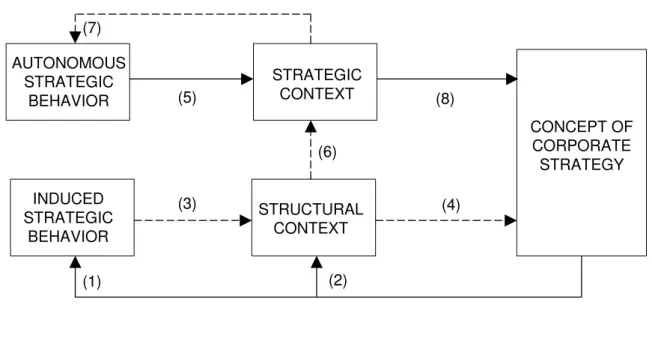
The model is represented in Figure 1. The two generic categories of strategic behavior discussed above are discerned: induced (following the current strategy) and autonomous (addressing new opportunities). Induced strategic behavior uses the categories provided by the current concept of strategy to identify opportunities that conform to this concept. Typically this include new product development projects for existing businesses, marketing development projects for existing products, and strategic capital investment projects for existing businesses. This is the type of strategic behavior documented by Bower [1970] and is one form of strategy emergence.
EAESP/FGV/NPP - NÚCLEODEPESQUISAS EPUBLICAÇÕES 38/140
RE L A T Ó R I O D E PE S Q U I S A Nº1 0/ 20 00 [1980]. The process as described parallels Bower’s conception and extends it to apply to autonomous (instead of induced) initiatives. Autonomous initiatives attempt to escape the selection of the current structural context. They provide change in corporate strategy. This is another form of strategy emergence.
Note that both types of behavior produce emergent strategies, but strategies emerge in a different sense. In induced strategic behavior, strategies form as detailed means of achieving the broad goals stipulated by the current concept of strategy. In autonomous strategic behavior, strategies form outside the current strategy and require changes in it.
Source: Burgelman [1983]
Figure 1. Burgelman’s model of two coexisting modes of strategic behavior.
AUTONOMOUS STRATEGIC
BEHAVIOR
STRATEGIC CONTEXT
INDUCED STRATEGIC
BEHAVIOR
STRUCTURAL CONTEXT
STRONG INFLUENCE WEAK INFLUENCE
CONCEPT OF CORPORATE STRATEGY (7)
(5)
(3)
(1) (2)
(6)
(8)
EAESP/FGV/NPP - NÚCLEODEPESQUISAS EPUBLICAÇÕES 39/140
RE L A T Ó R I O D E PE S Q U I S A Nº1 0/ 20 00 Corporate strategy strongly influences the structural context and induced strategic behavior (loops (2) and (1)). To the extent that top management achieves a high degree of control over this process, the influence of induced strategic behavior in causing changes in the structural context or in the corporate strategy itself is weak (loops (3) and (4)). Autonomous strategic behavior, on the other hand, causes an impact on corporate strategy through the workings of the strategic context (loops (5) and (8)). The effect of the structural context on the strategic context was found to be weak in Burgelman’s previous study (loop (6)). Finally, the degree to which middle management is successful in activating the process of strategic context determination provides guidance for further entrepreneurial initiatives at the operational level (loop (7)).
Two selective processes are considered in the model. The structural context selects induced initiatives, through the various structures and mechanisms that direct the interests of the strategic actors in the organization. The strategic context selects autonomous initiatives through the efforts of middle managers to link autonomous behavior into corporate strategy.
Burgelman draws two implications of his study which are relevant to the present one. One implication refers to the dilemma resulting in large firms from the two opposing tendencies toward stability and change.
EAESP/FGV/NPP - NÚCLEODEPESQUISAS EPUBLICAÇÕES 40/140
RE L A T Ó R I O D E PE S Q U I S A Nº1 0/ 20 00 His paper, Burgelman maintains, suggests that such challenges may be faced more aptly by recognizing the different requirements of the different strategic situations represented in the model, which coexist in the organization [68].
Another implication refers to organizational learning. Current corporate strategy is a frame of reference or “paradigm” about the bases of the firm’s past success. It provides guidance for action. But it also crystallize attitudes, managerial styles and an ideology of success. Therefore, autonomous strategic behavior, identified here as a major source of strategic renewal, is likely to face nonrational obstacles.
IV. OTHER INTERPRETATIONS OF STRATEGY
EMERGENCE
Several interrelated concepts were reviewed so far, all describing the emergence of strategy in some sense. Concisely, these views stated that:
1. Strategies may emerge as a result of “muddling through”, an incremental process in which each individual administrator make decisions on the basis of experience, limited analysis, successive limited comparisons, and choosing goals and actions simultaneously [Lindblom 1959].
2. Strategies may emerge as a result of autonomous strategic initiatives coming from lower levels in the hierarchy arising both from changes in the environment and by the perception of managers at various levels of the opportunities for the use of firm’s resources that these changes offer [Burgelman’s (1983) reading of Chandler 1962].
EAESP/FGV/NPP - NÚCLEODEPESQUISAS EPUBLICAÇÕES 41/140
RE L A T Ó R I O D E PE S Q U I S A Nº1 0/ 20 00 4. Strategies may emerge from a process which is purposeful, effective, and
proactive, but at the same time fragmented, evolutionary and largely intuitive. In this process, strategy tends to evolve as internal decisions and external events flow together to create a new, widely shared consensus within top management [Quinn 1980].
5. Strategies may emerge spontaneously anywhere in the organization initially as unintended patterns in action and may become organizational as they become collective [Mintzberg & McHugh 1985].
6. Strategies may emerge in two ways in the same organization: from autonomous strategic initiatives originating at lower levels in the hierarchy and outside the current strategy, and from induced initiatives also coming from lower down and within the current strategy [Burgelman 1983].
In what follows, some further ideas related to emergence but more distant from the literature reviewed so far will be commented on. In these perspectives:
1. Strategies may emerge as they are discovered in action [March 1976]
2. Strategies may emerge through ongoing, retrospective sense-making, within a learning process that substitutes for rational decision making [Weick 1995].
3. Strategies may emerge as a result of a process of learning over time, in which initiatives at lower levels in the organization create streams of experience that may be reinforced and converge into patterns [Mintzberg 1990].
EAESP/FGV/NPP - NÚCLEODEPESQUISAS EPUBLICAÇÕES 42/140
RE L A T Ó R I O D E PE S Q U I S A Nº1 0/ 20 00 Finally, it must be acknowledged that many other authors have presented conceptions of the strategic process which describe some sort of emergence. Among these, the following may be cited:
1. Strategies may emerge as they evolve over time from an indescribable mix of operating decisions [Wrapp 1967].
2. Strategies may emerge as the result of experimentation [Nystrom & Starbuck 1984].
3. Strategies may emerge as the result of improvisation [Miner, Moorman & Bassooff, 1996].
These last three will not be reviewed here, but some of their ideas will appear interspersed in the discussion of the previous four.
1. EMERGENT GOALS
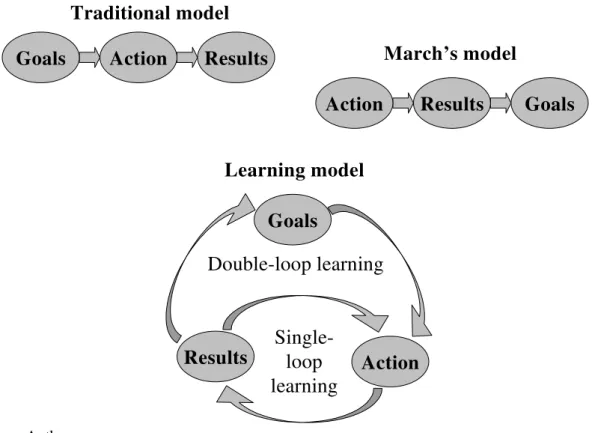
We have been talking about the emergence of strategy as a pattern in action that develops when intentions are either absent or contradicted. But what if one deliberately acts first, in order to discover his or her own intentions? This question was explicitly taken up by James March [1976].
March starts by observing that in most of the Western world, individuals and organizations see themselves as making choices. The proper way to make choices, so goes the theory, is first to evaluate alternatives in terms of goals, on the basis of information currently available, and then to choose the alternative that is most attractive in terms of the goals.