FUNDACAO GETULIO VARGAS
EBAPE
ESCOLA BRASILEIRA DE ADMINISTRACAO PUBLICA
e de EMPRESAS
“Web 2.0, dilemmas 1.0:
Essay on an Evolving Market”
Dissertation presented to Escola Brasileira de Administracao Publica e de
Empresas de Fundacao Getulio Vargas To obtain the degree Master in
Management
MACAULAY DUFF KERR
2
Abstract 3
Introduction 3
Literature Review 4
1. Internet and Web 1.0 4
1.1.Tim Berners-Lee 4
1.2.Browsers 5
1.3.Marc Andreessen and Eric Bina 6
2. Netscape Browser 7
3. The Web Today 8
4. Enter Web 2.0 9
4.1.Key to Web 2.0 Services and Applications 10
4.1.1. Blogs 11
4.1.2. Wikis 12
4.1.3. Tagging and Bookmarking 12
4.1.4. Multimedia Sharing 14
4.1.5. Audio Blogging and Podcasting 14
4.1.6. RSS and Syndication 14
5. Seven Principals of Web 2.0 15
5.1.Web as a Platform 17
5.1.1. Google and Netscape 18
5.1.2. DoubleClick, Overture and AdWords 19
5.1.3. Akamai and Bit Torrent 22
5.1.4. Collective Intelligence 22
5.1.5. Blogging 24
5.1.6. Power of the Database 26
5.1.7. End of Software Release 27
5.1.8. Software Above the Level of One Device 27
5.1.9. Web 2.0 Follow up 27
6. Microsoft Model 28
7. Google 32
7.1 Google Architecture Overview 33
8. Value of Blog Sites 36
9. Start up VC Valuations 38
9.1. Post-Money 39
9.2. Pre-Money 39
10.Purchases of Applications 41
10.1 YouTube Purchase by Google 42
10.2 Photobucket Purchase 44
10.3 Geni.com Purchase 48
10.4 Rivals vs. Scout.com 48
11. Business Valuations – Tech Companies 48
11.1 Methods of Valuation 52
Conclusion 59
Figures 61
Glossary of Terms 62
3
Abstract
Today the Internet is entwined into our everyday society. From the beginning days in 1980 to today, the Internet has been evolving. The creator of the World Wide Web, Tim Berners-Lee, envisioned that the Internet would be a system with everything connected to everything. The web today is changing with new applications arriving from outside the previous channels of the megalithic software companies. Thousands of individual developers are creating micro-applications to enhance the earlier framework of the web. This revolution has been coined “Web 2.0”. Many observers today are skeptical that Web 2.0 is really a revolution at all, but maybe is just a continuation of Berners-Lee’s original concept. This paper examines, based on a critical literature review, the discussions taking place regarding Web 2.0.
Introduction
4
If a standard literature review is conducted along with keyword searches of the World Wide Web, relevant key words, such as “Web 2.0, Web 1.0, Google, Berners-Lee, Andreessen and many more” are obtained. We will venture into these topics in this work. This research also included international journals, smaller journals, conference papers and other literature that may be considered “grey” literature (i.e., popular articles, unpublished reports, and other documents), and some Internet (non-journal) materials.
The literature review revealed that though the subject of the Internet is well documented, the topic of Web 2.0 does not create a single mindset, but divides observers into discussion if new ideas are unique or simply small extensions and aberrations of old concepts.
1.0 Internet and Web 1.0
It is important to review the early days of the Internet and the World Wide Web (WWW) to understand the changes that have taken place, are taking place and will continue to develop in the future (Venkatraman, N. 2000, p.14,15,16). Extremely important are the lessons to be learned from the early concepts, ideas, successes and failures of the pioneers, such as Tim Berners-Lee and Marc Andreessen. The beginning of the Internet can be traced to the creation of the ARPANET in 1969 (McAdams and Nelson, 1995). The creation of the World Wide Web can be traced to Tim Berners-Lee (Anderson, 2007).
1.1 Tim Berners-Lee
5
1
Berners-Lee´s original proposal to CERN included a plan to develop an information system, one that would essentially create a web of information. His proposal to CERN received no reply, but he continued to work on what was to become the Hypertext Transfer Protocol (HTTP) language. Berners-Lee also created the Universal Resource Locator (URL) address system and the client program known as “WorldWideWeb” (Anderson, 2006; Wikipedia 2007). The pages used Hypertext Markup Language (HTML). His creations also include the first web server, for hosting the collections of data. Berners-Lee offered to sell his new creation to CERN, but was not successful. He received no license, patent or royalties for his invention, making the standards open to all.
Without success in selling his program, he turned to the Internet community, making his software available to everyone. Computer enthusiasts around the world began to set up their own servers. The beginning of the WWW was happening. Berners-Lee had established the basic tenet of his vision of the web, open sharing of information to allow faster and better development of information (O’Reilly, 2005). His vision will later be entangled in the discussion of whether Web 2.0 is actually a new concept, or simply a new term associated with a few new applications (Alexander, 2006).
In Berners-Lee’s book, Weaving the Web, (1999) he describes his original vision as a collaborative workspace, where in a ‘single, global information space’ everything was linked to everything (p.5).
1.2 Browsers
Berners-Lee’s browser was created on the NeXT platform, and quickly it became apparent that other browsers, running on other platforms would be necessary to make the new web available to more users (Berners-Lee, 1999; Anderson, 2007). Erwise, a collaboration of University of Helsinki students, was created for Unix machines, and Berners-Lee and his colleagues created a browser for Macintosh called Samba. Berners-Lee proposed in his book “Weaving the Web”, that it was just as important to edit the web as to browse it. In the current
1
6
evolution of Web 2.0, Berners-Lee’s original ideas are beginning to take greater shape, possibly moving closer to what his original vision was for the web (Berners-Lee, 1999).
1.3 Marc Andreessen and Eric Bina
Marc Andreessen and Eric Bina created the first Internet browser adopted by the general public for the personal PC. In 1992, the two National Center for Supercomputing (NSCA) employees developed the Mosaic browser. Their new browser was much different than earlier browsers, which were very simplistic graphically, and mostly designed to work with Unix machines. Their new browser was designed to run on Unix, but soon after, PC and Mac versions would follow. One major breakthrough was the creation of the “image” tag, which allowed the inclusion of images on the web page, whereas before images were only viewable as separate files. For the first time, Mosaic made it possible for images and text to appear on the same page, which is one foundation for the popularity of the web today. One important creation incorporated in Mosaic included a graphical interface, using “clickable” buttons to navigate and scroll through text easily. Additionally, the creation of the hyperlink was very important, as before, in different browsers, links contained numerical references to documents. Now, hyperlinks allowed the user to simply click to be transported to the document. These very simple tasks, that are taken for granted today, were novel in 1992. Mosaic was tested on the NSCA computers in 1993, and it was immediately popular. Within weeks, tens of thousands of people had downloaded the software. This could be proposed as the first viral program on the Internet, long before the term ‘viral’ had been coined in this usage (Tracy, 2001).
7
After completing his education at the University of Illinois, Andreessen moved to Silicon Valley in California. He soon met with Jim Clark, one of the founders of Silicon Graphics, and later discussions led to the creation of a startup company, Mosaic Communications Corp. The mandate of the company was to create a better product than the original Mosaic, and since the original Mosaic was built with university money, it belonged to the university, forcing the team to start from scratch, including a new name, NETSCAPE.
2.0 Netscape Browser
Pricing for the new Netscape product would be a key to its development, and the issue then would prove to be a model for the development of Web 2.0 today. Free usage vs. paid subscriptions was a difficult choice then (and is still a difficult choice today). All models used today, which generate revenue, are either free, paid or a hybrid, with premium offerings on top of free services, this has not changed since 1993. As will be examined in this work, many questions faced in 1993, at the beginning of Web 1.0 are just as relevant and complex today.
A comment from Andreessen explains the thought process for the introduction of Netscape: “That was the way to get the company jump-started, because that just gives you essentially a
broad platform to build off of. It’s basically a Microsoft lesson, right? If you get ubiquity, you
have a lot of options, a lot of ways to benefit from that. You can get paid by the product you
are ubiquitous on, but you can also get paid on projects that benefit as a result. One of the
fundamental lessons is that market share now equals revenue later, and if you don’t have
market share now, you are not going to have revenue later. Another fundamental lesson is
that whoever gets the volume does win in the end. Just plain win.”
8
is merely a subsidiary of AOL, which has fallen from grace in its own way (Cosumano and Yoffie, 1998). Microsoft’s Internet Explorer has long since replaced Netscape as the number one browser, mainly because it is included free with the Windows operating system (Davis; Murphy, 2000, p 184,;Klein, B., 2001). Not all was lost for Netscape and it founders; in 1999 AOL bought Netscape Communications for $10 billion in stock. Today AOL does not use Netscape as it official browser. The Netscape story demonstrates the volatility of the Internet market and should not be forgotten in the evaluations of today’s high flying acquisition markets, especially in the area of social networking sites, which have a short history to draw from in reference to their fad factor and long term staying power (O’Malley, M. and Rosenzwig, R., 1997). Marc Andreessen is still actively involved in technology companies today (Klein, B.,2003).
Figure 1
Internet Browser Market Share – July 2007
78.84% Microsoft Internet Explorer
14.55% Firefox
4.49% Safari
0.91% Opera
0.78%
Netscape
0.21% Opera Mini
0.22% Others
(Source – marketshare.hitslink.com – July 2007)
At the height of its market penetration, Netscape had over 85% of the browser market, today as is shown in a recent report of browser market shares, Netscape has less than 1% of the market.
3.0 The Web Today
9
One way to describe the current evolution is to look at the Internet in two phases, one before the NASDAQ collapse of 2001, and again after the collapse of the markets (Ofek, E.,; Richardson, M., 2003). The financial wellbeing of an industry is not necessarily a good benchmark, but does provide a historical perspective to define two eras. During the fall of 2001, much of the industry came crashing down from the unrealistic expectations that were driving the unprecedented NASDAQ climb. Many Silicon Valley companies were being valued simply on smoke and mirrors, without solid evidence of even remotely profitable futures. As the market values came tumbling down, the Web 1.0 era came to a roaring halt from a financial investment perspective. The pretenders were ushered out the door and a few survivors remained, with Yahoo!, Amazon and eBay being the leaders in showing their strength, separating themselves from the rest. Financially, Web 2.0 is being defined by the lack of IPO’s in contrast to the Web 1.0 era. During the boom years at the end of Web 1.0, venture capitalist (VC’s) were bundling new IPO’s as fast as the retail market would swallow them up (Graham, 2007). Today, with the retail investor weary of Internet stocks, the play for VC’s has changed to one of acquisition, which will be explored later in this paper.
4.0 Enter WEB 2.0
10
Brian Alexander, Director for Research at the National Institute for Technology and Liberal Education, argues that Web 2.0 is not really about a single new development, and suggests few people can agree even on the general outlines of what Web 2.0 is. Alexander (2006) offers that Web 2.0 may more aptly be a collection of heterogeneous mixes of emerging technologies. He proposes that Web 2.0 may be linked with the term, social software, an idea that dates back to the 1960’s. Social software of the past was defined by listservs, Usenet groups and web-based communities. The social software of today can be defined by blogs, wikis, trackback, podcasting, videoblogs and new models; such as MySpace and Facebook. In his writings, Alexander points out that wikis originally appeared in the late 1990’s, before the term Web 2.0 was coined, reinforcing his concept that Web 2.0 is evolving from earlier ideas, and is not a brand new idea.
Johnson provides another point of view for the Web 1.0 vs. Web 2.0 discussion. He notes, some revolutions are very abrupt, and clearly defined, such as LCD computer monitors vs. tube style monitors, where the difference is more clearly defined. For most Internet users, the first revolutionary moment was when they clicked their first hyperlink, a totally new experience, and truly a revolutionary event. He points out that other technological revolutions, such as email, took years to catch on. The current change in the structure of the web is a transformation, taking place in small steps by thousands of individual programmers, dozens of startups and a few software giants. He proposes that what is really taking place is a massive software upgrade for the whole web, which some are calling Web 2.0 (Johnson, 2005).
4.1 Key Web 2.0 Services and Applications
To understand the business models of the companies making headlines today it is appropriate to look at the technologies they are employing inside their applications. A brief explanation of several key terms and applications follows. Tech companies employing these web 2.0 ideas are being purchased by or merging with larger companies (Clemens, E., 2006).
11
multimedia sharing services, podcasting and tagging services for content (Alexander, 2006; Anderson, 2007; O’Reilly, 2005).
4.1.1 Blogs
John Barger coined the term web-log or blog in 1997. A simple definition is a webpage consisting of brief paragraphs of opinion, ‘information, personal diary entries or links (posts), arranged chronologically, with the most recent first, in the style of an online journal’ (Doctorow, et al, 2002). Normally a blog will permit a reader to add a comment below the latest entry. Anderson (2007) comments that the key to a blog is it allows the reader to contribute as much as they consume. Blogging has become in many ways a signature item of social software. Part of the rise of popularity of blogs is the ability of Google to search them efficiently. Google has added a separate blog search site, blogsearch.google.com. As many thousands of new blogs and posts are added every hour, it takes a system like Google Search to make sure relevant posts can be found. Additional blog and RSS search services have appeared, which have made searching the blogosphere easier (Alexander, 2006).
To the benefit of bloggers that want their sites to be found, they can register for free with Technorati.com and their posts will be searchable by content and tags (see tags defined below).
Tagging each post with a key word or two (i.e. author-subject) allows the subject of the blog to be categorized, allowing for the system to later retrieve the blog via a standard menu system. Another term, called linking, is important in blogging as it allows for a deeper conversational nature for the blogosphere. By creating a permalink, the item can be retrieved later. Another key blogging technology is trackback. It allows blogger (A) to notify blogger (B) they have referenced their blog, creating interaction (Alexander 2006, Anderson 2007).
Blogging is currently available to most readers of online media sources, such as national news outlets and even local newspapers.
12
the leading blog on emerging technology companies. Niche blogs allow for control over the users media reception, unleashing individuals from ties to stories only from mainstream media (TechCrunch.com, 2007).
An interesting site for blogs is digg.com. The site is worth mention as it supports the idea of social software, by allowing a more human interaction. Primarily targeted at technology stories, users can vote for, or “digg” stories they like, and the site promotes the results based on voting (Alexander, 2006).
4.1.2 Wikis
13
4.1.3 Tagging and Bookmarking
A tag is a keyword added to a digital object to describe it (Lastowka, F., 2000). Tagging is not a formal classification system. The lack of a formal system allowed Joshua Schacter to create one of the web’s most popular social bookmaking sites; del.icio.us. The site takes advantage of using tags, assigned by users (folksonomy) to attach key words to bookmarked pages. The bookmarks are collected in a web based server, and are available from any computer, not just the users personal PC. The tagged bookmarks are also available for sharing with other people with the same interests (Alexander, 2006; Anderson, 2007). One objective of del.icio.us is to promote the sharing of similar interests among users.
A look at the information about del.icio.us provides a look in to how the site works. The following description was taken directly from the del.icio.us website.
What is del.icio.us?
Information from Del.icio.us web site:
del.icio.us is a collection of favorites - yours and everyone else's. You can use del.icio.us to:
• Keep links to your favorite articles, blogs, music, reviews, recipes, and
more, and access them from any computer on the web.
• Share favorites with friends, family, coworkers, and the del.icio.us
community.
• Discover new things. Everything on del.icio.us is someone's favorite --
they've already done the work of finding it. So del.icio.us is full of bookmarks about technology, entertainment, useful information, and more. Explore and enjoy.
del.icio.us is a social bookmarking website -- the primary use of del.icio.us is to store your bookmarks online, which allows you to access the same bookmarks from any computer and add bookmarks from anywhere, too. On del.icio.us, you can use tags to organize and remember your bookmarks, which is a much more flexible system than folders.
14
Tagging can go far beyond simple bookmarking and sharing of bookmarks. Examples of Web 2.0 companies employing tagging are Flickr.com, for photos and YouTube.com, for videos.
Tagging solves basic problems in the area of search, but the user is then required to search all of the tagged results, which can lead to an overwhelming amount of data. This is apparent when general searches for keywords such as “travel” are entered into search engines. A typical search can yield 1000’s of matching responses, which clearly demonstrates one of the pitfalls of tagging. As the database grows, tagging loses its designed efficiency as well.
4.1.4 Multimedia Sharing
One of the biggest growth areas on the web is multimedia-sharing sites; such as YouTube (video), Flickr (photos) and Odeo (podcasts). Users of these sites are allowed to create content, which embodies the writeable web theory, part of Web 2.0, where users are part of the production process. This idea differs greatly from early content suppliers, such as AOL, and even Yahoo! One key is the massive scale from which content can come, barriers to entry are very low, made possible by low cost digital media technology such as cameras, phones and video recorders (O’Reilly, 2005).
4.1.5 Audio Blogging and Podcasting
Podcasts are usually audio recordings of talks, interviews and lectures. Playback devises can be either a desktop PC or other MP3 devices. Podcasts were originally created in an effort to add audio streams to early blogs (Felix and Stolarz, 2006). Users make podcasts available via uploading to a host server, and then via RSS let the world know about their site. The process (known as enclosure) adds a URL, as well as directions to the file on a host server (Patterson, 2006).
4.1.6 RSS and Syndication
15
as syndication. The user decides which feeds are important to receive updates from, then subscribes to the site, and then client software takes over, keeping the user informed about changes. RSS stands for Rich Site Summary (Doctorow, 2002). Later versions of RSS are also known as Really Simple Syndication (Anderson, 2007).
As the products and applications continue to develop, it is becoming difficult to keep up with the new entries. Sites such as TechCrunch.com provide news about startup companies and eConsultant’s Web 2.0 directory lists over 1200 services categories.
5.0 Seven Principals of Web 2.0
A paper authored in September 2005 by Tim O’Reilly, What is Web 2.0: Design Patterns and
Business Models for the Next Generation of Software, has laid the foundation for the
discussion around Web 2.0. Many others have read the paper and either proposed additional ideas and concepts or taken disagreement with his outline of what Web 2.0 is about (Anderson, 2007). The basic premise behind the paper is O’Reilly’s list of seven principals of Web 2.0. Others do not totally agree with the simplicity of the seven principals presented as defining Web 2.0. (Carr, 2005; Anderson, 2007).
i. The Web as a platform
ii. Harnessing collective intelligence iii. Data is the next “Intel Inside” iv. End of the software release cycle
v. Lightweight programming models
vi. Software above the level of a single device vii. Rich user experiences
16
In his paper, O’Reilly (2005) provides comparisons of several applications, which can help clarify several of the important points. A few examples can assist with the explanation. Each new service or application is an evolution of the earlier idea. O’Reilly proposed the following analogies:
WEB 1.0
WEB 2.0
DoubleClick Google AdWords
Ofoto Flickr
Akamai Bit Torrent
Mp3.com Napster
Britannica Online Wikipedia
Personal Websites Blogging
Evite Upcoming.org and EVBD
Domain name speculation Search engine optimization
Page views Cost per click
Screen scraping Web services
Publishing Participation
Content management systems Wikis
Directories (taxonomy) Tagging (folksonomy)
Stickiness Syndication
These examples revel how the Internet has transformed itself from earlier services and applications, and how the latest developments are incorporating much greater user participation, a core requirement for inclusion into Web 2.0 theology.
The list of comparisons could be greatly expanded. What is important is to look at several ideals and attempt to distinguish between Web 1.0 and 2.0. Although there is not a hard, fast line between the two, there are significant differences worth exploring. Currently, many companies are jumping on the marketing bandwagon, claiming any new application, use or product is Web 2.0, and simply associating Web 2.0 as a buzzword.
17
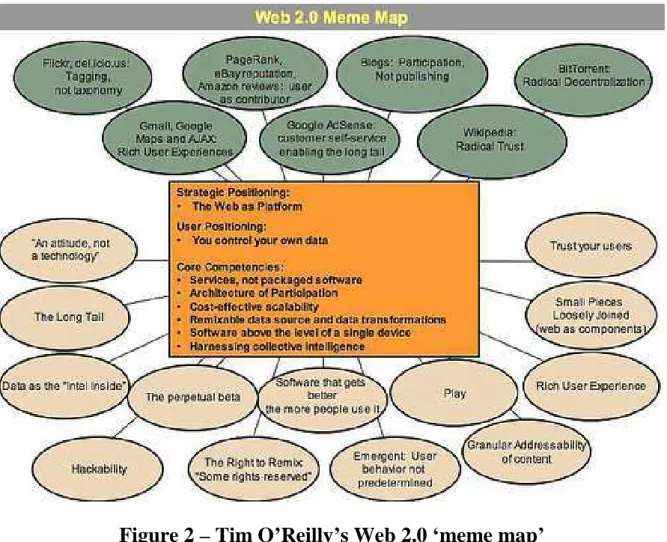
Figure 2 – Tim O’Reilly’s Web 2.0 ‘meme map’
Looking at the map above, it becomes clearer how the Web 2.0 might be broken into elements and principals that help to define and compare Web 2.0 to Web 1.0. The map highlights how Web 2.0, in theory, is much more interactive and open than Web 1.0.
5.1 The Web as a Platform
18
An emergence of web-based services, which pull data from backend servers is occurring (Por Yu Cong, Hui Du, 2007). Ad hoc relationships between remote machines are freeing data that was once held by the gatekeepers. Virtual applications are becoming the norm, not the exception. New applications tend to be small, and deploy rapidly (Miller, 2005). A whole new generation of software is being developed, a wave that has not been seen since microcomputers first occurred. Microsoft sees the new wave and can do little to react, as it is coming to fast for them. Microsoft is currently in a battle with Google to buy as many new startups as possible, but Google has the lead at the moment (Graham, 2005).
Although the “web as a platform” may be a rallying cry of Web 2.0, Graham points out that delivering desktop applications over the web is as old as the web itself. The problem was in how it was delivered, via java applets, developed by Sun. The idea was to run java applets delivered from a server. He states Ajax is the next hot platform, and writes that thousands of hackers have suddenly started building things on top of it. Graham concludes his review of Web 2.0 by proposing that Google may be a true model. From his perspective, Google uses the Web, ‘as it was meant to be used’. Graham says, ‘Their sailing with the wind, instead of sitting becalmed praying for a business model, like the print media, or trying to tack upwind by suing their customers like the record labels.’
5.1.1 Google and Netscape
19
have power over the standards for controlling the display and applications in the browser. Netscape sought to use their “webtop” to replace the desktop of Microsoft. In reality, the idea was short lived as web browsers and servers quickly became commodity items (ibiblio.org, 2007).
Google has taken a different approach, using a native web application, a product that has never been sold or packaged. Their suites of offerings are simply services, where customers are paying either directly or indirectly for the service. They do not reply on physical software with scheduled updates, but in contrast provide a continuously updated product. One huge advantage is that there are not compatibility issues, their applications work with most operating systems.
One major difference that distinguishes Netscape from Google is that Google operates a database, which Netscape never required. Google is essentially a huge database, without which their application tools would be worthless. But, contrarily without their custom software, the data would be unmanageable. Another major difference is that software does not need to be distributed, only managed. Google does not produce a browser, or a server, but simply their service is delivered by the existing infrastructure of browsers and servers in place. In fact, Google does not even host the content users view and find, they simply facilitate the location of the information. They are the middleman between your PC and the host of the information you seek.
While it is true that both Netscape and Google can be called software companies, there is stark contrast in that Netscape can be compared to same software world as Lotus, Microsoft, SAP and Oracle. Google would more correctly be compared to companies of the likes of eBay, Amazon and Napster.
5.1.2 DoubleClick, Overture and AdWords
20
are joined seamlessly. Banner ads were added to third party web sites, thus integrating three parties seamlessly. It is important to look at the early pioneers to compare where the use of the web platform has evolved and how today’s companies are taking solutions to a higher level. An examination of several cases will revel the differences of Web 2.0 vs. Web 1.0.
DoubleClick provides advertisements to content providers, namely in the form of banner ads (Weinberg, J., 2000, ; Basho, K. 2000). Google recently purchased DoubleClick, a company that was built in the era of Web 1.0. DoubleClick successfully implemented the major banner ad programs associated with Web 1.0. The model for DoubleClick is interesting, in that it is specifically mentioned in the book, “The Search”, by David A. Vise and Mark Malseed (2005) as one of the defining factors in the creation of Googles AdWords. Google founders, Larry Page and Sergey Brin, disliked the model for banner ads, in the sense that they were to brazen, and in technological terms, to slow too download. But yet today, their company owns DoubleClick. DoubleClick also does not take advantage of the long tail of advertisers, for which AdWords is famous, but in the past, only focused on the major media market. This recent purchase further blurs the lines of Web 1.0 vs. Web 2.0. As the quintessential 2.0 company, Google, has blended its technology with a Web 1.0 competitor (Battelle; Vise, 2005).
Figure 3 – Google Press Release
Q. What are the terms of the agreement?
21
Q. How did Google come to the value of $3.1 billion?
A. We see this as bringing the worlds of search and display advertising together. We determined the value based upon the clear synergies between DoubleClick and Google advertisers, publishers, and ad agencies.
Source – Google Press Release – April 13, 2007
DoubleClick is a true Internet pioneer and a product of Web 1.0. Its main product is software, specifically banner advertising, and it works with data management (Weinberg, J., 2000; Basho, K., 2000). One limitation to DoubleClick, which is characteristic of Web 1.0, is the business model they have chosen. Their model of matching key ads with customers only extends to large customers, providing a base of approximately 2000 customers. Their premise in the 90’s was that the web was about publishing, not participation. This model followed the old school thinking that advertisers, not consumers should call the shots, and that the Internet was important for the top websites. What really was important in Web 1.0 was media scoring numbers, provided by companies such as MediaMetrix and others. A bold example of this model is that DoubleClick, on its website, promotes that over 2000 companies successfully implement their software. In contrast, Web 2.0 companies such as Yahoo! Search marketing (formerly Overture) and Google AdWords and AdSense serve hundreds of thousands of advertisers each.
The Yahoo! and Google school of thought is based on what is described by Battelle ( 2005) as “the long tail”, which implies that the real power of the Internet is the power of the collective small users, not just a handful of large companies. In reality, the small users make up the bulk of the Internet, and this is especially true today with the options and powers individuals have. Google and Yahoo! figured out how to avoid formal sales contracts, and created methods to put ads on virtually every website. And especially important to their model, was not pushing, and in fact supporting anti-banner web advertising. Both companies use simple text ads, which do not attempt to compete with the content. (Google now has banner ads)
22
Google would be accused of infringing on the Overture patent. Although the case never went to trial Google did pay Yahoo! damages. Overture was the original model for Google Adwords (Battelle, 2005).
An important lesson learned from Web 2.0 thinking is to make sure that customers can service themselves, and also to ensure data can be shared with the long tail, not just the head. eBay is a prime example of the long tail, by making a few dollars off of many users, vs. bigger revenue from a few clients.
5.1.3 Akamai and Bit Torrent
Akamai is a classic example of a business that concentrates on the head, not the tail. They specialize in movement of large data packets and heavy user demand environments. Their service relies on the use of massive servers of their own and their clients. By manipulating the data, they are able to move massive data streams and accommodate for huge traffic overloads of a single site. A recent example is their technology was used to distribute the live video stream for LiveEarth.org. concert (Akamai.com, 2007).
Bit Torrent is one of the early pioneers of the Peer-to-Peer (P2P) movement, which allows the Internet to be decentralized. P2P takes advantage of every user being a server, and allows clients to be served from many locations, which allows for multiple input points, and faster transfers of data. One result is that the more popular a download is, it creates more sources that are available, which decreases download time. This simple point is a key element of Web 2.0, the service should automatically get better when more people use it. This is in contrast to Akamai, which requires more servers to improve service. By creating an environment of participation, the servers act as brokers of information, allowing the edges to connect to each other (O’Reilly, 2005).
5.1.4 Collective Intelligence
23
share new information on the web. Yahoo! was born as a collection of links, which started as a few thousand and evolved into millions, later focusing more on becoming a portal. Even as a portal Yahoo! knows the importance of its concentration of work as its core value. Graham (2005) refers to this collective intelligence as “Democracy”. He points out that in the world of news, many sources are letting the masses decide what stories are important.
In a paper written by Anderson (2007) he refers to a book titled “Wisdom of the Crowds” by author James Surowiecki. In the book, one main inference is that the collective knowledge of many is usually superior to few. Anderson cites an example of Cloudmark, a collective spam filtering system, which aggregates individual user decisions about what and what is not spam. He contends this human system can be superior to a machine based system. Graham posits that democracy of the net is being displayed by the quality of the material on the net, with numerous individual sites better than magazine articles or news stories. He observed many of the top sites in Reddit.com, a site that ranks stories by user interest, are linked to individuals sites, such as Michael Arrington’s TechCrunch.com (Graham, P., 2005).
eBay is another example of the power of the collective works of its users providing critical mass, which enhances usefulness and relevance. This mass also prohibits new entrants as well, whose offerings would be less attractive to users (Anderson, 2006, O’Reilly, 2005).
Comparing BarnesandNoble.com to Amazon, it is easy to see that they sell many of the same products, but Amazon has made as science of creating useful interactive relations with their customers. These interactions lead to more useful searches and additional selling opportunities as well. Amazon is not afraid to let users see the most relevant searches, even those that lead to products not directly under their control. Amazon has figured out that more interaction, or collecting intelligence, leads to greater sales (O’Reilly, 2005).
24
behind Web 2.0, participation, collectivism, virtual communities and amateurism, but he extols that it is not accurate in many cases, and the information is slipshod, and less than professional. He contends that collective input does not equal intelligence. He opines that quantity of news is not a replacement for quality of news (Carr, 2005).
Blogging sites like del.icio.us and Flickr use a process called “folksonomy”, which is a style of collaboration, that allows sites to be found using “tags” which are based on looser protocols. Users are allowed to create their own tag words, and not limited to pre-selected categories.
One common trait many of the most successful Internet sites have is that they were created with word of mouth advertising, and relied on the power of viral marketing to take root. Web 2.0 sites tend to rely almost exclusively on word of mouth advertising, which is in contrast to Web 1.0, when huge marketing budgets were spent to create market share.
Many of the most productive web server tools are a collaboration of peer-production. Examples are Linux, MySQL, Apache and Perl.
5.1.5 Blogging
In Web 2.0 the power of collective intelligence is expanding and developing. The premise of search engines is to track and index new links, and blogs. With their huge amount of daily additions, they have a large role in shaping the results of search engines. Bloggers have a keen interest in the writings and posts of other bloggers, which leads to an “echo chamber effect” (Anderson, 2006).
Blogging has resemblances to Wikipedia, which is a model for collective intelligence. Blogging serves as a collection point for ideas, and filters out information quickly. Comments and posts are reviewed and questioned immediately, and sometimes harshly.
25
bloggers as a whole to attract an audience. In this new media, the power to decide what stories are important lies in the hands of the people, not a few key media companies.
In Web 2.0, the era of the blog has evolved, with the medium on the rise (Owen, T., 2003). Much different than personal home pages, blogs have provided chronological order to the users information. By allowing structure to the commentary, it becomes collectively more useful, as well as easier to find and comment. A major breakthrough in the development of blogs can be traced to the creation of a technology called RSS. (RSS was born from Dave Winer’s: Really Simple Syndication technology, and originally from Netscape’s: Rich Site Summary- see definition of RSS below). Using RSS the user is notified when changes or additions are made to sites of relevance, which makes an RSS feed a much stronger link than a bookmark.
Figure 4 – RSS Definition
Definition of a RSS format
RSS is a format for syndicating news and the content of news-like sites, including major news sites like Wired, news-oriented community sites like Slashdot, and personal weblogs. But it's not just for news. Pretty much anything that can be broken down into
discrete items can be syndicated via RSS: the "recent changes" page of a wiki, a changelog of CVS checkins, even the revision history of a book. Once information about each item is in RSS format, an RSS-aware program can check the feed for changes and react to the changes in an appropriate way. http://www.xml.com/pub/a/2002/12/18/dive-into-xml.html
RSS-aware programs called news aggregators are popular in the weblogging community. Many weblogs make content available in RSS. A news aggregator can help you keep up with all your favorite weblogs by checking their RSS feeds and displaying new items from each of them.
RSS is not only used for blogs, but also to provide all forms of data, from stock quotes to sports scores and weather. Web logs differ from other web pages in other ways as well. For the first time it became easy to simply link to specific posts on another users site and to discuss it. These innovations lead to greater discussion and chat.
26
5.1.6 The Power of the Database
A powerful database is at the center of the many successful Web 2.0 applications: Google and Yahoos! search engines, Amazons product database, eBay’s marketplace, and the iTunes music store are examples. Competency managing databases can be defined as trait of Web 2.0 enterprises.
Databases, and how they are managed, can define a Web 2.0 companies success. An example case is Mapquest, which was the leader in online mapping very early, beginning in 1995. Mapquest received its data from a third party supplier. Later, when Yahoo! Microsoft and Google added mapping functions, the same data available to MapQuest was available to these new entrants. MapQuest, in a very typical Web 1.0 way of thinking, did not add value to the data, by allowing users to add information to the database.
In contrast, Amazon used ISBN numbers from a third party supplier, and with the help of its huge customer base added relevant reviews to their database. Today the evolving database contains reviews from millions of customers, which makes an entry by latecomers into book selling much more difficult. Amazon has leveraged their position even stronger by using collective intelligence, a Web 2.0 trait of successful companies.
Google has taken a totally different approach to projects such as mapping. They allow the use of their mapping software to be combined with other programs to create what are known as “mashups”, which are a combination of web applications. An example would be the combining of Google maps with real estate listings. Neither Google maps, nor the real estate listing alone would provide the combined effect of a mashup, containing a description and a mapped location of the property. The mashup is an example of Web 2.0 at work.
27
5.1.7 End of the Software Release Cycle
Web 2.0 companies are avoiding the release of software via set distribution cycles, and have embraced the perpetual beta idea. They are also using the web to host applications, and not requiring desktop applications. Web 2.0 software is always up-to-date. The discussion here is brief, as this topic is better explained in the section 6 on “The Microsoft Model”.
5.1.8 Software Above the Level of One Device
Web 2.0 companies are beyond designing applications and solutions for individual operating systems. New applications are web based and universal, with more concern about browser compatibility vs. OS compatibility. Many new apps are designed to work equally well on mobile devices.
5.1.9 Web 2.0 Follow up
After numerous articles, debates and blogs about Web 2.0, Tim O’Reilly decided to post his updated definition of Web 2.0 -
From O’Reilly -
• Web 2.0 is the business revolution in the computer industry caused by the move to the Internet as platform, and an attempt to understand the rules for success on that new
platform. Chief among those rules is: Build applications that harness network effects
to get better, the more people use them
o (this is what he referred to earlier as “harnessing collective intelligence)
A comment by Eric Schmidt, CEO of Google, provides an even briefer formulation of the rule. Schmidt said, “ Don’t fight the Internet” (O’Reilly, 2007).
28
Other rules of O’Reilly include:
• Don’t treat software as an artifact, but as a process of engagement with your users- “The perpetual beta”
• Open your data and services for re-use by others, and re-ruse the data and services of others whenever possible - “Small pieces loosely joined”
• Don’t think of applications that reside on either client or server, but build
applications that reside in the space between devices – “Software above the level of a
single device”
• Remember that in a network environment, open APIs and standard protocols win, but this doesn’t mean that the idea of competitive advantage goes away.
• Chief among the future sources of lock in and competitive advantage will be data, whether through increasing returns from user generated data (eBay, Amazon reviews,
audioscrobbler info into last.fm, email/IM/phone traffic data as soon as soon as
someone who owns a lot of that data figures out that’s how to use it to enable social
networking apps. GPS and other location data, through owning a namespace
(Gracenote/CDDB, Network Solutions), or through proprietary file formats (Microsoft
Office, iTunes). (O’Reilly, T., 2006)
6.0 The Microsoft Model
The Microsoft (MS) model represents a model that is specific not only to the world’s largest software company, but is a reference to the practice of releasing software via physical discs and for unique operating systems, i.e., Windows or Macintosh personal computers. MS has dominated the software world since the 1980’s, mostly with their Windows Operating System (WOS). Windows, in its many variations, was and is primarily released through the sale and distribution of CD-DVD discs. The disks contain single versions of operating systems (OS), the OS is machine specific and not compatible with other platforms, virtually locking the user in one version, Mac or PC. This model has proven to be extremely successful, currently MS Windows products are used on approximately 90% of the world’s PC’s (eweek.com, 2007).
29
What is changing for not only MS, but also all software companies is the model of software releases at all (Gurnani, H.;Karlapalem, K., 2001). Most new startups do not even consider requiring users to buy or use disks to import programs onto their PC’s. In the Web 2.0 world this would be the kiss of death to any new project. Internet users today, are becoming resistant to even downloading programs from the web. New technologies employed by YouTube, Flickr and others do not even require a flash plug-in, windows media player or real player download to work. The entire process is built into the application. Everything is web based, easy and fast to use. New standards are being set for the future. The use of the embedded Internet platforms spells death for most software applications requiring physical discs (O’Reilly, 2005; Gurnani and Karlapalem, 2001). Exceptions, of course, must be made for specialized programs and also for global locations limited to slow or mediocre Internet connections. MS will still retain markets for their OS products, but primarily through embedding at the manufacturers sites. O’Reilly adds that companies that succeed in the Web 2.0 era will be those that understand the game, in contrast to those who try to return to the rules of the PC era. Companies that seek to lock in applications are not playing to the strengths of the platform (Choudhary et al., 1997). He also reflects that Windows, which solved early problems with the PC, is a single monolithic solution, which is becoming the problem, and is no longer the solution (Miller, 2005).
In an article from Wharton Business School, Don Huesman, senior director of information technology at Wharton, suggests MS is investing heavily today to buy the company time to reinvent itself. MS had announced plans to spend $2 billion dollars in 2007 on new investments. Huesman continued by saying “The competition isn’t just Google. Sooner or later in the future, you won’t own software but have access to it (online)” (Huesman, 2006).
So apparent is the coming change in the model, that Microsoft CEO, Steve Ballmer acknowledged the MS core business could shift focus. Ballmer said, “Software really is evolving to be software and service as apposed to software as some kind of standalone entity”.
30
money, while if they win, they win big time.” He continues, “This encourages risk-seeking behavior. If Microsoft, IBM or Apple fail, it’s visible and gets press coverage that the little guys don’t have to worry about.” Clemons suggests the solution is to buy breakthrough technology, not to invent it (Clemons, 2006).
Protecting the MS Windows franchise is the goal of MS today, and thus requires spending to protect the golden goose. As an example, in May of 2006, MS had a market capitalization of $236 billion. A startup firm with a market cap of $2 billion is considered a success. Should MS lose the value of it franchise Windows and Office products to competition, it would require over 100 newly acquired, and wildly successful startups to replace the equity that is at stake. This scenario is where a potential showdown with Google is developing, should Google be able to take share away from MS, they would begin to experience a slowdown in OEM OS sales, lost market share, margin compression and price pressures, all leading to a decrease in value of the MS franchise. At the present time MS is more about protecting the franchise than innovating.
An argument can be made in favor of MS’s future as well, in that compared to Google, which receives most of it revenue from search related activities, MS is more diverse. Technology can affect Google in a negative way just as easily as MS.
Raphael Amit, management professor at Wharton said, “What Google wants to do is strategically decrease peoples reliance on MS. It’s as simple as that” (Amit, R, 2005).
Huesman (2006) counters in MS’s defense and warns that the competitors should not take MS lightly. He uses an analogy of the US Civil War, where the South (like Google) was smaller and took on the plodding, but wealthier (Microsoft) in the North. “The South, led by the most brilliant generals of the day, dominated early with a series of amazing successes,” says Huesman. “Ultimately, however, the slower but stubborn forces of the north prevailed, due largely to their sheer size and wealth.” MS will not sit idly by without returning fire.
31
free” and have short tolerances for failures. In contrast to past models, where MS was able to endure product operational glitches, Web 2.0 companies will not have this luxury. There are too many options available for users to remain loyal through many growing pains. Web 2.0 is about customer satisfaction.
Companies embracing Web 2.0 can benefit by allowing input from users, which act as beta testers for services. Treating users as co-developers, and following the doctrine of “release early and release often”, leads to what can be called perpetual “beta”. In contrast, releasing late, and rarely may be a recipe for failure. Recent Web 2.0 companies do not have the business models of the past to shed, and are much quicker to adopt current ideas.
A common belief in the computer business is that in the future that technology could establish a web-based platform that runs in the browser and is written in the language of the browser, vs. the language of the operating system. Re-enter Marc Andreessen (co-founder of browser company Netscape Communications), back in the mid 90’s, Andreessen made the comment that the web would reduce computer operating systems to the level of ‘poorly debugged sets of device drivers’ (Whitehouse, K., 2005).
O’Reilly proposes that a platform beats an application every time. An examination of Microsoft’s model will help explain his theory. MS, in earlier confrontations with rivals, played to its strength, the Windows platform. This allowed MS to compete and displace products such as Lotus 1-2-3 with Excel, WordPerfect with word and Netscape navigator with Internet Explorer. By controlling Windows, they had advantages.
32
7.0 GOOGLE
To better understand the renewed exuberance in purchasing technology companies, we need to study Google, one of the main drivers of the new revolution taking place now.
A brief history of the creation and growth of Google will set the stage for future evaluations, and is therefore very important. Information about Google is obtained primarily from three sources, “The Search” by John Battelle, “The Google Story” by David Vise and Mark Malseed, and the research papers of Larry Page and Sergey Brin while at Stanford University.
Google owns and maintains the worlds largest computer system, which is actually a collection of over 200,000 individual PC’s combined to provide unimaginable computing power. Casual observers of Google’s search service simply see the results and imagine that their software is the main driver behind their success, but, in reality, the hardware behind the scenes is equally impressive (Battelle; Vise, 2005).
The beginnings of the global search engine can be traced to the chance meeting of two Stanford University PhD students, Larry Page and Sergey Brin. The founders met in 1997. Larry Page was working on his thesis for his PhD, and began to investigate the form of the evolving Internet.
The name of the company is equally as chance happenstance as the meeting of the founders. The original idea was to name the company after the mathematical term googol, but because they could not spell, the name was registered as google.com. The logo was created by Brin, and is simplistic beautiful and recognized worldwide. In 1997 Google was available to students and faculty of Stanford. The university would prove to be an excellent beta site for the new program.
33
order of the growing web pages, research began on what would later become the Google algorithm.
At the heart of the Google algorithm is the concept of PageRank, an idea created by Larry Page, and named after him. While examining the existing search methods, he noticed that search results were determined by the association, and number of occurrences of key words embedded in web pages. This method is ineffective for several reasons, most notably is that the number of occurrences of a search term did not always lead to the most relevant results. Simply embedding repeated key words into early web pages tricked search engines. The results often led to pornographic sites, which embedded key words in white text, on white backgrounds, which led to porno sites being the number one search result for many thousands of key search terms. The search system was basically unusable and ineffective. The current search results were based on quantity, not quality of key terms. This is the basic premise behind the creation of PageRank. PageRank uses a system of ranking not only the links a site is attached to (backrub), but also the relevance of the linking sites. Linking sites such as Yahoo, or AOL had more relevance that smaller traffic sites. The idea came from the concept of citations used for scholarly papers. With the idea being, not only do the number of citations mentioned matter, but the relevance of the citations. Additionally, the number of links each of those citations is attachedto add relevance as well.
34
Excerpt from the original paper of Sergey Brin and Larry Page
! " #
$ % $ & $
$ ' ()" ()" $
' $
' $
* $ + $ +
()" $ ' #
$ # ' # $
* '
# ,
, ' # $ -$
-# ' #
$
$ '
#
' ()" ()" $
()" + # #
+ $
+ ' $
. ) %/ . 001&
The PageRank software was shopped to VC’s in Silicon Valley and with little success; nobody was interested in search as a standalone product. The main question was where is the revenue stream? Companies of the era were concentrating on selling ads. When offered to Yahoo!, one of the founders, David Filo, suggested that Larry and Sergey should start their own company, which would allow them to further develop their ideas. These famous words may someday come back to bite Mr. Filo.
In the spring of 1998, with the company in early stages, and email was sent to friends of Larry and Sergey’s, urging them to spread the word about Google. At this time the total Google index was 24 million pages.
35
Bechtolsheim’s initial internal evaluation included the following mental keys. • Did the idea solve real problems
• Was there potential to produce real profits • Were the founders passionate and capable
He said, “This is the single best idea I have heard in years” and “I want to be part of it”. He was especially impressed with Larry and Sergey’s concern for spending money wisely, and not promoting large advertising and marketing budgets. He gave them a $100,000 check that day. Larry and Sergey celebrated by having dinner at Burger King. They had a check, but because they did not have corporation, it took two weeks to deposit the check and form a corporation. Bechtolsheim’s confidence in their idea allowed them to raise an additional $900,000 to purchase equipment and locate to new offices.
PageRank is the brains behind the Google algorithm, without the unique software, the answers provided by the Google search engine would not produce results in meaningful order. Producing useful searches, leads to producing useful advertising links, which promotes success for Google’s AdWords program. Accurate linkage of search results and associated text advertisements provide the huge revenue streams that Google receives today. It is “the long tail” effect at work (Vise; Malseed, 2005, Anderson, 2006).
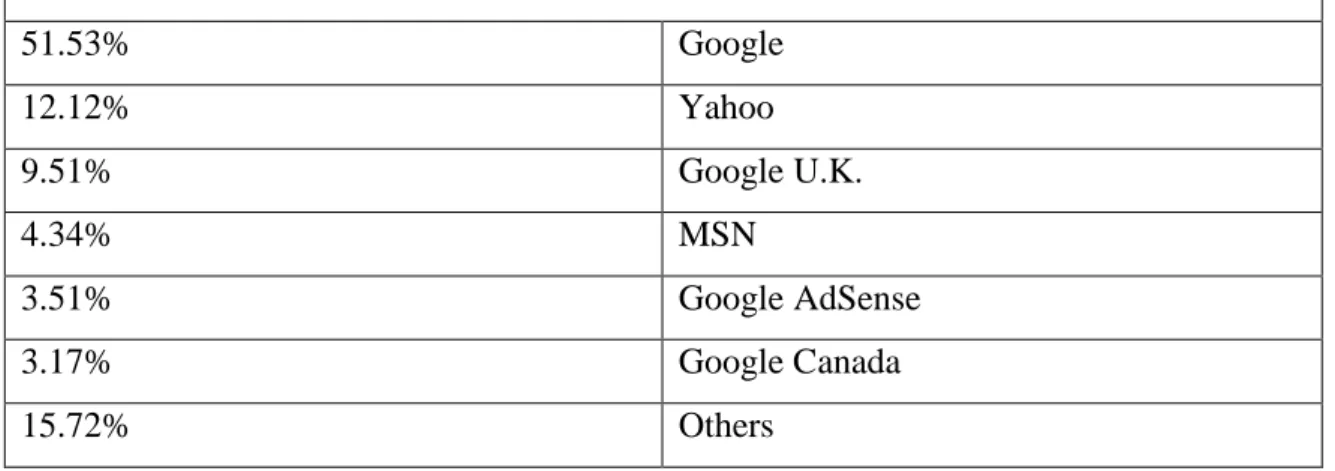
Figure 6 – Search Engine Market %
Search Engine Market Percentage as of July 2007 – marketshare.hitslink.com
51.53% Google
12.12% Yahoo
9.51% Google U.K.
4.34% MSN
3.51% Google AdSense
3.17% Google Canada
15.72% Others
36
8.0 The Value of Blog Sites
What are blogs? Blogs are simply individuals’ thoughts about topics ranging from sports, to birds, to travel, to business and politics. A blog is simply a name for a web log, or in short, “blog”. Blogs have quickly become as important as any major network news department, as an avenue for news. The reliability of the source is purely a function of the readers’ belief in the content provided by the Blog owner, but what is most important is that incorrect facts are quickly challenged, and can be corrected immediately if wrong.
One of the most influential technology blogs is TechCrunch.com (TC) and is owned by its editor, Michael Arrington. Similar to the companies TC reports about, TC was started in 2005, as a part time endeavor, and has since grown to be the fourth most popular blog on the internet according to Technorati, an blog rating service (verified June 30, 2007). Monthly visitation is reported at over 5 million users, which makes TC a very influential player in the world of new technology.
The TC format is to post breaking stories in the technology world, with emphasis on new web based applications, programs and companies. Additionally, TC takes pride in having information of potential sales and mergers of tech companies. One recent blog post announced the sale of YouTube to Google for $1.5 billion, and TC is credited as being the first source for the story, beating the traditional major news organization with the scoop. This is one small example of how small media is changing the face of information distribution. No longer is media in control of only a few mighty companies, which speak to the masses (Newsweek, June 25, 2007).
37
As the importance of TC grows, the role of gatekeeper for new technology may be applicable. Because of the influence of his blog, Arrington can strongly sway the press startup companies will receive. Appearing in TC is a big milestone for start-ups (Newsweek, June 25, 2007, pg26). A mention for an upstart company in TC can lead to discovery by larger media outlets, which can lead to even greater exposure, which, if the news is positive, can influence funding from VC’s. TC must take care not too appear to biased in its support for new companies, and must remain neutral when reporting issues. A recent quote in Newsweek, says “When Arrington writes, Silicon Valley listens”.
In the same Newsweek article, it was reported that TC takes in approximately $100,000 per month in advertising revenue. Based on a simple model of estimated annual revenue of $1.2 million, it can be juxtaposed that with an acceptable five times multiple of revenue, that TC is today worth approximately $6,000,000. And further simple modeling would imply that with 465,000 subscribers (verified July 17, 2007 from TC site), each subscriber is worth approximately $10.75 (TechCrunch, 2007).
Technorati is a search engine for blogs. Using Technorati allows users to sift through the thousands of blogs, and locate only those that are of interest to the reader. Technorati is a major search site for blogs. With the ease of creation and availability of free hosting, the blogosphere is expanding rapidly. Technorati indexes over 75 million blogs (Wikipedia, http://en.wikipedia.org/wiki/Technorati), with approximately 50 million from MySpace alone. Looking at the sheer number of blogs, estimated at 75 million, it is easily understood that to stand out is difficult, which makes the impact and importance of TC extremely influential in a very crowded sea of blogs. Arrington’s TC is rated number four out of 75 million and is extremely important.
38
9.0 Start up VC Valuations
To effectively attempt to place valuation on new technology companies, one must understand the jargon, techniques, methods and business models of the trade. In the preceding sections information was explored to explain the required background knowledge for examinations of values. Following are several techniques and methods used to evaluate technology startups.
Many technology companies are started in Silicon Valley. The city at the center of the action in Silicon Valley is San Jose, California. San Jose is home to many of biggest names in technology, such as Yahoo, Apple, eBay, Hewlett-Packard and Google.
Silicon Valley is also home to many of the worlds leading VC firms, which have been, and will continue to be the lifeblood of new development. Without VC money, many start-ups would never survive (Di Gregorio, D and Shane, S., 2000). The role of the VC is a double edge sword. The VC requires an ownership interest, and usually meaningful managerial input via a seat on the board of directors.
Gompers and Lerner (2000) offer that traditional finance theory implies that a firm is worth the value of it discounted future cash flows. If the investors learn the future risks will be lower, the value should increase. Similarly, if they learn the future profits will be higher, the value should increase. Both risk and future returns are related to the cost of capital. In VC funding rounds, the percentage of equity given up for funding depends on these, as well as other factors.
As discussed by Kaplan and Stromberg (2000) they found that VC firms look intensively at management and marketing team analysis, in contrast to explicit financial forecasts. In their study, they found only 20 of 42 companies included sales and earnings forecast for the new ventures.
39
Because startups often have little or no proven revenue, the leap of faith required for a VC’s investment is huge. But, the returns can be beyond imagination. For example, the founders and VC’s behind successful start up YouTube, invested approximately 20 million and in less than 20 months received a return of 1.65 billion dollars from Google. Estimating their percentage of ownership at 30%, their return was 2475%.
Valuing returns on investments is easily obtained with simple mathematics. What is much more difficult is to analyze and value these young companies as they are being developed in the early stages. When companies go public, information about revenue and profit is disclosed, and traditional financial analysis can be performed.
VC’s provide early capital to young companies, and in exchange they require equity from the founders and management of the company. The early funding is referred to by different names as different levels of investment are funded. The first level may be the “Angel”, followed by the “A, B, C” rounds of capital investiture. To better understand these terms, and the consequences involved for the company owners, definitions of Pre-Money and Post-Money are given.
9.1 Definition –Post Money
Post-money valuation
A post-money valuation is a term used in private equity or venture capital, which refers to the valuation of a company or asset immediately after an investment or financing.
External investors, such as venture capitalists and angel investor, will use a pre-money valuation to determine how much equity to demand in return for their cash injection to an entrepreneur and his/her startup company. The implied post-money valuation is calculated as the dollar amount of investment divided by the equity stake gained in an investment.
40
9.2 Definition –Pre Money
Pre-money valuation
A pre-money valuation is a term used in private equity or venture capital that refers to the valuation of a company or asset prior to an investment or financing.
External investors, such as venture capitalists and angel investors will use a pre-money valuation to determine how much equity to demand in return for their cash injection to an entrepreneur and his or her startup company (Wikipedia, Investorpedia, 2007).
Example
For example, if an investor makes a $100 million investment into a company in return for 20% of the company’s equity, the implied post-money valuation is $500 million. To calculate the pre-money valuation, the amount of the investment is subtracted from the post-money valuation. In this case, the implied pre-money valuation is $400 million.
What is difference between Pre-Money and Post-Money?
They short answer to the question is that they differ in timing of valuation. Both pre-money and post-money are valuation measures of companies. Pre-money refers to a company’s value before it receives outside financing or the latest round of financing, while post-money refers to is value after it gets outside funds or its latest capital injection. If one is talking about pre-money valuation this refers to the value of the company not including external funding or the latest round of funding. Post-money valuation, then, includes outside financing or the latest injection. It is important to know which is being referred to as they critical concepts in valuation.
Example - Say an investor is looking to invest in a hi-tech startup. The entrepreneur and the investor both agree that the company is worth
$1 million and the investor will put in $ 250,000.
The ownership percentages will depend on whether we are talking about a $1 million pre-money or post-pre-money valuation. If the $1 million valuation is pre-pre-money it means that the company is valued at $1 million before the investment and after investment will be valued at $1.25 million. If the $1 million valuation takes into consideration the $250,000 investment, it is referred to as pre-money.
Figure 7
Example of Difference between Pre-Money and Post-Money
Pre-Money Valuation Post-Money Valuation
Value Percent Percent Value
Entrepreneur $ 1,000,000 80 Entrepreneur 75 $ 750,000 Investor $ 250,000 20 Investor 25 $ 250,000