Malaria related knowledge, practices and behaviour of people in Nepal
A.B. Joshi & M.R. Banjara
Institute of Medicine, Tribhuvan University, Kathmandu, Nepal
Abstract
Background & objectives: The information on malaria related knowledge, practices and behaviour of the people of Nepal living in malaria endemic areas are essential to develop behavioural change communication messages and for producing policy to prevent and control malaria in the country. The objective of this study was to assess knowledge, practices and behaviour of the people living in malaria endemic districts and relate with malaria control policy in Nepal.
Methods: The paper utilizes data from a cross-sectional study of 1330 households conducted during December 2004 to April 2005 in rural areas of Jhapa, Kailali and Kanchanpur districts. The method used includes structured questionnaire and focus group discussions.
Results: The results revealed that 40% respondents were illiterates. Eighty-six percent respondents have heard about malaria but only 50% responded fever with chills as the sign and symptom of malaria. Seventy-three percent responded that mosquito bite causes malaria transmission and 74% respondents considered that malaria is the fatal disease but very few have knowledge that the treatment of malaria in time can save life. More than 50% did not have information on availability of free treatment of malaria in Nepal. Still 16% were found consulting traditional healers for the treatment. The outside sleeping habit was found in almost one fourth of the population mainly in summer season indicating no knowledge about prevention of malaria. Although bednet use practice was higher, only 4% had knowledge on insecticide impregnated bednets and 23% of them practicing it. Issues regarding the proper and regular use of bednets, the quality of the bednet and use of free treatment provided by the government, since these districts are reporting high incidence of malaria.
Interpretation & conclusion: Health education must be taken into account for communities in malaria endemic areas to produce desired outcomes in malaria control.
Key words Behaviour – community knowledge – control policy – malaria – practices
Introduction
Malaria caused by four species of Plasmodium is increasingly becoming a serious burden in most tropi-cal countries and a major cause of death in children in sub-Saharan Africa. Approximately 300 million people worldwide are affected by malaria and be-tween 1 and 1.5 million people die every year due to malaria1.
About 70% of Nepal’s population live in areas with unstable malaria transmission. In 2001, out of 23.2 million population of the country, 16.5 million are at malaria risk in Nepal2. Malaria remains uncontrolled
and also leads to large number of deaths, particularly among young children3.
Ignoring community’s attitudes and beliefs regarding malaria has contributed to the inability of control programmes to achieve sustainable control. Under-standing community perceptions of aetiology, symp-tom identification and treatment of malaria is an important step towards the disease control4,5. It needs
for targeting health messages towards poorly edu-cated people in order to empower them with the knowledge and resources to recognize and manage their health problems6.
Health education remains an indispensable compo-nent for the malaria control activities in Nepal. The main objective of the health education activities is to involve community as much as possible in different aspects of malaria control programme. This is done through different methods of health education activi-ties such as personal contact, workshops, and malaria education to the school children. To achieve commu-nity participation, increased health education, distri-bution of malaria-related posters, pamphlets, book-lets, calendars, etc. are adopted in the context of pri-mary health care approach7.
This cross-sectional study was conducted to establish baseline information assessing knowledge, practices and behaviour of the population in regard to malaria in three malaria endemic districts of Nepal. The ulti-mate use of this study would enable to develop effec-tive behavioural change communication (BCC) mes-sages. An intervention will be designed and imple-mented by the Epidemiology and Disease Control Di-vision, Ministry of Health and Population.
Material & Methods
It was a cross-sectional study conducted to assess the knowledge, practices and behaviour related to ma-laria during December 2004 to April 2005. The sample was designed to provide estimates of the
study objectives for the three malaria endemic dis-tricts, Jhapa in the Eastern Development Region, Kailali and Kanchanpur in the Far Western Develop-ment Region of Nepal. Further, the study population was selected from the disease endemic and malaria potential areas of the districts. The primary sampling unit was the Village Development Committee (VDC), a small geopolitical unit in different disease endemic/ epidemic areas of the districts.
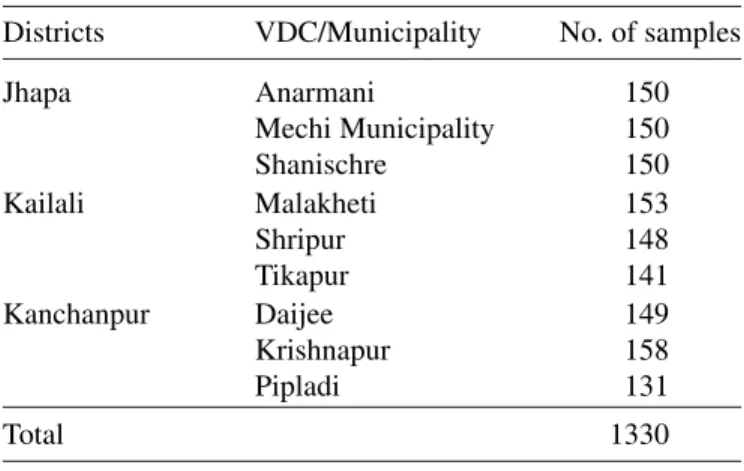
Data regarding malaria status (endemic or epidemic) of the study districts were reviewed using Annual Reports of the Department of Health Services and data were obtained through Health Management In-formation System (HMIS). The malaria endemic VDCs of the study districts, Jhapa, Kailali and Kanchanpur were listed using HMIS reporting data. From each district, three VDCs were randomly se-lected. These VDCs represent different districts with different disease status (Table 1). The classification of the study area was based on the areas of the district where disease had become endemic/epidemic and areas of past epidemic.
After selecting study VDCs, the study households were selected by using sampling interval. The total number of households in that VDC was divided by 450 (the required sample size) and sampling interval was calculated. The households to be interviewed
Table 1. Study Village Development Committees (VDCs) and sample size
Districts VDC/Municipality No. of samples
Jhapa Anarmani 150
Mechi Municipality 150
Shanischre 150
Kailali Malakheti 153
Shripur 148
Tikapur 141
Kanchanpur Daijee 149
Krishnapur 158
Pipladi 131
were then identified in every sampling interval of first randomly selected households.
The questionnaire was prepared to assess the knowl-edge, practices and malaria-related behaviour in dif-ferent selected malaria endemic district. The BCC materials developed by the Department of Health Services and Environment Health Project of United States Agency for International Development (USAID) were also reviewed. The questions were developed in English and translated into Nepali. The study tool consisted of questions regarding demographic char-acteristics of the respondents, availability of commu-nication media, preference of commucommu-nication media, knowledge/information on malaria and mosquito, preventive and control measures of malaria, and availability of free treatment, bednet using practices and the different preventive and control activities conducted by different institutions.
Training of field supervisors and enumerators was done to ensure quality and completeness of data col-lection, manage appropriate data collection in diffi-cult situations and to handle diffidiffi-culties, if any. The training was concentrated on sampling of households, validity and reliability of data, introducing each ques-tion of the quesques-tionnaire for easy of use. Altogether, 1330 questionnaires were filled constituting 450 from Jhapa, 442 from Kailali and 438 from Kanchanpur. Focus group discussions were conducted in each dis-trict in seven to eight groups. These groups consisted of female community health volunteers, health profes-sionals, mothers, pregnant women, school teachers, local clubs, NGOs, drug vendors and local health prac-titioners.
Ethical approval was taken from the Institutional Review Board (IRB) of the Institute of Medicine, Tribhuvan University, Nepal. Verbal ethical consent was taken from the respondent before administering the questionnaire.
Database was prepared using Epi Info Version 6 and
accordingly data entry was done. Data were analyzed using SPSS version 11.5. Chi-square test was used to test for significance among groups. A p-value of 0.05 was used to indicate statistical significance. Sub-group analyses were performed for gender, age, level of education and previous infection with malaria.
Results
Among total 1330 respondents constituting 450 from Jhapa, 442 from Kailali, 438 from Kanchanpur, 64.5% were males and 35.5% were females. The mean age of the respondents was 36.8 ± 14.4 yr. The education level of the respondents showed that about 40% were illiterate. Others were literate (25.5%), 5–10 class (16.8%), 10 to 12 (16.3%) and graduate and above (1.7%).
The average family size was 7 ± 4 ranging from 1 to 30. Majority of respondents had agriculture occupa-tion (58.8%), followed by business (8.2%), house-wife (9.4%), students (9.6%), carpenter/driver/tailor/ labour (7.7%), teachers (3.5%) and other services (2.7%). In those households, 98 (7.4%) suffered from malaria in the past.
Among all of the respondents, 86.1% had heard about malaria. The respondents who have heard reported that radio (58.1%) and television (25.4%) are the media sources for malaria messages. Other reported health workers (21.7%), relatives/friends (13.5%), malaria patients (10.2%) and posters/pamphlets/news-papers (9.1%) as the source of malaria messages.
dirty environment and staying with malaria patient as the cause of malaria transmission. Majority of the respondents (73.7%) , replied that malaria is transmit-ted by the mosquitoes. Similarly, 41.9 and 9.6% re-plied that encephalitis and filariasis respectively are also the diseases transmitted by the mosquitoes.
Regarding the breeding places of mosquitoes, 59.8% responded stagnant water. Rotten things and animal shed are considered as breeding places of mosquitoes by 20.9 and 20.6% respectively. Among total, 54.4 and 41.1% of the respondents considered dark corner of the house and bushes respectively are the living places of mosquitoes during the daytime (Table 2).
Regarding the knowledge on fatality of malaria, 73.9% considered malaria as the fatal disease. Sixteen percent respondents replied that treatment of malaria
Table 2. Knowledge and perceptions about malaria, mosquitoes
Particulars Frequency Percent
Knowledge on signs and symptoms of malaria (n = 1330)
Continuous fever 625 46.9
Fever with chills 670 50.4
Others 69 5.2
Don’t know 280 21.1
Perceptions of the causes of malaria transmission as reported by the respondents (n = 1330)
Mosquito bite 966 72.6
Dirty environment 230 17.3
Staying with malaria patient 35 2.6
Don’t know 263 19.8
Knowledge on breeding places of mosquito (n = 1328)
Animal shed 274 20.6
Stagnant water 794 59.8
Rotten things 278 20.9
Others 9 0.7
Don’t know 271 20.4
Living place of mosquito during the daytime (n = 1330)
Dark corner of the house 725 54.5
Bushes 548 41.2
Paddy-fields 57 4.3
Others 18 1.3
Don’t know 206 15.5
in time can save life. Among the total, 90.1% respon-dents replied that people could protect from malaria. Regarding the method to protect from malaria, 41.9% replied to take precaution to prevent mosquito bite. Similarly, 41.3, 25.8 and 17.8% respondents replied to take prophylactic medicine, personal hygiene and spraying respectively. Regarding the knowledge on measures to limit the mosquito population, 73.2% respondents have knowledge on measures to limit the mosquito population. However, 66.7, 48.1 and 32.1% responded removal of the water collected in ditches, spraying insecticides and cutting of bushes respec-tively to limit the mosquitoes population. Very few responded fish farming as a method of limiting mos-quito population. Information on knowledge about protection from mosquito bite was collected. Among total, 92% responded the use of bednet protects from mosquito bite. Similarly, the responses on cleaning environment, insecticide spraying, making smoke and using mosquito coil were 22.9, 18.9, 11.7 and 7.4%, respectively (Table 3).
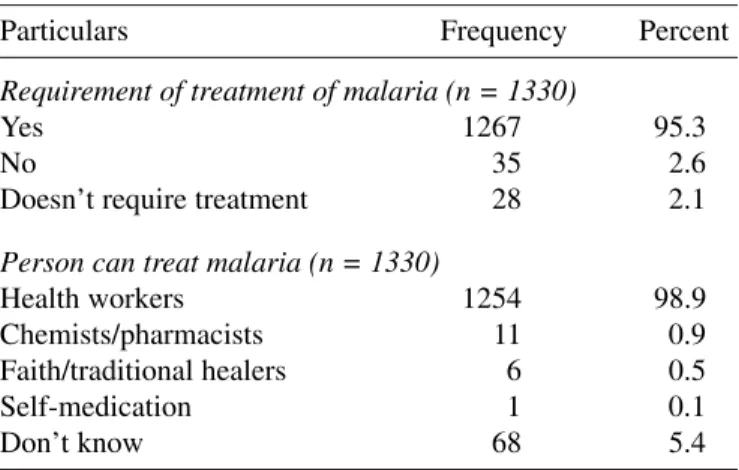
Among all respondents, 95.3% responded that ma-laria could be treated. Among them, 98.9% responded that health worker can treat malaria. Very few respon-dents (0.5%) have faith on traditional healer and 5.4% respondents still do not know the person who can treat malaria. Free treatment of malaria is available in Nepal. However, 50.7% of the respondents didn’t have information on free treatment (Table 4).
Information regarding the sleeping habit of house-hold members in the animal shed, in the open areas outside the house, 9.5% respondents replied that their household members sleep inside the animal shed. But the sleeping habit of the household members outside the house in the open is quite high (23%).
Since most of the households are using bednets, they also know the reason of using it. Among total, 95.2% responded that bednet use is to prevent mosquito/ insect bite and 11.2% responded to prevent from malaria. The knowledge of insecticide impregnated bednet was low (3.6%). Among them, use of impreg-nated bednet was also found low (22.9%). The re-spondents who don’t have bednet in the house were further asked for reasons of not having the bednet in the house. Majority of them responded that they can-not afford it. Other responses were bednet was can-not available locally (6.1%) and they do not like it (4.5%).
The respondents were asked whether the insecticide spray was done in their houses within last twelve months. Most of them (86.8%) responded that they do not allow their houses to be sprayed. Among those who got their houses sprayed within last twelve months, 58% responded that they plastered or painted the house walls after spraying. They responded that 12.6% plastered/painted immediately after spray. Similarly, 39.1 and 20.7% plastered /painted within one month and two months of spray respectively. But 14.9 and 12.6% responded that they plastered/painted the walls within and after three months respectively. The reasons for plastering or painting the house walls within three months after spraying were bad smell (28.9%), festivals (57.9%), and regular activities of painting/plastering (14.5%) (Table 5).
Discussion
This study was conducted to provide baseline infor-mation about malaria related knowledge, practices
Table 3. Knowledge and information regarding preventive measures
Particulars Frequency Percent
Knowledge on methods to protect from malaria (multiple response) (n = 1198)
Taking precaution to prevent 502 41.9 mosquito bite
Killing mosquitoes e.g. spraying 213 17.8 Taking prophylactic medicine 495 41.3 Keeping personal hygiene 309 25.8
Others 2 0.2
Don’t know 18 1.5
Measures of limiting the mosquito population (multiple response)
Know the measures 973 73.2
Removal of the water collected 649 66.7 in ditches
Spraying insecticides 468 48.1
Cutting bushes 312 32.1
Fish farming 23 2.4
Others 8 0.8
Protection from mosquito bite (multiple response) (n = 1330)
Using a bednet 1224 92.0
Cleaning environment 304 22.9
Insecticide spraying 252 18.9
Plastering the wall/floor 36 2.7
Keeping away domestic 56 4.2
animals/pets
Making smoke 155 11.7
Using mosquito coil 99 7.4
Others 4 0.3
Don’t know 38 2.9
Particulars Frequency Percent
Requirement of treatment of malaria (n = 1330)
Yes 1267 95.3
No 35 2.6
Doesn’t require treatment 28 2.1
Person can treat malaria (n = 1330)
Health workers 1254 98.9
Chemists/pharmacists 11 0.9
Faith/traditional healers 6 0.5
Self-medication 1 0.1
Don’t know 68 5.4
Table 5. Households adopting preventive measures
Particulars Frequency Percent
n = 1330
Households having bednets 1198 90.1 Information on insecticides 48 3.6
impregnated bednet
Household using ITNs 11 0.8
Households spraying insecticides 150 11.3 within last twelve months
and behaviour to be used in the development of munity health education messages to increase com-munity participation in the prevention and control of malaria. The development of behavioural change communication messages is to emphasize the need of bednet use, early diagnosis and prompt treatment for effective control of malaria. Health education needs to be context sensitive, i.e. mindful of the ways in which knowledge will ultimately be transformed into action8. Health education was the main reason for an
increase in knowledge about the vector and the use of bednets in Ecuador and Peru; which ultimately led to a decrease in malaria9.
The study results show that majority of the respon-dents were illiterate. Illiteracy had a profound influ-ence on their perception of cause and treatment-seeking behaviour for malaria10. Most of the
respon-dents have heard about the disease malaria through radio and television. The recognition of signs and symptoms of malaria was low in our study; however, this response was reported more than 80% in an African study11. Majority respondents considered that
malaria is the fatal disease but very few had knowl-edge that the treatment of malaria in time can save life.
Almost 73% respondents replied that mosquito bite is the cause of malaria transmission which was lower as compared to more than 92% of Mpumalanga and Guyana studies4,11. Response on dirty water as a cause
of malaria transmission is still significant similar to other studies12. As compared to knowledge on
dis-eases transmitted by the mosquitoes, the knowledge on breeding places of mosquitoes, living places of mosquitoes during the daytime is lower. To educate entire population, effective messages with relation to breeding places of mosquitoes and their role in dis-ease transmission should be delivered.
Regarding the treatment of past malaria cases in the household, most of them consulted with the health facilities. But 16.3% did not consult anywhere and
16.1% consulted with the traditional healers. Absence of health workers in the health facilities, lack of time to go to the health facilities and lack of knowledge where to go were the reasons of not consulting the health facilities for the treatment during fever with chills. Similar study reported inaccessibility of health care, waiting until the disease worsened, and a belief that febrile disease resolves spontaneously as the reasons for not seeking modern treatment in time13.
Among the total, 50.7% did not have knowledge on availability of free treatment of malaria in Nepal. Necessity of full course of treatment and availability of free treatment of malaria need to be informed.
The sleeping habit inside the animal shed, and the outside sleeping habits were found and these were mainly in summer season. In Nepal, the epidemic peak of vector borne diseases is higher during sum-mer season starting from April/May and diminishes in October/November. Therefore, seasonality of ma-laria and its relation with mosquito bite need to be in-formed. The bednet use practice was higher (90.1%) but the information and practice of using insecticide impregnated bednet was quite low. Majority of re-spondents who were not using bednet replied that they could not afford it. Since the bednet use was found higher in these areas, they are reporting higher number of malaria cases. It raises a question regard-ing the proper and regular use of bednet and quality of the bednet.
It was found that most of the households did not use spraying. Therefore, recommending spray of house-holds should be considered. The regular plastering and painting practices need to be considered even if the spraying is done.
Health education in the community may be a more effective way to disseminate health information14,15.
Corresponding author: Dr Anand B. Joshi, Institute of Medicine, Tribhuvan University, Kathmandu, Nepal. E-mail: [email protected]
Received: 14 December 2007 Accepted in revised form: 23 January 2008
Acknowledgement
This study was funded by Global Fund for Malaria, Department of Health Services, Ministry of Health and Population, Nepal. It was conducted by the Insti-tute of Medicine in collaboration with Global Fund, Epidemiology and Disease Control Division, Depart-ment of Health Services, Ministry of Health and Population.
References
1. Winstanley P, Ward S, Snow R, Breckenridge A. Therapy of falciparum malaria in sub-Saharan Africa: from mol-ecule to policy. Clin Microbiol Rev 2004; 17(3): 612–37.
2. Annual Report. Kathmandu, Nepal: Department of Health Services, Ministry of Health 2002/2003.
3. Wongsrichanalai C, Pickard AL, Wernsdorfer WH, Meshnick SR. Epidemiology of drug-resistant malaria.
Lancet Infect Dis 2002; 2: 209–18.
4. Govere J, Durrheim D, Grange KI, Mabuza A, Booman M. Community knowledge and perceptions about malaria and practices influencing malaria control in Mpumalanga prov-ince, South Africa. S Afr Med J 2000; 90: 611–6.
5. Simsek Z, Kurcer MA. Malaria: knowledge and behaviour in an epidemic rural area of Turkey. Public Health 2005;
119: 202–8.
6. Ibidapo CA. Perceptions of causes of malaria and treatment seeking behaviour of nursing mothers in a rural community.
Aust J Rural Health 2005; 13: 214–8.
7. Bista MB, Banarjee MK, Vaidya RG, Thakur GD. The
annual internal assessment of malaria and kala-azar control activities, 2003. Kathmandu, Nepal: Epidemiology and Disease Control Division, Department of Health Services, Ministry of Health 2005.
8. Montgomery CM, Mwengee W, Kong’ong’o M, Pool R. To help them is to educate them: power and pedagogy in the prevention and treatment of malaria in Tanzania. Trop Med Int Hlth 2006; 11(11): 1661–9.
9. Nieto T, Mendez F, Carrasquilla G. Knowledge, beliefs and practices relevant for malaria control in an endemic urban area of the Colombian Pacific. Soc Sci Med 1999; 49:
601–9.
10. Barish G, Maude GH, Bockarie MJ, Eggele TA, Green-wood BM, Ceesay S. Malaria in a rural area of Sierra Leone: initial results. Ann Trop Med Parasitol 1993; 87:
125–36.
11. Booth CM, MacLean JD. Knowledge, treatment-seeking, and socioeconomic impact of malaria on the Essequibo Coast of Guyana. McGill J Med 2001; 6: 17–25.
12. Tsuyuoka R, Wagatsuma Y, Makunike B. The knowledge and practice on malaria among community members in Zimbabwe. Cent Afr J Med 2001; 47: 14–7.
13. Nyamongo IK. Health care switching behaviour of malaria patients in a Kenyan rural community. Soc Sci Med 2002;
54: 377–86.
14. Lewin SA, Dick J, Pond P, Zwarenestin M, Aja G, vanWyk B, et al.Lay health workers in primary and community health care (review). Cochrane Database Syst Rev 2005;
25(1): CD004015.