Amplitude ratios and the approach to bulk criticality in parallel plate geometries
M. M. Leite
Instituto de Fı´sica Teo´rica, Universidade Estadual Paulista, 01405-900 Sa˜o Paulo, SP, Brazil
M. Sardelich and M. D. Coutinho-Filho
Laborato´rio de Fı´sica Teo´rica e Computacional, Departamento de Fı´sica, Universidade Federal de Pernambuco, 50670-901 Recife, PE, Brazil
~Received 2 September 1998!
We present analytical and numerical results for the specific heat and susceptibility amplitude ratios in parallel plate geometries. The results are derived using field-theoretic techniques suitable to describe the system in the bulk limit, i.e., (L/j6)@1, where L is the distance between the plates andj6is the correlation length above~1!and below (2) the bulk critical temperature. Advantages and drawbacks of our method are discussed in the light of other approaches previously reported in the literature.@S1063-651X~99!04703-0#
PACS number~s!: 64.10.1h, 64.60.Fr, 64.60.Ak
I. INTRODUCTION
Since the advent of modern scaling concepts and renormalization-group techniques the study of finite-size and surface effects on the behavior of systems near or at critical-ity has attracted the attention of a number of investigators @1#.
Fixing our interest in the case of a system confined be-tween two infinite (d21)-dimensional parallel plates distant L from each other, we may classify three well defined dis-tinct regimes in this problem. The first one, where the scaling variable (L/j6)@1, is characterized by the dominance of bulk over surface and finite-size effects and the physics is quasi-d-dimensional. Here, j6 specifies the critical correla-tion length above~1!and below (2) the bulk critical tem-perature Tc. The second regime, where (L/j6)!1, the
sys-tem behaves as a quasi-(d21)-dimensional object. Finally, for (L/j6);1, the physics interpolates between a quasi-d-and a quasi-(d21)-dimensional system. A full description of the system should therefore unveil very interesting cross-over behaviors.
According to the region and phenomenon of interest, dif-ferent field-theoretic techniques have been devised to deal with such systems. Indeed, Diehl and Dietrich@2,3# success-fully implemented these techniques to study critical and mul-ticritical phenomena near surfaces within a finite momentum cutoff regularization scheme. The use of dimensional regu-larization was shown@4,5#to simplify the computational pro-cedure and allowed the study of ordinary @2# and special transitions @3# through standard f4-field theories under Di-richlet and Neumann boundary conditions ~DBC’s and NB-BC’s!, respectively. The former mimics very strong repul-sive forces at the surface, thus preventing order at it ~a parameter c, which measures these forces@2#, has fixed point value c*5`), whereas under the later boundary condition both the surface and the bulk go critical simultaneously. The special transition is in fact a multicritical point @3#, c*50, where the two lines describing systems with repulsive (c
.0) and attractive forces (c,0) at the surface meet. In the later case, namely, the extraordinary transition@5,6#, the sur-face undergoes a second-order transition before criticality
sets in the bulk. Moreover, it has been shown @7# that a scaling description holds so that the critical exponents asso-ciated with excess surface singularities may be expressed completely in terms of bulk exponents. However, it has also been shown @7#that fluctuations may induce divergences at the surface and in these cases local quantities and associated exponents must be defined resulting in new scaling relations. Therefore, in treating these quantities at the multicritical point, Neumann boundary conditions are valid only at the mean-field level @7#.
On the other hand, in order to properly describe finite-size effects using field-theoretic techniques in critical systems subject, for example, to periodic boundary conditions
~PBC’s!, Brezin and Zinn-Justin @8# and, independently,
Rudnick, Guo, and Jasnow @9#, introduced a method in which the zero-momentum component is isolated whereas the other nonzero modes are treated perturbatively. This method has been largely used @10–12# and generalized to study different boundary conditions. More recently @13#, some difficulties regarding the treatment of critical systems below Tcusing this technique have been circumvented.
Both finite-size and surface effects are simultaneously present, except in special circumstances such as for PBC’s, the surface effects of which vanish. At T5Tc, where
Ca-simir forces are manifest, these contributions compete in a very special way, and powerful tools and methods such as conformal invariance @14#and elaborated perturbation tech-niques @15# have been used to study this regime and the approach to Tc @12–15#.
In this work we shall calculate specific heat and suscepti-bility amplitude ratios using field-theoretic andP-expansion methods@16#particularly suitable to describe systems in the first regime mentioned above in which bulk behavior domi-nates over surface and finite-size contributions. The reported results complement previous studies @16# and shed some light on the approach to bulk criticality as the distance L between the plates increases.
For a system of volume V5AL, where A is a (d21)-dimensional surface~layered geometry!, the follow-ing asymptotic scalfollow-ing form for the sfollow-ingular part of the free-energy density holds @17#:
PRE 59
f~utu,L!; 1 ALY~Lutu
n/a!
5ybutudn1ys
utu~d21!n
L
1df~Lutun/a!, ~1!
where t5(T2Tc)/Tc, n is the bulk correlation length
ex-ponent and a is the only nonuniversal metric factor. Using the hyperscaling relation dn522a, one identifies the first term~proportional to yb) as the bulk contribution, the second
one ~proportional to ys) as the excess surface term and the
last one as a finite-size correction term. In the limit (j6/L)
!1 one expects exponentially small corrections from df , whereas for (j6/L)@1 it compensates the bulk and surface contributions and gives rise to the Casimir effect@13–15#at T5Tc.
From the above scaling assumptions the specific heat and susceptibility should behave as
C~t,L!;utu2aA 6~Lutu
n/a!, ~2!
x~t,L!;utu2gC
6~Lutun/a!, ~3!
where a andg are the bulk critical exponents, but even in the regime Lutun
@1 one expects that excess surface and finite-size contributions modify their critical amplitudes in a non-trivial manner. In fact, the ratio of these amplitudes are quite sensitive in identifying the universality class of a criti-cal system, particularly in numericriti-cal simulations@18#where one has to control both corrections to scaling and surface and finite-size effects.
In Sec. II we explain our method and derive both the renormalized free energy and the equation of state from which the above quantities can be calculated. Finally, in Sec. III a discussion of the results and conclusions are presented.
II. SPECIFIC HEAT AND SUSCEPTIBILITY CRITICAL AMPLITUDES
In this section we shall use field-theoretic and renormalization-group techniques to calculate the amplitude ratios of C andx in layered geometries. We shall keep close contact with standard bulk f4-field theory @19# and when-ever necessary to deal with the finite size of the system we employ methods @16# which are particularly suitable in the regime (L/j6)@1.
A. Renormalized free energy and boundary conditions
We start by writing the expression for the one-loop renor-malized Helmholtz free-energy density at the fixed point as-sociated with the bulk critical behavior of the system:
F~t, M ;L!512t M 2
14!1 u*M4114~t 2
1u*t M2114u* 2
M4!Is p
12L1
(
j
E
dd21q ln@1
1~1/2!
3u*M2/~q21kj
2
1t!#. ~4!
In the equation above t, M (t05Zf2t, M05Zf1/2M ) are the
renormalized ~bare! reduced temperature and order
param-eter, respectively,Zf2,Zf are renormalization functions, u* is the dimensionless renormalized coupling constant of a continuous ~bulk! f4 theory at the fixed point, qW is a (d
21)-dimensional wave vector along the direction parallel to the plate,kj5pj/L are the eigenvalues of the kinetic energy operator satisfying proper boundary conditions ~see below! and Is p5P21@1
1(P/2)#1O(P) is the one-loop integral of a bulkf4 theory evaluated at the symmetry point using di-mensional regularization, where P542d. Notice that tak-ing the lim L→`in Eq.~4!one obtains the standard
expres-sion for the d-dimenexpres-sional f4 one-loop renormalized free energy.
In deriving F(t, M ;L) we have considered that the local field of a f4 theory may satisfy periodic, Neumann, or Di-richlet boundary conditions, defined by f(rW,z)5f(rW,z
1L), (]/]zuz50)f(rW,z)5(]/]zuz5L)f(rW,z)50, and
f(rW,z50)5f(rW,z5L)50, respectively, where rW is a (d
21)-dimensional position vector perpendicular to the z(dth) direction. It then follows that the sum in Eq.~4!has values j50, 61, 62, . . . , for PBC’s, j50,1,2, . . . , for NBC’s, and j51,2, . . . , for DBC’s, respectively. The local field is Fourier transformed in the form @16#
f~rW,z!5
(
j~2p!12d
E
dd21q exp~iqW•rW!fj~qW!uj~z!,
~5!
wherefj(qW) are plane waves parallel to the plate and uj(z)
are eigenfunctions of the kinetic energy operator (2d2/dz2) with eigenvalues k2j
. The bare order parameter M0is thus the expectation value of the local field above. We call attention that the usual counterterms of a bulkf4theory are used to renormalize the free energy and that the boundary conditions are implemented on the bare vertex functions. De-tails of the Feynman rules involving propagators and vertices can be found in Ref.@16#.
B. Specific heat amplitude ratio
Since the vertex functionG(0,2)is additively renormalized, the critical behavior ~singular part! of the specific heat is calculated using the expression @19#
C5Autu2a
52anB~u*!2GR~0,2!, ~6!
where B(u*) is the inhomogeneous term of the renormalization-group equation forGR
(0,2) and
GR~0,2!5] 2
]t2F~t, M ;L!. ~7!
For T.Tc, M50, and we find, using Eqs.~4!and~7!,
GR~
0,2!~T
.Tc!52
1
2L
(
jE
dd21q
~q21kj
2
1t!21 1
2Is p, ~8!
whereas for T,Tcwe use the value of M at the coexistence
GR~0,2!
~T,Tc!52
3
u*2 2
L
(
jE
dd21q
~q21kj
2
12utu!212Is p. ~9!
The one-loop integrals are evaluated using dimensional regularization and some useful formulas@16,20#to sum infi-nite series. We thus obtain for the boundary conditions of interest:
1
L
(
jE
dd21q
~q21kj
2
1t˜!2
5t˜2P/21 P
S
12P 2
D
12p21/2
S
2p LD
d24 G~d/2!
3G@~52d!/2!]sin@p~52d!/2#f~52d!/2
F
L t˜~52d!/2
2sp
G
1tp
1/2
2 G~d/2!G@~52d!/2#@t˜
~d25!/2
/L#, ~10!
where Sd/(2p)d[1, Sd being the area of the
d-dimensional unity sphere, t˜5t1(1/2)u*M25t( t˜52utu) for T.Tc (T,Tc), s51 for PBC’s, s50 for both NBC’s and DBC’s, t50,11,21 for PBC’s, NBC’s, and DBC’s, respectively, and
fa~a!5
E
a`~u22a2!2adu
exp~2pu!21 , a,1. ~11!
The above representation is particularly suitable in the bulk limit, L/j6@1, but difficulties arise as a→0 (L/j6!1) in
Eq.~11!, as will be later numerically evidenced. A represen-tation allowing access to both regimes, but not without some problems for T,Tc, was formulated by Krech and Dietrich
@15#and used to study films at bulk criticality.
Now using theP expansion@19#for the nonsingular part
of the specific heat, 2(n/a)B(u*)5(32P)1(295/108)
1O(P), we find the amplitudes above and below Tc:
A15 3 P2
F
11P47
541P 222s
3 f1/2
S
Lt1/22sp
D
1P t3
p
Lt1/2
G
1O~P2!, ~12!
A25 6
P2a
F
12P 7541P 222s
3 f1/2
S
A
2Lutu1/2 2spD
1P tp
3
A
2Lutu1/2G
1O~P2!, ~13!
wherea5P/61O(P2).
From the above equations we finally obtain the specific heat amplitude ratio:
A1 A25
2a
4 @11Pf~x!1PSA~x!#1O~P
2!, ~14!
where f (x) and SA(x) are given by
f~x!52
22s
3 @f1/2~x/2
sp
!2f1/2~
A
2x/2sp!#, ~15!SA~x!5t p
3x
S
12 1A
2D
, ~16!and x5L/j, with j5utu21/2. For x→`, we can use the asymptotic limit @16,20# for f1/2(a) in Eq. ~11! and write f (x) in the more simplified form
f~x!52
12s
~2p!1/2
3
F
exp~2212sx
!
~212sx!1/2
2exp~2
A
2212sx!
~
A
2212sx!1/2G
, x→`. ~17!C. Susceptibility amplitude ratio
Using Eq.~1!we obtain the following renormalized equa-tion of state:
HR5]F
]M5t M1 1 6u*M
3
112u*M~t1 1 2u*M
2 !
3
F
Is p2(
j1 L
E
dd21q
~q21kj
2!~q2
1kj
2
1t112u*M 2!
G
.~18!
The one-loop integral is calculated similarly as for the specific heat:
1
L
(
jE
dd21q
~q2
1kj
2 !~q2
1kj
2
1t˜!
512G@22~P/2!#G~P/2!
E
01
dx~t˜x!2P/2
12p21/2
S
2sp
L
D
d24 G~d/2!
3G@~52d!/2#sin@p~52d!/2#
E
01
dx f~52d!/2
3
F
L~t˜x! ~52d!/22sp
G
1t p1/22 G~d/2!G@~52d!/2#
3
E
0 1
dx@~t˜x!~d25!/2
/L#. ~19!
By noticing that the first term in the right-hand side of Eq. ~19! may be written as @P21
HR5t M11 6u*M
3
114u*M t˜
H
~11lnt˜!22
E
01 d y f1/2
F
L~y t˜!1/2
2sp
G
1t pt˜21/2L
J
, ~20!where u*5(2/3)P1O(P2) and t˜
5t1(1/2)u*M2. The susceptibility amplitudes are then readily calculated from
x21
5~Cutu2g!21
5GR~2,0!
5]]HMR. ~21!
As before, for T.Tc, M50, and for T,Tc we use
u*M2526t. The amplitudes above and below Tcthus read
C1512P 6 1
P 3
E
01 d y f1/2
S
xy1/2
2sp
D
1P tp6x1O~P 2!,
~22!
C251 2
H
12P
6 ~41ln 2!1 P
3
E
0 1d y f1/2
F
x~2y!1/2
2sp
G
1P tp
6
A
2xJ
1O~P2!, ~23!
where x5L/j.
Using Eq. ~11! and performing the integrations in y, we find the susceptibility amplitude ratio:
C1
C252
g21g
b1Ph~x!1PSC~x!1O~P
2
!, ~24!
where g511(P/6)1O(P2), b
51/22(P/6)1O(P2) and
h~x!52
s11p
3x
F
~12
A
2! 24 2E
a`
du g~a/u!
1
A
2E
b `
du g~b/a!
G
, ~25!SC~x!5t
p
3x
S
12 1A
2D
, ~26!with a5
A
2x/2sp, b5x/2sp, andg~c/u!5u cos@arcsin~c/u!#
exp~2pu!21 . ~27!
III. DISCUSSION AND CONCLUSIONS
First, we should point out that the main step in our ap-proach is the representation@16,20#used to evaluate the dis-crete sums in Eqs.~10!and~19!. It has proved very useful in different field-theoretic contexts@20#and here it clearly helps to split the bulk, surface and finite size contributions, as re-quired by scaling@see Eqs.~1!–~3!#, in a rather simple way,
though its range of effectivenes precludes direct access to the Casimir effect.
Second, our starting renormalized free energy, Eq. ~4!, does not consider any distortion of the order parameter pro-file, i.e., our description is restricted to calculating the effect of the boundary conditions on bulk quantities as a result of fluctuations, i.e., in the amplitude ratios, Eqs. ~14!and~24!, excess surface and finite size contributions are of O(P). Nevertheless, we observe that if the excess surface contribu-tions for NBC’s in Eqs. ~12! and~13! are isolated, we find (A1/A2)s5223/2
1O(P), which is the same result derived in Ref.@5#for the special transition~the excess surface spe-cific heat exponent is aS5a1n). This is so because in this particular case there is no distortion of the order parameter at the mean-field level. Notice also that, above Tc, (A1)s p/(A1)ord5211O(P
2), where (A
1)s p,ord
re-fer to the specific heat amplitudes at the special~NBC’s!and ordinary~DBC’s!transitions, a result already derived in Ref. @4#. As for the excess surface contributions for the suscepti FIG. 1. Amplitude of the excess surface contribution ~solid line!, from Eqs. ~16! and ~26!, and scaling functions fp ~dashed line! and fN,D ~dotted line! for periodic, Neumann, and Dirichlet boundary conditions, respectively, numerically evaluated using Eqs. ~15!and~11!in d53, as functions of x5L/j.
bility amplitudes we also notice that the last term in Eq.~22! is consistent with the result found in Ref.@7#for the special transition above Tc(gS5g1n), since again no distortion
of the order parameter is necessary in this case. Below Tc, however, the order parameter profile differs from
the bulk value as one approaches the surface of the plate, and therefore no comparasion can be made since our method excludes this feature as a starting point.
From the discussion above and the derived results in Sec. II, particularly Eqs. ~14!–~17! and ~24!–~27!, it is clear that in the regime L/j6@1, and to first order in an P expansion, the specific heat and susceptibility display singularities well described by bulk exponents, but with amplitudes sensitive to the boundary conditions, which manifest as excess surface and finite-size contributions. Notice also that these fluctuation effects result quite effectively from the difference between the amplitudes of the correlation length above and below Tc, which satisfy
(j0,1/j0,2)5
A
21O(P).In Figs. 1, 2, and 3 we plot the scaling functions f (x) and h(x), numerically evaluated in d53, as defined by
Eqs. ~11!,~15!,~25!–~27!. They both decay very rapidly to
zero as x5Lt1/2increases, in agreement with the asymptotic result @16,20# for f1/2(x), x→`. In fact, for PBC’s and x57 we find fp(x).2.731024 either by using the
numerical estimate or the asymptotic result predicted by
Eq. ~17!. For this value of x it is indeed expected @18#
that these corrections to the bulk limit are indeed negligible. Notice also that for DBC’s and NBC’s the magnitude of the scaling functions are the same in our one-loop approximation, in agreement with Ref. @15#, although a two-loop calculation shows @15# that they differ slightly if the same regime of validity applies. However, as x→0
our approach does not correctly describe the Casimir effect, as shown in Figs. 1 and 2: f (x) diverges and h(x) approaches zero, whereas in a correct treatment @13–15# both tend to a constant value, the Casimir amplitudes for each case. This failure for x,1 has already been pointed out by Nemirovsky and Freed @16#. Here, our results
deal with this issue in a more quantitative way, thus evidencing the advantages, limitations and drawbacks of the method.
For comparison, we also plot in Fig. 1 the excess surface contribution for the cases of both NBC’s and DBC’s, i.e.,
uSA(x)u5uSC(x)u[S(x). As clearly seen from Figs. 1 and 2,
as x→` these contributions are the leading ones @11,15# modifying the amplitudes of both the bulk specific heat and susceptibility. Notice that they have the same magnitude and decay as x21 @this is fortuitously true only because these effects are treated as fluctuation contributions to the bulk limit, see Eqs. ~16!,~26!#.
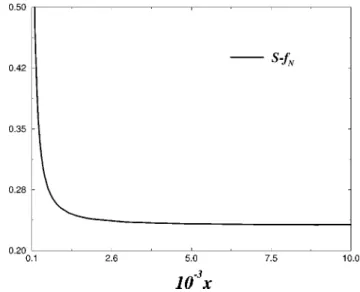
Finally, in Fig. 4 we plot the difference between the ex-cess surface contribution and the scaling function for NBC’s. We see that this difference ‘‘almost’’ saturates as x→0, as expected in the Casimir effect, but lastly it diverges for very small values of x ~an x21 dependence is in fact expected from Eq. ~11! as x→0, but an extra ln x contribution pre-cludes a good description of the Casimir effect!.
In summary, we have presented a field-theoretic descrip-tion of the approach to bulk criticality in parallel plate ge-ometries, in which excess surface and finite-size contribu-tions appear as a result of fluctuacontribu-tions and are controlled by the boundary condition imposed on the system. Despite the fact that other more general methods to deal with finite sys-tems do exist, our approach is probably the simplest one and a fair description, at least to O(P), in the regime L/j6
@1.
ACKNOWLEDGMENTS
We thank A. M. Nemirovsky for collaboration in an early stage of this work and several fruitful discussions. M. M. L. acknowledges FAPESP ~State of Sa˜o Paulo Foundation! for financial support under Grant No. 96/ 03546-7. M.D.C.-F. and M.S. acknowledge FINEP, CNPQ, CAPES, and FACEPE ~Brazilian agencies! for financial support.
FIG. 3. Scaling functions hp~dashed line!and hN,D~dotted line! for periodic, Neumann, and Dirichlet boundary conditions, respec-tively, numerically evaluated using Eqs. ~25!and ~27! in d53, as functions of x5L/j.
@1#See, e.g., M.E. Fisher, in Critical Phenomena, edited by M. S. Green~Academic, London, 1971!, p. 1; V. Privman, in Finite Size Scaling and Numerical Simulation of Statistical Systems, edited by V. Privman~World Scientific, Singapore, 1990!, p. 1; M. N. Barber, in Phase Transitions and Critical Phenom-ena, edited by C. Domb and J. L. Lebowitz~Academic, New York, 1983!, Vol. VIII, p. 145; H. W. Diehl, in Phase Transi-tions and Critical Phenomena, edited by C. Domb and J. L. Lebowitz ~Academic, New York, 1986!, Vol. X, p. 75; S. Dietrich, in Phase Transitions and Critical Phenomena, edited by C. Domb and J. L. Lebowitz~Academic, New York, 1988!, Vol. XII, p. 1.
@2#H. W. Diehl and S. Dietrich, Z. Phys. B 42, 65~1981!; 43, 281~E! ~1981!; Phys. Lett. A 80, 408~1980!.
@3#H. W. Diehl and S. Dietrich, Z. Phys. B 50, 117~1983!. @4#Y. Y. Goldschmidt and D. Jasnow, Phys. Rev. B 29, 3990
~1984!.
@5#E. Eisenriegler, J. Chem. Phys. 81, 4666~1984!; E. Eisenrie-gler and P. J. Upton, ibid. 98, 3582~E! ~1993!.
@6#P. Upton, Phys. Rev. B 45, 8100 ~1992!; E. Eisenriegler and M. Stapper, ibid. 50, 10 009~1994!.
@7#H. W. Diehl, G. Gompper, and W. Speth, Phys. Rev. B 31, 5841~1985!; H. W. Diehl and M. Shpot, Phys. Rev. Lett. 73, 3431~1994!. See also H. W. Diehl, in Phase Transitions and Critical Phenomena~Ref.@1# !.
@8#E. Bre´zin and J. Zinn-Justin, Nucl. Phys. B 257, 867~1985!. @9#J. Rudnick, H. Guo, and D. Jasnow, J. Stat. Phys. 41, 353
~1985!.
@10#E. Eisenriegler and R. Tomaschitz, Phys. Rev. B 35, 4876 ~1987!; E. Eisenriegler, Z. Phys. B 61, 299~1985!.
@11#W. Huhn and V. Dohm, Phys. Rev. Lett. 61, 1368~1988!; V.
Dohm, Phys. Scr. T49, 46~1993!and references therein. @12#For crossover effects, see: D. O’Connor and C. R. Stephens,
Nucl. Phys. B 360, 297 ~1991!; J. Phys. A 25, 101 ~1992!; Phys. Rev. Lett. 72, 506~1994!.
@13#X. S. Chen, V. Dohm, and N. Schultka, Phys. Rev. Lett. 77, 3641~1996!; A. Esser, V. Dohm, and X. S. Chen, Physica A 222, 355~1995!and references therein.
@14#J. L. Cardy, Phys. Rev. Lett. 65, 1443~1990!; T. W. Burkhardt and T. Xue, ibid. 66, 895 ~1991!; E. Eisenriegler and U. Ritschel, Phys. Rev. B 51, 13 717~1995!; T. W. Burkhardt and E. Eisenriegler, Phys. Rev. Lett. 74, 3189~1995!.
@15#M. Krech and S. Dietrich, Phys. Rev. Lett. 66, 345~1991!; 67, 1055~E! ~1991!; Phys. Rev. A 46, 1886 ~1992!; E. Eisenrie-gler, M. Krech, and S. Dietrich, Phys. Rev. Lett. 70, 619 ~1993!; 70, 2051~E! ~1993!; M. Krech, Phys. Rev. E 56, 1642 ~1997!; The Casimir Effect in Critical Systems~World Scien-tific, Singapore, 1994!, and references therein.
@16#A. M. Nemirovsky and K. F. Freed, Nucl. Phys. B 270, 423 ~1986!; J. Phys. A 18, L319~1985!; M. M. Leite, A. M. Ne-mirovsky, and M. D. Coutinho-Filho, J. Magn. Magn. Mater. 104-107, 181~1992!.
@17#See, e.g. V. Privman and M. E. Fisher, Phys. Rev. B 30, 322 ~1984!; V. Privman, ibid. 38, 9261~1988!.
@18#M. Caselle and M. Hasenbusch, J. Phys. A 30, 4963~1997!; X. S. Chen, V. Dohm, and A. L. Talapov, Physica A 232, 375 ~1996!.
@19#See, e.g., D.J. Amit, Field Theory, the Renormalization Group and Critical Phenomena~World Scientific, Singapore, 1984!. @20#See, e.g., N. D. Birrell and L. H. Ford, Phys. Rev. D 22, 330