LUCAS NAVARRO PAOLUCCI
FIRE IN THE AMAZON: IMPACTS OF FUEL LOADS AND FREQUENCY ON ANTS AND THEIR INTERACTIONS WITH SEEDS
Tese apresentada à Universidade Federal de Viçosa, como parte das exigências do Programa de Pós-Graduação em Ecologia, para obtenção do título de Doctor Scientiae.
VIÇOSA
Ficha catalográfica preparada pela Biblioteca Central da Universidade Federal de Viçosa - Câmpus Viçosa
T
Paolucci, Lucas Navarro, 1984-P212f
2016
Fire in the Amazon : impacts of fuel loads and frequency on ants and their interactions with seeds / Lucas Navarro Paolucci. – Viçosa, MG, 2016.
viii, 95f. : il. (algumas color.) ; 29 cm.
Inclui apêndices.
Orientador: José Henrique Schoereder.
Tese (doutorado) - Universidade Federal de Viçosa. Inclui bibliografia.
1. Ecologia das florestas tropicais. 2. Fogo e ecologia -Amazônia. 3. Incêndios florestais - -Amazônia. 4. Comunidades vegetais. 5. Relação inseto-planta. 6. Formigas . I. Universidade Federal de Viçosa. Departamento de Biologia Geral. Programa de Pós-graduação em Ecologia. II. Título.
AGRADECIMENTOS
Aos meus pais, Helenice e Ricardo, por possibilitarem minhas conquistas e acreditarem nos meus sonhos, além de me ensinarem valores que sempre carregarei comigo. Sem o apoio de vocês eu não teria conseguido realizar este sonho. Amo vocês!!!
Aos meus irmãos, Luiza e Rodrigo, pela amizade e amor que compartilham comigo.
À Universidade Federal de Viçosa, por ter me proporcionado esta formação sólida e completa, desde a graduação.
Ao Programa de Pós-Graduação em Ecologia, pela formação e oportunidade de ter cursado o doutorado neste tema apaixonante.
Ao Prof. José H. Schoereder, por dividir seus conhecimentos comigo desde 2006. Por me ensinar grandes valores éticos da ciência, por me ensinar a fazer ciência da melhor qualidade, e por dar asas às minhas ideias. Zhé, você é um profissional que admiro e me espelho, e é o responsável por grande parte das minhas conquistas acadêmicas. Muito obrigado!!!
Ao Prof. Alan Andersen, pela imensa colaboração, paciência e dedicação durante a orientação no meu período de doutorado sanduíche.
À Tathi, pela coorientação/orientação desde a graduação. Pelas críticas e sugestões e parcerias em (quase) todos os projetos que desenvolvi até então e, principalmente, pela sua grande amizade.
Ao Bob, grande amigo desde a graduação e que sempre se dispôs a discutir ecologia e estatística durante todo este período.
Ao Goiano, que desde a graduação tem sido um grande amigo e espero que continue sendo para a vida toda.
Aos Doutores Inara Leal, Júlio Louzada, Tathiana Sobrinho e Ricardo Solar por se disporem a participar da banca examinadora e pelas contribuições ao trabalho.
Ao Ricardo Campos, pelas discussões do projeto e amizade.
Ao Marcão, Vanessa e Malu pela ajuda na montagem do experimento e coleta dos dados. Ao IPAM e sua equipe técnica, por terem disponibilizado acesso às áreas, e apoio para todo o
trabalho de campo.
À Thaynara e Filipe pela ajuda na triagem e montagem das formigas.
Ao Júlio, que auxiliou na identificação das formigas.
Ao Getulinho, que me auxiliou nas discussões sobre cálculos de biomassa vegetal.
Ao Instituto Nacional de Pesquisas da Amazônia (INPA), pela oportunidade de ter participado do curso Ecologia da Floresta Amazônica (EFA), o que certamente contribuiu para minha formação profissional e pela qualidade desta tese.
À Capes, pela bolsa de doutorado, e ao CNPq, pela bolsa de doutorado sanduíche.
A todos colegas do Laboratório de Ecologia de Comunidades / UFV, que felizmente não são apenas colegas, mas amigos.
A todos os colegas e amigos do CSIRO / Darwin, com quem compartilhei ótimos momentos durante minha estadia na Austrália.
A todos os amigos da Capoeira Alternativa, e à própria capoeira, que fizeram parte da minha vida durante todo o período de doutorado, e foram essenciais para que eu conseguisse atravessar este momento com a mente e o corpo sãos.
A todos os amigos da Xango Capoeira / Darwin, sem os quais eu não teria tido momentos tão felizes e inesquecíveis na Austrália.
A todos os meus amigos, que são essenciais em minha vida.
ÍNDICE
RESUMO ... vi
ABSTRACT ... viii
GENERAL INTRODUCTION ... 1
CHAPTER ONE – FIRE IN THE AMAZON: IMPACT OF EXPERIMENTAL FUEL ADDITION ON RESPONSES OF ANTS AND THEIR INTERACTIONS WITH MYRMECOCHOROUS SEEDS ... 5
Abstract ... 7
Introduction ... 8
Materials and Methods ... 11
Results ... 17
Discussion ... 19
Acknowledgements ... 23
References ... 24
Figure legends ... 34
Figures ... 35
Electronic supplementary material ... 40
CHAPTER TWO – RESPONSES OF RAINFOREST ANTS TO HIGH FIRE FREQUENCY: CONGRUENCE WITH VEGETATION CHANGE IN THE SOUTHERN AMAZON ... 54
Abstract ... 56
Introduction ... 57
Materials and methods ... 59
Results ... 65
Discussion ... 68
Acknowledgements ... 71
References ... 73
Figure legends ... 80
Figures ... 81
Appendix ... 86
vi
RESUMO
PAOLUCCI, Lucas Navarro, D.Sc., Universidade Federal de Viçosa, Fevereiro de 2016. Fogo na Amazônia: impactos da quantidade de combustível e frequência sobre as formigas e suas interações com sementes. Orientador: José Henrique Schoereder. Coorientadores: Tathiana Guerra Sobrinho e Ricardo Ildefonso de Campos.
vii
viii
ABSTRACT
PAOLUCCI, Lucas Navarro, D.Sc., Universidade Federal de Viçosa, February, 2016. Fire in the Amazon: impacts of fuel loads and frequency on ants and their interactions with seeds. Adviser: José Henrique Schoereder. Co-advisers: Tathiana Guerra Sobrinho and Ricardo Ildefonso de Campos.
GENERAL INTRODUCTION
Fire is a major agent of disturbance across different biomes, shaping the patterns of diversity, distribution and composition of several taxa (Bond et al. 2005). Many biomes as tropical savannas, Mediterranean scrubs, grass fields, boreal forests and eucalypt woodlands burn naturally (Bond and Keeley 2005), and the biotas of such fire-prone biomes are usually highly resilient to fire, because of their association with it over the evolutionary time. However, fire currently represents an important disturbance also for tropical forests, which rarely burn naturally due to their humid microclimate and high rates of litter decomposition (Uhl and Kauffman 1990). These habitats are facing high anthropogenic pressures that increase the risk of fire occurrence and its intensity (Nepstad et al. 1999; Ray et al. 2005).
The rainforest-savanna transitional region of the southern Amazon is known as “The Arch of Deforestation”, and it is particularly threatened by human disturbances, mainly due to the expansion of its agricultural frontier. These forests are now experiencing high rates of deforestation and consequently understory fires (Morton et al. 2013). Such human activities causes lower tree cover, drier microclimate, and higher and drier fuel loads of forest edges, increasing the risk of fire occurrence. Once burned, a positive fire feedback may be established (Cochrane et al. 1999), and natural fire return intervals can dramatically decrease (Cochrane 2001; Pivello 2011).
Amazonian forests, and also for the ecosystem services they provide.
REFERENCES
Alencar AA, Brando PM, Asner GP, Putz FE (2015) Landscape Fragmentation, Severe Drought and the New Amazon Forest Fire Regime. Ecological Applications
Balch JK et al. (2015) The Susceptibility of Southeastern Amazon Forests to Fire: Insights from a Large-Scale Burn Experiment. BioScience 65:893-905
Balch JK, Massad TJ, Brando PM, Nepstad DC, Curran LM (2013) Effects of high-frequency understorey fires on woody plant regeneration in southeastern Amazonian forests. Philosophical Transactions of the Royal Society B: Biological Sciences 368:20120157
Bond WJ, Keeley JE (2005) Fire as a global ‘herbivore’: the ecology and evolution of flammable ecosystems. Trends in Ecology & Evolution 20:387-394 doi:http://dx.doi.org/10.1016/j.tree.2005.04.025
Bond WJ, Woodward FI, Midgley GF (2005) The global distribution of ecosystems in a world without fire. New Phytologist 165:525-538 doi:10.1111/j.1469-8137.2004.01252.x
Brando PM et al. (2014) Abrupt increases in Amazonian tree mortality due to drought–fire interactions. Proceedings of the National Academy of Sciences 111:6347-6352 doi:10.1073/pnas.1305499111
Brando PM et al. (2012) Fire‐induced tree mortality in a neotropical forest: the roles of bark traits, tree size, wood density and fire behavior. Global Change Biology 18:630-641
Cochrane MA et al. (1999) Positive Feedbacks in the Fire Dynamic of Closed Canopy Tropical Forests. Science 284:1832-1835 doi:10.1126/science.284.5421.1832 Morton DC, Le Page Y, DeFries R, Collatz GJ, Hurtt GC (2013) Understorey fire
frequency and the fate of burned forests in southern Amazonia. Philosophical Transactions of the Royal Society B: Biological Sciences 368:20120163 Nepstad DC et al. (1999) Large-scale impoverishment of Amazonian forests by
logging and fire. Nature 398:505-508
Pivello VR (2011) The use of fire in the Cerrado and Amazonian rainforests of Brazil: past and present. Fire ecology 7:24-39
Ray D, Nepstad D, Moutinho P (2005) Micrometeorological and canopy controls of fire susceptibility in a forested amazon landscape. Ecological Applications 15:1664-1678 doi:10.1890/05-0404
CHAPTER ONE
FIRE IN THE AMAZON: IMPACT OF EXPERIMENTAL FUEL ADDITION ON RESPONSES OF ANTS AND THEIR INTERACTIONS WITH
MYRMECOCHOROUS SEEDS
Fire in the Amazon: impact of experimental fuel addition on responses of ants and their interactions with myrmecochorous seeds
Authors: Lucas N. Paolucci1*; Maria L. B. Maia1; Ricardo R. C. Solar1; Ricardo I.
Campos2; José H. Schoereder2 and Alan N. Andersen3.
1
Programa de Pós-Graduação em Ecologia; 2 Departamento de Biologia Geral, Universidade Federal de Viçosa, Av. P.H. Rolfs, s/n, Campus Universitário, CEP 36570-000, Viçosa, MG, Brasil. 3 CSIRO Land and Water, Tropical Ecosystems Research Centre PMB 44, Winnellie, NT, 0822, Australia.
Abstract
The widespread clearing of tropical forests causes lower tree cover, drier microclimate, and higher and drier fuel loads of forest edges, increasing the risk of fire occurrence and its intensity. We used a manipulative field experiment to investigate the influence of fire and fuel loads on ant communities and their interactions with myrmecochorous seeds in the southern Amazon, a region currently undergoing extreme land-use. Experimental fire and fuel addition was applied to 50 x 50 m plots in six replicated blocks, and ants were sampled between 15-30 days after fires in four habitat strata: subterranean, litter, epigaeic, and arboreal. Understory fire had extensive negative effects on ant communities. Highly specialized taxa such as cryptobiotic species of the litter layer and epigaeic specialist predators were the most sensitive, but we did not find evidence of overall biotic homogenization following fire. Fire reduced rates of seed location and transport, and therefore the effectiveness of a key ecosystem service provided by ants, which we attribute to increased thermal stress. Experimental fuel addition had only minor effects on attributes of fire severity, and had limited effects on ant responses to fire. Our findings indicate that enhanced fuel loads will not decrease ant diversity and ecosystem services through increased fire severity, at least in wetter years. However, higher fuel loads can still have an important effect on ant diversity in Amazonian rainforests because it increases the risk of fire occurrence, which has a detrimental impact on ant communities and a key ecosystem service they provide.
Introduction
Fire is a dominant agent of disturbance worldwide, shaping global patterns of vegetation structure and biodiversity (Bond et al. 2005; Bowman et al. 2009). The biotas of fire-prone biomes are usually highly resilient to fire as a consequence of their association with it over evolutionary time (Bond and van Wilgen 1996; Whelan 1995). However, fire-prone biomes often occur in close juxtaposition with less-flammable habitats whose biotas do not have an evolutionary association with frequent fire. Fire can penetrate such habitats if unusual fuel conditions allow it, thus posing a risk to their fire-sensitive biotas.
Throughout high rainfall regions of the seasonal tropics, highly fire-prone savannas often occur in close juxtaposition with rainforest, with the boundary between these biomes being determined largely by fire (Bowman 2000; Hoffmann et al. 2009; Hopkins 1992). A lack of grassy fuels, moist litter and humid microclimate in rainforest combine to form a fire barrier, such that the forest-savanna boundary is often extremely abrupt (Bowman 2000). However, if fire penetrates rainforest it can cause substantial top kill of trees (Hoffmann et al. 2009; Uhl and Kauffman 1990), and such degradation of forest structure has severe consequences for its shade-adapted fauna (Barlow and Silveira 2009). For example, fire in central Amazonian forests negatively affects specialist vertebrate species (Barlow et al. 2002; Barlow and Peres 2006; Mestre et al. 2013; Peres et al. 2003), and has marked impacts on the composition of litter-dwelling insects (Silveira et al. 2015).
region has increased the flammability of forest edges, due to lower tree cover, drier microclimate, and invasion by exotic grasses (Balch et al. 2015; Cochrane 2001; Cochrane and Schulze 1999; Silvério et al. 2013). The resultant higher and drier fuel loads not only increase fire occurrence, but can also lead to increased fire intensity due to higher flame heights and faster rates of spread (Balch et al. 2015; Balch et al. 2008; Ray et al. 2005). The increased fire-proneness of such transitional regions has resulted in substantial mortality of trees and lianas (Balch et al. 2011; Brando et al. 2014), declines in carbon storage (Balch et al. 2015), disruption of plant regeneration process (Balch et al. 2013; Massad et al. 2013), and the further establishment of exotic grasses (Silvério et al. 2013). However, the consequences of increased fire intensity due to enhanced fuel loads for the fauna are poorly known.
Ants are a dominant faunal group throughout the tropics, contributing a large proportion of total faunal biomass and playing a wide range of key ecological roles (Del Toro et al. 2012; Folgarait 1998). They are highly sensitive to anthropogenic disturbances (Hoffmann and Andersen 2003; Philpott et al. 2010), and are widely used as indicators of broader ecological change (Andersen and Majer 2004; Majer et al. 2007). Disturbance leads to predictable change in the functional composition of ant communities, and such functional change can help provide a mechanistic understanding of ecosystem change (Hoffmann and Andersen 2003; Leal et al. 2012).
Frizzo et al. 2012). Fire-mediated changes in forest structure have a marked impact on litter-dwelling ant communities in the Amazon (Silveira et al. 2013; Silveira et al. 2012; Silveira et al. 2015), and this can have important implications for ecological services provided by ants. For example, ants are key seed dispersers, and rates of seed removal can increase following fire because habitat simplification leads to increased foraging ranges of ant species (Andersen 1988; Beaumont et al. 2011; Parr et al. 2007).
Here we use a manipulative field experiment to investigate the influence of fire and enhanced fuel loads on rainforest ants and their interactions with myrmecochorous seeds in the Amazonian-Cerrado transitional region in the southern Amazon. We test four hypotheses.
First, we hypothesize that fire will have an overall negative effect on ant abundance and species richness, but such effects will vary according to the functional characteristics of ant species and the habitat stratum in which they occur. We expect that litter-dwelling species will be most affected, because their habitat is directly consumed by fire, and that subterranean and arboreal species will remain largely unaffected, because their habitat strata are not burnt. We expect epigaeic species to be differentially affected according to their functional characteristics, with highly specialized taxa most sensitive (Hoffmann and Andersen 2003; Leal et al. 2012).
disturbance-tolerant generalists. We expect that fire will result in a convergence of ant communities dominated by disturbance-tolerant opportunistic species.
Third, we hypothesize that the magnitude of the effects of fire on ant communities will be related to fire attributes associated with intensity and severity, and that fuel addition will exacerbate the effects of fire on ant communities because it will promote these attributes.
Finally, since seed-dispersing ants are typically unspecialized epigaeic species (Andersen 1997), we expect their populations to be little affected by fire. We hypothesize that seeds will be found faster in burned treatments because of increased foraging efficiency due to fire-induced simplification of ground-layer habitat structure (Parr et al. 2007).
Materials and Methods
Study site
study year (2,309 mm), especially when compared with the average of the four years prior to the experiment (1,563 mm; data collected at a meteorological station located 21 km from the study site).
Fire experiment
The experiment had a fully-replicated block design with six blocks, each composed of three 50 x 50 m plots, separated by trails approximately 2-m in width. Each block included three treatments: Control – unburned; B0 – burned without fuel manipulation; and B+ – burned with an average of 50% addition (~3.2 Mg ha-1) of fine fuel (dead leaves and twigs). The added fuel was obtained from nearby areas, and transferred to the treated plots two days prior to burning. Burning occurred on 27–29 August 2013, at the end of dry season. Two blocks were burned per day, and the fires lasted for approximately one hour in each plot. The burns were carried out in the driest period of the day (early afternoon, between 12:30 and 13:30 pm), using kerosene drip torches. Wind speed was low (0.77 m s-1) in the understory, and had no effect on fire behavior. The experimental site has < 2% of slope and was surrounded by undisturbed forest for at least 1 km in all directions. Average daytime air temperature during the four months prior the experiment was lower than the long-term averages, while precipitation and relative humidity were higher, which led to below-average fire danger (Brando et al. 2016). All litter was removed from the outer 5 m of each plot to act as a fire break, such that areas of 40 x 40 m were actually burned.
canopy cover) are provided by Brando et al. (2016). In summary, fine fuel addition was associated with a 20% increase in the proportion of burned area (B0 = 0.68 ± 0.03, B+ = 0.88 ± 0.01; mean ± SE, P < 0.01), an increase of 10 cm in flame height (B0 = 23.87 ± 2.22; B+ = 33.81 ± 7.32; P < 0.05), and of 3 MgC ha−1 in fine fuel consumption (B0 = 9.62 ± 0.62; B+ = 12.25 ± 2.35; P < 0.05). Fuel addition did not influence fire rate of spread or fire intensity. LAI did not differ among treatments prior to the experiment, but following the fires it decreased by 25% in B+ and by 10% in B0 treatments (from 4.6 m2 m-2 to 3.5 m2 m-2 and from 4.6 m2 m-2 to 4.1 m2 m-2 respectively), while remaining unchanged in the Control.
Ant sampling
Ant sampling commenced 15 days after the last fires, and continued for two weeks. In each plot we established a 5 x 2 grid of sampling stations with 10 m spacing. Each sampling station consisted of three unbaited pitfall traps – one subterranean, one epigaeic and one arboreal, as well as a 1 m2 litter sample. All pitfall traps were 5 cm in diameter, partly filled with a salt solution and detergent, and left open for 48 hours. We buried the subterranean pitfalls 15 cm deep; they had lids to avoid filling with soil, and four 1 cm-diam holes in their sides to allow ant entry. We buried the epigaeic traps with their rims flush to the soil surface, and tied arboreal traps at a height of 2 m to the trunk of the nearest tree with DBH >10 cm. We sifted litter samples and placed in mini-Winkler extractors for 48 hours at ambient temperature.
Seed removal
(Leal et al. 2015; Leal et al. 2007). We also measured rates of cheating, whereby ants feed on the elaiosome in situ, without seed removal (Andersen and Morrison 1998; Leal et al. 2014b). A single seed of Mabea fistulifera (Euphorbiaceae), a myrmecochorous shrub that occurs naturally in the region, was placed on a white piece of paper (10 x 15 cm) at each depot. Seeds were collected one month prior to the experiment, and refrigerated during this period. After setting the 25 depots in a plot, we walked around the area for one hour, noting the time that each removal event (defined as moving a distance >5 cm) occurred, and, where observed, the identity of the ant responsible. If the ant was not observed, we replaced the seed to make further observations on the ant species responsible for removal (but any subsequent removal was not included in analysis of rates of removal). We also noted “cheating” events, defined as ants remaining for at least 15 minutes feeding on the elaiosome. In order to cover different ant activity periods, we conducted these trials twice in each plot, once in the morning (between 9:00-11:00 am) and again in the afternoon (between 3:00-5:00 pm).
Ant functional groups
Data analysis
In all cases, our unit of analysis was plot, with data combined across sampling stations, and considering each stratum separately. We fitted generalized linear mixed models (GLMMs) with total ant species richness, abundance, and the abundance of common functional groups as response variables. We calculated species and functional group abundances as the sum of frequencies of any species and component species of each group, respectively. Only those functional groups with abundance ≥15 in the analyzed stratum were considered. In all GLMM analyses we set block as a random factor to account for the hierarchical spatial nature of the sampling design, and used Poisson distribution as response variables were count-data. We performed pairwise contrast analyses (Crawley 2012) to evaluate differences among treatments.
We evaluated if ant species and functional group composition differed among treatments by performing a permutational multivariate analysis of variance based on Jaccard’s dissimilarity (which is more suitable for presence/absence data) and with 5,000 permutations (PERMANOVA; Anderson 2001). We accounted for the hierarchical spatial nature of the sampling design by allowing randomizations to occur only within each block (Oksanen et al. 2015).
treatments we used a permutation test (999 permutations). As the same β diversity value can be generated by different mechanisms, replacement and nestedness (Baselga 2010; Baselga 2012), we tested if the contribution of the nestedness component is higher for the B+ treatment by conducting the same procedures described above, but using the nestedness-fraction of Sørensen pairwise dissimilarity.
We performed hierarchical partitioning to estimate the independent contribution of fire attributes and LAI to both ant species richness and abundance, and evaluated if each factor accounted for a greater unique variation than expected by chance by using a randomization test with 5,000 randomizations, based on an upper confidence limit of 0.95% (Z ≥ 1.65) (Mac Nally 2002). For this analysis, only data from burnt plots (B0 and B+) were used, as fire attributes do not apply to Control plots. There was no significant effect of blocks in any variables, and therefore no spatial autocorrelation. All models were built with a Poisson distribution. The direction of significant relationships was assessed with Pearson correlation analysis.
We conducted all analysis in the software R (R Core Team 2015), and analyzed the residuals to check for distribution suitability and homoscedasticity in all models. For all GLMM models we calculated the conditional coefficient of determination R2(c) following (Nakagawa and Schielzeth 2013), which represents the proportion of variance explained by the fixed and random effects combined. We checked for overdispersion in all GLM and GLMM models. When detected, we asserted a Quasi-poisson correction in the former, and fitted a Poisson-lognormal model in the latter, which is a simple and robust method to account for overdispersion in mixed models with count data (Harrison 2014). We used the lme4 v1.1-7 package (Bates et al. 2014) to build GLMMs models, betapart v1.3 package (Baselga et al. 2013) to calculate the pairwise dissimilarities, and the package vegan v2.3 (Oksanen et al. 2015) to PERMANOVA and PERMDISP tests. Diversity partitioning analyses were conducted using the hier.part v1.0-4 (Walsh et al. 2013), and survival analyses with the survival v2.38-1 package (Therneau and Grambsch 2015).
Results
was no difference in mean richness between the two burning treatments. Reductions in total abundance and species richness in burnt plots were highest (75% and 38% respectively) in the litter stratum, where the abundances of Arboreal Dominants (R2(c) = 0.36, P = 0.02), Cryptic Omnivores (R2(c) = 0.55, P = 0.03) and Epigaeic Predators (R2(c) = 0.5, P < 0.01) were highest in Control plots (Fig. 3). The abundance of Cryptic Predators (R2(c) = 0.73, P < 0.01) and Subordinate Camponotini (R2(c) = 0.67,
P < 0.01) in the litter stratum was lowest in B+ plots. In the epigaeic stratum, Epigaeic Predators were most abundant in Control plots (R2(c) = 0.29, P = 0.01) (Fig. 3). Other groups and strata either showed no significant variation, or did not have enough occurrences (abundance ≤ 15) for analysis.
There were no significant differences in ant species composition among treatments in any strata: subterranean (PERMANOVA F2,15 = 0.68; P = 0.88), litter (F2,15 = 0.90; P = 0.21), epigaeic (F2,15 = 0.86; P = 0.71), and arboreal (F2,15 = 1.08; P
= 0.36). Likewise, the composition of functional groups did not differ among treatments in either subterranean (PERMANOVA F2,15 = 0.24; P = 0.98), litter (F2,15 = 1.06; P = 0.06), epigaeic (F2,15 = 0.39; P = 0.79) or arboreal (F2,15 = 0.43; P = 0.87) strata. We also found no evidence of faunal convergence among burnt plots, as total β diversity did not differ among treatments in any strata: subterranean (PERMDISP F2,15 = 0.1; P = 0.9 ), epigaeic (F2,15 = 0.23; P = 0.78), litter (F2,15 = 0.69; P = 0.51) or arboreal (F2,15 = 0.1; P = 0.90). The nestedness component did not differentially explain total β diversity among treatments in either the subterranean (PERMDISP F2,15 = 0.47; P = 0.63), epigaeic (F2,15 = 2.33; P = 0.12), litter (F2,15 = 1.35; P = 0.29) or arboreal stratum (F2,15 = 1.01; P = 0.38).
single exception was that epigaeic ant abundance was negatively related to Proportion of Burned Area (z-score = 1.74), which explained 26.7% of total deviance.
Six ant species (of Pheidole, Trachymyrmex and Crematogaster) were observed removing seeds, and 25 were observed cheating by feeding on elaiosomes without removal (Table S2). The mean time for ants to discover a seed (independent of it leading to removal or cheating) was lower in the Control (43.8 min ± 1.22; mean ± SE) than in B0 (45.77 min ± 1.19; P = 0.05), which in turn was lower than in B+ plots (49.18 min ± 1.10; P = 0.02; Fig. 4). The mean total abundance of species interacting with seeds was lower in B+ plots (35.66 ± 4.97; mean ± SE; R2(c) = 0.45, P = 0.02) than in the Control (48.66 ± 4.19) and B0 (45.16 ± 6.09), which did not differ from each other. The averaged proportion of seed removal (over 1 hr) was higher in the Control (R2(c) = 0.12, P < 0.01) than in B0 and B+ (Fig. 5), which did not differ from each other. The abundances of remover species did not differ across treatments (P = 0.23). Rates of cheating did not differ across treatments (P = 0.23) (Fig. 5), but the abundances of cheater species were lower in B+ plots (R2(c) = 0.67, P < 0.01) than in Control and B0 plots, which did not differ from each other.
Discussion
litter-dwelling ants were the most affected by fires, with highest reductions in both abundance and species richness. Most litter-dwelling species nest in litter rather than within soil (Byrne 1994), and so would suffer substantial mortality during fire either through direct consumption or through radiant heat (Swengel 2001). Indirect effects due to the removal of litter also cause declines in litter-dwelling ants after fire through loss of habitat (Vasconcelos et al. 2009), including loss of nest sites (such ants are nest-site limited; Jiménez-Soto and Philpott 2015).
As also predicted, the ants most sensitive to fire in the epigaeic stratum were highly specialized species – fire caused a decrease in the abundance of Specialist Predators, but did not affect the abundance of any other functional group. Epigaeic predators are large bodied and occupy the highest trophic position among ants; both these traits make insects especially sensitive to disturbance (e.g. Andrade et al. 2014; Filgueiras et al. 2011; Leal et al. 2014a).
Our second hypothesis was that fire would lead to biotic homogenization by eliminating patchily distributed specialists and favoring widespread generalists. Fire did reduce species richness and had a particular effect on highly specialized species (Specialist Predators). However, we found no evidence of overall biotic homogenization, as shown by a lack of treatment variation in either total β diversity or its nestedness component. There was also little evidence for biotic homogenization of litter-dwelling ant communities after fire in the central Amazon (Silveira et al. 2015). This can be explained by the highly patchy nature of understory fires in the Amazon due to low fuel loads and variation in fuel moisture (Balch et al. 2008), which produces a fine-scale mosaic of burned and unburned areas. Such a mosaic would enable even highly sensitive species to persist in unburnt refuges, although at lower overall levels of abundance.
Biotic homogenization is not only a product of differential extinction, but can also be a result of post-disturbance invasion by similar species (Olden and Poff 2003). However, there was not enough time for this to be a major factor in our study, given that we sampled within a month after experimental fires and it is unlikely that ants could re-colonize the area in such a short period. Ant composition did not change after eight months or 10 years following fire at a nearby site (Silveira et al. 2013), which suggests that for this level of post-fire impact, invasion by disturbance-promoted species is not an issue in such forests even in the longer term. The lack of biotic homogenization of ant communities following fire in the Amazon is in striking contrast to the high biotic homogenization that follows the conversion of forests to agricultural landscapes (Solar et al. 2015).
only very weak support for this. There was a negative correlation between the proportion of burned area and the abundance of epigaeic ants, but we found no relationship between flame height, total fuel consumption, fire rate of spread or frontal fire intensity and any measure of ant abundance or richness. Fuel addition reduced overall ant abundance in the subterranean, litter and arboreal strata, but fuel loads had only minor effects on fire attributes. This appears to be typical for non-drought years across the southern Amazon (Balch et al. 2011). Fires are far more intense during drought years (Brando et al. 2014) and our experiment was conducted during an unusually wet year; the relationship between fuel loads and fire attributes, and the effects of fuel addition on ant communities, might be stronger during drier years.
In conclusion, low intensity understory fire had extensive negative effects on southern Amazonian ant communities, with highly specialized taxa (cryptobiotic species of the litter layer, and epigaeic specialist predators) being most sensitive. Fire reduced the effectiveness of a key ecosystem service provided by ants, which we attribute to reductions in foraging activity due to increased thermal stress. Our findings indicate that enhanced fuel loads at rainforest margins will not directly decrease ant biodiversity and ecosystem services through increased fire severity, at least in wet years. However, higher fuel loads can still have an important negative effect on ant diversity in Amazonian rainforests by increasing the risk of fire occurrence (Balch et al. 2015), which has a detrimental impact on ant communities and a key ecosystem service they provide.
Acknowledgements
References
Andersen A (1997) Functional groups and patterns of organization in North American ant communities: a comparison with Australia. Journal of biogeography 24:433-460
Andersen A, Brault A (2010) Exploring a new biodiversity frontier: subterranean ants in northern Australia. Biodiversity and Conservation 19:2741-2750 doi:10.1007/s10531-010-9874-1
Andersen A, Majer JD (2004) Ants show the way down under: invertebrate as bioindicators in land management. Frontiers in Ecology and the Environment 2:291-298
Andersen AN (1988) Immediate and longer‐term effects of fire on seed predation by ants in sclerophyllous vegetation in south‐eastern Australia. Australian Journal of Ecology 13:285-293
Andersen AN (1995) A classification of Australian ant communities, based on functional groups which parallel plant life-forms in relation to stress and disturbance. Journal of Biogeography:15-29
Andersen AN, Morrison SC (1998) Myrmecochory in Australia's seasonal tropics: effects of disturbance on distance dispersal. Australian Journal of Ecology 23:483-491
Andersen AN, Parr CL, Lowe LM, Müller WJ (2007) Contrasting fire‐related resilience of ecologically dominant ants in tropical savannas of northern Australia. Diversity and distributions 13:438-446
Andersen AN, Woinarski JCZ, Parr CL (2012) Savanna burning for biodiversity: fire management for faunal conservation in Australian tropical savannas. Austral Ecology 37:658-667
Anderson MJ (2001) A new method for non‐parametric multivariate analysis of variance. Austral ecology 26:32-46
Anderson MJ (2006) Distance‐Based Tests for Homogeneity of Multivariate Dispersions. Biometrics 62:245-253
Anderson MJ, Ellingsen KE, McArdle BH (2006) Multivariate dispersion as a measure of beta diversity. Ecology Letters 9:683-693
Andrade RB, Barlow J, Louzada J, Vaz-de-Mello FZ, Silveira JM, Cochrane MA (2014) Tropical forest fires and biodiversity: dung beetle community and biomass responses in a northern Brazilian Amazon forest. Journal of Insect Conservation 18:1097-1104
Balch JK et al. (2015) The Susceptibility of Southeastern Amazon Forests to Fire: Insights from a Large-Scale Burn Experiment. BioScience 65:893-905
Balch JK, Massad TJ, Brando PM, Nepstad DC, Curran LM (2013) Effects of high-frequency understorey fires on woody plant regeneration in southeastern Amazonian forests. Philosophical Transactions of the Royal Society B: Biological Sciences 368:20120157
Balch JK et al. (2008) Negative fire feedback in a transitional forest of southeastern Amazonia. Global Change Biology 14:2276-2287 doi:10.1111/j.1365-2486.2008.01655.x
Barlow J, Haugaasen T, Peres CA (2002) Effects of ground fires on understorey bird assemblages in Amazonian forests. Biological Conservation 105:157-169 Barlow J, Peres CA (2006) Effects of single and recurrent wildfires on fruit
production and large vertebrate abundance in a central Amazonian forest. Biodiversity & Conservation 15:985-1012
Barlow J, Silveira JM (2009) The consequences of fire for the fauna of humid tropical forests. In: Cochrane MA (ed) Tropical Fire Ecology: Climate Change, Land Use, and Ecosystem Dynamics. Springer Berlin Heidelberg, Chichester, UK, pp 543-556
Baselga A (2010) Partitioning the turnover and nestedness components of beta diversity. Global Ecology and Biogeography 19:134-143 doi:10.1111/j.1466-8238.2009.00490.x
Baselga A (2012) The relationship between species replacement, dissimilarity derived from nestedness, and nestedness. Global Ecology and Biogeography 21:1223-1232
Baselga A, Orme D, Villeger S, De Bortoli J, Leprieur F (2013) betapart: Partitioning beta diversity into turnover and nestedness components. R package version 1.3 Bates D et al. (2014) Package ‘lme4’. R Foundation for Statistical Computing, Vienna Beaumont KP, Mackay DA, Whalen MA (2011) Interactions between ants and seeds of two myrmecochorous plant species in recently burnt and long‐unburnt forest sites. Austral Ecology 36:767-778
Bond WJ, van Wilgen BW (1996) Fire and plants. Chapman & Hall, London
Bowman DM (2000) Australian rainforests: islands of green in a land of fire. Cambridge University Press, Cambridge, UK
Bowman DM et al. (2009) Fire in the Earth system. science 324:481-484
Brando P, Oliveira-Santos C, Rocha W, Cury R, Coe M (2016) Effects of experimental fuel additions on fire intensity and severity: unexpected carbon resilience of a Neotropical forest. Global Change Biology
Brando PM et al. (2014) Abrupt increases in Amazonian tree mortality due to drought–fire interactions. Proceedings of the National Academy of Sciences 111:6347-6352 doi:10.1073/pnas.1305499111
Cochrane MA (2001) Synergistic Interactions between Habitat Fragmentation and Fire in Evergreen Tropical Forests. Conservation Biology 15:1515-1521 doi:10.1046/j.1523-1739.2001.01091.x
Cochrane MA, Schulze MD (1999) Fire as a Recurrent Event in Tropical Forests of the Eastern Amazon: Effects on Forest Structure, Biomass, and Species Composition1. Biotropica 31:2-16 doi:10.1111/j.1744-7429.1999.tb00112.x Crawley MJ (2012) The R book, Second Edition edn. John Wiley & Sons, Chichester DeBano LF (2000) The role of fire and soil heating on water repellency in wildland
environments: a review. Journal of Hydrology 231–232:195-206 doi:http://dx.doi.org/10.1016/S0022-1694(00)00194-3
Del Toro I, Ribbons RR, Pelini SL (2012) The little things that run the world revisited: a review of ant-mediated ecosystem services and disservices (Hymenoptera: Formicidae). Myrmecological News 17:133-146
Sampling Ground-dwelling Ants: case studies from the world’s rain forests. Curtin University, Perth, pp 1-17
Filgueiras BKC, Iannuzzi L, Leal IR (2011) Habitat fragmentation alters the structure of dung beetle communities in the Atlantic Forest. Biological Conservation 144:362-369 doi:http://dx.doi.org/10.1016/j.biocon.2010.09.013
Folgarait PJ (1998) Ant biodiversity and its relationship to ecosystem functioning: a review. Biodiversity and Conservation 7:1221-1244 doi:10.1023/a:1008891901953
Frizzo TLM, Campos RI, Vasconcelos HL (2012) Contrasting Effects of Fire on Arboreal and Ground‐Dwelling Ant Communities of a Neotropical Savanna. Biotropica 44:254-261
Hansen MC et al. (2008) Humid tropical forest clearing from 2000 to 2005 quantified by using multitemporal and multiresolution remotely sensed data. Proceedings of the National Academy of Sciences 105:9439-9444 doi:10.1073/pnas.0804042105
Harrison XA (2014) Using observation-level random effects to model overdispersion in count data in ecology and evolution. PeerJ 2:e616
Hoffmann BD, Andersen AN (2003) Responses of ants to disturbance in Australia, with particular reference to functional groups. Austral Ecology 28:444-464 Hoffmann WA et al. (2009) Tree topkill, not mortality, governs the dynamics of
savanna–forest boundaries under frequent fire in central Brazil. Ecology 90:1326-1337 doi:10.1890/08-0741.1
Jiménez-Soto E, Philpott SM (2015) Size matters: nest colonization patterns for twig‐ nesting ants. Ecology and Evolution 5:3288-3298
Kimuyu DM, Sensenig RL, Riginos C, Veblen KE, Young TP (2014) Native and domestic browsers and grazers reduce fuels, fire temperatures, and acacia ant mortality in an African savanna. Ecological Applications 24:741-749
Leal IR, Filgueiras B, Gomes J, Iannuzzi L, Andersen A (2012) Effects of habitat fragmentation on ant richness and functional composition in Brazilian Atlantic forest. Biodiversity and Conservation 21:1687-1701 doi:10.1007/s10531-012-0271-9
Leal IR, Leal LC, Andersen AN (2015) The Benefits of Myrmecochory: A Matter of Stature. Biotropica 47:281-285 doi:10.1111/btp.12213
Leal IR, Wirth R, Tabarelli M (2007) Seed dispersal by ants in the semi-arid Caatinga of north-east Brazil. Annals of Botany 99:885-894
Leal LC, Andersen AN, Leal IR (2014a) Anthropogenic disturbance reduces seed-dispersal services for myrmecochorous plants in the Brazilian Caatinga. Oecologia 174:173-181
Leal LC, Neto MCL, de Oliveira AFM, Andersen AN, Leal IR (2014b) Myrmecochores can target high-quality disperser ants: variation in elaiosome traits and ant preferences for myrmecochorous Euphorbiaceae in Brazilian Caatinga. Oecologia 174:493-500
Mac Nally R (2002) Multiple regression and inference in ecology and conservation biology: further comments on identifying important predictor variables. Biodiversity & Conservation 11:1397-1401
Macedo MN, DeFries RS, Morton DC, Stickler CM, Galford GL, Shimabukuro YE (2012) Decoupling of deforestation and soy production in the southern Amazon during the late 2000s. Proceedings of the National Academy of Sciences 109:1341-1346
Majer JD, Orabi G, Bisevac L (2007) Ants (Hymenoptera: Formicidae) pass the bioindicator scorecard. Myrmecological News 10:69-76
Massad TJ et al. (2013) Interactions between repeated fire, nutrients, and insect herbivores affect the recovery of diversity in the southern Amazon. Oecologia 172:219-229
McKinney ML, Lockwood JL (1999) Biotic homogenization: a few winners replacing many losers in the next mass extinction. Trends in ecology & evolution 14:450-453
Mestre LA, Cochrane MA, Barlow J (2013) Long‐term Changes in Bird Communities after Wildfires in the Central Brazilian Amazon. Biotropica 45:480-488 Nakagawa S, Schielzeth H (2013) A general and simple method for obtaining R2
from generalized linear mixed‐effects models. Methods in Ecology and Evolution 4:133-142
Nepstad DC et al. (1999) Large-scale impoverishment of Amazonian forests by logging and fire. Nature 398:505-508
Olden JD, Poff NL (2003) Toward a mechanistic understanding and prediction of biotic homogenization. The American Naturalist 162:442-460
Parr CL, Andersen AN, Chastagnol C, Duffaud C (2007) Savanna fires increase rates and distances of seed dispersal by ants. Oecologia 151:33-41
Peres CA, Barlow J, Haugaasen T (2003) Vertebrate responses to surface wildfires in a central Amazonian forest. Oryx 37:97-109
Philpott SM, Perfecto I, Armbrecht I, Parr CL (2010) Ant diversity and function in disturbed and changing habitats. In: Lach L, Parr CL, Abbott KL (eds) Ant Ecology. Oxford University Press, Oxford, New York
R Core Team (2015) R: A language and environment for statistical computing. R Foundation for Statistical Computing, Vienna, Austria. URL http://www.R-project.org/.
Ray D, Nepstad D, Moutinho P (2005) Micrometeorological and canopy controls of fire susceptibility in a forested amazon landscape. Ecological Applications 15:1664-1678 doi:10.1890/05-0404
Rocha W et al. (2014) Ecosystem productivity and carbon cycling in intact and annually burnt forest at the dry southern limit of the Amazon rainforest (Mato Grosso, Brazil). Plant Ecology & Diversity 7:25-40
Silveira JM et al. (2013) The responses of leaf litter ant communities to wildfires in the Brazilian Amazon: a multi-region assessment. Biodiversity and conservation 22:513-529
Silveira JM et al. (2015) A Multi‐Taxa Assessment of Biodiversity Change After Single and Recurrent Wildfires in a Brazilian Amazon Forest. Biotropicadoi:doi: 10.1111/btp.12267
Silvério DV et al. (2013) Testing the Amazon savannization hypothesis: fire effects on invasion of a neotropical forest by native cerrado and exotic pasture grasses. Philosophical Transactions of the Royal Society B: Biological Sciences 368:20120427
Soares-Filho BS, Nepstad DC, Curran LM (2006) Modelling conservation in the Amazon basin. Nature 440:520-523
Solar RRC et al. (2015) How pervasive is biotic homogenization in human-modified tropical forest landscapes? Ecology Letters 18:1108-1118 doi:10.1111/ele.12494
Swengel AB (2001) A literature review of insect responses to fire, compared to other conservation managements of open habitat. Biodiversity & Conservation 10:1141-1169
Tabarelli M, Peres CA, Melo FPL (2012) The ‘few winners and many losers’ paradigm revisited: Emerging prospects for tropical forest biodiversity. Biological Conservation 155:136-140
Therneau TM, Grambsch PM (2015) A Package for Survival Analysis in S. version 2.38, http://CRAN.R-project.org/package=survival.
Turnbull CL, Culver DC (1983) The timing of seed dispersal in Viooa nuttallii: attraction of dispersers and avoidance of predators. Oecologia 59:360-365 Uhl C, Kauffman JB (1990) Deforestation, fire susceptibility, and potential tree
Vasconcelos HL et al. (2009) Dynamics of the leaf-litter arthropod fauna following fire in a Neotropical woodland savanna. PLoS One 4:e7762
Walsh C, Mac Nally R, Walsh MC (2013) Package ‘hier. part’. Version
Figure legends
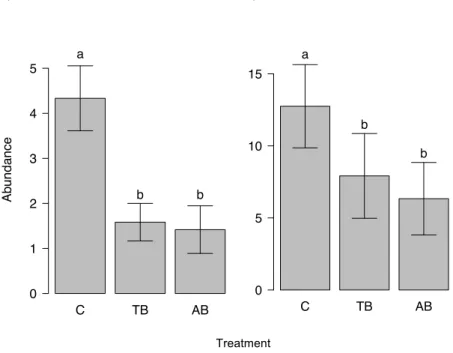
Fig. 1 Variation in ant abundance among treatments (C = Control; B0 = No fuel addition; B+ = Fuel addition) in each habitat stratum. Bars represent standard error. Different letters indicate significant differences among treatments, according to ANOVA
Fig. 2 Variation in ant species richness among treatments (C = Control; B0 = No fuel addition; B+ = Fuel addition) in each habitat stratum. Bars represent standard error. Different letters indicate significant differences among treatments, according to ANOVA
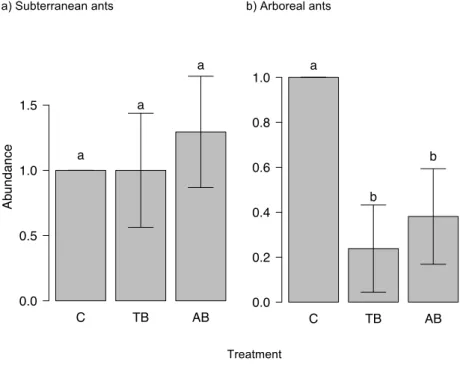
Fig. 3 Abundances of ant functional groups that showed statistically significant variation among treatments (C = Control; B0 = No fuel addition; B+ = Fuel addition) in a habitat stratum. Bars represent standard error. Different letters indicate significant differences among treatments, according to ANOVA
Fig. 4 Variation in seed discovery time among treatments (C = Control; B0 = No fuel addition; B+ = Fuel addition). Seeds were discovered fastest in the Control, and slowest in the B+ treatment
Figures
Figure 1
a) Subterranean b) Litter-dwelling
c) Epigaeic d) Arboreal
Treatment
Ab
undance (no
. of occurrence in pitf
alls) 0 2 4 6 8 10 12 14 a a b 0 10 20 30 40 50 a a b
C B0 B+
Ab
undance (no
. of occurrence in pitf
alls) 0 20 40 60 80 a a a
C B0 B+
Figure 2
a) Subterranean b) Litter-dwelling
c) Epigaeic d) Arboreal
Treatment
Species r
ichness (no
. of species)
0 2 4 6 8 10 12 a b b 0 5 10 15 20 25 30 a b b
C B0 B+
Species r
ichness (no
. of species)
0 10 20 30 40 a b b
C B0 B+
Figure 3
a) Litter – Arboreal Dominants b) Litter – Cryptic Omnivores
c) Litter – Cryptic Predators d) Litter – Epigaeic Predators
e) Litter – Subordinate Camponotini c) Epigaeic – Epigaeic Predators
Treatment
Ab
undance (no
. of occurrence in pitf
alls) 0.0 0.5 1.0 1.5 2.0 2.5 3.0 a b b 0.0 0.5 1.0 1.5 2.0 2.5 a b b Ab undance (no
. of occurrence in pitf
alls) 0 1 2 3 4 5 6 7 a a b 0.0 0.5 1.0 1.5 2.0 2.5 3.0 a b b
C B0 B+
Ab
undance (no
. of occurrence in pitf
alls) 0.0 0.5 1.0 1.5 2.0 2.5 3.0 a a b
C B0 B+
Figure 4
0 10 20 30 40 50 60
0.4 0.5 0.6 0.7 0.8 0.9 1.0
Time for discovery (min)
Propor
tion of undisco
vered seeds
Figure 5
a) b)
Treatment
C B0 B+
0.00 0.02 0.04 0.06 0.08 0.10 0.12
Seed remo
v
al (%)
a
b b
C B0 B+
0.0 0.1 0.2 0.3 0.4 0.5
Cheating (%)
a
a
Electronic supplementary material
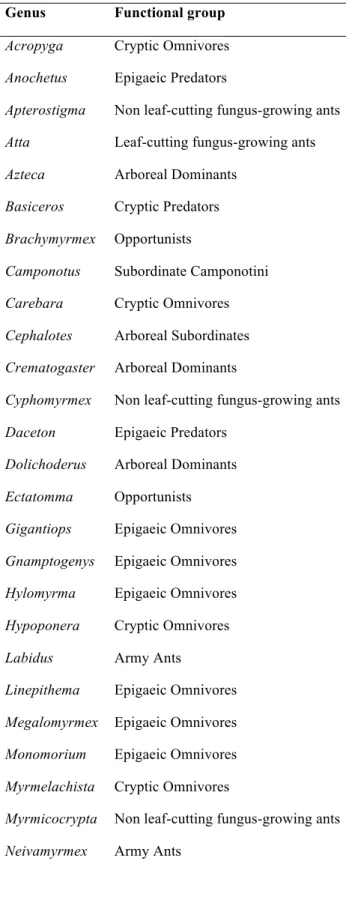
Table S1. Classification of ant genera into functional groups,
adapted from Andersen (1995) and Leal et al. (2012).
Genus Functional group
Acropyga Cryptic Omnivores
Anochetus Epigaeic Predators
Apterostigma Non leaf-cutting fungus-growing ants
Atta Leaf-cutting fungus-growing ants
Azteca Arboreal Dominants
Basiceros Cryptic Predators
Brachymyrmex Opportunists
Camponotus Subordinate Camponotini
Carebara Cryptic Omnivores
Cephalotes Arboreal Subordinates
Crematogaster Arboreal Dominants
Cyphomyrmex Non leaf-cutting fungus-growing ants
Daceton Epigaeic Predators
Dolichoderus Arboreal Dominants
Ectatomma Opportunists
Gigantiops Epigaeic Omnivores
Gnamptogenys Epigaeic Omnivores
Hylomyrma Epigaeic Omnivores
Hypoponera Cryptic Omnivores
Labidus Army Ants
Linepithema Epigaeic Omnivores
Megalomyrmex Epigaeic Omnivores
Monomorium Epigaeic Omnivores
Myrmelachista Cryptic Omnivores
Myrmicocrypta Non leaf-cutting fungus-growing ants
Neoponera Epigaeic Predators
Nesomyrmex Epigaeic Omnivores
Nylanderia Opportunists
Ochetomyrmex Epigaeic Omnivores
Odontomachus Epigaeic Predators
Pachycondyla Epigaeic Predators
Pheidole Epigaeic Omnivores
Pseudomyrmex Arboreal Subordinates
Rasopone Epigaeic Predators
Rogeria Cryptic Omnivores
Sericomyrmex Non leaf-cutting fungus-growing ants
Solenopsis Epigaeic Omnivores
Strumigenys Cryptic Predators
Tapinoma Opportunists
Trachymyrmex Non leaf-cutting fungus-growing ants
Tranopelta Cryptic Omnivores
Xenomyrmex Arboreal Subordinates
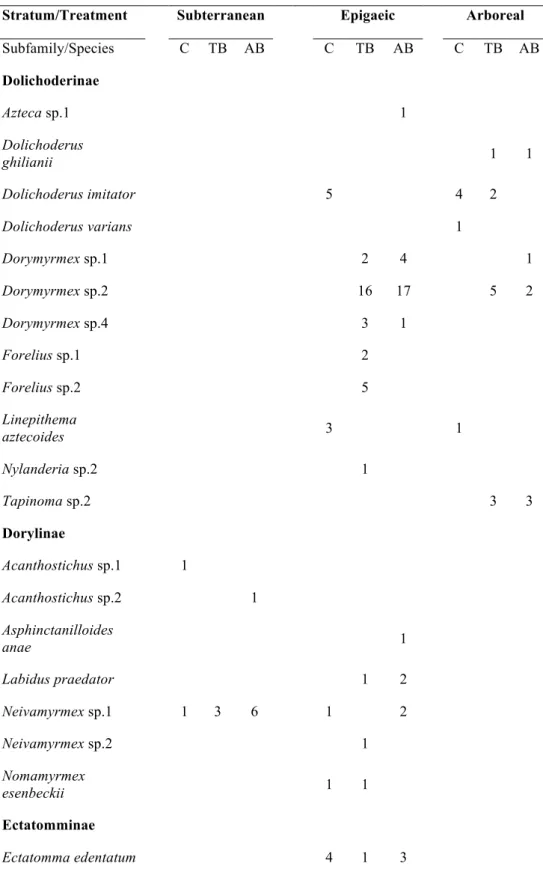
Table S2. List of ant species sampled in each strata and treatment (C = Control; B0 = No fuel addition; B+ = Fuel addition), and removing seeds or cheating. Numbers indicate the frequency of occurrence of each species in correspondent stratum and treatment.
Stratum/Treatment Subterranean Litter Epigaeic Arboreal Removed Cheated
Subfamily/Species C B0 B+ C B0 B+ C B0 B+ C B0 B+ C B0 B+ C B0 B+
Dolichoderinae
Azteca sp.1 1 1 5 2 2 3 3 2 1 1
Azteca sp.2 1
Azteca sp.3 1 1
Azteca sp.4 1 1
Azteca sp.5 1 1
Azteca sp.6 1
Dolichoderus ghilianii 1 1
Dolichoderus imitator 1 1 2 3 1
Dolichoderus
attelaboides 1
Linepithema sp.2 1
Linepithema aztecoides 1
Tapinoma sp.2 1
Dorylinae
Labidus praedator 1
Neivamyrmex sp.1 1 1 1
Ectatomminae
Ectatomma edentatum 1 4 1
Ectatomma lugens 1 3 1 1
Ectatomma
tuberculatum 1 1 1 1
Gnamptogenys striatula 2 1 1
Formicinae
Acropyga sp.1 3
Acropyga sp.2 2
Acropyga sp.3 1
Brachymyrmex sp.1 1 14 11 8 1 3 5 3
Brachymyrmex sp.2 1 5 6 3 3 2 1
Brachymyrmex sp.4 1 1 1 1
Brachymyrmex sp.5 3 1
Camponotus atriceps 1 21 15 14 14 18 16
Camponotus crassus 4 5 28 26 15 13 11 8
Camponotus
Camponotus sp.1 7 1 3 1 1
Camponotus sp.2 1 1
Camponotus sp.5 2 1
Camponotus sp.7 1 2 1
Camponotus sp.8 1 4 2 1
Camponotus sp.11 7 9 6 3 4
Camponotus sp.13 2 2 1 1
Camponotus sp.15 1
Camponotus sp.19 1
Camponotus sp.21 2 1 1 1
Camponotus sp.22 3 3 7 6 2 1
Camponotus sp.28 1 5 3 1 8 5 4 2 3 1
Camponotus sp.34 1
Camponotus sp.37 1
Camponotus sp.39 1
Camponotus sp.42 1
Gigantiops destructor 16 9 11 3 7
Myrmelachista nodigera 1 1
Nylanderia sp.2 5 6 3 5 8 6 1 1
Nylanderia sp.4 1 1
Nylanderia sp.5 1 1
Myrmicinae
Apterostigma carinatum 1 2 2
Apterostigma
megacephala 1 1
Apterostigma sp.1 1 1 8 4 2
Apterostigma sp.3 1 1 1 1
Apterostigma sp.4 1
Atta laevigata 1 5 3 4 1
Atta sp.6 1
Atta sp.8 3 1
Basiceros militaris 1 1
Carebara sp.1 1
Carebara sp.2 1
Carebara sp.3 1
Carebara sp.4 9 11 6 1
Cephalotes atratus 1
Cephalotes oculatus 1
Cephalotes patellaris 1 1 1
Cephalotes sp.2 1
Cephalotes sp.9 1
Crematogaster
crassinoda 1
Crematogaster
flavosensitiva 1
Crematogaster sp.1 2 1 4 12 14 5 9 9 4 1 1
Crematogaster sp.2 3 3 3 2 1
Crematogaster sp.9 1
Crematogaster sp.10 1 1 3 1
Crematogaster sp.12 2 1 1 1
Crematogaster sp.13 1
Cyphomyrmex
laevigatus 2 4 2 3
Cyphomyrmex sp.1 2 2 1 1
Cyphomyrmex sp.2 1
Cyphomyrmex sp.4 2 1
Cyphomyrmex sp.5 1
Daceton armigerum 1 1
Hylomyrma immanis 1
Megalomyrmex sp.1 1
Megalomyrmex sp.2 1
Megalomyrmex sp.3 1
Monomorium floricola 1 1 1 1
Myrmicocrypta foreli 1
Nesomyrmex sp.1 1 1
Nesomyrmex sp.3 1
Ochetomyrmex
neopolitus 1 1 1
Ochetomyrmex
semipolitus 1 2 1 2 1 4 2 3 1
Pheidole fimbriata 2 1 2 1
Pheidole sp.1 2 4 6 9 6
Pheidole sp.2 8 11 10 12 15 10 39 40 44 2 1 1 1 5 4 9
Pheidole sp.4 2 2 5 4
Pheidole sp.5 1
Pheidole sp.6 2 1 1 1 1 9 7 6 1 1 1
Pheidole sp.7 3 1 3 10 7 14 14 14 3 5 8 5
Pheidole sp.9 3 7 11
Pheidole sp.10 9 8 3 11 8 9 1
Pheidole sp.11 3 7 6 5 1
Pheidole sp.14 3 1 1 1
Pheidole sp.15 1 2
Pheidole sp.17 1 1 3 1 12 23 15 1
Pheidole sp.18 2 1 2
Pheidole sp.20 2 4
Pheidole sp.21 1
Pheidole sp.26 1 2 3
Pheidole sp.28 1 1 1
Pheidole sp.31 1 3
Pheidole sp.32 1
Pheidole sp.33 1 4 2
Pheidole sp.37 3 1
Pheidole sp.38 1 1 1 1
Pheidole sp.41 1
Pheidole sp.42 1 1 1 3
Pheidole sp.43 1 2 5 8 1 1
Pheidole sp.44 1
Pheidole sp.46 1
Pheidole sp.49 1 1 1
Pheidole sp.52 4 2 1 1
Pheidole sp.54 1
Pheidole sp.60 1
Pheidole sp.61 1 1 1 1 2 3 4 1
Rogeria sp.1 1
Sericomyrmex sp.1 2 1 3 4 3
Sericomyrmex sp.2 1
Sericomyrmex sp.5 1
Solenopsis saevissima 1 2
Solenopsis sp.1 3 2 1 29 20 15 21 11 9 19 15 10 3 5 2
Solenopsis sp.4 1 1 8 7 4
Solenopsis sp.6 12 15 6
Solenopsis sp.7 1 1
Solenopsis sp.9 1 2
Solenopsis sp.10 1
Solenopsis sp.11 1 1
Solenopsis sp.12 1
Solenopsis sp.13 1 10 12 9 4 3 1
Solenopsis sp.14 15 6 8 5 1
Solenopsis sp.16 1 1 1
Solenopsis sp.17 2 1 1
Solenopsis sp.18 1
Solenopsis sp.19 1
Solenopsis sp.20 1
Solenopsis sp.21 2 1
Solenopsis sp.22 1
Solenopsis sp.23 1
Solenopsis sp.25 1 1 1 3
Solenopsis sp.29 1
Solenopsis sp.35 1 1
Strumigenys aff.
crassicornis 1
Strumigenys denticulata 1 13 12 7
Strumigenys elongata 1 1
Strumigenys perpava 5 5
Strumigenys trudifera 1
Strumigenys zeteki 2 1
Trachymyrmex sp.1 2 7 8 15 14 15 2 2
Trachymyrmex sp.2 1 1 1 2
Trachymyrmex sp.3 1 2 2
Trachymyrmex sp.4 1 3
Trachymyrmex sp.6 1 17 16 15
Trachymyrmex sp.9 1
Tranopelta sp.1 11 12 6 2 1
Xenomyrmex sp.1 1
Wasmannia sp.1 1
Wasmannia
Ponerinae
Anochetus diegensis 1 2
Anochetus mayri 3 1
Anochetus targionii 3 1
Hypoponera sp.1 1
Hypoponera sp.2 1
Hypoponera sp.3 1
Hypoponera sp.4 1 1 1
Hypoponera sp.5 5 3
Hypoponera sp.6 2
Neoponera apicalis 3 1
Neoponera carinulata 1 1
Neoponera commutata 3 4
Neoponera verenae 24 12 7
Neoponera villosa 1 1 1 1
Odontomachus meinerti 1 1
Odontomachus sp.2 1
Pachycondyla
Pachycondyla harpax 3 1 1 1
Rasopone aff. lunaris 1
Rasopone arhuaca 1
Pseudomyrmecinae
Pseudomyrmex sp.1 1 1
Pseudomyrmex sp.2 1 1
Pseudomyrmex sp.3 6 2 1
Pseudomyrmex sp.4 7 2 2
Pseudomyrmex sp.5 1 4
Pseudomyrmex sp.6 2
CHAPTER TWO
RESPONSES OF RAINFOREST ANTS TO HIGH FIRE FREQUENCY:
CONGRUENCE WITH VEGETATION CHANGE IN THE SOUTHERN
AMAZON
Responses of rainforest ants to high fire frequency: congruence with vegetation
change in the southern Amazon
Running Head: Fire frequency and rainforest ants
Authors: Lucas N. Paolucci1*; José H. Schoereder2 and Alan N. Andersen3.
1
Programa de Pós-Graduação em Ecologia; 2 Departamento de Biologia Geral,
Universidade Federal de Viçosa, Av. P.H. Rolfs, s/n, Campus Universitário, CEP
36570-000, Viçosa, MG, Brasil. 3 CSIRO Land & Water, Tropical Ecosystems
Research Centre PMB 44, Winnellie, NT, 0822, Australia.
Abstract
Human activities on tropical forests fragment the original habitat, and increase
the flammability of its edges. Once burned, a positive fire feedback may be established
and fire return intervals can drastically decrease. Here we assess the effects of repeated
fires on forest ant communities in the southern Amazon using a manipulative
experiment where treatment plots were subject to annual and triennial fires over a
six-year period. We ask the question: Do ant communities show comparable plot
differences in abundance, biomass, species diversity and species composition to that
shown by trees? Experimental fires were applied to adjacent forest plots (0.5 X 1.0
km): one plot was burnt annually, another was burnt triennially, and a third was left
unburnt. Trees from three size-classes (small, 10-19.9; medium, 20-39.9 and large, ≥
40 cm diameter at breast height) were surveyed in each 50-ha treatment prior to the
first experimental fires, and again two years after the last fires. Ants were sampled
three years after the last fires in three strata: subterranean, epigaeic and arboreal. Ant
responses to burning were highly consistent with those of trees. Epigaeic ant species
were the most sensitive, and particularly affected by annual fires. Fire had a much
more severe impact on abundance and biomass of trees than of ants, as the effects on
ants are primarily indirect rather than through direct mortality. Changes in ant biomass
in burnt plots were disconnected from changes in ant abundance, which has important
implications for using changes in abundance as proxies for changes in ecological
function. Species diversity and composition varied similarly for ants and trees.
Recurrent fires in southern Amazonian forests have dramatic effects not only on trees,
but also on ants, one of the most abundant and ecologically important faunal groups.
Preventing such disturbance should be a priority for conservation management.
Introduction
Tropical forests rarely burn naturally, due to their humid microclimate and
high rates of litter decomposition (Bond and van Wilgen 1996; Mueller-Dombois
1981; Uhl and Kauffman 1990). However, fire risk is increased by logging and
agricultural development, which create fire-prone agricultural habitats, fragment the
original forest, and increase the flammability of forest edges (Alencar et al. 2004;
Nepstad et al. 1999). Once burned, a positive fire feedback may be established due to
higher canopy openness, and higher and drier fuel loads (Cochrane et al. 1999;
Nepstad et al. 2001). Such factors can drastically alter fire return intervals in tropical
forests, from an historical 500-1000 years (Pivello 2011) to as little as 5-10 years
(Cochrane 2001).
Recurrent fires in tropical forests influence both fire intensity and ecological
responses. Compared with a single fire, recurrent fires are usually more intense due to
higher flame heights and faster spread rates (Ray et al. 2005). Trees with thick bark
and larger diameter are less susceptible to fire (Brando et al. 2012), but sufficient
fire-free intervals are required to allow recruitment into fire-resistant size classes
(Hoffmann et al. 2009). Recurrent fires increase the vulnerability of resprounting
stems, extirpate more pioneer species than do single fires, and lead to higher turnover
in tree species composition (Barlow and Peres 2008). It also leads to a greater impact
on faunal communities (Barlow and Peres 2006; Silveira et al. 2015).
The rainforest-savanna transitional region of the southern Amazon is
undergoing extreme land-use change that is increasing the fire risk of remaining forest
(Morton et al. 2013). These forests are already more fire-prone than those in the
central Amazon because they experience more frequent and intense droughts (Coe et
(Brazilian savanna), with the boundary between these two biomes largely determined
by fire (Bowman 2000; Hoffmann et al. 2009; Hopkins 1992). Under suitable
conditions, fire can penetrate the forest edges, reducing canopy cover, increasing fuel
loads and therefore making them more fire-prone (Silvério et al. 2013).
Forests of the southern Amazon are relatively resistant to single fires, but can
be dramatically impacted by repeated burning, especially under extreme climatic
conditions (Balch et al. 2015; Brando et al. 2014; Brando et al. 2012). Repeated fires
cause high tree mortality and severely degrade forest structure (Balch et al. 2011;
Brando et al. 2014), promote the invasion of native and pasture grasses (Silvério et al.
2013), and markedly change patterns of plant regeneration and succession (Balch et
al. 2013). However, the extent to which repeated fires have comparable impacts on
faunal assemblages has been little studied.
Ants are a globally dominant faunal group that are widely used as
environmental and biodiversity indicators of the effects of habitat disturbance
(Andersen and Majer 2004; Majer et al. 2007). They are especially abundant and
ecologically important in tropical forests (Agosti et al. 2000; Hölldobler and Wilson
1990). Single fires in southern Amazonian forests decrease ant species richness, alter
functional group composition, and reduce the effectiveness of ecosystem services they
provide (Paolucci et al. 2016; Silveira et al. 2012). However, there has been only one
study of the effects of repeated fires on ant communities of southern Amazon forests,
where the abundance of epigaeic ants was found to be promoted by burning on three
occasions over a three-year period, due at least in part to an increased occurrence of