DO WE REALLY HATE OUR JOBS? DETERMINANTS OF JOB
SATISFACTION IN ROMANIA
S veanu Tomina
University of Oradea, Faculty of Economic Sciences
S veanu Sorana
University of Oradea, Faculty of Economic Sciences
Job satisfaction is said to be an important factor of productivity at work along with having the proper training, interests and motivation. Frustrations at work may derive from different aspects of the job itself, the work environment as well as personal motivation for work and its results. Human resources management theories focus on job satisfaction and motivations as means for achieving the institution’s objectives, and consequently see motivations and satisfaction at an individual level. Our paper investigated these issues at macro level, going beyond the individual variables of job satisfaction to the ones hat explain the attitudes towards work at national level. This approach is derived from cultural theories analyzing attitudes towards work as a cultural value that varies across nations. In this manner we analyze data at national level, investigating the factors that influence work satisfaction and attitudes towards work of Romanians.
This paper aims at explaining the identified differences regarding the individual’s attitude towards their professional life. Considering the fact that work occupies a lot of time in people’s life and it is considered the second most important aspect of life after family, we questioned the aspects that explain the levels of job satisfaction both in the light of theoretical constructs and as results on the Romanian population. These indexes have a direct impact on the quality of life, reflect the level of development, as well as point to further social aspirations of individual actors. The current analysis reflects on different aspects of the appreciation of work and investigates variations of work satisfaction: Which is the value attributed to work? How important is work and how satisfied are individuals with their jobs? Which are the characteristics that determine variations of job satisfaction?
After a theoretical synthesis of different approaches of work related attitudes in the literature, the second section presents the data and the main research findings. For data analysis we used the data obtained in the European Values Survey 2008, research conducted by the Romanian group for the study of social values, supported by the Research Institute for Quality of Life. Other data used in this paper derived from a research program developed at University of Oradea – Social Sciences Faculty - HURO 0801/180 ENRI. The reserach section of this paper follows the theoretical questions: first we focus on the value attributed to work by Romanians and its contribution to self definition, then reflect on the significations of work, and finally explain the levels of work satisfaction. The main findings of our analysis suggest that even though work is seen as very important by Romanians, the main explanatory factor of job satisfaction at a general level is connected to economical status provided by a certain job. In the concluding section we stated several research directions that would provide better insight in this topic.
Keywords: apreciation of work, job satisfaction,
JEL codes: M12, O15, J89
Theoretical aspects
activities of the individuals over the institutions in which they are performing their activities. The second dimension is in connection with the analysis of economical policies, different work indicators (incomes, work hours, professional training, satisfaction, commitment to the organization) being taken into consideration for measuring the well-being of the citizens and also for doing evaluations and comparisons between countries. We are going to present the general elements and results of the researches from both directions in order to point out their importance and interdependence. A general analysis of all attitude co-variables regarding the job has to contain both individual and organizational characteristics of the field of activity and also the ones from the macro-social level, like the political-economical environment; the effects of satisfaction/dissatisfaction towards the job can also be found in all of these three levels. From the first approach category regarding work, it is important the classical distinction between the types of work motivations are based on intrinsic-extrinsic classification. The individual characteristics, like responsibility (the feeling that own work is important), autonomy, the possibility of usage and development of own abilities etc. belong to the first category, these being stable characteristics in time, from which the perceived professional life quality's appreciation derives. Extrinsic motivational factors contain all kinds of rewards and penalties: bonuses, promotion, criticism, wage diminishing (Armstrong: 2009). The types of motivations that act upon the individuals are important for the work satisfaction: a motivated person who gains the awaited work benefits (be it intrinsic or extrinsic) is satisfied by the undertaken professional activity. Motivation can be defined as "the sum of forces, internal and external energies which initialize and lead the behavior towards an objective, which once fulfilled determines the satisfaction of a need", in other words, work satisfaction is directly influenced by the satisfaction of motivational needs (Abrudan: 2009). Thus, the level of satisfaction can be influenced by opportunities, independence, relationship with co-workers, communication with the superiors, success obtained in the field of work etc. Money is the most direct and obvious type of motivation, not because of its intrinsic value, but for the things that can be achieved with it: social prestige and position, access to superior goods and resources. Contrary to a general and accepted perception by the common sense, the studies do not demonstrate a direct relationship between work satisfaction and performance, the relationship having the possibility of being inversely: an individual who gets to high performances consequently is going to be satisfied by his/her work (Judge et al., 2010), element taken into consideration in the previous analysis of the authors regarding evaluation of work performances (Saveanu, Osvat, Saveanu 2010: 706). Even though, motivating the employees is important for the managers for achieving organizational objectives, for creating a positive work environment, low absenteeism etc. (Mathis: 1997, apud Abrudan: 2009). Even though, it is important to keep the conceptual differences between work attitude, work satisfaction in subjective terms and work evaluation based on objective criteria, distinctions kept in the analysis in this paper (Weiss 2002).
average period of work, fields of professional activity etc. This data is also completed by the subjective indicators of life quality, just like the perceived satisfaction regarding work, the value given to the job. These dimensions are the ones that build up the objective of the present paper. Thus, the comparative analysis between Romania and other European countries has revealed the fact that Romanians are generally less satisfied with the job, less sure regarding their job, a fact explained through the structure of the labor force and also through the rate of occupancy of the active population in our country (Ciutacu 2008: 59-108). Other factors that explain the work satisfaction degree of the Romanians are: age (young and old), education and occupation (those with a superior educational and/or occupational level are more satisfied) (Comsa, 2009: 1). The type of employment is also a factor that influences work satisfaction, the owners being the most satisfied ones according to a representative study on a national level (Comsa 2008: 46 - 48). These relationships are going to be tested in the present paper for highlighting the factors that influence work attitude and the degree of satisfaction on macro-social level, as social indexes of well-being and of development level. Nevertheless, the present analysis did not allow the comparison with the results obtained in these countries, being more an investigation on a national level of the aspects regarding work.
Data and methodology
The objective of this paper is the investigation of the variation of work valuing and of work satisfaction. For obtaining the results, I have used the data of the EVS 2008 survey. The 2008 research performed by the Romanian group for studying social values, sustained by the Life Quality Research (ICCV) Institute, had as objective the evaluation of the values' dynamics of the Romanians. The study is part of the surveys known as European Values Study (EVS) and has as objective the comparison of values between different European countries and the presentation of the evolution in time of the values' orientation (for more information regarding the EVS study in Romania, go to www.iccv.ro/valori). The representative sample for the Romanian population involved 1489 subjects. The structure of the sample is the following: distribution according to gender -51.8 women, 48.2 men, average age of 46.4 years, with a standard deviation of 18.3. The data has been processed by the authors by using the SPSS statistics software.
Results
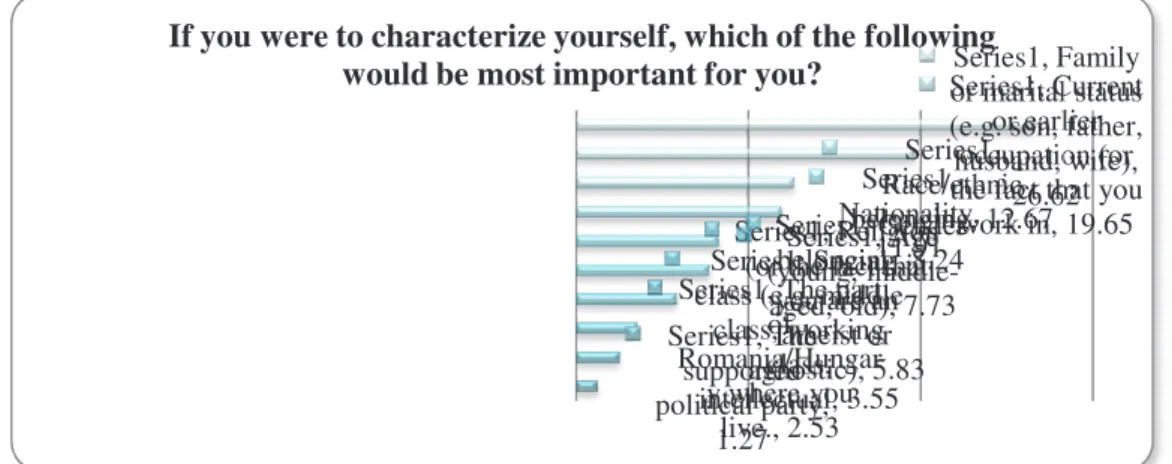
Graphic 1. The importance of wor
What is important to highlight regard the defining aspects of the individ collective of the Sociology desk, Un only occupy an important place in th the subjects answered the Which is th by 19% declaring (on the second pla
Graphic 2. Appreciation of the def
Taking into consideration these aspe Series1,
family, 3.84Series1, wo 3.46
How
If you were to char would
ork attribution, made by the author, data source:
arding work appreciation is the fact that work repre iduals' identity. According to a research perfor University of Oradea (HURO 0801/180 ENRI), w
the life of the individuals, but it also defines them s the most important thing that describes who you a
lace after family) that work is what defines them.
efining characteristics of social identity, made by data source: ENRI 2010
pects hereinafter, we are going to investigate which work, Series1,
religion, 3.38
Series1, leasure time,
3.16 friends, 3.05Series1,
Series1, politics, 1.90 ow important is in your life...
(mean values 1-4 scale)
Series1, The supported political party,
1.27
Series1, The part of Romania/Hungar
y where you live., 2.53 Series1, Social class (e.g. middle
class, working class, intellectual, 3.55
Series1, Religion (or the fact that
you are an atheist or agnostic), 5.83
Series1, Age (young, middle-aged, old), 7.73 Series1, Gender belonging, 8.24 Series1, Nationality, 11.91 Series1, Race/ethnic belonging, 12.67 Series1, C or earl occupatio the fact th work in, Series1, F or marital (e.g. son, husband, 26.62 haracterize yourself, which of the following
ld be most important for you?
e: EVS 2008
presents one of formed by the work does not em as persons: are? question
by the author,
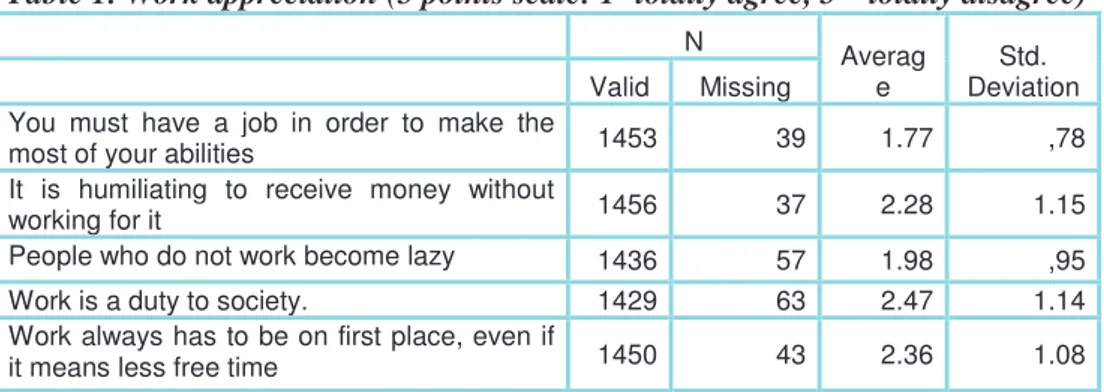
Table 1. Work appreciation (5 points scale: 1- totally agree, 5 – totally disagree)
N Averag
e
Std. Deviation
Valid Missing
You must have a job in order to make the
most of your abilities 1453 39 1.77 ,78
It is humiliating to receive money without
working for it 1456 37 2.28 1.15
People who do not work become lazy 1436 57 1.98 ,95
Work is a duty to society. 1429 63 2.47 1.14
Work always has to be on first place, even if
it means less free time 1450 43 2.36 1.08
The centrality of work is also confirmed in the case of these items. Most of the individuals consider that work gives them the possibility to prove their abilities and keeps them active. The fidelity of the scale is thus confirmed (cronbach alpha>.700), by using the inverted variants of the items, we have developed the index for work appreciation, having an average value of 19.1. High index values show a strong valuing of work.
The analysis regarding the variations of the work appreciation index did not show specific characteristics of the individuals which determine different levels of the valuing of work. We had a positive correlation only in the case of age (Pearson coef. .166**, sig. 000), thus older people value work more. One of the possible explanations for the lack of significant relationships can be found in the way the scale has been built. It can be seen that the scale uses codes from 1 to 5, where 1 stands for a positive appreciation. Even though we used inverted values for developing the index, it is possible that the answers given to these items to be distorted due to the used codes (downward orientation).
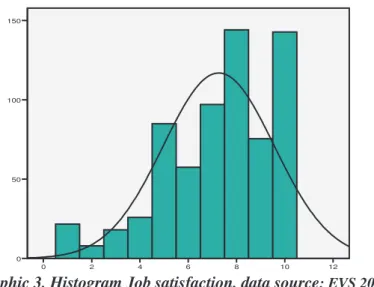
Graphic 3. Histogram Job satisfaction, data source: EVS 2008
The analysis show a higher degree of satisfaction in the case of subjects with a superior occupational level, both regarding the type of employment and what this implies: the level of incomes and work position.
The tested relationship between the degree of work satisfaction and the level of incomes shows the major impact of income over the work appreciation. Thus, one of the major criteria according to which a job is evaluated is the salary. The positive value of the correlation coefficient is of Pearson coef. .235**, sig. 000.
The difference is significant regarding the type of employment. The average value of work satisfaction is higher in the case of self employed individuals: 8.25, in comparison to the 7.29 average value obtained for those who are employed (F=9.7, sig<005).
Also regarding the type of employment, the Leverne Test for the equality of the variance shows a significant difference regarding the number of subordinates an individual has. Thus, the average value of work satisfaction is higher for those who have subordinates, compared to those who do not have subordinates (7.91 in comparison to 7.17: F=6.31, sig<005).
Also, in the case of decision making freedom degree, the analysis identify a significant relationship. Thus, the positive correlation coefficient shows higher levels of work satisfaction if a job implies a high decision making power (Pearson coef. .572**, sig. 000).
Another aspect investigated by the paper deals with testing the relationships regarding the type of professions. For coding the professions, the Classification of Professions from Romania 2011 (COR) was used, recoding the professions in the database on the 10 major occupation group: (1) Members of the legislative body of the executive, heads of public administration, superior chiefs and officers from economical-social and political units; (2) Specialists with intellectual and scientific professions; (3) Technicians, fitters and assimilates; (4) Administrative officers; (5) Operative agents in services, commerce and assimilates; (6) Farmers and qualified workers in
12 10 8 6 4 2 0 150
100
50
groups: the second salary level group is represented by the intellectual and scientific professions, thus it is possible that the obtained significant differences to also come from the income differences of these (INS, 2010).
Final discussion
The analysis presented in this paper contributes to the larger understanding of the work motivations and satisfactions of the Romanians, as an index of both well-being and of development level. In the same manner as other studies regarding this issue, I have shown that for the Romanians, work is a very important dimension, second after family, the professional status being and important criteria in shaping personal identity. The analysis regarding work valuing, with other words the role of work, sustains the conclusion that this represents an essential dimension of life, even if it is important to draw a line between involvement in professional life and involvement in different other activities outside work.
These results generated the analysis performed in the following section, the investigation of work satisfaction level of the Romanians. Their conclusion shows the fact that, even if work by itself is considered as being very important, satisfaction is connected to incomes, chief status, self-employment, high decision making power, intellectual and administrative professions - all of these showing a superior occupational level.
Further investigations are necessary for testing the direction of determination between work satisfaction level and achieved performances. For these, it is necessary to obtain information regarding the type of employer, work relationships and other institutional level indexes. This way, the individual level is averaged to the macro-social one, making generalizations possible.
Bibliography:
1.Abrudan, Maria-Madela (coord.). Manualul departamentului de resurse umane. Oradea: Editura Universit ii din Oradea, 2009
2.Armstrong, Michael. Managementul resurselor umane. Edi ia X. Bucuregti: Editura CODECS, 2009
3.Ciutacu, Constantin i Chivu, Lumini a. Calitatea muncii i a ocup rii for ei de munc în România. Bucure ti: Editura Expert,2008.
4.Com a, Mircea. 2009. Etica muncii. în NEWSLETTER. Valorile românilor. Nr. 4, ICCV 5.Grupul românesc pentru studiul valorilor sociale, accesta la 15 martie 2011. http://www.iccv.ro/valori/newsletter/newsletter4.etica_muncii.pdf
6.Com a, Mircea, Rughini , Cosima i Tufi , Claudiu. Atitudini fa de munc în România, 7.Funda ia Soro . 2008. accesibil la adresa: http://www.soros.ro/ro/publicatii.php?pag=5# 8.S veanu, Tomina, Osvat, Claudia i S veanu, Sorana. „An Integrated and Empirical Model of Performance Assessment – A Case Study”. în Analele Universit ii din Oradea, sec iunea tiin e Economice, Tom XIX 2010, Nr. 1 – iulie 2010, pag. 703 – 708
http://anale.steconomiceuoradea.ro/volume/2010/n1/110.pdf
9.Seashore, Stanley i Taber, Thomas. 1975. Job Satisfaction Indicators and their Correlates. în American Behaviral Scientist, vol. 18, no. 3, ianuarie- februarie 1975, Sage Publications.
10.Judge, Timothy, Thoresen, Carl, Bono, Jozce i Pattin, Gregory. 2001. Job Satisfaction – Job Performance Relationship: a Qualitative and Quantitative Review.. în Psychological Bulletin, vol. 127, no. 3, 376-407, 2001, American Psychological Association.
11.Weiss, Howard. 2002. Deconstructing Job Satisfaction. Separating evaluations, beliefs, and affective experiences. În Human Resource Management Review, no. 12.2002: 273-194.