ALPHA AND BETA DIVERSITY OF LEPIDOPTERA IN EUCALYPTUS
PLANTATIONS IN THE AMAZONIAN REGION OF BRAZIL
JOSÉ COLA ZANUNCIO1,*, PEDRO GUILHERME LEMES1, GERMI PORTO SANTOS2, CARLOS FREDERICO WILCKEN3, BRUNO ZACHÉ3, ROSENILSON PINTO4AND JOSÉ EDUARDO SERRÃO5
1
Departamento de Entomologia, Universidade Federal de Viçosa, 36570-900 Viçosa, Minas Gerais, Brazil
2
Empresa de Pesquisa Agropecuária de Minas Gerais, Centro Tecnológico da Zona da Mata. Vila Gianetti, 46, Centro, 36570-900, Viçosa, Minas Gerais, Brazil
3
Departamento de Produção Vegetal, Faculdade de Ciencias Agronomicas, Universidade Estadual Paulista, Botucatu, São Paulo, Brazil
4
Faculdade de Engenharia (FaEnge), Universidade do Estado de Minas Gerais, Avenida Brasília, 1304, Bairro Baú, CEP: 35930-314, João Monlevade, Minas Gerais, Brazil
5
Departamento de Biologia Geral, Universidade Federal de Viçosa, 36570-900, Viçosa, Minas Gerais, Brazil
*Corresponding author; E-mail: [email protected]
ABSTRACT
The Lepidoptera are among the insect groups with the greatest species diversity and eco-logical services. The distribution, abundance and variation in time and space of species in natural communities are important. The occurrence of pests (primary pest species) and those species with potential to cause damage (secondary pest species), plus other species, are studied in monitoring programs in forest plantations as groups I, II and III, respectively. The objective of this work was to study alpha and beta diversity patterns, and the effect of native forest in these indexes by monitoring Lepidoptera in eucalyptus plantations in the Amazonian region of Brazil. Surveys were conducted with light traps at 4 sites in this region. Alpha diversity was calculated with the Jackknife first-order proce-dure and beta diversity with the Jaccard index in order to estimate the dissimilarity per point and the effect of the distance between the native forest and the plantations on the Lepidoptera fauna. The richness showed 10 or 11 species of group I; 9 or 10 species of II and 378 to 409 species of III, without differences per group between regions. The curves of accumulated number of primary pest species stabilized between the 15th and 35th samplings and those for secondary pest species stabilized in the range from 20th to 70th samplings, with variations among sites. The estimation of richness for species of group III ranged from 50 to 100 species with a steep slope of the curve until approximately the 60th sampling with a slow increase and a tendency of stabilization in the 4 areas after this date. The primary pest species were the same in all areas and therefore their beta diversity was zero. The dissimilarity of secondary pests was similar between areas ex-cept for Felipe. Group III showed lower dissimilarity between Caracuru and Ponte Maria (14.88%) and highest values between Felipe and Pacanari (21.64%). The lower number of individuals of group I in Felipe and Ponte Maria and lower species richness of group III in Felipe can be explained by the proximity of eucalyptus plantations to the native forest. The knowledge of population dynamics and species richness of Lepidoptera defoliators is important for pest management. These indexes allow a better detection of species with a history of damage and decision-making with the most appropriate preventive measures for each situation.
Key Words: defoliator, forest entomology, IPM, primary pests
RESUMO
para causarem danos tem sido estudada em programas de monitoramento em plantios florestais. O objetivo deste trabalho foi estudar o padrão da diversidade alfa e beta e o efeito da mata nativa sobre esses índices pelo monitoramento de lepidópteros em plan-tios de eucalipto na região amazônica do Brasil. Os levantamentos foram realizados com armadilhas luminosas em Caracuru, Ponte Maria e Pacanari no município de Almerim, Estado do Pará, Brasil e em Felipe no município de Laranjal do Jari, Estado do Amapá, Brasil. Os lepidópteros coletados foram divididos em pragas primárias (grupo I), pragas secundárias (grupo II) e espécies sem importância definida para o eucalipto (grupo III). A diversidade alfa foi calculada com o procedimento Jacknife de primeira ordem e a beta com o índice de Jaccard estimando-se a dissimilaridade média por ponto de coleta. Os índices de frequência e constância e o efeito da distância entre a mata nativa e o plantio sobre a fauna de Lepidoptera foram determinados e comparados. A riqueza foi de 10 ou 11 espécies do grupo I, nove ou 10 do II e 378 a 409 espécies do III, sem diferença por grupo entre as áreas. As curvas de acúmulo das pragas primárias se estabilizaram en-tre as 15a
e 35a
amostragens e as das secundárias entre a 20a
e a 70a
amostragem, com variações entre os locais. A estimativa da riqueza das espécies sem importância definida para a eucaliptocultura foi de 50 e 100 espécies com inclinação acentuada da curva até, aproximadamente, a 60ª amostragem e crescimento lento com tendência de estabilização nos quatro locais a partir desta data. As espécies pragas primárias foram as mesmas em todos os locais e, por isso, sua diversidade beta foi nula. A dissimilaridade das pragas secundárias foi semelhante entre os locais, exceto em Felipe. O grupo III apresentou menor dissimilaridade entre Caracuru e Ponte Maria (14,88%) e maior entre Felipe e Pacanari (21,64%). O menor número de indivíduos do grupo I em Felipe e Ponte Maria e a menor riqueza de espécies do III em Felipe estão, possivelmente, relacionados à maior proximidade dos plantios de eucalipto com a mata nativa. O conhecimento da dinâmica populacional e da riqueza de espécies de lepidópteros desfolhadores são importantes para o manejo de pragas. Esses índices permitem melhorar a detecção de espécies com histórico de danos e a tomada de decisão com medidas preventivas mais apropriadas para cada situação.
Palavras Chave: desfolhador, entomologia florestal, MIP, pragas primárias
Insects have important role in the ecosystems as herbivores, pollinators, nutrient cyclers, regu-lating populations of other organisms and feed-ing on or servfeed-ing as food for other species (Losey & Vaugan 2006; Losey & Vaugan 2008; Lemos et al. 2003). The Lepidoptera are among the largest groups of insects with great diversity and differ-ent ecological services (Summerville & Crist 2008; Pereira et al. 2008). However, climate change can reduce the number and diversity of Lepidoptera (Gimesi et al. 2012).
The insect species richness in tropical rainfor-est ecosystems is high and its evenness is low, with a few abundant ones and mostly rare spe-cies (Hill & Hamer 1998; Nummelin 1998). Tropi-cal rainforests have more species than temperate habitats, but their abundance and distribution in these communities need to be better studied (DeVries et al. 2009). Local and regional species richness may improve understanding of the rela-tive influence of regional and local processes on community structure (Ricklefs 1987).
More homogeneous environments such as for-est plantations may have continuous modifica-tions affecting the composition and structure of animal communities due to interactions between biotic and abiotic factors (Ganho & Marinoni 2005). Furthermore, species diversity may be re-lated to the effective-functioning of the ecosystem (Loreau et al. 2001). Therefore, studies on the
abundance of species in natural communities and their variation in time and space are important.
The increase of eucalyptus plantations in Bra-zil facilitates a larger number of native Lepidop-tera to adapt to these exotic plant species, such
as Eupseudosoma aberrans Schaus and
Eupseu-dosoma involuta Sepp (Arctiidae), Automeris sp.
Walker and Eacles imperialis Walker (Saturni-idae), Oxydia vesulia Cramer, Sabulodes caberata Guenée and Thyrinteina arnobia (Stoll) (Geome-tridae) (Guedes et al. 2000; Zanuncio et al. 2006). Lepidoptera pests like T. arnobia are important to forestry because of population outbreaks and consequent damage in eucalyptus plantations in Brazil (Zanuncio et al. 2006).
The occurrence of Lepidoptera pests and spe-cies with the potential to acquire pest status has been defined in monitoring programs by forestry companies (Pereira et al. 2001; Zanuncio et al. 2001; Zanuncio et al. 2006) in different regions using light traps (Kitching et al. 2000; Osaki et al. 2011).
The objective of this study was to evaluate and to compare the spatial distribution of species di-versity of Lepidoptera across eucalyptus planta-tions in the Amazon region of Brazil.
MATERIALS AND METHODS
Lepidoptera Sampling
The insects were collected in Eucalyptus
uro-phylla S.T. Blake (Myrtaceae) plantations, which
were 6 mo to 2 yr old at the beginning of the study (Table 1). Each area was monitored every 15 days from Sep 1992 to Aug 1997 with a light trap model Intral AL 012 (Clarke, Sao Paulo, Brazil), equipped with fluorescent black light bulb F15 T12 LN, with a wavelength of 290 nm to 450 nm powered by a 12-V and 55 A battery placed at 2 m height at the midpoint of each eucalyptus stand and operated from 6:00 P.M. to 6:00 A.M. of the next day. A plastic bag of 45 × 75 cm in width and length, respectively, with strips of newsprint and a bottle with ethyl acetate and a wick were at-tached to the bottom of the trap to hasten death and avoid excessive fraying of the insects. A distance of approximately 50 km separated the traps in Caracuru, Pacanari and Ponte Maria in Almerim municipality, Pará State and in Felipe, Laranjal do Jari municipality, Amapá State in the Amazonian region of Brazil.
The insects collected were sorted, packed and sent to the Laboratory of Biological Control of Insects, Department of Entomology, Federal Uni-versity of Viçosa, in Viçosa, Minas Gerais State, Brazil. The specimens collected were identified based on the literature, and by comparison with those in the Regional Museum of Entomology/ UFV (UFVB), and by experts of the Center of Phytophagous Insect Identification of the Federal University of Paraná, in Paraná State, Brazil. The insects were deposited in the collection of the Regional Museum of Entomology/UFV.
Alpha Diversity
Richness is a measure of the number of spe-cies in an area, but may present systematic
flaws (Ricklefs 1996). This index has been cal-culated with rarefaction methods to obtain the «expected» number of species according to the number of sampled individuals (Ramalho & Sil-va 2002). The first order Jackknife procedure is one of the more accurate nonparametric meth-ods to express the richness of a community and to correcting its shortcomings (Palmer 1991). Comparisons between sampling efforts were conducted by correction using randomized cu-mulative species curves based on samples, after 100 randomizations calculated by the software EstimateS version 8.2 (Colwell 2009), using the Statistica 9.0 (Statsoft 2009) analysis to com-pare the results.
A species accumulation curve for each sampled site with the Jackkinfe estimator and values es-timated at a confidence interval of 95% (Colwell & Coddington 1994) was made. The estimate by Jackknife is:
where: Sobs= is the total number of observed
spe-cies in all samples; m = total number of samples.
Beta Diversity
The beta diversity indices with presence and absence data are still controversial (Wilson & Shmida 1984; Harrison et al. 1992) and with a wide variety of indexes. The approach of this study was based on dissimilarity measures esti-mated by the Jaccard index. The index is defined as:
where: Dij = is the measure of dissimilarity be-tween the squares; i and j = the number of com-mon species or genera; Si and Sj= species richness
of species or genera in each area.
The mean dissimilarity per point compared to the others was used as a measure of beta diver-sity. High values of this measure mean a place with very particular species composition and preservation.
Sjack1 = Sobs +
m – 1
,m
D (i, j) = Si ,
Si + Sj
TABLE 1. CHARACTERIZATIONOFSAMPLINGSITESOFLEPIDOPTERANDEFOLIATORSON EUCALYPTUSIN CARACURU, PACANARIAND PONTE MARIA, PARÁ STATEAND FELIPE, AMAPÁ STATE, BRAZIL.
Characteristics Ponte Maria Pacanari Caracuru Felipe
Latitude S 00° 47' 44" S 00° 36' 13" S 00° 32' 16" S 00° 54' 19" Longitude W 52° 47' 19" W 52° 36' 58" W 52° 51' 34" W 52° 21' 56"
Altitude 88 126 110 164
Planting date of Eucalyptus Mar/1991 Mar/1992 Mar/1990 Mar/1990 Distance to native forest 2,600 m 5,300 m 4,300 m 800 m Width of native forest 700 m 5,000 m 2,100 m 600 m
Lepidopterans collected were divided in groups I, II and III, which consisted of primary pests, secondary pests and those with undefined importance to eucalyptus, respectively (Zanuncio et al. 2006).
RESULTS
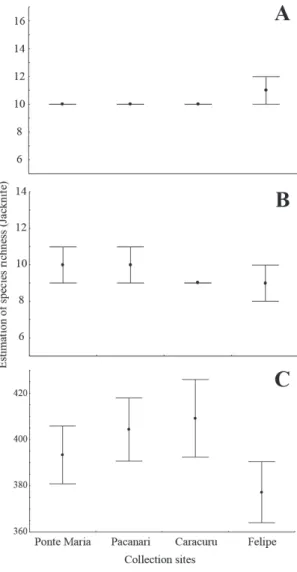
For the eucalyptus plantations in Caracuru, Felipe, Pacanari and Ponte Maria, the respective numbers of lepidopteran individuals collected were 8,381, 1,010, 3,459 and 1,015 for the prima-ry pests; 666, 324, 249 and 351 for the secondaprima-ry ones and 3,195, 3,558, 4,034, and 5,615 for those species with undefined importance for the euca-lyptus. The estimated value of the richness (Fig. 1), calculated by the Jackknife index, ranged from 10 to 11 species of group I; 9 to 10 species of group II and 378 to 409 species of group III, between the sampling sites, without differences per group between areas.
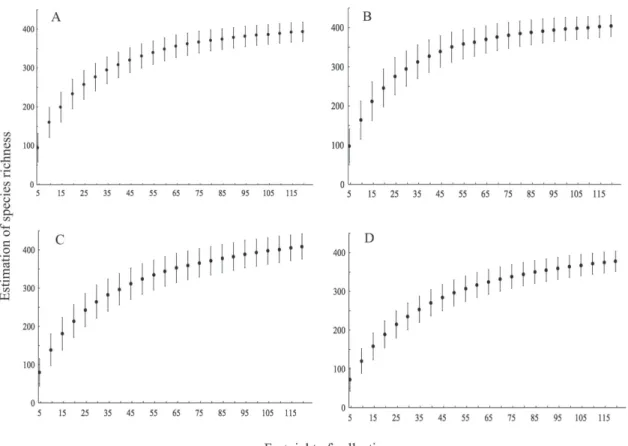
The species accumulation curves showed sta-bility for the primary pests group between the 15th and 35th sampling and for the secondary ones in the 70th, 45th, 35th and 20th samplings in Caracuru, Felipe, Pacanari and Ponte Maria, respectively. The accumulation curves for the species with undefined importance to eucalyptus differed from those of other groups for the 4 pling areas (Fig. 2). At the beginning of the sam-pling, the estimated species richness of this group ranged from 50 to 100 species and increased with a steep slope curve until approximately the 60th sample, when it slowly increased and tended to stabilize in the 4 areas.
The primary pest species were the same in all areas, and therefore, the beta diversity of this group was zero. Species diversity of group II was low (Table 2, Fig. 1) and similar in Caracuru, Pa-canari and Ponte Maria, differing only in Felipe. Group III showed the highest beta diversity, pos-sibly due to major differences in species richness, and the region of Felipe again showed the most difference between the areas (Table 2).
The dissimilarity of secondary pests differed between the areas except in Felipe, which differed by 5.88% from the others (Table 3). The species with undefined importance to eucalyptus planta-tions showed lower dissimilarity between Cara-curu and Ponte Maria (14.88%) and with greater values between Felipe and Pacanari (21.64%) (Table 3).
DISCUSSION
The primary and secondary pest species col-lected were those commonly found in eucalyptus plantations in different regions of Brazil (Pereira et al. 2001; Zanuncio et al. 2003; Freitas et al. 2005; Zanuncio et al. 2006). This indicates that
they are associated with alternative hosts, but have adapted to cultivated eucalyptus (Freitas et al. 2005; Pereira et al. 2009). Furthermore, for-est plantations have lower diversity of plants and therefore can have lower numbers of natural en-emies.
The abundance of lepidopterans may be in-fluenced by habitat type (Robinson et al. 2012); however, all of the areas studied were adjacent
to E. urophylla plantations, which may have
con-tributed to the herbivore and host specificity, as reported for other Brazilian regions (Pereira et al. 2001; Oliveira et al. 2005; Zanuncio et al. 2006).
The lower numbers of individuals of group I in Felipe and Ponte Maria and of species richness of the group III in Felipe are possibly related to the greater proximity of eucalyptus plantations to the native forest. This agrees with the lower number of lepidopteran pests found in E. cloeziana plan-tations with strips of native vegetation in Minas Gerais State, Brazil (Zanuncio et al. 1998b). Also, geographical factors such as area, distance and connectivity between sites affect the richness of lepidopteran species as reported in temperate environments (Bila et al. 2013). Furthermore, this can occur with natural enemy populations, suggesting that maintenance of areas or strips
of native vegetation near eucalyptus plantations can be a reservoir of natural enemies such as hy-menopteran parasitoids (Zanuncio et al. 2001). Protected and in post-successional stage forests may exhibit higher diversity and numbers of in-sects, because such areas have greater resourc-es and varietiresourc-es of microclimatresourc-es (Merckx et al. 2012). This favors the migration of natural en-emies to eucalyptus plantations where they can reduce pest populations (Zanuncio et al. 1998a; Teja & Roland 2004).
The asymptotic curves of species accumulation showed that all primary and secondary pest spe-cies present in plantations were represented in
TABLE 2. BETADIVERSITYINDICESFORLEPIDOPTERANPRIMARYPESTS (I), SECONDARYPESTS (II) ANDSPECIESWITH UNDEFINEDIMPORTANCEFOREUCALYPTUS (III) INTHEREGIONSOF CARACURU, PACANARIAND PONTE MA
-RIA, PARÁ STATE AND FELIPE, AMAPÁ STATE, BRAZIL.
Group Ponte Maria Pacanari Caracuru Felipe
I 0.0000 0.0000 0.0000 0.0000
II 0.0196 0.0196 0.0196 0.0588
III 0.1715 0.1854 0.1701 0.2012
all areas. The stabilization of these curves, over shorter periods, is attributed to the adaptation of these species to eucalyptus, as observed in other Brazilian regions (Freitas et al. 2005; Pereira et al. 2009). The cutting of native trees, whether managed or not, may favor lepidopteran pest spe-cies that feed on alternative hosts (Summerville et al. 2013) to migrate to the plantations, which justify the conservation of these areas.
The lack of stabilization of species accumula-tion curves in short term for the species of group III may be caused by the low variability of plants and scarcity of alternative sources of food for lepi-dopterans in the plantation understory in the first months of planting. Moreover, it can be attributed to the smallest canopy volume of young planta-tions, because species richness may be positively correlated with tree cover (Houlihan et al. 2013).
The group III species may not feed on euca-lyptus plants and, therefore, require other hosts, which would explain the greater effort, and the sampling period to stabilize the curve for this group. Rare lepidopteran species may be associ-ated with plant species in areas with forest domi-nance or underbrush vegetation (Meehan et al. 2013). The high species diversity of this group may be related to vegetation diversity in native forests near the plantations, whose insect fauna can mi-grate to forest plantations (Zanuncio et al. 2001).
The higher richness and abundance of lepi-dopteran species of group III can be explained by the positive correlation with the size and distance of the native forest fragment from the eucalyptus plantation (Rosin et al. 2012). Areas with such plantations were surrounded by the Amazon forest with large trees, mainly in Caracuru and Pacanari, which may have increased the species diversity of group III at these sites.
The similarity between areas shows that a lower sampling effort was required to achieve the stabilization of species accumulation curves of the primary and secondary pests. Furthermore,
the low dissimilarity between sampling sites in-dicates that the monitoring methodology was ap-propriate to represent the fauna of lepidopteran pests of this group of eucalyptus. This type of sur-vey is important for the development of programs of integrated management aiming to control these insects (Maalik et al. 2013). The eucalyp-tus plantations, even at 50 km away from each other, have biotic and abiotic conditions without high variations, which contribute to the similar results between them.
The knowledge of the population dynamics and estimation of species richness are important strategies for monitoring defoliator lepidopterans of eucalyptus. The survey of primary and second-ary pests of this plant can be concentrated in shorter periods to streamline the management and to reduce the costs of monitoring and control. This can be done because the primary and second-ary pests are the same or with very low variations between the sampled sites.
ACKNOWLEDGMENTS
To “Conselho Nacional de Desenvolvimento Cientí-fico e Tecnológico (CNPq)”, “Coordenação de Aperfeiçoa-mento de Pessoal de Nível Superior (CAPES)” and “Fundação de Amparo à Pesquisa do Estado de Minas Gerais (FAPEMIG)” for financial support.
REFERENCES CITED
BILA, K., KURAS, T., SIPOS, J., AND KINDLMANN, P. 2013. Lepidopteran species richness of alpine sites in the High Sudetes Mts.: effect of area and isolation. J. Insect Conserv. 17: 257-267.
COLWELL, R. K., AND CODDINGTON, J. A. 1994. Estimat-ing terrestrial biodiversity through extrapolation. Philos. Trans. R. Soc. B. 345: 101-118.
COLWELL, R. K. 2009. Estimates: Statistical estimation of species richness and shared species from samples. Version 8.2. User’s Guide and application published at: http://purl.oclc.org/estimates.
TABLE 3. DISSIMILARITIESOFALPHADIVERSITIESCALCULATEDBYTHE JACCARD INDEXFORLEPIDOPTERANSECOND
-ARYPESTS (II) ANDSPECIESWITHUNDEFINEDIMPORTANCETOEUCALYPTUS (III) INTHEREGIONSOF CARA
-CURU, PACANARIAND PONTE MARIA, PARÁ STATEAND FELIPE, AMAPÁ STATE, BRAZIL.
Ponte Maria Pacanari Caracuru Felipe
Secondary pests (II)
Ponte Maria — 0.0000 0.0000 0.0588
Pacanari 0.0000 — 0.0000 0.0588
Caracuru 0.0000 0.0000 — 0.0588
Felipe 0.0588 0.0588 0.0588 —
Species with undefined importance to eucalyptus (III)
Ponte Maria — 0.1750 0.1488 0.1906
Pacanari 0.1750 — 0.1648 0.2164
Caracuru 0.1488 0.1648 — 0.1966
DEVRIES, P. J., AUSTIN, G. T., AND MARTIN, N. H. 2009. Estimating species diversity in a guild of Neotropical skippers (Lepidoptera: Hesperiidae) with artificial lures is a sampling problem. Insect Conserv. Diver. 2: 125-134.
DYER, L. A., SINGER, M. S., LILL, J. T., STIREMAN, J. O., GENTRY, G. L., MARQUIS, R. J., RICKLEFS, R. E., GREENEY, H. F., WAGNER, D. L., MORAIS, H. C., DI
-NIZ, I. R., KURSAR, T. A. AND COLEY, P. D. 2007. Host specificity of Lepidoptera in tropical and temperate forests. Nature 448: 696-700.
FREITAS, F. A., ZANUNCIO, T. V., ZANUNCIO, J. C., CON
-CEIÇÃO, P. M., FIALHO, M. C. Q., AND BERNARDINO, A. S. 2005. Effect of plant age, temperature and rain-fall on Lepidoptera insect pests collected with light traps in a Eucalyptus grandis plantation in Brazil. Ann. Forest Sci.62: 85-90.
GANHO, N. G., AND MARINONI, R. C. 2005. A diversidade inventarial de Coleoptera (Insecta) em uma paisa-gem antropizada do Bioma Araucária. Rev. Bras. Entomol. 49: 535-543.
GIMESI, L., HOMORÓDI, R., HIRKA, A., SZABÓKI, C., AND
HUFNAGEL, L. 2012. The effect of climate change on the phenology of moth abundance and diversity. Appl. Ecol. Environ. Res. 10: 349-363.
GUEDES, R. N. C., ZANUNCIO, T. V., ZANUNCIO, J. C.,
AND MEDEIROS, A. G. B. 2000. Species richness and fluctuation of defoliator Lepidoptera populations in Brazilian plantations of Eucalytus grandis as af-fected by plant age and weather factors. Forest Ecol. Mgt. 137: 179-184.
HARRISON, S., ROSS, S. J., AND LAWTON, J. H. 1992. Beta diversity on geographic gradients in Britain. J. Anim. Ecol. 61: 151-158.
HARRISON, T., AND BERENBAUM, M. R. 2013. Moth di-versity in three biofuel crops and native prairie in Illinois. Insect Sci. 20: 407-419.
HILL, J. K., AND HAMER, K. C. 1998. Using species abun-dance models as indicators of habitat disturbance in tropical forests. J. Appl. Ecol.35: 458-460.
HOULIHAN, P. R., HARRISON, M. E., AND CHEYNE, S. M.
2013. Impacts of forest gaps on butterfly diversity in a Bornean peat-swamp forest. J. Asia-Pacific Ento-mol. 16: 67-73.
KITCHING, R. L., ORR, A. G., THALIB, L., MITCHELL, H., HOPKINS, M. S., AND GRAHAM, A. W. 2000. Moth as-semblages as indicators of environmental quality in remnants of upland Australian rain forest. J. Appl. Ecol. 37: 284-297.
LEMOS, W. P., RAMALHO, F. S., SERRÃO, J. E., AND ZA
-NUNCIO, J. C. 2003. Effects of diet on development
of Podisus nigrispinus (Dallas) (Heteroptera:
Pen-tatomidae), a predator of the cotton leafworm. J. Appl. Entomol. 127: 389-395.
LOREAU, M., NAEEM, S., INCHAUSTI, P., BENGTSSON, P., GRIME, J. P., HECTOR, A., HOOPER, D. U., HUSTON, M. A., RAFFAELLI, D., SCHMID, B., TILMAN, D., AND
WARDLE, D. A. 2001. Biodiversity and ecosystem functioning: current knowledge and future challeng-es. Science 294: 804–808.
LOSEY, J. E., AND VAUGHAN, M. 2006. The economic value of ecological services provided by insects. Bio-science56: 311-323.
LOSEY, J. E., AND VAUGHAN, M. 2008. Conserving the ecological services provided by insects. American Entomol.54: 113-115.
MAALIK, S., RANA, S. A., KHAN, H. A., AND ASHFAQ, M.
2013. Diversity and abundance of lepidopteran
pop-ulations from selected crops of district Faisalabad, Pakistan. Pakistan J. Agric. Sci. 50: 95-101.
MEEHAN, T. D., GLASSBERG, J., AND GRATTON, C. 2013. Butterfly community structure and landscape com-position in agricultural landscapes of the central United States. J. Insect Conserv.17: 411-419.
MERCKX, T., FEBER, R. E., HOARE, D. J., PARSONS, M. S., KELLY, C. J., BOURN, N. A. D., AND MACDONALD, D. W. 2012. Conserving threatened Lepidoptera: Towards an effective woodland management policy in landscapes under intense human land-use. Biol. Conserv. 149: 32-39.
NUMMELIN, M. 1998. Log-normal distribution of species abundances is not a universal indicator of rain forest disturbance. J. Appl. Ecol.35: 454-457.
OLIVEIRA, H. N., ZANUNCIO, J. C., PEDRUZZI, E. P. P.,
AND ESPINDULA, M. C. 2005. Rearing of Thyrinteina
arnobia (Lepidoptera: Geometridae) on guava and
Eucalyptus in Laboratory. Brazilian Arch. Biol. Technol. 48: 801-806.
OSAKI, K., SAYAMA, K., UEDA, A., ITO, M., TABUCHI, K.,
AND HIRONAGA, T. 2011. Short-term, efficient sam-pling strategies for estimating forest moth diversity using light traps. Ann. Entomol. Soc. America 104: 739-748.
PALMER, M. W. 1991. Estimating richness species: the second order jacknife reconsidered. Ecology 72: 1512-1513.
PEREIRA, J. M. M., ZANUNCIO, T. V., ZANUNCIO, J. C.,
AND PRATISSOLI, D. 2001. Lepidoptera pests collect-ed in Eucalyptus urophylla plantations during five years in Três Marias, State of Minas Gerais, Brazil. Rev. Biol. Trop.49: 997-1006.
PEREIRA, F. F., ZANUNCIO, T. V., ZANUNCIO, J. C., PRA
-TISSOLI, D., AND TAVARES, M. T. 2008. Species of Lepidoptera defoliators of Eucalyptus as new host for the parasitoid Palmistichus elaeisis (Hymenop-tera: Eulophidae). Brazilian Arch. Biol. Technol. 51: 259-262.
PEREIRA, A. I. A., CURVÊLO, C. R. S., GUERRA, A. M. N. M., ANDRADE, G. S., AND ZANUNCIO, J. C. 2009.
Eucalyptus cloeziana as a new host to Hylesia paulex
(Lepidoptera: Saturniidae) in Southeast Brazilian. Rev. Caatinga 22: 1-5.
RAMALHO, M. AND SILVA, M. 2002. Flora oleífera e sua guilda de abelhas em uma comunidade de restinga tropical. Sitientibus, Sér. Ciênc. Biol. 2: 34-43.
RICKLEFS, R. E. 1987. Community diversity: relative roles of local and regional processes. Science 235: 167-171.
RICKLEFS, R. E. 1996. A economia da natureza. 3 ed. Guanabara Koogan, Rio de Janeiro, 470 pp.
ROBINSON, N., ARMSTEAD, S., AND DEANE BOWERS, M.
2012. Butterfly community ecology: The influences of habitat type, weather patterns, and dominant spe-cies in a temperate ecosystem. Entomol. Exp. Appl. 145: 50-61.
ROSIN, Z. M., MYCZKO, L, SKORKA, P., LENDA, M., MO
-RON, D., SPARKS, T. H., AND TRYJANOWSKI, P. 2012. Butterfly responses to environmental factors in frag-mented calcareous grasslands. J. Insect Conserv. 16: 321-329.
STATSOFT, INC. 2009. STATISTICA (Data Analysis Software System), version 9.0. www.statsoft.com.
SUMMERVILLE, K. S., LANE, J., AND COURARD-HAURI, D.
2013. Stability in forest lepidopteran communities: how sensitive are pest species to experimental for-est management? Insect Conserv. Diver.6: 265-275.
TEJA, T., AND ROLAND. B. 2004. Plant-insect interac-tions in fragmented landscapes. Annu. Rev. Ento-mol.49: 405–30.
WILSON, M. V., AND SHMIDA, A. 1984. Measuring be-ta diversity with presence-absence dabe-ta. J. Ecol. 72:1055-1064.
ZANUNCIO, T. V., ZANUNCIO, J. C., MIRANDA, M. M. M.,
AND MEDEIROS, A. G. B. 1998a. Effect of plantation age on diversity and population fluctuation of Lepi-doptera collected in Eucalyptus plantations in Bra-zil. Forest Ecol. Mgt.108: 91-98.
ZANUNCIO, J. C., MEZZOMO, J. A., GUEDES, R. N. C., AND
OLIVEIRA, A. C. 1998b. Influence of strips of native
vegetation on Lepidoptera associated with
Eucalyp-tus cloeziana in Brazil. Forest Ecol. Mgt.108: 85-90.
ZANUNCIO, J. C., GUEDES, R. N. C., ZANUNCIO, T. V.,
AND FABRES, A. S. 2001. Species richness and abun-dance of defoliating Lepidoptera associated with
Eucalyptus grandis in Brazil and their response to
plant age. Austral Ecol.26: 582-589.
ZANUNCIO, J. C., ZANUNCIO, T. V., FREITAS, F. A., AND
PRATISSOLI, D. 2003. Population density of Lepi-doptera in an plantation of Eucalyptus urophylla
in the state of Minas Gerais, Brazil. Anim. Biol.53: 17-26.
ZANUNCIO, T. V., ZANUNCIO, J. C., FREITAS, F. A., PRA
-TISSOLI, D., SEDIYAMA, C. A. Z., AND MAFFIA, V. P.