www.epjournal.net – 2013. 11(2): 405-414
¯ ¯ ¯ ¯ ¯ ¯ ¯ ¯ ¯ ¯ ¯ ¯ ¯ ¯ ¯ ¯ ¯ ¯ ¯ ¯ ¯ ¯ ¯ ¯ ¯ ¯ ¯ ¯
Original Article
Is Cunnilingus-Assisted Orgasm a Male Sperm-Retention Strategy?
Michael N. Pham, Department of Psychology, Oakland University, Rochester, MI, USA. Email:
Todd K. Shackelford, Department of Psychology, Oakland University, Rochester, MI, USA.
Yael Sela, Department of Psychology, Oakland University, Rochester, MI, USA.
Lisa L. M. Welling, Department of Psychology, Oakland University, Rochester, MI, USA.
Abstract: We secured data from 243 men in committed, sexual, heterosexual relationships to test the sperm retention hypothesis of oral sex. We predicted that, among men who perform cunnilingus on their partner, those at greater risk of sperm competition are more likely to perform cunnilingus until their partner achieves orgasm (Prediction 1), and that, among men who ejaculate during penile-vaginal intercourse and whose partner experiences a cunnilingus-assisted orgasm, ejaculation will occur during the brief period in which female orgasm might function to retain sperm (Prediction 2). The results support Prediction 1 but not Prediction 2. We discuss limitations of the current research and discuss how these results may be more consistent with alternative hypotheses regarding female orgasm and oral sex.
Keywords: evolutionary psychology, oral sex, female orgasm, sperm competition, cunnilingus
¯ ¯ ¯ ¯ ¯ ¯ ¯ ¯ ¯ ¯ ¯ ¯ ¯ ¯ ¯ ¯ ¯ ¯ ¯ ¯ ¯ ¯ ¯ ¯ ¯ ¯ ¯ ¯ ¯ ¯ ¯ ¯ ¯ ¯ ¯ ¯ ¯ ¯ ¯ ¯ ¯ ¯ ¯ ¯ ¯ ¯ ¯ ¯ ¯ ¯ ¯ ¯ ¯ ¯ ¯ ¯ ¯ ¯ ¯ ¯ ¯ ¯ ¯ ¯ ¯ ¯ ¯ ¯ ¯ ¯ ¯ ¯ ¯ ¯ ¯ ¯ ¯ ¯ ¯ ¯ ¯ ¯ ¯ ¯ ¯ ¯ ¯ ¯
Introduction
Human sperm competition
male adaptations designed to thwart or counter the costs of infidelity (Shackelford and Goetz, 2007).
Men use various cues to estimate the risk of their partner’s infidelity (and thus sperm competition). Men who spend a greater proportion of time apart from their partner since the couple’s last copulation experience a greater risk of sperm competition because their partner has more opportunities to surreptitiously copulate with other men (Baker and Bellis, 1993a; McKibbin, Bates, Shackelford, Hafen, and LaMunyon, 2010; Pham and Shackelford, in press; Shackelford, Goetz, McKibbin, and Starratt, 2007; Shackelford et al., 2002). Women also may present a recurrent risk of sperm competition for their partner; men mated to women who have a history of infidelity or who possess personality traits predictive of infidelity are at greater recurrent risk of sperm competition (Goetz et al., 2005; McKibbin et al., 2010). Men mated to more attractive women also are at greater recurrent risk of sperm competition because rival men more frequently approach, and successfully lure away, more attractive women (Goetz et al., 2005; Schmitt and Buss, 2001).
Men adjust their behaviors and physiology to minimize the risk of cuckoldry. Men at greater risk of sperm competition ejaculate a greater number of sperm at the couple’s next copulation (Baker and Bellis, 1993a), report greater interest in copulating with their partner (Pham and Shackelford, in press; Shackelford et al., 2002, 2007; Starratt, McKibbin, and Shackelford, 2013), perform deeper and more vigorous copulatory thrusts that may function to displace rival semen (Gallup et al., 2003; Goetz et al., 2005), and are more likely to sexually coerce their partner (Goetz and Shackelford, 2006). Furthermore, men perform more frequently mate retention behaviors—behaviors designed to decrease the risk of their partner’s infidelity—when she is ovulating than when she is not ovulating (Gangestad, Thornhill, and Garver, 2002; Haselton and Gangestad, 2006; Pillsworth and Haselton, 2006). These behaviors appear to be anti-cuckoldry tactics.
Sperm retention and oral sex
that men’s interest in, and time spent performing, cunnilingus reflects their motivation to promote the occurrence of their partner’s orgasm, thereby facilitating retention of the most recently deposited sperm.
In this study, we test this sperm-retention hypothesis of cunnilingus. Here, we restrict our sample to men who performed cunnilingus on their partner at the couple’s most recent sexual encounter. We predict that, among men who perform cunnilingus on their partner, those at greater recurrent risk of sperm competition will be more likely to report that their partner achieved orgasm (Prediction 1). Moreover, previous research indicates that sperm retention increases as the time between a man’s ejaculation and his partner’s orgasm decreases, and that the greatest sperm retention occurs when a woman achieves orgasm one minute before and up to 45 minutes after her partner ejaculates into her vagina (Baker and Bellis, 1993b; Thornhill, Gangestad, and Comer, 1995). We therefore predict that, among men whose partner achieves cunnilingus-assisted orgasm, female orgasm will occur during the brief time period during which it might function to retain sperm (Prediction 2). Because men’s relationship satisfaction and the length of their relationship are correlated with their interest in their partner’s orgasm (McKibbin et al., 2010) and with the performance and frequency of cunnilingus (Kaestle and Halpern, 2007; Santilla et al., 2008), we control statistically for these potential confounds.
Materials and Methods
Participants
We recruited by word-of-mouth 243 men from universities and the community (United States: n = 190; Germany: n = 53) who were at least 18 years of age, and who were in a committed, heterosexual, sexual relationship lasting at least one year. Based on informal discussions with the participants, we estimate that 75% of the participants lived together and 50% were legally married. All participants reported having had sex with their partner at least once in the past week. The mean participant age was 25.5 years (SD = 8.2) and the mean relationship length was 50.2 months (SD = 63.4; range: 12-475).
Materials and procedures
Extremely). Participants were asked to place the completed questionnaire in an envelope that they then sealed and returned to the experimenter.
Initial processing of data
Following previous research (Goetz et al., 2005; Pham and Shackelford, 2013a), we constructed a recurrent risk of sperm competition measure (α = .84) from the mean of four variables: how sexually and physically attractive the participant views his partner, and how sexually and physically attractive the participant believes other men view his partner. We constructed a relationship satisfaction measure (α = .85) from the mean of four variables: sexual, emotional, and overall satisfaction with partner, and commitment to partner. We excluded from analyses data from men who reported not remembering or who were uncertain of whether their partner achieved a cunnilingus-assisted orgasm (n = 29). Following these exclusion criteria, data reported by 214 men remained.
Results
To test Prediction 1, we used hierarchical logistic regression to predict the occurrence of cunnilingus-assisted orgasm from recurrent risk of sperm competition, controlling statistically for men’s relationship satisfaction and the length of the relationship. In the first step, we entered recurrent risk of sperm competition into the model, which was statistically significant, χ2(1) = 28.31, p < .001, explained 3.7% (Cox and Snell R2) to 5.0% (Nagelkerke R2) of the variance, and correctly classified 60.7% of the cases (see Table 1).
Table 1. Logistic regression analysis predicting the occurrence of partner orgasm from the recurrent risk of sperm competition
Predictors B S.E. Wald Odds Ratio
Recurrent Risk .31 .11 7.73** .74
Constant 1.74 .79 4.91* 5.72
Notes: n = 214 men; df = 1; *p < .05; **p < .01
Table 2. Logistic regression analysis predicting the occurrence of partner orgasm from the recurrent risk of sperm competition, controlling for relationship length and men’s relationship satisfaction
Predictors B S.E. Wald Odds Ratio
Recurrent Risk .30 .13 4.73* .75
Relationship Length .00 .00 3.75 1.00
Relationship Satisfaction .05 .13 .13 1.05
Constant 1.04 .94 1.20 2.82
Notes: n = 214 men; df = 1; *p < .05 (two-tailed)
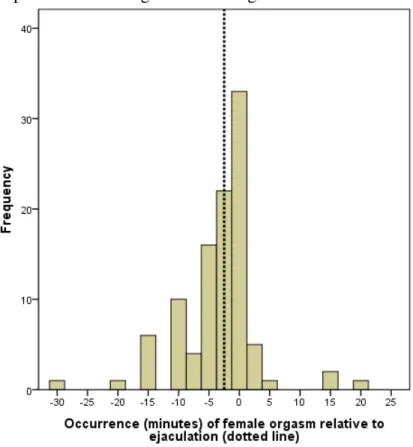
Figure 1 displays the timing of men’s ejaculation relative to their partner’s cunnilingus-induced orgasm. To test Prediction 2, we conducted a binomial test (50% test proportion) to assess whether, among men whose partner achieved cunnilingus-assisted orgasm and who ejaculated during penile-vaginal intercourse, female orgasm occurred in the time period during which it might function to retain sperm—one minute before and up to 45 minutes after ejaculation (Baker and Bellis, 1993b; Thornhill et al., 1995). Prediction 2 was not supported: 42 of 102 men (41%) reported ejaculating within the greater retention period (p > .05).
Discussion
The results of the current study are not consistent with the hypothesis that cunnilingus is designed to promote sperm retention. Men at greater recurrent risk of sperm competition are more likely to perform cunnilingus on their partner until she achieves orgasm; however, ejaculation usually does not occur in the brief time period during which orgasm might function to retain sperm.
Female orgasm may be designed to increase relationship satisfaction (Pair-Bond Hypothesis), to encourage subsequent copulations (Promoting Future Copulations Hypothesis), to retain preferentially the sperm of men with higher genetic quality (Sire Choice Hypothesis), to promote fertilization (for a critical review, see Levin, 2011), or female orgasm may be a non-functional byproduct of male orgasm (reviewed in Puts, Dawood, and Welling, 2012). The results of the current research provide support for the Pair-Bond Hypothesis and the Promotion of Future Copulations Hypothesis. The Pair-Bond Hypothesis states that female orgasm functions to strengthen the emotional bond between partners, and the Promoting Future Copulations Hypothesis states that female orgasm functions to reward sexual behaviors, thereby promoting future sexual encounters with a particular man. These two hypotheses are consistent with the broader hypothesis that men promote their partner’s orgasm to minimize the risk of her infidelity because women who experience stronger feelings of intimacy and who are more satisfied with their partner are less likely to commit infidelity (Buss and Shackelford, 1997). However, one hypothesis alone may not best explain the function of female orgasm (e.g., McKibbin et al., 2010, who documented that men’s risk of sperm competition moderates the association between men’s relationship satisfaction and their interest in their partner’s orgasm). Given the ongoing debate regarding the function of female orgasm (reviewed in Puts et al., 2012), future research should continue to investigate the several proposed functions of female orgasm and, in particular, should attempt to replicate the research of Baker and Bellis (1993b), which relied on a relatively small sample to document that female orgasm may increase sperm retention.
Pham and Shackelford (2013a) identified three evolutionary functions of cunnilingus. Men may perform oral sex on their partner to detect her sexual infidelity by smelling and tasting other men’s semen near or within her vagina (Infidelity Detection Hypothesis; Thornhill, 2006), to facilitate their partner’s orgasm and consequent sperm retention, or to minimize the risk of their partner’s infidelity by increasing her relationship satisfaction (Mate Retention Hypothesis). The results of the current study appear to support the Mate Retention Hypothesis, which is consistent with previous research documenting that men who report greater interest in, and spend more time performing, cunnilingus on their partner also perform more frequently mate retention behaviors (Pham and Shackelford, 2013b).
ejaculating into their partner’s vagina temporally near her orgasm) depend on men’s perception of the risk of their partner’s infidelity. Men’s perception of the occurrence of their partner’s orgasm is arguably a more appropriate assessment when investigating their sperm competition psychology. Future research could nevertheless benefit from securing directly women’s reports of their own orgasm.
A substantial minority of women cannot achieve orgasm, and research has identified several health factors that adversely affect a woman’s capacity to achieve orgasm (Lightner, 2002). We secured men’s perceptions of their partner’s sexual and physical attractiveness as proxies for the recurrent risk of sperm competition. These assessments, in turn, might provide indirect assessments of women’s health (Weeden and Sabini, 2005), but many health conditions may not manifest in women’s attractiveness (Weeden and Sabini, 2005). However, evidence suggests that the vast majority of women are capable of experiencing orgasm (Lloyd, 2005), and that social factors may better predict female orgasm than sexual health (Marshall, 1971). Nevertheless, future research on female orgasm could benefit from securing data on the health status of women to control for this potential confound.
The current research assessed men’s risk of their partner’s infidelity from their partner’s attractiveness. Previous research documented that men attend simultaneously to multiple cues to partner infidelity (McKibbin, Starratt, Shackelford, and Goetz, 2011; Pham and Shackelford, in press). Future research investigating the function of cunnilingus in contexts of partner infidelity would benefit from using combinations of partner infidelity cues, including men’s partner’s attractiveness (Goetz et al., 2005), her history of infidelity (McKibbin et al., 2010), her current conception risk (Gangestad et al., 2002; Haselton and Gangestad, 2006; Pillsworth and Haselton, 2006), and the time she spends with male friends (Pham and Shackelford, in press).
In conclusion, an evolutionary perspective can generate testable hypotheses regarding the function of behaviors and underlying mechanisms. In the current research, we explored and tested the functions of cunnilingus and female orgasm. The results of the current research suggest that cunnilingus and female orgasm may be best explained as elements of a broader male mate retention strategy, but also that a single hypothesis alone may not provide a complete explanation.
Received 24 January 2013; Revision submitted 16 April 2013; Accepted 25 April 2013
References
Baker, R. R., and Bellis, M. A. (1993a). Human sperm competition: Ejaculate adjustment by males and the function of masturbation. Animal Behaviour, 46, 861-885.
Baker, R. R., and Bellis, M. A. (1993b). Human sperm competition: Ejaculate manipulation by females and a function for the female orgasm. Animal Behaviour, 46, 887-909. Buss, D. M., and Shackelford, T. K. (1997). Susceptibility to infidelity in the first year of
marriage. Journal of Research in Personality, 31, 193-221.
and Fertility, 22, 243-251.
Gallup, G. G., Burch, R. L., Zappieri, M. L., Parvez, R. A., Stockwell, M. L., and Davis, J. A. (2003). The human penis as a semen displacement device. Evolution and Human Behavior, 24, 277-289.
Gangestad, S. W., Thornhill, R., and Garver, C. E. (2002). Changes in women's sexual interests and their partners' mate-retention tactics across the menstrual cycle: Evidence for shifting conflicts of interest. Proceedings of the Royal Society B-Biological Sciences, 269, 975-982.
Goetz, A. T., and Shackelford, T. K. (2006). Sexual coercion and forced in-pair copulation as sperm competition tactics in humans. Human Nature, 17, 265-282.
Goetz, A. T., Shackelford, T. K., Weekes-Shackelford, V. A., Euler, H. A., Hoier, S., Schmitt, D. P., and LaMunyon, C. W. (2005). Mate retention, semen displacement, and human sperm competition: A preliminary investigation of tactics to prevent and correct female infidelity. Personality and Individual Differences, 38, 749-763. Haselton, M. G., and Gangestad, S. W. (2006). Conditional expression of women's desires
and men's mate guarding across the ovulatory cycle. Hormones and Behavior, 49, 509-518.
Kaestle, C. E., and Halpern, C. T. (2007). What’s love got to do with it? Sexual behaviors of opposite‐sex couples through emerging adulthood. Perspectives on Sexual and Reproductive Health, 39, 134-140.
King, R., and Belsky, J. (2012). A typological approach to testing the evolutionary functions of human female orgasm. Archives of Sexual Behavior,41, 1145-1160. Levin, R. J. (2001). Sexual desire and the deconstruction and reconstruction of the human
female sexual response model of Masters and Johnson. In W. Everaerd, E. Laan, and S. Both (Eds.), Sexual appetite, desire and motivation: Energetics of the sexual system (pp. 63-93). Amsterdam: Royal Netherlands Academy of Arts and Sciences. Levin, R. J. (2011). Can the controversy about the putative role of the human female
orgasm in sperm transport be settled with our current physiological knowledge of coitus? Journal of Sexual Medicine, 8, 1566-1578.
Lightner, D. J. (2002). Female sexual dysfunction: Concise review for clinicians. Mayo Foundation for Medical Education and Research, 77, 698-702.
Lloyd, E. A. (2005). The case of female orgasm: Bias in the science of evolution. Cambridge, MA: Harvard University Press.
Marshall, D. S. (1971). Sexual behavior on Mangaia. In D. S. Marshall and R. C. Suggs (Eds.), Human sexual behavior (pp. 103-162). New York: Basic Books.
Masters, W. H., and Johnson, V. E. (1966). Human sexual response. Boston: Little, Brown. McKibbin, W. F., Bates, V. M., Shackelford, T. K., Hafen, C. A., and LaMunyon, C. W.
(2010). Risk of sperm competition moderates the relationship between men’s satisfaction with their partner and men’s interest in their partner’s copulatory orgasm. Personality and Individual Differences, 49, 961-966.
Parker, G. G. (1970). Sperm competition and its evolutionary consequences in the insects.
Biological Review, 45, 525-567.
Pham, M. N., and Shackelford, T. K. (2013a). Oral sex as infidelity-detection. Personality and Individual Differences, 54, 792-795.
Pham, M. N., and Shackelford, T. K. (2013b). Oral sex as mate retention behavior.
Personality and Individual Differences, 55,185-188.
Pham, M. N., and Shackelford, T. K. (in press). The relationship between objective sperm competition risk and men’s copulatory interest is moderated by partner’s time spent with other men. Human Nature.
Pillsworth, E. G., and Haselton, M. G. (2006). Male sexual attractiveness predicts differential ovulatory shifts in female extra-pair attraction and male mate retention.
Evolution and Human Behavior, 27, 247-258.
Puts, D. A., Dawood, K., and Welling, L. L. (2012). Why women have orgasms: An evolutionary analysis. Archives of Sexual Behavior,41, 1127-1143.
Richters, J., de Visser, R., Rissel, C., and Smith, A. (2006). Sexual practices at last heterosexual encounter and occurrence of orgasm in a national survey. Journal of Sex Research, 43, 217-226.
Santilla, P., Wager, I., Katarina, W., Harlaar, N., Jern, P., Johansson, A., . . . Sandnabba, N. K. (2008). Discrepancies between sexual desire and sexual activity: Gender differences and associations with relationship satisfaction. Journal of Sex and Marital Therapy, 34, 29-42.
Schmitt, D. P., and Buss, D. M. (2001). Human mate poaching: Tactics and temptations for infiltrating existing mateships. Journal of Personality and Social Psychology, 80, 894-917.
Shackelford, T. K., and Goetz, A. T. (2007). Adaptation to sperm competition in humans.
Current Directions in Psychological Science, 16, 47-50.
Shackelford, T. K., Goetz, A. T., McKibbin, W. F., and Starratt, V. G. (2007). Absence makes the adaptations grow fonder: Proportion of time apart from partner, male sexual psychology, and sperm competition in humans (Homo sapiens). Journal of Comparative Psychology,121, 214-220.
Shackelford, T. K., LeBlanc, G. J., Weekes-Shackelford, V. A., Bleske-Rechek, A. L., Euler, H. A., and Hoier, S. (2002). Psychological adaptation to human sperm competition. Evolution and Human Behavior, 23, 123-138.
Shackelford, T. K., and Pound, N. (Eds.) (2006). Sperm competition in humans. New York: Springer.
Smith, R. L. (1984). Human sperm competition. In R. L. Smith (Ed.), Sperm competition and the evolution of animal mating systems (pp. 601-659). New York: Academic Press.
Starratt, V. G., McKibbin, W. F., and Shackelford, T. K. (2013). Experimental manipulation of psychological mechanisms responsive to female infidelity. Personality and Individual Differences,55, 59-62.
Thornhill, R., Gangestad, S. W., and Comer, R. (1995). Human female orgasm and mate fluctuating asymmetry. Animal Behavior, 50, 1601-1615.
Weeden, J., and Sabini, J. (2005). Physical attractiveness and health in western societies: A review. Psychological Bulletin, 131, 635-653.
Wildt, L., Kissler, S., Licht, P., and Becker, W. (1998). Sperm transport in the human female genital tract and its modulation by oxytocin as assessed by hysterosalpingoscintigraphy, hysterotonography, electrohysterography and Doppler sonography. Human Reproduction Update, 4, 655-666.
Zervomanolakis, I., Ott, H. W., Hadziomerovic, D., Mattle, V., Seeber, B. E., Virgolini, I., . . . Wildt, L. (2007). Physiology of upward transport in the human female genital tract. Annals of the New York Academy of Sciences, 1101, 1-20.