Incidence and risk factors
for intimate partner violence
during the postpartum period
I Programa de Pós-Graduação em Saúde da Criança e do Adolescente. Centro de Ciências da Saúde. Universidade Federal de Pernambuco. Recife, PE, Brasil
II Programa de Pós-Graduação Integrado em Saúde Coletiva. Centro de Ciências da Saúde. Universidade Federal de Pernambuco. Recife, PE, Brasil
Correspondence:
Elisabete Pereira Silva
R. Baltazar Passos, 611 Apto 1206 Boa Viagem 51130-290 Recife, PE, Brasil
E-mail: [email protected] Received: 3/6/2014
Approved: 12/5/2014
ABSTRACT
OBJECTIVE: To estimate the incidence and identify risk factors for intimate partner violence during postpartum.
METHODS: This prospective cohort study was conducted with women, aged between 18-49 years, enrolled in the Brazilian Family Health Strategy in Recife, Northeastern Brazil, between 2005 and 2006. Of the 1.057 women interviewed during pregnancy and postpartum, 539 women, who did not report violence before or during pregnancy, were evaluated. A theoretical-conceptual framework was built with three levels of factors hierarchically ordered: women’s and partners’ sociodemografic and behavioral characteristics, and relationship dynamics. Incidence and risk factors of intimate partner violence were estimated by Poisson Regression.
RESULTS: The incidence of violence during postpartum was 9.3% (95%CI 7.0;12.0). Isolated psychological violence was the most common (4.3%; 95%CI 2.8;6.4). The overlapping of psychological with physical violence occurred at 3.3% (95%CI 2.0;5.3) and with physical and/or sexual in almost 2.0% (95%CI 0.8;3.0) of cases. The risk of partner violence during postpartum was increased for women with a low level of education (RR = 2.6; 95%CI 1.3;5.4), without own income (RR = 1.7; 95%CI 1.0;2.9) and those who perpetrated physical violence against their partner without
being assaulted irst (RR = 2.0; 95%CI 1.2;3.4), had a very controlling partner (RR = 2.5; 95%CI 1.1;5.8), and had frequent ights with their partner
(RR = 1.7; 95%CI 1.0;2.9).
CONCLUSIONS: The high incidence of intimate partner violence during postpartum and its association with aspects of the relationship’s quality between the couple, demonstrated the need for public policies that promote
conlict mediation and enable forms of empowerment for women to address
the cycle of violence.
DESCRIPTORS: Violence Against Women. Spouse Abuse. Battered Women. Pregnant Women. Postpartum Period. Cohort Studies. Elisabete Pereira SilvaI
Sandra ValongueiroII
Thália Velho Barreto de AraújoII
Many studies on violence committed against women
have identiied the victim’s intimate partner as the
most common aggressor.5,9,19 These studies have
also estimated its magnitude7 and the factors associ-ated with intimate partner violence (IPV) before and during pregnancy19 as well as evaluated its impact on the physical and mental health of women2,16 and their children.6 However, postpartum IPV has been studied by few researchers.4,8-12,17,18,23
Postpartum IPV prevalence varies from 8.3% in China10
to 24.2% in Sweden.11 The incidence of any type of
postpartum IPV (psychological, physical and sexual) found in a population-based study by Guo et al10 (2004),
in China, was around 2.5%. Whereas Hedin11 (2000)
observed an incidence of 69.0% in a sample of 132 women attended, eight weeks after childbirth, in three prenatal clinics in Sweden. The incidence of physical violence was found in less than 1.0% of women in the United States18 in a population-based study, and at 11.0%,9 in a sample of 175 women receiving care at a prenatal clinic at a university hospital. These differences
may have been inluenced by the different methodolo -gies, instruments, sample compositions and the post-partum period in which the interview was conducted, which compromised the comparability, especially with respect to the types of violence studied.
Intimate partner violence against women of reproduc-tive age constitutes a public health problem and has
attracted interest from scientiic and political ields.
Nevertheless, no articles on the incidence and risk factors for postpartum IPV in Brazil were found up to the conclusion of this study.
The risk factors for IPV during pregnancy and post-partum are similar to those found in other periods of life: younger women,9,18 with no partner,4 lower educa-tion8 and precarious socioeconomic conditions,22 use of alcohol and illicit drugs by the woman and her
partner,4 partner’s aggressive behavior outside the
home,1,22 length of the relationship,22 dificult commu -nication with the partner,16 ights between the couple,19
partner suspicion of inidelity,12 physical violence by the woman against her partner without being assaulted
irst24 and controlling behavior by a partner.7,22 Another IPV risk factor is the experience of woman or partner, in childhood or adolescence, with IPV against their mother or personal experience (direct) of violence perpetrated by a relative during childhood or adolescence, indi-cating another serious problem – the transgenerational transmission of violence.5,6
The aim of this study was to evaluate the incidence of intimate partner violence during postpartum and iden-tify its risk factors.
INTRODUCTION
METHODS
This cohort study was performed at the Distrito
Sanitário II (one of the six health areas) in a poor
region of the city of Recife, PE, in the Northeastern region of Brazil.
All pregnant women (n = 1,133), aged from 18 to 49 years old, who were enrolled in the Brazilian Family Health Strategy of the district were considered eligible. Twelve of these women did not complete the
question-naire: ive were homeless, three moved away from the
study area and four could not be found by the inter-viewers despite several visits. Once the losses were accounted for, 1,121 (98.9%) pregnant women were interviewed. 1,057 of these women were interviewed again during postpartum. Sixty-four women dropped out between pregnancy and postpartum, two of these for being unable to attend the second interview, three deaths, 37 who changed their address, four who ended up living on the street, 13 who moved to areas controlled by
drug dealers and ive who refused to participate. The 64
women who were not interviewed during postpartum had
lower education (p = 0.001), but no statistically signii -cant difference was observed regarding the frequency of violence during pregnancy, or with any other socioeco-nomic and demographic variables.
The irst contact with the pregnant women was made
during their prenatal consultation. The pregnant women
were identiied from the prenatal care records of 42
Family Health Strategy teams. Records from commu-nity health agents were also evaluated so as to include women not receiving antenatal care at the family health strategy units. The preferred option was for the prenatal interview to take place at the health unit, but some women were interviewed at home, when requested.
The women, during their postpartum period, were contacted during childcare consultations or at home, following the same pattern that was established for interviews during pregnancy. Most of the interviews were held at the interviewees’ homes between May and December 2006.
The 518 women who reported IPV before and during pregnancy were excluded to estimate the incidence, leaving 539 women who were reinterviewed up to 12 months after childbirth.
Two questionnaires were applied: one during pregnancy and the other during the postpartum period. Data were collected between July 2005 and December 2006 by female interviewers.
Conidentiality and privacy for those interviewed
women had experienced IPV, all received speciic
information on social services, health, legal and law enforcement, which were made available in the study area. Services that provide assistance to female victims of violence were solicited to provide help to any women interviewed who was suffering from domestic violence.
The IPV-related questions were prepared referring to the questionnaire of the World Health Organization Multi-country Study on Women’s Health and Domestic violence against women, which has already been vali-dated in Brazil.20
The intimate partner was deined as a partner or former
partner whom the woman is living or used to live with, regardless of any formal union and whom the woman was having or had had sexual relations with.16
Questions to identify physical violence were char-acterized as physical aggression or use of weapons or objects to cause injury; psychological violence as threatening behavior, humiliation or insult; and sexual violence as sexual relations imposed by phys-ical force or threats and any imposed acts that were considered humiliating. Women who answered “Yes” to at least one of the questions that referred to each type of violence were considered a positive case. The time of every report of violence was explored
about its occurrence before and during pregnancy and postpartum. Additional information about the study methods are reported in other publications.7,16
The analysis was guided by a theoretical and concep-tual model (Figure 1), which describes the hierarchical relationships between postpartum IPV risk factors, divided into three levels of determinants (proximal, intermediate and distal).25
Level 1 (distal) included sociodemographic character-istics of the woman and her partner: age (< 20 years; ≥ 20 years), race/skin color (white; non-white), years in education (< 9 years; ≥ 9 years) and employment status (inactive; active). The following variables were also taken into account for the woman: currently living with partner (yes; no), housing status (owner; not owner) and own income (yes; no).
Level 2 (intermediate) included behavioral variables, with answers (yes; no) about the women: tobacco use, alcohol abuse and illicit drug use; and answers (yes; no) about the partner: alcohol abuse, illicit drug use and aggressive behavior outside the home.
Level 3 (proximal) included the dynamics of
the relationship: relationship duration (≤ 1 year;
> 1 year), ights between the couple (≥ 1 time/month; < 1 time/month), physical violence committed by the
Figure 1. Theoretical-conceptual hierarchical model of risk factors for incidence of intimate partner violence postpartum. Violence by intimate partner
postpartum (postpartum IPV) Block 3
Relationship profile (Proximal) Block 1
Sociodemographic characteristics
(Distal)
Block 2 Behavioral characteristics (Intermediate)
Couple Relationship duration Communication with partner Fights Woman
Age
Race/skin color Marital status Education Employment status Income
Own house
Woman Tobacco use Alcohol abuse Illicit drug use
Partner Alcohol abuse Illicit drug use Aggressive behavior outside the home
Woman Physical violence against partner
Partner Controlling behavior Partner
Age
women against her partner without being assaulted irst (yes; no), communication with the partner (good; difi -cult), and controlling behavior by the partner (none; moderate; high). More detailed descriptions of these last two variables can be found in published literature.16 Analysis was performed using Stata, version 10.1 soft-ware. Poisson regression was used to estimate crude
and adjusted relative risk (RR), and the 95% coni -dence interval of the association between postpartum IPV and the explanatory variables.
The analysis strategy for the hierarchical model of determination, following the distal-proximal order, which made it possible to evaluate whether the effect of risk factors on postpartum IPV, was direct or mediated by other factors.5,25 Model 1 included variables from levels 1, 2 and 3, which were adjusted by the variables at the same level. In model 2, variables from level 2 were adjusted for the variables from the same level and for those that remained in model 1. In model 3, variables from level 3 were adjusted for those that remained in models 1 and 2.
The statistically signiicant variables (p ≤ 0.05) in model 1 were kept in the subsequent models. The previously
tested block, which lost its signiicance when included
in a new block, remained in the model.
When the three hierarchical levels are considered, the model presents: a) estimates for the effects of sociode-mographic characteristics of the woman and her partner on postpartum IPV, not mediated by variables from the intermediate and proximal levels (dashed and dotted arrows in Figure 1); b) estimates for the effects of sociodemographic characteristics of the woman and her partner on the relationship dynamics, not mediated by the intermediate level (dashed arrow); c) estimates for the effects of the behavior of the woman and her partner on postpartum IPV, adjusted for variables from the distal level and not mediated by variables from the proximal level (dotted arrow); and d) estimates for the effects of the variables of the relationship dynamics on the postpartum IPV, adjusted for variables from the distal and intermediate levels.
This research was approved by the Ethics Committee at the Federal Universidade Federal de Pernambuco (Protocol 303/2004). All participants signed an informed consent term.
RESULTS
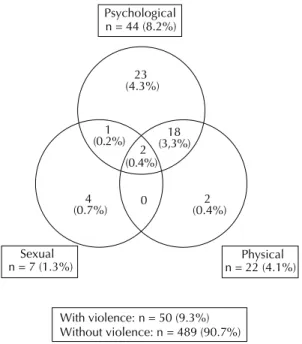
The incidence of some kind of postpartum IPV (Figure 2) was 9.3% (95%CI 7.0;12.0), with isolated psychological violence being more common (4.3%; 95%CI 2.8;6.4) than overlapping psychological and physical violence (3.3%; 95%CI 2.0;5.3) and psychological and/or physical and/or sexual violence
(1.7%; 95%CI 0.8;3.0). Sexual violence was the
least frequent and all the cases occurred in the irst
40 days of postpartum.
The risk of postpartum IPV was most common among women without own income, those who had less than nine years of education, who were not living with their intimate partner when the interview was held or whose partners abused alcohol and used illicit drugs (Table 1). Postpartum IPV was also more common in women, who had been in their relationship for less than one year, those with a very controlling partner, those
who reported having frequent ights with their partner
or who had committed physical assaults against their
partner without being assaulted irst (Table 1).
Table 2 shows the results of the hierarchical analysis. The risk of postpartum IPV was higher for women with low education (RR = 2.6; 95%CI 1.3;5.4) with no personal income (RR = 1.7; 95%CI 1.0;2.9), which physically attacked the partner without being assaulted
irst (RR = 2.0; 95%CI 1.2;3.4), had a very controlling
partner (RR = 2.5; 95%CI 1.1;5.8) and had frequent
ights with their partner (RR = 1.7; 95%CI 1.0;2.9).
The association between alcohol abuse by the partner and
postpartum IPV lost statistical signiicance when adjusted
for factors related to sociodemographic conditions.
DISCUSSION
This is the irst known Brazilian cohort study to estimate
the incidence and risk factors for postpartum IPV. The
Psychological n = 44 (8.2%)
Physical n = 22 (4.1%) Sexual
n = 7 (1.3%)
23 (4.3%)
2 (0.4%) 4
(0.7%)
18 (3,3%) 1
(0.2%)
0 2 (0.4%)
With violence: n = 50 (9.3%) Without violence: n = 489 (90.7%)
Table 1. Association of sociodemographic, behavioral characteristics and the relationship proile with incidence of violence by intimate partner postpartum. Recife, PE, Northeastern Brazil, 2005-2006.
Variable n = 539 % Cases (n = 50) % RR 95%CI
Sociodemographic characteristic
Age (years)
≥ 20 469 87.01 41 8.74 1.0 –
< 20 70 12.99 9 12.86 1.5 0.7;2.9
Race/skin color
White 112 20.78 11 9.82 1.0 –
Non-white 427 79.22 39 9.13 0.9 0.5;1.8
Education of the women (years of study)
≥ 9 221 41.00 9 4.07 1.0 –
< 9 318 59.00 41 12.89 3.2 1,6;6,4a
Marital status
With partner 477 88.50 40 8.39 1.0 –
Without partner 62 11.50 10 16.13 1.9 1.0;3.6b
Employment status
Other 148 27.46 9 6.08 1.0 –
Unemployed 391 72.54 41 10.49 1.7 0.8;3.5
Own income
Yes 316 58.63 23 7.28 1.0 –
No 223 41.37 27 12.11 1.6 0.9;2.8
Own house
Yes 363 67.35 32 8.82 1.0 –
No 176 32.65 18 10.23 1.2 0.7;2.0
Behavioral characteristic
Tobacco use
No 482 89.42 42 8.71 1.0 –
Yes 57 10.58 8 14.04 1.6 0.8;3.2
Alcohol abuse
No 461 85.53 39 8.46 1.0 –
Yes 78 14.47 11 14.10 1.7 0.9;3.1
Illicit drug use
No 535 99.26 49 9.16 1.0 –
Yes 4 0.74 1 25.00 2.7 0.5;15.2
Alcohol abuse by partner
No 347 64.38 25 7.20 1.0 –
Yes 192 35.62 25 13.02 1.8 1.1;3.0b
Illicit drug use by partner
No 498 92.39 43 8.63 1.0 –
Yes 41 7.61 7 17.07 1.9 0.9;4.1
Aggressive behavior by the partner outside the home
No 496 92.02 45 9.07 1.0 –
Yes 43 7.98 5 11.63 1.3 0.5;3.0
data show a high incidence of postpartum IPV associ-ated with gender inequality in the relationship.
The incidence of postpartum IPV was higher than that found by Guo et al10 (2004) and by Martin et al18 (2001), who evaluated postpartum physical violence. However, it was lower than the incidence of physical violence found by Gielen et al9 (1994) and the three types of violence cited by Hedin (2000).11
As in other studies the overlapping of different types of violence was frequent.10 The highest incidence of psycho-logical violence alone or overlapping with other types had been reported in some studies,4,17 but differs from a study performed in China,10 that found psychological violence to be less common than sexual or physical violence. The low percentage of psychological violence
reported in some studies may relect cultural inluences
and structured relationships in gender inequality, which
make it dificult for women to recognize situations
that are considered psychological abuse. According to Charles and Perreira4 (2007), the high percentage of psychological violence during postpartum can be due to high levels of stress and discord, which are associated
with the signiicant life changes that occur for a woman
or a couple when a new child is born.
In this study, all episodes of sexual violence reported
occurred in the irst 40 days after childbirth. Macy et al17 (2007) found a higher percentage of sexual violence in
the irst month of postpartum. For Jasinski13 (2004), this
may result of less interest of women in sexual activity in the immediate postpartum, which is possibly a result of their special hormonal state following childbirth. In addition, Ansara et al2 (2005) showed that women who have recently given birth may experience physical prob-lems, ranging from fatigue to pain in various parts of the body, especially for those who are victims of IPV. Women also face problems of psychosocial adjustingto
motherhood and dificulties regardinglack of support and understanding of the dynamics of puerperium, particularly from their partner.
A varied group of potential risk factors for postpartum IPV emerged during the bivariate analysis. However, during the hierarchical analysis, remained associated with the incidence of postpartum IPV women with low education, without own income and those who
physi-cally abused their partner without being assaulted irst; frequent ights between the couple and controlling
behavior by the partner.
The risk of postpartum IPV found in this study was higher for women who had less than nine years of schooling, which suggest the importance of education
for empowerment, self-conidence and an active stance
in society. Women’s higher levels of schooling can also be one of the factors that make them more vulnerable to IPV,9 highlighting the gender inequality that permeates violent relationships and the importance of promoting
equal access to education for men and women.1
Continuation Related to the couple
Relationship length (years)
> 1 406 75.32 32 7.88 1.0 –
≤ 1 133 24.68 18 13.53 1.7 1,0;2,9b
Communication with partner
Good 494 91.65 43 8.70 1.0 –
Dificult 45 8.35 7 15.56 1.9 0.8;3.7
Fights (twice a month)
< 1 401 74.40 21 7.23 1.0 –
≥ 1 138 25.60 29 15.22 2.1 1.2;3.6b
Related to the woman
Physical violence committed by the women against the partner without being assaulted irst
No 436 80.89 31 7.11 1.0 –
Yes 103 19.11 19 18.45 2.6 1.5;4.4a
Related to the partner Controlling behavior
None 220 40.82 11 5.00 1.0 –
Moderate 276 51.21 31 11.23 2.2 1.2;4.4b
High 43 7.98 8 18.60 3.7 1.6;8.7b
The lack of women’s inancial autonomy demonstrated
by not having own income was associated with inci-dence of postpartum IPV, probably for making the woman more dependent upon the man, for her own and her children’s survival. This vulnerability14 hinders the possibilities of negotiating changes in the relationship, of separating from the partner or of seeking help when assaulted. In addition, women living in poverty are exposed to more severe and frequent IPV. Financially independent women can become more empowered in certain contexts, but not in those where women’s economic activity can be understood as a challenge to male identity of power and control.1,14
Couples who quarreled frequently showed increased risk of postpartum IPV. For Jasinski13 (2004), couples with a newborn child often experience sleepless nights, and the changes in family dynamics may cause arguments
between the couple, especially regarding sexual activity, which can lead to increased sexual violence. Other factors, suggested by Stewart23 (1994), are increasing inancial responsibility, women’s physical changes and couples adjusting to their new roles of father and mother and other family relationships. This context, which includes
inter-personal conlict, dissatisfaction with the relationship, poor communication and dificult for problem solving
strengthens the role of the relationship dynamics between the couple regarding the incidence of IPV.3
The association of controlling behavior with postpartum IPV, found during this study, was also shown in other studies on IPV.1,7,22 Controlling behavior may relect the increased vulnerability for IPV of women living in social contexts of gender inequality.14
Physical aggression perpetrated by the woman against her partner was also reported by Swan and Snow24 (2006)
Table 2. Risk factors for incidence of intimate partner violence postpartum. Recife, PE, Northeastern Brazil, 2005-2006.
Variable Model 1
a Model 2b Model 3c
RR 95%CI RR 95%CI RR 95%CI
Sociodemographic characteristic
Education of the women (years of study)
≥ 9 1.0 1.0 1.0
< 9 3.0 1.5;6.0d 3.0 1.5;6.1d 2.6 1.3;5.4d
Own income
Yes 1.0 1.0 1.0
No 1.7 1.0;2.9e 1.7 1.0;2.8e 1.7 1.0;2.9e
Behavioral characteristic
Alcohol abuse by partner
No 1.0 1.0 1.0
Yes 1.7 1.0;2.9e 1.6 0.9;2.7 1.5 0.9;2.7
Relationship proile Relationship length (years)
> 1 1.0 1.0
≤ 1 1.6 0.9;2.7 1.4 0.8;2.4
Fights (twice a month)
< 1 1.0 1.0
≥ 1 1.7 1.0;3.0e 1.7 1.0;2.9e
Physical violence against the partner without being assaulted irst
No 1.0 1.0
Yes 2.0 1.2;3.5e 2.0 1.2;3.4e
Controlling behavior
None 1.0 1.0
Moderate 1.9 0.9;3.7 1.8 0.9;3.4
High 2.6 1.1;6.3e 2.5 1.1;5.8e
a Blocks 1, 2 and 3 individually adjusted. b Block 2 adjusted by block 1.
c Block 3 adjusted by blocks 1 and 2. d p < 0.01.
1. Abramsky T, Watts CH, Garcia-Moreno C, Devries K, Kiss L, Ellsberg M, et al. What factors are associated with recent intimate partner violence? indings from the WHO multi-country study on women’s health and domestic violence. BMC Public Health. 2011;11:109. DOI:10.1186/1471-2458-11-109
2. Ansara D, Cohen MM, Gallop R, Kung R, Schei B. Predictors of women’s physical
health problems after childbirth. J Psychosom Obstet Gynaecol. 2005;26(2):115-25. DOI:10.1080/01443610400023064
3. Bell KM, Naugle AE. Intimate partner violence theoretical considerations: moving towards a contextual framework. Clin Psychol Rev. 2008;28(7):1096-107. DOI:10.1016/j.cpr.2008.03.003 REFERENCES
as a strong risk factor for violence against women. These authors consider contextual factors to understand the reasons that lead a woman assaulting her partner. They argue that this action can be an expression of the woman’s desire to defend herself and their children from physical harm; but it can also go beyond self-defense and include anger, revenge and the desire to control the partner.
In a study by Guo et al10 (2004), 44.6% of women
responded all suffered aggressions, using active strategies to maximize their security, whereas a study by Silva et al21 (2012) shows a higher percentage (85.0%). Some studies that evaluated the bidirectionality of violence between partners found that the frequency of IPV perpetrated by women was higher, but resulting serious injury was more common when the man was the perpetrator.24
Alcohol abuse by the partner was associated with
postpartum IPV, but lost statistical signiicance when
adjusted to the socioeconomic conditions. The asso-ciation between alcohol abuse by the partner and IPV is still controversial. This association depends on the different ways of measuring alcohol use, types of samples and violence, individual partner characteris-tics, situational variables and relationship factors.1,12,14
This study has several advantages: it is a population-based cohort study on gender violence and complements previous results from prospective studies on postpartum IPV;8,10,12,17,18,23 it evaluates three kinds of violence; the questionnaire used is internationally recognized,7 it is validated in Brazil20 and gauges violence based on
speciic acts, which increases the reliability of the results;
and it has a theoretical-conceptual hierarchical model that aims to integrate contextual dimensions to understand why violence in intimate relationships exists.3
Some limitations should be considered. Violence perpe-trated by an intimate partner is a complex, delicate and intimate topic. Thus, women’s psychological resources
used to deal with the trauma suffered and their difi -culties and obstacles that result from this experience can interfere with their willingness to talk about it. Women may not always recognize their experience of IPV when questioned in some situations, or they can minimize the importance of IPV by considering it to be natural,15 which may contribute to the seriousness
of these actions being underestimated. In addition to these factors, which are intrinsic to woman, others may cause violence to be underestimated, such as: the non-empathetic interviewer-interviewee relationship, the interview location, the woman’s insecurity about
interview conidentiality, the current relationship with
the partner, the sense of fear regarding the partner-aggressor and the protection that the woman gives the partner based on her desire to maintain the rela-tionship, especially if he is the father of the child; and among many other factors, the stigma and the shame of being assaulted.8 With the objective of minimizing those limitations, interviewers selected had experience in dealing with “violence against women” and were
properly trained and monitored during the ield work.
In Brazil, the social and institutional responses to demands from women’s movements have resulted in greater IPV awareness. However, cases reported by
women and cases identiied and reported by institutions
and health professionals still continue to be underesti-mated.15 The high observed incidence of VPI during partum may still be underestimated and shows that post-partum is a not period of security for either the woman or her child. Women reporting violence is dependent on, as well as various other factors, the socioeconomic condi-tions of women and their partners. It is also dependent on personal concepts and sociocultural contexts, in which hierarchy is more or less legitimized, which contributes to the increase or decrease in reports of violence.4,7,15,18
This study showed a high incidence of IPV, which involved a complex network of risk factors, with emphasis on the quality of the affective-sexual rela-tionship. In this sense, to reduce the incidence of IPV, in addition to the public policy of protection and
assis-tance to women, preventive measures that foster conlict
mediation and seek social and gender equity would be needed. In this context, another important aspect is that, in addition to women, children are also exposed to IPV during their vulnerable and early stage of devel-opment. Therefore, childcare consultations are oppor-tunities for the health professional to build a trusting relationship with the mother, which can facilitate
strat-egies for disclosing violence and enable to ind ways of
4. Charles P, Perreira KM. Intimate partner violence during pregnancy and 1-year postpartum. J Fam Viol. 2007;22(7):609-19. DOI:10.1007/s10896-007-9112-0
5. D Oliveira AFPL, Schraiber LB, França-Júnior I, Ludermir AB, Portella AP, Diniz CS, et al. Fatores associados à violência por parceiro íntimo em mulheres brasileiras. Rev Saude Publica. 2009;43(2):299-310. DOI:10.1590/S0034-89102009005000013
6. Durand JG, Schraiber LB, França-Júnior I, Barros C. Repercussão da exposição à violência por parceiro íntimo no comportamento dos ilhos. Rev Saude Publica. 2011;45(2):355-64. DOI:10.1590/S0034-89102011005000004
7. Garcia-Moreno C, Jansen HAFM, Ellsberg M, Heise L, Watts CH; WHO Multi-country Study on Women’s Health and Domestic Violence against Women Study Team. Prevalence of intimate partner violence: indings from the WHO multi-country study on women’s health and domestic violence. Lancet. 2006; 368(9543):1260-69. DOI:10.1016/S0140-6736(06)69523-8
8. Gartland D, Hemphill SA, Hegarty K, Brown SJ. Intimate partner violence during pregnancy and the irst year postpartum in an Australian pregnancy Cohort study. Matern Child Health J. 2011;15(5):570-78. DOI:10.1007/s10995-010-0638-z
9. Gielen AC, O’Campo PJ, Faden RR, Kass NE, Xue X. Interpersonal conlict and physical violence during the childbearing year. Soc Sci Med. 1994;39(6):781-7. DOI:10.1016/0277-9536(94)90039-6
10. Guo SF, Wu JL, Qu CY, Yan RY. Domestic abuse on women in China before, during, and after pregnancy. Chin Med J (Engl). 2004;117(3):331-6.
11. Hedin LW. Postpartum, also a risk period for domestic violence. Eur J Obstet Gynecol Reprod Biol. 2000;89(1):41-5. DOI:10.1016/S0301-2115(99)00164-5
12. Hellmuth JC, Gordon KC, Stuart GL, Moore TM. Risk factors for intimate partner violence during pregnancy and postpartum. Arch Womens Ment Health. 2013;16(1):19-27. DOI:10.1007/s00737-012-0309-8
13. Jasinski JL. Pregnancy and domestic violence: a review of the literature. Trauma Violence Abuse. 2004;5(1):47-64. DOI:10.1177/1524838003259322
14. Jewkes R. Intimate partner violence: causes and prevention. Lancet. 2002;359(9315):1423-9. DOI:10.1016/S0140-6736(02)08357-5
15. Kiss L, d’Oliveira AF, Zimmerman C, Heise L, Schraiber LB, Watts C. Brazilian policy responses to
violence against women: government strategy and the help-seeking behaviors of women who experience violence. Health Hum Rights. 2012;14(1):E64-77.
16. Ludermir AB, Lewis G, Valongueiro SA, Araújo TVB, Araya R. Violence against women by their intimate partner during pregnancy and postnatal depression: a prospective cohort study. Lancet. 2010;376(9744):903-10. DOI:10.1016/S0140-6736(10)60887-2
17. Macy RJ, Martin SL, Kupper LL, Casanueva C, Guo S. Partner violence among women before, during, and after postpartum: multiple opportunities for intervention. Womens Health Issues. 2007;17(5):290-9. DOI:10.1016/j.whi.2007.03.006
18. Martin SL, Mackie L, Kupper LL, Buescher PA, Moracco KE. Physical abuse of women before, during, and after pregnancy. JAMA. 2001;285(12):1581-4. DOI:10.1001/jama.285.12.1581
19. Saltzman LE, Christopher HJ, Gilbert BC, Goodwin MM. Physical abuse around the time of pregnancy: an examination of prevalence and risk factors in 16 states. Matern Child Health J. 2003;7(1):31-43. DOI:10.1023/A:1022589501039
20. Schraiber LB, Latorre MRD, França-Junior I, Segri NJ, D’Oliveira AFPL. Validade do instrumento WHO/VAW STUDY para estimar violência de gênero contra a mulher. Rev Saude Publica. 2010;44(4):658-66. DOI:10.1590/S0034-89102010000400009
21. Silva RA, Araújo TVB, Valongueiro S, Ludermir AB. Facing violence by intimate partner: the experience of women in an urban area of Northeastern Brazil. Rev Saude Publica. 2012;46(6):1014-22. DOI:10.1590/S0034-89102013005000007
22. Sonis J, Langer M. Risk and protective factors for recurrent intimate partner violence in a cohort of low-income inner-city women. J Fam Viol. 2008;23(7):529-38. DOI:10.1007/s10896-008-9158-7
23. Stewart DE. Incidence of postpartum abuse in women with a history of abuse during pregnancy. CMAJ. 1994;151(11):1601-4.
24. Swan SC, Snow DL. The development of a theory of women’s use of violence in intimate relationships. Violence Against Women. 2006;12(11):1026-45. DOI:10.1177/1077801206293330
25. Victora CG, Huttly SR, Fuchs SC, Olinto MTA. The role of conceptual frameworks in epidemiological analysis: a hierarchical approach. Int J Epidemiol. 1997;26(1):224-7. DOI:10.1093/ije/26.1.224