Editorial
‘‘Manifesto’’ for Advancing the Control and Elimination
of Neglected Tropical Diseases
Peter J. Hotez1*, Bernard Pecoul2*
1Department of Microbiology, Immunology, and Tropical Medicine, George Washington University and Sabin Vaccine Institute, Washington, D. C., United States of America,2DNDi (Drugs for Neglected Diseases Initiative), Geneva, Switzerland
Neglected tropical diseases (NTDs) are the most common infections of the world’s poorest people and the leading causes of chronic disability and poverty in low- and middle-income countries [1–3]. NTDs (Table 1) especially affect children and young women of reproductive age [4], and consequently deprive them of their health and economic potential [3]. NTDs also impair agricultural productiv-ity and are an important reason why the world’s poorest 1.4 billion people who live below the poverty line cannot escape destitution and despair [3]. Despite the devastating effect of these diseases on health and development, with evidence that their global burden is as great as that of any other serious disease [1–3], finan-cial support for control and elimination efforts, as well as research and develop-ment (R&D), have been inadequate [2,5].
Indeed, in Millennium Development
Goal 6 (to ‘‘combat HIV/AIDS, malaria and other diseases’’), NTDs were not even specifically mentioned but merely consid-ered as part of the ‘‘other diseases’’ [6]. However, policy makers are slowly begin-ning to appreciate the importance of NTDs.
The World Health Organization
(WHO) has a new Department of Ne-glected Tropical Diseases, and WHO-TDR (Special Programme for Research and Training in Tropical Diseases) has a new 10-year strategic plan with support from UN agencies, member states, and private philanthropies. At the same time, funding for integrated NTD preventive chemotherapy control from the govern-ments of the US and UK has increased
dramatically and is approaching US$100
million annually, while support remains strong for product development partner-ships from the Bill & Melinda Gates Foundation, Me´decins Sans Frontie`res (MSF), and a few European governments. Recently, the new Director of the US National Institutes of Health, Francis Collins, has targeted NTDs as a research priority, and the UK charity Wellcome Trust has agreed with the multinational pharmaceutical company Merck & Co. to
allocate substantial funds for a joint, not-for-profit research center in India to develop inexpensive ‘‘antipoverty’’ vac-cines against neglected diseases [7,8]. Additional efforts to combat NTDs are also being shared among major multina-tional pharmaceutical companies (i.e., Novartis, GlaxoSmithKline, Pfizer, Sa-nofi-Aventis, Merck & Co.) and others who have also committed resources and made investments in research and
devel-opment for these conditions. Thus,
although at present only about 10% of the global funds required for preventive chemotherapy and NTD mass drug ad-ministration have been committed, and although R&D for NTDs has not even reached the so-called 10/90 gap [9,10] (meaning only 10% of available global R&D spending is committed for diseases that disproportionately affect 90% of the world living in low-income and middle-income countries), there is cautious opti-mism that such disparities could diminish in the coming decade.
With a combination of funds from the group of eight (G8) nations, emerging economies (e.g., Brazil, India), multina-tional companies, and private philanthrop-ic sources, together with a community of scientists, physicians, and other healthcare workers, global public health experts and policy makers committed to NTDs have begun to deliberate about how future resources and investments should be best allocated, particularly in terms of an appropriate balance between implementa-tion and R&D. The leadership of key
international agencies such as WHO, ministries of health in disease-endemic countries, and the communities themselves is key to achieve any ambitious strategy. With a global dialogue now underway, this is an appropriate time to present an eight-point manifesto (‘‘a public declaration of motives and intentions by a government or by a person or group regarded as having some public importance’’ [2,11]) for NTDs.
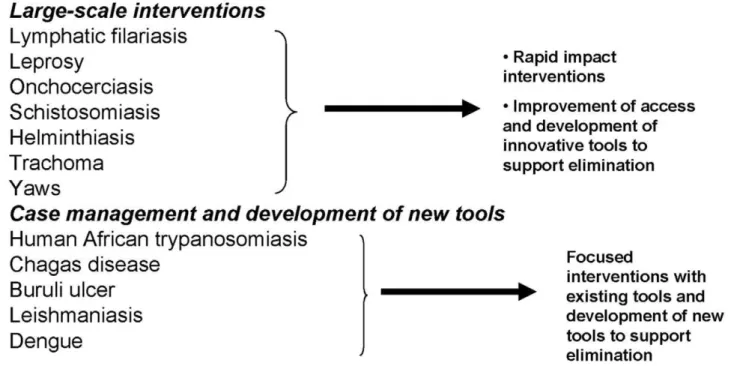
1. All NTDs are ‘‘tool ready’’ Tools refer partly to the drugs used to treat NTDs in low- and middle-income countries, particularly when these are used as agents of control and elimination through mass drug administration [12]. Today, most of the NTDs have tools that could be implemented now, even if for some diseases such tools are far from being perfect or complete (Figure 1). For exam-ple, each year, hundreds of millions of poor people receive donated or low-cost generic drugs, which in some epidemio-logical environments have led to the elimination of lymphatic filariasis (LF), onchocerciasis, and trachoma [13–15], as well as reduction of morbidity for the three major soil-transmitted helminth infections (i.e., ascariasis, trichuriasis, and hookworm infection), and for schistosomiasis (Table 2) [1–3,12]. At present, populations at risk for LF and onchocerciasis are receiving
the highest global drug coverage (.40%),
whereas less than 10% of school-aged children at risk for soil-transmitted
hel-Citation:Hotez PJ, Pecoul B (2010) ‘‘Manifesto’’ for Advancing the Control and Elimination of Neglected Tropical Diseases. PLoS Negl Trop Dis 4(5): e718. doi:10.1371/journal.pntd.0000718
PublishedMay 25, 2010
Copyright: ß2010 Hotez, Pecoul. This is an open-access article distributed under the terms of the Creative Commons Attribution License, which permits unrestricted use, distribution, and reproduction in any medium, provided the original author and source are credited.
Funding:The authors received no specific funding for this study.
Competing Interests: Peter J. Hotez is an inventor on international patents for hookworm and schistosomiasis vaccines.
* E-mail: [email protected] (PJH); [email protected] (BP)
minth infections and schistosomiasis are receiving treatment [12]. To improve global coverage rates, in many cases the control of these large-scale–intervention NTDs could be achieved by simultaneous administration of several drugs, sometimes in a so-called ‘‘rapid impact package’’
costing around US$0.50 per person per
year [1–3,12,16,17]. Similarly, leprosy has
been eliminated in many countries
through multi-drug therapy [18]. The NTD manifesto mandates that mass drug administration programs continue to ex-pand until they reach the entire ‘‘bottom billion’’ who deserves access to essential medicines. Simultaneously, support must be provided for parallel operational re-search to optimize integration of the different NTD mass treatment programs
and for other aspects of implementation science.
Tools for NTDs also refer to field-based diagnostics and vector-control strat-egies (in some cases using geographic information systems and remote sensing), as well as improvements in water and sanitation. The nearly-complete eradica-tion of dracunculiasis is an outstanding example of how non-drug-based ap-proaches can achieve sustained control [19]. There have been successes in the local control of dengue and other arbo-viral infections through mosquito control measures [20], and in trachoma elimina-tion through a combined strategy of surgery, antibiotics, face washing, and environmental control (SAFE strategy) [1,3,12,21].
At present, we can also achieve substan-tial sustainable control for the important
vector-borne kinetoplastid NTDs (i.e.,
human African trypanosomiasis [HAT], Chagas disease, and leishmaniasis). For example, during the early part of the 20th century, Jamot and his colleagues imple-mented mobile teams for Gambian HAT in West Africa. These health teams, with the logistical support of the military, traveled to endemic areas to identify human cases for treatment with either tryparasamide or, later, pentamidine, to-gether with a vertically structured vector-control strategy (i.e., for tse-tse only) [2,22]. For stage 1 HAT, this approach using pentamidine is still valid today, while for stage 2 HAT (affecting the central nervous system) a new available treatment
is nifurtimox–eflornithine combination
therapy (NECT), which reduces the time and cost required for treatment with eflornithine alone and is safer and more effective than previous arsenical treatment options [23]. Similarly, new cases of Chagas disease have been eliminated in some South American countries through detection of the bug vectors and insecticide spraying for vector control, in addition to programs of diagnostics and treatment with benznidazole or nifurtimox, providing medical care to patients, and screening blood donors [24,25]. Finally, an elimina-tion program of visceral leishmaniasis has been launched on the Indian subcontinent through passive and active case detection, early diagnosis and treatment, integrated vector management (including indoor re-sidual spraying and insecticide-treated bed nets) and vector surveillance, as well as environmental management and social mobilization [26–29].
The NTD manifesto mandates that such programs of case detection, treatment, and integrated vector management should also continue to receive adequate support. Health education is yet another important element for prevention, and, for some NTDs, it is the only available tool (i.e. the food-borne trematode infection opisthorchi-asis [30] and Buruli ulcer [31]). Indeed, with a few possible exceptions, we now have control tools in hand for almost all major NTDs, but their use must be expanded and, where appropriate, im-proved strategies for their use must contin-ue to be developed [32], and supported through a robust program of operational research and implementation science.
2. All NTDs are ‘‘tool deficient’’ Although tools exist to control, or in some cases even eliminate, NTDs, for
Table 1.Neglected tropical diseases.
Category Infections
Helminth Infections Ascariasis Trichuriasis Hookworm Strongyloidiasis
Toxocariasis and larva migrans Lymphatic filariasis
Onchocerciasis Loiasis Dracunculiasis Schistosomiasis Food-borne trematodiases Taeniasis-cysticercosis Echinococcosis
Protozoan Infections Leishmaniasis Chagas disease
Human African trypanosomiasis Amebiasis
Giardiasis Balantidiasis Toxoplasmosis Trichomoniasis
Bacterial Infections Bartonellosis Bovine tuberculosis Buruli ulcer Cholera
Enteric pathogens (Shigella,Salmonella,E. coli) Leprosy
Leptospirosis Relapsing fever Trachoma
Treponematoses: Bejel, pinta, syphilis, yaws
Viral Infections Dengue fever
Japanese encephalitis Jungle yellow fever Other arboviral infections Rabies
Rift Valley fever Viral hemorrhagic fevers
Fungal Infections Mycetoma
Paracoccidiomycosis
Ectoparasitic Infections Scabies Myiasis Tungiasis
many of these diseases the tools and implementation strategies available are suboptimal, incomplete, or inadequate to sustain elimination efforts. Consequently, substantial investments in R&D are ur-gently needed to develop new-generation control tools and strategies for their improved use and implementation.
The currently available drugs for HAT are highly toxic or need long treatment regimens and careful patient monitoring, which are often difficult in resource-poor settings or fragile health systems located in conflict or post-conflict endemic areas [22,23,33]. NECT is an efficacious and easier to administer alternative compared to arsenicals or eflornithine alone [23], but it is only a temporary suboptimal solution and better tools are still needed to achieve HAT elimination. The completed genome for African trypanosomes and other ki-netoplastids offers great potential for the development of new drugs [34]. However, there is still a big gap between genomics data and target identification and valida-tion, and subsequent compound screening. Several years will be needed to develop screening hits that become drug candi-dates through the lead optimization pro-cess. To respond to the urgent needs of new, better, and inexpensive treatments for HAT, several product development partnerships and WHO-TDR have initi-ated a systematic search for drug targets and drugs candidates from existing com-pounds made by various pharmaceutical organizations and research institutes [35].
One of the compounds is fexinidazole [36], which has been now been taken all the way from discovery and into clinical development. However, because of the high attrition rate in drug development, continued efforts in building the HAT drug pipeline need to be maintained until new oral drugs are available.
Similarly for Chagas disease, the two existing drugs, benznidazole and nifurti-mox, have several limitations in terms of safety, questionable efficacy in the pre-vention of long-term complications asso-ciated with cardiomyopathy and
mega-colon/megaesophagus, and difficult
delivery in fragile healthcare systems in the poorest regions of Latin America [37,38]. In addition, most patients iden-tified through systematic surveillance are children, and pediatric formulations do not exist, although a nascent program to develop a pediatric formulation of benz-nidazole is underway. Based on genomics and proteomics analyses, some new and promising approaches exist for the devel-opment of drugs for Chagas disease, including new agents that target
ergos-terol and trypanothione biosynthesis,
farnesyl-pyrophosphate synthase, purine salvage pathways, and a unique cysteine protease known as cruzipain [37,38]. As with HAT, a systematic search for drug candidates from the pipelines of pharma-ceutical companies has been conducted and several antifungal azoles have been identified as possible clinical candidates for the treatment of Chagas disease.
However, because of the lack of clearly defined efficacy endpoints and no pre-dictive animal model, drug development for Chagas disease is a very challenging task.
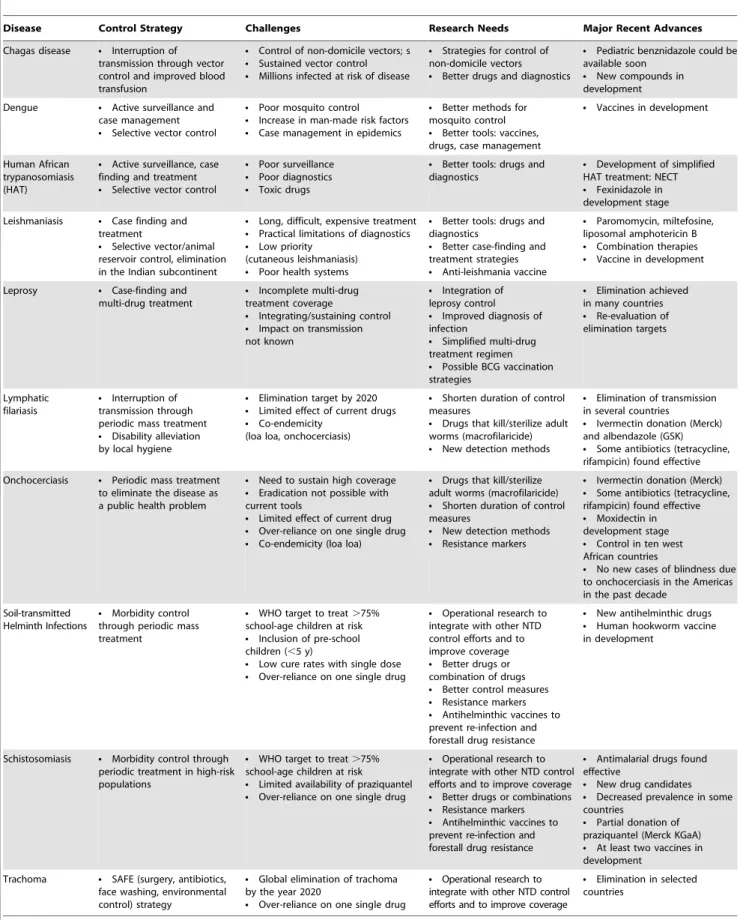
For visceral leishmaniasis, the existing tools still largely depend on antimonials, which have not yet been optimized to reduce toxicity and prevent emerging drug resistance [28,29],. Furthermore, only three new effective treatments have been licensed over the past decade, and even these remain largely inaccessible to most control programs of leishmaniasis in resource-poor settings (Table 2) [39]. Although several combination treatments are under development to prevent the emergence of drug resistance and to reduce treatment duration, these are not going to be enough for disease elimination. Therefore, the NTD manifesto mandates urgent action to provide adequate support for the development of such anti-kineto-plastid drugs. Vaccines for all three kinetoplastid infections are also in early-stage development, and a recombinant leishmaniasis vaccine is in clinical testing [7,8,40,41]. Similarly, vaccines for other nonhelminthic NTDs such as amebiasis and the neglected mycobacterial infections Buruli ulcer and leprosy are in early development [7,8,42–44], and at least two live attenuated tetravalent vaccine candidates for dengue fever are in phase 2 clinical trials, with numerous other vaccine candidates also under develop-ment [7,8,45,46].
Table 2.Control strategies, challenges, research need and major recent advances for selected NTDs.
Disease Control Strategy Challenges Research Needs Major Recent Advances
Chagas disease N Interruption of
transmission through vector control and improved blood transfusion
N Control of non-domicile vectors; s N Sustained vector control N Millions infected at risk of disease
N Strategies for control of
non-domicile vectors
N Better drugs and diagnostics
N Pediatric benznidazole could be
available soon
N New compounds in
development
Dengue N Active surveillance and
case management
N Selective vector control
N Poor mosquito control N Increase in man-made risk factors N Case management in epidemics
N Better methods for
mosquito control
N Better tools: vaccines,
drugs, case management
N Vaccines in development
Human African trypanosomiasis (HAT)
N Active surveillance, case
finding and treatment
N Selective vector control
N Poor surveillance N Poor diagnostics N Toxic drugs
N Better tools: drugs and
diagnostics
N Development of simplified
HAT treatment: NECT
N Fexinidazole in
development stage
Leishmaniasis N Case finding and
treatment
N Selective vector/animal
reservoir control, elimination in the Indian subcontinent
N Long, difficult, expensive treatment N Practical limitations of diagnostics N Low priority
(cutaneous leishmaniasis)
N Poor health systems
N Better tools: drugs and
diagnostics
N Better case-finding and
treatment strategies
N Anti-leishmania vaccine
N Paromomycin, miltefosine,
liposomal amphotericin B
N Combination therapies N Vaccine in development
Leprosy N Case-finding and
multi-drug treatment
N Incomplete multi-drug
treatment coverage
N Integrating/sustaining control N Impact on transmission
not known
N Integration of
leprosy control
N Improved diagnosis of
infection
N Simplified multi-drug
treatment regimen
N Possible BCG vaccination
strategies
N Elimination achieved
in many countries
N Re-evaluation of
elimination targets
Lymphatic filariasis
N Interruption of
transmission through periodic mass treatment
N Disability alleviation
by local hygiene
N Elimination target by 2020 N Limited effect of current drugs N Co-endemicity
(loa loa, onchocerciasis)
N Shorten duration of control
measures
N Drugs that kill/sterilize adult
worms (macrofilaricide)
N New detection methods
N Elimination of transmission
in several countries
N Ivermectin donation (Merck)
and albendazole (GSK)
N Some antibiotics (tetracycline,
rifampicin) found effective
Onchocerciasis N Periodic mass treatment
to eliminate the disease as a public health problem
N Need to sustain high coverage N Eradication not possible with
current tools
N Limited effect of current drug N Over-reliance on one single drug N Co-endemicity (loa loa)
N Drugs that kill/sterilize
adult worms (macrofilaricide)
N Shorten duration of control
measures
N New detection methods N Resistance markers
N Ivermectin donation (Merck) N Some antibiotics (tetracycline,
rifampicin) found effective
N Moxidectin in
development stage
N Control in ten west
African countries
N No new cases of blindness due
to onchocerciasis in the Americas in the past decade
Soil-transmitted Helminth Infections
N Morbidity control
through periodic mass treatment
N WHO target to treat.75% school-age children at risk
N Inclusion of pre-school
children (,5 y)
N Low cure rates with single dose N Over-reliance on one single drug
N Operational research to
integrate with other NTD control efforts and to improve coverage
N Better drugs or
combination of drugs
N Better control measures N Resistance markers N Antihelminthic vaccines to
prevent re-infection and forestall drug resistance
N New antihelminthic drugs N Human hookworm vaccine
in development
Schistosomiasis N Morbidity control through
periodic treatment in high-risk populations
N WHO target to treat.75% school-age children at risk
N Limited availability of praziquantel N Over-reliance on one single drug
N Operational research to
integrate with other NTD control efforts and to improve coverage
N Better drugs or combinations N Resistance markers N Antihelminthic vaccines to
prevent re-infection and forestall drug resistance
N Antimalarial drugs found
effective
N New drug candidates N Decreased prevalence in some
countries
N Partial donation of
praziquantel (Merck KGaA)
N At least two vaccines in
development
Trachoma N SAFE (surgery, antibiotics,
face washing, environmental control) strategy
N Global elimination of trachoma
by the year 2020
N Over-reliance on one single drug
N Operational research to
integrate with other NTD control efforts and to improve coverage
N Elimination in selected
countries
For the soil-transmitted helminth infec-tions (the world’s most common NTDs), albendazole is still the only agent available that can treat all three major infections (i.e., ascariasis, trichuriasis, and hookworm infection) when used as a single dose in mass drug administration campaigns. Al-though mebendazole can still be used for ascariasis, a recent meta-analysis has shown that single-dose mebendazole has high failure rates against hookworm [47]. This finding means that we must rely on a single drug to treat more than one billion infected people every year, despite the fact that this class of benzimidazole anthelmin-thic is highly susceptible to drug resistance when widely used to deworm livestock [48]. Therefore, development of new anthelminthics, such as the amino-aceto-nitrile derivatives that are highly effective as veterinary agents [48], or tribendimi-dine, a nicotinic acetylcholine receptor agonist discovered in China [49], is urgently needed. Alternatively, mebenda-zole or albendamebenda-zole could be combined with other existing anthelminthic drugs (i.e., pyrantel or levamisole) to reduce development of drug resistance, and a new Bacillus thuringiensis crystal protein is showing promise in preclinical testing [50]. A human hookworm vaccine is under product and clinical development and would be used in a program of vaccine-linked chemotherapy to prevent hookworm reinfection after treatment
[7,8,51]. Similarly, for schistosomiasis
praziquantel is the only available agent to treat more than 200 million people, and while drug resistance has not been clearly shown, development of new drugs through automated screening [52,53], or by min-ing the genome [54] is urgently needed. Anti-schistosome vaccines together with chemotherapy are an important new option [7,8,55], and there is a need to think about how to integrate such new tools into changing demographic, health, and social systems [56]. For both oncho-cerciasis and LF, if a macrofilaricide was available (i.e., a drug for mass distribution that destroys the adult worm), as opposed to the existing microfilaricidal drugs iver-mectin and diethylcarbamazine citrate, fewer rounds of annual distribution would be necessary and elimination efforts would be made much more efficient [57]. Antibiotics that destroy the parasite’s bacterial symbionts are also being ex-plored for this purpose [58].
For most of the major NTDs, the current approaches to diagnosis and case detection were developed in the early- or mid-twentieth century. There is an urgent need to develop new diagnostics and
rapidly introduce them into ongoing and future control programs [59,60].
As the US and UK Governments increase funding for integrated NTD control, there is an urgent need to also increase significantly R&D efforts devel-oped by product development partner-ships and other organizations. Indeed, the poorest people living in low- and middle-income countries have the right to access not only essential medicines but also innovation. Unfortunately, global initia-tives, especially from the G8 nations, have largely lacked efforts to support R&D. The George Institute has recently analyzed how much money is invested every year on R&D for neglected diseases [5]. About three-quarters of total neglected disease R&D annual spending is for HIV/AIDS, malaria, and tuberculosis, leaving only
about US$600 million worldwide for all
NTDs per year, with only US$139 million
for all kinetoplastid infections, US$132
million for diarrheal diseases, US$127
million for dengue, US$67 million for all
human helminth infections, and less than
US$10 million for each neglected
myco-bacterial infection, trachoma, and Buruli ulcer [5]. Because of the huge disease burden from these infections, such modest R&D support reflects what may be a 1/99 gap relative to other chronic diseases in developed nations. We also need to ensure funds are made available for clinical research (which is expensive) into new drugs and vaccines. The development of truly modern antimicrobial/antiparasitic agents and vaccines will take many years and is likely to remain a high-risk endeavor with respect to the level of investment in R&D and the high attrition rate of drug discovery. In order to facilitate this research, and due to the pressing needs in NTDs, governments and regula-tors need to ensure that incentives and enabling regulatory systems are made available to product developers [61].
3. All NTDs are ‘‘most neglected’’
Because of the great disease burden of NTDs and the absence of adequate funding to support their control or elim-ination, each of the major NTDs listed in Table 1 should be considered as severely neglected. In contrast, diseases such as malaria and tuberculosis have been also neglected but they have received signifi-cantly more attention during the past ten years from the international community, with the creation of the US President’s Emergency Plan for AIDS Relief, the US President’s Malaria Initiative, the Global
Fund to Fight AIDS, Tuberculosis, and Malaria, and considerable R&D invest-ments from the Bill & Melinda Gates Foundation, NIH, Wellcome Trust, and at least five dedicated product development partnerships for drugs and vaccines to combat these conditions [5]. Funding for NTD control and R&D should be brought closer to the level of current support for HIV/AIDS, malaria, and tuberculosis.
4. There is a profound human rights dimension to NTDs
Although poverty is surely one of the main risk factors for neglected diseases, increasing evidence indicates an associa-tion between their prevalence and conflict and violation of human rights [62]. As noted above, NTDs affect the poorest of the poor, who have no economic and political power and are very often neglect-ed by their governments. Many NTDs are disfiguring, causing severe social conse-quences. Most affected populations live in remote areas with limited or no access to treatment or prevention. Indigenous or aboriginal people are also disproportion-ately affected by NTDs [63], while in the Americas NTDs were introduced through the Atlantic slave trade and to this day they disproportionately affect non-white people [64,65]. NTDs are found wherever extreme poverty occurs—not only in developing countries but in poor areas in developed countries including the USA and Europe [64,66]. Mahatma Gandhi (who himself suffered from hookworm infection [67]) once said that a ‘‘civiliza-tion is judged by the treatment of its minorities’’ [68]. This observation is particularly relevant for people living with neglected diseases, which generally can be either treated or prevented at low cost.
5. NTDs destabilize societies and contribute to conflict
Many poor societies have either been recently engaged in a civil or international conflict or are currently at war [69]. The potentially destablilizing effects of NTDs, especially on agricultural productivity and food security, may partly explain why considerable geographic overlap has been
observed between NTDs and recent
areas are insecure and unstable, frequently with no functioning national disease pro-gram. In these situations, medical human-itarian assistance and innovative health strategies are greatly needed to combat NTDs [71].
6. Involvement by the WHO and other international health agencies is crucial for current and future NTD control
The community working on NTDs greatly appreciates the active involvement of the WHO, through their new Depart-ment of Neglected Tropical Diseases, WHO-TDR, and the regional offices. The technical advisory role and convening power of the WHO and their regional offices, and their active contributions to global control and elimination efforts, indicate success and commitment. Accord-ingly, WHO is absolutely essential for the future global control and elimination efforts supported by governments and private partners (NGOs, pharmaceutical companies, and philanthropic organiza-tions). At the same time, it needs to be recognized that WHO is not alone in this success. UNICEF (United Nations Inter-national Children’s Emergency Fund), UNDP (United Nations Development Program), FAO (Food and Agricultural Organization), the World Bank and sev-eral regional banks, as well as the NTD control public–private partnerships, have greatly contributed to global NTD control
and elimination, and their ongoing
efforts should be both applauded and encouraged.
7. Building health systems under the leadership of health ministries in disease-endemic countries and the communities is a high priority
Nothing is more important to the success of global NTD control than the
involvement of communities themselves, with disease-endemic countries’ health ministries providing leadership. Commu-nity-directed treatments for ivermectin, for instance, have helped the establishment of a key health system for onchocerciasis control [72,73]. This and similar activities account for much of the high-level cover-age for onchocerciasis and LF [73], and are vital for ensuring that in the near future treatment coverage for soil-trans-mitted helminth infections, schistosomia-sis, and other NTDs reaches similar levels. In many areas of conflict and postconflict in Africa, community involvement in NTD control is one of the few actively functioning health systems. Such activities have facilitated the delivery of additional interventions such as insecticide-treated bed nets, antimalarial drugs, micronutri-ents, and childhood immunizations [74]. The coordination and leadership by health ministries is crucial to achieve sustainable control and elimination efforts for NTDs in integrating the different vertical strate-gies into a coordinated, strengthened public health system. To this end, NTDs need to be prioritized at the level of health ministries. This can occur with greater awareness and improved funding mecha-nisms for local control programs.
8. Moving forward through a global strategy combining access and innovation
Millennium Development Goal 8 (‘‘de-velop a global partnership for de(‘‘de-velop- develop-ment’’) advocates for international part-nerships to achieve all millennium targets [6]. Under the leadership of international organizations (WHO and its regional offices, UNICEF, FAO), all stakehold-ers—health ministries in disease-endemic countries, affected communities, public– private partnerships, research communi-ties in both endemic and nonendemic countries, product development partner-ships for the development of new tools,
large and small nongovernmental organi-zations—should establish a well-function-ing international strategy for NTD con-trol. Global partnerships for NTDs are involved in the delivery of existing treat-ments and in the development of new ones. With adequate support from the G8 Governments and some emerging econo-mies [75], notably through the G20, the international NTD community could sub-stantially reduce poverty and serve as a highly efficient vehicle for millennium targets, and all this potentially at costs far lower than other international initiatives. Countries affected by NTDs must also assume responsibility in addressing the dire health needs of impoverished popula-tions and work to deliver new policies that will develop health innovation capacity through research networks and technology transfer schemes.
Although NTDs threaten the lives of millions in the developing world, their burden on global health is under-recog-nized, often sidelined, and under-re-sourced.
Actions are urgently needed to promote interactions among scientists working on NTDs, to facilitate the dissemination of information about NTDs, to identify funding opportunities and the most cost-effective ways to fight NTDs, and to explore possibilities for international col-laborations for promoting and implement-ing R&D projects. By highlightimplement-ing impor-tant challenges in the fight against NTDs, this manifesto calls on the global commu-nity for urgent, renewed, and innovative efforts.
Acknowledgments
The authors thank Drs. Lorenzo Savioli and Robert Ridley of WHO for their input into this manuscript.
References
1. Hotez PJ, Molyneux DH, Fenwic k A, Kumaresan J, Ehrlich Sachs S, et al. (2007) Control of neglected tropical diseases. N Engl J Med 357: 1018–1027.
2. Hotez PJ (2008) Forgotten People, Forgotten Diseases: the Neglected Tropical Diseases and their Impact on Global Health and Development. ASM Press 218.
3. Hotez PJ, Fenwick A, Savioli L, Molyneux DH (2009) Rescuing the bottom billion through control of neglected tropical diseases. Lancet 373: 1570–1575. 4. Hotez PJ (2009) Empowering women and im-proving female reproductive health through control of neglected tropical diseases. PLoS Negl Trop Dis 3: e559. doi:10.1371/journal.pntd. 0000559.
5. Moran M, Guzman J, Henderson K, Ropars A-L, McDonald A, et al. (2009) G-Finder: Neglected Disease Research & Development: New Times, New Trends; Health Policy Division, The George Institute for International Health. 101 p. 6. United Nations (2009) The Millennium
Develop-ment Goals Report. Available. http://www.un.org/ millenniumgoals/pdf/MDG_Report_2009_ENG. pdf. Accessed 27 Apr 2010.
7. Hotez PJ, Ferris MT (2006) The antipoverty vaccines. Vaccine 24: 5787–5799.
8. Hotez PJ, Brown AS (2009) Neglected tropical disease vaccines. Biologicals 37: 160–164. 9. Ad Hoc Committee on Health Research Relating
to Future Intervention Options (1996) Investing in health research and development. Document
10. TDR/Gen/96.1. Geneva: World Health Organization.
10. Chirac P, Torreele E (2006) Global framework on essential health R&D. Lancet 367: 1560–1561. 11. Webster’s New World College Dictionary Fourth
Edition 2000.
12. Hotez PJ (2009) Mass drug administration and integrated control for the world’s high-prevalence neglected tropical diseases. Clin Pharmacol Therap 85: 659–664.
13. [No authors listed] (2008) Global programme to eliminate lymphatic filariasis. Wkly Epidemiol Rec 83: 333–341.
endemic foci in Africa: First evidence from studies in Mali and Senegal. PLoS Negl Trop Dis 3: e497. doi:10.1371/journal.pntd.0000497. 15. Biebesheimer JB, House J, Hong KC, Lakew T,
Alemayehu W, et al. (2009) Complete local elimination of infectious trachoma from severely affected communities after six biannual mass azithromycin distributions. Ophthalmology 116: 2047–2050.
16. Molyneux DH, Hotez PJ, Fenwick A (2005) ‘‘Rapid impact’’ interventions: How a policy of integrated control for Africa’s neglected tropical diseases could benefit the poor. PLoS Med 2: e336. doi:10.1371/journal.pmed.0020336. 17. Hotez PJ, Molyneux DH, Fenwick A, Ottesen E,
Sachs J (2006) Incorporating a rapid impact package for neglected tropical diseases with programs for HIV/AIDS, tuberculosis and ma-laria, a comprehensive pro-poor health policy and strategy for the developing world. PLoS Med 3: e102. doi:10.1371/journal.pmed.0030102. 18. Rinaldi A (2005) The global campaign to
eliminate leprosy. PLoS Med 2: e341. doi:10.1371/journal.pmed.0020341.
19. Hopkins DR, Ruiz-Tiben E, Downs P, Withers PC, Jr., Roy S (2008) Dracunculiasis eradication: neglected no longer. Am J Trop Med Hyg 79: 474–479.
20. Vu SN, Nguyen TY, Tran VP, Truong UN, Le QM, et al. (2005) Elimination of dengue by community programs using Mesocycyclops (Co-pepoda) against Aedes aegypti in central Vie-tham. Am J Trop Med Hyg 72: 67–73. 21. Wright HR, Turner A, Taylor HR (2008)
Trachoma. Lancet 37: 1945–1954.
22. Jannin J, Louis FJ, Lucas P, Simarro PP (2001) Control of human African trypanosomiasis: back to square one (French). Med Trop (Mars) 61: 437–440.
23. Priotto G, Kasparian S, Mutombo W, Ngouama D, Ghorashian S, et al. (2009) Nifurtimox-eflornithine combination therapy for second-stage African Trypanosoma brucei gam-biense trypanosomiasis: a multicentre, rando-mised, phase III, non-inferiority trial. Lancet 374: 56–64.
24. Dias JC (2009) Elimination of Chagas disease transmission: perspectives. Mem Inst Oswaldo Cruz 104 (Suppl 1): 41–45.
25. Yun O, Lima MA, Ellman T, Chambi W, Castillo S, et al. (2009) Feasibility, drug safety, and effectiveness of etiological treatment pro-grams for chagas disease in Honduras, Guate-mala, and Bolivia: 10-year experience of Mede-cins Sans Frontieres. PLoS Negl Trop Dis 3: e488. doi:10.1371/journal.pntd.0000488. 26. Narain JA, Prasittisuk C, Bhatia R, Hashim G,
Banjara JA, et al. (2008) Can visceral leishman-iasis be eliminated from Asia? J Vector Borne Dis 45: 105–111.
27. Sharma U, Singh S (2008) Insect vectors of Leishmania: distribution, physiology and their control. J Vector Borne Dis 45: 255–272. 28. Croft SL, Sundar S, Fairlamb AH (2006) Drug
Resistance in Leishmaniasis. Clin Microbiol Rev 19: 111–126.
29. Hailu A, Musa AM, Royce C, Wasunna M (2005) Visceral Leishmaniasis: new health tools are needed. PLoS Med 2: e211. doi:10.1371/journal. pmed.0020211.
30. Kaewpitoon N, Kaewpitoon SJ, Pengsaa P, Sripa B (2008) Opisthorchias viverrini: the carcinogenic human liver fluke. World J Gastroenterol 14: 666–674.
31. Portaels F, Silva MT, Meyers WM (2009) Buruli ulcer. Clin Dermatol 27: 291–305.
32. World Health Organization Maximizing Positive Synergies Collaborative Group (2009) An assess-ment of interactions between global health initiatives and country health systems. Lancet 373: 2137–2169.
33. Wilkinson SR, Kelly M (2009) Trypanocidal drugs: mechanisms, resistance and new targets. Expert Rev Mol Med 11: e31.
34. El-Sayed NM, Myler PJ, Blandin G, Berriman M, Crabtree J, et al. (2005) Comparative genomics of trypanosomatid parasitic protozoa. Science 309: 404–409.
35. The TDR Targets Database. Available: http:// tdrtargets.org/. Accessed 8 Feb 2010. 36. Jennings FW, Atouguia JM, Murray M (1996)
Topical chemotherapy for experimental murine African CNS-trypanosomiasis: the successful use of the arsenical, melarsoprol, combined with the 5-nitroimidazoles, fexinidazole or MK-436. Trop Med Int Health 1: 590–598.
37. Urbina JA (2009) Specific chemotherapy of Chagas disease: relevance, current limitations and new approaches. Acta Trop, Epub ahead of print. doi:10.1016/j.actatropica.2009.10.023. 38. McKerrow JH, Doyle PS, Engel JC, Podhust LM,
Robertson SA, et al. (2009) Two approaches to discovering and developing new drugs for Chagas disease. Mem Inst Oswaldo Cruz 104 (Suppl 1): 263–269.
39. Den Boer ML, Alvar J, Davidson RN, Ritmeijer K, Balasegaram M (2009) Develop-ments in the treatment of visceral leishmaniasis. Expert Opin Emerg Drugs 14: 395–410. 40. Camargo EP (2009) Perspectives of vaccination in
Chagas disease revisited. Mem Inst Oswaldo Cruz 104 (Suppl 1): 275–280.
41. Coler RN, Reed SG (2005) Second-generation vaccines against leishmaniasis. Trends Parasitol 21: 244–249.
42. Chaudhry OA, Petri WA, Jr. (2005) Vaccine prospects for amebiasis. Expert Rev Vaccines 4: 657–668.
43. Huygen K, Adjei O, Affolabi D, Bretzel G, Demangel C, et al. (2009) Buruli ulcer disease: prospects for a vaccine. Med Microbiol Immunol 198: 69–77.
44. Schuring RP, Richardus JH, Pahan D, Oskam L (2009) Protective effect of the combination BCG vaccination and rifampicin prophylaxis in leprosy prevention. Vaccine 27: 7125–7128.
45. Webster DP, Farrar J, Rowland-Jones S (2009) Progress towards a dengue vaccine. Lancet Infect Dis 9: 678–687.
46. Durbin AP, Whitehaead SS (2010) Dengue vaccine candidates in development. Curr Top Microbiol Immunol 338: 129–143.
47. Keiser J, Utzinger J (2008) Efficacy of current drugs against soil-transmitted helminth infections: systematic review and meta-analysis. JAMA 299: 1937–1948.
48. Kaminsky R, Ducray P, Jung M, Clover R, Rufener L, et al. (2008) A new class of anthelmintics effective against drug-resistant nem-atodes. Nature 452: 176–180.
49. Hu Y, Xiao SH, Aroian RV (2009) The new anthelmintic tribendimidine is an L-type (levam-isole and pyrantel) nicotinic acetylcholine recep-tor agonist. PLoS Negl Trop Dis 3: e499. doi:10.1371/journal.pntd.0000499.
50. Hu Y, Georghious SB, Kelleher AJ, Aroian RV (2010) Bacillus thuringiensis Cry5B protein is highly efficacious as a single-dose therapy against an intestinal roundworm infection in mice. PLoS Negl Trop Dis 4: e614. doi:10.1371/journal. pntd.0000614.
51. Loukas A, Bethony J, Brooker S, Hotez P (2006) Hookworm vaccines: past, present, and future. Lancet Infect Dis 6: 733–741.
52. Sayed AA, Simeonov A, Thomas CJ, Inglese J, Austin CP, et al. (2008) Identification of oxadia-zoles as new drug leads for the control of schistosomiasis. Nat Med 14: 407–412. 53. Abdulla MH, Ruelas DS, Wolff B, Snedecor J,
Lim KC, et al. (2009) Drug discovery for schistosomiasis: hit and lead compounds identi-fied in a library of known drugs by medium-throughput phenotypic screening. PLoS Negl Trop Dis 3: e478. doi:10.1371/journal.pntd. 0000478.
54. Berriman M, Haas BJ, LoVerde PT, Wilson RA, Dillon GP, et al. (2009) The genome of the blood
fluke Schistosoma mansoni. Nature 460: 352–358.
55. McManus DP, Loukas A (2008) Current status of vaccines for schistosomiasis. Clin Microbiol Rev 21: 225–242.
56. Utzinger J, Raso G, Brooker S, De Savigny D, Tanner M, et al. (2009) Schistosomiasis and neglected tropical diseases: towards integrated and sustainable control and a word of caution. Parasitology 136: 1859–1872.
57. Hopkins AD (2005) Ivermectin and onchocerci-asis: is it all solved? Eye (Lond) 19: 1057–1066. 58. Hoerauf A (2008) Filariasis: new drugs and new
opportunities for lymphatic filariasis and oncho-cerciasis. Curr Opin Infect Dis 21: 673–681. 59. Perkins MD, Small PM (2006) Partnering for
better microbial diagnostics. Nat Biotechnol 24: 919–921.
60. Frew SE, Liu VY, Singer PA (2009) A business plan to help the ‘global South’ in its fight against neglected diseases. Health Aff (Millwood) 28: 1760–1773.
61. The George Institute for International Health. Registering New Drugs: The African Context, Available: http://www.dndi.org/images/stories/ advocacy/regulatory-report_george-institute-dndi_jan2010.pdf. Accessed 29 March 2010. 62. Beyrer C, Villar JC, Suwanvanichkij V, Singh S,
Baral SD, et al. (2007) Neglected diseases, civil conflicts, and the right to health. Lancet 370: 619–627.
63. Hotez PJ (2010) Neglected Infections of Poverty among the Indigenous Peoples of the Arctic. PLoS Negl Trop Dis 4: e606. doi:10.1371/ journal.pntd.0000606.
64. Hotez P (2009) Neglected diseases amid wealth in the United States and Europe. Health Aff (Mill-wood) 28: 1720–1725.
65. Lammie PJ, Lindo JF, Secor WE, Vasquez J, Ault SK, et al. (2007) Eliminating lymphatic filariasis, onchocerciasis, and schistosomiasis from the Americas: breaking a historical legacy of slavery. PLoS Negl Trop Dis 1: e71. doi:10.1371/ journal.pntd.0000071.
66. Hotez PJ (2008) Neglected infections of poverty in the United States of America. PLoS Negl Trop Dis 2: e256. doi:10.1371/journal.pntd.0000256. 67. Hotez PJ (21 January 2010) Gandhi’s hookworms.
Foreign Policy, Available: http://www.foreignpolicy. com/articles/2010/01/21/gandhis_hookworms. Accessed 8 February 2010.
68. Fischer L (1997) The Life of Mahatma Gandhi. HarperCollins. Part II; 43: 424.
69. Collier P (2007) The bottom billion: Why the poorest countries are failing and what can be done about it. Oxford, UK: Oxford University Press.
70. Hotez PJ, Thompson TG (2009) Waging peace through neglected tropical disease control: a U.S. foreign policy for the bottom billion. PLoS Negl Trop Dis 3: e346.
71. Me´dicins Sans Frontie`res (2005) Sleeping Sick-ness. A practical manual for the treatment and control of human African trypanosomiasis. 72. Remme JHF (2004) Research for control: the
onchocerciasis experience. Trop Med Int Health 9: 243–254.
73. Amazigo UV, Obono OM, Dadzie KY, Remme J, Jiya J, et al. (2002) Monitoring community-directed treatment programmes for sustainability: lessons from the African Programme for Oncho-cerciasis Control (APOC). Ann Trop Med Para-sitol 96 (Suppl 1): 75–92.
74. CDI study group (2009) Community directed interventions for priority health problems in Africa: results of a multi-country study Bull World Health Organization. doi:10.2471/ BLT.09.069203.