A molecular phylogeny of the Cephinae (Hymenoptera,
Cephidae) based on mtDNA COI gene:
a test of traditional classification
Mahir Budak1,†, E. Mahir Korkmaz2,‡, Hasan H. Basibuyuk1,§
1 Department of Biology, Faculty of Science, Cumhuriyet University, 58140-Sivas, Turkey 2 Department of Molecular Biology and Genetics, Faculty of Science, Cumhuriyet University, 58140-Sivas, Turkey
Corresponding author:Hasan H. Basibuyuk ([email protected])
Academic editor:Michael Sharkey | Received 2 May 2011 | Accepted 26 May 2011 | Published 24 September 2011
Citation: Budak M, Korkmaz EM, Basibuyuk HH (2011) A molecular phylogeny of the Cephinae (Hymenoptera, Cephidae) based on mtDNA COI gene: a test of traditional classiication. In: Shcherbakov DE, Engel MS, Sharkey MJ (Eds) Advances in the Systematics of Fossil and Modern Insects: Honouring Alexandr Rasnitsyn. ZooKeys 130: 363–378.
doi: 10.3897/zookeys.130.1466
Abstract
Cephinae is traditionally divided into three tribes and about 24 genera based on morphology and host utilization. here has been no study testing the monophyly of taxa under a strict phylogenetic criterion. A molecular phylogeny of Cephinae based on a total of 68 sequences of mtDNA COI gene, representing seven genera of Cephinae, is reconstructed to test the traditional limits and relationships of taxa. Mono-phyly of the traditional tribes is not supported. MonoMono-phyly of the genera are largely supported except for
Pachycephus. A few host shift events are suggested based on phylogenetic relationships among taxa. hese results indicate that a more robust phylogeny is required for a more plausible conclusion. We also report two species of Cephus for the irst time from Turkey.
Keywords
Hymenoptera, phylogeny, Cephidae, COI, host shift
www.zookeys.org
Copyright M. Budak et al. This is an open access article distributed under the terms of the Creative Commons Attribution License, which permits unrestricted use, distribution, and reproduction in any medium, provided the original author and source are credited.
Introduction
he Cephidae is a small family of Hymenoptera with a thin integument, usually black or dark colored and commonly with narrow yellow bands on the abdomen. It com-prises approximately 160 species in three subfamilies and about 24 genera and is pri-marily Holarctic (Benson 1935, 1946; Smith and Schmidt 2009; Taeger et al. 2010). Two of the subfamilies, Athetocephinae and Australcephinae are represented by only four species and are restricted to Madagascar and the Australian Region (Benson 1935, 1946; Smith and Shinohara 2002a; Smith and Schmidt 2009). he majority of species are included in the Holarctic subfamily Cephinae. Although several faunal treatments (Ries 1937; Middlekauf 1969; Zhelochovtsev and Zinovjev 1988; Calmasur and Oz-bek 2010; Korkmaz et al. 2010) and a single world review (Muche 1981) have been published, and a number of cephid species have been described in recent years (Smith and Solomon 1989; Smith 1997; Smith and Shinohara 2002a,b; Smith and Schif 2005; Wei 2007; Smith and Schmidt 2009; Wei and Smith 2010), their phylogenetic relationships have not been investigated.
Cephidae can be easily identiied since they are morphologically intermediate be-tween the hymenopteran suborders Symphyta and Aculeata. Because of several apocri-tan-like characters, such as a weak constriction between the irst and second abdominal segments, the lack of cenchri and the rough area on fore wing, and the form of male genitalia, they were once considered as a likely sister group of Apocrita (Königsmann, 1977). However, considerable evidence from both morphological and molecular data strongly support a sister group relationship between Orussidae and Apocrita, and the Cephoidea, containing the only family Cephidae, appears as to share a last common ancestor with a lineage leading to the Siricoidea (e.g., Rasnitsyn 1980,1988; Basibuyuk and Quicke 1995; Vilhelmsen 1997, 2001; Ronquist et al. 1999; Schulmeister et al. 2002; Sharkey 2007).
Ries (1937) suggested that Janus is the most primitive genus of Cephinae based on its iliform and many segmented antennae and tarsal claws. Benson (1946) di-vided the Cephinae into three tribes, Cephini, Hartigiini and Pachycephini based both on morphology and host utilization. he larvae of Cephini bore in the stems of Poaceae, those of Pachycephini live in the stems of Papaveraceae and Poaceae, and those of Hartigiini bore in the twigs of Rosaceae or other arborescent plant families (Benson 1946; Middlekauf 1969). Numerous morphological characters and color patterns that traditionally have been used for separation of the taxa with-in the family are claimed to be either variable or display phenotypic plasticity (Ries 1937; Benson 1946, 1968; Korkmaz et al. 2010). Current classiication is mainly based on morphology and host usage and therefore necessitates a close examination under the phylogenetic approaches.
diversiica-tion at all hierarchical levels (Mopper and Strauss 1998; Berlocher and Feder 2002; Funk et al. 2002; Nosil et al. 2002; Eubanks et al. 2003; Lozier et al. 2007). How-ever, host specialization in the Cephinae, as observed in most phytophagous insect groups, might have led to evolutionary shift between higher taxonomic groups. Host shift probably has taken place many times at diferent periods, and therefore the classiication based on host use may not relect the true phylogenetic relation-ship within the Cephinae.
Here, we selected the mitochondrial cytochrome oxidase subunit I (COI) gene to reconstruct the phylogenetic relationships of the Cephinae and identify systematic po-sition of its tribes and genera by applying phylogenetic inference methods. he selected COI gene region is informative for estimating relationships at both intra- and inter-species level due to possession of both completely conserved and variable regions and having a heterogeneous evolutionary rate across the gene (Lunt et al. 1996; Dowton and Austin 1997; Caterino et al. 2000; Roe and Sperling 2007; Bacci et al. 2009) his region is also utilized as DNA–based bio-identiication system for animals at the global level (Hebert et al. 2003). Cephus parvus (Dovnar-Zapolskij, 1931) and C. runcator
Konow, 1896, are recorded for the irst time from Turkey.
Material and methods
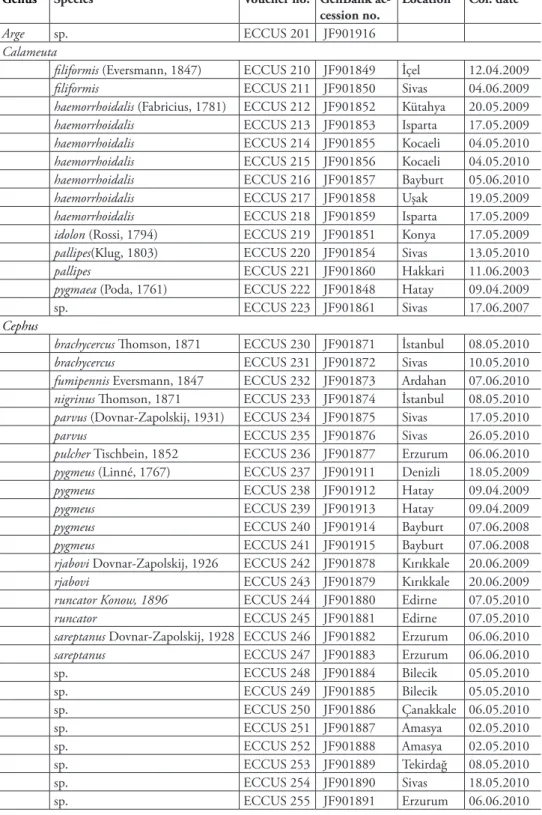
Sixty-eight specimens representing three tribes and seven genera of the subfamily Cephinae were collected from localities presented in Table 1. All specimens are de-posited in the Entomological Collection of Cumhuriyet University, Sivas (ECCUS). A specimen of Arge sp. (Argidae) was included as an outgroup in the phylogenetic analyses. Several keys were used to identify the specimens (Benson 1946, 1951, 1968; Muche 1981; Zhelochovtsev and Zinovjev 1988). he taxa names, the voucher speci-mens, and GenBank accession numbers are presented in Table 1.
DNA extraction, ampliication, and sequencing
table 1. List of taxa and voucher specimens used for sequencing.
Genus Species Voucher no. GenBank ac-cession no.
Location Col. date
Arge sp. ECCUS 201 JF901916
Calameuta
iliformis (Eversmann, 1847) ECCUS 210 JF901849 İçel 12.04.2009
iliformis ECCUS 211 JF901850 Sivas 04.06.2009
haemorrhoidalis (Fabricius, 1781) ECCUS 212 JF901852 Kütahya 20.05.2009
haemorrhoidalis ECCUS 213 JF901853 Isparta 17.05.2009
haemorrhoidalis ECCUS 214 JF901855 Kocaeli 04.05.2010
haemorrhoidalis ECCUS 215 JF901856 Kocaeli 04.05.2010
haemorrhoidalis ECCUS 216 JF901857 Bayburt 05.06.2010
haemorrhoidalis ECCUS 217 JF901858 Uşak 19.05.2009
haemorrhoidalis ECCUS 218 JF901859 Isparta 17.05.2009
idolon (Rossi, 1794) ECCUS 219 JF901851 Konya 17.05.2009
pallipes(Klug, 1803) ECCUS 220 JF901854 Sivas 13.05.2010
pallipes ECCUS 221 JF901860 Hakkari 11.06.2003
pygmaea (Poda, 1761) ECCUS 222 JF901848 Hatay 09.04.2009
sp. ECCUS 223 JF901861 Sivas 17.06.2007
Cephus
brachycercus homson, 1871 ECCUS 230 JF901871 İstanbul 08.05.2010
brachycercus ECCUS 231 JF901872 Sivas 10.05.2010
fumipennis Eversmann, 1847 ECCUS 232 JF901873 Ardahan 07.06.2010
nigrinus homson, 1871 ECCUS 233 JF901874 İstanbul 08.05.2010
parvus (Dovnar-Zapolskij, 1931) ECCUS 234 JF901875 Sivas 17.05.2010
parvus ECCUS 235 JF901876 Sivas 26.05.2010
pulcher Tischbein, 1852 ECCUS 236 JF901877 Erzurum 06.06.2010
pygmeus (Linné, 1767) ECCUS 237 JF901911 Denizli 18.05.2009
pygmeus ECCUS 238 JF901912 Hatay 09.04.2009
pygmeus ECCUS 239 JF901913 Hatay 09.04.2009
pygmeus ECCUS 240 JF901914 Bayburt 07.06.2008
pygmeus ECCUS 241 JF901915 Bayburt 07.06.2008
rjabovi Dovnar-Zapolskij, 1926 ECCUS 242 JF901878 Kırıkkale 20.06.2009
rjabovi ECCUS 243 JF901879 Kırıkkale 20.06.2009
runcator Konow, 1896 ECCUS 244 JF901880 Edirne 07.05.2010
runcator ECCUS 245 JF901881 Edirne 07.05.2010
sareptanus Dovnar-Zapolskij, 1928 ECCUS 246 JF901882 Erzurum 06.06.2010
sareptanus ECCUS 247 JF901883 Erzurum 06.06.2010
sp. ECCUS 248 JF901884 Bilecik 05.05.2010
sp. ECCUS 249 JF901885 Bilecik 05.05.2010
sp. ECCUS 250 JF901886 Çanakkale 06.05.2010
sp. ECCUS 251 JF901887 Amasya 02.05.2010
sp. ECCUS 252 JF901888 Amasya 02.05.2010
sp. ECCUS 253 JF901889 Tekirdağ 08.05.2010
sp. ECCUS 254 JF901890 Sivas 18.05.2010
Genus Species Voucher no. GenBank ac-cession no.
Location Col. date
sp. ECCUS 256 JF901892 Kars 07.06.2010
sp. ECCUS 257 JF901893 Kars 07.06.2010
sp. ECCUS 258 JF901894 Bolu 04.05.2010
Trachelus
iudaicus (Konow, 1907) ECCUS 260 JF901865 Bayburt 05.06.2010
iudaicus ECCUS 261 JF901866 Bayburt 05.06.2010
libanensis (André, 1881) ECCUS 262 JF901867 İçel 13.04.2009
libanensis ECCUS 263 JF901868 İçel 13.04.2009
sp. ECCUS 264 JF901862 Sivas 12.06.2010
sp. ECCUS 265 JF901863 Sivas 30.05.2010
tabidus (Fabricius, 1775) ECCUS 266 JF901869 İçel 12.04.2009
tabidus ECCUS 267 JF901870 Çanakkale 06.05.2010
troglodyta (Fabricius, 1787) ECCUS 268 JF901864 Zonguldak 03.05.2010
Hartigia
linearis (Schrank, 1781) ECCUS 270 JF901896 Ardahan 07.06.2010
linearis ECCUS 271 JF901897 Kırşehir 03.06.2003
linearis ECCUS 272 JF901898 Kırşehir 03.06.2003
nigra (M. Harris, 1779) ECCUS 273 JF901899 Konya 17.05.2009
sp. ECCUS 274 JF901900 Sivas 17.05.2010
sp. ECCUS 275 JF901901 Sivas 13.05.2010
xanthostoma (Eversmann, 1847) ECCUS 276 JF901902 Zonguldak 03.05.2010
xanthostoma ECCUS 277 JF901903 Zonguldak 03.05.2010
Syrista
parreyssii (Spinola, 1843) ECUUS 280 JF901906 Sivas 26.05.2007
parreyssii ECUUS 281 JF901907 Adana 05.06.2003
Characopygus
sp. ECCUS 290 JF901895 İçel 13.04.2009
Pachycephus
cruentatus (Eversmann, 1847) ECCUS 300 JF901904 Sivas 06.06.2009
smyrnensis J.P.E.F. Stein, 1876 ECCUS 301 JF901908 Edirne 07.05.2010
smyrnensis ECCUS 302 JF901909 Edirne 07.05.2010
smyrnensis ECCUS 303 JF901910 Sivas 11.06.2010
sp. ECCUS 304 JF901905 Sivas 12.06.2010
Data analysis
Estimates of evolutionary divergence analyses were conducted in MEGA5 (Tamura et al. 2007) using the Kimura 2-parameter model (Kimura 1980) over sequence pairs be-tween genera. he rate variation among sites was modeled with a gamma distribution (shape parameter = 0.87). he presence of substitution saturation was determined with DAMBE version 4.5.18 (Xia and Xie 2001). he genetic distance versus the number of transitions and transversions at irst, second and third codon position in all taxa was plotted to examine the saturation at a partial COI gene sequences.
Results
Evaluation of the material collected after publication of Korkmaz et al. (2010) and Calmasur and Ozbek (2010) revealed that there are two additional species of Cephus
occur in Turkey. he examined material is presented below.
Cephus parvus (Dovnar-Zapolskij, 1931)
Material examined. Turkey: Sivas [39°42.71'N, 37°01.30'E] 1300 m, 26.05.2010,
1♀, 17.05.2010, 1♂.
Distribution. Palearctic region.
Cephus runcator Konow, 1896
Material examined. Turkey: Edirne [40°39.32'N, 26°17.82'E] 50 m, 07.05.2010,
6♀, 1♂.
Distribution. Turkey, S. E. Europe.
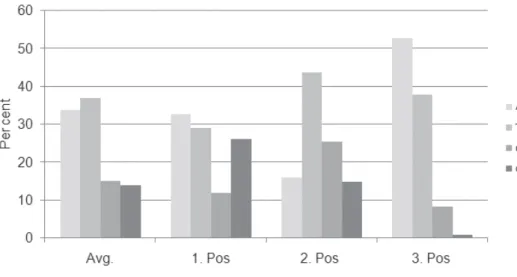
he complete alignment of the partial mitochondrial COI gene sequences from 68 cephid specimens, including representatives of these two new records, resulted in a fragment containing 658 base pairs, among which 287 nucleotide positions were variable and 223 sites of which were parsimony-informative. he analyzed sequences correspond to a functional mitochondrial gene region because of the presence of sin-gular peaks in each chromatograph and absence of in–del and premature stop codons, and presence of the highest nucleotide substitutions at the third codon position (Avise 1994). he percentages of nucleotide composition at each codon position are vari-able (Fig. 1). he mean frequency of COI sequences used in the analyses showed a bias of A + T (T 37.0%, C 15.2%, A 33.9% and G 16.0%), which is similar to other reported members of Hymenoptera (Jermiin and Crozier 1994, Dowton and Austin 1995,1997, Leys et al. 2000, Danforth et al. 2003). he A + T content at the third, second and irst codon positions are 90.7%, 59.8%, and 61.9%, respectively. he nu-cleotide G has lowest (1.0%) and the A highest content (52.8%) at the third codon positions. he distribution of polymorphic sites for all cephid species shows that the majority of substitutions are at synonymous sites. he vast majority of synonymous substitutions are also found at third codon positions with a rate of 87.88% for the Cephinae. he irst and the second positions are relatively more conserved in compari-son with the third position.
Chara-copygus and Pachycephus (p= 0.062) and, the most are Hartigia and Syristra (p= 0.161) also with highest standard error value of 0.017.
All three codon positions in the partial COI gene were analyzed for saturation, achieved by plotting the number of observed substitutions against the model TN93 genetic distance estimates. he scattergrams (Fig. 2a–c) showed that transitions and transversions for the irst, second and third codons of the partial COI gene increased with the genetic distance, but considerable scattering was also observed. In addition, a similar plot of the third codon transition of the COI gene (Fig. 2d) suggested that saturation of transition occurred between certain pairs of the taxa, which may lead to higher levels of homoplasy (Kumar et al. 2001; Zhang et al. 2008).
Figure 1. Percentage of nucleotide composition at each codon position.
table 2. Estimates of evolutionary divergence over sequence pairs between genera. he number of base substitutions per site from averaging over all sequence pairs between groups are shown. Standard error estimates are shown above the diagonal.
Genera 1 2 3 4 5 6 7 8
1. Calameuta 0.010 0.011 0.010 0.013 0.012 0.015 0.025
2. Trachelus 0.110 0.010 0.009 0.013 0.012 0.014 0.025
3. Cephus 0.108 0.119 0.007 0.013 0.010 0.016 0.026
4. Characopygus 0.078 0.094 0.069 0.012 0.007 0.012 0.028
5. Hartigia 0.136 0.146 0.143 0.114 0.013 0.017 0.029
6. Pachycephus 0.116 0.125 0.113 0.062 0.137 0.013 0.029
7. Syrista 0.124 0.145 0.156 0.102 0.161 0.125 0.030
Figure 2. Saturation plots of transversion and transition rates against JC69 distance at a irst codon posi-tion b second codon position c third codon position, and d sum of data.
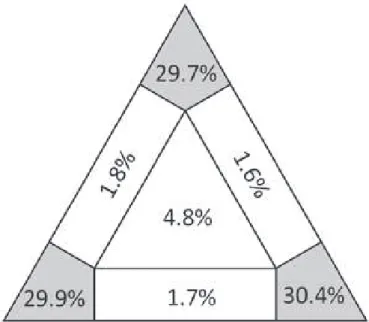
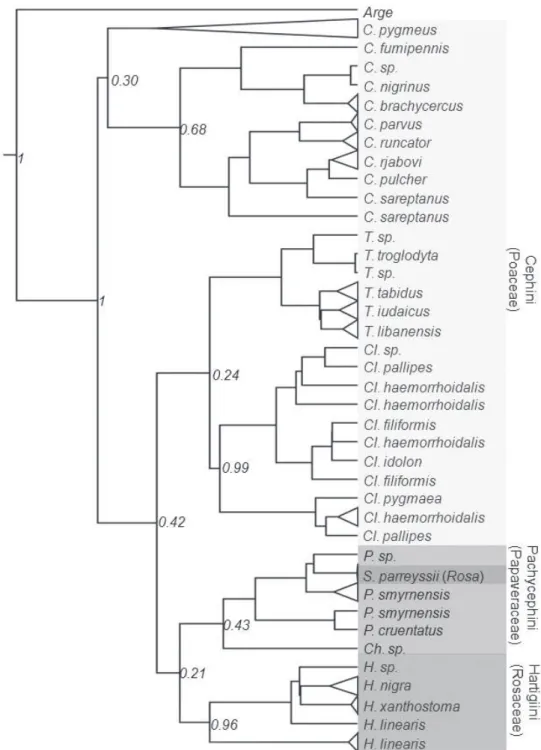
Result of likelihood mapping is presented in Fig. 3. High dichotomic phyloge-netic signal was detected in the dataset. he percentage of the quartets suggesting a star- or network- like phylogeny is 9.9%, indicating that data are reliable for a di-chotomic phylogenetic analysis (Schmidt 2009). For ML analysis GTR+I+G models showed a signiicantly better it than the other less complicated models for the COI dataset. Maximum likelihood analyses under the same model of evolution resulted in topologies with lnL = – 5570.6831 in RAxML, which were very close to the BI tree. Bayesian inference under the GTR+I+G model resulted in a topology with mean lnL = – 5347.963. Posterior probability values from the BI were congruent with ML boot-strap support. ML and BI analyses generated a tree with almost the same overall topol-ogy (Fig. 4). Equally weighted parsimony analysis of the 287 parsimony-informative characters produced 12 most parsimonious trees with a length of 1065 steps (Homo-plasy Index = 0.608, Retention Index = 0.392 and Consistency Index = 0.392). hese equally parsimonious solutions were due to diferences in terminal branches. However, the branching pattern of bootstrap tree was comb-like and recovered almost no origi-nal branches. Considering that this may be due to many synonymous changes in the third codon position, we run an analysis excluding the third codon position from the data. he analysis produced 60 equally parsimonious trees with a length of 200 and the bootstrap application was also resulted with no support to branching pattern of original trees. his may be partly attributed to the nature of data and relatively a short sequence not suicient to detect phylogenetic signal under parsimony interference. herefore, we do not present any MP trees here.
Discussion
Currently, the Cephinae is divided into three tribes based on morphology and feeding habits of larvae. he recovered mitochondrial gene trees substantially conlict with the current taxonomic arrangement, particularly the tribe level. Trees constructed under ML and BI methods supported monophyly of each genus except Pachycephus but failed to recover monophyly of any tribes. However, it should be noted that monophyly of most genera were supported by low posterior values (Fig. 4). his is probably due to the strongly biased nucleotide composition and the saturation at the third codon posi-tion (Fig. 2). he BI tree suggests that the most basal clade of Cephinae is the genus
Cephus making the Cephini paraphyletic with respect to rest of Cephini and other
tribes. Occurrence of Syrista within Pachycephini rather than Hartigiini makes both tribes polyphyletic and paraphyletic respectively (Fig. 4). Otherwise, Pachycephini and Hartigiini appear as sister groups. However, we do not propose a new classiication as the present phylogeny is generated from a single gene fragment.
man 1994), and many insect species feed only on a single plant species (Schefer and Wiegmann 2000). Syrista which is considered in the tribe Hartigiini, occurred within Pachycephini clade (see Fig. 4) and this placement is questionable as larvae of Syristra
feed on Rosa. However, if this placement is considered to be true than it suggests a host shift event from Papaveraceae to Rosaceae. Occurrence of Cephus at most basal clades also suggests two later shifts from Poaceae to Rosaceae and Papaveraceae (Fig. 4). Con-sidering relationships among genera and species of Cephini inferred from the present phylogenetic hypothesis, several host shift events are also evident. However, we are re-luctant for further discussion until a more robust phylogeny become available derived from analyses of several gene sequences of both nuclear and mitochondrial genomes.
Acknowledgements
We thank Mahir Yildirim and Burcu Temel for accompanying us on some of our ield trips and collecting specimens. his research was funded by Cumhuriyet University via research grants provided to the project CÜBAP F-224. We are grateful to Dr. Donald L.J. Quicke (Imperial College, London) and the other anonymous reviewer for their valuable comments on the early version of the manuscript.
References
Avise JC (1994) Molecular markers, natural history and evolution. Chapman and Hall, New York, NY, 511 pp. doi: 10.1007/978-1-4615-2381-9
Bacci M, Solomon SE, Mueller UG, Martins VG, Carvalho AOR, Vieira LGE, Silva-Pinhati ACO (2009) Phylogeny of leafcutter ants in the genus Atta Fabricius (Formicidae: Attini) based on mitochondrial and nuclear DNA sequences. Molecular Phylogenetics and Evolu-tion 51: 427–437. doi: 10.1016/j.ympev.2008.11.005
Basibuyuk HH, Quicke DLJ (1995) Morphology of the antenna cleaner in the Hymenoptera with particular reference to non-aculeate families (Insecta). Zoologica Scripta 24: 157– 177. doi: 10.1111/j.1463-6409.1995.tb00397.x
Benson RB (1935) On the genera of the Cephidae, and the erection of a new family Syntexidae (Hymenoptera, Symphyta). he Annals and Magazine of Natural History, including Zool-ogy, Botany, and Geology 16(10): 535–553. doi: 10.1111/j.1365-2311.1946.tb00445.x Benson RB (1946) Classiication of the Cephidae (Hymenoptera Symphyta). Transactions of
the Royal Entomological Society of London 96: 89–108. doi: 10.1111/j.1365-2311.1946. tb00445.x
Benson RB (1951) Hymenoptera, Symphyta. Handbooks for the Identiication of British In-sects 6(2a), 49 pp.
Berlocher SH, Feder JL (2002) Sympatric speciation in phytophagous insects: moving be-yond controversy? Annual Review of Entomology 47: 773–815. doi: 10.1146/annurev. ento.47.091201.145312
Bernays EA, Chapman RF (1994) Host-plant selection by phytophagous insects. Chapman & Hall, New York, 312 pp.
Calmasur O, Ozbek H (2010) Distribution data on the Cephidae (Hymenoptera: Symphyta) fauna of Turkey. Zoology in the Middle East 50: 144–146.
Caterino MS, Cho S, Sperling FAH (2000) he current state of insect molecular systematics: A thriving Tower of Babel. Annual Review of Entomology 45: 1–54. doi: 10.1146/annurev. ento.45.1.1
Danforth BN, Conway L, Ji S (2003) Phylogeny of eusocial Lasioglossum reveals multiple losses of eusociality within a primitively eusocial clade of bees (Hymenoptera: Halictidae). Sys-tematic Biology 52: 23–36. doi: 10.1080/10635150390132687
Dowton M, Austin AD (1995) Increased genetic diversity in mitochondrial genes is correlated with the evolution of parasitism in the Hymenoptera. Journal of Molecular Evolution 41: 958–965. doi: 10.1007/BF00173176
Dowton M, Austin AD (1997) Evidence for AT-transversion bias in wasp (Hymenoptera: Sym-phyta) mitochondrial genes and its implications for the origin of parasitism. Journal of Molecular Evolution 44: 398–405. doi: 10.1007/PL00006159
Drummond AJ, Rambaut A (2007) BEAST: Bayesian evolutionary analysis by sampling trees. Bmc Evolutionary Biology 7: 214. doi: 10.1186/1471-2148-7-214
Eubanks MD, Blair CP, Abrahamson WG (2003) One host shift leads to another? Evidence of host-race formation in a predaceous gall-boring beetle. Evolution 57: 168–172.
Felsenstein J (1981) Evolutionary trees from DNA sequences: a maximum likelihood approach. Journal of Molecular Evolution 17: 368–376. doi: 10.1007/BF01734359
Funk DJ, Filchak KE, Feder JL (2002) Herbivorous insects: model systems for the compara-tive study of speciation ecology. Genetica 116: 251–267. doi: 10.1023/A:1021236510453 Hebert PD, Ratnasingham S, de Waard JR (2003) Barcoding animal life: cytochrome c oxidase
subunit 1 divergences among closely related species. Proceedings of the Royal Society B 270(Suppl 1): S96-S99. doi: 10.1098/rsbl.2003.0025
Huelsenbeck JP, Ronquist F (2001) MRBAYES: Bayesian inference of phylogenetic trees. Bio-informatics 17: 754–755. doi: 10.1093/bioBio-informatics/17.8.754
Jermiin LS, Crozier RH (1994) he cytochrome b region in the mitochondrial DNA of the ant
Tetraponera rufoniger: sequence divergence in Hymenoptera may be associated with nu-cleotide content. Journal of Molecular Evolution 38: 282–294. doi: 10.1007/BF00176090 Kimura M (1980) A simple method for estimating evolutionary rates of base substitutions
through comparative studies of nucleotide sequences. Journal of Molecular Evolution 16: 111–120. doi: 10.1007/BF01731581
Korkmaz EM, Budak M, Orgen SH, Bagda E, Gencer L, Ulgenturk S, Basibuyuk HH (2010) New records and a checklist of Cephidae (Hymenoptera: Insecta) of Turkey with a short biogeographical consideration. Turkish Journal of Zoology 34: 203–211.
Kumar S, Tamura K, Jakobsen IB, Nei M (2001) MEGA2: molecular evolutionary genetics analysis software. Bioinformatics 17: 1244–1245. doi: 10.1093/bioinformatics/17.12.1244 Leys R, Cooper SJ, Schwarz MP (2000) Molecular phylogeny of the large carpenter bees, ge-nus Xylocopa (Hymenoptera: apidae), based on mitochondrial DNA sequences. Molecular Phylogenetics and Evolution 17: 407–418. doi: 10.1006/mpev.2000.0851
Lozier JD, Roderick GK, Mills NJ (2007) Genetic evidence from mitochondrial, nuclear, and endosymbiont markers for the evolution of host plant associated species in the aphid ge-nus Hyalopterus (Hemiptera: Aphididae). Evolution 61: 1353–1367. doi: 10.1111/j.1558-5646.2007.00110.x
Lunt DH, Zhang DX, Szymura JM, Hewitt GM (1996) he insect cytochrome oxidase I gene: Evolutionary patterns and conserved primers for phylogenetic studies. Insect Molecular Biology 5: 153–165. doi: 10.1111/j.1365-2583.1996.tb00049.x
Middlekauf WW (1969) he Cephid stem borers of California (Hymenoptera: Cephidae). Bulletin of the California Insect Survey 11: 1–19.
Mitter C, Farrell B, Wiegmann B (1988) he phylogenetic study of adaptive zones - has phytophagy promoted insect diversiication. American Naturalist 132: 107–128. doi: 10.1086/284840
Mopper S, Strauss SY (1998) Genetic structure and local adaptation in natural insect popula-tions: efects of ecology, life history, and behavior. Chapman & Hall, New York, London, xix, 449 pp.
Muche H (1981) Die Cephidae der Erde (Hymenoptera: Cephidae). Deutsche Entomologis-che Zeitschrift 28: 239–295. doi: 10.1002/mmnd.19810280405
Nosil P, Crespi BJ, Sandoval CP (2002) Host-plant adaptation drives the parallel evolution of reproductive isolation. Nature 417: 440–443. doi: 10.1038/417440a
Posada D, Crandall KA (1998) MODELTEST: testing the model of DNA substitution. Bioin-formatics 14: 817–818. doi: 10.1093/bioinBioin-formatics/14.9.817
Rambaut A. (2008) FigTree v1.2. Available from: http://tree.bio.ed.ac.uk/software/ FigTree/ Rasnitsyn AP (1980) Origin and evolution of Hymenoptera. Transactions of the
Paleontologi-cal Institute of the Academy of Sciences of the USSR 174: 1–192.
Rasnitsyn AP (1988) An outline of evolution of hymenopterous insects (order Vespida). Ori-ental Insects 22: 115–145.
Ries DT (1937) Revision of the Nearctic Cephidae. Transactions of the American Entomologi-cal Society 63: 259–324.
Roe AD, Sperling FAH (2007) Patterns of evolution of mitochondrial cytochrome c oxidase I and II DNA and implications for DNA barcoding. Molecular Phylogenetics and Evolution 44: 325–345. doi: 10.1016/j.ympev.2006.12.005
Ronquist F, Rasnitsyn AP, Roy A, Eriksoon K, Lindgren M (1999) Phylogeny of the Hyme-noptera: a cladistic reanalysis of Rasnitsyn’s (1988) data. Zoologica Scripta 28: 13–50. doi: 10.1046/j.1463-6409.1999.00023.x
Schmidt HA, Strimmer K, Vingron M, von Haeseler A (2002) TREE-PUZZLE: maximum likelihood phylogenetic analysis using quartets and parallel computing. Bioinformatics 18: 502–504. doi: 10.1093/bioinformatics/18.3.502
Schmidt HA (2009) Testing tree topologies. In: Lemey P, Salemi M, Vandamme AM (Eds) he Phylogenetic Handbook: a Practical Approach to Phylogenetic Analysis and Hypothesis Testing. Cambridge University Press, Cambridge, 381–404.
Schulmeister S, Wheeler WC, Carpenter JM (2002) Simultaneous analysis of the basal lineages of Hymenoptera (Insecta) using sensitivity analysis. Cladistics 18: 455–484.
Sharkey MJ (2007) Phylogeny and classiication of Hymenoptera. Zootaxa 1668: 521–548. Simon C, Frati F, Beckenbach A, Crespi B, Liu H, Flook P (1994) Evolution, weighting, and
phylogenetic utility of mitochondrial gene-sequences and a compilation of conserved polymerase chain-reaction primers. Annals of the Entomological Society of America 87: 651–701.
Smith DR (1997) A new species of Janus (Hymenoptera: Cephidae) from Indonesia. Entomo-logical News 108: 24–28.
Smith DR, Schif NM (2005) A new western Nearctic species of Calameuta Konow (Hymenop-tera: Cephidae). Proceedings of the Entomological Society of Washington 107: 864–868. Smith DR, Schmidt S (2009) A new subfamily, genus, and species of Cephidae (Hymenoptera)
from Australia. Zootaxa 2034: 56–60.
Smith DR, Shinohara A (2002a) A new genus and new species of Cephidae (Hymenoptera) from Sulawesi Utara, Indonesia. Proceedings of the Entomological Society of Washington 104: 624–628.
Smith DR, Shinohara A (2002b) he stem-boring sawly genus Cephus Latreille (Hymenop-tera: Cephidae) in Japan. Proceedings of the Entomological Society of Washington 104: 479–484.
Smith DR, Solomon JD (1989) A new Janus (Hymenoptera, Cephidae) from Quercus, and key to North American species. Entomological News 100: 1–5.
Stamatakis A (2006) RAxML-VI-HPC: maximum likelihood-based phylogenetic analyses with thousands of taxa and mixed models. Bioinformatics 22: 2688–2690. doi: 10.1093/bioin-formatics/btl446
Strimmer K, von Haeseler A (1997) Likelihood-mapping: A simple method to visualize phylo-genetic content of a sequence alignment. Proceedings of the National Academy of Sciences of the United States of America 94: 6815–6819. doi: 10.1073/pnas.94.13.6815
Swoford DL (2002) PAUP* Phylogenetic analysis using parsimony (*and other methods). Ver-sion 4.0b10 ed. Sinauer Associates, Sunderland, Massachusetts.
Taeger A, Blank SM, Liston AD (2010) World Catalog of Symphyta (Hymenoptera). Zootaxa 2580: 1–1064.
Tamura K, Dudley J, Nei M, Kumar S (2007) MEGA4: Molecular evolutionary genetics analy-sis (MEGA) software version 4.0. Molecular Biology and Evolution 24: 1596–1599. doi: 10.1093/molbev/msm092
penalties and weight matrix choice. Nucleic Acids Research 22: 4673–4680. doi: 10.1093/ nar/22.22.4673
Vilhelmsen L (1997) he phylogeny of lower Hymenoptera (Insecta), with a summary of the early evolutionary history of the order. Journal of Zoological Systematics and Evolutionary Research 35: 49–70. doi: 10.1111/j.1439-0469.1997.tb00404.x
Vilhelmsen L (2001) Phylogeny and classiication of the extant basal lineages of the Hyme-noptera (Insecta). Zoological Journal of the Linnean Society 131: 393–442. doi: 10.1111/ j.1096-3642.2001.tb01320.x
Wei MC (2007) On the genus Syrista Konow, with the description of a new species from China (Hymenoptera: Cephidae). Entomological News 118: 450–458. doi: 10.3157/0013-872X( 2007)118[450:OTGSKW]2.0.CO;2
Wei MC, Smith DR (2010) Review of Syrista Konow (Hymenoptera: Cephidae). Proceedings of the Entomological Society of Washington 112: 302–316. doi: 10.4289/0013-8797-112.2.302
Xia X, Xie Z (2001) DAMBE: Software package for data analysis in molecular biology and evolution. Journal of Heredity 92: 371–373. doi: 10.1093/jhered/92.4.371
Zhang M, Zhong Y, Cao TW, Geng YP, Zhang Y, Jin K, Ren ZM, Zhang R, Guo YP, Ma EB (2008) Phylogenetic relationship and morphological evolution in the subfamily Limeni-tidinae (Lepidoptera: Nymphalidae). Progress in Natural Science 18: 1357–1364. doi: 10.1016/j.pnsc.2008.03.025