Raisa Kabeer
Rinoy Varghese
Kannan V.M.
John Richard Thomas
Sylas V. Poulose
Rhizosphere bacterial diversity and heavy metal
accumulation in
Nymphaea pubescens
in aid of
phytoremediation potential
Authors’ address:
School of Environmental Sciences, Mahatma Gandhi University, Kottayam, Kerala, India.
Correspondence:
Raisa Kabeer
School of Environmental Sciences, Mahatma Gandhi University, PD Hills PO, Kottayam, Kerala 686560, India.
e-mail: [email protected]
Article info:
Received: 11 September 2013
Accepted: 28 February 2014
ABSTRACT
The present work aims to characterize the bacterial diversity of the rhizosphere system of Nymphaea pubescens and the sediment system where it grows naturally. Heavy metal content in the sediment and Nymphea plant from the selected wetland system were also studied. Results of the current study showed that the concentration of copper, zinc and lead in the sediment ranged from 43 to 182 mg/Kg, from 331 to 1382 mg/Kg and from 121 to 1253 mg/Kg, respectively. Cadmium concentration in sediment samples was found to be zero and the order of abundance of heavy metals in the sediment samples was Zn>Pb>Cu>Cd. The abundance patterns of heavy metals in leaf, petiole and root were Cd>Cu>Pb>Zn. Microbial load in rhizosphere of Nymphea pubescens ranged from 93×102 to
69×103and that of sediment was 62×102to 125×103
. Bacterial load in rhizosphere was higher than that of growing sediment. Four bacterial genera were identified from the rhizosphere of Nymphaea pubescens which include Acinetobacter, Alcaligens, Listeria and Staphylococcus. Acinetobacter, Alcaligens and Listeria are the three bacterial genera isolated from sediment samples. Copper resistance studies of the 14 bacterial isolates from rhizosphere and 7 strains from sediment samples revealed that most of them showed low resistance (<100 µg/ml) and very few isolates showed high resistance of 400-500 µg/ml.
Key words: Heavy metals, pollution, aquatic macrophytes, rhizosphere, phytoremediation
Introduction
The term “heavy metals” refers to any metallic element
that has a relatively high density and is toxic or poisonous even at low concentration. High concentrations of heavy metals in the plants, sediment and water clearly demonstrate pollution by heavy metals. Many industries release heavy metals such as Zn, Cd and Pb in water. Because of their toxicity, persistence, and non-degradability in the environment, heavy metals pollution in the aquatic systems is one of the largest threats to their environment that affects directly on flora, fauna and human health. High levels of Cd, Cu, Pb, and Fe can act as ecological toxins in aquatic and terrestrial ecosystems (Guilizzoni, 1991; Balsberg-Påhlsson, 1989). Heavy metals are more accumulated in wetlands due
to changes in natural environment and influence of human activities (Mitsch & Gosselink, 2000).
submerged, emergent and free-floating aquatic macrophytes are known to accumulate and bioconcentrate heavy metals (Bryan, 1971; Chow et al., 1976). Aquatic macrophytes take up metals from the water, producing an internal concentration several fold greater than their surroundings. Many of the aquatic macrophytes are found to be the potential scavengers of heavy metals from water and wetlands (Gulati et al., 1979).
Rhizosphere is considered to be the most diverse and complicated environment (Hsu & Bartha, 1986). Rhizoremediation involves the removal of specific contaminants from contaminated sites by mutual interaction of plant roots and suitable microbial flora. Aquatic macrophytes are generally not considered as the main mode
of remediation in ‘rhizosphere treatment’ technique. Rather,
the plant creates a niche for rhizosphere microorganisms to carry out the degradation. In most cases, bacteria and fungi living in the rhizosphere closely associated with plants, may contribute to mobilize metal ions, increasing the bioavailable fraction. Rhizospheric microorganisms are well known for their coexistence with plants and for providing nutrition to plants (Uroz et al., 2007) and the microorganisms facilitate the uptake of essential elements such as iron, copper and zinc (Terano et al., 2002; Chen et al., 2006). Bacterial populations inhabiting the rhizosphere can enhance biomass production and heavy metal tolerance of plants in polluted environments (Sheng & Xia, 2006; Dell‟Amico et al., 2008). Thus, an alternative way to reduce the toxicity of heavy metals, especially to plants, is by using the rhizosphere microorganisms (Burd et al., 2000).
Heavy metals influence the microbial population by affecting their growth, morphology, biochemical activities and ultimately resulting in decreased biomass and diversity. Due to the selective pressure from the metal in the growth environment, microorganisms have evolved various mechanisms to resist the heavy metal stress. Bacteria develop heavy-metal resistance mostly for their survivals, especially a significant portion of the resistant phenomena was found in the environmental strains (with or without the presence of heavy metals) (Goering et al., 1999). Long term exposure to metals leads to the selection/adaptation of a microbial community, which then thrives in polluted areas (Perez-de-Mora et al., 2006). Certain heavy metal resistant bacteria have the ability to promote plant growth by various mechanisms such as nitrogen fixation, solubilisation of minerals, production of siderophores and phytohormones, and transformation of nutrients (Glick et al, 1999).
Thus, a basic idea of the rhizosphere bacterial diversity of the metal accumulated plants, how the bacterial population resist the major metal pollutant and how much metal is accumulated by the plant in a natural system are assumes significance. Therefore, in the present study we analyze the diversity of rhizosphere bacteria of Nymphaea pubescens and an associated sediment system. The identified bacterial isolates were tested for their resistance to copper, the major agro pollutant in Kuttanad. Heavy metal contents in sediment and Nymphaea plant parts (leaf, petiole and root) were also analyzed.
Materials and Methods
Study area and experimental plant
Vembanad Kol Wetland System is a Ramsar site having significance in the point of biodiversity, water quality, mineral wealth, flora and fauna, hydrology etc. The environmental trouble of the wetland system with reference to heavy metal content of water, sediment and animals had been reported by many authors. But very few studies have reported on the rhizosphere bacterial diversity and accumulation of heavy metals in the aquatic macrophytes. For the present study, the aquatic macrophyte Nymphaea pubescens (water lily) was selected and it is a perennial aquatic rhizomatous stoloniferous herb. Nymphaea is commonly known as water lily, which includes about fifty species and widely distributed in tropical and temperate regions inhabiting stagnant fresh water, ponds, lakes and swamps. Kuttanad has a good diversity of Nymphaea pubescens and growing extrovertly in the selected regions of the wetland.
Collection of Nymphaea pubescens and sediments
Nymphaea pubescens, of uniform size were collected from the water bodies of selected Nymphaea bed (Kainady, Poovam and Nedumudi) of Kuttanad wetland ecosystem. The macrophytes were transferred to a sterile polythene cover for heavy metal analysis. The root region of Nymphaea pubescens was washed in sterile polypropylene bottles using sterilized water for the isolation of rhizosphere associated bacteria. Sediment samples were also collected from the selected Nymphaea bed. The plant, sediment and rhizosphere samples were transported to the laboratory in an ice box and
Analysis of heavy metals
The collected plants were first washed with tap water and then with deionised water, allowed to drain off excess water and the plants were separated into three parts: petioles, leaves and roots. Subsequently, the plant parts were dried in the oven for 24 hours at 70°C for the preparation to ascertain the accumulation of heavy metal (Mokhtar et al., 2011). In the lab, soil samples were air dried and then grounded to fine powder using an agate mortar. Then, the samples were separated to granulometric fraction (<200 µ) using ASTM sieves and this fraction was used for the heavy metal analysis. The collected sediment samples were also digested by the same method. Two hundred milligrams of dried ground plant samples and sediment samples were taken in digestion tubes and digested by Nitric-Perchloric Acid Digestion method as described by USEPA, 1995 (APHA, 1995). The digested plant and sediment samples were analyzed for heavy metal content by Volta metric trace metal analyzer (Metrohm 797 VA Computrace) using HMDE (Hanging Mercury Drop Electrode) method.
Isolation and identification of bacteria
Bacterial strains were isolated from rhizosphere and growing sediment bed of Nymphea pubescens. Isolation and enumeration of bacteria were carried by standard serial dilution plate technique. Serially diluted samples were sow in Nutrient agar and incubated at 37°C for 24-48 hours. Bacterial colonies from Nutrient agar were isolated, purified and maintained as pure cultures, which were characterized and identified up to genus level by morphological tests as per
Bergey’s Manual of Determinative Bacteriology: 8th edition
and 9th edition (Buchanan & Gibbons, 1974). Morphological tests carried out for the identification of the isolates are
Gram’s staining, cell shape and arrangement, pigment
production, O/F glucose tests, endospore staining, motility, catalase, oxidase etc.
Results and Discussion
Heavy metal content in Nymphaea pubescens and growing sediment bed
The results of the current study showed that the concentration of copper, zinc and lead in the sediment samples ranged from 43 to 182 mg/Kg, from 331 to 1382 mg/Kg and from 121 to 1253 mg/Kg, respectively (Figure 1). Cadmium concentration in sediment samples was found to be zero and the order of abundance of heavy metals in the
sediment samples was Zn>Pb>Cu>Cd. Heavy metal concentration in the sediment varied spatially. Canal systems in Kuttanad are interconnected with many river systems that carrying domestic, municipal agricultural and industrial waste from upstream. That may be the reason for the presence of heavy metals in the wetland system. Similar trends of results were also observed by Haque et al., (2005) in the surface water of the River Ganga at Sundarban estuary. Sediment metal concentrations are influenced by a range of factors. They include physical and hydrological characteristics of the region and its benthos, atmospheric conditions, productivity, pH, soil texture, redox potential and cation exchange capacity among others. The quantity of heavy metals retained in sediments is also affected by the characteristics of the sediment into which they are adsorbed. Grain size, partition coefficient (Kd), cation exchange, organic matter content and mineral constituents all influence the uptake of heavy metals in the aquatic environment (Unnikrishnan & Nair, 2004; Casey et al. 2007).
Figure 1. Heavy metals concentrations in the sediment samples
(1992): for Cd (0.03-0.5 μg.g-1 d.w.), Cu (2-20 μg.g-1 d.w.)
and Zn (15-80 μg.g-1 d.w.) in general.
Figure 2. Copper accumulation in plant parts of Nymphaea pubescens
Figure 3. Zinc accumulation in plant parts of Nymphaea pubescens
Figure 4. Cadmium accumulation in plant parts of Nymphaea pubescens
Figure 5. Lead accumulation in plant parts of Nymphaea pubescens
The majority of the studies point out that roots accumulate more metals than the above ground tissues for emergent macrophytes such as Typha spp., Juncus effusus, Phragmites australis, Schoenoplectus validus (Dunbabin & Bowmer, 1992; Deng et al., 2004). This omission of metals from above ground tissues has been recommended as a metal tolerant strategy (Deng et al., 2004) and plants that employ this policy are designated as non-accumulator species. In the present work, zinc levels in Nymphaea pubescens were higher in roots. Therefore, the studied species presented an exclusion strategy for these metals. Copper, cadmium and lead levels in Nymphaea were higher in leaf and petiole compared to root system. Thus, the plant was correctly selected as accumulator species for copper, cadmium and lead.
Bacterial diversity in the rhizosphere of Nymphaea pubescens and bulk sediment
The microbial load in rhizosphere of Nymphaea pubescens ranged from 93×102 to 69×103 and that of
sediment was 62×102 to 125×103
. In the present study, microbial load in rhizosphere was higher than that of growing sediment (Figure 6). Four bacterial genera were identified from the rhizosphere of Nymphaea pubescens, which include
Acinetobacter, Alcaligens, Listeria and Staphylococcus.
Acinetobacter, Alcaligens and, Listeria were the three bacterial genera isolated from sediment samples. Maya et al. (2011) also reported thirteen bacterial genera from the sediment samples of Kuttanad wetland, which belongs to
biomass production and heavy metal tolerance of plants in polluted environments (Sheng & Xia, 2006; Dell’Amico et al., 2008). Thus, an alternative way to reduce the toxicity of heavy metals, especially to plants, is by using the rhizosphere microorganisms (Burd et al., 2000).
Figure 6. Load of rhizosphere and bulk sediment bacteria of Nymphaea pubescens
Bacterial copper resistance
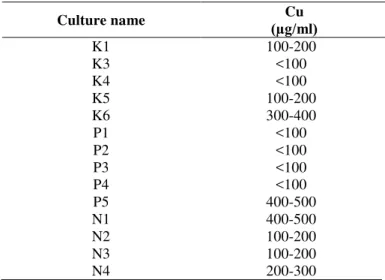
Copper resistance studies of the 14 bacterial isolates from rhizosphere of Nymphaea and 7 strains from sediment samples revealed that most of them showed low resistance (<100 µg/ml) and very few isolates showed high resistance of 400-500 µg/ml (Table 1 and Table 2). The high levels of resistance found among the isolates are probably attributed to past or present copper contamination in the growing environment (Abou-Shanab et al., 2003). Berg et al. (2009) also reported that microbes isolated from copper amended systems were more resistant to copper than strains isolated from control plots. Bacterial strains isolated from heavy metal polluted environments are tolerant to higher concentrations of metals than those isolated from unpolluted areas. In addition to this, after addition of heavy metals, metal tolerance is increased in bacterial communities by the disappearance of sensitive species and strains, and subsequent competition and adaptation of surviving bacteria (Diaz-Ravina & Baath, 1996). This metal tolerance can be attributed to the interactions between microbial cell wall components and heavy metal ions, both contributing for metal detoxification (Frostegård et al., 1993; Roane & Kellog, 1996.
Table 1. Copper resistance patterns of bacterial strains isolated from rhizosphere of Nymphaea pubescens
Culture name (µg/ml)Cu
K1 100-200
K3 <100
K4 <100
K5 100-200
K6 300-400
P1 <100
P2 <100
P3 <100
P4 <100
P5 400-500
N1 400-500
N2 100-200
N3 100-200
N4 200-300
Table 2. Copper resistance patterns of bacterial strains isolated from sediment
Culture name (µg/ml)Cu
K1 400-500
K2 100-200
K3 <100
N1 200-300
N2 200-300
N3 <100
P1 100-200
Conclusion
Acknowledgement
Authors are thankful to Directorate of Environment and Climate Change (DoECC), Government of Kerala, India for financial assistance.
References
Abou-Shanab RI, Angle JS, Delorme TA, Chaney RL, van Berkum P, Moawad H, Ghanem K, Ghozlan HA. 2003. Rhizobacterial effects on nickel extraction from soil and uptake by Alyssum murale. New Phytologist, 158: 219-224.
APHA (American Public Health Associtation). 2005. Standard Methods for the Examination of Water and Wastewater. 21st Ed.
Balsberg-Påhlsson AM. 1989. Toxicity of heavy metals (Zn, Cu, cd, Pb) to vascularplants. A literature review. Water Air and Soil Pollution, 47: 287-319.
Berg G. 2009. Plant-microbe interactions promoting plant growth and health: perspectives for controlled use of microorganisms in agriculture. Appl. Microbiol. Biotechnol., 84(1): 11-18. Bryan GW. 1971. The effects of heavy metals (other than mercury)
on marine and estuarine organisms. Proc. Roy. Soc. Lond., B., 177: 389- 410.
Buchanan RE, Gibbons NE. 1974. Bergey’s Manual of Determinative Bacteriology. Williams and Wilkins, Baltimore. 8: 529-551.
Burd GI, Dixon DG, Glick BR. 2000. Plant growth-promoting bacteria that decrease heavy metal toxicity in plants. Can. J. Microbiol.,46(3): 237–245.
Casey RE, Simon JA, Atueyi A, Snodgrass JW, Karouna-Renier N, Sparling DW. 2007. Temporal trends of trace metals in sediment and invertebrates from stormwater management ponds. Water Air Soil Pollut., 178: 69-77.
Chen XC, Wang, YP, Lin Q, Shi JY, Wu WX, Chen YX. 2006. Biosorption of copper(II) and zinc(II) from aqueous solution by
Pseudomonas putida CZ1. Colloids Surf. B. Biointerfaces, 46(2): 101-107.
Chow TJ, Snyder CB, Snyder HG, Earl JL. 1976. Lead content of some marine organisms. Journal of Environmental Science & Health, A11: 33-44.
Chung IH, Jeng SS. 1974. Heavy metal pollution of Ta-Tu River. Bulletin Inst. Zool. Acad. Sinica, 13: 69-73.
Dell’Amico E, Cavalca L, Andreoni V. 2008. Improvement of
Brassica napus growth under cadmium stress by cadmium-resistant rhizobacteria. Soil Biology & Biochemistry, 40(1): 74– 84.
Deng H, Ye ZH, Wong MH. 2004. Accumulation of lead, zinc, copper and cadmium by 12 wetland plant species thriving in metal-contaminated sites in China. Environ. Pollut., 132(1): 29-40.
Devlin RM.(edited). 1967. Plant Physiology. Reinhold, New York. 564.
Diaz-Ravina M, Baath E. 1996. Development of metal tolerance in soil bacterial communities exposed to experimentally increased metal levels. Appl. Environ. Microbiol.,62(8): 2970-2977.
Dunbabin JS, Bowmer KH. 1992. Potential use of constructed wetlands for treatment of industrial wastewaters containing metals. Sci. Tot. Environ., 111(2-3): 151-168.
Frostegård A, Tunlid A, Bååth E. 1993. Phospholipid fatty acid composition, biomass, activity of microbial communities from two soil types experimentally exposed to different heavy metals. Appl. Environ. Microbiol.,59(11): 3605-3617.
George M, Cyriac N, Nair A, Hatha AAM. 2011. Diversity of
Bacillus and Actinomycetes in the water and sediment samples from Kumarakom region of Vembanadu lake. Indian Journal of Geo Marine Sciences, 40(3): 430-437.
Glick BR, Patten CL, Holguin G, Penrose GM. 1999. Biochemical and genetic mechanisms used by plant growth promoting bacteria. Imperial College Press, London.
Goering PL, Aposhian HV, Mass MJ, Cebrián M, Beck BD, Waalkes MP. 1999. The enigma of arsenic carcinogenesis: role of metabolism. Toxicol. Sci., 49(1): 5-14.
Guilizzoni P. 1991. The role of heavy metals and toxic materials in the physiological ecology of submerged macrophytes. Aquatic Botany, 41: 87-109.
Gulati KL, Nagpaul KK, Bukhari SS. 1979. Uranium, boron, nitrogen, phosphorus and potassium in leaves of mangroves, Mahasagar – Bulletin of the National Institute of Oceanography, 12: 183-186.
Haque MR, Ahmad JU, Chowdhurv MDA, Ahmed MK, Rahman MS. 2005. Seasonal variation of heavy metal concentration in sediments of the rivers and estuaries of Sunderban mangrove forest. Asian Journal of Microbiology, Biotechnology & Environmental Sciences Paper, 6(2): 175-185
Hsu TS, Bartha R. 1979. Accelerated mineralization of two organophosphate insecticides in the rhizosphere. Appl. Environ. Microbiol., 37(1): 36–41.
Kabata-Pendias A, Pendias H. 1993. Biogeochemia pierwiastkow sladowych. PWN, Warszawa, 398 p.
Markert B. 1992. Presence and significance of naturally occurring chemical elements of the periodic system in the plant organism and consequences for future investigations on inorganic environmental chemistry in ecosystems. Vegetatio, 103: 1-30. Mitsch WJ, Gosselink JG. 2000. Phospholipid fatty acid
composition and heavy metal tolerance of soil microbial communities along two heavy metal-polluted gradients in coniferous forest. Applied and Environmental Microbiology. 62: 420-428.
Mokhtar H, Morad N, Ahmad Fizri FF. 2011. Phytoaccumulation of copper from aqueous solutions using Eichhornia crassipes and
Centella asiatica. International Journal of Environmental Science and Development. 2(3): 46-52.
Perez-de-Mora A, Burgos P, Madejón E, Cabrera F, Jaeckel P, Schloter M. 2006. Microbial community structure and function in a soil contaminated by heavy metals: effects of plant growth and different amendments. Soil Biology & Biochemistry, 38(2): 327-341.
Roane TM, Kellogg ST. 1996. Characterisation of bacterial communities in heavy metal contaminates soils. Can. J. Microbiol.,42(6): 593-603.
Terano H, Nomoto K, Takase S. 2002. Siderophore production and induction of iron-regulated proteins by a microorganism from rhizosphere of barley. Biosci. Biotechnol. Biochem., 66: 2471– 2473.
Unnikrishnan P, Nair SM. 2004. Partitioning of trace metals in dissolved and particulate faces in a tropical backwater system of Kerala, India. Int. J. Environ. Stud., 61: 659–676.