Rev Bras Psiquiatr. 2013;35:097-098
Oficial Journal of the Brazilian Psychiatric Association Volume 35 • Number 1 • February/2013
Psychiatry
Revista Brasileira de Psiquiatria
Could disuliram be a new treatment for crack
cocaine dependence? A pilot study
Letter to the Editors
Dear Editor,
Crack cocaine use has increased in Brazil in recent years and is already considered an epidemic. It is a cheaper form of cocaine use but is much more damaging to the body. There are few treatments available for the public, particularly low-cost treatments. Some clinical trials have demonstrated
success with the administration of disuliram as an add-on
therapy in patients with cocaine dependence.1-3 However, no
study has evaluated the eficacy and safety of this medication
in crack cocaine addiction.
This double-blind pilot study followed 30 patients with crack cocaine dependence who spontaneously sought out the Psychosocial Attention Center for Alcohol and Drugs of Palmas, Brazil. The study assessed the effectiveness and
safety of disuliram as an add-on therapy to motivational
interviewing and group therapy in patients with crack cocaine dependence. The inclusion criteria were as follows: male; subjects with a diagnosis of crack cocaine dependence ac-cording to the 10th edition of the International Classiication
of Diseases (ICD-10); and age between 18 and 40 years. The exclusion criteria were as follows: negative history of crack cocaine dependence, physical illness or another psychiatric disorder; use of another drug; and unable or unwilling to consent. The presence of another psychiatric disorder was assessed by a psychiatrist that used the ICD-10 diagnostic criteria.Seventy-four subjects were assessed, and 30 patients had a diagnosis of dependence.
The subjects were randomly divided by permuted blocks into two groups; 15 subjects (28.6 ± 4.4 years of age)
re-ceived 250 mg of disuliram daily for 60 days, and 15 controls
(matched by gender, age and diagnosis) received placebo. The subjects were compared regarding the following factors: (i) treatment adherence (number of subjects who received treatment for the full 60 days); (ii) frequency of drug use (mean of number of days per week that crack cocaine was used); (iii) drug dose (daily mean dose of crack cocaine used
in grams); and (iv) drug-free rate (number of subjects that
stopped crack cocaine use after 60 days, conirmed by uri -nalysis); (v) side-effects. All subjects were assessed weekly by a psychiatrist who also used motivational interviewing. The subjects participated in eight sessions of motivational interviewing and group therapy during the study. Patients who abandoned treatment continued the motivational interview-ing and group psychotherapy with a psychiatrist.
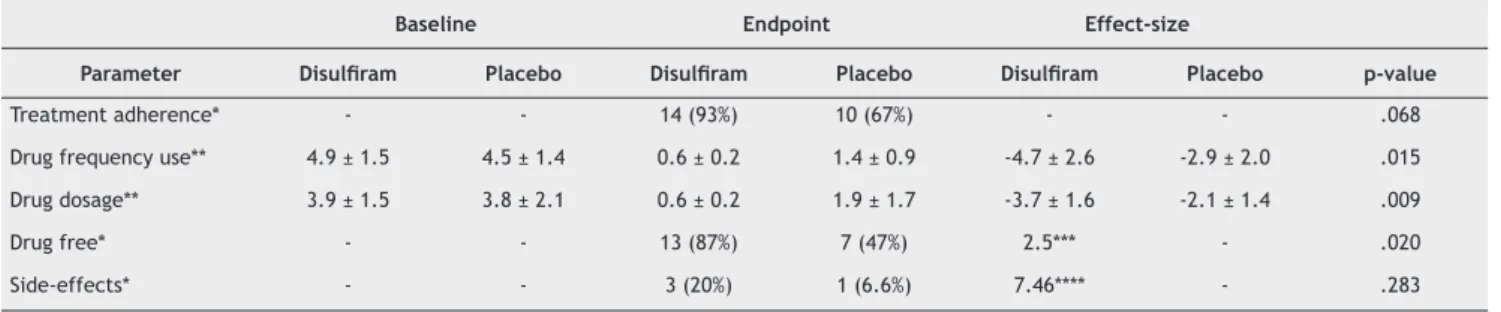
After 60 days, 14 (93%) subjects in the disuliram group
and 10 (67%) in the control group completed the treatment
(p = 0.068). Disuliram reduced the drug frequency (baseline
4.9 ± 1.5 days/week, endpoint 0.6 ± 0.2 days/week, effect size -4.7 ± 2.6) when compared to the control group (baseline 4.5 ± 1.4 days/week, endpoint 1.4 ± 0.9 days/week, effect
size -2.9 ± 2.0, p = 0.015). Disuliram also promoted the
reduction of the mean drug dose used per day (baseline 3.9 ± 1.5 g, endpoint 0.6 ± 0.2 g, effect size -3.7 ± 1.6) when compared to the control group (baseline 3.8 ± 2.1 g, endpoint 1.9 ± 1.7 g, effect size -2.1 ± 1.4, p = 0.009). Thirteen (87%)
subjects in the disuliram group were drug free at the end of
the study compared to 7 (47%) in the control group (p = 0.020). Three (20%) subjects experienced side effects related to
di-suliram, including headache, slurred speech and drowsiness.
One (6.6%, p = 0.282) subject reported headache with
pla-cebo. Disuliram did not cause an elevation of liver enzymes (mean AST = 35 ± 2.0 units per liter in the disuliram group
and AST = 32 ± 3.0 units per liter in the placebo group; mean ALT = 46 ± 1.0 units per liter in the disulfiram group and ALT = 44 ± 2.2 units per liter in the placebo group).
These data corroborate previous studies that reported
the eficacy and safety of disuliram in subjects with a crack
cocaine addiction.1,4 A recent meta-analysis5 evaluated the
eficacy and acceptability of disuliram as an add-on therapy
for cocaine dependence. The authors concluded that there
is scant evidence supporting the eficacy of disuliram in
the treatment of cocaine dependence.5 In addition, disuliram
98 L. Baldaçara et al.
is inexpensive. However, it has been shown to increase the plasma cocaine concentration by three to six fold and
signiicantly increase cocaine-associated cardiovascular
responses in previous studies of acute and chronic administra-tion.6,7 Additionally, these studies demonstrated that it did
not signiicantly alter the behavioral responses to cocaine.6,7
However, we did not observe these side effects in our sample. This study was limited in some respects. The sample size
was small, but the results were signiicant. Additionally,
urine testing was performed only twice in the eight-week study period. Therefore, it was necessary to complement the evaluation with self-reporting.
We demonstrated that disuliram reduced the drug use
frequency and dose by more than 50% in 60 days and con-clude that it may be effective and safe as an add-on therapy for crack cocaine addiction. However, additional long-term
studies with larger sample sizes are necessary to conirm these indings.
Leonardo Baldaçara,
1Thaynne Almeida Diniz,
2Bruna Leal Parreira,
2Jaqueline Jerônimo Milhomem,
2Lincoln Jose Cueto de Almeida,
3Camila Campitelli Fernandes
31Universidade Federal de São Paulo, Psychiatry;
Universidade Federal do Tocantins, Medicine,Brazil;
2Universidade Federal do Tocantins, Medicine, Brazil; 3Secretaria Municipal de Saúde de Palmas,
Centro de Atenção Psicossocial para Álcool e Drogas, Brazil.
Disclosures
Leonardo Baldaçara
Employment: Universidade Federal de São Paulo (Unifesp), Psiquiatria; Universidade Federal do Tocantins (UFT), Medicine, Brazil.
Thaynne Almeida Diniz
Employment: Universidade Federal do Tocantins, Medicine, Brazil.
Bruna Leal Parreira
Employment: Universidade Federal do Tocantins, Medicine, Brazil.
Jaqueline Jerônimo Milhomem
Employment: Universidade Federal do Tocantins, Medicine, Brazil.
Lincoln Jose Cueto de Almeida
Employment: Secretaria Municipal de Saúde de Palmas, Centro de Atenção Psicossocial para Álcool e Drogas, Brazil.
Camila Campitelli Fernandes
Employment: Secretaria Municipal de Saúde de Palmas, Centro de Atenção Psicossocial para Álcool e Drogas
This study was approved by the Institutional Review Board (IRB) of Universidade Federal do Tocantins (CEP 028/2011) and was registered in the Australian New Zealand Clinical Trials Registry (ACTRN12611000103965). * Modest
** Signiicant
*** Signiicant. Amounts given to the author's institution or to a colleague for
research in which the author has participation, not directly to the author.
References
1. Carroll K, Fenton L, Ball S, et al. Eficacy of disuliram and cognitive behavior therapy in cocaine-dependent outpatients: a randomized placebo-controlled trial. Arch Gen Psychiatry. 2004;61(3):264-72.
2. Carroll KM, Nich C, Ball SA, McCance E, Rounsavile BJ. Treatment of cocaine and alcohol dependence with psychotherapy and disuliram. Addiction. 1998;93(5):713-27.
3. Grassi MC, Cioce AM, Giudici FD, Antonilli L, Nencini P. Short-term eficacy of Disuliram or Naltrexone in reducing positive urinalysis for both cocaine and cocaethylene in cocaine abusers: a pilot study. Pharmacol Res. 2007;55(2):117-21.
4. Roache JD, Kahn R, Newton TF, Wallace CL, Murff WL, De La Garza R 2nd, et al. A double-blind, placebo-controlled assessment of the safety of potential interactions between intravenous cocaine, ethanol, and oral disuliram. Drug Alcohol Depend. 2011;119:37-45.
5. Pani PP, Trogu E, Vacca R, Amato L, Vecchi S, Davoli M. Disuliram for the treatment of cocaine dependence. Cochrane database of systematic reviews (Online). (1):CD007024.
6. McCance-Katz EF, Kosten TR, Jatlow P. Chronic disuliram treatment effects on intranasal cocaine administration: initial results. Biol Psychiatry. 1998;1(43):540-3.
7. McCance-Katz EF, Kosten TR, Jatlow P. Disulfiram effects on acute cocaine administration. Drug Alcohol Depend. 1998;52(1):27-39.
Table 1 Outcome measures
Baseline Endpoint Effect-size
Parameter Disuliram Placebo Disuliram Placebo Disuliram Placebo p-value
Treatment adherence* - - 14 (93%) 10 (67%) - - .068
Drug frequency use** 4.9 ± 1.5 4.5 ± 1.4 0.6 ± 0.2 1.4 ± 0.9 -4.7 ± 2.6 -2.9 ± 2.0 .015
Drug dosage** 3.9 ± 1.5 3.8 ± 2.1 0.6 ± 0.2 1.9 ± 1.7 -3.7 ± 1.6 -2.1 ± 1.4 .009
Drug free* - - 13 (87%) 7 (47%) 2.5*** - .020
Side-effects* - - 3 (20%) 1 (6.6%) 7.46**** - .283