Training Standards Statements of Family
Medicine Postgraduate Training
–
A Review
of Existing Documents Worldwide
Elisabeth Flum1☯*, Sarah Berger1‡, Joachim Szecsenyi1‡, Sabine Marquard1‡,
Jost Steinhaeuser2☯
1Department of General Practice and Health Services Research, University Hospital Heidelberg, Heidelberg, Germany,2Institute of Family Medicine, University Hospital Schleswig-Holstein, Campus Luebeck, Luebeck, Germany
☯These authors contributed equally to this work.
‡These authors also contributed equally to this work.
Abstract
Introduction
For the effective and safe management of complex care needs for patients in community settings, high quality family medicine (FM) training programmes are needed. In less primary care oriented countries, training standards statements for FM postgraduate training are less commonly found. The aim of this study was to review international training standards state-ments in FM postgraduate training and to catalogue these statestate-ments to be used as a best practice standard guide for FM training programs in Germany.
Materials and Methods
A structured three-tiered search was performed: a systematic literature search in MED-LINE1
; a search of international indicator databases; and a search in grey literature, con-sisting of a survey of international experts and a search in“Google (Scholar)”. From all identified documents, training standards statements were extracted, translated and summa-rized into categories referring to the same quality aspect.
Results
The search strategy revealed 25 relevant documents (MEDLINE1
n = 15, databases n = 2, experts n = 7,“Google”n = 1), containing 337 training standards statements. These were summarized into 80 statements. They covered structure quality (n = 35); process quality (n = 43); and two training standards statements referred to outcome quality (n = 2).
Conclusion
A broad range of internationally sourced training standards statements for FM postgraduate training could be identified from countries with well-established primary care systems. Only few statements internationally referred to outcome quality, expressing the difficulty in
a11111
OPEN ACCESS
Citation:Flum E, Berger S, Szecsenyi J, Marquard S, Steinhaeuser J (2016) Training Standards Statements of Family Medicine Postgraduate Training
–A Review of Existing Documents Worldwide. PLoS ONE 11(7): e0159906. doi:10.1371/journal. pone.0159906
Editor:Saravana Kumar, University of South Australia, AUSTRALIA
Received:November 26, 2015
Accepted:July 11, 2016
Published:July 26, 2016
Copyright:© 2016 Flum et al. This is an open access article distributed under the terms of the Creative Commons Attribution License, which permits unrestricted use, distribution, and reproduction in any medium, provided the original author and source are credited.
Data Availability Statement:All relevant data are within the paper and its Supporting Information files.
Funding:The authors have no support or funding to report.
assessing outcome. The resulting inventory of training standards statements for FM post-graduate training can serve as a resource for institutions seeking to formalise and systema-tise FM training at regional or national levels.
Introduction
To improve health care quality, the American Institute of Medicine recommended the improvement of education for health care professionals [1,2]. Family medicine (FM) is a com-plex medical specialty requiring a broad spectrum of clinical as well as non-clinical competen-cies and skills [3,4]. For the effective and safe management of complex care, high quality FM training programmes are needed [5]. Training standards statements for FM training pro-grammes are also essential. These can be found in training documents from health care systems with strong primary care services as, for example, the United Kingdom (UK) or Canada. In 2013, the WONCA working party on education defined standards for FM postgraduate train-ing by adapttrain-ing thePostgraduate Medical Education World Federation for Medical Education (WFME) Global Standards for Quality Improvement[6]. A set of global standards consisting of nine areas including, for example, evaluation training process, assessment of trainees and edu-cational resources was developed [7]. Besides definition of training standards, assessment and supervision of training outcomes were deemed also necessary [8].
In Germany, a country with a less developed primary care system, none of these training standards statements have yet been implemented into the mandatory (five-year) FM postgrad-uate training. Despite formal standards from the German Medical Council, nationally no specific training standards and no quality criteria are defined [9,10]. One exception is an inde-pendent state level initiative, the VerbundweiterbildungplusBaden-Wuerttemberg (Verbund-weiterbildungplus), which offers a competence-based postgraduate training in FM within purpose specific training posts [11]. It includes continuing and structured rotation through hospital and ambulatory care settings as well as regular education seminars [12,13]. Following recognition by the German College of General Practitioners and Family Physicians (DEGAM), other federal states in Germany have also begun to develop similar training programs for FM. This is raising the impetus to formalise training standards based on a national catalogue from the German College of General Practitioners and Family Physicians (DEGAM-Verbundweiter-bildungplus) [14].
Aim of this study was to review international training standards statements for FM training programmes and to catalogue these statements for use in FM postgraduate training in Germany.
Materials and Methods
The structured search strategy for internationally established training standards statements and quality criteria in FM postgraduate training programs had 3 elements: a systematic MED-LINE1
literature search; a search of international indicator databases; and a search in“grey lit-erature”, consisting of a survey of international experts and a search in“Google (Scholar)”.
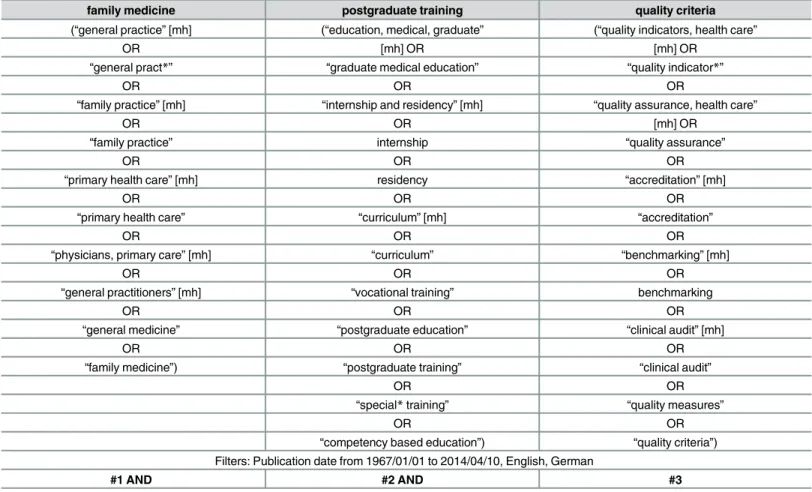
An exploratory search was performed to define a model for the systematic literature search. Various strategies were tested in MEDLINE1with different combinations of Medical Subject Headings (MeSH)-terms and free text. The results of these tests were used to optimise and specify the final search strategy.Table 1shows the final search strategy.
postgraduate training and defined training standards covering different aspects such as training in hospital or practice, curriculum and educational seminars. Furthermore, training standards regarding assessment of knowledge and competencies as well as the trainees’and trainers’ per-spective were included. Exclusion criteria were defined as follows: publication did not refer to FM postgraduate training or no quality standards were specifically named. Publications were also excluded, if only an abstract was available, no full text in English or German language was obtainable or if the chosen time period was not met.
Systematic literature search and search of indicator databases
The systematic literature search was carried out in the database MEDLINE1for the time period from 10-04-2014 back to 01-01-1967. Four researchers in two pairs, screening indepen-dently from each other, assessed title and abstract according to the pre-defined inclusion and exclusion criteria. Results were compared and discussed by the pairs of researchers and a con-sensus version created. If discussion did not result in a concon-sensus, the publication was included in the second round, where full text screening occurred. If available, all publications identified as potentially relevant were ordered in full text. The full text screening process was carried out in the same way as the title and abstract screening by the pairs of researchers. All publications identified as relevant after the full text screening were included in the study.
International indicator databases were identified by a list of international databases, which was obtained from the Institute for Applied Quality Improvement and Research in Healthcare
Table 1. Final search strategy.
family medicine postgraduate training quality criteria
(“general practice”[mh] (“education, medical, graduate” (“quality indicators, health care”
OR [mh] OR [mh] OR
“general pract*” “graduate medical education” “quality indicator*”
OR OR OR
“family practice”[mh] “internship and residency”[mh] “quality assurance, health care”
OR OR [mh] OR
“family practice” internship “quality assurance”
OR OR OR
“primary health care”[mh] residency “accreditation”[mh]
OR OR OR
“primary health care” “curriculum”[mh] “accreditation”
OR OR OR
“physicians, primary care”[mh] “curriculum” “benchmarking”[mh]
OR OR OR
“general practitioners”[mh] “vocational training” benchmarking
OR OR OR
“general medicine” “postgraduate education” “clinical audit”[mh]
OR OR OR
“family medicine”) “postgraduate training” “clinical audit”
OR OR
“special*training” “quality measures”
OR OR
“competency based education”) “quality criteria”) Filters: Publication date from 1967/01/01 to 2014/04/10, English, German
#1 AND #2 AND #3
(AQUA-Institute), a renowned institution in Germany for health care quality [15]. An indica-tor database is a (commonly freely) accessible website that contains collections of quality stan-dards. The list of the indicator databases used is available from the corresponding author. Two researchers searched the databases independently from each other according to the predefined inclusion and exclusion criteria. As with the literature review, results were compared and dis-cussed by researchers resulting in a consensus version. If a consensus was not possible, the doc-ument of the database was included in the study for subsequent further evaluation. Finally, a list with relevant documents of databases was developed.
Search in grey literature
All member countries of The World Organization of National Colleges, Academies and Aca-demic Associations of General Practitioners / Family Physicians (WONCA) Europe were con-tacted via email to the international chairman or president indicated by the official website of WONCA Europe [16]. The member countries were asked to name experts in FM postgraduate training, who could potentially provide specific documents containing training standards. Fur-thermore, the researchers contacted experts in FM postgraduate training using personal net-works from previous international projects [17]. All experts were asked to provide documents regarding training standards in FM postgraduate training programs. Furthermore, unstruc-tured hand searches in the searching machine“Google”and“Google Scholar”were performed by the research team, using the terms defined for the systematic literature search. Again, all identified documents were reviewed according to the inclusion and exclusion criteria and dis-cussed by two independent researchers, resulting in a final list of relevant documents. All corre-spondence with the experts was done via email.
Standardised extraction of data
A structured template for the extraction and preparation of the identified training standards was obtained from the AQUA-Institute [15] and adapted to the FM training context. The tem-plate contained for example the following items: specification, original wording, domain and reference list; the template is available from the corresponding author. The identified training standards were translated, catalogued and summarized into categories referring to the same quality aspect by a researcher. This was carried out by the research team based on the checklist developed by the DEGAM-Verbundweiterbildungplus[14]. The results were reviewed and dis-cussed by the research team resulting in a final consensus version. Similar training standards referring to the same aspect were summarized as variations into one template to ensure com-prehensibility and to reduce volume. The training standards were assigned to three categories: structure, process and outcome quality according to Donabedian [18].
Results
Systematic literature search and indicator databases
The systematic literature was performed on 10-04-2014 in the database MEDLINE1and resulted in 2.016 hits. Screening of title- and abstracts excluded 1.918 publications, leaving 98 publications for full text screening. From all full texts, 83 were excluded, 15 relevant publica-tions were included.
included. A 2013 WONCA document recommended by one of the reviewers was also subse-quently included [7].
Grey literature
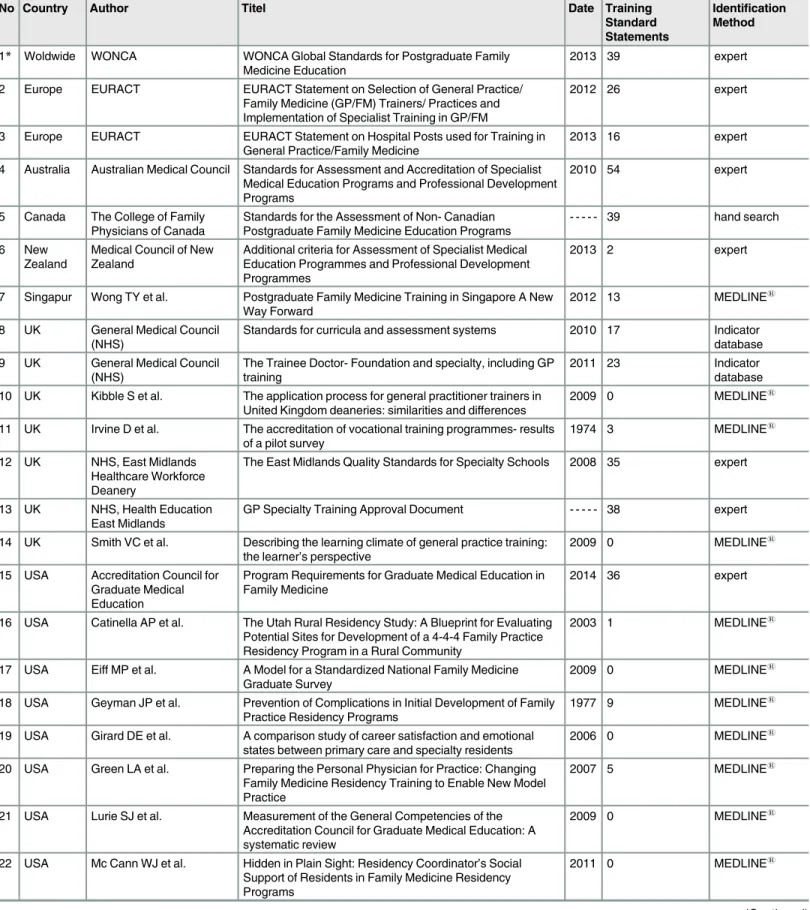
From 09-01-2014 to 30-05-2014, all 39 member countries of WONCA Europe and the six experts in FM postgraduate training personally known to the researchers were contacted via email. All in all, eight experts answered. Luxemburg and the Netherlands could only provide training standards in the respective language of the country and not in English or German. Switzerland was not able to provide documents specific for FM. Due to the predefined inclu-sion and excluinclu-sion criteria, these documents were not included. In total, 23 documents were reviewed by the researchers: Australia and New Zealand (n = 8), European Academy of Teach-ers in General Practice / Family Medicine (EURACT, n = 7), the UK (n = 2) and the United States (USA, n = 5). Included according to the predefined criteria were: Australia (n = 1), New Zealand (n = 1), EURACT (n = 2), UK (n = 2) and USA (n = 1). From the hand search in “Goo-gle”, one relevant Canadian document was included. TheS1 Tablepresents the results of the survey of experts. All in all eight relevant documents were included into the study.Fig 1shows the results of the systematic search strategy.Table 2shows all included documents.
Standardised extraction of data
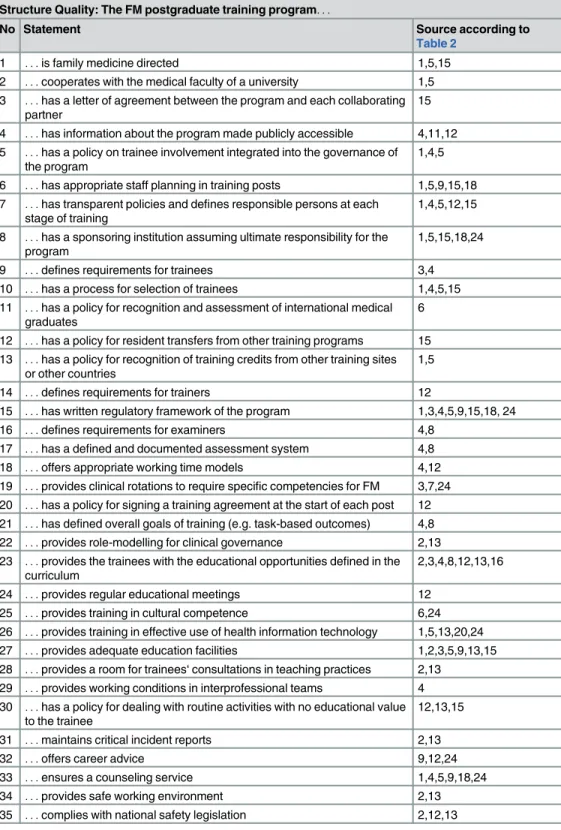
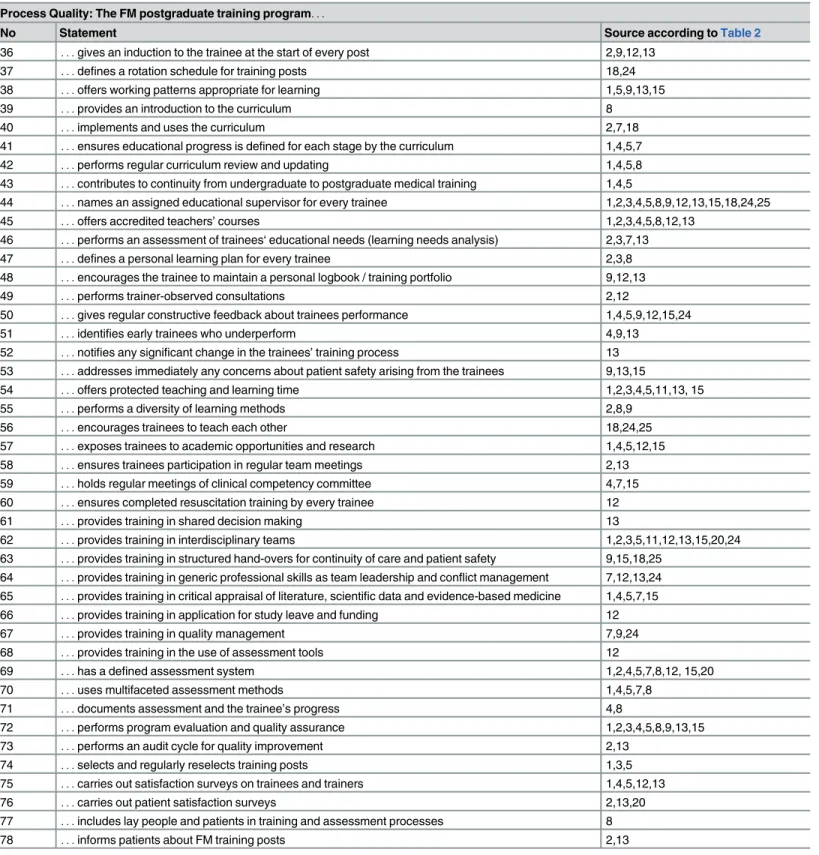
From all identified documents, 337 training standards statements for FM postgraduate training were extracted and translated. Repeated statements referring to the same training standard were summarized into one template, resulting in 80 categories. Some templates contained up to 20 statements covering the same aspects. For example, the category“supervision of trainees” was named several times. All identified and summarized training standard statements were classified into three categories: structure, process and outcome quality.Table 3shows all identi-fied training standards statements related to the category of structure quality (n = 35). Training standards statements related to the category of process quality (n = 43) are displayed in
Table 4.Table 5lists all training standards statements related to the category of outcome qual-ity (n = 2).
Discussion
What is known and what is new
Although training standards statements are found in FM postgraduate training documents, this is the first attempt to create an inventory of exemplary statements. Our final set of interna-tionally sourced training standards statements for FM postgraduate training programs con-tained 80 statements, resulting in detailed and elaborate elements. This catalogue can serve as a best practice standard guide for FM training programmes in Germany. It is also a useful resource for other nations in the process of formalising and systematising their FM training programmes.
standards statements referred to non-technical skills as“shared decision making”or“generic professional skills such as team leadership or conflict management”, which are also important to enhance collaboration with patients and other members of the health care team and reduce medical errors from trainee doctors [19].
Several identified training standards statements, for example, requirements for training, selection process of trainees or assessment methods, relating to the regulatory framework of the nation, were specific to the national context of the respective country and its health care system making it difficult to adapt them for the German setting. Furthermore, many identified training standards statements described very generic aspects, for example:“The trainee must achieve knowledge of scientific basis and methods of family medicine and (. . .) become
famil-iar with evidence-based medicine and critical clinical decision making.”[20]. Generic state-ments have the potential to create difficulties in assessment.
For adaptation to other countries regulatory frameworks and health care systems, a valida-tion process, for example, a group facilitating technique is necessary [21]. The identified training standards statements for FM postgraduate training programmes rarely indicated clas-sification or validation processes. Gaining access to such information would be very useful for nations seeking to formalise and systematise their FM training programmes.
Strength of this study
The strength of this study is that it provides a first comprehensive review of international docu-ments with training standards statedocu-ments for FM postgraduate training programs. Our exten-sive search strategy was intended to cover all relevant aspects of postgraduate training in FM. Most of the relevant documents were found via hand searching in grey literature or provided by experts, meaning that the identified documents may possibly not be representative world-wide. This underlines the necessity for more publicly available online resources to be shared in
Fig 1. Results of the search strategy.
Table 2. Documents included in the analysis.
No Country Author Titel Date Training
Standard Statements
Identification Method
1* Woldwide WONCA WONCA Global Standards for Postgraduate Family Medicine Education
2013 39 expert
2 Europe EURACT EURACT Statement on Selection of General Practice/ Family Medicine (GP/FM) Trainers/ Practices and Implementation of Specialist Training in GP/FM
2012 26 expert
3 Europe EURACT EURACT Statement on Hospital Posts used for Training in General Practice/Family Medicine
2013 16 expert
4 Australia Australian Medical Council Standards for Assessment and Accreditation of Specialist Medical Education Programs and Professional Development Programs
2010 54 expert
5 Canada The College of Family Physicians of Canada
Standards for the Assessment of Non- Canadian Postgraduate Family Medicine Education Programs
- - - 39 hand search
6 New
Zealand
Medical Council of New Zealand
Additional criteria for Assessment of Specialist Medical Education Programmes and Professional Development Programmes
2013 2 expert
7 Singapur Wong TY et al. Postgraduate Family Medicine Training in Singapore A New Way Forward
2012 13 MEDLINE1
8 UK General Medical Council (NHS)
Standards for curricula and assessment systems 2010 17 Indicator database 9 UK General Medical Council
(NHS)
The Trainee Doctor- Foundation and specialty, including GP training
2011 23 Indicator
database 10 UK Kibble S et al. The application process for general practitioner trainers in
United Kingdom deaneries: similarities and differences
2009 0 MEDLINE1
11 UK Irvine D et al. The accreditation of vocational training programmes- results of a pilot survey
1974 3 MEDLINE1
12 UK NHS, East Midlands Healthcare Workforce Deanery
The East Midlands Quality Standards for Specialty Schools 2008 35 expert
13 UK NHS, Health Education East Midlands
GP Specialty Training Approval Document - - - 38 expert
14 UK Smith VC et al. Describing the learning climate of general practice training: the learner’s perspective
2009 0 MEDLINE1
15 USA Accreditation Council for Graduate Medical Education
Program Requirements for Graduate Medical Education in Family Medicine
2014 36 expert
16 USA Catinella AP et al. The Utah Rural Residency Study: A Blueprint for Evaluating Potential Sites for Development of a 4-4-4 Family Practice Residency Program in a Rural Community
2003 1 MEDLINE1
17 USA Eiff MP et al. A Model for a Standardized National Family Medicine Graduate Survey
2009 0 MEDLINE1
18 USA Geyman JP et al. Prevention of Complications in Initial Development of Family Practice Residency Programs
1977 9 MEDLINE1
19 USA Girard DE et al. A comparison study of career satisfaction and emotional states between primary care and specialty residents
2006 0 MEDLINE1
20 USA Green LA et al. Preparing the Personal Physician for Practice: Changing Family Medicine Residency Training to Enable New Model Practice
2007 5 MEDLINE1
21 USA Lurie SJ et al. Measurement of the General Competencies of the Accreditation Council for Graduate Medical Education: A systematic review
2009 0 MEDLINE1
22 USA Mc Cann WJ et al. Hidden in Plain Sight: Residency Coordinator’s Social Support of Residents in Family Medicine Residency Programs
2011 0 MEDLINE1
the interests of facilitating collaboration, benchmarking and best practice standards for FM training internationally.
Limitations of the study
The response rate of the contacted WONCA Europe-member countries was low (3 countries out of 39 responded). Interestingly, none of the participating experts referred to the“WONCA Global Standards for Postgraduate Family Medicine Education”[7]. This reference was not included in the analysis until one reviewer of the manuscript recommended it. As the docu-ment is to a large extent congruent with theStandards for the Assessment of Non-Canadian Postgraduate Family Medicine Education Programs, which was included in the original analy-sis, the results did not differ after inclusion of the WONCA standards. Not all identified docu-ments were available in English or German and therefore had to be excluded for this reason, adding a further limitation to the data available for analysis.
Future developments
Countries with a primary health care system that is placed centrally in the health care system have elaborately defined training standards for FM postgraduate training programs, which can be a resource for other nations. The final set of internationally acceptable training standards statements produced in this process could serve as a best practice guide for other countries that are in the process of formalising and systematising FM training. For Germany, the next step will be the selection and cultural adaptation process of the identified training standards state-ments by an expert panel using a modified RAND/UCLA method [22]. Afterwards, a pilot study will be undertaken to test validity and reliability of the training standards statements for FM postgraduate training programs.
Conclusion
An inventory of 80 training standards statements have been identified and collated from 26 FM training standards documents worldwide—consisting of 35 structure, 43 process, and 2 outcome statements. These training standards statements could be of value to other countries in the process of developing FM postgraduate training programs.
Table 2.(Continued)
No Country Author Titel Date Training
Standard Statements
Identification Method
23 USA Musick DW et al. A Conceptual Model for Program Evaluation in Graduate Medical Education
2006 1 MEDLINE1
24 USA Rieselbach RE et al. Academic Medicine: A Key Partner in Strengthening the Primary Care Infrastructure Via Teaching Health Centers
2013 16 MEDLINE1
25 USA Schuhmacher DJ et al. Perspective: Beyond Counting Hours: The Importance of Supervision, Professionalism, Transitions of Care, and Workload in Residency Training
2012 3 MEDLINE1
26 USA Shaugnessy AF et al. EPA in Family Medicine 2013 0 MEDLINE1
Abbreviations: EURACT = European Academy of Teachers in General Practice / Family Medicine; FM = family medicine; GP = General Practitioner; NHS = National Health Service; UK = United Kingdom; USA = United States of America
*This document was included after the original analysis based on the recommendation of a reviewer of the manuscript
Table 3. Training standards statements related to structural quality of postgraduate training (n = 35).
Structure Quality: The FM postgraduate training program. . .
No Statement Source according to
Table 2
1 . . .is family medicine directed 1,5,15
2 . . .cooperates with the medical faculty of a university 1,5
3 . . .has a letter of agreement between the program and each collaborating
partner
15
4 . . .has information about the program made publicly accessible 4,11,12
5 . . .has a policy on trainee involvement integrated into the governance of
the program
1,4,5
6 . . .has appropriate staff planning in training posts 1,5,9,15,18
7 . . .has transparent policies and defines responsible persons at each
stage of training
1,4,5,12,15
8 . . .has a sponsoring institution assuming ultimate responsibility for the
program
1,5,15,18,24
9 . . .defines requirements for trainees 3,4
10 . . .has a process for selection of trainees 1,4,5,15
11 . . .has a policy for recognition and assessment of international medical
graduates
6
12 . . .has a policy for resident transfers from other training programs 15
13 . . .has a policy for recognition of training credits from other training sites
or other countries
1,5
14 . . .defines requirements for trainers 12
15 . . .has written regulatory framework of the program 1,3,4,5,9,15,18, 24
16 . . .defines requirements for examiners 4,8
17 . . .has a defined and documented assessment system 4,8
18 . . .offers appropriate working time models 4,12
19 . . .provides clinical rotations to require specific competencies for FM 3,7,24
20 . . .has a policy for signing a training agreement at the start of each post 12
21 . . .has defined overall goals of training (e.g. task-based outcomes) 4,8
22 . . .provides role-modelling for clinical governance 2,13
23 . . .provides the trainees with the educational opportunities defined in the
curriculum
2,3,4,8,12,13,16
24 . . .provides regular educational meetings 12
25 . . .provides training in cultural competence 6,24
26 . . .provides training in effective use of health information technology 1,5,13,20,24
27 . . .provides adequate education facilities 1,2,3,5,9,13,15
28 . . .provides a room for trainees‘consultations in teaching practices 2,13
29 . . .provides working conditions in interprofessional teams 4
30 . . .has a policy for dealing with routine activities with no educational value
to the trainee
12,13,15
31 . . .maintains critical incident reports 2,13
32 . . .offers career advice 9,12,24
33 . . .ensures a counseling service 1,4,5,9,18,24
34 . . .provides safe working environment 2,13
35 . . .complies with national safety legislation 2,12,13
Table 4. Training standards statements related to process quality of postgraduate training (n = 43).
Process Quality: The FM postgraduate training program. . .
No Statement Source according toTable 2
36 . . .gives an induction to the trainee at the start of every post 2,9,12,13
37 . . .defines a rotation schedule for training posts 18,24
38 . . .offers working patterns appropriate for learning 1,5,9,13,15
39 . . .provides an introduction to the curriculum 8
40 . . .implements and uses the curriculum 2,7,18
41 . . .ensures educational progress is defined for each stage by the curriculum 1,4,5,7
42 . . .performs regular curriculum review and updating 1,4,5,8
43 . . .contributes to continuity from undergraduate to postgraduate medical training 1,4,5
44 . . .names an assigned educational supervisor for every trainee 1,2,3,4,5,8,9,12,13,15,18,24,25
45 . . .offers accredited teachers’courses 1,2,3,4,5,8,12,13
46 . . .performs an assessment of trainees‘educational needs (learning needs analysis) 2,3,7,13
47 . . .defines a personal learning plan for every trainee 2,3,8
48 . . .encourages the trainee to maintain a personal logbook / training portfolio 9,12,13
49 . . .performs trainer-observed consultations 2,12
50 . . .gives regular constructive feedback about trainees performance 1,4,5,9,12,15,24
51 . . .identifies early trainees who underperform 4,9,13
52 . . .notifies any significant change in the trainees’training process 13
53 . . .addresses immediately any concerns about patient safety arising from the trainees 9,13,15
54 . . .offers protected teaching and learning time 1,2,3,4,5,11,13, 15
55 . . .performs a diversity of learning methods 2,8,9
56 . . .encourages trainees to teach each other 18,24,25
57 . . .exposes trainees to academic opportunities and research 1,4,5,12,15
58 . . .ensures trainees participation in regular team meetings 2,13
59 . . .holds regular meetings of clinical competency committee 4,7,15
60 . . .ensures completed resuscitation training by every trainee 12
61 . . .provides training in shared decision making 13
62 . . .provides training in interdisciplinary teams 1,2,3,5,11,12,13,15,20,24
63 . . .provides training in structured hand-overs for continuity of care and patient safety 9,15,18,25
64 . . .provides training in generic professional skills as team leadership and conflict management 7,12,13,24
65 . . .provides training in critical appraisal of literature, scientific data and evidence-based medicine 1,4,5,7,15
66 . . .provides training in application for study leave and funding 12
67 . . .provides training in quality management 7,9,24
68 . . .provides training in the use of assessment tools 12
69 . . .has a defined assessment system 1,2,4,5,7,8,12, 15,20
70 . . .uses multifaceted assessment methods 1,4,5,7,8
71 . . .documents assessment and the trainee’s progress 4,8
72 . . .performs program evaluation and quality assurance 1,2,3,4,5,8,9,13,15
73 . . .performs an audit cycle for quality improvement 2,13
74 . . .selects and regularly reselects training posts 1,3,5
75 . . .carries out satisfaction surveys on trainees and trainers 1,4,5,12,13
76 . . .carries out patient satisfaction surveys 2,13,20
77 . . .includes lay people and patients in training and assessment processes 8
78 . . .informs patients about FM training posts 2,13
Supporting Information
S1 Table. Results of the survey of experts.Abbreviations: EURACT = European Academy of Teachers in General Practice / Family Medicine; FM = family medicine.
(DOCX)
Acknowledgments
The author would like to thank all international experts, who responded to the inquiry and provided documents for the study.
Author Contributions
Conceived and designed the experiments: EF J. Szecsenyi J. Steinhaeuser. Performed the experi-ments: EF J. Steinhaeuser. Analyzed the data: EF SM J. Steinhaeuser. Contributed reagents/ materials/analysis tools: EF SM SB J. Steinhaeuser. Wrote the paper: EF J. Szecsenyi SM SB J. Steinhaeuser.
References
1. Institute of Medicine. Shaping the future for health. Crossing the quality chasm. A new health system for the 21st century. 2001. https://www.iom.edu/~/media/Files/Report%20Files/2001/Crossing-the-Quality-Chasm/Quality%20Chasm%202001%20%20report%20brief.pdf(accessed on 20 Feb 2015). 2. Institute of Medicine. Health Professions Education: A Bridge to Quality. 2003.https://www.nap.edu/
login.php?record_id=10681&page=http%3A%2F%2Fwww.nap.edu%2Fdownload.php%3Frecord_id %3D10681(accessed 20 Feb 2015).
3. Sharma MA, Cheng N, Moore M, Coffman M, Bazemore AW. Patients with high-cost chronic conditions rely heavily on primary care physicians. The Journal of the American Board of Family Medicine 2014; 27:11–12. doi:10.3122/jabfm.2014.01.130128PMID:24390880
4. Allen J, working party of EURACT Council on behalf of WONCA European Council. The European defi-nition of general practice / family medicine. 2005.http://www.woncaeurope.org/sites/default/files/ documents/Definition%202nd%20ed%202005.pdf(accessed 20 Feb 2015).
5. World Health Organization, Regional Office for Europe: Framework for professional and administrative development of general practice/family medicine in Europe.http://www.euro.who.int/__data/assets/ pdf_file/0007/119167/E60714.pdf(accessed 20 Feb 2015).
6. World Federation for Medical Education (WFME) Executive Council. Postgraduate Medical Education WFME Global Standards for Quality Improvement. WFME Office: University of Copenhagen Denmark 2003. http://wfme.org/standards/pgme/17-quality-improvement-in-postgraduate-medical-education-english/file(accessed 20 Feb 2015).
7. World Organization of National Colleges, Academies and Academic Associations of General Practition-ers / Family Physicians (WONCA) Working Party on Education (WWPE). WONCA Global Standards for Postgraduate Family Medicine Education. June 2013.http://www.globalfamilydoctor.com/site/ DefaultSite/filesystem/documents/Groups/Education/WONCA%20ME%20stds_edit%20for%20web_ 250714.pdf(accessed 20 Feb 2015).
8. Walton MM, Elliott SL. Improving safety and quality: how can education help? The Medical Journal of Australia 2006; 184(10):60–64.
Table 5. Training standards statements related to outcome quality of postgraduate training (n = 2).
Outcome Quality: The FM postgraduate training program. . .
No Statement Source according to
Table 2
79 . . .defines graduate outcomes addressing the roles in FM, technical and
clinical expertise
1,5,15
80 . . .documents successful completion of training 4
9. Flum E, Maagaard R, Godycki-Cwirko M, Scarborough N, Scherpbier N, Ledig T, et al. Assessing fam-ily medicine trainees—what can we learn from the European neighbours? GMS Zeitschrift für Medizi-nische Ausbildung 2015; 32(2):1–15.
10. Miani C, Pitchforth E, Bienkowska-Gibbs T, Hinrichs S, Disbeschl S, Roland M, et al. Medical graduate and postgraduate education from an international perspective [Medizinische Aus- und Weiterbildung aus internationaler Perspektive] 2015.http://www.kbv.de/media/sp/RAND_Studie_DrNolte.pdf (accessed 24 March 2015).
11. Maagaard R. An external report on the training of General Practitioners in the Verbundweiterbildung
-plus
-scheme in Baden-Württemberg [Verbundweiterbildungplus
, Allgemeinmedizin Baden-Württem-berg]. January 2012.https://www.weiterbildung-allgemeinmedizin.de/content/beirat.jsp(accessed 20 Feb 2015).
12. Steinhaeuser J, Roos M, Haberer K, Ledig Th, Peters-Klimm F, Szecsenyi J, et al. The program„ Ver-bundweiterbildung plus”in Baden-Wuerttemberg. [Das Programm Verbundweiterbildung plus des Kom-petenzzentrums Allgemeinmedizin Baden-Wuerttemberg—Entwicklung, Umsetzung und
Perspektiven.] Zeitschrift für Evidenz, Fortbildung und Qualität im Gesundheitswesen 2011; 105:105–
109.
13. Steinhaeuser J, Chenot JF, Roos M, Ledig T, Joos S. Competence-based curriculum development for general practice in Germany: a stepwise peerbased approach instead of reinventing the wheel. BMC Research Notes 2013; 6:314. doi:10.1186/1756-0500-6-314PMID:23937795
14. Verbundweiterbildungplus
DEGAM-Konzept. 2013.http://www.degam.de/files/Inhalte/Degam-Inhalte/ Sektionen_und_Arbeitsgruppen/Sektion_Weiterbildung/DEGAM_Konzept_Verbundweiterbildung_ plus_130718.pdf(accessed 20 Feb 2015).
15. Institute for Applied Quality Improvement and Research in Healthcare (AQUA-Institute).http://www. aqua-institut.de(accessed 20 Feb 2015).
16. The World Organization of National Colleges, Academies and Academic Associations of General Prac-titioners / Family Physicians. WONCA Europe.http://www.woncaeurope.org/member-organisations (accessed 31 Aug 2015).
17. Wensing M, Oxman A, Baker R, Godycki-Cwirko M, Flottorp S, Szecsenyi J, et al. Tailored implementa-tion for chronic diseases (TICD): A project protocol. Implementaimplementa-tion Science 2011; 6:103. doi:10. 1186/1748-5908-6-103PMID:21899753
18. Donabedian A. Explorations in quality assessment and monitoring. Volume I. The definition of quality and approaches to its assessment. Ann Arbor, Michigan: Health administration press, 1980. 19. Greig PR, Higham H, Vaux E. Patient and carer identified factors which contribute to safety incidents in
primary care: a qualitative study. BMJ Quality & Safety 2015; 24:558–560.
20. The College of Family Physicians of Canada. Standards for the Assessment of Non-Canadian Post-graduate Family Medicine Education Programs.http://www.cfpc.ca/uploadedFiles/Education/ Standards%20for%20the%20Assessment%20of%20Non-Canadian%20Postgraduate%20Family% 20Medicine%20Education%20Programs.pdf(accessed 20 February 2015).
21. Levitt CA, Nair K, Dolovich L, Price D, Hilts L. Refinement of indicators and criteria in a quality tool for assessing quality in primary care in Canada: a Delphi Panel study. Family Practice 2014; 31(5):607–
621. doi:10.1093/fampra/cmu021PMID:24850794