GMDD
5, 2179–2214, 2012Porting marine ecosystem model
spin-up to GPUs
E. Siewertsen et al.
Title Page
Abstract Introduction
Conclusions References
Tables Figures
◭ ◮
◭ ◮
Back Close
Full Screen / Esc
Printer-friendly Version Interactive Discussion
Discussion
P
a
per
|
Dis
cussion
P
a
per
|
Discussion
P
a
per
|
Discussio
n
P
a
per
|
Geosci. Model Dev. Discuss., 5, 2179–2214, 2012 www.geosci-model-dev-discuss.net/5/2179/2012/ doi:10.5194/gmdd-5-2179-2012
© Author(s) 2012. CC Attribution 3.0 License.
Geoscientific Model Development Discussions
This discussion paper is/has been under review for the journal Geoscientific Model Development (GMD). Please refer to the corresponding final paper in GMD if available.
Porting marine ecosystem model spin-up
using transport matrices to GPUs
E. Siewertsen1, J. Piwonski2, and T. Slawig2
1
Institute for Computer Science, Christian-Albrechts Universit ¨at zu Kiel, 24098 Kiel, Germany
2
Institute for Computer Science and Kiel Marine Science – Centre for Interdisciplinary Marine Science, Cluster The Future Ocean, Christian-Albrechts Universit ¨at zu Kiel,
24098 Kiel, Germany
Received: 19 July 2012 – Accepted: 20 July 2012 – Published: 31 July 2012
Correspondence to: T. Slawig ([email protected])
Published by Copernicus Publications on behalf of the European Geosciences Union.
GMDD
5, 2179–2214, 2012Porting marine ecosystem model
spin-up to GPUs
E. Siewertsen et al.
Title Page
Abstract Introduction
Conclusions References
Tables Figures
◭ ◮
◭ ◮
Back Close
Full Screen / Esc
Printer-friendly Version Interactive Discussion
Discussion
P
a
per
|
Dis
cussion
P
a
per
|
Discussion
P
a
per
|
Discussio
n
P
a
per
|
Abstract
We have ported an implementation of the spin-up for marine ecosystem models based on the “Transport Matrix Method” to graphics processing units (GPUs). The original im-plementation was designed for distributed-memory architectures and uses the PETSc library that is based on the “Message Passing Interface (MPI)” standard. The spin-up
5
computes a steady seasonal cycle of the ecosystem tracers with climatological ocean circulation data as forcing. Since the transport is linear with respect to the tracers, the resulting operator is represented in so-called “transport matrices”. Each iteration of the spin-up involves two matrix-vector multiplications and the evaluation of the used biogeochemical model. The original code was written in C and Fortran. On the GPU,
10
we use the CUDA standard, a specialized version of the PETSc toolkit and a CUDA Fortran compiler. We describe the extensions to PETSc and the modifications of the original C and Fortran codes that had to be done. Here we make use of freely avail-able libraries for the GPU. We analyze the computational effort of the main parts of the
spin-up for two exemplary ecosystem models and compare the overall computational
15
time to those necessary on different CPUs. The results show that a consumer GPU
can beat a significant number of cluster CPUs without further code optimization.
1 Introduction
This work is motivated by the usually huge effort that is needed when computing
steady annual cycles (or, mathematically speaking, periodic solutions) of spatially
20
three-dimensional marine ecosystem models. In most cases this is done by “spinning up” the model, i.e. by performing a time-stepping algorithm with climatological, periodic forcing data until the steady cycle is reached, at least up to a certain tolerance. This can take a huge number of iterations, in typical cases about 3000 to 5000 yr, each of which involves thousands of time steps (e.g. 2880 steps for a three-hour step-size).
25
GMDD
5, 2179–2214, 2012Porting marine ecosystem model
spin-up to GPUs
E. Siewertsen et al.
Title Page
Abstract Introduction
Conclusions References
Tables Figures
◭ ◮
◭ ◮
Back Close
Full Screen / Esc
Printer-friendly Version Interactive Discussion
Discussion
P
a
per
|
Dis
cussion
P
a
per
|
Discussion
P
a
per
|
Discussio
n
P
a
per
|
aiming at parameter optimization or sensitivity studies, the spin-up process has to be repeated several times, and thus in these cases a reduction of the computational time of a single spin-up run is even more important.
There are several strategies to reduce this computational effort. The following ones
are more or less independent from each other: one of them is of course parallelization,
5
usually by domain decomposition methods. The second one is to use precomputed “transport matrices” (see Khatiwala, 2007) that represent the (eventually linearized) tracer transport scheme applied in an ocean model. Usually monthly averaged matrices for the explicit and the implicit parts of the ocean tracer transport operator are used. In the ecosystem spin-up, these averaged matrices are then interpolated accordingly in
10
every time step. With this method, the transport part of the ecosystem model reduces to matrix-vector multiplications, whereas the biogeochemical source-minus-sink terms are evaluated separately. A third way to reduce computational effort is to replace the
standard spin-up (which, in mathematically terms, is a fixed-point iteration) by variants of Newton’s method, which have higher convergence rates.
15
In this work we start from an implementation of a spin-up that applies the first two strategies: it uses transport matrices generated by the MITgcm ocean model, see M.I.T. (2012). The tracer transport operator is thus pre-computed by twelve pairs of implicit and explicit matrices, each pair representing an average “climatological” month. The matrices are stored in a sparse format, and are appropriate to perform matrix-vector
20
multiplications on distributed memory hardware using MPI. For this purpose, we use the PETSc library. The main advantages of this toolkit is that all MPI calls are hidden in built-in functions, and that optimized functions for matrix-vector operations (and more) already exist. The resulting software can be coupled with a wide range of biogeochem-ical models, as long as they conform with a rather flexible and general interface.
25
The main focus of this work is to describe the necessary changes to the software to port it to GPU hardware and to determine the resulting speed-up (if there is any). The motivation for this clearly is that matrix-vector multiplications are one of the numer-ical operations predestined for GPUs. Thus we expect a big performance gain when
GMDD
5, 2179–2214, 2012Porting marine ecosystem model
spin-up to GPUs
E. Siewertsen et al.
Title Page
Abstract Introduction
Conclusions References
Tables Figures
◭ ◮
◭ ◮
Back Close
Full Screen / Esc
Printer-friendly Version Interactive Discussion
Discussion
P
a
per
|
Dis
cussion
P
a
per
|
Discussion
P
a
per
|
Discussio
n
P
a
per
|
porting just the transport and neglecting the spatially local and usual nonlinear biogeo-chemical interactions. We furthermore wanted to check how this performance gain be-haves when incorporating the biogeochemical models. For this purpose, we take here two examples with just two tracers. One oft them is a linear uncoupled one, describ-ing for example the radioactive decay of two species. The second one is the coupled
5
and nonlinear N-DOP model described by Parekh et al. (2005) and used, for example, in Kriest et al. (2010). High performance computing on GPU or other special, highly parallel hardware becomes more and more attractive also in climate and geophysical research, we just refer to NVIDIA Corporation (2012, docs/IO/43499/Headwave.pdf) and Hanappe et al. (2011); Horn (2012) as some examples here. To our knowledge
10
there is no publication about using GPU for marine ecosystem simulations.
Since we want to explicitly show what steps were necessary for the mentioned CPU-to-GPU port, we start be describing the original software for the ecosystem spin-up and the used ecosystem models in Sect. 2. Afterwards we describe the standards, tools and libraries used for GPU programming in Sect. 3. We show which GPU-adapted software
15
could be used and what kind of adaption we additionally had to make ourselves. This is topic of Sect. 4. Then we show the numerical results for the two models, both on CPU and GPU hardware. We end the paper with some conclusions and an outlook, especially treating the option of a nested parallel simulation using
2 Coupled marine tracer transport simulation using transport matrices
20
A marine ecosystem is usually modeled as a system of equations for the ocean circu-lation and the transport of temperature, salinity and the incorporated biogeochemical tracers including their interactions. A fully coupled simulation – reflecting the fact that tracers are advected by the ocean circulation, their diffusion is dominated by the
turbu-lent mixing of marine water and vice versa a tracer concentration may effect the ocean 25
GMDD
5, 2179–2214, 2012Porting marine ecosystem model
spin-up to GPUs
E. Siewertsen et al.
Title Page
Abstract Introduction
Conclusions References
Tables Figures
◭ ◮
◭ ◮
Back Close
Full Screen / Esc
Printer-friendly Version Interactive Discussion
Discussion
P
a
per
|
Dis
cussion
P
a
per
|
Discussion
P
a
per
|
Discussio
n
P
a
per
|
only, even more if steady annual cycles – whose simulation requires long-term spin-ups – are looked for.
In contrast, a so-called “offline” computation is a simplified approach for tracers that
are (or are regarded as) “passive”, i.e. they do not affect the ocean physics, or this
influence is neglected. This results in a one-way coupling from the ocean circulation to
5
the tracer dynamics only, where the pre-computed circulation data (advection velocity vector fieldv, mixing coefficientκ, temperature, and optionally salinity) enter the tracer transport equations as forcing.
Here (x,t) denotes a point in the space-time cylinderΩ×[0,T] withΩ∈R3being the
spatial domain (i.e. the ocean) with boundaryΓ =∂Ωand [0,T],T >0, the time interval.
10
With this data given, a marine ecosystem model considered in an offline computation
consists of the following system of parabolic partial differential equations (here for n
tracersyi summarized in the vectory=(yi)i=1,...,n): ∂yi
∂t =∇ ·(κ∇yi)− ∇ ·(vyi)+qi(y), i =1,. . .,n, (1)
in the space-time cylinderΩ×[0,T] withΩ∈R3being the spatial domain (i.e. the ocean) 15
and [0,T],T >0, the time interval. Additionally, homogeneous Neumann boundary con-ditions on Γ =∂Ω for all tracers yi are imposed. The source-minus-sink or coupling termsqi in general are nonlinear and represent growth, dying, and tracer interaction. Each of them not necessarily depends on all tracers in y, but usually on more than
theyi itself, thus reflecting tracer coupling given for example, by grazing etc. Here, we
20
neglect the additional dependency on the space and time coordinates (x,t) in the
no-tation for brevity. The qi also include model parameters (as growth and dying rates, sinking velocities etc.) that are often subject to identification or estimation. They are usually spatially and temporally constant and not mentioned explicitly here.
GMDD
5, 2179–2214, 2012Porting marine ecosystem model
spin-up to GPUs
E. Siewertsen et al.
Title Page
Abstract Introduction
Conclusions References
Tables Figures
◭ ◮
◭ ◮
Back Close
Full Screen / Esc
Printer-friendly Version Interactive Discussion
Discussion
P
a
per
|
Dis
cussion
P
a
per
|
Discussion
P
a
per
|
Discussio
n
P
a
per
|
2.1 Transport matrices
Since in an offline simulation the ocean circulation data is only used as pre-computed
input for the tracer transport equations (Eq. 1), the spatial differential operators therein
can be represented as a linear operator and the equations can be formally written as
∂yi
∂t =L(κ,v,t)yi+qi(y), i =1,. . .,n. (2)
5
Here, L(κ,v,t) is a linear operator comprising the whole transport, i.e. diffusion and
advection, for the given ocean circulation dataκ andv. It is time-dependent since the circulation date depend on time also, no matter if a transient computation shall be performed or a stable annual cycle with climatological input data is looked for. The operator A is identical for all tracers if the molecular diffusion of the tracers is small 10
compared to the turbulent mixing, which is a reasonable simplification.
The idea of the “Transport Matrix Method (TMM)” introduced in Khatiwala et al. (2005) is to compute or approximate the matrices that represent an appropriate dis-cretization ofL. This is done by running time-steps of the ocean model that has pro-duced the circulation datav,κetc., with special, only locally non-zero initial distributions
15
for one tracer. By varying the support of the initial distributions over the whole spatial domain, an approximation for one or several time steps can be obtained, which can be then used to build up a matrix representation ofL. A comprehensive discussion of the temporal and spatial discretization as well as the process of evaluating transport ma-trices, especially in combination with operator splitting schemes can be found in
Khati-20
wala et al. (2005). For our results we used twelve implicit and twelve explicit transport matrices, which represent monthly averaged diffusion and advection. The matrices are
interpolated linearly to the corresponding discrete time step during simulation.
As a result, we obtain the following fully (temporal and spatial) discrete scheme where we now denote byyj the appropriately arranged vector of the values of all n 25
tracers on all spatial grid points at time stepj. In the same way, we denote byqj the
GMDD
5, 2179–2214, 2012Porting marine ecosystem model
spin-up to GPUs
E. Siewertsen et al.
Title Page
Abstract Introduction
Conclusions References
Tables Figures
◭ ◮
◭ ◮
Back Close
Full Screen / Esc
Printer-friendly Version Interactive Discussion
Discussion
P
a
per
|
Dis
cussion
P
a
per
|
Discussion
P
a
per
|
Discussio
n
P
a
per
|
j. Using the TMM for a fixed time step-size τ, the time integration scheme for (Eq. 2) reads
yj+1=Aimp,j(Aexp,jyj+τqj(yj))=:ϕj(yj), j=0,. . .,nτ−1. (3)
Herenτ is the total number of time steps andAimp,j,Aexp,j are the implicit and explicit transport matrices at time step j. The matrices are block-diagonal and sparse and
5
depend on the used time-stepping scheme: if – as a simple and not realistic example – the whole system would be solved explicitly by an Euler step,Aimp,j would be the identity and Aexp,j would be the discrete counterpart ofI+τL(κ,v,tj). Summarizing, starting from a vector y0 of initial values, each step in the time integration scheme
(Eq. 3) to solve the tracer transport equations (Eq. 1) consists of the evaluation of the
10
source-minus-sink term and two matrix-vector multiplications.
Table 1 shows typical values for the sizes and sparsity of transport matrices gen-erated by the MITgcm ocean model for two typical spatial resolutions, see Khatiwala et al. (2005); Piwonski and Slawig (2011). Figure 1 shows the sparsity patterns.
2.2 Applying parallel algorithms using the PETSc library
15
From the sizes of the transport matrices it can be deduced that a parallelization of the matrix-vector multiplication occurring every time step can significantly speed up the process, even more when computing the steady annual cycle by the pseudo-time stepping (or fixed point iteration) described above. In the CPU setting, see for example Piwonski and Slawig (2011), the parallelization is carried out on a distributed
mem-20
ory architecture using the “Message Passing Interface (MPI)” standard (Argonne Nat. Lab., 2012). In our case this means that every matrix-vector multiplication is distributed among several processor cores. In order to avoid the direct implementation of MPI di-rectives, we make use of the PETSc library (Balay et al., 2012). It is a collection of data structures and algorithms for the parallel solution of numerical problems and
pro-25
vides interfaces (APIs) to programming languages as Fortran, C, C++, Python, and
GMDD
5, 2179–2214, 2012Porting marine ecosystem model
spin-up to GPUs
E. Siewertsen et al.
Title Page
Abstract Introduction
Conclusions References
Tables Figures
◭ ◮
◭ ◮
Back Close
Full Screen / Esc
Printer-friendly Version Interactive Discussion
Discussion
P
a
per
|
Dis
cussion
P
a
per
|
Discussion
P
a
per
|
Discussio
n
P
a
per
|
MATLAB®. Main advantages of PETSc for our application are the hiding of the MPI di-rectives in the matrix-vector-multiplication routines and the usage of an efficient sparse
matrix storage format, in our case the default PETSc format, namely the “AIJ” or “Yale sparse” or “CSR (compressed sparse row)” format. Since the amount of available stor-age on a GPU is limited, the storstor-age requirements of the matrices are essential. We
5
thus give a short description of the CSR format as a C structure:
typedef struct { unsigned int nnz; unsigned int nrows; unsigned int ncols; 10
double *Vals; int *ColInd; int *RowPtr; } CSRMat;
The format only stores non-zero values and needs as storage
15
nnz·sizeof(double)+(nnz+nrows+4)·sizeof(int) (4)
for a matrix with entries in double precision. Here nnz, nrows refer to the values in Table 1. The sparsity patterns (represented by the valuesnnz,nrows,ncolsand the arraysColIndandRowPtr) are the same for Aimp,j in all time steps (i.e. for all j) on
20
one hand and for allAexp,j on the other. Thus it is also possible to store only two sparsity patterns for the whole set of matrices, which might be useful when the memory on the GPU is too small to store the complete CSR data structures for each of them.
2.3 Computation of steady annual cycles
Computing a periodic solution of the discretized system (Eq. 3) means looking for
25
a fixed point of the mapping Φ =ϕn
GMDD
5, 2179–2214, 2012Porting marine ecosystem model
spin-up to GPUs
E. Siewertsen et al.
Title Page
Abstract Introduction
Conclusions References
Tables Figures
◭ ◮
◭ ◮
Back Close
Full Screen / Esc
Printer-friendly Version Interactive Discussion
Discussion
P
a
per
|
Dis
cussion
P
a
per
|
Discussion
P
a
per
|
Discussio
n
P
a
per
|
yn
τ= Φ(y0)=y0. (5)
Thus one application of the mapping Φ corresponds to the computation of one year
model time (or model year). The time-step used in our computations was 3 h which corresponds (taking 360 days a year) tonτ=2880. The discretization of the biogeo-5
chemical termsqi may include shorter time-steps (typically 8 per outer 3-h step). The whole iteration to compute a steady cycle (or fixed point) now consists of a re-peated application of the mappingΦ, i.e.
yl+1= Φ(yl,u), l =0,. . .,nl−1, (6)
where yl is the vector of discretized tracer after l model years, i.e. yl :=yl·nτ,
10
and nl the total number of model years necessary to reach a steady an-nual cycle. The resulting structure of the spin-up is sketched in Algorithm 1.
Algorithm 1: Marine Ecosystem Spin-up using TMM
RequireSet of monthly averaged transport matricesAimp,j,Aexp,j, initial tracer distributiony0, time stepτ
EnsureAt the endyis a tracer distribution (at one point in time) of a steady annual cycle 1:y=y0
2:repeat
3: forj=0,. . .,nτ−1do
4: compute biogeochemical source-minus-sink terms: y˜=q(y)
5: interpolate the monthly averaged transport matrices to the current time stepj
6: perform explicit step: yˆ=Aexp,jy 7: perform implicit step: y=Aimp,j( ˆy+τy)˜ 8: end for
9:untilsteady annual cycle is reached
GMDD
5, 2179–2214, 2012Porting marine ecosystem model
spin-up to GPUs
E. Siewertsen et al.
Title Page
Abstract Introduction
Conclusions References
Tables Figures
◭ ◮
◭ ◮
Back Close
Full Screen / Esc
Printer-friendly Version Interactive Discussion
Discussion
P
a
per
|
Dis
cussion
P
a
per
|
Discussion
P
a
per
|
Discussio
n
P
a
per
|
In our original implementation (Piwonski and Slawig, 2011) used on a multi-processor CPU cluster, the biogeochemical part (line 4) is implemented in Fortran, whereas the remainder of the code is realized in C. There is a difference with respect
to the access of the tracer data that becomes important later on the GPU: for the biogeochemical computations (line 4), the values of the separate tracers and also on
5
different spatial grid points (compare Eq. 7) are needed simultaneously. In contrast,
the matrix-vector products (lines 6, 7) are executed separately for each tracer, thus allowing to store and work with one block of the transport matrices only. Each matrix-vector product is computed by one call to the internally parallelized PETSc routine
MatMult().
10
For the interpolation step in line 5, three other PETSc routines are used (for explicit and implicit matrix separately) to compute the appropriately weighted matrices:
MatCopy(A[i_alpha], *A_work, SAME_NONZERO_PATTERN); MatScale(*A_work, alpha);
MatAXPY(*A_work, beta, A[i_beta], SAME_NONZERO_PATTERN); 15
These three routines together compute a linear interpolant or convex combination of two succeeding monthly averaged matrices, which are stored in the arrayAstarting at indexi alphaandi beta, respectively. Thus the above lines compute
A_work = alpha * A[i_alpha] + beta * A[i_beta] 20
which gives the desired interpolated matrix inAwork, ifalpha,betaare chosen cor-rectly with respect to the time stepj. Since these three routines (copying, scaling and adding) operate locally on every element of the matrix only, they are predestinated for an efficient parallelization, especially on the GPU hardware.
From several computations it can be observed that after aboutnl =3000 iterations 25
(model years), a numerical steady solution (up to an accuracy of about 10−2in discrete
L2(Ω)n norm) is obtained. Thus we refer to this as a “converged steady annual cycle”.
GMDD
5, 2179–2214, 2012Porting marine ecosystem model
spin-up to GPUs
E. Siewertsen et al.
Title Page
Abstract Introduction
Conclusions References
Tables Figures
◭ ◮
◭ ◮
Back Close
Full Screen / Esc
Printer-friendly Version Interactive Discussion
Discussion
P
a
per
|
Dis
cussion
P
a
per
|
Discussion
P
a
per
|
Discussio
n
P
a
per
|
2.4 Ecosystem and biogeochemical model examples
We use two simple models to test the computational gain possible with the GPU hard-ware. Each of them has two tracers (i.e.n=2 in Eq. 1 and thereafter). Both are
de-scribed and available in Piwonski and Slawig (2011).
The first one is a simple radioactive decay model which is uncoupled and has the
5
autonomous source-minus-sink term
q(y)=
−λ1y1
−λ2y2
.
The parameters λ1,λ2>0 are the decay rates of the two radioactive elements. We chose Iodine I131 with λ1≈44.88 and Caesium Cs137 with λ2≈0.0331. This
uncou-pled model is used in order to test the gain in CPU time for the pure matrix-vector
10
multiplication and interpolation in the TMM.
The second model is a typical biogeochemical model, including both coupling and nonlinearities. It is based on the N-DOP model described in Parekh et al. (2005) which was also used in Kriest et al. (2010), from which we basically take the notation. The model incorporates phosphate (nutrients, N, y1) and dissolved organic phosphorus
15
(DOP, y2). The source-minus-sink term is split up into the upper, sun-lit or euphotic zoneΩ1with depthl′, and the lower, non-euphotic zoneΩ2:
q1(y)=
−f
(y1)+λy2 inΩ1
(1−σ)∂
∂zF(y1)+λy2inΩ2 q2(y)=
σf(y1)−λy2 inΩ1
−λy2 inΩ2,
20
z being the vertical coordinate. The biological production (the net community produc-tivity) is calculated as a function
f(y1)=α y1 y1+KN
I I+KI
GMDD
5, 2179–2214, 2012Porting marine ecosystem model
spin-up to GPUs
E. Siewertsen et al.
Title Page
Abstract Introduction
Conclusions References
Tables Figures
◭ ◮
◭ ◮
Back Close
Full Screen / Esc
Printer-friendly Version Interactive Discussion
Discussion
P
a
per
|
Dis
cussion
P
a
per
|
Discussion
P
a
per
|
Discussio
n
P
a
per
|
of nutrients y1 and light I. The dependence on the latter is omitted here in the no-tation for brevity. The production is limited by a half saturation function, also known as Michaelis-Menten kinetics, and a maximum production rate parameter α. Light is modeled as a portion of short wave radiationISWR, which is computed as a function of latitude and season following the astronomical formula of Paltridge and Platt (1976).
5
The portion depends on the photo-synthetically available radiationσPAR, the ice cover
σice, and the exponential attenuation of water, i.e.
I=ISWRσPAR(1−σice) exp(−zKH
2O).
A fractionσ of the biological production remains suspended in the water column as dissolved organic phosphorus, which remineralizes with a rate λ. The remainder of
10
the production sinks as particulate to depth where it is remineralized according to the empirical power law relationship determined by Martin et al. (1987),
F(y1)=z
l′ −b
l′ Z
0
f(y1)dz. (7)
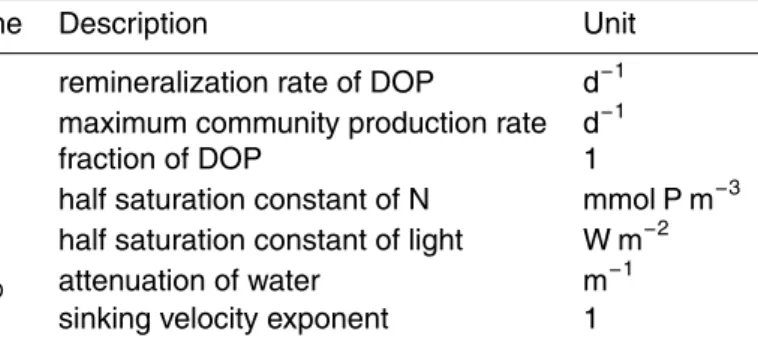
Similar modeling of biological production can be found for example in Dutkiewicz et al. (2005). The remaining model parameters are given in Table 2.
15
3 GPU computing with CUDA
In this section we describe the basic architecture of GPUs and the consequences on exploiting their advantages for scientific computing, and give an overview of some use-ful libraries. We concentrate on the “CUDA” (NVIDIA Corporation, 2012) programming framework. One alternative is, for example, “OpenCL” (The Khronos Group, 2012).
20
GMDD
5, 2179–2214, 2012Porting marine ecosystem model
spin-up to GPUs
E. Siewertsen et al.
Title Page
Abstract Introduction
Conclusions References
Tables Figures
◭ ◮
◭ ◮
Back Close
Full Screen / Esc
Printer-friendly Version Interactive Discussion
Discussion
P
a
per
|
Dis
cussion
P
a
per
|
Discussion
P
a
per
|
Discussio
n
P
a
per
|
cards as well as the increased memory bandwidth, it is possible to perform a far greater number of floating point operations per second (FLOPS) than on CPUs. While CPUs have about one to eight cores each with up to 4 GHz clock rate, GPUs nowadays do have a lower clock rate, but hundreds of cores which can run multiple threads simulta-neously.
5
The basic unit of the CUDA architecture is called “kernel”. A kernel is a piece of program code executed on the graphics card many times in parallel threads. These threads are addressed via a so-called “grid” of blocks. A “block” consists of threads, and its size is determined by a size with up to three dimensions. up to specification. By the CUDA language construct
10
kernel<<<gridSize, blockSize>>>()
the blocks are created and run in parallel by the GPU. The maximum number of threads equals the product of block size and number of blocks.
The GPU consists of several so-called “Streaming Multiprocessors (SM)”. Each SM
15
has its own buffer memory, registers, and a number of cores. The cores have their own
calculators for integer and floating-point calculation. For example, the GeForce GTX 480 used here has 15 SM with each 32 cores, i.e. a total of 480 cores. On a core the smallest executable unit is a so-called “warp”, which consists of 32 threads. The total number of threads that can run simultaneously on a multiprocessor is dependent on
20
NVIDIA’s so-called “Compute Capability (CC)” of the graphics chips. For the GTX 480 the limit is 1536 threads (p. 159 NVIDIA Corporation, 2011) which results in a maximum number of concurrent threads for the entire GPU of 15×1536=23040.
The device memory on the GPU is divided into three types of physical and virtual portions. At first, a thread has access to its own private memory (which is, depending on
25
the CC between 16 kB and 512 kB, see NVIDIA Corporation, 2011, p. 159). Secondly, threads within one block have access to a shared memory of between 16 kB to 48 kB. Finally, all threads have access to a shared global memory whose size is limited by the total amount of memory of the GPU.
GMDD
5, 2179–2214, 2012Porting marine ecosystem model
spin-up to GPUs
E. Siewertsen et al.
Title Page
Abstract Introduction
Conclusions References
Tables Figures
◭ ◮
◭ ◮
Back Close
Full Screen / Esc
Printer-friendly Version Interactive Discussion
Discussion
P
a
per
|
Dis
cussion
P
a
per
|
Discussion
P
a
per
|
Discussio
n
P
a
per
|
While working with CUDA, it is essential to distinguish between the memories of CPU and GPU. In order to run kernel code on the GPU, all data must be transferred from the host memory of the CPU to the device memory on the GPU.
To interact with the GPU via CUDA, a program consists of two components: first, the kernel code consisting of the CUDA Instruction Set (called PTX), on the other, the
5
C code which calls this kernel. NVIDIA provides a compiler (nvcc) that translates C code in PTX code, and that behaves similarly to the C compiler in the GNU compiler Collectiongcc. The extension for CUDA source code files is.cu. NVIDIA also provides a port of the GNU debuggergbd.
3.1 Libraries
10
We use some libraries that simplify several basic actions and algorithm while working with GPUs. The first one is “Thrust” (Thrust, 2012), a C++collection of generic
algo-rithms, similar to the C++“Standard Template Library STL”, that exploit the parallelism
of the GPU in a transparent way. Using Thrust, many problems can be solved without even writing code for the GPU. We here show an example operation: on the host
sys-15
tem a large array is created using random numbers, which then is ported to the GPU, sorted there, and transferred back to the CPU:
int main(void) {
// generate random numbers on the host thrust::host vector<int> h_vec(1 << 24);
thrust::generate(h vec.begin(), h_vec.end(), rand); 20
// transfer data to the device
thrust::device vector<int> d_vec = h_vec; // sort data on the device
thrust::sort(d_vec.begin(), d_vec.end()); // transfer data back to host
25
GMDD
5, 2179–2214, 2012Porting marine ecosystem model
spin-up to GPUs
E. Siewertsen et al.
Title Page
Abstract Introduction
Conclusions References
Tables Figures
◭ ◮
◭ ◮
Back Close
Full Screen / Esc
Printer-friendly Version Interactive Discussion
Discussion
P
a
per
|
Dis
cussion
P
a
per
|
Discussion
P
a
per
|
Discussio
n
P
a
per
|
return 0; }
The second library is “Cusp”, which provides data types for sparse matrices and algorithms for basic linear algebra operations on them. The following example shows how a matrix in the “HYB” sparse storage format is generated on the device (i.e. the
5
GPU) memory, how it is filled with values from a file, and how then a linear system is solved by the “Conjugate Gradient” method on the GPU.
int main(void) {
// create an empty sparse matrix structure (HYB format) cusp::hyb_matrix<int, float, cusp::device_memory> A; 10
// load a˜matrix stored in MatrixMarket format
cusp::io::read_matrix_market_file(A, "filename.mtx"); // allocate storage for solution x and right hand side b cusp::array1d<float, cusp::device_memory> x(A.num_rows, 0); cusp::array1d<float, cusp::device_memory> b(A.num_rows, 1); 15
// solve A˜x = b with Conjugate Gradient method
cusp::krylov::cg(A, x, b); return 0;
}
As can be seen, all data structures in Cusp have a parameter that determines
20
whether it is stored in CPU or GPU memory. All operations on the data will then take place in the respective storage area. For our application, in particular the structure
cusp::csr matrix for the CSR format and the matrix-vector multiplication routine
cusp::multiplythat uses the algorithm described in Bell and Garland (2008, 2009),
which was specially developed for GPUs, are important.
25
The third library we used was the preliminary implementation of PETSc for the CUDA architecture presented in Minden et al. (2010). With the help of the Thrust and Cusp libraries, a large part of the PETScVectorand some parts of theMatrixclass have
GMDD
5, 2179–2214, 2012Porting marine ecosystem model
spin-up to GPUs
E. Siewertsen et al.
Title Page
Abstract Introduction
Conclusions References
Tables Figures
◭ ◮
◭ ◮
Back Close
Full Screen / Esc
Printer-friendly Version Interactive Discussion
Discussion
P
a
per
|
Dis
cussion
P
a
per
|
Discussion
P
a
per
|
Discussio
n
P
a
per
|
been implemented. The fundamental problems of interaction of PETSc with the GPU have been resolved, but only the routines that were necessary for the example treated in Minden et al. (2010) have been implemented. Basically this “PETSc GPU” extends the built-in structures by a value that indicates in which memory the most recent data are stored. This guarantees that the correct data are available (and if necessary copied
5
to) the memory that is currently used.
There is a recent PETSc version 3.3 which “supports CUDA” (Balay et al., 2012), but this version was not used in this work and we did not study if features equivalent to our extensions have already been included.
4 Port of the marine ecosystem simulation onto the GPU
10
We now describe the necessary modifications and extensions of the original program that was running on a multiprocessor CPU cluster in order to run the simulation on a GPU. Basically these modifications are extensions of PETSc GPU, modifications necessary to use of a CUDA Fortran compiler for the biogeochemical model parts and some conversions between different data structures.
15
4.1 Necessary extensions of PETSc GPU
The preliminary PETSc GPU implementation was designed to solve systems of equa-tions, and thus not all functions necessary for our applications were included. To avoid any copying of data between CPU and GPU storage that would have destroyed the speed-up, we thus had to extend the library. In our case, the three PETSc routines
20
MatCopy,MatScale, andMatAXPYmentioned in Sect. 2.3 had to be modified.
PETSc functions in C have to conform to a format which basically looks like this:
PETScErrorCode DoSomething(...) {
GMDD
5, 2179–2214, 2012Porting marine ecosystem model
spin-up to GPUs
E. Siewertsen et al.
Title Page
Abstract Introduction
Conclusions References
Tables Figures
◭ ◮
◭ ◮
Back Close
Full Screen / Esc
Printer-friendly Version Interactive Discussion
Discussion
P
a
per
|
Dis
cussion
P
a
per
|
Discussion
P
a
per
|
Discussio
n
P
a
per
|
PETScFunctionReturn(0); }
Here the dots denote the parameter list. PETSc requires each function to return
a PETScErrorCode that describes its success or failure and is returns by the call
toPETScFunctionReturn()in the last line.
5
The PETSc wrapper function
MatCopy(Ain, *Aout, SAME_NONZERO_PATTERN);
copies the values of matrix Ain into matrix Aout. The third parameter indicates if both matrices have the same sparsity pattern, which then avoids unnecessary memory allocations.
10
For our GPU versionMatCopy SeqAIJCUSP()for the “AIJ” sparse format, it is the-oretically possible for both matrices that are either currently in the GPU memory, the CPU memory or in both. For a complete and correct implementation, it would have been necessary to cover all these cases, and accordingly select memory in which the matrices are actually copied. For our application it was sufficient to cover only the case 15
where the matrices are both in the GPU memory, thus only this case was implemented. Therefore, an additionally implemented functionMatCUSPCopyToGPU()ensures that both matrices are in the GPU memory. Here we could make use of available Cusp functions.
Both PETSc functionsMatScale()andMatAXPY()implement typical linear
alge-20
bra subproblems. As a consequence, they could be nearly completely realized using the Cusp BLAS library on the GPU. The operations are only performed on the non-zero matrix elements.
4.2 PGI CUDA-Fortran
Many biogeochemical models are implemented in Fortran. Since we want to port them
25
to the GPU, we need a Fortran compiler that generates code that can be linked against the C code compiled by thenvcccompiler such that the resulting executable runs on
GMDD
5, 2179–2214, 2012Porting marine ecosystem model
spin-up to GPUs
E. Siewertsen et al.
Title Page
Abstract Introduction
Conclusions References
Tables Figures
◭ ◮
◭ ◮
Back Close
Full Screen / Esc
Printer-friendly Version Interactive Discussion
Discussion
P
a
per
|
Dis
cussion
P
a
per
|
Discussion
P
a
per
|
Discussio
n
P
a
per
|
the GPU. At the time of this work there was one candidate, namely the “PGI CUDA Fortran compiler” (The Portland Group, 2012). It extends the language by constructs for calling kernel functions as well as the CUDA API functions. The syntax of a kernel call in Fortran is
call kernel <<<...>>> 5
and thus similar to CUDA C++. There are some extensions compared to CUDA C++,
but also some restrictions. For details we refer to the manual (The Portland Group, 2011a, p. 14).
4.3 Other extensions to the implementation on the CPU
As described in Sect. 2.3, there are two different data structures useful for the spin-up 10
using the TMM (see Algorithm 1): one for the biogeochemical source-minus sink terms, where all tracers are needed and thus kept together in one structure, and another one for the multiplication with the transport matrices, where every tracer is kept separately to reduce the storage requirements for the matrices. Thus a copying between these two data structures is necessary in every step of the algorithm. For the use on the GPU,
15
three copying functions in the original code were modified using the Thrust library.
4.4 The compilation process for the GPU
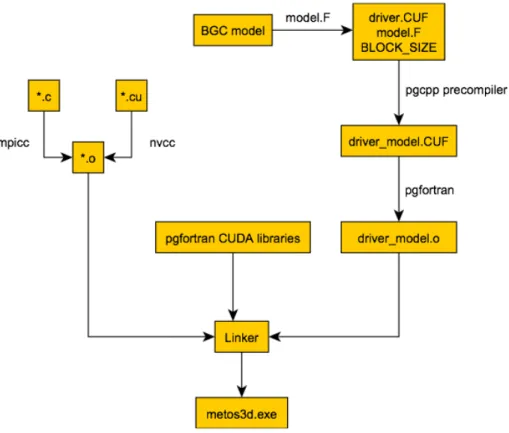
Here we briefly sketch the overall compilation and linking process of the resulting code for the use on the GPU. The process is visualized in Fig. 2.
In a first step (top right in Fig. 2), the biogeochemical model implemented in Fortran
20
in the filemodel.F, together with a driver routine driver.CUF, is translated by the PGI CUDA-Fortran pre-compiler pgcpp into a form (driver model.CUF) that can be coupled to the remaining part of the simulation package written in C. The Fortran compilerpgfortranthen generates an object filedriver model.o.
The driver routinedriver.CUFhas two tasks: at first the Fortran compiler requires
25
GMDD
5, 2179–2214, 2012Porting marine ecosystem model
spin-up to GPUs
E. Siewertsen et al.
Title Page
Abstract Introduction
Conclusions References
Tables Figures
◭ ◮
◭ ◮
Back Close
Full Screen / Esc
Printer-friendly Version Interactive Discussion
Discussion
P
a
per
|
Dis
cussion
P
a
per
|
Discussion
P
a
per
|
Discussio
n
P
a
per
|
The Portland Group (2011b). Since the compiler has no ability to set default attributes for all functions, it is necessary to integrate them through a pre compiler definition. Therein the Fortran keywordsubroutineis replaced by
attributes(device) subroutine
Secondly, the driver provides support functions for the three entry points into the
5
biogeochemical model, namely (i) the evaluation of the source-minus-sink terms, (ii) the initialization and (iii) de-initialization functions of the model. These three functions need corresponding kernel functions on the GPU.
On the other hand (top left of Fig. 2), the original code of the C files is translated as in the CPU version with the MPI wrapper of the GNU C compilermpicc, while the
10
extensions in form of CUDA kernels and their wrappers are translated with the CUDA compilernvcc.
Finally all object code is linked against some additional PGI Fortran libraries, which gives the final executable file (here calledmetos3d.exe).
5 Numerical results
15
In this section we compare the spin-up performed on CPU and GPU hardware. We use the two models described in Sect. 2.4. A special emphasis lies on the time needed for the different parts of the spin-up, namely the matrix-vector multiplications, the
evalua-tion of the biogeochemical source minus-sink terms, and the matrix interpolaevalua-tion which includes matrix copying.
20
5.1 Setup
The test system for the GPU is described in Table 3. The used GPU, the GeForce GTX 480, is a consumer card and already an older model of the GTX series. As of this writing, there are already successor models with more cores. Moreover, the NVIDIA “Tesla” series is especially designed for numerical computations on GPU hardware.
25
GMDD
5, 2179–2214, 2012Porting marine ecosystem model
spin-up to GPUs
E. Siewertsen et al.
Title Page
Abstract Introduction
Conclusions References
Tables Figures
◭ ◮
◭ ◮
Back Close
Full Screen / Esc
Printer-friendly Version Interactive Discussion
Discussion
P
a
per
|
Dis
cussion
P
a
per
|
Discussion
P
a
per
|
Discussio
n
P
a
per
|
For the following test setups and results, only one CPU and one graphics card was used. When reproducing the tests it is crucial to ensure that the graphic card is not used by any “real” graphic output by the operating system. Many graphical user interfaces are now GPU-accelerated, so the results can be falsified. In particular, it is possible that there is not enough memory on the card for the used monthly set of (then totally 24)
5
implicit and explicit transport matrices. When the 2.8125◦horizontal resolution is used, they need about 1 GB memory. A monthly averaged set of transport matrices based on a 1◦resolution is too big for the used GPU system.
To perform an accurate time measurement, the profiling system of PETSc was used, see Balay et al. (2012, docs/manualpages/Profiling/index.html). All measurements are
10
means of 100 runs. No further code optimization was performed on the code for the GPU, such that all comparisons are somehow “fair”.
5.2 Results
We start by comparing the time needed for one annual cycle (i.e. one model year) in the spin-up for both the I-Cs and the N-DOP model. The reduction factor is about 12
15
for the simpler I-Cs model and about 22 for the more complex N-DOP model.
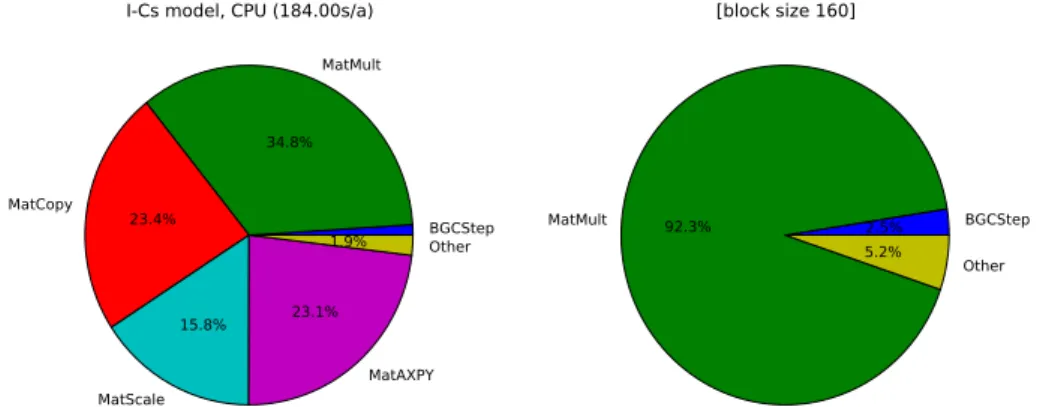
Using the profiler, we evaluated the time needed for the different steps in the
“repeat-until” loop of Algorithm 1 corresponding to one annual cycle. The respective functions are listed in Table 5. Note that for the I-Cs modelBGCStepis just a scaling of the tracer vector.
20
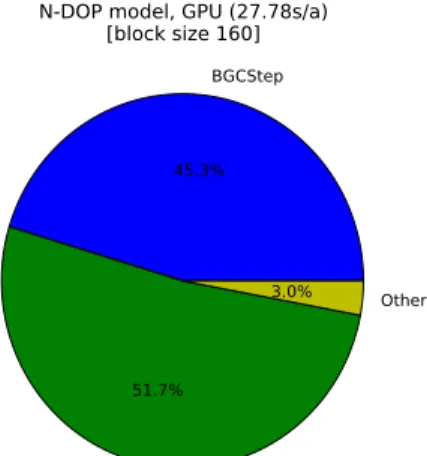
Figures 3 and 4 show the results for both models with a block size of 160 on the GPU. We discuss the effect of different block sizes later on. We make the following
observations. For the uncoupled I-Cs model (without tracer coupling) we find:
– The effort needed on both CPU and GPU forBGCStepis negligible.
– On the CPU, the effort for the three functions used for the matrix interpolation are 25
GMDD
5, 2179–2214, 2012Porting marine ecosystem model
spin-up to GPUs
E. Siewertsen et al.
Title Page
Abstract Introduction
Conclusions References
Tables Figures
◭ ◮
◭ ◮
Back Close
Full Screen / Esc
Printer-friendly Version Interactive Discussion
Discussion
P
a
per
|
Dis
cussion
P
a
per
|
Discussion
P
a
per
|
Discussio
n
P
a
per
|
avoid the interpolation, but this would result is a huge storage effort since then
matrices for every time-step would have to be stored.
– Since the operations needed for the interpolation are very appropriate for the parallelization on the GPU, they become negligible there, such that the main effort
now is the matrix-vector multiplication.
5
– The matrix-vector multiplication is sped up by a factor of 4.5 from CPU to GPU.
For the N-DOP model that includes nonlinear and also non-local tracer coupling we can see:
– More than two third of computational effort on the CPU is spent forBGCStep. The
fractions of the remaining time spent on the linear algebra operations correspond
10
to those for the I-Cs model: again the interpolation takes significantly more time than the matrix-vector-multiplication inMatMult, i.e. the tracer transport itself.
– On the GPU, the overall time needed is nearly equally split between BGCStep
andMatMult.
– For this model, the speed-up from CPU to GPU is again 4.5 forMatMult(which
15
is natural, since this operation is the same for both models).
– ForBGCStep, the speed-up is 34.2, which is rather surprising since the nonlinear
and coupled operations at first seem not to be predestined for the GPU.
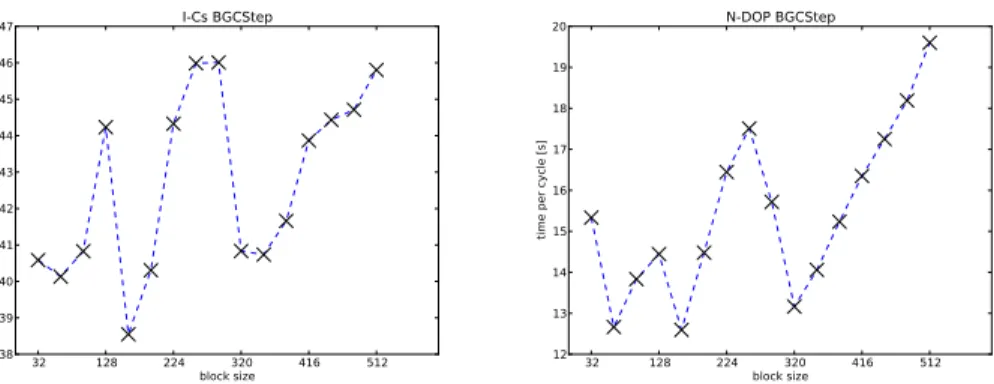
Another parameter to be examined is the block size for the PGI Fortran CUDA kernel call of the biogeochemical model. The block size describes the number of vertical
pro-20
files that are processed within a block. Figure 5 depicts the time needed on the GPU depending on the block size. In both models, there are strong fluctuations up to 100 % of the needed time as a function of block size. In both models the absolute minimum of time (I-Cs: 0.35 s, N-DOP: 13 s) is obtained for a block size of 160. That is the rea-son that this size was used in the above comparirea-sons. Furthermore, both graphs show
25
GMDD
5, 2179–2214, 2012Porting marine ecosystem model
spin-up to GPUs
E. Siewertsen et al.
Title Page
Abstract Introduction
Conclusions References
Tables Figures
◭ ◮
◭ ◮
Back Close
Full Screen / Esc
Printer-friendly Version Interactive Discussion
Discussion
P
a
per
|
Dis
cussion
P
a
per
|
Discussion
P
a
per
|
Discussio
n
P
a
per
|
similar occurrence of minima and maxima. For the N-DOP model these extrema are even bigger, since the part of the biogeochemical model in the total computation time is significantly higher.
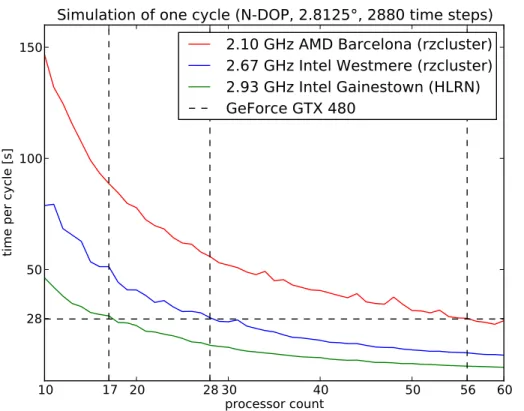
As a last comparison, we tested the performance of the GPU against CPU clusters with three more or less current processor types. As can be seen in Fig. 6, the single (!)
5
GPU for the N-DOP model simulation has the same performance as approximately 56 Barcelona, 28 Westmere, and 17 Gainestown processors.
6 Conclusions
In order to port the existing implementation of the spin-up of marine ecosystem models using the Transport Matrix Method from CPU to GPU hardware, some extensions of
10
necessary libraries had to be done. These require some knowledge in the computing architecture of the used CUDA programming framework. On the other hand, several libraries for the GPU are already available, and since GPU computation is a growing field of research and applications, there will be more in the future. In order to compile Fortran code for the GPU, a commercial compiler was necessary.
15
Concerning the computational gain, in our computations the effect was totally as
expected (about 20). Overall, the used single consumer (and even not latest) GPU outperforms a considerable high number of CPUs in a cluster architecture. The accel-eration effect on the matrix-vector multiplications was poorer (about 4.5) than expected,
whereas the effect on simple matrix copying, scaling and addition was impressive. As 20
a surprise, also the effect on the computation of the nonlinear, coupled and also
non-local source-minus-sink terms in one of the tested biogeochemical models was quite high (about 34). The considered biogeochemical models were still rather simple, but because of this last point it would be very interesting how the spin-up performs on a GPU for more complex models. Additionally, also tests with more powerful GPUs
25
GMDD
5, 2179–2214, 2012Porting marine ecosystem model
spin-up to GPUs
E. Siewertsen et al.
Title Page
Abstract Introduction
Conclusions References
Tables Figures
◭ ◮
◭ ◮
Back Close
Full Screen / Esc
Printer-friendly Version Interactive Discussion
Discussion
P
a
per
|
Dis
cussion
P
a
per
|
Discussion
P
a
per
|
Discussio
n
P
a
per
|
would be interesting, in order to observe if the then necessary data transfer slows down the whole computation and thus reduces the performance gain.
Acknowledgements. The GPU computations were performed with kind permission and support of the Research Group for Communication Systems at Christian-Albrechts-Universit ¨at zu Kiel, Institute for Computer Science. The access to the HLRN computing facility was kindly provided
5
by the group Marine Biogeochemical Modelling at IfM GEOMAR, Kiel, Germany.
References
Argonne Nat. Lab.: The Message Passing Interface (MPI) standard, available at: http://www. mcs.anl.gov/research/projects/mpi/ (last access: 19 July 2012), 2012. 2185
Balay, S., Buschelman, K., Gropp, W. D., Kaushik, D., Knepley, M. G., McInnes, L. C.,
10
Smith, B. F., and Zhang, H.: PETSc web page, available at: http://www.mcs.anl.gov/petsc (last access: 19 July 2012), 2012. 2185, 2194, 2198
Bell, N. and Garland, M.: Efficient sparse matrix-vector multiplication on CUDA, Technical
Re-port NVR-2008-04, NVIDIA Corporation, Santa Clara, CA 95050, USA, 2008. 2193
Bell, N. and Garland, M.: Implementing sparse matrix-vector multiplication on
throughput-15
oriented processors, in: SC 2009: Proceedings of the Conference on High Performance Computing Networking, Storage and Analysis, New York 2009, 1–11, ACM, 2009. 2193 Dutkiewicz, S., Follows, M., and Parekh, P.: Interactions of the iron and phosphorus cycles:
a three-dimensional model study, Global Biogeochem. Cy., 19, 1–22, 2005. 2190
Hanappe, P., Beuriv ´e, A., Laguzet, F., Steels, L., Bellouin, N., Boucher, O., Yamazaki, Y. H.,
20
Aina, T., and Allen, M.: FAMOUS, faster: using parallel computing techniques to accelerate the FAMOUS/HadCM3 climate model with a focus on the radiative transfer algorithm, Geosci. Model Dev., 4, 835–844, doi:10.5194/gmd-4-835-2011, 2011. 2182
Horn, S.: ASAMgpu V1.0 – a moist fully compressible atmospheric model using graphics pro-cessing units (GPUs), Geosci. Model Dev., 5, 345–353, doi:10.5194/gmd-5-345-2012, 2012.
25
2182
Khatiwala, S.: A computational framework for simulation of biogeochemical tracers in the ocean, Global Biogeochem. Cy., 21, GB3001, doi:10.1029/2007GB002923, 2007. 2181
Khatiwala, S., Visbeck, M., and Cane, M.: Accelerated simulation of passive tracers in ocean circulation models, Ocean Model., 9, 51–69, 2005. 2184, 2185
30
GMDD
5, 2179–2214, 2012Porting marine ecosystem model
spin-up to GPUs
E. Siewertsen et al.
Title Page
Abstract Introduction
Conclusions References
Tables Figures
◭ ◮
◭ ◮
Back Close
Full Screen / Esc
Printer-friendly Version Interactive Discussion
Discussion
P
a
per
|
Dis
cussion
P
a
per
|
Discussion
P
a
per
|
Discussio
n
P
a
per
|
Kriest, I., Khatiwala, S., and Oschlies, A.: Towards an assessment of simple global marine biogeochemical models of different complexity, Prog. Oceanogr., 86, 337–360, doi:10.1016/j.pocean.2010.05.002, 2010. 2182, 2188, 2189
Martin, J. H., Knauer, G. A., Karl, D. M., and Broenkow, W. W.: VERTEX: carbon cycling in the Northeast Pacific, Deep-Sea Res. Pt. I, 34, 267–285, 1987. 2190
5
Minden, V., Smith, B., and Knepley, M.: Preliminary implementation of PETSc using GPUs, in: Proceedings of the 2010 International Workshop of GPU Solutions to Multiscale Problems in Science and Engineering, Harbin, November 2010, Springer, New York, USA, 2010. 2193, 2194
M.I.T.: M.I.T. General Circulation Model, available at: http://mitgcm.org/ (last access: 19 July
10
2012), 2012. 2181
NVIDIA Corporation: CUDA C Programming Guide, available at: http://developer.download. nvidia.com/compute/DevZone/docs/html/C/doc/CUDA C Programming Guide.pdf (last ac-cess: 19 July 2012), 2011. 2191
NVIDIA Corporation: CUDA, available at: http://www.nvidia.com/object/cuda home new.html
15
(last access: 19 July 2012), 2012. 2182, 2190
Paltridge, G. W. and Platt, C. M. R.: Radiative Processes in Meteorology and Climatology, Elsevier, New York, 1976. 2190
Parekh, P., Follows, M. J., and Boyle, E. A.: Decoupling iron and phosphate in the global ocean, Global Biogeochem. Cy., 19, GB2020, doi:10.1029/2004GB002280, 2005. 2182, 2189
20
Piwonski, J. and Slawig, T.: Metos3D: A Marine Ecosystem Toolkit for Optimization and Sim-ulation, CAU Kiel, Institut f ¨ur Informatik, available at: http://www.informatik.uni-kiel.de/co2/ software/metos3d (last access: 19 July 2012), 2011. 2185, 2188, 2189
The Khronos Group: OpenCL – The open standard for parallel programming of heterogeneous systems, available at: http://www.khronos.org/opencl/ (last access: 19 July 2012), 2012.
25
2190
The Portland Group: PGI Fortran Compiler Reference Manual, available at: http://www.pgroup. com/doc/pgiref.pdf (last access: 19 July 2012), 2011a. 2196
The Portland Group: CUDA Fortran Programming Guide and Reference, available at: http:// www.pgroup.com/doc/pgicudafortug.pdf (last access: 19 July 2012), 2011b. 2197
30
GMDD
5, 2179–2214, 2012Porting marine ecosystem model
spin-up to GPUs
E. Siewertsen et al.
Title Page
Abstract Introduction
Conclusions References
Tables Figures
◭ ◮
◭ ◮
Back Close
Full Screen / Esc
Printer-friendly Version Interactive Discussion
Discussion
P
a
per
|
Dis
cussion
P
a
per
|
Discussion
P
a
per
|
Discussio
n
P
a
per
|
Thrust: Thrust, http://docs.thrust.googlecode.com/hg/modules.html (last access: 19 July 2012), 2012. 2192
GMDD
5, 2179–2214, 2012Porting marine ecosystem model
spin-up to GPUs
E. Siewertsen et al.
Title Page
Abstract Introduction
Conclusions References
Tables Figures
◭ ◮
◭ ◮
Back Close
Full Screen / Esc
Printer-friendly Version Interactive Discussion
Discussion
P
a
per
|
Dis
cussion
P
a
per
|
Discussion
P
a
per
|
Discussio
n
P
a
per
|
Table 1.Resolution, sizes and sparsity of one block of the explicit and implicit transport matrices for two resolutions computed with the MITgcm.
horizontal vertical matrix size number of non-zeros, total (nnz) and percent
resolution layers (nrows) Aexp Aimp
GMDD
5, 2179–2214, 2012Porting marine ecosystem model
spin-up to GPUs
E. Siewertsen et al.
Title Page
Abstract Introduction
Conclusions References
Tables Figures
◭ ◮
◭ ◮
Back Close
Full Screen / Esc
Printer-friendly Version Interactive Discussion
Discussion
P
a
per
|
Dis
cussion
P
a
per
|
Discussion
P
a
per
|
Discussio
n
P
a
per
|
Table 2.Parameters in the N-DOP model.
Name Description Unit
λ remineralization rate of DOP d−1
α maximum community production rate d−1
σ fraction of DOP 1
KN half saturation constant of N mmol P m−3
KI half saturation constant of light W m−2
KH2O attenuation of water m −1
b sinking velocity exponent 1
GMDD
5, 2179–2214, 2012Porting marine ecosystem model
spin-up to GPUs
E. Siewertsen et al.
Title Page
Abstract Introduction
Conclusions References
Tables Figures
◭ ◮
◭ ◮
Back Close
Full Screen / Esc
Printer-friendly Version Interactive Discussion
Discussion
P
a
per
|
Dis
cussion
P
a
per
|
Discussion
P
a
per
|
Discussio
n
P
a
per
|
Table 3.Specification of the used GPU system. Only one of the two GPUs was used.
Component Details
CPU 2x Intel®Xeon®E5520 @2.27 GHz, each 4 hyper-threaded cores
RAM 40 GB
GMDD
5, 2179–2214, 2012Porting marine ecosystem model
spin-up to GPUs
E. Siewertsen et al.
Title Page
Abstract Introduction
Conclusions References
Tables Figures
◭ ◮
◭ ◮
Back Close
Full Screen / Esc
Printer-friendly Version Interactive Discussion
Discussion
P
a
per
|
Dis
cussion
P
a
per
|
Discussion
P
a
per
|
Discussio
n
P
a
per
|
Table 4.Computation time and reduction for one model year. CUDA block size: 160.
model CPU GPU relation CPU : GPU
I-Cs 184.00 s 15.55 s 11.8 N-DOP 616.00 s 27.78 s 22.2
GMDD
5, 2179–2214, 2012Porting marine ecosystem model
spin-up to GPUs
E. Siewertsen et al.
Title Page
Abstract Introduction
Conclusions References
Tables Figures
◭ ◮
◭ ◮
Back Close
Full Screen / Esc
Printer-friendly Version Interactive Discussion
Discussion
P
a
per
|
Dis
cussion
P
a
per
|
Discussion
P
a
per
|
Discussio
n
P
a
per
|
Table 5.The three main portions in every time step of the spin-up.
lines in Alg. 1 Function Description
4 BGCStep evaluation of source-minus-sink terms 5 MatScale,MatAXPY,MatCopy interpolation of transport matrices 6, 7 MatMult multiplication of transport matrices
GMDD
5, 2179–2214, 2012Porting marine ecosystem model
spin-up to GPUs
E. Siewertsen et al.
Title Page
Abstract Introduction
Conclusions References
Tables Figures
◭ ◮
◭ ◮
Back Close
Full Screen / Esc
Printer-friendly Version Interactive Discussion
Discussion
P
a
per
|
Dis
cussion
P
a
per
|
Discussion
P
a
per
|
Discussio
n
P
a
per
|
Fig. 1.One block of the explicit (left) and implicit transport matricesAexp,j,Aimp,jcomputed using the MITgcm model for a 2.8125◦resolution (output of MATLAB®’sspycommand).
GMDD
5, 2179–2214, 2012Porting marine ecosystem model
spin-up to GPUs
E. Siewertsen et al.
Title Page
Abstract Introduction
Conclusions References
Tables Figures
◭ ◮
◭ ◮
Back Close
Full Screen / Esc
Printer-friendly Version Interactive Discussion
Discussion
P
a
per
|
Dis
cussion
P
a
per
|
Discussion
P
a
per
|
Discussio
n
P
a
per
|
GMDD
5, 2179–2214, 2012Porting marine ecosystem model
spin-up to GPUs
E. Siewertsen et al.
Title Page
Abstract Introduction
Conclusions References
Tables Figures
◭ ◮
◭ ◮
Back Close
Full Screen / Esc
Printer-friendly Version Interactive Discussion
Discussion
P
a
per
|
Dis
cussion
P
a
per
|
Discussion
P
a
per
|
Discussio
n
P
a
per
|
BGCStep MatMult
34.8%
MatCopy 23.4%
MatScale 15.8%
MatAXPY 23.1%
Other 1.9%
I-Cs model, CPU (184.00s/a)
BGCStep 2.5%
MatMult 92.3%
Other 5.2%
I-Cs model, GPU (15.55s/a)[block size 160]
Fig. 3.Fraction of computational time needed for the different steps in one year of the spin-up (Algorithm 1) for I-Cs model on CPU (left) and GPU.
GMDD
5, 2179–2214, 2012Porting marine ecosystem model
spin-up to GPUs
E. Siewertsen et al.
Title Page
Abstract Introduction
Conclusions References
Tables Figures
◭ ◮
◭ ◮
Back Close
Full Screen / Esc
Printer-friendly Version Interactive Discussion
Discussion
P
a
per
|
Dis
cussion
P
a
per
|
Discussion
P
a
per
|
Discussio
n
P
a
per
|
BGCStep
69.9%
MatMult 10.5%
MatCopy 7.2%
MatScale 4.8% MatAXPY
7.1% Other
N-DOP model, CPU (616.00s/a)
BGCStep
45.3%
MatMult 51.7%
Other 3.0%
N-DOP model, GPU (27.78s/a)[block size 160]