Fascicle VI – Food Technology, 34(2)
ORIGINAL ARTICLE
THE STUDY OF ACETYLSALICYLIC ACID EFFECTS ON WHEAT SEEDS GERMINATION IN SALT STRESS CONDITIONS*
SORIN TĂNASA, VASILICA BARBU
“Dunarea de Jos” University, Faculty of Food Science and Engineering 111 Domnească street., 800201, Galaţi, Romania
The present study was conducted in order to determine whether a treatment usingacetylsalicylic acid (ASA)would increase the germinative energy of wheat seeds in conditions of salt stress. Wheat seeds were immersed in six solutions of ASA of different concentrations (0, 0.1, 0.5, 1, 2 and 3 mM) and then germinated in two solutions of different levels of salinity (one replicating normal conditions of salinity in crop soils, and one reproducing the conditions present in salty soil). The optimum concentration of ASA for alleviating the effects of salt stress proved to be 1 mM. The enzymatic activities of three antioxidant enzymes (catalase, peroxidase and poliphenoloxidase) were also monitored in all the experimental variants to determine whether the effects of the ASA on wheat seeds germination were due to its effects on the antioxidant system. The treatment using ASA in 1 mM concentration increased, in high salinity conditions, foremost the catalase activity and less the peroxidase and poliphenoloxidase activity, making catalase the most indicative enzyme in explaining the effects of ASA on saline stress reduction.
Keywords: ASA – acetylsalicylic acid, catalase, peroxidase, poliphenoloxidase, antioxidant, wheat
1. Introduction
Soil salinization is present in Romania on an area of 0.6 million ha, with a potential risk of expansion due to improper irrigation and drainage, the areas being exposed to these dangers representing another 0.6 million ha. Common responses to salt stress include: withering, inhibition of metabolic processes, lipidperoxidation, changes in membrane permeability, ion transport and cell division. In plants, this negative effects result in alterations of plant physiology, causing a reduction of growth and decrease of bioproductivity.
Clarke et al. 2001 proved that salicylic acid (SA) is a phytohormone, which, in small doses, stimulates cell proliferation and inhibits cell growth, and, in higher doses, induces cell apoptosis; it is involved in mediating System Acquired Resistance (SAR) in plants, against bacterial, viral or fungal phytopathogens. AS is thus considered as representing a signal molecule involved in growth processes, reactions to stress, wounding and pathogen attack, etc. (Antofie et al. 2003). Studies made on plants regarding the SA content, found this compund to be located mostly in leaves and the reproductory organs in angiosperms (Raskin, 1990).
SA is now considered to be an important signal molecule in coordinating the growth processes (Ryan et al., 1998). SA is a growth regulator, influencing many physiological processes, such as: germination (Cutt şi Klessig, 1992), seedlings growth (Shakirova et al., 2003; Sakhabutdinova, 2004), stomatal closure (Larque-Saavedra, 1979), membrane permeability (Barkosky et al., 1993), the control over ion intake to roots and stomatal conductivity (Raskin, 1992), the content of photosynthetic pigments (Hayat et al., 2005), the rate of photosynthesis, etc. (Khan et al., 2003). Experimental data suggest that SA is implicated in gene expression signaling and regulation during leaf senescence in Arabidopsis sp.. Furthermore, SA could serve as a chloroplast biogenesis (Morris et al., 2000) and photosynthesis (Fariduddin et al., 2003) regulator and could be involved in other processes such as fruit ripening inhibition (Srivastava et al., 2000), and geotropism (Medvedev et al., 1991).
*
Tănasa S., Barbu V.
24
Although SA has only recently been admitted as being a phytohormone, it has proven to be a nonspecific inducer of plant resistance to various stress factors and pathogen infection, especially to moulds, which recommends the use of this substance and its analogues in treatments applied to crops to combat desertification and low crop yields in general.
SA is a water-soluble antioxidant compound that can also regulate plant growth (Aberg 1981). It also has a role in abiotic stress tolerance such as drought tolerance in wheat (Singh et al., 2003), and salt tolerance in wheat (Sakhabutdinova et al., 2003; Shakirova et al., 2003).
2. Material and method
An experiment was carried out to study the effects of ASA on wheat seed germination in two different salt stress conditions, looking to create a technique that would allow for growing wheat in salty soil conditions. The ASA was chosen due to its widespread, low cost and to the high similarity to SA inters of biochemical effects on plants.
Before germination, 1200 seeds, necessary for obtaining the 12 experimental variants, were washed in normal and then distilled water. The seeds were then introduced in 12 separate assay tubes, 100 seeds each, along with 5mL ASA solutions of different molar concentrations, including the 0 mM test solution.
The seeds were kept for 5 hours in the ASA solutions, after which the solution was eliminated and the seeds were dried lightly by depositing them on filter paper that absorbed most of the solution left on the seeds, and then finally they were deposited in separate Petri dishes between two filter papers. The two saline solutions were then applied to their respective Petri dishes to serve as the source of humidity and salts needed for germination, simulating as much as possible the natural conditions. The seeds were left to germinate three days, after which the germinated seeds were counted in order to calculate the germinating energy. Finally, the filter papers were removed and the seeds were left to dry for three days in order to determine the activity of the antioxidant enzymes.
The germinative energy was determined by incubating 100 seeds, for three days, at room temperature, between two layers of filter paper soaked in a salty solution. The number of seeds germinated represents the germinative energy. Two complex salty solutions were created so that they imitate the natural conditions found in two types of soil: one for the normal salinity found in crop fields soil (the control) and one for salty soil (the test).
For determining the peroxidase and poliphenoloxidase activity of the wheat seedling extract, a spectrophotometer was used, adjusted to the 420 nm wavelength for peroxidases and the 470 nm wavelength for poliphenoloxidase. The catalase activity was measured by dosing the oxygenated water left after the action of the enzymatic exstract on an initial defined amount of this substrate.
3. Results and discussions
3.1. The influence of ASA on wheat seeds germinative energy
The interpretations were focused on comparing the germinative energies of germinated seeds using as treatment only the immersion in distilled water for 5 hours (representing the 0 mM ASA concentration) with the germinative energies of seeds treated with ASA in different concentrations, in order to determine the physiological effects on wheat seeds germination.
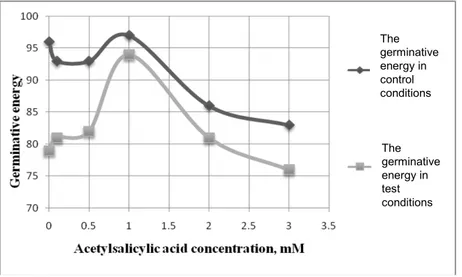
Results revealed an optimum of wheat germination at 1 mM ASA in both control and test conditions (Figure 1).
In control conditions, treatments with 0.1 and 0.5 mM revealed a slight inhibition effect on the germinative energy, whilst the 2 and 3 mM concentrations had a high inhibition effect on this parameter. Only the 1 mM concentration of ASA insured a higher germinative energy than that of untreated seeds, however not by much.
the 1 mM concentration (at 2 mM ASA) and even to that registered with only distiled water as treatment (only at 3 mM ASA).
Figure 1. The effects of ASA on wheat seeds germination energy
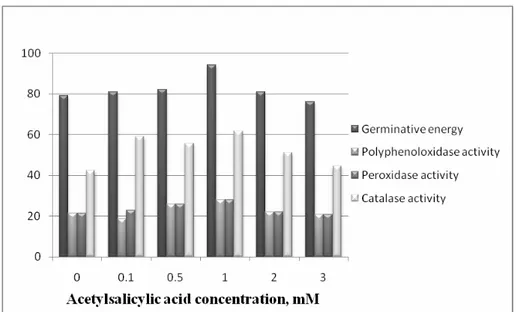
In order to determine the mechanisms by which ASA influences the development of wheat seedlings on the two studied saline solutions, a comparison between the values for germinative energy and the activity of the three enzymes studied was made (Figure 2 and Figure 3). The vertical values display both germinative energy and enzymatic activities, and so the charts are only to be viewed as a visual comparison tool in order to understand the correlation between these values.
Figure 2. Correlations between the germinative energy and the enzymatic activities of the oxidoreductases studied in control conditions
3.2. The influence of ASA on the activity of oxidoreducing enzymes
The peroxidase activity increases for concentrations of up to 1 mM compared to the 0 mM control, in both conditions of salinity. Also, a significant decrease in peroxidase activity was noticed in wheat seedlings germinated in the high salinity solution compared to the ones from the normal salinity solution when treated with ASA, suggesting a synergetic effect of the two factors. The poliphenoloxidase activity was also significantly increased by concentrations of up to 0.5 mM ASA and severely inhibited by high salinity conditions. The catalase activity registered, however, the greatest values in conditions of high salinity, especially for concentrations of 0.5 and 1 mM, similarly to the evolution of the germinative energy.
The germinative energy in control conditions
The germinative energy in test conditions The germinative energy in control conditions
Tănasa S., Barbu V.
26
Figure 3. Correlations between the germinative energy and the enzymatic activities of the oxidoreductases studied in test conditions
3.3. Correlations between the germinative energy and the enzymatic activity of the oxidoreductases studied
In control conditions, the values of the four factors studied did not present comparable values, and so in this case the ASA didn’t have a visible positive effect on wheat seed germination and seedling enzymatic activity.
In the test germinated seeds however, a similarity between the germinative energy and the enzymatic activity of oxidoreductases can be observed. The greatest value of the germinative energy and of the enzymes tested was found for the 1 mm concentration of ASA treatment. So, it can be stated that antioxidant enzymes are involved in the plant’s adaptation to saline stress conditions, which is also confirmed by experiment carried out by Dolatabadian et al. in 2009, where saline stress significantly increased the activity of antioxidant enzymes (catalase, superoxide-dismutase, peroxidase and polyfenoloxidase) in wheat seedlings, and AS reduced the activity of antioxidant enzymes as stress signaling molecules.
The experiment has, therefore, confirmed that high salinity significantly inhibits the germinative energy of wheat seedlings, affecting very little the activities of the studied oxidoreducing enzymes. It can be said that the inhibition mechanism is not due to oxidative stress, but more to the reduction of the amount of free water necessary for biochemical reactions, changes in the membrane permeability and ion transport and therefore in cell division and development.
The results have revealed a significant improvement of the germinative energy of wheat seeds in the salty solution when treated with 1 mM solution of ASA, as well as in smaller concentrations, however with minor changes. The results obtained from the two series of germinated wheat (test and control) suggest the successful use of the 1 mM solution ASA in treating wheat seeds so that they can germinate and grow in salty soils.
The ASA binding protein in plants has proven to be a catalase (Chen et al., 1993), and therefore, it is possible that during the treatment with ASA, an increase in catalase production takes place to match the ASA molecules, and in high salinity conditions, the catalases may be released or simply the binding may be blocked. Thanks to the increased activity of catalase, the H2O2 produced by salt stress is consumed primarily by the catalase and so degradation of cell membranes by peroxidase induced lipidperoxidation is avoided.
The catalase contribution to saline stress adaptation is confirmed by the experiment carried out by Esfandiari et al. in 2007 on two cultivars of wheat, where the cultivar that naturally synthesized more catalases resisted more to high salinity conditions. Whatever the explanation to this phenomenon may be, using the treatment with a 1 mM solution of ASA described here may raise the germination outputs and even crop productivities.
4. Conclusions
High salinity significantly inhibits the germinative energy of wheat seedlings, affecting very little the activities of the studied oxidoreducing enzymes.
Salt stress combined with ASA treatement inhibited the activity of peroxidases and poliphenoloxidases and stimulated that of catalases.
ASA stimulated wheat seeds germination in the salt stress conditions found in medium salty soils. The 1 mM concentration was the most effective in realising this.
Acknowledgements
This research was supported by project: Probiotic lactic acid bacteria for functional food on basis of germinated cereals, 2007-2010, PN II ID_658, nr. 315/1.10.2007
References
Chen, Z., Ricigliano, J.W., Klessig, D.F. 1993. Purification and characterization of a soluble salicylic acid-binding protein from tobacco. The Proceedings of the National Academy of Sciences, 90(20), 9533–9537. Esfandiari, E., Shekari, F., Shekari, F., Esfandiari, M. 2007. The effects of salt stress on antioxidant enzymes
activity and lipid peroxidation on the wheat seedling. Notulae Botanicae Horti Agrobotanici Cluj-Napoca, 35(1), 48-56
Dolatabadian, A., Seyed, A.M.S.M., Sharifi, M. 2009. Effect of salicylic acid and salt on wheat seed germination. Acta Agriculturae Scandinavica - B, 59,456-464.
Sakhabutdinova, A. R., Fatkhutdinova, D. R., Bezrukova, M. V., Shakirova F.M. 2003. Salicylic acid prevents the damaging action damaging action of stress factors on wheat plants. Bulgarian Journal of Plant Physiology,1, 314–319.
Sakhabutdinova, A.R., Fatkhutdinova, D.R., Shakirova, F.M. 2004. Effect of salicylic acid on the activity of antioxidant enzymes in wheat under conditions of salination. Journal of Applied Biochemistry and Microbiology,40, 579–583.
Raskin, I., Skubathz, H., Tang, W., and Meeuse, B.J.D. 1990. Salicylic acid levels in thermogenic and non-thermogenic plants. Annals of Botany,66, 369-373.
Antofie, M., Carasan, M.E., Brezeanu, A. 2003. Salicylic acid effects on two Gardenia Jasminoides cell lines. Acta Horti Bot. Bucureşti, 30, 135-145.
Barkosky, R.R., Einhellig, F.A. 1993. Effects of salicylic acid on plant water relationship. Journal of Chemical Ecology, 19, 237-247.
Cutt, J.R., Klessig, D.F. 1992. Salicylic acid in plants. A changing perspective. Pharmaceutical Technology, 16, 25-34.
Fariduddin, Q., Hayat, S., Ahmad, A. 2003. Salicylic Acid Influences Net Photosynthetic Rate, Carboxylation Efficiency, Nitrate Reductase Activity, and Seed Yield in Brassica juncea. Photosynthetica, 41(4), 281-284 Hayat, S., Q. Fariduddin, B. Ali, and A.Ahmad. 2005. Effects of salicylic acid on growth and enzymes activities
of wheat seedlings, Acta Agronomica Academiae Scientiarum Hungaricae, 53, 433-437.
Khan, W., Prithiviraj, B. 2003. Photosynthetic responses of corn and soybean to foliar application of salicylates. Journal of Plant Physiology, 160,485-492.
Larque-Saavedra, A. 1979. Stomatal closure in response to salicylic acid treatment. Pflanzenphysiology, 93, 371-375.
Tănasa S., Barbu V.
28
Morris, K.A.H., Mackerness, S., Page T., John, C.F., Murphy, A.M., Carr, J.P., Buchanan-Wollaston, V. 2000. Salicylic acid has a role in regulating gene expression during leaf senescence. ThePlant Journal,23, 677– 685.
Raskin, I. 1992. Role of salicylic acid in plants. Annual Review of Plant Physiology,43, 439–463.
Ryan, C.A., Farmer, E.E. 1992. Oligosaccharide signals in plants: a current assessment Annual Review of Plant Physiology and Plant Molecular Biology,42, 651-674.
Shakirova, F.M., Sakhabudinova, A.R., Bezrukova, M.V., Fakhutdinova, R. A., Fakhutdinova, D.R. 2003. Changes in the hormonal status of wheat seedlings induced by salicylic acid and salinity. Plant Science,164, 317-322.
Singh, B., and Usha, K. 2003. Salicylic acid induced physiological and biochemical changes in wheat seedlings under water stress. Journal ofPlant Growth Regulation,39, 137-141.
Srivastava, M.K., and Dwivedi, U.N. 2000. Delayed ripening of banana fruit by salicylic acid, Plant Science,