Submitted 20 August 2015 Accepted 12 November 2015 Published7 December 2015
Corresponding author
Jeffrey C. Way,
Academic editor
Guo-Qiang Chen
Additional Information and Declarations can be found on page 14
DOI10.7717/peerj.1468
Copyright
2015 Chen et al.
Distributed under
Creative Commons CC-BY 4.0
OPEN ACCESS
Production of fatty acids in
Ralstonia
eutropha
H16 by engineering
β
-oxidation and carbon storage
Janice S. Chen1,3, Brendan Col ´on2, Brendon Dusel1, Marika Ziesack2, Jeffrey C. Way1and Joseph P. Torella2
1Wyss Institute for Biologically Inspired Engineering, Harvard Medical School, Boston, MA,
United States
2Department of Systems Biology, Harvard Medical School, Boston, MA, United States
3Current affiliation: Department of Molecular and Cell Biology, University of California Berkeley,
Berkeley, CA, United States
ABSTRACT
Ralstonia eutrophaH16 is a facultatively autotrophic hydrogen-oxidizing bacterium capable of producing polyhydroxybutyrate (PHB)-based bioplastics. As PHB’s physical properties may be improved by incorporation of medium-chain-length fatty acids (MCFAs), and MCFAs are valuable on their own as fuel and chemical intermediates, we engineeredR. eutropha for MCFA production. Expression ofUcFatB2, a medium-chain-length-specific acyl-ACP thioesterase, resulted in production of 14 mg/L laurate in wild-typeR. eutropha. Total fatty acid production (22 mg/L) could be increased up to 2.5-fold by knocking out PHB synthesis, a major sink for acetyl-CoA, or by knocking out the acyl-CoA ligasefadD3, an entry point for fatty acids intoβ-oxidation. AsΔfadD3mutants still consumed laurate, and because theR. eutrophagenome is predicted to encode over 50 acyl-CoA ligases, we employed RNA-Seq to identify acyl-CoA ligases upregulated during growth on laurate. Knock-outs of the three most highly upregulated acyl-CoA ligases increased fatty acid yield significantly, with one strain (ΔA2794) producing up to 62 mg/L free fatty acid. This study demonstrates that homologousβ-oxidation systems can be rationally engineered to enhance fatty acid production, a strategy that may be employed to increase yield for a range of fuels, chemicals, and PHB derivatives inR. eutropha.
Subjects Bioengineering, Microbiology, Synthetic Biology
Keywords β-oxidation, Acyl-CoA ligase, Ralstonia, Biofuel, Metabolic engineering
INTRODUCTION
Ralstonia eutrophaH16 is a facultatively chemolithoautotrophic bacterium capable of using H2and CO2as sole sources of energy and carbon, respectively (Pohlmann et al.,
heterologous enzymes, precursors in PHB synthesis can be redirected to the synthesis of short-chain fusel alcohols such as isopropanol and isobutanol (Grousseau et al., 2014;Li et al., 2012;Lu et al., 2012). This work has demonstrated the plausibility of usingR. eutropha as a chassis for fuel and chemical production beyond PHB-based bioplastics.
The capacity ofR. eutrophato grow autotrophically using CO2and H2/formate has also made it an attractive chassis organism for “electrosynthesis”: the use of electricity to drive biological carbon fixation for renewable chemical production (Nevin et al., 2010;
Rabaey et al., 2010), an alternative to non-renewable oil-based methods. Owing to the difficulty of electrochemically reducing CO2to infrastructure-compatible carbon-based fuels (Kuhl et al., 2012), and the forty-year-old knowledge thatR. eutrophais capable of robust growth in actively electrolyzed media (Schlegel & Lafferty, 1965), electrosynthesis usingR. eutrophahas emerged as an attractive future technology for renewable fuel and chemical production. Efforts by Li and colleagues (2012) demonstrated the ability to integrate precious metal-based electrochemical formate production with engineered R. eutrophato convert electricity and CO2to isobutanol and 3-methyl-1-butanol. In recent work from our lab, we coupledR. eutrophawith scalable, earth-abundant electrodes to produce isopropanol at high efficiency, and achieved biomass yields comparable to those of terrestrial plants (Torella et al., 2015). These studies provide a proof of principle demonstration thatR. eutrophamay be useful for the renewable production of fuels and chemicals from electricity and CO2.
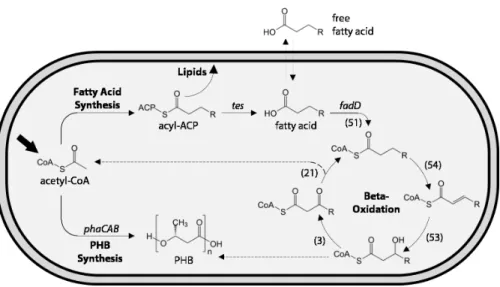
While many efforts to engineerR. eutrophahave focused on the production of bioplas-tics or short-chain alcohols by redirecting the PHB synthesis pathway, few have focused on engineering more chemically diverse products for fuel and chemical applications. Fatty acids represent a broad category of important chemicals that are facile to produce from precursors in bacterial metabolism (Fig. 1), and may be converted biologically or chemically into a range of biofuels and valuable industrial chemicals including alcohols, alkanes, and wax esters (Steen et al., 2010;Lennen & Pfleger, 2013;Akhtar, Turner & Jones, 2013). Moreover, medium-chain fatty acids (MCFAs) may be incorporated into the PHB production pathway to make copolymers with superior physical properties compared to pure PHB (Lageveen et al., 1988).
Recent efforts to produce fatty acids and fatty acid-related chemicals inR. eutropha include the successful production of long-chain fatty acids and methyl ketones (Muller et al., 2013), as well as alcohols, aldehydes and alkanes (Bi et al., 2013). While significant yields of methyl ketones have been achieved, the fatty acid precursors to ketones have only been produced at a maximum yield of 0.017 mg/L in 2% fructose minimal medium and 10 mg/L in LB medium (Muller et al., 2013). This limitation is likely due to extensive fatty acid degradation, orβ-oxidation.R. eutrophaexpresses over 50 homologues of some of its
Figure 1 Schematic of fatty acid production and uptake byRalstonia eutrophaH16.Heterotrophic and autotrophic growth ofR. eutrophaH16 both result in production of the central metabolite acetyl-CoA (bold arrow). During fatty acid synthesis, derivatives of acetyl-CoA are iteratively condensed on an acyl carrier protein (ACP) scaffold to yield a series of acyl-ACPs of increasing length for lipid synthesis. Heterologous expression of chain-length-specific acyl-ACP thioesterases (tes) enables the hydrolysis of acyl-ACPs and release of fatty acids, some of which are capable of crossing the lipid membrane. Fatty acids can be re-consumed through theβ-oxidation pathway, which iteratively removes two carbons from the fatty acid to yield acetyl-CoA (top dashed line). Entry of fatty acids intoβ-oxidation is catalyzed by one or more acyl-CoA ligases (fadDhomologues). Multiple homologues of each step of theβ-oxidation pathway have been identified in the genome of R. eutrophaH16, with the number of homologues indicated in parentheses. Acetyl-CoA may also be converted to polyhydroxybutyrate (PHB) through the action of three enzymes (phaCAB) under periods of carbon excess but limitation of nutrients such as nitrogen or phosphate.β-oxidation and PHB synthesis share common metabolic intermediates and may be co-regulated. The dashed line indicates the potential for 3-hydroxyl-acyl-CoAs to enter PHB synthesis pathway and be incorporated into the polymer.
In this work, we engineeredR. eutrophato produce the medium-chain fatty acid laurate by expressingUcFatB2, a medium-chain-length-specific acyl-ACP thioesterase, and obtained laurate yields of up to 14 mg/L. Fatty acid yields were increased by deleting one of several acyl-CoA ligases (fadD3,A0285, A2794) that catalyze the first step in fatty acidβ-oxidation. These were identified by RNA-Seq as genes strongly upregulated in R. eutrophaduring growth on lauric acid. Fatty acid yield could also be increased by knocking out PHB synthesis (phaCAB). In all, we achieved maximum production of 62 ±2 mg/L free fatty acids, the highest yield of fatty acids reported in this organism to date.
This work provides a starting point for the production of fatty acid-derived fuels and chemicals at high yield, including biofuels and PHB-derived bioplastics, inR. eutropha.
MATERIALS AND METHODS
Bacterial growth and induction
kanamycin as appropriate. Rich medium plates were prepared from the same media plus 1.5% agar (BD). Lauric acid minimal media plates were produced with 1.5% agar and the following salts: 4.0 g/L NaH2PO4, 4.6 g/L Na2HPO4, 0.45 g/L K2SO4, 0.39 g/L MgSO4, 0.062 g/L CaCl2, 0.05% (w/v) NH4Cl, 0.1% lauric acid, 1% NP40 and 1 ml/L of a trace metal solution (15 g/L FeSO4·7H2O, 2.4 g/L MnSO4·H2O, 2.4 g/L ZnSO4·7H2O, and 0.48 g/L CuSO4·5H2O in 0.1 M HCl). For lauric acid minimal media plate growth experiments,R. eutrophastrains were streaked out onto rich medium plates for 2 days at 30◦C, and then a single colony was transferred onto minimal media plates containing 0.1% laurate and grown at 30◦C for 5 days before imaging with a Canon EOS Rebel T3i Digital SLR camera.
To generate liquid cultures ofE. coliorR. eutropha, a single freshly-grown colony was inoculated into 10 mL of culture medium in a 14 mL BD Falcon disposable polypropylene culture tube and shaken at 220 rpm overnight.R. eutrophafree fatty acid (FFA) production experiments were conducted in 2 mL 96-well plates (Thermo Scientific, Waltham, MA, USA) or 30 mL glass culture tubes. In both cases, individualR. eutrophacolonies were first inoculated in 10 mL rich medium with appropriate antibiotics and grown at 220 rpm at 30◦C for 20–22 h. For FFA production in 96-well plates,R. eutrophaovernight cultures were diluted 1:20 into 1 mL fresh rich medium plus necessary antibiotics and shaken at 30◦C, 1,200 rpm on a Titramax 1,000 platform shaker (Heidolph, Schwabach, Germany) for 4–5 h before induction with 0.5% L-arabinose. For FFA production in glass culture tubes,R. eutrophaovernight cultures were diluted 1:20 into 1 ml fresh rich medium supplemented with required antibiotics and shaken at 180 RPM at 30◦C. After 20 h, these cultures were induced with 0.5% L-arabinose and a 20% (v/v) dodecane overlay added. OD600was measured using an Ultrospec 10 spectrophotometer (Amersham, Little Chalfont, UK).
Construction of plasmids
was generated as described byLu et al. (2012), using primer pairs pJC078/JC079 and pJC080/JC081 for overlap extension PCR. The resulting PCR product and parent plasmid pCB96 were digested with XbaI and SacI and ligated to generate pJC046. The gene deletion fragment forA2794was synthesized by IDT as described above, except the fragment was flanked upstream by XbaI and downstream by SacI, with∼30 bp overlap regions to pCB96 on both ends. The fragment was assembled to the pCB96 backbone (linearlized by XbaI/SacI) via Gibson Assembly to generate theA2794markerless deletion plasmid, pJC045. All newly-ligated plasmids and Gibson assembly reactions were transformed into TSS-competentE. coliTURBO or Mach1 cells, isolated and re-transformed into E. coliS17-1 cells for conjugative transfer of plasmid DNA intoR. eutropha. Following conjugation,UcFatB2thioesterase plasmids (pJC022–pJC025) were extracted from R. eutropha and frozen for subsequent electroporation. Primers used in plasmid construction are listed inTable S2.
Genomic modifications
Generation ofR. eutropha MCFA production strains
Freshly-prepared electrocompetentR. eutrophastrains were generated for all FFA production experiments usingUcFatB2thioesterase plasmids (pJC022–pJC025). Single R. eutrophacolonies were grown overnight in rich medium, diluted 1:10 in 10 ml rich medium in 15 ml falcon tubes, and harvested at OD600=0.8. Cultures were submerged in ice for 10 min, pelleted and washed twice with 1 ml ice-cold 10% sucrose. The cell pellet was resuspended in 1 ml 10% sucrose, and 50 ul electrocompetent cells were combined with 1–2µg of plasmid DNA. The cell suspension was transferred to a pre-chilled 0.1 cm gap cuvette and electroporated using the Biorad electroporator manually set at 1.15 kV. Immediately following electroporation, 250µl rich medium was added and the cells were transferred to an eppendorf tube. Electroporated cells were recovered at 30◦C for 2 h before being plated on selective medium and grown for 2–3 days at 30◦C.
Enzymatic assays for FFA measurements
Fatty acids were measured using the enzymatic Free Fatty Acid Half Micro Test (Roche, Basel, Switzerland) as described byTorella et al. (2013). For FFA measurements with 20% dodecane, 5µl of the overlay was diluted into 20 ul dodecane before assaying with the same sample volume as previously discussed. Because acyl-CoAs are not cell permeable, detection of these compounds by the enzymatic assay is not possible in the cell supernatant or dodecane overlay.
GCMS identification of lauric acid
Fatty acids were extracted from 400µl of acidified culture with ethyl acetate and esterified with ethanol. Fatty ethyl esters were extracted with hexane and run on an Agilent GC-MS 5975/7890 (Agilent Technologies, Santa Clara, CA, USA) using an HP-5MS (length: 30 m; diameter: either 0.25 or 0.50 mm; film: 0.25µm) column, as described byTorella et al. (2013). This method is unable to detect acyl-CoAs, because they cannot be extracted into the solvent layer due to their hydrophilic properties.
Isolation of RNA and RNAseq analysis
RESULTS
Expression of the medium-chain thioesterase UcFatB2 enables
MCFA production inR. eutropha
To produce the MCFA lauric acid, we clonedUcFatB2, a thioesterase selective for 12-carbon acyl-ACP substrates from the plantU. californica(Voelker & Davies, 1994), into an arabinose-inducible, R. eutropha-compatible replicative vector (pJC007;
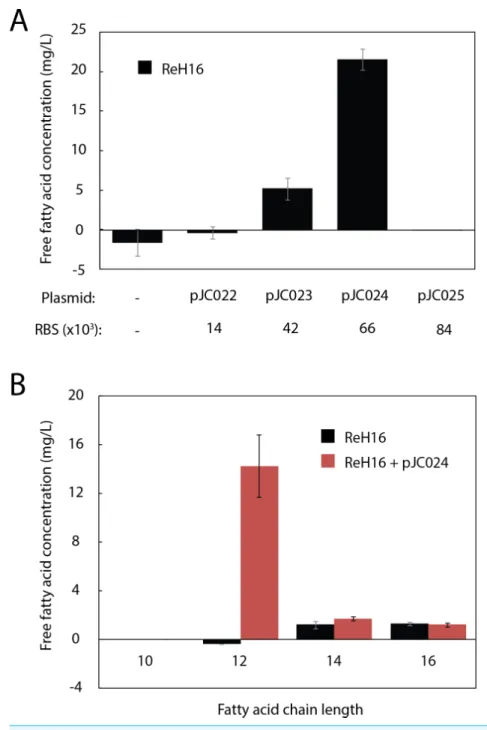
Table S1). Ribosome Binding Sites (RBS) with a range of predicted expression strengths (Translational Initiation Region (TIR) values from 14,000 to 84,000 inR. eutropha) were designed using the RBS Calculator (Salis, Mirsky & Voigt, 2009) and cloned upstream ofUcFatB2(pJC022–pJC025;Table S1). One variant (pJC024, TIR=66,000) resulted in 22 mg/L total free fatty acid (FFA) production within 48 h (Fig. 2A). The absence of detectable fatty acid production in the variant with the highest predicted TIR (84,000, pJC025) may reflect toxicity or inclusion body formation resulting from high expression, or insufficient protein production (e.g., in the case that the actual TIR is much lower than predicted).
GCMS analysis of the ReH16-pJC024 culture confirmed production of lauric acid at 14.3±2.6 mg/L after 24 h of induction; laurate production did not occur in wild-type ReH16 (Fig. 2B). Compared to lauric acid, significantly smaller amounts of myristic (C14:0) and palmitic (C16:0) acids were detected from both wild-type andUcFatB2-expressing strains (Fig. 2B,∼2 mg/L), while the concentration of shorter and unsaturated products was negligible.
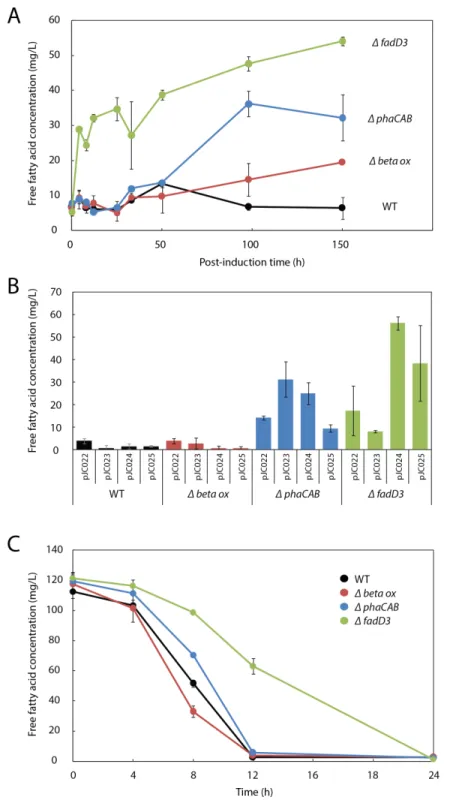
Although FFA production was significant within the first∼24 h following arabinose induction, by 50 h post-induction FFAs were undetectable in the culture (Fig. 3A). This behavior is consistent with the expectation that fatty acids should be re-consumed byR. eutrophathroughβ-oxidation, something previously observed in other microbes engineered to produce fatty acids (Lu, Vora & Khosla, 2008;Runguphan & Keasling, 2014).
Fatty acid production inR. eutropha is limited byβ-oxidation and
PHB synthesis
To evaluate the role ofβ-oxidation in FFA reconsumption, we expressedUcFatB2in R. eutrophastrain Re2303, which contains knockouts in two putativeβ-oxidation operons and is incapable of growth on oleic acid (Brigham et al., 2010). In contrast to the wild-type, Re2303 (Δβ-oxidation) produced FFA concentrations up to 20 mg/L without reconsumption over a 150 h time course, indicating thatβ-oxidation in the wild-type contributes to the decline in FFA yields (Fig. 3A).
(ΔfadD3) led to a 2.8-fold improvement over the Re2303 (Δβ-oxidation) mutant strain and an 8.5-fold increase over wild-type parent strain (Figs. 3Aand3B), indicating that disruption of the first step inβ-oxidation enhanced the production of FFAs beyond what is achieved by blocking downstream steps inβ-oxidation (e.g., in Re2303).
As PHB synthesis is a sink both for acetyl-CoA (Cook & Schlegel, 1978) andβ-oxidation intermediates (Shimizu et al., 2013) inR. eutropha, we hypothesized that it may also limit FFA yield. Expression ofUcFatB2in aphaCABdeletion strain (Re2061) resulted in a considerable 5-fold increase in FFA yield over wild-type by 150 h. Unlike the initial burst of FFAs observed in Re2312 (ΔfadD3), the increase in FFA production by Re2061 (ΔphaCAB) began 40 h after arabinose induction, suggesting a different mechanism for increasing FFA yield. Indeed, PHB synthesis is induced in response to nutrient limitation (Verlinden et al., 2007), which may explain the increase in FFA synthesis at a late time-point in this strain (Figs. 3Aand3B). It is worth noting that simultaneously knocking out PHB synthesis and beta-oxidation genes was unable to enhance FFA production over that achieved byΔfadD3alone (Fig. S1), suggesting that beta oxidation is the limiting factor for FFA yield. Our study therefore focused on manipulating the acyl-CoA ligases responsible for lauric acid consumption to enhance fatty acid yields inR. eutropha.
Consistent with the hypothesis that Re2312 (ΔfadD3) had increased FFA production due to a lower rate of FFA consumption, we found that it had a slower rate of exogenous FFA uptake (Fig. 3C). Wild-typeR. eutropha, Re2303, Re2061 and Re2312 (none express-ingUcFatB2) were incubated with 120 mg/L laurate and the levels of extracellular FFA monitored over a 24 h time period. The wild-type, Re2303 (Δβ-oxidation) and Re2061 (ΔphaCAB) strains had similar consumption rates with laurate no longer detectable in the media by 12 h. Re2312 (ΔfadD3) cells exhibited a slower rate of consumption relative to the other strains, with laurate becoming undetectable by 24 h (Fig. 3C). Laurate consumption was not blocked entirely, suggesting that other acyl-CoA ligases may still be active in Re2312. Indeed, we found that Re2312 was still capable of growth on laurate minimal medium (Fig. S2).
Identification of three additional acyl-CoA ligases that limit FFA yield through RNA-Seq
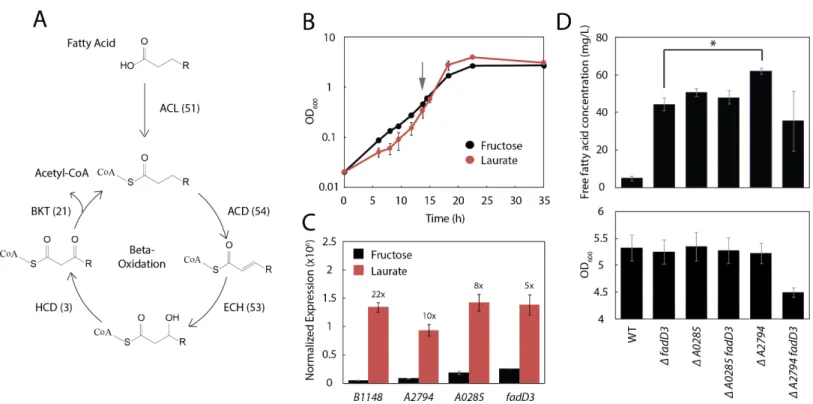
Deletion of the primary acyl-CoA ligase inR. eutropha,fadD3, results in slower uptake of fatty acids (Fig. 3C) but does not block their utilization as a sole carbon source (Brigham et al., 2010). This is consistent with computational predictions that theR. eutrophagenome harbors an apparently redundantβ-oxidation system (Pohlmann et al., 2006), estimated to contain 51 homologues of the acyl-CoA ligase alone (Shimizu et al., 2013) (Fig. 4A).
Figure 4 Three additional acyl-CoA ligases limit FFA yield.(A) Schematic diagram ofβ-oxidation inR. eutropha. The first enzymatic step of
β-oxidation is carried out by an acyl-CoA ligase (ACL) followed by an acyl-CoA dehydrogenase (ACD), enoyl-CoA hydratase (ECH), 3-hydroxyacyl-CoA dehydrogenase (HCD) andβ-ketoacyl-CoA thiolase (BKT). Eachβ-oxidation gene has multiple annotated homologues in theR. eutropha genome (number indicated in parentheses). (B) Time course of Re2061 growth on fructose or laurate minimal medium. Error bars represent S.E.M. fromN=3 independent experiments. The grey arrow indicates the point at which cultures were sampled for RNA-Seq analysis. (C) Expression levels of four acyl-CoA ligases upregulated during growth on laurate, measured by RNA-Seq and normalized by the upper quartile method (Methods). Numbers above bars indicate fold-increase in laurate media as compared to fructose media. Error bars represent S.E.M. of the normalized expression levels for three independent experiments. Differences in expression between fructose and laurate conditions are significant for all four genes after correcting for multiple hypothesis testing (q-value<0.001). (D) Total FFA production 96 h after arabinose induction byR.eutrophaknockout mutants, as measured by the fatty acid half-micro assay (top). OD600 96 h after induction for each mutant. Error bars represent S.E.M. fromN=4 independent experiments in both panels.∗indicates a significant difference in mean FFA production withp<0.05, evaluated using the one-tailed student’st-test.
elected not to analyze the resulting data in full here (a future manuscript is forthcoming). Nevertheless, it provided enough information on acyl-CoA ligase expression patterns to engineer improved FFA production inR. eutropha.
Read counts normalized to upper-quartile gene expression (McClure et al., 2013;
Bullard et al., 2010) were used to identify four genes annotated as acyl-CoA ligases in the R. eutrophagenome that were upregulated strongly (≥5-fold) and significantly (q-value
ΔA2794ΔfadD3double knockout (JT339) actually decreased FFA yield. As the latter was the only strain tested with impaired biomass yield (Fig. 4D, bottom panel), this reduced mean yield may reflect a synthetic loss of fitness associated with theΔA2794ΔfadD3 double knockout.
DISCUSSION
R. eutrophais a versatile industrial organism capable of synthesizing a range of biofuels and bioplastics either heterotrophically from organic substances or autotrophically from H2 and CO2. In this study, we engineered medium-chain fatty acid (MCFA) synthesis in R. eutrophaby optimizing the expression of a heterologously expressed thioesterase, UcFatB2.Deletion of the acyl-CoA ligase fadD3increased fatty acid yields without completely abolishing fatty acid uptake, implying the action of additional acyl-CoA ligases. Because 51 such enzymes have been annotated in theR. eutrophagenome, we employed RNA-Seq to identify which were upregulated during growth on the MCFA lauric acid. Of the four candidate genes identified, knockouts in three (fadD3,A0285, A2794) led to higher fatty acid yields, with one (ΔA2794) providing the highest yield of fatty acids yet reported inR. eutropha(62 mg/L).
Expression ofUcFatB2inR. eutropharesulted in relatively selective production of lauric acid, as laurate production increased by 15 mg/L, while all other detected fatty acids increased by less than 1 mg/L (Fig. 2B). This level of selectivity appears higher than in E. coli, where expression ofUcFatB2has previously been shown to liberate a significant amount of decanoate, myristate and palmitate (Torella et al., 2013). Likewise, although UcFatB2has previously been shown to produce methyl ketones inE. coli(presumably by catalyzing hydrolysis ofβ-ketoacyl-ACPs (Voelker & Davies, 1994)), we failed to detect methyl ketones inR. eutrophaexpressingUcFatB2by GCMS. These results may suggest different rates of product degradation, a difference in interaction betweenUcFatB2and R. eutrophaACP, or a distinct distribution of acyl- andβ-ketoacyl-ACPs inR. eutrophathat result in altered product profiles.
During our fatty acid production timecourse, theΔfadD3strain produced an initial burst of 30 mg/ml free fatty acids in the 4 h following thioesterase induction that was not observed in the wild-type (Fig. 3A). These kinetics suggest that the rate of acyl-ACP hydrolysis byUcFatB2is faster than the rate at which free fatty acids leave the cell, and that the intracellular pool of free fatty acids are rapidly acted on by FadD3 in the wild-type to generate acyl-CoAs. This hypothesis is consistent with a previous observation byMuller et al. (2013)in whichR. eutrophaexpressing a thioesterase in aΔβ-oxidation background produced free fatty acids that accounted for only∼0.00016% of the fructose carbon consumed. However, addition of a heterologous methyl ketone pathway that acts on
β-oxidation intermediates produced greater than 50 mg/L methyl ketones, or about 2% of the fructose carbon consumed (Muller et al., 2013).
phaCABstrains, however, accumulate acetyl-CoA, which is converted to pyruvate or can be diverted by engineered pathways to other products (e.g., isopropanol or isobutanol (Grousseau et al., 2014;Li et al., 2012;Lu et al., 2012)). High acetyl-CoA levels stimulate fatty acid synthesis and inhibit beta-oxidation (Torella et al., 2013;Dellomonaco et al., 2011), and could explain the increase in fatty acid production observed in theΔphaCAB mutant. Moreover, as acetyl-CoA would only accumulate after nutrient depletion, the observed∼30 h delay may reflect the time required to deplete an essential nutrient in the growth medium.
Our identification of differential expression offadDhomologs (fadD3,A0285,A2794 andB1148) inR. eutrophaduring growth on lauric acid and fructose using RNA-Seq (Fig. 4C) was consistent with a previously published microarray study (Brigham et al., 2010), and hints at the possibility of differential regulation ofβ-oxidation enzymes in response to fatty acids of different chain lengths. Previous work byBrigham et al. (2010)
identified significant upregulation offadD3(A3288) andA2794during growth on trioleate relative to fructose, similar to our observation that these genes are upregulated during growth on laurate. However, they did not observe increased expression ofA0285orB1148, though these were strongly upregulated in response to laurate in our system. These results may indicate that differentβ-oxidation enzymes inR. eutrophaare induced by structurally distinct fatty acid substrates, discriminating for example on the basis of saturation and chain length.
Knockouts offadD3,A0285andA2794expressingUcFatB2increased FFA production by 8.9, 10.2 and 12.5-fold (respectively) over WT at 96 h post-induction, without altering total biomass yield (Fig. 4D). Surprisingly, knocking out candidate acyl-CoA ligases in conjunction withfadD3failed to further improve yield: theΔA0285ΔfadD3double mutant did not yield any added FFA increase over the individual mutations, and the
ΔA2794ΔfadD3double mutant had lower yields than either of the single mutants alone. The failure to increase yield in these double mutants may be due to compensatory regulation of acyl-CoA ligases in response to an increase in laurate levels, to kinetic features ofR. eutropha’s extensiveβ-oxidation system, or both. In the specific case of
ΔA2794ΔfadD3, the drop in productivity may also be due to a fitness defect, indicated by the relative decrease in total biomass yield at 96 h compared to its parent strains (Fig. 4D). As FadD is essential for stationary phase survival inE. coli(Farewell et al., 1996), it is possible that acyl-CoA ligases inR. eutrophaperform compensatory roles in the maintenance of stationary phase fitness, and that the deletion of some combinations of ligases carry a stationary phase fitness cost. In all, these results indicate a potentially complex metabolic and regulatory relationship among the acyl-CoA ligases inR. eutropha that may be addressed through more systematic engineering, as well as transcriptomic and metabolic investigation.
understand the relationship between PHB synthesis and fatty acid metabolism, both because their co-regulation complicates efforts to produce FFAs at high yields, and because of the importance ofR. eutrophaas a chassis for industrial polyhydroxyalkanoate (PHA) production. As PHA co-polymers containing medium-chain-length side chains have superior physical properties compared to PHB (Nomura et al., 2004) and these side chains are derived fromβ-oxidation intermediates (Tsuge et al., 2005;Insomphun et al., 2014), a desirable application of the present research will be to engineerR. eutrophafor the production, partialβ-oxidation, and incorporation of MCFAs into PHA co-polymers. In particular, the link betweenβ-oxidation and PHA synthesis has been demonstrated in two related PHA-producing species,Pseudomonas putidaandPseudomonas entomophila: knocking out key enzymes inβ-oxidation was sufficient to increase metabolic flux through the PHA synthesis pathway, and this enabled chain-length-specific production of PHA consisting of 3-hydroxydodecanoate when grown on lauric acid (Liu et al., 2011;
Chung et al., 2011). We also note that while our study lays a foundation for improved FFA production byR. eutrophaduring growth in rich medium, it will be important to demonstrate high-yield production of FFAs in minimal carbon media and on H2and CO2in order to exploit the full capacity of this metabolically versatile, chemolithotrophic bacterium. In particular, H2and CO2-based FFA production would enable integration with water splitting catalysts for efficient solar-to-fuel transformation (Li et al., 2012;
Torella et al., 2015), offering new, sustainable routes for the production of chemicals, bioplastics, and fuels.
ACKNOWLEDGEMENTS
We thank PA Silver for project guidance, J Lu and AJ Sinskey for plasmids and reagents; J Lu, CJ Brigham, TJ Ford, DC MacKellar and O Mavrothalassitis for helpful discussion.
ADDITIONAL INFORMATION AND DECLARATIONS
Funding
This work was supported by the ONR Multidisciplinary University Research Initiative (MURI) Award N00014-11-1-0725 (PAS), and a National Science Foundation Graduate Research Fellowship (JPT). The funders had no role in study design, data collection and analysis, decision to publish, or preparation of the manuscript.
Grant Disclosures
The following grant information was disclosed by the authors:
ONR Multidisciplinary University Research Initiative: N00014-11-1-0725. National Science Foundation Graduate Research Fellowship.
Competing Interests
Author Contributions
• Janice S. Chen and Joseph P. Torella conceived and designed the experiments, performed the experiments, analyzed the data, contributed reagents/materials/analysis tools, wrote the paper, prepared figures and/or tables, reviewed drafts of the paper.
• Brendan Col ´on and Marika Ziesack performed the experiments, analyzed the data,
contributed reagents/materials/analysis tools, reviewed drafts of the paper. • Brendon Dusel performed the experiments, analyzed the data, contributed
reagents/materials/analysis tools.
• Jeffrey C. Way conceived and designed the experiments, analyzed the data.
Data Availability
The following information was supplied regarding data availability: Fructose—replicate 1:https://zenodo.org/record/34443
Fructose—replicate 2:https://zenodo.org/record/34444
Fructose—replicate 3:https://zenodo.org/record/34445
Lauric acid—replicate 1:https://zenodo.org/record/34446
Lauric acid—replicate 2:https://zenodo.org/record/34447
Lauric acid—replicate 3:https://zenodo.org/record/34448.
Supplemental Information
Supplemental information for this article can be found online athttp://dx.doi.org/ 10.7717/peerj.1468#supplemental-information.
REFERENCES
Akhtar MK, Turner NJ, Jones PR. 2013.Carboxylic acid reductase is a versatile enzyme for the conversion of fatty acids into fuels and chemical commodities.Proceedings of the National Academy of Sciences of the United States of America110:87–92DOI 10.1073/pnas.1216516110.
Bi C, Su P, Muller J, Yeh Y-C, Chhabra S, Beller H, Singer S, Hillson N. 2013.Development of a broad-host synthetic biology toolbox forRalstonia eutrophaand its application to engineering hydrocarbon biofuel production.Microbial Cell Factories12:107
DOI 10.1186/1475-2859-12-107.
Brigham CJ, Budde CF, Holder JW, Zeng Q, Mahan AE, Rha C, Sinskey AJ. 2010.Elucidation of beta-oxidation pathways inRalstonia eutrophaH16 by examination of global gene expression.
Journal of Bacteriology192:5454–5464DOI 10.1128/JB.00493-10.
Bullard JH, Purdom E, Hansen KD, Dudoit S. 2010.Evaluation of statistical methods for normalization and differential expression in mRNA-Seq experiments.BMC Bioinformatics 11:94DOI 10.1186/1471-2105-11-94.
Chung AL, Jin HL, Huang LJ, Ye HM, Chen JC, Wu Q, Chen GQ. 2011. Biosynthesis and characterization of poly(3-hydroxydodecanoate) byβ-oxidation inhibited mutant of pseudomonas entomophila L48.Biomacromolecules12:3559–3566DOI 10.1021/bm200770m.
Dellomonaco C, Clomburg JM, Miller EN, Gonzalez R. 2011. Engineered reversal of the beta-oxidation cycle for the synthesis of fuels and chemicals.Nature476:355–359 DOI 10.1038/nature10333.
Farewell A, Diez AA, DiRusso CC, Nystrom T. 1996.Role of theEscherichia coliFadR regulator in stasis survival and growth phase-dependent expression of the uspA, fad, and fab genes.Journal of Bacteriology178:6443–6450.
Grousseau E, Lu J, Gorret N, Guillouet SE, Sinskey AJ. 2014.Isopropanol production with engineered Cupriavidus necator as bioproduction platform.Applied Microbiology and Biotechnology98:4277–4290DOI 10.1007/s00253-014-5591-0.
Henderson RA, Jones CW. 1997.Physiology of poly-3-hydroxybutyrate (PHB) production by Alcaligenes eutrophus growing in continuous culture.Microbiology143:2361–2371 DOI 10.1099/00221287-143-7-2361.
Insomphun C, Mifune J, Orita I, Numata K, Nakamura S, Fukui T. 2014.Modification of beta-oxidation pathway in Ralstonia eutropha for production of poly(3-hydroxybutyrate-co-3-hydroxyhexanoate) from soybean oil.Journal of Bioscience and Bioengineering117:184–190 DOI 10.1016/j.jbiosc.2013.07.016.
Kuhl KP, Cave ER, Abram DN, Jaramillo TF. 2012. New insights into the electrochemical reduction of carbon dioxide on metallic copper surfaces.Energy & Environmental Science 5:7050–7059DOI 10.1039/c2ee21234j.
Lageveen RG, Huisman GW, Preusting H, Ketelaar P, Eggink G, Witholt B. 1988.Formation of polyesters by pseudomonas oleovorans: effect of substrates on formation and composition of poly-(R)-3-hydroxyalkanoates and poly-(R)-3-hydroxyalkenoates.Applied and Environmental Microbiology54:2924–2932.
Lennen RM, Pfleger BF. 2013.Microbial production of fatty acid-derived fuels and chemicals.
Current Opinion in Biotechnology24:1044–1053DOI 10.1016/j.copbio.2013.02.028.
Li H, Opgenorth PH, Wernick DG, Rogers S, Wu TY, Higashide W, Malati P, Huo YX, Cho KM, Liao JC. 2012.Integrated electromicrobial conversion of CO2 to higher alcohols.Science 335:1596DOI 10.1126/science.1217643.
Liu Q, Luo G, Zhou XR, Chen GQ. 2011.Biosynthesis of poly(3-hydroxydecanoate) and 3-hydroxydodecanoate dominating polyhydroxyalkanoates byβ-oxidation pathway inhibited
pseudomonas putida.Metabolic Engineering13:11–17DOI 10.1016/j.ymben.2010.10.004.
Lu J, Brigham CJ, Gai CS, Sinskey AJ. 2012.Studies on the production of branched-chain alcohols in engineered Ralstonia eutropha.Applied Microbiology and Biotechnology96:283–297 DOI 10.1007/s00253-012-4320-9.
Lu X, Vora H, Khosla C. 2008.Overproduction of free fatty acids inE. coli: implications for biodiesel production.Metabolic Engineering10:333–339DOI 10.1016/j.ymben.2008.08.006.
McClure R, Balasubramanian D, Sun Y, Bobrovskyy M, Sumby P, Genco CA, Vanderpool CK, Tjaden B. 2013.Computational analysis of bacterial RNA-Seq data.Nucleic Acids Research 41:e140DOI 10.1093/nar/gkt444.
Muller J, MacEachran D, Burd H, Sathitsuksanoh N, Bi C, Yeh YC, Lee TS, Hillson NJ, Chhabra SR, Singer SW, Beller HR. 2013.Engineering of Ralstonia eutropha H16 for autotrophic and heterotrophic production of methyl ketones.Applied and Environmental Microbiology79:4433–4439DOI 10.1128/AEM.00973-13.
Nevin KP, Woodard TL, Franks AE, Summers ZM, Lovley DR. 2010.Microbial electrosynthesis: feeding microbes electricity to convert carbon dioxide and water to multicarbon extracellular organic compounds.MBio1e00103–e00110DOI 10.1128/mBio.00103-10.
production by coexpression of genetically engineered 3-ketoacyl-acyl-carrier-protein synthase III (fabH) and polyhydroxyalkanoate synthesis genes.Biomacromolecules5:1457–1464 DOI 10.1021/bm049959v.
Pohlmann A, Fricke WF, Reinecke F, Kusian B, Liesegang H, Cramm R, Eitinger T, Ewering C, Potter M, Schwartz E, Strittmatter A, Voss I, Gottschalk G, Steinbuchel A, Friedrich B, Bowien B. 2006.Genome sequence of the bioplastic-producing “Knallgas” bacterium Ralstonia eutropha H16.Nature Biotechnology24:1257–1262DOI 10.1038/nbt1244.
Rabaey K, Butzer S, Brown S, Keller J, Rozendal RA. 2010.High current generation coupled to caustic production using a lamellar bioelectrochemical system.Environmental Science and Technology44:4315–4321DOI 10.1021/es9037963.
Runguphan W, Keasling JD. 2014.Metabolic engineering of Saccharomyces cerevisiae for production of fatty acid-derived biofuels and chemicals.Metabolic Engineering21:103–113 DOI 10.1016/j.ymben.2013.07.003.
Salis HM, Mirsky EA, Voigt CA. 2009.Automated design of synthetic ribosome binding sites to control protein expression.Nature Biotechnology27:946–950DOI 10.1038/nbt.1568.
Schlegel HG, Lafferty R. 1965.Growth of /‘Knallgas/’ bacteria (Hydrogenomonas) using direct electrolysis of the culture medium.Nature205:308–309DOI 10.1038/205308b0.
Shimizu R, Chou K, Orita I, Suzuki Y, Nakamura S, Fukui T. 2013. Detection of
phase-dependent transcriptomic changes and Rubisco-mediated CO2 fixation into poly (3-hydroxybutyrate) under heterotrophic condition in Ralstonia eutropha H16 based on RNA-seq and gene deletion analyses.BMC Microbiology13:169DOI 10.1186/1471-2180-13-169.
Steen EJ, Kang Y, Bokinsky G, Hu Z, Schirmer A, McClure A, Del Cardayre SB, Keasling JD. 2010.Microbial production of fatty-acid-derived fuels and chemicals from plant biomass.
Nature463:559–562DOI 10.1038/nature08721.
Torella JP, Ford TJ, Kim SN, Chen AM, Way JC, Silver PA. 2013.Tailored fatty acid synthesis via dynamic control of fatty acid elongation.Proceedings of the National Academy of Sciences of the United States of America110:11290–11295DOI 10.1073/pnas.1307129110.
Torella JP, Gagliardi CJ, Chen JS, Bediako DK, Colon B, Way JC, Silver PA, Nocera DG. 2015.
Efficient solar-to-fuels production from a hybrid microbial-water-splitting catalyst system.
Proceedings of the National Academy of Sciences of the United States of America112:2337–2342 DOI 10.1073/pnas.1424872112.
Tsuge T, Yano K, Imazu S-I, Numata K, Kikkawa Y, Abe H, Taguchi S, Doi Y. 2005.Biosynthesis of polyhydroxyalkanoate (PHA) copolymer from fructose using wild-type and laboratory-evolved PHA synthases.Macromolecular Bioscience5:112–117DOI 10.1002/mabi.200400152.
Verlinden RA, Hill DJ, Kenward MA, Williams CD, Radecka I. 2007.Bacterial synthesis of biodegradable polyhydroxyalkanoates. Journal of Applied Microbiology102:1437–1449 DOI 10.1111/j.1365-2672.2007.03335.x.
Voelker TA, Davies HM. 1994.Alteration of the specificity and regulation of fatty acid synthesis ofEscherichia coliby expression of a plant medium-chain acyl-acyl carrier protein thioesterase.
Journal of Bacteriology176:7320–7327.
FURTHER READING
Kovach ME, Elzer PH, Hill DS, Robertson GT, Farris MA, Roop 2nd RM, Peterson KM. 1995.
Four new derivatives of the broad-host-range cloning vector pBBR1MCS, carrying different antibiotic-resistance cassettes.Gene166:175–176DOI 10.1016/0378-1119(95)00584-1.