PGC
and
ERCC6
Gene Polymorphisms in Gastric Cancer
and Atrophic Gastritis
Qian Xu1,2, Jing-wei Liu1,2, Cai-yun He1,2, Li-ping Sun1,2, Yue-hua Gong1,2, Jing-jing Jing1,2, Cheng-zhong Xing1,2, Yuan Yuan1,2*
1Tumor Etiology and Screening Department of Cancer Institute and General Surgery, the First Affiliated Hospital of China Medical University, Shenyang, Liaoning, People’s Republic of China,2Key Laboratory of Cancer Etiology and Prevention, China Medical University, Liaoning Provincial Education Department, Shenyang, Liaoning, People’s Republic of China
Abstract
Background:The aim of this study was to investigate the interaction effects of pri-let-7a-1 rs10739971 withpepsinogen C
(PGC) andexcision repair cross complementing group 6 (ERCC6) gene polymorphisms and its association with the risks of gastric cancer and atrophic gastritis. We hoped to identify miRNA polymorphism or a combination of several polymorphisms that could serve as biomarkers for predicting the risk of gastric cancer and its precancerous diseases.
Methods:Sequenom MassARRAY platform method was used to detect polymorphisms of pri-let-7a-1 rs10739971 GRA,
PGCrs4711690 CRG,PGCrs6458238 GRA,PGCrs9471643 GRC, andERCC6rs1917799 in 471 gastric cancer patients, 645
atrophic gastritis patients and 717 controls.
Results:An interaction effect of pri-let-7a-1 rs10739971 polymorphism withERCC6rs1917799 polymorphism was observed for the risk of gastric cancer (Pinteraction= 0.026); and interaction effects of pri-let-7a-1 rs10739971 polymorphism withPGC rs6458238 polymorphism (Pinteraction= 0.012) andPGCrs9471643 polymorphism (Pinteraction= 0.039) were observed for the risk of atrophic gastritis.
Conclusion:The combination of pri-let-7a-1 rs10739971 polymorphism andERCC6andPGCpolymorphisms could provide a greater prediction potential than a single polymorphism on its own. Large-scale studies and molecular mechanism research are needed to confirm our findings.
Citation:Xu Q, Liu J-w, He C-y, Sun L-p, Gong Y-h, et al. (2014) The Interaction Effects of pri-let-7a-1 rs10739971 withPGCandERCC6Gene Polymorphisms in Gastric Cancer and Atrophic Gastritis. PLoS ONE 9(2): e89203. doi:10.1371/journal.pone.0089203
Editor:Xiaoping Miao, MOE Key Laboratory of Environment and Health, School of Public Health, Tongji Medical College, Huazhong University of Science and Technology, China
ReceivedNovember 20, 2013;AcceptedJanuary 16, 2014;PublishedFebruary 25, 2014
Copyright:ß2014 Xu et al. This is an open-access article distributed under the terms of the Creative Commons Attribution License, which permits unrestricted use, distribution, and reproduction in any medium, provided the original author and source are credited.
Funding:This work was supported by grants from the National Key Basic Research Program of China (973 Program ref no. 2010CB529304), the National Natural Science Foundation of China (Ref No. 31200968), and the Science Technology Project in Liaoning Province (Ref No. 2011225002). The funders had no role in study design, data collection and analysis, decision to publish, or preparation of the manuscript.
Competing Interests:The authors have declared that no competing interests exist. * E-mail: [email protected]
Introduction
Individuals with similar living habits and living in similar environments possess different risks of cancer. Identifying and predicting individuals at high risk of developing cancer can indicate the need for changing living habits. Single nucleotide polymorphisms (SNPs) play a pivotal role in predicting individuals with increased cancer risk. In recent years, polymorphisms of pri-miRNA were reported to be biomarkers for predicting cancer risk, such as pri-miR-34b/c rs4938723 polymorphism [1], pri-miR-218 rs11134527 polymorphism [2] and pri-miR-938 rs2505901 polymorphism [3]. Studies have found that the number of single gene polymorphisms was associated with the risk of gastric cancer [4]. However, gastric cancer is a complex multi-step disease with many genes involved, and single SNPs have limited ability to predict gastric cancer risk [5–7]. Several studies have reported that gene-gene interactions are more important than the main effect of
a single gene in complex diseases, such as cancers [7–9]. The basic research approach for gene-gene interactions is to investigate the combination of two or more polymorphisms with minor or no effects from previous single SNP studies [10,11]. However, most previous studies have focused on the predictive role of a single gene SNP and overlooked the potential application of gene-gene interactions.
Our previous candidate gene association study investigated the association ofpepsinogen C(PGC) andexcision repair cross complementing group 6(ERCC6) with the risk of gastric cancer, and found thatPGC
gene rs4711690 CRG, rs6458238 GRA, and rs9471643 GRC
polymorphisms had protective effects against atrophic gastritis [4]. PGC had protective effects on the normal stomach and showed low expression in gastric cancer, and the loss of protection was associated with the occurrence of gastric cancer [14]. ERCC6 is a member of the DNA repair family which participates in the
repairing DNA damage in carcinogenesis [15].ERCC6rs1917799
T.G polymorphism in the promoter region was associated with
increased gastric cancer risk in a Chinese population [16]. Let-7a is a tumor suppressor, and recent studies found that the function of mature let-7a is closely related to the incidence and development of gastric cancer, and decreased expression of let-7a is associated with malignant biological behavior [17,18]. However, let-7a genetic variants were not examined for their associations and
gastric cancer risks. Rs10739971 is a SNP located 2559 bp
upstream of 1, which might be a promoter region of let-7a-1. In the Hapmap database, the minimum allele frequency of
rs10739971 is$5% in both Europeans and Asians. But whether
there is an association between rs10739971 and disease risk, and interactions between rs10739971 and other polymorphisms, remain unknown. We hypothesized that the above-mentioned variants may be optimal candidates to investigate potential SNP-SNP interactions at two or more loci contributing to gastric cancer etiology.
In this case-control study using a Chinese population, we investigated the association of pri-let-7a-1 rs10739971 with gastric cancer risk, and the interaction effects of miRNA-let-7a-1
rs10739971 polymorphism andPGCandERCC6polymorphisms
in samples of the same group, and discuss its application prospects in gastric cancer and its precancerous diseases. To our knowledge, this is the first study attempting to assess potential SNP-SNP interactions of miRNA SNPs and gene SNPs at two or more loci implicated in gastric cancer susceptibility. We hoped to find combinations of gene-gene polymorphisms that could predict the risk of gastric cancer and its precancerous diseases, and to provide experimental evidence for the early diagnosis of gastric cancer.
Methods Patients
In this study, a total of 1834 individuals, which included 471 gastric cancer patients, 646 atrophic gastritis patients and 717 controls, were retrospectively recruited from patients undergoing gastroscopy examination screening in Zhuanghe region and patients who underwent gastroscopy examination or gastric surgery at the First Affiliated Hospital of China Medical University, Liaoning Province, China between 2002 and 2011. Fasting venous blood was collected and all enrolled participants were diagnosed based on their gastroscopic and histopathological examinations. Gastric cancer was diagnosed based on WHO criteria, and atrophic gastritis and superficial gastritis were classified by Sydney’s classification. Eligible controls were those participants with a normal stomach or only gastritis according to gastroscopic and pathological examinations and had no other diseases.
The design of the study was approved by the Human Ethics Committee of China Medical University (Shenyang, China). Written informed consent was obtained from all participants. Medical histories (including age, sex, smoking, and alcohol consumption) were obtained by questionnaire and the records were computerized. Each individual involved in the study
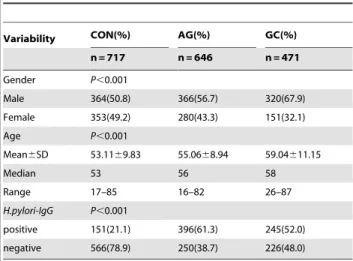
provided written informed consent for epidemiological investiga-tion. Detailed participant characteristics are summarized in Table 1.
Genomic DNA extracted
Genomic DNA was extracted using a previously described method with slight modification [19]. In brief, a frozen clot (500mL) was added to 800mL of TE buffer (triethanolamide), mixed well and centrifuged at 10,0006gfor 5 min to disperse the
clot. Following clot disruption, 400mL of TE, 25mL of 10% SDS
and 5mL of 20 mg/mL proteinase K were added and incubated
at 37uC overnight. The supernatant was extracted and an equal volume of phenol was added. The tube was placed on a rotator for
15 min and then centrifuged at 10,0006 g for 15 min. The
supernatant was removed and a second extraction was performed with the addition of an equal volume of a mixture of phenol and chloroform (1:1). Following centrifugation, the supernatant was removed and a third extraction was performed with the addition of an equal volume of chloroform. Following centrifugation, the supernatant was absorbed and two volumes of protein precipita-tion soluprecipita-tion (two volumes of absolute ethanol containing 10% 3 mol/L sodium acetate) were added and incubated for 2 h at 220uC. Each sample was centrifuged at 10,0006gfor 10 min.
After centrifugation, the resulting DNA pellet was rinsed with 75%
ethanol and centrifuged at 10,0006g for 10 min. The 75%
ethanol was decanted and the tube inverted on clean absorbent paper for 30 min. The resulting DNA was reconstituted in TE buffer and stored at220uC until use.
SNP genotyping
DNA samples were diluted to working concentrations of 50 ng/ mL before genotyping. The assays, primer design, and genotyping of 29 polymorphism sites selected for a candidate gene associated study were all carried out by CapitalBio (Beijing, China) using Sequenom MassARRAY platform (Sequenom, San Diego, CA, USA) between May 2011 and December 2011 based on the manufacturer’s directions[4,20]. Five of 29 polymorphisms were further selected for interaction analysis in the present study. To evaluate the quality of the genotyping, 5% repeated samples were genotyped and the results were 100% consistent.
Table 1.The basic messages of the subjects.
Variability CON(%) AG(%) GC(%)
n = 717 n = 646 n = 471
Gender P,0.001
Male 364(50.8) 366(56.7) 320(67.9)
Female 353(49.2) 280(43.3) 151(32.1) Age P,0.001
Mean6SD 53.1169.83 55.0668.94 59.04611.15
Median 53 56 58
Range 17–85 16–82 26–87
H.pylori-IgG P,0.001
positive 151(21.1) 396(61.3) 245(52.0) negative 566(78.9) 250(38.7) 226(48.0)
Detection of H. pylori in serum
Serological tests forH. pyloriwere performed to check the status of H. pylori infection using ELISA (H. pylori-IgG ELISA kit, BIOHIT Plc, Helsinki, Finland), as described previously [21]. Positive was judged as the titer ofH. pylori-IgG higher than 34EIU (the cut-off value given by the protocol). Briefly, serum samples were diluted 1:200 (5mL+995mL) with diluent buffer and mixed well. Then 100mL of blank solution, calibrators, controls and diluted samples were added to wells. The plate was covered with
the incubation cover and incubated for 30 min at 37uC. After
incubation, the wells were washed five times with 350mL of
diluted (1:100) washing buffer and the plate gently tapped several times on filter paper. Then 100mL of mixed conjugate solution was added to the wells and incubated for 30 min at 37uC. After
incubation, the wells were washed again and 100mL of mixed
substrate solution was added to the wells before incubating for
30 min at room temperature (20–25uC) in a dark environment.
Lastly, 100mL of mixed stop solution was added and the
absorbance was read at 450 nm within 30 min.
Statistical analysis
All statistical analyses were carried out using SPSS 16.0 software (SPSS, Chicago, IL, USA). Pearson’sx2tests were used to evaluate
differences between genders in case and control groups. ANOVA was performed to assess any differences between ages in the different groups. Likelihood ratio tests were performed to assess interaction effects on the risk of gastric cancer by comparing the model that only involved the main effects and the full model that also contained the interaction term. AP-value,0.05 for all two-sided tests was regarded as statistically significant.
Results
Main effect analyses of individual polymorphisms
In our previous study, we found that pri-let-7a-1 rs10739971 polymorphism was significantly associated with increased risk of
atrophic gastritis (OR = 2.59, P= 0.018) in the smaller study
population but no significant association was found in the further validation study of a larger population (unpublished data); PGC
rs4711690, rs6458238, and rs9471643 polymorphisms were significantly associated with increased risk of atrophic gastritis
(P= 0.093, OR = 0.75; P= 0.015, OR = 0.73; P= 0.033,
OR = 0.69, respectively) [4]; ERCC6 rs1917799 polymorphism
was significantly associated with increased risk of gastric cancer (OR = 1.38,P= 0.035) [20].
The two-way interaction of pri-let-7a-1 rs10739971 and PGC, ERCC6 polymorphisms in the risk of gastric cancer/ atrophic gastritis
To investigate whether gene polymorphisms and miRNA polymorphism had an interaction effect, we analyzed interactions between miRNA polymorphism and each gene polymorphism.
We found that miRNA polymorphism and PGC and ERCC6
polymorphisms showed strong statistical association with gastric cancer or atrophic gastritis. Thus, we analyzed the interaction
effect of pri-let-7a-1 rs10739971 polymorphism and PGC and
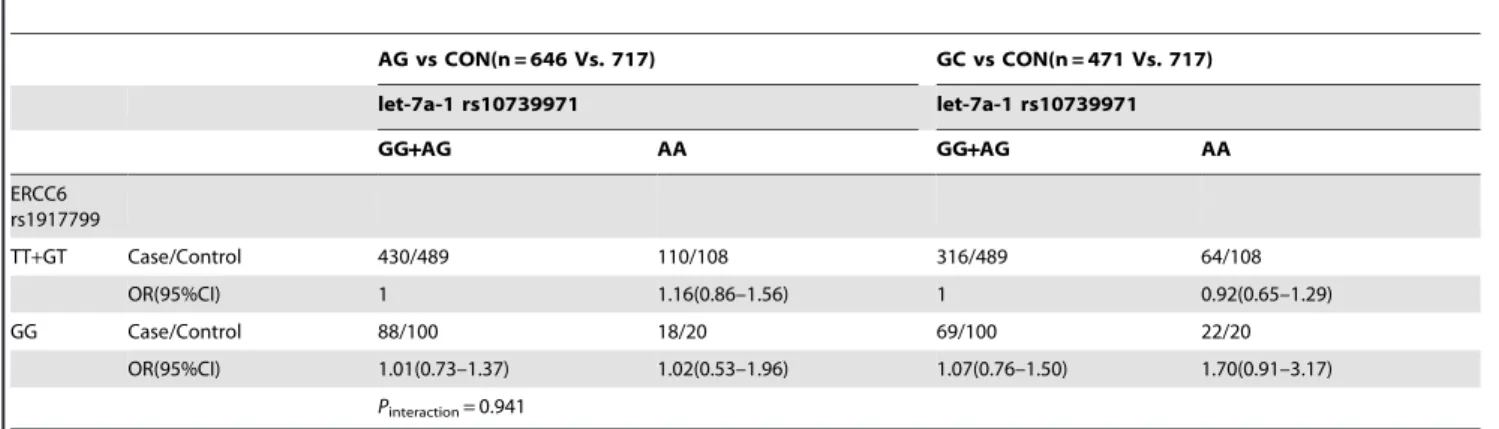
ERCC6 polymorphisms, and its associations, with the risks of gastric cancer and atrophic gastritis. The results indicated that
pri-let-7a-1 rs10739971 polymorphism and ERCC6rs1917799
poly-morphism had interaction effects for gastric cancer risk (Pinteraction
= 0.026, Table 2). This SNP pair showed increased risk of gastric cancer (OR = 2.59, 95%CI = 1.12–5.97). Pri-let-7a-1 rs10739971
polymorphism and PGC rs65458238 and rs9471643
polymor-phisms had interaction effects for the risk of atrophic gastritis (Pinteraction= 0.012 and 0.039, respectively, Table 3). For the
rs65458238 polymorphism, the SNP pair showed increased risk of atrophic gastritis (OR = 2.77, 95%CI = 1.25–6.13); while the other SNP pair showed decreased risk of atrophic gastritis (OR = 0.52, 95%CI = 0.28–0.97) for rs9471643 (Table 3).
SNP-SNP interactions involving multiple SNPs using logistic regression
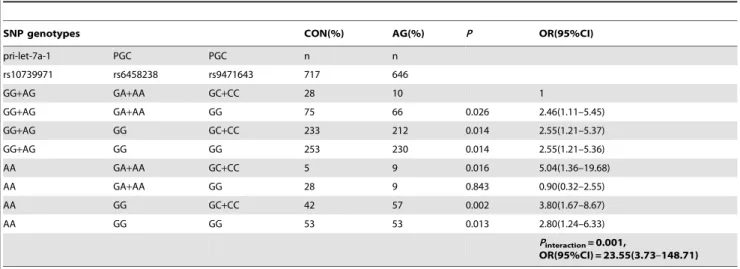
We further investigated the SNP-SNP interaction involving three positive SNPs (pri-let-7a-1 rs10739971–PGCrs6458238–PGC
rs9471643) and the result was statistically significant (Pinteraction
= 0.001, Table 4). The SNP combination showed increased risk of atrophic gastritis (OR = 23.55, 95%CI = 3.73–148.71).
Discussion
Polymorphisms of genes or miRNA might serve as potential biomarkers for predicting disease risk. Previous studies have mainly focused on the association of a single gene polymorphism with disease risk, and the risk was often of weak effect (OR,1.5). As for the combination of two or more SNP-SNP interactions, the risk was often of moderate (OR$1.5) or strong effect (OR$2) [4,10,22–24]. The present study, for the first time, investigated the
interaction effects of miRNA polymorphism andPGCandERCC6
polymorphisms in a Northern Chinese population. The study aimed to provide experimental evidence for the early diagnosis and mechanisms of gastric cancer by finding combinations of gene-gene polymorphisms that could predict the risk of gastric cancer and its precancerous diseases.
Among the SNPs from our group investigated during our
candidate gene association study, ERCC6 single-locus showed a
weak effect for gastric cancer risk (OR = 1.46) [16]; the threePGC
single-locus demonstrated a weak protective effect for atrophic gastritis risk (OR for rs4711690 = 0.75; OR for rs6458238 = 0.73; OR for rs9471643 = 0.69) [4]. We therefore hypothesized that these polymorphisms may be optimal candidates to investigate potential SNP-SNP interactions at two or more loci contributing to gastric cancer etiology. We performed the interaction effect analysis of miRNA polymorphism and gene polymorphisms and found three SNP-SNP pairs associated with diseases, of which the
interaction of one pair (pri-let-7a-1 rs10739971–ERCC6
rs1917799) was associated with gastric cancer risk, and the interactions of the other two pairs (pri-let-7a-1 rs10739971–PGC
rs65458238, and pri-let-7a-1 rs10739971–PGC rs9471643) were
associated with atrophic gastritis risk.ERCC6rs1917799
polymor-phism andPGC rs6458238 and rs9471643 polymorphisms have
been reported previously. In this study, we additionally analyzed pri-let-7a-1 rs10739971 polymorphism in the same group. The
pair of pri-let-7a-1 rs10739971 polymorphism and ERCC6
rs1917799 polymorphism had an OR of their interaction of 2.59 for gastric cancer risk, which was greater than their individual single-locus effects of 0.92 and 1.07, respectively. Similarly, the pair of pri-let-7a-1 rs10739971 polymorphism andPGCrs6458238 polymorphism had an OR of their interaction of 2.77 for atrophic gastritis risk, which was larger than their individual single-locus effects of 0.74 and 1.23, respectively. The pair of pri-let-7a-1
rs10739971 polymorphism and PGC rs9471643 polymorphism
had an OR of their interaction of 0.52 for atrophic gastritis risk. Interestingly, their individual single-locus effects were contrary to the above findings, with OR of 1.65 and 1.06, respectively, which deserves further independent replication of our findings.
we further carried out interaction analysis of the three positive polymorphisms. The results showed that the OR for the risk of atrophic gastritis was 23.55 (P= 0.001). Generally, a single-locus has a weak effect (OR,1.5) on disease risk, and the combination of two or more SNP-SNP interactions often demonstrates a moderate (OR$1.5) or a strong effect (OR$2). In the present study, the OR of pri-let-7a-1 single locus was 1.61; the OR for
interaction effects withERCC6andPGCwere both more than 2;
the combination of the three positive loci demonstrated an even higher OR of 23.55. These outcomes indicated the application prospects of a combination of two or more SNPs as potential biomarkers to predict disease risk.
Investigating the interaction effects of miRNA polymorphisms and gene polymorphisms will contribute to the comprehensive understanding of the gene network and the role of miRNA in the
pathogenic process. Findings of SNP-SNP interactions often have underlying mechanisms rather than being merely statistical results [9]. The three pairs of SNPs indicated that miRNA might interact with genes in gastric carcinogenesis. PGC protein has a protective effect in the epithelium of the normal stomach, and its expression decreased in an atrophic gastritis group when compared with a normal group [14,25]. The exact role of PGC in atrophic gastritis is still not clear. ERCC6 is involved in the DNA repair pathway, and repeated DNA damage and repair may lead to cell carcinogenesis [15]. On the basis of the findings in the present study, it is reasonable to suggest that let-7a may participate in the processes of PGC inducing atrophic gastritis and ERCC6 inducing gastric cancer. According to results from miRNA target prediction software, there were possible binding sites of let-7a with 39-UTR
for both PGC and ERCC6. Whether the SNP-SNP interaction
Table 2.The interaction of pri-let-7a-1 rs10739971 and ERCC6 rs1917799 polymorphisms in the risk of gastric cancer/atrophic gastritisa.
AG vs CON(n = 646 Vs. 717) GC vs CON(n = 471 Vs. 717)
let-7a-1 rs10739971 let-7a-1 rs10739971
GG+AG AA GG+AG AA
ERCC6 rs1917799
TT+GT Case/Control 430/489 110/108 316/489 64/108
OR(95%CI) 1 1.16(0.86–1.56) 1 0.92(0.65–1.29)
GG Case/Control 88/100 18/20 69/100 22/20
OR(95%CI) 1.01(0.73–1.37) 1.02(0.53–1.96) 1.07(0.76–1.50) 1.70(0.91–3.17)
Pinteraction= 0.941
Pinteraction= 0.026,OR(95%CI) = 2.59(1.12–5.97) Note:a,
Pfor interaction was used Logistic Regression adjusted by gender, age andH.pyloriinfection status. CON: controls; AG: atrophic gastritis; GC: gastric cancer. doi:10.1371/journal.pone.0089203.t002
Table 3.The interaction of pri-let-7a-1 rs10739971 and PGC polymorphisms in the risk of gastric cancer/atrophic gastritisa.
AG vs CON(n = 646 Vs. 717) GC vs CON(n = 471 Vs. 717)
let-7a-1 rs10739971 let-7a-1 rs10739971
GG+AG AA GG+AG AA
PGC rs4711690
CG+GG Case/Control 202/247 53/55 161/247 34/55
OR(95%CI) 1 1.18(0.77–1.79) 1 0.95(0.59–1.52)
CC Case/Control 316/342 75/73 224/342 52/73
OR(95%CI) 1.13(0.89–1.44) 1.26(0.87–1.82) 1.01(0.77–1.30) 1.09(0.73–1.64)
Pinteraction= 0.630 Pinteraction= 0.369
PGC rs6458238
GA+AA Case/Control 76/103 18/33 73/103 17/33
OR(95%CI) 1 0.74(0.39–1.41) 1 0.73(0.38–1.40)
GG Case/Control 442/486 110/95 312/486 69/95
OR(95%CI) 1.23(0.89–1.70) 1.57(1.05–2.35) 0.91(0.65–1.26) 1.03(0.67–1.58)
Pinteraction= 0.012,OR(95%CI) = 2.77(1.25–6.13)Pinteraction= 0.115PGC rs9471643GC+CCCase/Control222/26166/47166/26138/47OR(95%CI)11.65(1.09– 2.50)11.27(0.80–2.03)GGCase/Control296/32862/81219/32848/81OR(95%CI)1.06(0.84–1.35)0.90(0.62–1.31)1.05(0.81–1.36)0.93(0.62–
1.40)Pinteraction= 0.039,OR(95%CI) = 0.52(0.28–0.97)Pinteraction= 0.196
Note:a,Pfor interaction was calculated by Logistic Regression adjusted by gender, age andH.pyloriinfection status. CON: controls; AG: atrophic gastritis; GC: gastric
cancer.
effects observed in this study were because of binding of miRNA and its target genes still requires further functional experiments.
This study had some limitations. First, although we had a relative large sample size of 471 gastric cancer patients, 645 atrophic gastritis patients and 717 controls, this sample size may still be inadequate for detecting interaction effects, particularly for rare alleles. Second, the mechanisms of the associated SNP-SNP interactions need to be clarified, and subsequent functional experiments are required. Third, several genome-wide association studies suggest an integration of data from genome-wide association studies of gastric cancer from Chinese populations; therefore, data should be integrated, and may be used as candidate polymorphism sites to be studied in the future. Fourth, the interaction between gene and environment for gastric cancer risk is an important factor to be considered, such as smoking and drinking. In this study, we collected some data on smoking and drinking, but there remains nearly a third of missing data from the samples. Interactions between genes and smoking and drinking behavior on gastric cancer risk should be examined.
Conclusion
This study, for the first time, reports that pri-let-7a-1
rs10739971 polymorphism andERCC6rs1917799 polymorphism
might have an interaction effect on gastric cancer risk; and pri-let-7a-1 rs10739971 polymorphism might have an interaction effect
withPGCrs6458238 and rs9471643 polymorphisms on atrophic
gastritis risk. Some data have been collected providing for the possible construction of a gastric cancer network pathway. Future large-scale studies and mechanism experiments are required to confirm the findings of this study.
Author Contributions
Conceived and designed the experiments: YY. Performed the experiments: QX YG JJ. Analyzed the data: CH LS. Contributed reagents/materials/ analysis tools: CH LS. Wrote the paper: QX JL. Collected a part of the samples: CX.
References
1. Xu Y, Liu L, Liu J, Zhang Y, Zhu J, et al. (2011) A potentially functional polymorphism in the promoter region of miR-34b/c is associated with an increased risk for primary hepatocellular carcinoma. Int J Cancer 128: 412–417. 2. Zhang LS, Liang WB, Gao LB, Li HY, Li LJ, et al. (2012) Association between pri-miR-218 polymorphism and risk of hepatocellular carcinoma in a Han Chinese population. DNA Cell Biol 31: 761–765.
3. Arisawa T, Tahara T, Shiroeda H, Matsue Y, Minato T, et al. (2012) Genetic polymorphisms of IL17A and pri-microRNA-938, targeting IL17A 39-UTR, influence susceptibility to gastric cancer. Hum Immunol 73: 747–752. 4. He C, Tu H, Sun L, Xu Q, Li P, et al. (2013) Helicobacter pylori-related host
gene polymorphisms associated with susceptibility of gastric carcinogenesis: a two-stage case-control study in Chinese. Carcinogenesis 34: 1450–1457. 5. Altmuller J, Palmer LJ, Fischer G, Scherb H, Wjst M (2001) Genomewide scans
of complex human diseases: true linkage is hard to find. Am J Hum Genet 69: 936–950.
6. Hirschhorn JN, Lohmueller K, Byrne E, Hirschhorn K (2002) A comprehensive review of genetic association studies. Genet Med 4: 45–61.
7. Moore JH, Williams SM (2002) New strategies for identifying gene-gene interactions in hypertension. Ann Med 34: 88–95.
8. Cordell HJ (2009) Detecting gene-gene interactions that underlie human diseases. Nat Rev Genet 10: 392–404.
9. Moore JH (2003) The ubiquitous nature of epistasis in determining susceptibility to common human diseases. Hum Hered 56: 73–82.
10. Liu L, Wu C, Wang Y, Zhong R, Wang F, et al. (2011) Association of candidate genetic variations with gastric cardia adenocarcinoma in Chinese population: a multiple interaction analysis. Carcinogenesis 32: 336–342.
11. Sapkota Y, Mackey JR, Lai R, Franco-Villalobos C, Lupichuk S, et al. (2013) Assessing SNP-SNP interactions among DNA repair, modification and metabolism related pathway genes in breast cancer susceptibility. PLoS One 8: e64896.
12. Link A, Kupcinskas J, Wex T, Malfertheiner P (2012) Macro-role of microRNA in gastric cancer. Dig Dis 30: 255–267.
13. Mishra PJ, Bertino JR (2009) MicroRNA polymorphisms: the future of pharmacogenomics, molecular epidemiology and individualized medicine. Pharmacogenomics 10: 399–416.
14. Ning PF, Liu HJ, Yuan Y (2005) Dynamic expression of pepsinogen C in gastric cancer, precancerous lesions and Helicobacter pylori associated gastric diseases. World J Gastroenterol 11: 2545–2548.
15. Pines A, Hameetman L, de Wilde J, Alekseev S, de Gruijl FR, et al. (2010) Enhanced global genome nucleotide excision repair reduces UV carcinogenesis and nullifies strand bias in p53 mutations in Csb2/2mice. J Invest Dermatol 130: 1746–1749.
16. Liu J, He C, Sun L, Xu Q, Xing C, et al. (2013) ERCC6 rs1917799 T.G polymorphism associated with susceptibility to gastric cancer in Chinese population: a case-control study. Asian Pacific Journal of Cancer Preventio-n(accepted).
17. Zhu YM, Zhong ZX, Liu ZM (2010) Relationship between let-7a and gastric mucosa cancerization and its significance. World J Gastroenterol 16: 3325– 3329.
18. Wang WN, Chen Y, Zhang YD, Hu TH (2013) The regulatory mechanism of CCR7 gene expression and its involvement in the metastasis and progression of gastric cancer. Tumour Biol 34: 1865–1871.
Table 4.The genotype combinations of the SNP-SNP interactions in three polymorphisms with the risk of atrophic gastritisa.
SNP genotypes CON(%) AG(%) P OR(95%CI)
pri-let-7a-1 PGC PGC n n
rs10739971 rs6458238 rs9471643 717 646
GG+AG GA+AA GC+CC 28 10 1
GG+AG GA+AA GG 75 66 0.026 2.46(1.11–5.45)
GG+AG GG GC+CC 233 212 0.014 2.55(1.21–5.37)
GG+AG GG GG 253 230 0.014 2.55(1.21–5.36)
AA GA+AA GC+CC 5 9 0.016 5.04(1.36–19.68)
AA GA+AA GG 28 9 0.843 0.90(0.32–2.55)
AA GG GC+CC 42 57 0.002 3.80(1.67–8.67)
AA GG GG 53 53 0.013 2.80(1.24–6.33)
Pinteraction= 0.001,
OR(95%CI) = 23.55(3.73–148.71)
Note:a,Pfor interaction was calculated by Logistic Regression adjusted by gender, age andH.pyloriinfection status. CON: controls; AG: atrophic gastritis.
19. Xu Q, Yuan Y, Sun LP, Gong YH, Xu Y, et al. (2009) Risk of gastric cancer is associated with the MUC1 568 A/G polymorphism. Int J Oncol 35: 1313–1320. 20. Liu JW, He CY, Sun LP, Xu Q, Xing CZ, et al. (2013) The DNA Repair Gene ERCC6 rs1917799 Polymorphism is Associated with Gastric Cancer Risk in Chinese. Asian Pac J Cancer Prev 14: 6103–6108.
21. Gong YH, Sun LP, Jin SG, Yuan Y (2010) Comparative study of serology and histology based detection of Helicobacter pylori infections: a large population-based study of 7,241 subjects from China. Eur J Clin Microbiol Infect Dis 29: 907–911.
22. Zhong R, Liu L, Zou L, Sheng W, Zhu B, et al. (2013) Genetic variations in the TGFbeta signaling pathway, smoking and risk of colorectal cancer in a Chinese population. Carcinogenesis 34: 936–942.
23. Liu L, Wu J, Zhong R, Wu C, Zou L, et al. (2013) Multi-loci analysis reveals the importance of genetic variations in sensitivity of platinum-based chemotherapy in non-small-cell lung cancer. Mol Carcinog 52: 923–931.
24. Chen W, Song H, Zhong R, Zhu B, Guo H, et al. (2013) Risk of GWAS-identified genetic variants for breast cancer in a Chinese population: a multiple interaction analysis. Breast Cancer Res Treat 142: 637–644.