www.bjournal.com.br
Volume 44 (2) 84-181 February 2011
doi:
Braz J Med Biol Res, February 2011, Volume 44(2) 123-129
10.1590/S0100-879X2010007500152
Effects of -174 G/C polymorphism in the promoter region of
the interleukin-6 gene on plasma IL-6 levels and muscle
strength in elderly women
D.S. Pereira, D.M. Garcia, F.M.S. Narciso, M.L.A.S. Santos, J.M.D. Dias, B.Z. Queiroz,
E.R. Souza, O.T. Nóbrega and L.S.M. Pereira
Campus
Institutional Sponsors
The Brazilian Journal of Medical and Biological Research is partially financed by
Effects of -174 G/C polymorphism in the
promoter region of the interleukin-6 gene on
plasma IL-6 levels and muscle strength
in elderly women
D.S. Pereira
1, D.M. Garcia
1, F.M.S. Narciso
1, M.L.A.S. Santos
1,
J.M.D. Dias
1, B.Z. Queiroz
1, E.R. Souza
2, O.T. Nóbrega
2,3and L.S.M. Pereira
11Programa de Pós-Graduação em Ciências da Reabilitação, Departamento de Fisioterapia,
Universidade Federal de Minas Gerais, Belo Horizonte, MG, Brasil
2Programa de Pós-Graduação Stricto Sensu em Gerontologia,
Universidade Católica de Brasília, Brasília, DF, Brasil
3Programa de Pós-Graduação em Ciências Médicas,
Universidade de Brasília, Brasília, DF, Brasil
Abstract
We investigated the effect of -174 G/C single-nucleotide polymorphism in the promoter region of the IL6 gene on plasma IL-6 levels and muscle strength, and the relationship between IL-6 levels and muscle strength in elderly women. The sample con-sisted of 199 elderly residents (73.0 ± 7.8 years old) from rest homes and the community in Belo Horizonte, MG, Brazil. -174 G/C polymorphism was determined by direct sequencing of the product by PCR, and plasma IL-6 concentrations were measured by ELISA. Muscle strength in the knee joint was evaluated using a Biodex System 3 Pro® isokinetic dynamometer. ANCOVA was used to determine the effect of polymorphism on IL-6 levels and muscle strength, and the Pearson correlation coefficient
to assess the relationship between IL-6 levels and muscle strength. -174 G/C polymorphism was associated with the plasma IL-6 levels of elderly women (P < 0.01) since homozygotes for the G allele showed high IL-6 levels (GG 3.85 pg/mL, GC + CC 2.13 pg/mL). There was no association of polymorphism on muscle strength (P > 0.05). No association was found between
IL-6 levels and knee extensor muscle (r = 0.087, P = 0.306) or flexor (r = -0.011, P = 0.894) strength. An interaction between -174 G/C polymorphism and housing conditions of the sample of elderly women was identified, with the effect of genotype on
IL-6 levels being higher in the institutionalized elderly. These results support the evidence that -174 G/C polymorphism of the IL6 gene associates with individual variability of plasma IL-6 levels in elderly women.
Key words: Interleukin-6; Elderly; Muscular strength; -174 G/C polymorphism
Introduction
Correspondence: L.S.M. Pereira, Av. Antônio Carlos, 6627, 31270-901 Belo Horizonte, MG, Brasil. Fax: +55-31-3409-4781. E-mail: [email protected]
Received July 13, 2010. Accepted December 8, 2010. Available online December 24, 2010. Published February 7, 2011.
The aging process is associated with subliminal chronic
inflammatory activity, with the occurrence of an idiopathic elevation of serum levels of inflammatory mediators such as interleukin-1 (IL-1), tumor necrosis factor-alpha (TNF-α),
interleukin-6 (IL-6), and acute phase proteins such as C-reactive protein (CRP), among other mediators (1,2). This
subliminal state of inflammation has been linked to the
pathological process of various age-related diseases and to the increased disability and mortality of the elderly (1-4).
IL-6 is a multifunctional pleiotropic cytokine with
recog-nized pro- and anti-inflammatory action. It plays an important
role in the homeostasis of the immune and neuroendocrine
systems, as well as in the balance of proinflammatory/anti-inflammatory pathways and in response to stress (1,2,5).
There is evidence that the concentration of IL-6 increases in the supernatant of peripheral blood mononuclear cell cultures and in the plasma of elderly individuals (1,6,7). Increased plasma IL-6 levels are associated with the pres-ence of cardiovascular and rheumatic diseases, sarcopenia, functional decline, and mortality in the elderly (1,7,8).
124 D.S. Pereira et al.
polymorphisms (SNP) in its promoter region, like the variants -597 G/A, -572 G/C, -373 A/T, and -174 G/C, among others (10-12). Several studies have questioned the functional role of the -174 G/C SNP in the production of IL-6 both in vivo (13-15) and in vitro (10-12). The change of guanine
bases to cytosine (G → C) at position -174 seems to affect
the transcription of the IL6 gene and therefore the plasma levels of this cytokine in young (10,12), elderly (12,13,15) and centenarian individuals (13,16). However, the results of studies regarding the activity and effects of polymorphisms on plasma levels of these mediators and susceptibility to different diseases are contradictory.
Some evidence suggests that genetic factors may
influence the physical functioning of elderly people since
the hereditary factor for muscle strength may vary from 36 to 65% (17-19). However, there is little information about
specific genes that may contribute to the physical disability
related to aging. In this respect, the genes involved in
regu-lating the inflammatory process, which increases with age,
may contribute to individual variation in plasma cytokine levels and muscle strength in the elderly. However, despite evidence pointing at the action of IL-6 as one of the factors related to the reduction of muscle mass and muscle strength (sarcopenia) (1,20-22) and the importance of genetic varia-tion in the regulavaria-tion of this cytokine, studies investigating the impact of the -174 G/C polymorphism of the IL6 gene on the variables of muscle performance are scarce.
The objective of the present study was to investigate the effect of -174 G/C SNP in the promoter region of the IL6
gene on plasma IL-6 levels and muscle strength in elderly women. The association between plasma IL-6 levels and muscle strength was also analyzed.
Material and Methods
This was a cross-sectional observational study with a convenience sample consisting of elderly female residents of homes for the aged and in the community, in the city of Belo Horizonte. The study was approved by the Ethics Committee of Universidade Federal de Minas Gerais (ETIC 322/07) and all volunteers gave written informed consent to participate, according to the principles of the Helsinki Declaration.
Sample
The sample was a convenience selection, whereby the participants were recruited by consecutive recruiting visits to homes for the aged, health centers and senior citizen social groups and by announcements in local homes for the aged and in the community. Exclusion criteria were:
elderly people with acute phase inflammatory disease, using
drugs that act on the immune system, presenting cognitive impairment detectable by the Mini-Mental State Examination (23), amputation or lower limb fracture in the last 6 months, and the presence of neurological sequelae.
For sampling in the community, 455 potential volunteers were initially contacted, and 153 elderly subjects were se-lected on the basis of the inclusion and exclusion criteria. Of these, 8 dropped out: 4 because of health problems (cataract surgery, erysipelas, deep vein thrombosis, and cardiac abnormalities) and 4 because of transportation
dif-ficulties to reach the site of assessment. The total number
of elderly subjects was 145, who were from the community. Due to the high prevalence of cognitive disorders, sickness in the acute phase, use of medications acting on the im-mune system and refusal of some homes for the aged to participate, the sample from homes for the aged consisted of only 57 elderly women. Therefore, with the elderly from the community and the homes for the aged, a total of 202 participants were selected for the study.
To characterize the sample, the sociodemographic data (age, marital status, education, and personal income) and information on the clinical conditions of the elderly (comor-bidities, number and type of medications, body mass index (BMI), presence of pain, walking capacity, and occurrence of falls in the previous year) were obtained using a struc-tured questionnaire and a clinical assessment, carried out by trained personnel.
Muscle strength
Muscle strength was assessed using a Biodex® System
3 Proisokinetic dynamometer(Biodex Medical Systems Inc., USA). The muscle groups assessed were the knee
joint extensors and flexors of the dominant limb. Work
was standardized according to body mass, selected as a parameter of muscle performance, and was obtained by means of concentric contractions at an angular velocity of
60°/s, with five repetitions. All procedures were performed
according to the assessment protocol suggested by the manufacturer, such as positioning of the volunteer, calibra-tion, correction for gravity, familiarizacalibra-tion, and strong verbal
encouragement (24). Considering the difficulties in selecting
and transporting the institutionalized elderly to the place of assessment, muscle strength was measured only in the elderly from the community.
IL-6 levels
Five milliliters of blood was collected from the ulna vein
of the participants into Vacutainers with citrate by a qualified
healthcare professional. The blood was then centrifuged and the plasma was removed in a sterile environment and stored in Eppendorf tubes in a freezer at -70°C for 2 years.
Plasma IL-6 concentrations were measured by ELISA using high sensitivity kits from Quantikine® HS, R&D
Sys-tems, USA, according to manufacturer recommendations. Measurements were made in duplicate and results are
mL (pg/mL). Absorbance was measured using a single microplate reader at 490 nm with length correction at 650 nm (Microplate Reader Asys, Austria).
Identification of genotype
Total DNA was isolated from peripheral plasma samples using the QIAamp DNA Mini-Kit (Qiagen, USA) according to manufacturer recommendations. The -174 G/C polymor-phism in the promoter region of the IL6 gene (rs1800795) was determined by direct sequencing of the product of a polymerase chain reaction (PCR). A 628-bp region of the
IL6 gene containing the polymorphic point was amplified
using a specific pair of primers: 5’-GAACACAGAAGAACTC AGATGACTGG-3’ (sense) and 5’-AGGAGTTCATAGCTGG GCTCCTGGAG-3’ (antisense). The reactions were per -formed in tubes containing 100 ng DNA, 10 mM Tris-HCl, pH 9.2, 25 mM KCl, 1.5 mM MgCl2, 0.2 mM dNTP, 20 pmol
of each primer, 0.5 µg purified albumin (purified chicken
albumin) and one unit of Taq polymerase DNA (Phoneutria,
Brazil) in a final volume of 50 µL. After 1 min of initial heat -ing at 80°C and an initial denaturation for 2 min at 94°C,
amplification was performed for 36 cycles of 40 s at 94°C,
45 s at 64°C, and 50 s at 72°C, followed by 5 min at 72°C. A sample (100 ng) of each PCR product was sequenced directly with an ABI PRISM 3700 DNA analyzer (Applied Biosystems, USA) using the DYEnamic ET Terminator Cycle Sequencing Kit (GE Healthcare, UK) along with 2
µM of the 5’-GCCTCAGAGACATCTCCAGTCC-3’ primer
in the reaction tube. Sequencing condi-tions using a PE 9700 thermal cycler (Perkin Elmer, USA) were as follows: 30 cycles of 20 s at 95°C, 15 s at 50°C, and 1 min at 60°C. Each sequence obtained was examined using the Staden software
package (MRC, UK) and confirmed by
visual inspection.
Statistical analysis
The description of the subject sample was done by measuring central tendency (means ± SD) and frequency of the socio-economic and clinical variables. Violation of Hardy-Weinberg equilibrium was tested by the chi-square test, taking P < 0.05.
The effect of polymorphism on IL-6 levels and muscle strength in the elderly women was investigated by analysis of covariance (ANCOVA). Considering the heterogeneity of the sample and the known association of some variables with plasma IL-6 indexes and muscle strength, a covariance test was performed in which IL-6 levels were considered as dependent variable regarding genotype, housing conditions (institutionalized or living in the
community) and the presence of osteoarthritis constituted
the fixed factors (independent). Age and BMI were used
as covariants.
The Pearson correlation coefficient (r) was used to
assess the correlation between plasma IL-6 levels and muscle strength. Data normality was checked by the Kolmogorov-Smirnov test and homogeneity of variances
by the Levene test. The level of significance was set at α
= 0.05 in all analyses. Analyses were performed using the Statistical Package for Social Sciences (SPSS) for Windows (version 15.0).
Results
Of the 202 elderly subjects from the community and homes for the aged that met the inclusion criteria, 199 participated in the study, 55 of them residents of homes for the aged and 144 residents of the community. Three elderly women (2 institutionalized and 1 from the commu-nity) were excluded because it was not possible to obtain their genotype for the -174 G/C polymorphism of the IL6
gene. The sociodemographic and clinical characteristics of the total sample are presented in Table 1.
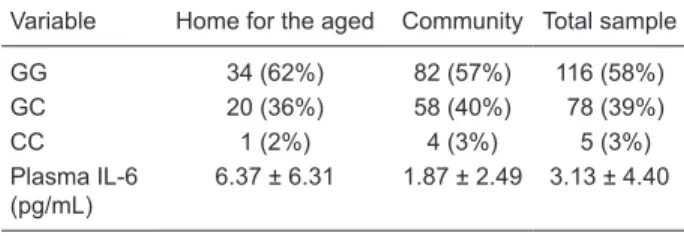
The genotypes were consistent with Hardy-Weinberg equilibrium proportions (58% GG, 39% GC, and 3% CC; P > 0.05). The frequency of genotypes for the -174 G/C polymorphism and the plasma levels of IL-6 are presented in Table 2. For analysis, the genotypes were
Table 1. Sociodemographic and clinical characteristics of the elderly women as-sessed.
Variable Home for the aged N = 55 (28%)
Community N = 144 (72%)
Total sample N = 199
Age (means ± SD) 77.4 ± 9.5 71.3 ± 6.2 73.0 ± 7.8 Educational level
No schooling 13 (24%) 13 (9%) 26 (13%) 1 to 7 years of schooling 31 (56%) 63 (11%) 94 (47%) 8 or more years of schooling 11 (20%) 68 (47%) 79 (40%) Marital status
Single 35 (64%) 6 (4%) 41 (21%)
Married 0 59 (41%) 59 (30%)
Widow 17 (31%) 57 (40%) 74 (37%)
Divorced 3 (5%) 22 (15%) 25 (13%)
Income
<2 minimum wages* 51 (93%) 46 (32%) 96 (49%) 2-3.99 minimum wages 4 (7%) 51 (35%) 55 (28%)
≥4 minimum wages 0 46 (32%) 46 (23%)
BMI (kg/m2) 25.3 ± 5.5 28.9 ± 4.7 28.0 ± 5.2
Osteoarthritis 26 (47%) 113 (79%) 139 (70%)
HBP 27 (49%) 91 (63%) 118 (59%)
126 D.S. Pereira et al.
grouped as GG vs GC + CC.
The difference in mean plasma IL-6 levels was significant
between the groups of genotype GG vs GC + CC, with the elderly women with the GG genotype having higher levels of this cytokine when compared with carriers of the C al-lele (ANCOVA). The effect of polymorphism on IL-6 levels
was significant even under the influence of, and interaction
between, the housing condition variables (homes for the aged or community), and the presence of osteoarthritis and BMI were controlled (F = 10.99; P < 0.01).
In the analysis of variance of IL-6 levels attributed to genotype and housing condition factors, the polymorphism
showed a higher relative effect of IL-6 levels (partial η2 =
0.058), which, however, was lower than the effect of the
housing conditions on this mediator (partial η2 = 0.189).
Moreover, an interaction between residing status and -174 G/C polymorphism (F = 5.84; P = 0.02) was observed, with the effect of genotype on IL-6 levels being higher in the institutionalized elderly compared to the elderly women from the community. Comparison of IL-6 levels between groups of genotypes (GG vs GC + CC) revealed more marked levels in the institutionalized elderly women compared to those living in the community (P < 0.05; Table 3).
To analyze the effect of polymorphism on muscle strength, 139 of 144 elderly women from the community were assessed using an isokinetic dynamometer, and 5 dropped out during this phase of the study. No difference was observed in the muscle strength of knee joint
exten-sors and flexors, assessed according to work/body mass
in the elderly from the community, between groups of genotypes (GG vs GC + CC) (P > 0.05). Similarly, no cor-relation was found between plasma IL-6 levels and knee extensor muscle.
Discussion
Results obtained for the sociodemographic profile
and the clinical population studied were consistent with literature report regarding low education and low income. The sample presented a tendency toward excess weight according to Lipschitz (25) cutoff points for the elderly, and the prevalence of osteoarthritis was high.
Analysis of covariance showed that the -174 G/C poly-morphism affected the plasma IL-6 levels of elderly women regardless of whether they resided in the community or were institutionalized (P < 0.01). Higher IL-6 levels were observed in the group of elderly women with the GG genotype, as also observed in another recent Brazilian study (26). This
effect was significant even when factors related to IL-6
levels were controlled, such as the following variables: housing conditions (homes for the aged or community), presence of osteoarthritis, age and BMI. However, the housing condition variable for the elderly women strongly affected the plasma IL-6 levels, with institutionalized women presenting comparatively higher IL-6 levels than women
from the community.
The institutionalized elderly women usually represent a distinct population: they have more associated diseases, comorbidities, a higher prevalence of depression and
dif-ficulty to perform daily tasks. Moreover, they live without a
multigenerational family and social contact and are submit-ted to a routine and to interventions that are peculiar to the institution where they live. Research has documented the impact of the social support network on the dysregulation of physiological parameters, where there is a lack of this association with morbidity and mortality (27,28). Growing evidence points to a relationship between social conditions and adverse environmental conditions and high levels of
inflammatory mediators (27,28). Due to this, the living
conditions of institutionalized elderly women can contribute to a chronic condition of biopsychosocial stress, which in
turn can influence the plasma levels of proinflammatory
mediators. These factors could explain the impact of insti-tutionalization on the increased plasma IL-6 levels in the sample studied.
In the present study, a significant interaction effect
between genotype and housing conditions of the elderly was also observed. The institutionalized elderly showed higher levels of plasma IL-6 compared to those living in the community, indicating that the effect of genotype on
Table 2. Distribution of genotypes and plasma IL-6 levels in el-derly women living in homes for the aged or in the community.
Variable Home for the aged Community Total sample
GG 34 (62%) 82 (57%) 116 (58%) GC 20 (36%) 58 (40%) 78 (39%)
CC 1 (2%) 4 (3%) 5 (3%)
Plasma IL-6 (pg/mL)
6.37 ± 6.31 1.87 ± 2.49 3.13 ± 4.40
Data are reported as means ± SD. IL-6 = interleukin-6.
Table 3. Comparison of IL-6 levels between groups of genotypes GG vs GC + CC for IL6 gene -174 G/C polymorphism.
Variable Plasma IL-6 (pg/mL) ANCOVA
Home for the aged Community F P
GG 7.74 ± 6.5 2.24 ± 2.3 5.84 0.02* GC + CC 4.17 ± 3.4 1.36 ± 1.3
IL-6 levels appears to be greater in the institutionalized elderly. Recent studies have shown that the control of the expression of IL-6 is extremely complex, being regu-lated by different mechanisms and factors (9,11,29). The promoter region of IL6 genes behaves as a sophisticated biosensor regarding the homeostasis of the immune system, hormonal changes and different environmental factors such as diet and stress conditions as determined by lifestyle, social and psycho-emotional issues (30). In this context, the condition of institutionalization of elderly women could lead to imbalances of a nutritional
and psychosomatic nature with inflammatory repercus -sions, causing the effect of a genotype prone to a higher production of cytokines.
However, even being influenced by environmental fac -tors, the effect of -174 G/C polymorphism on IL-6 levels was
significant for both the institutionalized and community-living
elderly women. Indeed GG homozygous individuals showed higher levels of IL-6 even in distinct social and environ-mental conditions, providing evidence that this genotype
interfered significantly with plasma IL-6 levels in the sample studied. These findings provide further support for literature
data showing that the -174 GG genotype is associated with greater production of IL-6 both in vitro (10,12) and in vivo (12,13), but they differ from reports showing that this
genetic influence is dependent on gender (12). Olivieri et
al. (12) analyzed the effect of -174 G/C polymorphism on the production of IL-6 in vitro and in vivo in a sample of 62
individuals aged 29 to 93 years. A significant association
between -174 G/C polymorphism and the production of IL-6 was observed both in vitro and in vivo, with GG individuals presenting higher IL-6 levels than CC + GC subjects, with a
significant association only for males. These results agree
with those reported by Bonafé et al.(13). However,
infor-mation regarding gender specificities is limited, but there
are indications of possible interactions between genes and sex hormones (31).
Other investigators, studying the association between
-174 G/C polymorphism and specific diseases and longevity,
have obtained contradictory results regarding genotypes (14,16,32,33). Rea et al. (34) evaluated changes in the frequency of GG homozygotes for polymorphism at position -174 G/C of the gene for IL-6 with aging and observed a 10% decline in the frequency of this genotype with advancing age, with homozygotes for the C allele presenting higher IL-6 levels. A study consistent with these results was con-ducted on individuals older than 80 years, with follow-up for a period of 6 years, where the C allele was associated with high levels of plasma IL-6 in octogenarians (14).
An important question should be considered regarding
the conflicting results in the literature. The aging process and
the health conditions related to age are complex phenotypes,
influenced by the interaction between genes and different
environmental factors. The different results observed among studies were possibly due to the interactions between
lifestyle and genetic factors, along with cultural and ethnic differences across different countries.
There is little research on the impact of the -174 G/C polymorphism of the IL6 gene on muscle performance variables. In the present study, no effect of -174 G/C poly-morphism of the IL6 gene was observed on muscle strength
of knee extensors and flexors, assessed by the work/body
mass of elderly women in the community. These results support other results reported in the literature (35,36). Roth et al. (35) investigated the association between -174 G/C polymorphism of the IL6 gene and muscle mass and strength in 242 individuals (110 men and 132 women) aged 21 to 92 years. These investigators found an as-sociation of this polymorphism with muscle mass, but not with muscle strength (35). Walston et al. (36) investigated the association of different alleles of the IL6 gene with variables such as plasma IL-6 levels, muscle strength and fragility, in two cohorts of elderly subjects. No relationship was demonstrable between plasma IL-6 levels, muscular strength (handgrip and isometric strength of knee extensors
and hip flexors) and weakness and the polymorphisms or
the haplotypes investigated for the IL6 gene, including the -174 G/C polymorphism.
However, these findings should be interpreted with
caution since an approach focused on the polymorphism
of a single inflammatory mediator is limited. Other media -tors besides IL-6 play an important catabolic role in muscle
and, likewise, their levels are influenced by functional
polymorphisms in the promoter region of their genes, such
as TNF-α. Another point to be considered is that possible
interactions between genes of these cytokines may contrib-ute to the variability in muscle performance observed with age, and mask the separate effects of a single polymor-phism. This requires a more detailed investigation of the complex interactions between polymorphisms of different
genes and their influence on specific phenotypes, such as
muscle strength.
Laboratory and clinical studies have shown that high levels of IL-6 are associated with a reduction of muscle mass and strength in the elderly (8,37,38). The mechanism by which these cytokines contribute to muscle alteration is not known, but involves its catabolic action on muscle, with
a reduction of myofibril protein being related to sarcopenia
(8). However, in the present sample of community-living elderly women, no correlation was observed between muscle strength and plasma IL-6 levels. This result may be explained by the fact that the plasma levels found in the elderly assessed here (1.87 ± 2.49 pg/mL) did not reach the
threshold necessary to influence muscle performance. In a
cohort of 627 elderly women presenting moderate to severe disabilities, Ferrucci et al. (37) found that those with plasma IL-6 levels in the highest tertiles (IL-6 >3.1 pg/mL) showed a greater reduction of knee extensor muscle strength and also of the ability to perform daily activities.
consid-128 D.S. Pereira et al.
ered. The fact that it was a convenience sample does not permit to generalize the results, limiting its external validity. Another point to be considered is that the level of physical activity of the elderly women was not recorded. There is
evidence that physical activity has an anti-inflammatory effect, with a reduction in plasma levels of inflammatory
mediators, so that physically active individuals present lower levels of plasma IL-6. IL-6 is released during physical exercise, produced by the muscle (myocyte) and is
ac-companied by the synthesis of anti-inflammatory cytokines such as IL-1ra, a soluble TNF-α receptor (sTNFR) and
IL-10. Moreover, physical activity has been shown to be an effective strategy for the prevention and treatment of sarcopenia (39,40). Thus, the practice of physical activity, if
carried out by participants, may have influenced the results
found regarding the effect of genotypes on muscle strength, and may have contributed to the lower levels of IL-6 found in the elderly women from the community.
The results of this study support the evidence that the
-174 G/C polymorphism of the IL6 gene influences the
levels of plasma IL-6 in elderly residents of homes for the aged and in the community. This effect persisted even
when the influence and interactions between factors known
to interfere with the production of IL-6 were controlled. Moreover, an interaction between -174 G/C polymorphism
and the housing conditions of the women was identified,
suggesting that environmental factors may modulate the effects of genotypes on the production of IL-6. No effect of polymorphism was observed on the muscle strength of the
extensors and flexors of the knee joint and no association
was found between plasma IL-6 levels and muscle strength in elderly women from the community.
Acknowledgments
Research partially supported by FAPEMIG (#CDS-APQ 1867-5.01/07) to L.S.M. Pereira, and by CNPq (#484318-2006-3) to O.T. Nóbrega.
References
1. Krabbe KS, Pedersen M, Bruunsgaard H. Inflammatory
mediators in the elderly. Exp Gerontol 2004; 39: 687-699. 2. Maggio M, Guralnik JM, Longo DL, Ferrucci L. Interleukin-6
in aging and chronic disease: a magnificent pathway. J Gerontol A Biol Sci Med Sci 2006; 61: 575-584.
3. Ferrucci L, Harris TB, Guralnik JM, Tracy RP, Corti MC, Cohen HJ, et al. Serum IL-6 level and the development of disability in older persons. J Am Geriatr Soc 1999; 47: 639-646.
4. Franceschi C, Bonafe M. Centenarians as a model for healthy aging. Biochem Soc Trans 2003; 31: 457-461. 5. Ershler WB, Keller ET. Age-associated increased
interleu-kin-6 gene expression, late-life diseases, and frailty. Annu Rev Med 2000; 51: 245-270.
6. Forsey RJ, Thompson JM, Ernerudh J, Hurst TL, Strindhall
J, Johansson B, et al. Plasma cytokine profiles in elderly
humans. Mech Ageing Dev 2003; 124: 487-493.
7. Ferrucci L, Corsi A, Lauretani F, Bandinelli S, Bartali B, Taub
DD, et al. The origins of age-related proinflammatory state.
Blood 2005; 105: 2294-2299.
8. Haddad F, Zaldivar F, Cooper DM, Adams GR. IL-6-induced skeletal muscle atrophy. J Appl Physiol 2005; 98: 911-917.
9. Pantsulaia I, Trofimov S, Kobyliansky E, Livshits G. Genetic and environmental influences on IL-6 and TNF-alpha plasma
levels in apparently healthy general population. Cytokine 2002; 19: 138-146.
10. Fishman D, Faulds G, Jeffery R, Mohamed-Ali V, Yudkin JS, Humphries S, et al. The effect of novel polymorphisms in the interleukin-6 (IL-6) gene on IL-6 transcription and plasma IL-6 levels, and an association with systemic-onset juvenile chronic arthritis. J Clin Invest 1998; 102: 1369-1376.
11. Terry CF, Loukaci V, Green FR. Cooperative influence of
genetic polymorphisms on interleukin 6 transcriptional regu-lation. J Biol Chem 2000; 275: 18138-18144.
12. Olivieri F, Bonafe M, Cavallone L, Giovagnetti S, Marchegiani F, Cardelli M, et al. The -174 C/G locus affects in vitro/in vivo
IL-6 production during aging. Exp Gerontol 2002; 37: 309-314.
13. Bonafé M, Olivieri F, Cavallone L, Giovagnetti S, Mayegiani F, Cardelli M, et al. A gender-dependent genetic predisposi-tion to produce high levels of IL-6 is detrimental for longevity. Eur J Immunol 2001; 31: 2357-2361.
14. Bruunsgaard H, Christiansen L, Pedersen AN, Schroll M, Jorgensen T, Pedersen BK. The IL-6 -174G>C polymor-phism is associated with cardiovascular diseases and mortality in 80-year-old humans. Exp Gerontol 2004; 39: 255-261.
15. Christiansen L, Bathum L, Andersen-Ranberg K, Jeune B, Christensen K. Modest implication of interleukin-6 promoter polymorphisms in longevity. Mech Ageing Dev 2004; 125: 391-395.
16. Di Bona D, Vasto S, Capurso C, Christiansen L, Deiana L, Franceschi C, et al. Effect of interleukin-6 polymorphisms on human longevity: a systematic review and meta-analysis. Ageing Res Rev 2009; 8: 36-42.
17. Arden NK, Spector TD. Genetic influences on muscle
strength, lean body mass, and bone mineral density: a twin study. J Bone Miner Res 1997; 12: 2076-2081.
18. Carmelli D, Kelly-Hayes M, Wolf PA, Swan GE, Jack LM,
Reed T, et al. The contribution of genetic influences to
measures of lower-extremity function in older male twins. J Gerontol A Biol Sci Med Sci 2000; 55: B49-B53.
19. Frederiksen H, Gaist D, Petersen HC, Hjelmborg J, McGue M, Vaupel JW, et al. Hand grip strength: a phenotype suitable for identifying genetic variants affecting mid- and late-life physical functioning. Genet Epidemiol 2002; 23: 110-122.
21. Pereira LS, Narciso FM, Oliveira DM, Coelho FM, Souza DG, Dias RC. Correlation between manual muscle strength and interleukin-6 (IL-6) plasma levels in elderly community-dwelling women. Arch Gerontol Geriatr 2009; 48: 313-316. 22. Coelho FM, Narciso FM, Oliveira DM, Pereira DS, Teixeira
AL, Teixeira MM, et al. sTNFR-1 is an early inflammatory
marker in community versus institutionalized elderly women.
Inflamm Res 2010; 59: 129-134.
23. Bertolucci PH, Brucki SM, Campacci SR, Juliano Y. [The Mini-Mental State Examination in a general population: impact of educational status]. Arq Neuropsiquiatr 1994; 52: 1-7.
24. Drouin JM, Valovich-mcLeod TC, Shultz SJ, Gansneder BM, Perrin DH. Reliability and validity of the Biodex system 3 pro isokinetic dynamometer velocity, torque and position measurements. Eur J Appl Physiol 2004; 91: 22-29. 25. Lipschitz DA. Screening for nutritional status in the elderly.
Prim Care 1994; 21: 55-67.
26. Tonet AC, Karnikowski M, Moraes CF, Gomes L, Karnikowski MG, Cordova C, et al. Association between the -174 G/C promoter polymorphism of the interleukin-6 gene and car-diovascular disease risk factors in Brazilian older women. Braz J Med Biol Res 2008; 41: 47-53.
27. Kiecolt-Glaser JK, Preacher KJ, MacCallum RC, Atkinson C, Malarkey WB, Glaser R. Chronic stress and age-related
increases in the proinflammatory cytokine IL-6. Proc Natl Acad Sci U S A 2003; 100: 9090-9095.
28. Glei DA, Goldman N, Chuang YL, Weinstein M. Do chronic stressors lead to physiological dysregulation? Testing the theory of allostatic load. Psychosom Med 2007; 69: 769-776.
29. de Maat MP, Bladbjerg EM, Hjelmborg JB, Bathum L,
Jes-persen J, Christensen K. Genetic influence on inflammation
variables in the elderly. Arterioscler Thromb Vasc Biol 2004; 24: 2168-2173.
30. Harris TB, Launer LJ, Eiriksdottir G, Kjartansson O, Jonsson PV, Sigurdsson G, et al. Age, Gene/Environment Suscepti-bility-Reykjavik Study: multidisciplinary applied phenomics. Am J Epidemiol 2007; 165: 1076-1087.
31. Bruunsgaard H, Pedersen AN, Schroll M, Skinhoj P,
Peder-sen BK. Impaired production of proinflammatory cytokines in
response to lipopolysaccharide (LPS) stimulation in elderly humans. Clin Exp Immunol 1999; 118: 235-241.
32. Stephens JW, Hurel SJ, Lowe GD, Rumley A, Humphries SE. Association between plasma IL-6, the IL6 -174G>C gene variant and the metabolic syndrome in type 2 diabetes mellitus. Mol Genet Metab 2007; 90: 422-428.
33. Humphries SE, Luong LA, Ogg MS, Hawe E, Miller GJ. The interleukin-6 -174 G/C promoter polymorphism is associated with risk of coronary heart disease and systolic blood pres-sure in healthy men. Eur Heart J 2001; 22: 2243-2252. 34. Rea IM, Ross OA, Armstrong M, McNerlan S, Alexander DH,
Curran MD, et al. Interleukin-6-gene C/G 174 polymorphism in nonagenarian and octogenarian subjects in the BELFAST study. Reciprocal effects on IL-6, soluble IL-6 receptor and for IL-10 in serum and monocyte supernatants. Mech Ageing Dev 2003; 124: 555-561.
35. Roth SM, Schrager MA, Lee MR, Metter EJ, Hurley BF, Ferrell RE. Interleukin-6 (IL6) genotype is associated with fat-free mass in men but not women. J Gerontol A Biol Sci Med Sci 2003; 58: B1085-B1088.
36. Walston J, Arking DE, Fallin D, Li T, Beamer B, Xue Q, et al. IL-6 gene variation is not associated with increased serum levels of IL-6, muscle, weakness, or frailty in older women. Exp Gerontol 2005; 40: 344-352.
37. Ferrucci L, Penninx BW, Volpato S, Harris TB, Bandeen-Roche K, Balfour J, et al. Change in muscle strength explains accelerated decline of physical function in older women with high interleukin-6 serum levels. J Am Geriatr Soc 2002; 50: 1947-1954.
38. Barbieri M, Ferrucci L, Ragno E, Corsi A, Bandinelli S,
Bonafe M, et al. Chronic inflammation and the effect of
IGF-I on muscle strength and power in older persons. Am J Physiol Endocrinol Metab 2003; 284: E481-E487.
39. Taaffe DR. Sarcopenia - exercise as a treatment strategy. Aust Fam Physician 2006; 35: 130-134.
40. Kryger AI, Andersen JL. Resistance training in the oldest
old: consequences for muscle strength, fiber types, fiber