Albanian j. agric. sci. 2013;12 (4): 729-733 Agricultural University of Tirana
Correspondence: Seit Shallari; Agricultural University of Tirana, Albania; Email: [email protected] (Accepted for publication 4 December 2013)
RESEARCH ARTICLE
(Open Access)
Identification of environmental aspects and oil pollution pressure on
spontaneous flora in the Patos-Marinëz industrial area
ALMA SHEHU1, ALFRED MULLAI2, SEIT SHALLARI1*
1
Agricultural University of Tirana, Department of Agri-Environment and Ecology, Tirana
2
University of Tirana, Faculty of Natural Sciences, Tirana
Abstract
Oil industry activities have contributed to environmental pollution in general showing direct impacts on ecosystems and living creatures. Hydrocarbons are hydrophobic or water-insoluble, making difficult their removal or degradation from terrestrial environment. The aim of the study is the "identification of environmental aspects causing environmental impacts and assessment of oil pollution pressure on spontaneous vegetation”. The study area is the oil field of Patos-Marinëz. In the area under study, the pollution lies in about 200 km2, of which 60000 ha are farmland. The water receiver environment of the oil industry emissions is Gjanica River. The effects extend to Seman River delta and then to the Adriatic Sea. Consequently, the water pollution causes impacts on living creatures in marine aquatic environments. These impacts can be accumulated in the marine and terrestrial food chain endangering human health. Leaks from well mouths, oil leaks and water layer leaks from the well hole, discharges and emissions from Ballsh Processing Plant, fluid collection groups and pipelines leaks are some of the most important environmental aspects in the study area. The dominant species of the spontaneous flora are Glyceria plicata dhe Sparganium erectum accompanied by a large number of species. Natural vegetation in this area is degraded and a reduction of the photosynthesis activity is observed. Pollution control and rehabilitation of the area are necessary.
Key Words: Pollution, oil, aspect, pressure, spontaneous flora.
1. Introduction
Oil exploitation is a complex process that begins with research, opening of wells, oil extraction and continues for many years. Oil pollution can be caused due to various reasons; obsolete equipment, discharges, and accidents due to human errors [1]. Oil industry activities have contributed to environmental pollution in general featuring direct impacts on ecosystems and living creatures. Environmental effects occur upon soil, water, air, flora, fauna and human health. Various authors [4], have identified the extent of environmental pollution in areas exploited by oil industry. The data show high content of oil components such as phenols, aromatic hydrocarbons in water and soil, etc..
Oil consists of various components. There are many different oil fractions ranging from the very light oils to the heavy ones or crude oil depending on the number of carbon atoms in the chain of hydrated carbons [3]. Pollution from hydrocarbons is consistent by the fact of low availability of microorganisms and soil biological activity.
A small oil amount can be dissolved in water. This is the most bio-available part and therefore is the part that has the highest potential to cause damage to
the living creatures. This part contains potentially toxic compounds such as naphthalene, phenanthrene and dibenzothiophene [10]. The aim of this study is "identification of environmental aspects1 causing environmental impacts and impact assessment of oil pollution on spontaneous vegetation.
2. Methodology of the study
2.1. Description of the study area
The area under study is the oil field of Patos-Marinëz which extends to about 200 km2. In the area under study pollution lies in about 200 km2 of which about 60 000 ha are farmland (table 1). Contamination of soil, water and air has caused adverse effects associated with the reduction of soil fertility, plant production and contamination of food chain up to the provocation of human diseases.
The water receiver environment of oil industry emissions is Gjanica River. The effects extend to Seman River delta and then to the Adriatic Sea. Consequently, water pollution causes effects on living
1
creatures in the marine aquatic environments. These effects can be accumulated in the marine and terrestrial food chain endangering human health.
Also in this area (figure 1), pollution is accumulated due to the long use of oil extraction and the lack of plans for the management of environmental impacts. The obsolete and amortized
technology is another factor that has contributed to the pollution of the area from hydrocarbons.
The industrial activities in this area have to do with the tracking or research and exploitation of oil and natural gas. At the peak of production, there were developed 338 wells in the northern zone and 123 wells in the southern zone for a total of 461 wells [9].
Figure 1. Satellite view of the study area
Table 1. Data for the territory of the area affected by the oil industry activity [9]
Form of the land use (ha)
A B C D E F
Ballsh Municipality 27,77 - 3,12 10,72 - 10,99
Patos Municipality 2,434 Roskovec
Municipality
1,157 57 - - - 20
Bubullimë Commune 2,878 42 - - - -
Cakran Commune 4,371 111 - 1,626 1,497 -
Kolonja Commune 2,833 - - 32 - -
Krutje Commune 3,781
Kuman Commune 2,281 89 110 15 36 82
Mbrostar Commune 3,280 - - 69 - -
Portëz Commune 2,104 - 55 284 21 -
Qendër Commune 3,858 256 42 40 - 33
Zharrëz Commune 2,090 2,090 36 77 36 36 77 21 77 21 - 77 21 -
Ruzhdie Commune 1,093 29 3 284 285 648
A- farmland; B-land; C- meadows; D-forests; E- pastures; F-not productive
The area under study is one of the most important agricultural areas of the country. Agricultural activity accounts for about 60% of economic activity in the area.
2.2. Identification of environmental aspects
Leaks from the mouthes of wells. In general, oil extraction wells during the work process cause environmental pollution. This situation results due to the bad hermetization of well mouths, therefore there are leaks in more than 50% of them. Oil and water
Identification of environmental aspects and oil pollution pressure on spontaneous flora in the Patos-Marinëz industrial area
Oil storage in reservoirs. The oil is stored in
open reservoirs from which hydrocarbons evaporate. In this area is felt a strong odor from the high presence of hydrogen sulphide in the air. If inhaled for a long time, it can cause headaches and respiratory disorder.
Emissions from Ballsh Processing Plant. The
plant discharges large quantities of oil in the environment, particularly in Gjanica River. One of the causes of the oil spill on the environment is that polluted wastewater plant is not treated to function properly.
Fluid accumulation groups. Another potential
source, which causes environmental pollution are also fluid accumulation groups. These are distributed throughout the oil field sites. These groups serve for the development of gas separation process from oil and a portion of the water layer. Currently, in most of the groups, the gas separators are not in working condition, and the accompanying gas is discharged into the atmosphere, causing its pollution.
Defects and accidents. Environmental pollution
is caused by defects that occur in gas or oil pipelines, which are associated with cracks or ruptures, thus discharging gas or oil into the environment.
2.3. Identification of spontaneous fauna in the
area under study
The dominant species are Glyceria plicata dhe Sparganium erectum which are accompanied by:Glyceria fluitans, Juncus effusus, Nasturtium officinale, Veronica beccabunga, Callitriche cophocarpa, Apium nodiflore, Bidens tripartita, Apium nodiflorum, Catabrosa aquatica etj
In addition, there is identified the presence of the following species: Brachypodium ramosum, Ruscus aquleatus, Asparagus acutifolius, Teucrium polium, Cistus incanus, Cistus salviafolius, Bellis perennis, Smilax aspera, Dactylis glomerata, Poa bulbosa, Micromeria juliana, Cynosurus echinatus, Pistacia lentiscus, Paliurus spina-christi, Pyrus amygdaliformis
, Quercus ilex, Arum italicum,, Cynodon dactylon, Anthoxanthum odoratum, Briza maxima, Chrysopogon gryllus.
The accompanying species with high value of coverage amount are represented by: Typha angustifolia, Lythrum salicaria, Cladiummariscus, Alismaplantago-aquatica, Sparganumerectum, etj.
2.3. Pollution pressure on spontaneous flora
The effect of a substance on an organism or creature is determined by the bio-availability. Bio-availability means the ability of a substance to enter or penetrate the body of a living creature. Furthermore, bio-availability is dependent on physical-chemical properties of the substance. Water solubility is a feature that affects bio-availability [2].
Chronic effects occur when the body is exposed to a low concentration for a long period of time. The effects may be different; growth reduction, anomalies, reproduction or production reduction etc., [4; 6].
Pollution can affect the distribution of species in the affected area. Some species may be more sensitive than others towards oil pollution. Some species may be reduced in number or disappear from the polluted areas. Other organisms may be more tolerant towards oil being able to colonize and dominate the contaminated areas [11].
From time to time, as a result of technological processes of oil wastes, significant oil quantities are discharged in Gjanica. The presence of high level of pollution has caused serious consequences on the flora and fauna of this area. This oil has not only changed the color of the river, where occasionally oil stains the entire surface of the water, but also the vegetation that once accompanied this watershed.
The plant leaves identified in the polluted site are covered with insects Necrosis is another symptom on the leaves of spontaneous plants observed under the effect of the pollution.
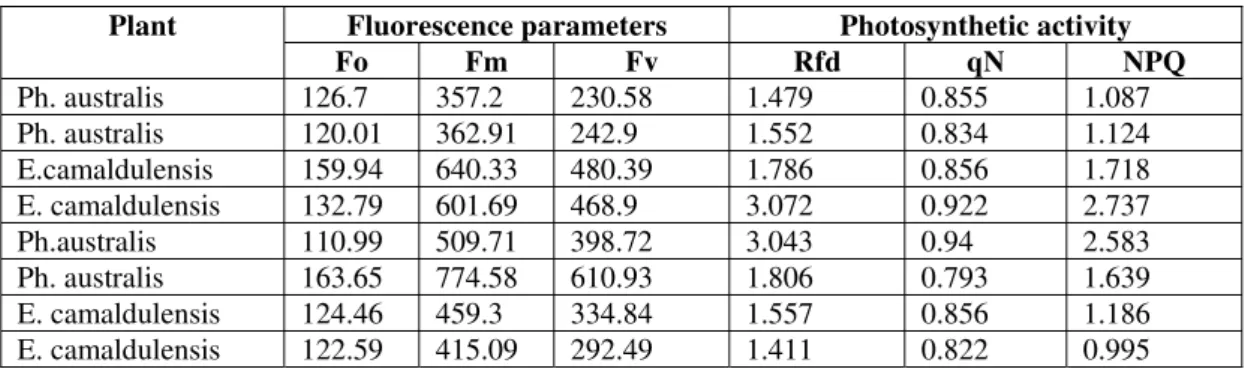
Table 2. Fluorescence parameters and photosynthetic activity in some species
Plant Fluorescence parameters Photosynthetic activity
Fo Fm Fv Rfd qN NPQ
Ph. australis 126.7 357.2 230.58 1.479 0.855 1.087
Ph. australis 120.01 362.91 242.9 1.552 0.834 1.124
E.camaldulensis 159.94 640.33 480.39 1.786 0.856 1.718
E. camaldulensis 132.79 601.69 468.9 3.072 0.922 2.737
Ph.australis 110.99 509.71 398.72 3.043 0.94 2.583
Ph. australis 163.65 774.58 610.93 1.806 0.793 1.639
E. camaldulensis 124.46 459.3 334.84 1.557 0.856 1.186
o in in l d a P s p ( f im in d h Figure that gr Figure that gr Based o of fluoressen ndicators, it ndicators of ow and mor developed ve
Leaves activity Phragmitesau stage (1 mon photosynthet (gradient and fluoressence
mpact of pol n this area (f
3. Discu
Ecosyste different typ hierarchical
2. Image
row in unpollu
3. Image
row in a pollut
n the data of nce and kin t results that f the plants e clearly exp egetative sta
that represe (Eucalipt ustralis) are nth age app ic activity in d uneven dis on leaves llution of hy figure 2 and
ussion and co
ems are com pes of organ manner in a
es of fluo
uted area.
s of fluore
ted area.
f the table an etics curves t the photos analyzed in pressed on th
ge.
ent a highe tuscamaldule e leaves in proximately) ndicators and stribution) o demonstra ydrocarbon de 3). onclusions mplex system nisms linke a complexity
orescence a
essence and
nd on the im s of fluoress synthetic act n such areas he leaves in
er photosynt ensis
early veget ). Low value d the distribu f the chlorop ate the neg
erived oil pr
ms, consistin ed together y of interac
and kinetic
d the kinet
mages sence tivity s are fully thetic and tative es of ution phyll gative resent ng of in a ctions and the sou po the of (fa ide Sp be env im few pie fru jun sur bla curves o tic curves
d in a contin e environm
urces and fro llution can t ese impacts m
the ecosyste Changes i amily, gende
entify pollut pecies may ei tolerant to vironment.
In the mpoverished v w varieties. eces of natu
uticosa or b
nceum. More
rfaces cove ackberry) an
f Phragmit
of Phragmi
nuous dynam ment can co
om natural o threaten ecos may depend em and the pr in the distri er and specie tion pressur
ither exhibit o the hydro
area unde very much a
In the entir ural vegetati
by Quercus
e often, there
ered by Ru
nd Paliurus
tes australis
ites australi
mics change ome from ones. The ac
systems [5]. on the sensi ressure exert ibution of th es) are a use
e on living t different se ocarbons pr
er study, and there ha re area are i ion dominate s coccifera e are observe ubus ulmifo
s spina-chri
s leaves
is leaves
[8]. Changes anthropoge ute situation The effects itivity and st ted [8]. he natural fl eful indicator g creatures [ ensitivity or c resence in
vegetation ave remained identified sm ed by Phlom
and Sparti
ed considera lius (thornl isti (Jerusal
Identification of environmental aspects and oil pollution pressure on spontaneous flora in the Patos-Marinëz industrial area
Thorn). Other indicators of this degradation are the spread in a considerable degree of the invasive species
such as Dittrichia viscosa, and anthropogenic types
Asphodelus aestivus, Andropogon ischaemum,
Erigeron sp.,etc.
As a conclusion we can say that in the polluted area is observed degradation of natural vegetation; it is necessary its improvement through afforestation with native species. Afforestation would rehabilitate and improve the landscape.
4. References
1. Anderson CM, LaBelle RP.: Update of
comparative occurrence rates for offshore oil spills. Spill Sci. Technol. Bull. 2000, 6(5/6): 303-321.
2. Baussant, T., Sanni, S., Skadsheim, A., Jonsson,
G., Børseth, J. F. & Gaudebert, B.:
Bioaccumulation of polycyclic aromatic compounds: 2. Modeling bioaccumulation in marine organisms chronically exposed to
dispersed oil. Environmental Toxicology and
Chemistry, 2001, 20 (6): 1185-1195.
3. Boyd, J. N., Kucklick, J. H., Scholz, D. K. S.,
Walker, A. H., Pond, R. G. & Bostrom, A.:
Effects of oil and chemically dispersed oil in
the environment. Health and Environmental
Sciences Departement. Cape Charles: American Petroleum Institute,. 2001, 63: 2-14 pp.
4. Charls, M. G., Babcock, M. M., Harris, P. M.,
Irvine, G. V., Cusick, J. A. & Rice, S. D.:
Persistence of oiling in mussel beds after the
Exxon Valdez oil spill. Marine Environmental
Research, 2001, 51 (2): 167-190.
5. Eggen, R. I. L., Behra, R., Burkhardt-Holm, P.,
Escher, B. I. & Schweigert, N.: Peer Reviewed:
Challenges in Ecotoxicology. Environmental
Science & Technology, 2004, 38 (3): 58A-64A.
6. Fukuyama, A. K., Shigenaka, G. & Hoff, R. Z.:
Effects of Residual Exxon Valdez Oil on
Intertidal Protothaca staminea: Mortality, Growth, and Bioaccumulation of
Hydrocarbons in Transplanted Clams. Marine
Pollution Bulletin, 2000, 40 (11): 1042-1050.
7. Gomez Gesteira, J. L., Dauvin, J. C. & Salvande
Fraga, M.: Taxonomic level for assessing oil
spill effects on soft-bottom sublittoral benthic
communities. 2003. Marine Pollution Bulletin,
46 (5): 562-572.
8. Harwell, M. A. & Gentile, J. H.: Ecological
Significance of Residual Exposures and Effects from the Exxon Valdez Oil Spill.
Integrated Environmental Assessment and
Management, 2006, 2 (3): 204-246.
9. Ministria e Ekonomisë: Plani i integruar
sektorial për zhvillimin e prodhimin e hidrokarbureve në vendburimin
Patos-Marinës. Miratuar me VKM. Nr. 477, datë
16.7.2004, 15 faqe.
10. Neff, J. M. & Stubblefield, W. A.: Chemical
And Toxicological Evaluation of Water Quality following the Exxon Valdez Oil Spill.
In Wells, P. G., Butler, J. N. & Huges, J. S. (eds) Exxon Valdez Oil Spill: Fate and Effects in
Alaskan Waters, 1995, pp. 141- 177.
Philadelphia: American Society for Testing and Materials.
11. Peterson, C. H., Rice, S. D., Short, J. W., Esler,
D., Bodkin, J. L., Ballachey, B. E. & Irons, D.
B.: Long-Term Ecosystem Response to the
Exxon. Valdez Oil Spill. Science, 2003, 302
(5653): 2082-2086.
12. Regulation (EC) no 1221/2009 of the European
Parliament and of the Council of 25 november 2009 on the voluntary participation by
organisations in a community Eco-Management
and Audit Scheme (EMAS), repealing
![Table 1. Data for the territory of the area affected by the oil industry activity [9]](https://thumb-eu.123doks.com/thumbv2/123dok_br/16388309.192481/2.892.75.723.600.899/table-data-territory-area-affected-oil-industry-activity.webp)