Materials Engineering, Vol. 16, 2009, No. 2
1MECHANICAL ALLOYING Al-C SYSTEM AND ITS STABILITY
Marián Varchola, Michal Besterci
,
Katarína Sülleiová
Received 5th May 2009; accepted in revised form 18th June 2009
Abstract
The main factors of mechanical alloying Al-C system and its structural and physical metallurgical regularities are presented in this work. In the present article dependences of hardness on structural changes of Al-C system annealed at the different times and temperatures are described.
Keywords: mechanical alloying Al4C3 system, structural stability, annealing
1. Introduction
Dispersion strengthened materials (DSM) belong to the group of composite materials, which are made mainly by the techniques of powder metallurgy (PM), which is considered as a solid route. The microstructure of DSM is composed by a polycrystalline matrix, in which dispersed particles are incorporated (mainly oxide, carbide and/or nitride) [1, 2]. These materials are produced by reaction milling in a high energy attritor and have the advantage of good elevated temperature mechanical properties in addition to the desirable properties of aluminium, e.g. low density, good workability, corrosion resistance, electrical and thermal conductivity [3]. Developed technologies enable to affect the volume fraction, morphology, granulometric composition of particles and its distribution in matrix.
The dispersion strengthened Al-Al4C3 alloys
manufactured by mechanical alloying using powder metallurgy technology are promising structural materials that enable significant weight cut for use first of all in aircraft and automobile industry and also at elevated temperatures [4, 5].
Mechanical properties of dispersion strengthened materials depend on microstructural and substructural parameters and their changes at elevated temperatures. From the viewpoint of the matrix the most important is: size, shape, disorientation of grains and subgrains, structure and morphology of boundaries, dislocation substructural and structural heterogeneities. Dispersoids represent the second
component of the structure. From viewpoint of mechanism of plastic deformation it all depends on their interaction with matrix dislocations. Dislocations are captured and pushed through the gaps between particles room temperature, while at the increased temperatures dislocations overcome the dispersoids by means of the thermal activation, namely by non-conservative motion of dislocations and oriented diffusion of vacancies [6].
2. Characteristic of production technology
All production methods of dispersion strengthened materials can be divided into 2 groups. Namely the methods introducing the strengthening phase of defined properties into the matrix or methods in which such a phase is formed during the production process, most frequently by chemical reaction. In the first case the parameters of dispersoid powder and the matrix, methods of compactization, or thermal treatment are importance. In the second case it is necessary to gain the knowledge of the mechanism and kinetic parameters of dispersion phase formation within the production cycle, to be able to modify the final microstructural composition and properties of the system. Powders, as the starting components of dispersion strengthened materials, can be produced by different ways. Their metallurgical purity and its changes resulting from technological operations (surface oxides, contamination of powders, composites) are of key importance. These defects and inclusions can lead to formation and growth of cracks and to strength degradation, but first of all of fatigue
Materials Engineering, Vol. 16, 2009, No. 2
2properties. Another factor influencing the structure and final properties is the way of preparation of the matrix-dispersoid composition. Gaining the knowledge of the laws of milling, mechanical alloying, salt coprecipitation and internal oxidation is therefore inevitable. Considerable reserves of structural optimalization and improvement of functional properties evidently exist in up to date knowledge.
Consolidation of composites (pressing, sintering and hot consolidation) to practically porousless product is achieved by various deformational processes. Methods of final consolidation at extremely high degree of plastic flow result in the rearrangement of dispersoids and increase of accumulated energy of failures of the crystallic structure. The process of hot consolidation can also take place under the conditions of thermal-mechanical processing, following the aim to produce a stable dislocation substructure. Such substructure does not exhibit any recrystallization in wide temperature range. Optimalization of thermal-deformation parameters conceals additional reserves of creep resistance of all types of dispersion strengthened materials.
3. Experimental possibilities of determination of structural parameters
Experimental determination of basic structural parameters in connection with the technology of preparation is important for characterization of materials or prediction of their properties.
In the case of dispersion strengthened materials it is necessary to combine the structural and phase analysis for the purpose of identification of minor phases, which is carried out by chemical methods or by means of chemical methods or X-ray diffraction. Structural analysis is conducted by several ways. The basic information about distribution of the largest particles of granulometric composition is obtained by means of planary metallographic section of the structure. These particles, however, do not usually have a decisive influence on the mechanical properties and their thermal stability. Another possibility offers the extraction of carbon replica, which, unlike the metalographic sample, provides the planary particle projections. This is based on presumption that this replica capture all particles intersecting its plane and no other. The situation in the real materials is, however, much more complicated, owing partly to the uneveness of etching, partly to the presence of deposited particles. The third possible way of particle observation is the thin foil. This approach is in principle the simplest and presents the
planary projection of the set of particles contained in the foil. This, however, necessitates the detemination of the foil thickness, knowledge of behaviour of particles in the surface layers at thining and compensation of the phenomenom of overlapping of particle projections. In spite of that we may regard the foil technique as the most reliable source of information about the strengthening hardening particles of the minor phase. This foils technique can by used also for analysis of subgrains and dislocation density [7, 8].
In the present article dependences of hardness on structural changes of Al-C system annealed at the different times and temperatures are described.
3.1 Experimental materials and methods
The starting experimental materials were prepared by mechanical alloying. Al powder of particle size of <50 m was dry milled in an attritor for 90min with the addition of KS 2.5 graphite thus creating 4 vol. % of Al4C3. The specimens were then cold pressed using a
load of 600 MPa. The specimens had cylindrical shape. Subsequent heat treatment at 550°C for 3 h induced chemical reaction 4Al+3C → Al4C3. The
cylinders were then hot extruded at 600°C with 94% reduction of the cross section. Due to a high affinity of Al to oxygen the system also contains a small amount of Al2O3 particles. The volume fraction of
starting Al2O3 was low, 1 vol. %. Detailed technology
preparation is described in [6].
4. Results and discussion
4.1. Mechanical properties at elevated temperatures
The microstructure of the starting material with 4 vol.% Al4C3 was fine-grained (the mean matrix
elongated grain size was 0.6 m), heterogeneous, with Al4C3 particles distributed in parallel rows as a
consequence of extrusion [9]. Beside the Al4C3 phase,
the systems contained also Al2O3 phase. Essentially, it
was the remnant of oxide shells of the original matrix powder and/or shells formed during the reaction milling in attritors. When describing microstructures, one has to consider geometrical and morphological factors. According to the microstructure observations, the particles in our materials can be divided into three distinctive groups: A– small Al4C3 particles, identified
by TEM, with mean size approximately 30 nm which made up to 70% of the dispersoid volume fraction; B– Al4C3 particles with mean size between 0.4 and 0.6
m, found on metallographic micrographs; and C-large Al2O3 particles with mean size of 1 m.
Morphologically, Al4C3 particles are elongated and
Materials Engineering, Vol. 16, 2009, No. 2
3Stability of structure and mechanic properties at elevated temperatures represents an important characteristic of dispersion strengthened Al-Al4C3
materials [9, 10]. For the purpose of evaluation of the role of Al4C3 carbidic phase and of the introduced
deformation energy prepared was the material with graphite KS-2.5. Kinetic curves of the carbidization are given in Fig.1.
Fig. 1. Kinetic curves of carbidization of Al-C system with KS 2.5 graphite
Influence of temperature and time of annealing on stability of Al-Al4C3 system was analyzed.
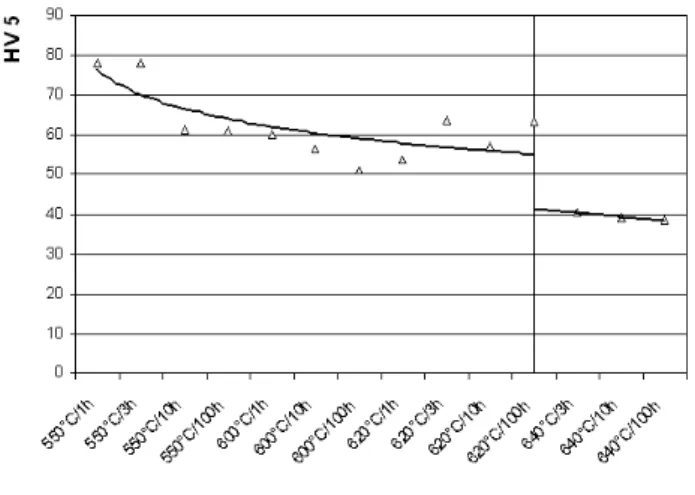
Hardness HV 5 values were confronted with substructural changes evaluated on TEM thin foils.
Hardness was measured on specimens, which annealed at the temperatures of 550°C, 600°C, 620°C, 640°C and times from 1 to 100 hour. Dependence of hardness on parameters of annealing process (temperature T [°C] and time t [h]) is shown in Fig. 2.
Fig. 2. Dependence of hardness on parameters of annealing process T [°C] / t [h]
The biggest decline in HV 5 hardness is evident at the temperature of 620°C/100h at the same direction of the curve. Substructures of two specimens
annealed at the temperatures of 600°C and 640°C for 10 hours were analyzed. Dependences of hardness on the time of annealing at the temperature of 600°C and 640°C are shown in Fig. 3 and Fig. 4. Hardness decreases with increasing temperature and annealing time.
Fig. 3. Dependence of hardness on annealing time at the temperature of 600°C
Fig. 4. Dependence of hardness on annealing time at the temperature of 640°C
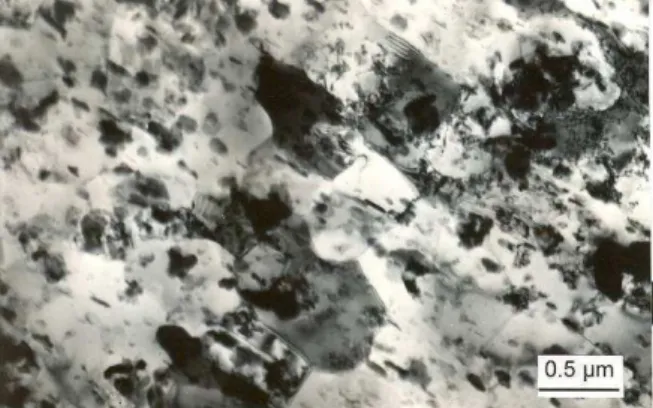
The mean size of subgrains was enlarged from 0.8 µm at the temperature 600°C to 1.8 µm. at the temperature of 640°C (Fig. 5 and Fig. 6). This parameter in dislocation substructure at the temperature of 640°C is related with softening respectively with the decrease of hardness. Al4C3
particles are lamellar and Al2O3 are spherical with
Materials Engineering, Vol. 16, 2009, No. 2
4Fig. 5. Al-Al4C3 material after annealing at the
temperature of 600°C, TEM
Fig. 6. Al-Al4C3 material after annealing at the
temperature of 640°C, TEM
5. Conclusion
Influence of temperature and time of annealing on stability of mechanically alloyed Al-Al4C3 system
was analyzed. Based on hardness measurements and substructure analyze the system is stable up to the temperature of 620°C at the long-time annealing of (100h). Coalescence and subgrain disintegration begins at the temperature higher than 620°C, what is softening.
Acknowledgements
The authors are grateful to the Slovak Grant
Agency for Science (Grant No. 2/0105/08) for the support of this work.
References
[1] Mendoza-Ruiz D.C., Esneider-Alcalá M. A., Estrada Guel I., Miki-Yoshida M., López-Gómez M., Martínez-Sánchez R.: Dispersion of graphite nanoparticles in a 6063 aluminium alloy by mechanical alloying and hot extrusion, Reviews on Advanced Materials Science, vol. 18, No. 3, 2008, pp. 280-283. [2] Santos-Beltrán A., Gallegos-Orozco V., Flores Zuniga
H., Alvarado-Hernandez F., Huirache-Acuna R., Martínez-Sánchez R.: Microstructure and properties Al-C-Cu system produced by mechanical milling, Journal of Alloys and Compounds, 2009-in press. [3] Srinivas M., Kamat S. V.: Influence of temperature
and notch root radius on the fracture toughness of a dispersion-strengthened aluminium alloy, Fatigue and Fracture of Engineering Materials and Structures, vol. 23, 2000, pp. 181-183.
[4] Besterci M., Velgosová O., Ivan J., Hvizdoš P., Kohútek I.: Influence of volume fraction on fracture mechanism of Al-Al4C3 system studied by in situ tensile test in SEM, Kovové Materiály, vol. 46, 2008 pp. 139–143.
[5] Besterci M.: Preparation, microstructure and properties of Al-Al4C3 system produced by mechanical alloying,
Materials and Design, vol.27, 2006, pp. 416-421. [6] Besterci M.: Dispersion-strenghtened aluminium
prepared by mechanical alloying, Cambridge International Science Publishing, 1999.
[7] Besterci M.: Zákonitosti procesov tvorby, deformácie a porušovania disperzne spevnených sústav, DrSc. thesis, 1986.
[8] Kohutek I., Besterci M.: Vzťah medzi objemovým podielom častíc v tenkej fólii a plošným podielom ich priemetu do roviny, Pokroky práškovej metalurgie, vol. 36, No.4, 1998, pp. 29-34.
[9] Šlesár M., Jangg G., Besterci M., Ďurišin J., Orolínová
M.: Teplotná stabilita subštruktúry disperzne spevneného hliníka, Metallic materials, vol. 4, No. 27, 1989, pp. 476-491.