Finding melanoma drugs through a
probabilistic knowledge graph
James P. McCusker1, Michel Dumontier2, Rui Yan1, Sylvia He1, Jonathan S. Dordick3,4and Deborah L. McGuinness1,4
1Department of Computer Science, Rensselaer Polytechnic Institute, Troy, NY, USA
2Stanford Center for Biomedical Informatics Research, Stanford University School of Medicine, Stanford, CA, USA
3Department of Chemical & Biological Engineering, Rensselaer Polytechnic Institute, Troy, NY, USA
4Center for Biotechnology & Interdisciplinary Studies, Rensselaer Polytechnic Institute, Troy, NY, USA
ABSTRACT
Metastatic cutaneous melanoma is an aggressive skin cancer with some progression-slowing treatments but no known cure. The omics data explosion has created many possible drug candidates; however, filtering criteria remain challenging, and systems biology approaches have become fragmented with many disconnected databases. Using drug, protein and disease interactions, we built an evidence-weighted knowledge graph of integrated interactions. Our knowledge graph-based system, ReDrugS, can be used via an application programming interface or web interface, and has generated 25 high-quality melanoma drug candidates. We show that probabilistic analysis of systems biology graphs increases drug candidate quality compared to non-probabilistic methods. Four of the 25 candidates are novel therapies, three of which have been tested with other cancers. All other candidates have current or completed clinical trials, or have been studied in in vivo or in vitro. This approach can be used to identify candidate therapies for use in research or personalized medicine.
Subjects Bioinformatics, Computational Biology, Data Science, World Wide Web and Web Science Keywords Melanoma, Knowledge graphs, Drug repositioning, Uncertainty reasoning
INTRODUCTION
Metastatic cutaneous melanoma is an aggressive cancer of the skin with low prevalence but very high mortality rate, with an estimated 5-year survival rate of 6% (Barth, Wanek & Morton, 1995). There are currently no known therapies that can consistently cure metastatic melanoma. Vemurafenib is effective against BRAF mutant melanomas (Chapman et al., 2011) but resistant cells often result in recurrence of metastases (Le et al., 2013). Melanoma itself may be best approached based on the individual genetics of the tumor, as it has been shown to involve mutations in many different genes to produce the same disease (Krauthammer et al., 2015). Because of this, an individualized approach may be necessary to find effective treatments.
Drug repurposing, or the discovery of new uses for existing approved drugs, can often lead to effective new treatments for diseases. A wide range of computational methods have been developed in support of drug repositioning. Computational approaches (Sanseau & Koehler, 2011) include topic modeling (Bisgin et al., 2012,2014), side-effect
Submitted27 April 2016
Accepted27 December 2016
Published13 February 2017
Corresponding authors
James P. McCusker, [email protected] Deborah L. McGuinness, [email protected]
Academic editor
Yonghong Peng
Additional Information and Declarations can be found on page 14
DOI10.7717/peerj-cs.106 Copyright
2017 McCusker et al.
Distributed under
similarity (Yang & Agarwal, 2011;Ye, Liu & Wei, 2014), drug and/or disease similarity (Chiang & Butte, 2009;Gottlieb et al., 2011), genome-wide association studies (Kingsmore et al., 2008;Grover et al., 2014), and gene expression (Lamb et al., 2006;Sirota et al., 2011). Systems biology has also provided a number of network analysis approaches (Yang & Agarwal, 2011;Wu, Wang & Chen, 2013;Cheng et al., 2012;Emig et al., 2013;Harrold, Ramanathan & Mager, 2013;Wu et al., 2013;Vogt, Prinz & Campillos, 2014) but the field has been limited by a fragmentation of databases. Most systems biology databases are not aligned with each other, and typically leave out crucial information about how other biological entities, like drugs and diseases, interact with the systems biology graph. Further, while some interaction databases provide human curation and validation of pathway interactions, and others provide experimental evidence for the recorded interactions, there has not yet been, to our knowledge, a resource that combines the two approaches and quantifies the reliability of the evidence used to assert the interactions. A knowledge graph is a compilation of facts and figures that can be used to provide contextual meaning to searches. Google is using knowledge graphs to improve its search and to analyze the information graph of the web; Facebook is using them to analyze the social graph. We built our knowledge graph with the goal of unifying large parts of biomedical domain knowledge for both mining and interactive exploration related to drugs, diseases, and proteins. Our knowledge graph is enhanced by the provenance of each fragment of knowledge captured, which is used to compute the confidence probabilities for each of those fragments. Further, we use open standards from the world wide web consortium (W3C), including the resource description framework (RDF) (Richard, David & Markus, 2014), web ontology language (OWL) (Motik, Patel-Schneider & Cuenca Grau, 2009), and SPARQL (Harris, Seaborne & Prud’hommeaux, 2013). The representation of the knowledge in our knowledge graph is aligned with best practice vocabularies and ontologies from the W3C and the biomedical community, including the provenance ontology (PROV-O) (Lebo, Sahoo & McGuinness, 2013), the HUPO proteomics standards initiative molecular interactions (PSI-MI) ontology (Hermjakob et al., 2004), and the semanticscience integrated ontology (SIO) (Dumontier et al., 2014). Use of these standards, vocabularies, and ontologies make it simple for ReDrugS to integrate with other similar efforts in the future with minimal effort.
We proposed and built a novel computational drug repositioning platform, that we refer to as ReDrugS, that applies probabilistic filtering over individually-supported assertions drawn from multiple databases pertaining to systems biology, pharmacology, disease association, and gene expression data. We use our platform to identify novel and known drugs for melanoma.
RESULTS
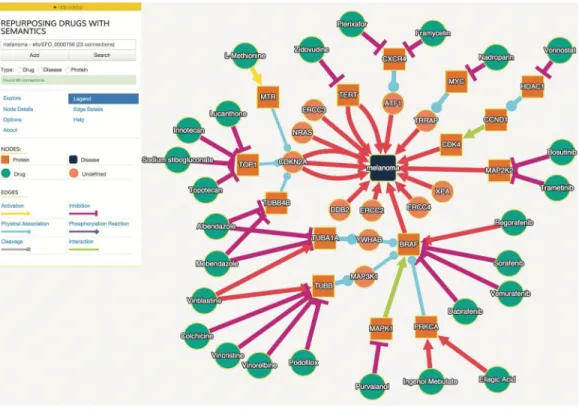
We examined drug and gene connections that were three or less interaction steps from melanoma, and additionally filtered interactions with a joint probability greater or equal to 0.93. We identified 25 drugs in the resulting drug–gene–disease network surrounding melanoma as illustrated inFig. 2.
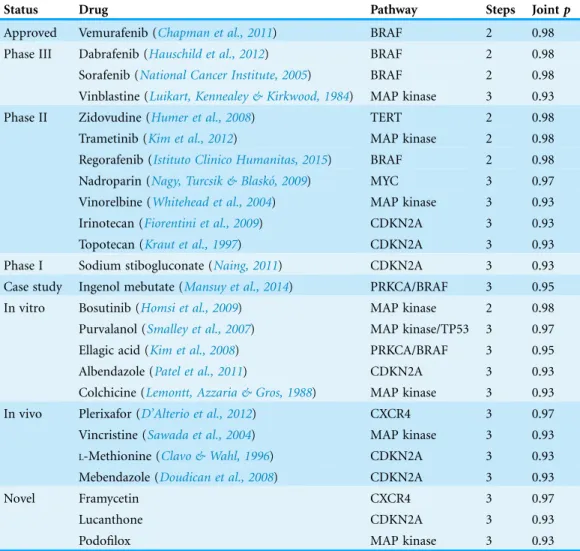
We then validated the set of 25 drugs by determining their position in the drug discovery pipeline for melanoma.Table 1shows that nearly all drugs uncovered by ReDrugS were previously been identified as potential melanoma therapies either in clinical trials or in vivo or in vitro. Of the 25 drugs, 12 have been in Phase I, II, or III clinical trials, five have been studied in vitro, four in vivo, one was investigated as a case study, and three are novel.
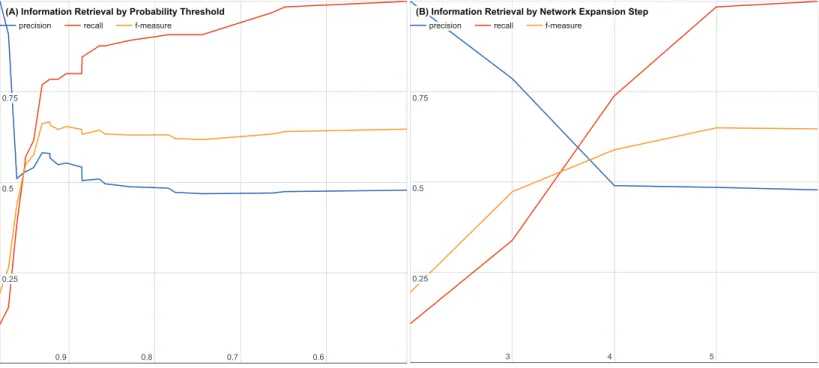
To further evaluate our system, we examined the impact of decreasing the joint probability or increasing the number of interaction steps.Figures 3Aand3Bshow precision, recall, and f-measure curves while varying each parameter. Using these information retrieval performance curves, we found that using a joint probability of 0.93 or greater with three or less interaction steps maximizes the precision and recall as shown in Fig. 3.
By performing a sampled literature search on hypothesis candidates with a joint probability of 0.5 or higher and six or fewer interaction steps, we were able to generate precision, recall, and f-measure curves for both cutoffs to find our cutoff of 0.93 with three or fewer interaction steps. The precision, recall, and f-measure curves are shown for varying joint probability thresholds inFig. 3Aand for varying interaction step counts in Fig. 3B.
DISCUSSION
We designed ReDrugS to quickly and automatically integrate and filter a heterogeneous biomedical knowledge graph to generate high-confidence drug repositioning
candidates. Our results indicate that ReDrugs generates clinically plausible drug candidates, in which half are in various stages of clinical trials, while others are novel or are being investigated in pre-clinical studies. By helping to consolidate the three main datatypes—drug targets, protein interactions, and disease genes—ReDrugs can amplify the ability of researchers to filter the vast amount of information into those that are relevant for drug discovery.
Candidate significance
Three drugs were identified that have not previously been studied for melanoma treatment. Framycetin, a CXCR4 inhibitor, has not previously been considered for melanoma treatment. While it is nephrotoxic when administered orally (Greenberg, 1965), it is used topically as an antibacterial treatment. While it may not be of use for metastasis, it might serve as a simple, inexpensive prophylactic treatment after excision of primary tumors. Additionally, Lucanthone and Podofilox were identified as having potential effects on melanoma through CDKN2A and MAP kinase, respectively.
One drug we identified, Vemurafenib, is approved for treatment of late stage melanoma has been shown to inhibit the BRAF protein in BRAF-V600 mutant melanomas
(Chapman et al., 2011). However, cells can become resistant to Vemurafenib, thereby leading to metastasis (Le et al., 2013).
A number of the drugs we identified are in clinical trials for treatment of melanoma. We identified BRAF-oriented drugs, Dabrafenib (Hauschild et al., 2012), Sorafenib (National Cancer Institute, 2005), and Regorafenib (Istituto Clinico Humanitas, 2015), that have been evaluated in clinical trials, but have not yet been approved. Zidovudine or Azidothymidine is a TERT inhibitor that has shown significant melanoma tumor reductions in mouse models (Humer et al., 2008). Three MAP kinase-related compounds, Vinblastine (Luikart, Kennealey & Kirkwood, 1984), Trametinib (Kim et al., 2012), and Vinorelbine (Whitehead et al., 2004) were identified that are in clinical trials for melanoma treatment. CDKN2A was another popular target, as Irinotecan (Fiorentini et al., 2009),
Table 1 Drug discovery status for 25 drug candidates identified using ReDrugS.
Status Drug Pathway Steps Jointp
Approved Vemurafenib (Chapman et al., 2011) BRAF 2 0.98
Phase III Dabrafenib (Hauschild et al., 2012) BRAF 2 0.98
Sorafenib (National Cancer Institute, 2005) BRAF 2 0.98 Vinblastine (Luikart, Kennealey & Kirkwood, 1984) MAP kinase 3 0.93
Phase II Zidovudine (Humer et al., 2008) TERT 2 0.98
Trametinib (Kim et al., 2012) MAP kinase 2 0.98
Regorafenib (Istituto Clinico Humanitas, 2015) BRAF 2 0.98 Nadroparin (Nagy, Turcsik & Blasko´, 2009) MYC 3 0.97 Vinorelbine (Whitehead et al., 2004) MAP kinase 3 0.93
Irinotecan (Fiorentini et al., 2009) CDKN2A 3 0.93
Topotecan (Kraut et al., 1997) CDKN2A 3 0.93
Phase I Sodium stibogluconate (Naing, 2011) CDKN2A 3 0.93
Case study Ingenol mebutate (Mansuy et al., 2014) PRKCA/BRAF 3 0.95
In vitro Bosutinib (Homsi et al., 2009) MAP kinase 2 0.98
Purvalanol (Smalley et al., 2007) MAP kinase/TP53 3 0.97
Ellagic acid (Kim et al., 2008) PRKCA/BRAF 3 0.95
Albendazole (Patel et al., 2011) CDKN2A 3 0.93
Colchicine (Lemontt, Azzaria & Gros, 1988) MAP kinase 3 0.93
In vivo Plerixafor (D’Alterio et al., 2012) CXCR4 3 0.97
Vincristine (Sawada et al., 2004) MAP kinase 3 0.93
L-Methionine (Clavo & Wahl, 1996) CDKN2A 3 0.93
Mebendazole (Doudican et al., 2008) CDKN2A 3 0.93
Novel Framycetin CXCR4 3 0.97
Lucanthone CDKN2A 3 0.93
Podofilox MAP kinase 3 0.93
Note:
Topotecan (Kraut et al., 1997), and Sodium stibogluconate (Naing, 2011) are all drugs in clinical trial that we identified as potential therapies.
Many other drugs were identified that are being studied in the lab. Additional drugs were identified that target the MAP kinase pathway, including Bosutinib (Homsi et al., 2009), Purvalanol (Smalley et al., 2007), Colchicine (Lemontt, Azzaria & Gros, 1988), and Vincristine (Sawada et al., 2004). Podofilox has not yet been investigated in melanoma treatments, but preliminary investigations have focused on treating chronic lymphocytic leukemia (Shen et al., 2013) and non-small cell lung cancer (Peng et al., 2014). Since these drugs attack MAPK2 and related proteins rather than BRAF or NRAS, they can potentially synergize with other treatments (Homsi et al., 2009). Bosutinib in particular has been investigated as a synergistic treatment for melanoma (Held et al., 2012). Another possible treatment pathway is CXCR4 inhibition. Mouse models suggest that CXCR4 inhibitors like Plerixafor can reduce tumor metastasis and primary tumor growth (D’Alterio et al., 2012). We identify both Plerixafor and Framycetin (Neomycin B) as useful CXCR4 inhibitors. Two PKRCA activators, Ingenol mebutate and Ellagic acid, were also identified. PKRCA binds with BRAF (Pardo et al., 2006), but it is mechanistically unclear how PKRCA activation would result in treatment of melanoma. A number of other therapies are also notable. Purvalenol can inhibit GSK3b, which in turn activates TP53. Some, but not all, melanomas have TP53 deactivation (Smalley et al., 2007). Nadroparin, a MYC inhibitor, may inhibit tumor progression (Nagy, Turcsik & Blasko´, 2009). More broadly, heparins can potentially inhibit the metastatic process in melanoma and other cancers (Maraveyas et al., 2010).
(A) Information Retrieval by Probability Threshold
(A) Information Retrieval by Probability Threshold
0.9
0.9 0.0.0.8 0.0.0.7 0.0.0.6 0.250.25
0.25 0.5 0.5 0.5 0.750.75 0.75
precision
precision recallrecall f-measuref-measure
(B) Information Retrieval by Network Expansion Step
(B) Information Retrieval by Network Expansion Step
3
3 444 555
.25 0.25 .5 0.5 .75 0.75
precision
precision recallrecall f-measuref-measure
The approach that we present here offers a novel, mechanism-focused exploration to identify and examine drugs and targets related to cancer. This approach filters our noisy or poorly supported parts of the knowledge graph to identify more confident mechanisms between drugs, targets, and diseases. Thus, our approach can be used to explore high confidence associations that are produced as a result of large scale computational screens that use network connectivity (Yang & Agarwal, 2011;Wu, Wang & Chen, 2013; Cheng et al., 2012;Emig et al., 2013;Harrold, Ramanathan & Mager, 2013;Wu et al., 2013; Vogt, Prinz & Campillos, 2014), the complementarity in drug-disease gene expression, and the similarity of chemical fingerprints, side-effects, targets, or indications (Yang & Agarwal, 2011;Ye, Liu & Wei, 2014;Chiang & Butte, 2009;Gottlieb et al., 2011;Lamb et al., 2006;Sirota et al., 2011). Importantly, since we focus on protein networks that are strongly linked with diseases, we believe that our mechanism focused approach will also aid in the identification of disease-modifying drug candidates, rather than solely those that would be useful for the treatment of symptomatic phenotypes or related co-morbid conditions.
Architecture
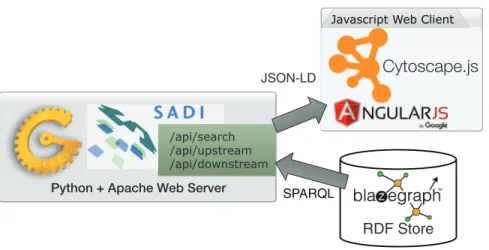
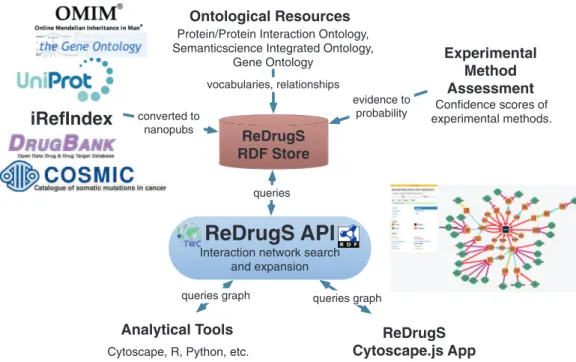
ReDrugS uses a fairly straightforward web architecture, as shown inFig. 4. It uses the Blazegraph RDF database backend. The database layer is interchangeable except that the full text search service needs to use Blazegraph-only properties to perform text searches as text indexing is not yet standardized in the SPARQL query language. All other aspects are standardized and should work with other RDF databases without modification. ReDrugs currently uses the Python-based TurboGears web application framework hosted using the web services gateway interface standard via an Apache HTTP server. TurboGears in turn hosts the semantic automated discovery and
integration (SADI) web services that drive the application and access the database. It also serves up the static HTML and supporting files.
RDF Store Python + Apache Web Server
/api/search /api/upstream /api/downstream
Javascript Web Client
Cytoscape.js Javascript Web Client
SPARQL JSON-LD
The user interface is implemented with AngularJS and Cytoscape.js, which submits queries to the SADI web services using JSON-LD and aggregates results into the
networked view. The software relies exclusively on standardized protocols (HTTP, SADI, SPARQL, RDF, and others) to make it simple to replace technologies as needed. The data itself is processed using conversion scripts as shown inFig. 5.
We have also adapted and featured ReDrugS in an immersive visualization laboratory called the collaborative-research augmented immersive virtual environment (CRAIVE) lab at RPI, as shown inFig. 6. The goal of the demonstration was to explore new ways to visualize, sonify, and interact with big data in large-scale virtual reality systems. We also leveraged a gesture controller (Microsoft kinect) to interact with the visualization. With the 360projection, multiple people can explore the visualization concurrently, which accelerates the exploration and discovery speed.
Limitations and future work
Our study has a some limitations. First, our study is limited by the sources of data used. We used three databases (DrugBank, iRefIndex, and online Mendelian inheritance in man (OMIM)) to construct the initial knowledge graph. These databases are continuously changing and necessarily incomplete with respect to the total number of drugs, targets, protein interactions, diseases, and disease genes. For instance, as of 8/15/2016 there are over 2,000 additional FDA approved drugs in DrugBank than in the version that was initially used. Second, the focus of our work is on the potential repositioning of FDA
ReDrugS API
Interaction network search and expansion
iRefIndex
ReDrugS RDF Store
Analytical Tools ReDrugS Cytoscape.js App Ontological Resources
Protein/Protein Interaction Ontology, Semanticscience Integrated Ontology,
Gene Ontology
vocabularies, relationships
queries
queries graph queries graph
I
I
Experimental Method Assessment
experimental methods. evidence to
probability converted to
nanopubs
Cytoscape, R, Python, etc.
approved drugs, which means that tens of thousands of chemical compounds with protein binding activity cannot be considered as candidates in the current study. Third, our path expansion is currently limited to pairwise protein–protein interactions, which excludes interactions as a result of protein complexes or regulatory pathways. Having a more sophisticated understanding of non-direct interactions will help identify candidate drugs that can regulate entire pathways in a more rational manner. Additionally, we aim to incorporate knowledge of the complementarity of drug and disease gene expression patterns as evidenced by the connectivity map (Lamb et al., 2006), which could suggest therapeutic and adverse interactions. Finally, as we develop new hypotheses about potential new drug effects, we plan to test them using a new three-dimensional cellular microarray to perform high-throughput drug screening (Lee et al., 2008) with reference samples. The integration of computational predictions and high-throughput screening platform will enable the systematic evaluation of any drug or mechanism of action against any disease or adverse event.
MATERIALS AND METHODS
This research project did not involve human subjects. The ReDrugS platform consists of a graphical web application, an application programming interface (API), and a knowledge base. The graphical web application enables users to initiate a search using drug, gene, and disease names and synonyms. Users can then interact with the application to expand the network at an arbitrary number of interactions away from the entity of interest, and to filter the network based on a joint probability between the source and target entities. Drug–protein, protein–protein, and gene–disease interactions were obtained from several datasets and integrated into ontology-annotated and provenance and evidence bearing representations called nanopublications. The web application obtains information from the knowledge base using semantic web services. Finally, we evaluated our approach by
examining the mechanistic plausibility of the drug in having melanoma-specific disease modifying ability. We evaluated a large number of possible drug/disease associations with varying joint probabilities and interaction steps to determine the thresholds with the highest f-measure, resulting in our thresholds of three or less interactions and a joint probability of 0.93 or higher.
Using the ReDrugS application page (http://redrugs.tw.rpi.edu) we initiate our search for “melanoma,” and select the first suggestion obtained from the experimental factor ontology (EFO) (http://www.ebi.ac.uk/efo/EFO_0000756). The application then provides immediate neighborhood of drugs and genes that are associated with melanoma. We expanded the network by first selecting the melanoma node and expanding the link distance to |I|3 and changing the minimum joint probability top0.93 in the search options. Importantly, we also limit the node type to “Drug.” Finally, we click on the “find incoming links” button (two left-facing arrows). When finished the network will show all drugs interacting with melanoma that meet the above criteria, as well as any intervening entities and their interactions. The resulting network can be downloaded as an image, or a summary CSV file. We used the CSV file to validate the links by searching Google Scholar and ClinicalTrials.gov for each proposed drug/disease combination. We consider a “hit” to be a pairing with a published positive experiment in vivo or in vitro or any pairing that has been tested in a clinical trial. While this level of validation does not guarantee efficacy, it does determine if the resulting connection is a plausible hypothesis that might be tested.
Data fusion
We developed a structured knowledge base containing data pertaining to drugs, targets, interactions, and diseases. We used five data sources: iRefIndex (Razick, Magklaras & Donaldson, 2008), DrugBank (Wishart et al., 2006), UniProt gene ontology annotations (GOA) (Camon et al., 2004), the online Mendelian inheritance in man (OMIM) (Hamosh et al., 2005), and the catalogue of somatic mutations in cancer (COSMIC) gene census (Futreal et al., 2004).
iRefIndex contains protein–protein interactions and protein complexes and is an amalgam of the biomolecular interaction network database (Bader, Betel & Hogue, 2003), BioGRID (Stark et al., 2006), the comprehensive resource of mammalian protein
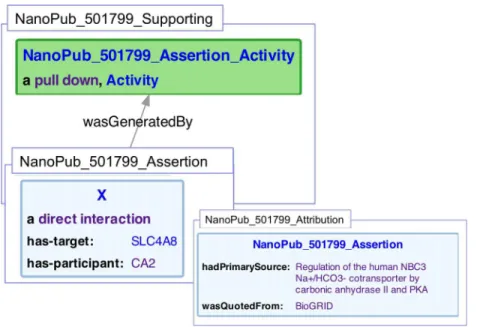
Each association (e.g., drug–target, protein–protein, disease–gene) was captured using the nanopublication (Groth, Gibson & Velterop, 2010) scheme. A nanopublication is a digital artifact that consists of an assertion, its provenance, and information about the digital publication. Our nanopublications are represented as linked data: each data item is identified using an dereferenceable HTTP uniform resource identifier (URI) and statements are represented using the RDF. Each nanopublication corresponds to a single interaction assertion from one of the databases. We used a number of automated scripts to produce the nanopublications and load them into the SPARQL endpoint. An example nanopublication is shown inFig. 7. We used the SIO (Dumontier et al., 2014) as a global schema to describe the nature and components of the associations, and coupled this with the PSI-MI ontology (Hermjakob et al., 2004) to denote the types of interactions. We used the W3C’s PROV-O (Lebo, Sahoo & McGuinness, 2013) to capture provenance of the assertion (which data source it originated from). We loaded our nanopublications into Blazegraph, an RDF nanopublication compatible database. The data is accessed using its native SPARQL endpoint by the web application.
Assertion probability
accurate. We plan to provide a more rigorous assessment of the accuracy of each method against gold standards in future work. These confidence values were encoded into an OWL ontology along with the evidence codes. The full inferences were extracted using Pellet (https://github.com/complexible/pellet) and loaded into the SPARQL endpoint, where they were used to apply the probabilities to each assertion in the knowledge graph that had experimental evidence.
Semantic web services
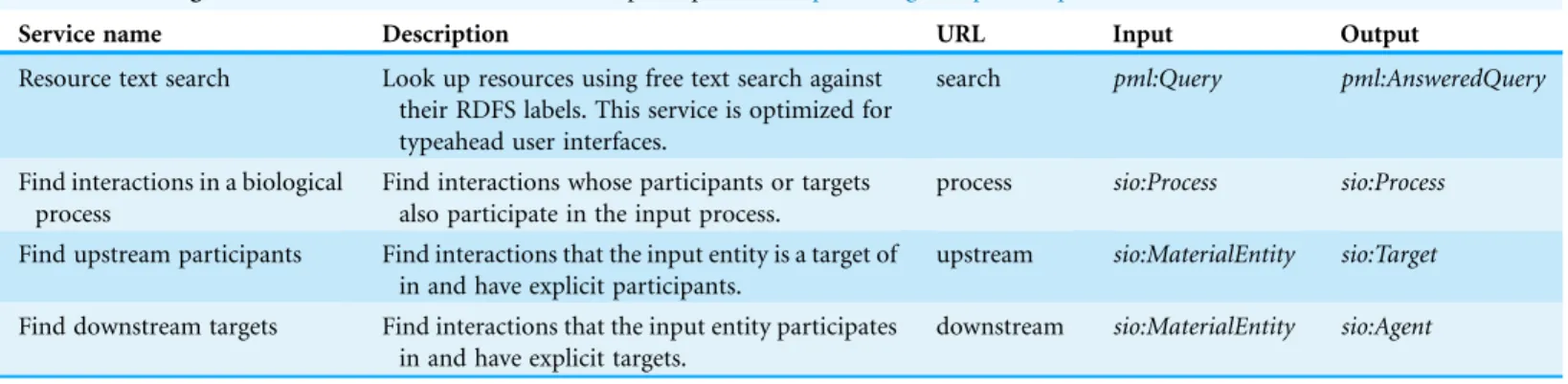
We developed four SADI web services (Wilkinson, Vandervalk & McCarthy, 2009) in Python1to support easy access to the nanopubications (seeTable 2) in ReDrugS. The four services are enumerated in Table 2.
The first service is a simple free text lookup, that takes anpml:Query2(McGuinness et al., 2007) with aprov:valueas a query and produces a set of entities whose labels contain the substring. This is used for interactive typeahead completion of search terms so users can look up URIs and entities without needing to know the details.
The other three SADI services look up interactions that contain a named entity. Two of them look at the entity to find upstream and downstream connections, and the third service assumes that the entity is a biological process and finds all interactions that related to that process. The services return only one interaction for each triple (source, interaction type, target). There are often multiple probabilities per interaction, and more than one interaction per interaction type. This is because the interaction may have been recorded in multiple databases, based on different experimental methods.
Figure 7 Representation of a protein/protein interaction within a nanopublication.Three graphs are represented. The assertion graph (NanoPub_501799_Assertion), states that an interaction (X) is of type
sio:DirectInteraction, and has the target of SLC4A8, and a participant of CA2. The supporting graph (NanoPub_501799_Supporting), states that the assertion graph was generated by a pull down experi-ment (one of many encoded experiexperi-ment types used in, a subclass ofprov:Activity. The attribution graph (NanoPub_501799_Attribution), in turn, states that the assertion had a primary source of (Loiselle et al., 2004) and that the interaction was quoted from BioGrid.
1For further information on developing
web services in Python using SADI, see this tutorial:https://github.com/ markwilkinson/SADI-Semantic-Web- Services-Core/wiki/Building-Services-in-Python
2PML 3, in development:https://github.
To provide a single probability score for each interaction of a source and target, the interactions are combined. A single probability is generated per identified interaction by taking the geometric mean of the probabilities for that interaction. However, this method is undesirable when combining multiple interaction records of the same type. We instead combine the interaction records using a form of probabilistic voting using compositeZ-scores. This is done to model that multiple experiments that produce the same results reinforce each other, and should therefore give a higher overall probability than would be indicated by taking their mean or even by Bayes theorem. We do this by converting each probability into aZ-score (aka standard score) using the quantile function (Q()), summing the values, and applying the cumulative distribution function (CDF()) to compute the corresponding probability:
P xð 1...nÞ ¼CDF Xn
i¼1
Q P xð ð Þi Þ !
These compositeZ-scores, which we transform back into probabilities, are frequently used to combine multiple indicators of the same underlying phenomena, as in (Moller et al., 1998). However, it has a drawback. One concern is that the strategy does not account for multiple databases recording the same non-independent experiment. This can possibly inflating the probabilities of interactions described by experiments that are published in more than one database.
Graph expansion using joint probability
In order to compute the probability that a given entity affects another, we compute the joint probability that each of the intervening interactions are true. Joint probability is the probability that every assertion in the set is true. This is computed by taking the product of probabilities of each interaction:
P xð 1^. . .^xnÞ ¼
Yn
i¼1
P xð Þi
This joint probability is used as a threshold that users can set to stop graph expansion. We also provide expansion limits using the number of interaction steps that are needed to connect the two entities.
Table 2 ReDrugS API SADI Web Services.The API endpoint prefix ishttp://redrugs.tw.rpi.edu/api/.
Service name Description URL Input Output
Resource text search Look up resources using free text search against their RDFS labels. This service is optimized for typeahead user interfaces.
search pml:Query pml:AnsweredQuery
Find interactions in a biological process
Find interactions whose participants or targets also participate in the input process.
process sio:Process sio:Process
Find upstream participants Find interactions that the input entity is a target of in and have explicit participants.
upstream sio:MaterialEntity sio:Target
Find downstream targets Find interactions that the input entity participates in and have explicit targets.
User interface
The user interface was developed using the above SADI web services and uses Cytoscape.js (http://cytoscape.github.io/cytoscape.js) angular.js (https://angularjs.org), and Bootstrap 3 (http://getbootstrap.com). An example network is shown inFig. 2. Users can
search for biological entities and processes, which can then be autocompleted to specific entities that are in the ReDrugS graph. Users can then add those entities and processes to the displayed graph and retrieve upstream and downstream connections and link out to more details for every entity. Cytoscape.js is used as the main rendering and network visualization tool, and provides node and edge rendering, layout, and network analysis capabilities, and has been integrated into a customized rich web client.
In order to evaluate this knowledge graph, we developed a demonstration web interface (http://redrugs.tw.rpi.edu) based on the Cytoscape.js (http://cytoscape.github.io/ cytoscape.js) JavaScript library. The interface lets users enter biological entity names. As the user types, the text is resolved to a list of entities. The user finishes by selecting from the list, and submitting the search. The search returns interactions and nodes associated with the entity selected, which are added to the Cytoscape.js graph. Users are also able to select nodes and populate upstream or downstream connections.Figure 2is an example output of this process.
ACKNOWLEDGEMENTS
A special thanks to Pascale Gaudet who, with Michel Dumontier, evaluated the experimental methods and evidence codes listed in the protein/protein interaction ontology and gene ontology. Thank you also to Kusum Solanki and John Erickson for evaluation, feedback, and planning in the initial stages of this project.
ADDITIONAL INFORMATION AND DECLARATIONS
Funding
The authors received no funding for this work.
Competing Interests
The authors declare that they have no competing interests.
Author Contributions
James P. McCusker conceived and designed the experiments, performed the
experiments, analyzed the data, contributed reagents/materials/analysis tools, wrote the paper, prepared figures and/or tables, performed the computation work, reviewed drafts of the paper.
Michel Dumontier conceived and designed the experiments, analyzed the data, contributed reagents/materials/analysis tools, wrote the paper, performed the computation work, reviewed drafts of the paper.
Sylvia He contributed reagents/materials/analysis tools, prepared figures and/or tables, performed the computation work, reviewed drafts of the paper.
Jonathan S. Dordick conceived and designed the experiments, reviewed drafts of the paper.
Deborah L. McGuinness conceived and designed the experiments, wrote the paper, reviewed drafts of the paper.
Data Deposition
The following information was supplied regarding data availability: Data can be found at https://data.rpi.edu/xmlui/handle/10833/1760.
REFERENCES
Bader GD, Betel D, Hogue CW. 2003.BIND: the biomolecular interaction network database.
Nucleic Acids Research31(1):248–250DOI 10.1093/nar/gkg056.
Barth A, Wanek L, Morton D. 1995.Prognostic factors in 1,521 melanoma patients with
distant metastases.Journal of the American College of Surgeons181(3):193–201.
Bisgin H, Liu Z, Fang H, Kelly R, Xu X, Tong W. 2014.A phenome-guided drug
repositioning through a latent variable model.BMC Bioinformatics15(1):267 DOI 10.1186/1471-2105-15-267.
Bisgin H, Liu Z, Kelly R, Fang H, Xu X, Tong W. 2012.Investigating drug repositioning
opportunities in FDA drug labels through topic modeling.BMC Bioinformatics13(Suppl 1):S6 DOI 10.1186/1471-2105-13-s15-s6.
Brown KR, Jurisica I. 2005.Online predicted human interaction database.Bioinformatics
21(9):2076–2082DOI 10.1093/bioinformatics/bti273.
Camon E, Magrane M, Barrell D, Lee V, Dimmer E, Maslen J, Binns D, Harte N, Lopez R,
Apweiler R. 2004.The gene ontology annotation (GOA) database: sharing knowledge in
UniProt with gene ontology.Nucleic Acids Research32(Suppl 1):D262–D266 DOI 10.1093/nar/gkh021.
Chapman PB, Hauschild A, Robert C, Haanen JB, Ascierto P, Larkin J, Dummer R, Garbe C, Testori A, Maio M, Hogg D, Lorigan P, Lebbe C, Jouary T, Schadendorf D, Ribas A, O’Day SJ, Sosman JA, Kirkwood JM, Eggermont AM, Dreno B, Nolop K, Li J, Nelson B, Hou J, Lee RJ,
Flaherty KT, McArthur GA. 2011.Improved survival with vemurafenib in melanoma with
BRAF V600E mutation.New England Journal of Medicine364(26):2507–2516.
Chatr-aryamontri A, Zanzoni A, Ceol A, Cesareni G. 2008.Searching the protein interaction
space through the MINT database. In: Thompson JD, Ueffing M, Schaeffer-Reiss C, eds.
Functional Proteomics: Methods and Protocols. Totowa: Humana Press, 305–317
DOI 10.1007/978-1-59745-398-1_20.
Chautard E, Fatoux-Ardore M, Ballut L, Thierry-Mieg N, Ricard-Blum S. 2011.MatrixDB, the
extracellular matrix interaction database.Nucleic Acids Research39(Suppl 1):D235–D240 DOI 10.1093/nar/gkq830.
Cheng F, Liu C, Jiang J, Lu W, Li W, Liu G, Zhou W, Huang J, Tang Y. 2012.Prediction of
drug-target interactions and drug repositioning via network-based inference.PLoS Computational
Biology8(5):e1002503DOI 10.1371/journal.pcbi.1002503.
Chiang AP, Butte AJ. 2009.Systematic evaluation of drug-disease relationships to identify leads for
Clavo A, Wahl R. 1996.Effects of hypoxia on the uptake of tritiated thymidine, L-leucine, L-methionine and FDG in cultured cancer cells.Journal of Nuclear Medicine37:502–506. D’Alterio C, Barbieri A, Portella L, Palma G, Polimeno M, Riccio A, Ierano` C, Franco R,
Scognamiglio G, Bryce J, Luciano A, Rea D, Arra C, Scala S. 2012.Inhibition of stromal
CXCR4 impairs development of lung metastases.Cancer Immunology Immunotherapy
61(10):1713–1720DOI 10.1007/s00262-012-1223-7.
Doudican N, Rodriguez A, Osman I, Orlow SJ. 2008.Mebendazole induces apoptosis via Bcl-2
inactivation in chemoresistant melanoma cells.Molecular Cancer Research6(8):1308–1315 DOI 10.1158/1541-7786.mcr-07-2159.
Dumontier M, Baker CJ, Baran J, Callahan A, Chepelev L, Cruz-Toledo J, Del Rio NR, Duck G, Furlong LI, Keath N, Klassen D, McCusker JP, Queralt-Rosinach N, Samwald M,
Villanueva-Rosales N, Wilkinson MD, Hoehndorf R. 2014.The semanticscience integrated
ontology (SIO) for biomedical research and knowledge discovery. Journal of Biomedical
Semantics 5(1):14DOI 10.1186/2041-1480-5-14.
Emig D, Ivliev A, Pustovalova O, Lancashire L, Bureeva S, Nikolsky Y, Bessarabova M. 2013. Drug target prediction and repositioning using an integrated network-based approach.
PLoS ONE8(4):e60618DOI 10.1371/journal.pone.0060618.
Fiorentini G, Aliberti C, Del CA, Tilli M, Rossi S, Ballardini P, Turrisi G, Benea G. 2009. Intra-arterial hepatic chemoembolization (TACE) of liver metastases from ocular melanoma with slow-release irinotecan-eluting beads. Early results of a phase II clinical study.In Vivo
23(1):131–137.
Futreal PA, Coin L, Marshall M, Down T, Hubbard T, Wooster R, Rahman N, Stratton MR.
2004.A census of human cancer genes.Nature Reviews Cancer4(3):177–183
DOI 10.1038/nrc1299.
Goll J, Rajagopala SV, Shiau SC, Wu H, Lamb BT, Uetz P. 2008.MPIDB: the microbial protein
interaction database.Bioinformatics24(15):1743–1744DOI 10.1093/bioinformatics/btn285.
Gottlieb A, Stein G, Ruppin E, Sharan R. 2011.PREDICT: a method for inferring novel drug
indications with application to personalized medicine.Molecular Systems Biology7:496 DOI 10.1038/msb.2011.26.
Greenberg LH. 1965.Audiotoxicity and nephrotoxicity due to orally administered neomycin.
JAMA194(7):827–828DOI 10.1001/jama.194.7.827.
Groth P, Gibson A, Velterop J. 2010.The anatomy of a nanopublication.Information
Services and Use30(1):51–56.
Grover MP, Ballouz S, Mohanasundaram KA, George RA, Sherman CDH, Crowley TM,
Wouters MA. 2014.Identification of novel therapeutics for complex diseases from
genome-wide association data.BMC Medical Genomics7(Suppl 1):S8DOI 10.1186/1755-8794-7-s1-s8. Gu¨ldener U, Mu¨nsterko¨tter M, Oesterheld M, Pagel P, Ruepp A, Mewes H-W, Stu¨mpflen V.
2006.MPact: the MIPS protein interaction resource on yeast.Nucleic Acids Research
34(Suppl 1):D436–D441DOI 10.1093/nar/gkj003.
Hamosh A, Scott AF, Amberger JS, Bocchini CA, McKusick VA. 2005.Online Mendelian
inheritance in man (OMIM), a knowledgebase of human genes and genetic disorders.
Nucleic Acids Research33(Suppl 1):D514–D517.
Harris S, Seaborne A, Prud’hommeaux E. 2013.SPARQL 1.1 query language.W3C
Recommendation,21.Available athttps://www.w3.org/TR/sparql11-query/.
Harrold JM, Ramanathan M, Mager DE. 2013.Network-based approaches in drug discovery
Hauschild A, Grob J-J, Demidov LV, Jouary T, Gutzmer R, Millward M, Rutkowski P, Blank CU, Miller WH, Kaempgen E, Martn-Algarra S, Karaszewska B, Mauch C, Chiarion-Sileni V, Martin A-M, Swann S, Haney P, Mirakhur B, Guckert ME, Goodman V, Chapman PB. 2012. Dabrafenib in BRAF-mutated metastatic melanoma: a multicentre open-label, phase 3 randomised controlled trial.Lancet380(9839):358–365DOI 10.1016/s0140-6736(12)60868-x. Held MA, Langdon CG, Platt JT, Graham-Steed T, Liu Z, Chakraborty A, Bacchiocchi A, Koo A,
Haskins JW, Bosenberg MW, Stern DF. 2012.Genotype-selective combination therapies for
melanoma identified by high-throughput drug screening.Cancer Discovery3(1):52–67 DOI 10.1158/2159-8290.cd-12-0408.
Hermjakob H, Montecchi-Palazzi L, Bader G, Wojcik J, Salwinski L, Ceol A, Moore S, Orchard S, Sarkans U, von Mering C, Roechert B, Poux S, Jung E, Mersch H, Kersey P, Lappe M, Li Y, Zeng R, Rana D, Nikolski M, Husi H, Brun C, Shanker K, Grant SGN, Sander C, Bork P, Zhu W, Pandey A, Brazma A, Jacq B, Vidal M, Sherman D, Legrain P,
Cesareni G, Xenarios I, Eisenberg D, Steipe B, Hogue C, Apweiler R. 2004. The HUPO
PSI’s molecular interaction format—a community standard for the representation of protein interaction data.Nature Biotechnology 22(2):177–183DOI 10.1038/nbt926.
Homsi J, Cubitt CL, Zhang S, Munster PN, Yu H, Sullivan DM, Jove R, Messina JL, Daud AI.
2009.Src activation in melanoma and Src inhibitors as therapeutic agents in melanoma.
Melanoma Research19(3):167–175DOI 10.1097/cmr.0b013e328304974c.
Humer J, Ferko B, Waltenberger A, Rapberger R, Pehamberger H, Muster T. 2008. Azidothymidine inhibits melanoma cell growth in vitro and in vivo.Melanoma Research
18(5):314–321DOI 10.1097/cmr.0b013e32830aaaa6.
Istituto Clinico Humanitas. 2015.Regorafenib in patients with metastatic solid tumors who
have progressed after standard therapy (RESOUND).Available athttps://clinicaltrials.gov/ct2/
show/NCT02307500(accessed 10 January 2016).
Kerrien S, Aranda B, Breuza L, Bridge A, Broackes-Carter F, Chen C, Duesbury M,
Dumousseau M, Feuermann M, Hinz U, Jandrasits C, Jimenez RC, Khadake J, Mahadevan U, Masson P, Pedruzzi I, Pfeiffenberger E, Porras P, Raghunath A, Roechert B, Orchard S,
Hermjakob H. 2011.The IntAct molecular interaction database in 2012.Nucleic Acids Research
40:D841–D846DOI 10.1093/nar/gkr1088.
Keshava Prasad TS, Goel R, Kandasamy K, Keerthikumar S, Kumar S, Mathivanan S,
Telikicherla D, Raju R, Shafreen B, Venugopal A, Balakrishnan L, Marimuthu A, Banerjee S, Somanathan DS, Sebastian A, Rani S, Ray S, Harrys Kishore CJ, Kanth S, Ahmed M, Kashyap MK, Mohmood R, Ramachandra YL, Krishna V, Rahiman BA, Mohan S,
Ranganathan P, Ramabadran S, Chaerkady R, Pandey A. 2009.Human protein reference
database—2009 update.Nucleic Acids Research 37(Suppl 1):D767–D772 DOI 10.1093/nar/gkn892.
Kim KB, Kefford R, Pavlick AC, Infante JR, Ribas A, Sosman JA, Fecher LA, Millward M, McArthur GA, Hwu P, Gonzalez R, Ott PA, Long GV, Gardner OS, Ouellet D, Xu Y,
DeMarini DJ, Le NT, Patel K, Lewis KD. 2012.Phase II study of the MEK1/MEK2 inhibitor
trametinib in patients with metastatic BRAF-mutant cutaneous melanoma previously treated with or without a BRAF inhibitor.Journal of Clinical Oncology31(4):482–489 DOI 10.1200/jco.2012.43.5966.
Kim S, Liu Y, Gaber MW, Bumgardner JD, Haggard WO, Yang Y. 2008. Development of
chitosan-ellagic acid films as a local drug delivery system to induce apoptotic death of human melanoma cells.Journal of Biomedical Materials Research Part B: Applied Biomaterials
Kingsmore SF, Lindquist IE, Mudge J, Gessler DD, Beavis WD. 2008.Genome-wide association studies: progress and potential for drug discovery and development.Nature Reviews Drug
Discovery7(3):221–230DOI 10.1038/nrd2519.
Kraut EH, Walker MJ, Staubus A, Gochnour D, Balcerzak SP. 1997.Phase II trial of topotecan in
malignant melanoma.Cancer Investigation15(4):318–320DOI 10.3109/07357909709039732. Krauthammer M, Kong Y, Bacchiocchi A, Evans P, Pornputtapong N, Wu C, McCusker J,
Ma S, Cheng E, Straub R, Serin M, Bosenberg M, Ariyan S, Narayan D, Sznol M,
Kluger H, Mane S, Schlessinger J, Lifton R, Halaban R. 2015.Exome sequencing identifies
recurrent mutations in NF1 and RASopathy genes in sun-exposed melanomas.Nature
Genetics 47(9):996–1002 DOI 10.1038/ng.3361.
Lamb J, Crawford ED, Peck D, Modell JW, Blat IC, Wrobel MJ, Lerner J, Brunet J-P, Subramanian A, Ross KN, Reich M, Hieronymus H, Wei G, Armstrong SA, Haggarty SJ,
Clemons PA, Wei R, Carr SA, Lander ES, Golub TR. 2006.The connectivity map: using
gene-expression signatures to connect small molecules, genes, and disease.Science
313(5795):1929–1935DOI 10.1126/science.1132939.
Le K, Blomain ES, Rodeck U, Aplin AE. 2013.Selective RAF inhibitor impairs ERK1/2
phosphorylation and growth in mutant NRAS vemurafenib-resistant melanoma cells.
Pigment Cell & Melanoma Research26(4):509–517DOI 10.1111/pcmr.12092.
Lebo T, Sahoo S, McGuinness D. 2013.PROV-O: the PROV ontology.
Available athttp://www.w3.org/TR/prov-o/.
Lee M-Y, Kumar RA, Sukumaran SM, Hogg MG, Clark DS, Dordick JS. 2008.Three-dimensional
cellular microarray for high-throughput toxicology assays.Proceedings of the National Academy
of Sciences of the United States of America105(1):59–63DOI 10.1073/pnas.0708756105.
Lemontt J, Azzaria M, Gros P. 1988.Increased mdr gene expression and decreased drug
accumulation in multidrug-resistant human melanoma cells.Cancer Research48(22):6348–6353.
Loiselle FB, Morgan PE, Alvarez BV, Casey JR. 2004.Regulation of the human NBC3Na+/HCO3
-cotransporter by carbonic anhydrase II and PKA.American Journal of Physiology-Cell Physiology
286(6):C1423–C1433DOI 10.1152/ajpcell.00382.2003.
Luikart S, Kennealey G, Kirkwood J. 1984.Randomized phase III trial of vinblastine, bleomycin,
and cis-dichlorodiammine-platinum versus dacarbazine in malignant melanoma.Journal of
Clinical Oncology2(3):164–168.
Lynn DJ, Winsor GL, Chan C, Richard N, Laird MR, Barsky A, Gardy JL, Roche FM, Chan THW, Shah N, Lo R, Naseer M, Que J, Yau M, Acab M, Tulpan D, Whiteside MD, Chikatamarla A, Mah B, Munzner T, Hokamp K, Hancock REW, Brinkman FSL. 2008. InnateDB: facilitating systems-level analyses of the mammalian innate immune response.
Molecular Systems Biology4(1):218DOI 10.1038/msb.2008.55.
Mansuy M, Nikkels-Tassoudji N, Arrese JE, Rorive A, Nikkels AF. 2014.Recurrent in situ
melanoma successfully treated with ingenol mebutate.Dermatology and Therapy
4(1):131–135DOI 10.1007/s13555-014-0051-4.
Maraveyas A, Johnson MJ, Xiao YP, Noble S. 2010.Malignant melanoma as a target
malignancy for the study of the anti-metastatic properties of the heparins.Cancer and
Metastasis Reviews29(4):777–784DOI 10.1007/s10555-010-9263-y.
McGuinness DL, Ding L, Silva PPD, Chang C. 2007.PML 2: a modular explanation interlingua.
In:Proceedings of the AAAI 2007 Workshop on Explanation-Aware Computing,Vancouver, 22–23.
Moller JT, Cluitmans P, Rasmussen LS, Houx P, Rasmussen H, Canet J, Rabbitt P, Jolles J, Larsen K, Hanning CD, Langeron O, Johnson T, Lauven PM, Kristensen PA, Biedler A,
postoperative cognitive dysfunction in the elderly: ISPOCD1 study.Lancet351(9106):857–861 DOI 10.1016/s0140-6736(97)07382-0.
Motik B, Patel-Schneider PF, Cuenca Grau B. 2009.OWL 2 Web Ontology Language: Direct
Semantics.Available athttps://www.w3.org/TR/owl2-direct-semantics/.
Nagy Z, Turcsik V, Blasko´ G. 2009.The effect of LMWH (nadroparin) on tumor progression.
Pathology & Oncology Research15(4):689–692DOI 10.1007/s12253-009-9204-7.
Naing A. 2011.Phase I dose escalation study of sodium stibogluconate (SSG) a protein
tyrosine phosphatase inhibitor, combined with interferon alpha for patients with solid tumors.
Journal of Cancer2:81–89DOI 10.7150/jca.2.81.
National Cancer Institute. 2005.Carboplatin and paclitaxel with or without sorafenib tosylate in
treating patients with stage III or stage IV melanoma that cannot be removed by surgery.
Available athttps://clinicaltrials.gov/ct2/show/NCT00110019(accessed 10 January 2016).
Pagel P, Kovac S, Oesterheld M, Brauner B, Dunger-Kaltenbach I, Frishman G, Montrone C,
Mark P, Stu¨mpflen V, Mewes H-W, Ruepp A, Frishman D. 2005.The mips mammalian
protein-protein interaction database.Bioinformatics21(6):832–834 DOI 10.1093/bioinformatics/bti115.
Pardo OE, Wellbrock C, Khanzada UK, Aubert M, Arozarena I, Davidson S, Bowen F, Parker PJ,
Filonenko VV, Gout IT, Sebire N, Marais R, Downward J, Seckl MJ. 2006.FGF-2 protects
small cell lung cancer cells from apoptosis through a complex involving PKCepsilon, B-Raf and S6K2.EMBO Journal25(13):3078–3088DOI 10.1038/sj.emboj.7601198.
Patel K, Doudican NA, Schiff PB, Orlow SJ. 2011.Albendazole sensitizes cancer cells to ionizing
radiation.Radiation Oncology6(1):160DOI 10.1186/1748-717x-6-160.
Peng X, Wang F, Li L, Bum-Erdene K, Xu D, Wang B, Sinn AA, Pollok KE, Sandusky GE, Li L,
Turchi JJ, Jalal SI, Meroueh SO. 2014.Exploring a structural protein–drug interactome for
new therapeutics in lung cancer.Molecular BioSystems10(3):581DOI 10.1039/c3mb70503j.
Razick S, Magklaras G, Donaldson IM. 2008.iRefIndex: a consolidated protein interaction
database with provenance.BMC Bioinformatics9(1):405DOI 10.1186/1471-2105-9-405.
Richard C, David W, Markus L. 2014.RDF 1.1 Concepts and Abstract Syntax.W3C
Recommendation.Available athttps://www.w3.org/TR/rdf11-concepts/.
Ruepp A, Waegele B, Lechner M, Brauner B, Dunger-Kaltenbach I, Fobo G, Frishman G,
Montrone C, Mewes H-W. 2010.Corum: the comprehensive resource of mammalian protein
complexes—2009.Nucleic Acids Research38(Suppl 1):D497–D501DOI 10.1093/nar/gkp914.
Sanseau P, Koehler J. 2011.Editorial: computational methods for drug repurposing.Briefings in
Bioinformatics12(4):301–302DOI 10.1093/bib/bbr047.
Sawada N, Kataoka K, Kondo K, Arimochi H, Fujino H, Takahashi Y, Miyoshi T, Kuwahara T,
Monden Y, Ohnishi Y. 2004.Betulinic acid augments the inhibitory effects of vincristine on
growth and lung metastasis of B16F10 melanoma cells in mice.British Journal of Cancer
90(8):1672–1678DOI 10.1038/sj.bjc.6601746.
Scott WA. 1955.Reliability of content analysis: the case of nominal scale coding.Public Opinion
Quarterly19(3):321–325DOI 10.1086/266577.
Shen M, Zhang Y, Saba N, Austin CP, Wiestner A, Auld DS. 2013.Identification of therapeutic
candidates for chronic lymphocytic leukemia from a library of approved drugs.PLoS ONE
8(9):e75252DOI 10.1371/journal.pone.0075252.
Sirota M, Dudley JT, Kim J, Chiang AP, Morgan AA, Sweet-Cordero A, Sage J, Butte AJ. 2011. Discovery and preclinical validation of drug indications using compendia of public gene expression data.Science Translational Medicine3(96):96ra77
Skrabanek L, Saini HK, Bader GD, Enright AJ. 2008.Computational prediction of protein-protein interactions.Molecular Biotechnology38(1):1–17DOI 10.1007/s12033-007-0069-2. Smalley KSM, Contractor R, Haass NK, Kulp AN, Atilla-Gokcumen GE, Williams DS,
Bregman H, Flaherty KT, Soengas MS, Meggers E, Herlyn M. 2007.An organometallic
protein kinase inhibitor pharmacologically activates p53 and induces apoptosis in human melanoma cells.Cancer Research67(1):209–217DOI 10.1158/0008-5472.can-06-1538.
Sprinzak E, Sattath S, Margalit H. 2003.How reliable are experimental protein–protein
interaction data?Journal of Molecular Biology327(5):919–923 DOI 10.1016/s0022-2836(03)00239-0.
Stark C, Breitkreutz B-J, Reguly T, Boucher L, Breitkreutz A, Tyers M. 2006.BioGRID: a general
repository for interaction datasets.Nucleic Acids Research34(Suppl 1):D535–D539 DOI 10.1093/nar/gkj109.
Vogt I, Prinz J, Campillos M. 2014.Molecularly and clinically related drugs and diseases are
enriched in phenotypically similar drug-disease pairs.Genome Medicine6(7):52 DOI 10.1186/s13073-014-0052-z.
Whitehead RP, Moon J, McCachren SS, Hersh EM, Samlowski WE, Beck JT, Tchekmedyian NS,
Sondak VK. 2004.A Phase II trial of vinorelbine tartrate in patients with disseminated
malignant melanoma and one prior systemic therapy.Cancer100(8):1699–1704 DOI 10.1002/cncr.20183.
Wilkinson M, Vandervalk B, McCarthy L. 2009.SADI Semantic Web Services–cause you can’t
always GET what you want! In:2009 IEEE Asia-Pacific Services Computing Conference (APSCC). Singapore: IEEE, 13–18.
Wishart DS, Knox C, Guo AC, Shrivastava S, Hassanali M, Stothard P, Chang Z, Woolsey J.
2006.DrugBank: a comprehensive resource for in silico drug discovery and exploration.
Nucleic Acids Research34(Suppl 1):D668–D672DOI 10.1093/nar/gkj067.
Wu C, Gudivada RC, Aronow BJ, Jegga AG. 2013.Computational drug repositioning through
heterogeneous network clustering.BMC Systems Biology7(Suppl 5):S6 DOI 10.1186/1752-0509-7-s5-s6.
Wu Z, Wang Y, Chen L. 2013.Network-based drug repositioning.Molecular BioSystems
9(6):1268–1281DOI 10.1039/c3mb25382a.
Xenarios I, Salwinski L, Duan XJ, Higney P, Kim S-M, Eisenberg D. 2002.DIP, the database of
interacting proteins: a research tool for studying cellular networks of protein interactions.
Nucleic Acids Research30(1):303–305DOI 10.1093/nar/30.1.303.
Yang L, Agarwal P. 2011.Systematic drug repositioning based on clinical side-effects.PLoS ONE
6(12):e28025DOI 10.1371/journal.pone.0028025.
Ye H, Liu Q, Wei J. 2014.Construction of drug network based on side effects and its application