AACL BIOFLUX
Aquaculture, Aquarium, Conservation & Legislation
International Journal of the Bioflux Society
Preliminary studies of quality assessment of
aquatic environments from Cluj suburban areas,
based on some invertebrates bioindicators and
chemical indicators
1
A. Bianca Badea,
1Andrea Gagyi-Palffy,
2Laurenţiu C. Stoian,
1Gheorghe Stan
1 Faculty of Environmental Sciences, Babeş-Bolyai University, Cluj-Napoca, Romania; 2 Faculty of Geography, Babeş-Bolyai University, Cluj-Napoca, Romania.
Corresponding author: A. B. Badea, [email protected]
Abstract. Systematic categories of invertebrates bioindicators correlated with some chemical parameters, were an effective way to characterize the quality of lotic (Someş River) and lentic (Lake Gilău) aquatic environment from Cluj-Napoca area. Invertebrate fauna was represented by species belonging to the following dominant systematic categories: Nematoda, Annelida, Crustacea and Insecta. This paper contains also some preliminary data on the bioindicators species belonging to Protozoa phylum. Dominant groups were crustaceans (the sampling points in Lake Gilău) and annelids (Somes River) and among species
Gammarus pulex, Daphnia pulex, Tubifex tubifex. The fauna composition shows the β-α mesosaprobic character of the water, with an evolution from β mesosaprobity upstream the Cluj-Napoca city to polysaprobic downstream of the city. This aspect has been observed and analyzed according to chemical parameters (pH, TDS, ORP, EC, t) and indices of saprobity (relative cleanliness, state of relative pollution, the deficit of species, saprobiological index).
Key Words: environmental quality, aquatic biotic environment, bioindicators, Protozoa, invertebrates, monitoring, saprobity.
Résumé. Les catégories systématique des espèces invertébrées bioindicateures, corrélées avec des paramètres chimiques, ont constitué une modalité efficiente pour caractériser un milieu aquatique lotique (la rivière de Someş) et un milieu aquatique stagnante (le lac Gilău) près de la ville de Cluj-Napoca. La faune invertébrée a été représentée par des espèces qui appartiennent aux catégories systématiques dominantes suivantes: Nematoda, Annelida, Crustacea et Insecta. Le travail contient aussi des informations préliminaires sur les espèces bioindicateures qui appartiennent de phylum Protozoa. Les crustacés (les points de prélèvement du lac Gilău) et les annélides (de la rivière de Someş) ont y été les groupes dominants; les espèces dominantes ont été Gammarus pulex, Daphnia pulex, Tubifex tubifex. La composition de la faune a mis en évidence le caractère β –a mezo-saprobique de l’eau, avec une évolution du β mezo-saprobique en amont au poli-saprobique en aval de la ville. On a observé aussi cet aspect conformément aux paramètres chimiques analysés (pH, TDS, ORP, EC, t) et conformément aux indices de saprobity (propreté relative, impureté relative, déficit d’ espèces, indices saprobiologiques).
Mots clefs: la qualité de l’environnement, le milieu biotic aquatique, Protozoa, bioindicateurs, invertébrés, surveillance, saprobity.
Rezumat. Categoriile sistematice de nevertebrate bioindicatoare, corelate cu unii parametri chimici, au constituit o modalitate eficientă de caracterizare a calităţii unui mediu acvatic lotic (râul Someş) şi lentic (lacul Gilău) din zona oraşului Cluj-Napoca. Fauna de nevertebrate a fost reprezentată de specii aparţinând următoarelor categorii sistematice dominante: Nematoda, Annelida, Crustacea şi Insecta. În lucrare sunt introduse şi date preliminare referitoare la specii bioindicatoare ale încrengăturii Protozoa. Dominante au fost grupele de crustacee (în punctele de prelevare din lacul Gilău) şi anelidele (râul Someş), iar dintre specii:
Gammarus pulex, Daphnia pulex, Tubifex tubifex. Compoziţia faunei a evindenţiat caracterul β-α mezosaprob al apei, cu o evoluţie de la β mezosaprob în amonte şi spre polisaprob în aval de oraş. Acest aspect a fost observat şi pe baza parametrilor chimici analizaţi (pH, TDS, ORP, EC, t) şi a indicilor de saprobitate (curăţenia relativă, starea de impurificare relativă, deficitul de specii, indicele saprobiologic).
Introduction. Human living standards are directly dependent on the state of health of environment evinces (Odagiu et al 2008; Oroian et al 2008abc; Proorocu et al 2008), but this natural capital must be protected, because it supports life (Miller 2008). Therefore, in order to maintain the health of ecosystems and prevent or interfere if some disturbances are to happen, the development of long term monitoring programs is necessary.
When studying the qualitative evolution of biotic aquatic environments it is recommended for the studies to include observations of both physical-chemical parameters, and biological parameters also (Bartram & Ballance 1996). Monitoring methods that use bioindicators as reference prove to be widely used in applied ecology (Hodkinson & Jackson 2005; Krebs 1999; Jeffrey & Madden 1991) as researches in the field contribute to environmental quality classification.
The present paper reflects the continuation of the researches carried out during the past years in respect to the quality of Someşul Mic River and Lake Gilău (Stoian et al 2009). According to up-to-date methodology, both chemical (pH, TDS, EC, temperature, ORP and salinity) and biological parameters (qualitative and quantitative studies on invertebrate fauna) were monitored and the saprobity class was determined (Bartram & Ballance 1996).
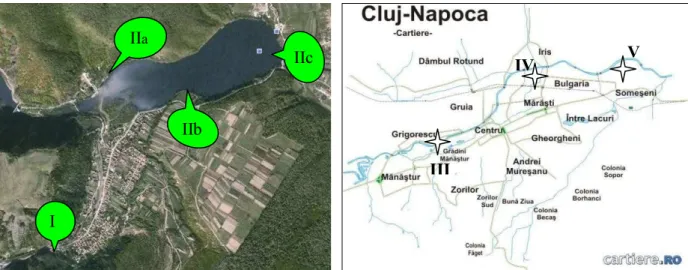
Materials and Methods. Establishing the sampling points. The quality study of aquatic biotic environments of Someş River and Lake Gilău was based on samples taken from the most representative points (I - Someşul Rece, II - Gilău - Luna de Sus, III - Grigorescu – Sports Centre, IV - Mărăşti – Industrial Area and V - Someşeni - Sânnicoară) (Fig. 1). Previous preliminary studies have considered the same sampling points (Stoian et al 2009). The sampling period materialised within 25.III.2009–3.VI.2009, with 10 to 14 days intervals. For each sample taken there were five repetitions.
Figure 1. Representation of sampling points on Someşul Rece River, Lake Gilău respectively Someşul Mic River (2009)(see details in text. Sources: Google Earth; cartiere.ro).
The water sampling. Sampling was conducted throughout the depth profile. Samples for biological material were taken in plastic bottles (V = 500 cm3), each sample consisting of 10 subsamples randomly selected from the sampling area. To include in evidences a greater diversity of zooplankton and aquatic invertebrate fauna, for each subprobe, the river bed was stirred up to include in the samples sand or mud substrate. For some systematics categories (Trichoptera larvae, Odonata, Plecoptera, Diptera, Crustacea) the rocky bottom of the ecosystem was also stirred (according to the situation). In the dam area, samples were taken only from the visibility zone of the water.
Samples analysis. In the laboratory, the samples were kept in low temperature and were sorted.
I
IIa
IIb
IIc
III
The invertebrates bioindicators fauna of Someşul Mic River and Lake Gilău was qualitatively and quantitatively analyzed. Systematic categories of invertebrates were identified in the samples. In this study we overviewed the quantitative data. Each sample (V = 500 cm3) was examined with stereomicroscope and microscope in 10 repetitions.
The number of individuals was assessed according to the volume of water sampled and estimated to the volume level (1 m3). The biological material was preserved in alcohol 75%.
Considering the presence and density or frequency of the bioindicators found in the samples, the state and the quality of the ecosystem was comparatively assessed based on several saprobity indices: relative cleanliness, state of relative pollution, the deficit of species, the saprobe-biological index (Sladeček 1973).
Chemical analysis took into consideration the following parameters: pH, totality of dissolved substances (TDS), electrical conductivity (EC), temperature (T), oxidation potential (ORP) and salinity.
Processing data. The information based on on-field and laboratory observations were statistically processed (Jarvis et al 1998; Krebs 1999; Waite 2000).
Results and Discussion. Data regarding the main systematic categories are presented in Fig. 2. The dominant systematic categories were: Protozoa, Nematoda, Annelida, Crustacea and Insecta.
Among the five phyla, the annelids, bioindicators of waters with a significant degree of pollution, were clearly dominant considering the total number of individuals in samples. Comparing the diversity of the species distinguished in the seven sampling points, a greater number of crustaceans, indicators of relatively clean waters, was found in samples taken from Lake Gilău, followed by an increase progressing to their disappearance in the samples collected in Someşeni district, where the annelids and nematods, recorded a maximum.
I II a II b II c III IV V
0 200 400 600 800 1000 1200 1400 1600
PROTOZOA NEMATODA
ANNELIDA (OLIGOCHAETA) CRUSTACEA
UNIRAMIA (INSECTA larve)
Figure 2. The change of the number of individuals of the most representative phyla, for the sampling points (see details in text).
For these systematic categories a number of characteristic bioindicators species were identified. In the relatively clear waters the following species were identified: Pyrganea grandis (Trichoptera), Cleon dipterium, Ephemera vulgata (Ephemerida), Perla sp. (Plecoptera), Planaria gonocephala (Platyhelmyntha), Isonichia sp., Tipula oleracea
(Diptera), Gammarus pulex (Crustacea).
Brachionus urceolaris (Rotifera), Hirudo medicinalis, Herpobdella atomaria (Hirudinea), Sphaerium corneum, Limnea sp. (Mollusca), Corophium curvispinum, Gammarus balcanicus, Nauplius sp. (Crustacea), Simulium sp., Chironomus sp., Culex pipiens, Stratiomys chamaeleon (Diptera) were identified.
A series of characteristic species for medium and high polluted waters were also identified, among which: Coleps hirtus, Euglena viridis, Spirulina sp., Colpidium colpoda, Vorticella microstoma (Protozoa), Tubifex tubifex (Annelida), Eristalis tenax, Chironomus sp., Simulium sp., Dixa sp. (Diptera).
The degree of environmental contamination was easily assessed studying the variation of the number of individuals and the number of species (Badea et al, in press).
The values of saprobity index (Table 1) revealed the biological features and characteristics of the analyzed ecosystem and its state of health.
Table 1 Saprobity indices for lake Gilău and Someşul Mic river,
based on sampling points and the appropriate category in which they are framed
Indices I II III IV V Media Category
Relative cleanliness (C) 0.79 0.66 0.36 0.18 0.07 0.41 5 Relative contamination (I) 0.08 0.27 0.51 0.76 0.82 0.49 5 Species deficit (SD) 0.41 0.62 0.79 0.98 0.92 0.74 6 Saprobe-biological index
(SI) 0.46 0.51 0.38 0.21 0.11 0.33 6
Category 4 4—6 5—6 6—8 7—8
The comparative saprobity analysis, based on saprobity indices, has highlighted the dominance of the 5-6 category, which indicated a β-α mesosaprob character. The lake showed biological and ecological characteristics closer to the β-mesosaprob character, while in the lotic ecosystem, a progressive increase of the degree of water contamination outside of Cluj-Napoca, was observed, revealing polysaprobic contitions for the water in this area.
The impact of human activities can be easily seen, especially when studying the comparison between the relative contamination (I) and relative cleanliness (C), species deficit (SD) and saprobe-biological index (SI) (Fig. 3).
These indices are usually the most used indices for assessing the quality and state of water saprobity. Their evolution at the level of the sampling points emphasises the strong connection between environmental conditions and the abundance of some species belonging to certain systematic categories. When the degree of contamination proved to be higher, the saprobe-biological index showed lower values, which determined a decrease in the number of species, increasing the number of individuals for some characteristic species (Badea et al, in press).
Studying the results of the chemical analysis, changes in the parameters during the study period were observed (Table 2). But the results were set in the normal values established by the Romanian environmental legislation (GD no 100/2002, Order no 161/2006), a matter highlighted by the analyzed parameters.
The correlation analysis made at the level of the studied parameters revealed no clear link between the chemical values for water and the number of individuals totally evaluated, even though in some cases there were fairly good positive correlation (y = 46.526 x - 1903.6; r = 0.89292). Close correlations were also observed at the level of species (Badea et al, in press).
Table 2 Results of the chemical analysis made for Lake Gilău and Someşul Mic River,
between 25.III.2009-03.06.2009 (the meaning of abbreviations is given in the text)
Sample
points pH ORP (mV) t (ºC) Salinity 0/00 (µS/cm) EC (mg/L) TDS
P1 (I) 7.29 -17.56 20.54 0 184.76 93.6
P2 (IIa) 7.55 -31.54 20.62 0 127.84 66
P3 (IIb) 7.54 -30.82 20.46 0 99.42 49.8
P4 (IIc) 7.56 -29.58 20.58 0 96.38 48.1
P5 (III) 7.6 -34.56 20.62 0 193.48 96.8
P6 (IV) 7.77 -43.24 20.72 0 341.2 170.2
P7 (V) 7.4 -22.56 20.82 0 505 253.3
Conclusions. In the lotic acvatic ecosystem, species belonging to Protozoa, Nematoda, Annelida, Crustacea and Insecta systematic categories were identified.
The saprobity analysis for this type of ecosystem indicated an alfa-meso-polysaprob character, revealed also by the presence of some characteristic bioindicators genera and species: Coleps hirtus, Euglena viridis, Spirulina sp., Colpidium colpoda, Vorticella microstoma, Tubifex tubifex, Eristalis tenax, Chironomus sp., Simulium sp., Dixa sp..
Clear water biotic environments were highlighted by the dominant bioindicators invertebrates species, such as: Pyrganea grandis, Cleon dipterium, Ephemera vulgata,
Planaria gonocephala, Gammarus pulex.
The study of invertebrate fauna in the lake showed a mezosaprobe character, highlighted especially by the presence of some crustaceea bioindindicator species (Gammarus pulex, Cyclops rubens, Acanthocyclops bicuspidatus, Daphnia pulex, D. magna,
Bosmina longirostris, Nauplius sp.).
The values of the chemical parameters analyzed were correlated, with bio-ecological characteristics of the bioindicators species identified.
Acknoledgements. The authors wish to thank for the financial support provided from programs co-financed by The SECTORAL OPERATIONAL PROGRAMME HUMAN RESOURCES DEVELOPMENT, Contract POSDRU 6/1.5/S/3 – „Doctoral studies: through science towards society".
References
Badea A. B., Gagyi-Palffy A., Stan Gh., [Observations in the ecological niches of bioindicators species and dominant species of aquatic ecosystems]. Environment & Progres 15 (in press).
Bartram J., Ballance R., 1996 Water quality monitoring - a practical guide to the design and implementation of freshwater quality studies and monitoring programmes. Published on behalf of United Nations Environment Programme and the World Health Organization. ISBN 0-419-22320-7.
Governmental Decision no 100/2002 for the approving of the quality standards for surface waters intended for the abstraction of drinking water and the Norms concerning the methods of measurement and frequencies of sampling and analysis of surface water intended for the abstraction of drinking water - (OJ 130/19.02.2002), modified and completed by GD no 662/2005 and GD no 210/2007.
Hodkinson I. D., Jackson J. K., 2005 Terrestrial and aquatic invertebrates as bioindicators for environmental monitoring, with particular reference to mountain ecosystems. Environmental Management 35(5):649–666.
Jarvis P., Fowler J., Cohen L.,1998Practical statistics for field biology. John Wiley & Sons, USA.
Jeffrey D. W., Madden B., 1991 Bioindicators and environmental management. Academic Press, London.
KrebsC. J., 1999 Ecological methodology. Addison Wesley Longman Inc., California.
Miller G. T. Jr., 2008 Environmental Science. Conservation and natural resources Thompson Brooks/Cole Ed.
Order no 161/2006 of the Ministry of the Environment and Water Management on the approval of the standard regarding a classification of surface water quality with a view to assessing the ecological state of water bodies.
Odagiu A., Oroian I., Proorocu M., Iederan C., Burduhos P., Balint C., 2008 Monitoring the strategic environmental assessment for plans and programmes. ProEnvironment ProMediu 1(1):25-28.
Oroian I., Proorocu M., Todea A., 2008a The strategic environmental assessment – European and Romanian Legislation. ProEnvironment ProMediu 1(1):5-9.
Oroian I., Odagiu A., Proorocu M., Paulette L., Iederan C., Braşovean I., 2008b [A short history of the environmental policies in Romania]. ProEnvironment ProMediu 1 (1):16-24. [In French]
Oroian I., Proorocu M., Odagiu A., Paulette L., Iederan C., Braşovean I., 2008c Approaching plans and programmes under the strategic environmental assessment view. ProEnvironment ProMediu 1(2):5-9.
Proorocu M., Coste C., Aşchilean I., Balint C., 2008 Implementation of the directives concerning the management of the air quality in 6 North-West region. ProEnvironment ProMediu 1(1):10-15.
Sladeček V., 1973 System of water quality from the biological point of view. Archiv Hidrobiology Bericht Ergbn Limnological 7(1-4):1-218.
Stoian L. C., Gagyi-Palffy A., Stan Gh., 2009 Preliminary aspects regarding the use of some invertebrate bioindicator species in the ecological study of an aquatic lotic ecosystem. AACL Bioflux 2(3):331-337.
Received: 11 November 2009. Accepted: 27 February 2010. Published online: 28 February 2010. Authors:
Ana Bianca Badea, Faculty of Environmental Sciences, Babeş-Bolyai University, Cluj-Napoca, Romania, 30 Fântânele, 400294, [email protected]
Andrea Gagyi-Palffy, Faculty of Environmental Sciences, Babeş-Bolyai University, Cluj-Napoca, Romania, 30 Fântânele, 400294, [email protected]
Laurenţiu Cristian Stoian, Faculty of Geography, Babeş-Bolyai University, Cluj-Napoca, Romania, 5-7 Clinicilor, 400006, [email protected]
Gheorghe Stan, Faculty of Environmental Sciences, Babeş-Bolyai University, Cluj-Napoca, Romania, 30 Fântânele, 400294, [email protected]
How to cite this article: