www.epjournal.net – 2008. 6(2): 234-245
¯ ¯ ¯ ¯ ¯ ¯ ¯ ¯ ¯ ¯ ¯ ¯ ¯ ¯ ¯ ¯ ¯ ¯ ¯ ¯ ¯ ¯ ¯ ¯ ¯ ¯ ¯ ¯
Original Article
Cross-National Variation in the Motivation for Uncommitted Sex: The Role of
Disease and Social Risks
Nigel Barber, Portland, Maine Email: [email protected]
Abstract: Evolutionary psychological meta-theory predicts that interest in “casual” sex should decline with its costs (e.g., acquiring HIV/AIDS or an infectious disease, unwanted pregnancy, loss of spousal commitment). Analyses of Schmitt’s (2005) data on sociosexuality in 48 countries (including gender differences therein) tested these predictions using multiple regressions controlling for economic development and population density. Sociosexuality declined as HIV/AIDS increased and as teen births increased, supporting the hypothesis, but female sociosexuality increased with the risk of infectious disease. Sociosexuality was lower in countries in which there was a greater proportion of men in the population and marriages likely involved greater commitment. Country differences in sexual motivation partly reflect varying costs of extramarital sexuality with females possibly increasing their interest in sexual variety to boost heritable disease resistance.
Keywords: Sociosexuality; marriage markets; mating effort; infectious diseases; HIV/AIDS; sex differences; economic development.
¯ ¯ ¯ ¯ ¯ ¯ ¯ ¯ ¯ ¯ ¯ ¯ ¯ ¯ ¯ ¯ ¯ ¯ ¯ ¯ ¯ ¯ ¯ ¯ ¯ ¯ ¯ ¯ ¯ ¯ ¯ ¯ ¯ ¯ ¯ ¯ ¯ ¯ ¯ ¯ ¯ ¯ ¯ ¯ ¯ ¯ ¯ ¯ ¯ ¯ ¯ ¯ ¯ ¯ ¯ ¯ ¯ ¯ ¯ ¯ ¯ ¯ ¯ ¯ ¯ ¯ ¯ ¯ ¯ ¯ ¯ ¯ ¯ ¯ ¯ ¯ ¯ ¯ ¯ ¯ ¯ ¯ ¯ ¯ ¯ ¯ ¯ ¯
Introduction
sociosexuality from the perspective of national variation in the social and biological costs of uncommitted sexual relationships.
Evolutionary concepts can be used to account for societal variation given that individuals respond adaptively to varied social circumstances (Barber, 2007). They do so due to several possible mechanisms, including adaptive modification of brain development, adaptive child-training procedures (Cronk, 2006; Low, 1989), as well as other forms of individual and social learning. I hypothesized that national differences in sociosexuality would be reflective of locally varying costs and benefits (with the emphasis on costs). For instance, one would predict that interest in “casual” sex would be lower in countries where this might pose the risk of contracting a life-threatening disease such as HIV/AIDS. Moreover, the social costs of extramarital sexuality can be onerous in some nations, either because of the ensuing threat of violence or diminished marriage prospects, or both. Although unrestricted sexuality can be dangerous for such reasons, one should not ignore the fact that it may also provide reproductive benefits. For men, it can increase reproductive success and women may obtain superior genes for their offspring from extra-pair copulation (Barber, 2002). Although such benefits clearly exist, they are notoriously difficult to quantify whereas costs are more tractable to research. This paper focused on two kinds of cost, namely health costs and social costs in terms of reduced marriageability.
Sexual Restrictedness and the Marriage Market
There a rich network of connections between marriage markets and sexual restrictedness. Generally speaking, in societies where women encounter favorable marriage markets, they tend to delay sexual intercourse until after marriage (Barber, 2007; Guttentag and Secord, 1983). Conversely, where there is a severe scarcity of marriageable men, young women typically initiate sexual behavior outside marriage and sexual behavior is less restricted in the entire society. A similar result is produced in societies where women delay marriage in order to develop careers. Given that there is a large pool of sexually active women in either case, men do not need to marry to lead an active sex life.
In general, single parenthood increases in societies having a scarcity of males, those in which many men are poor, and those where large numbers of women develop careers (Barber, 2003). One would predict that sociosexuality would thus increase in countries having a relative scarcity of males and Schmitt (2005) found that the sex ratios of 48 countries were negatively correlated with sociosexuality for both genders. One would also expect sociosexuality to increase with economic development as more women pursue careers. Schmitt found that female sociosexuality was positively correlated with gross domestic product (GDP, but not for men) and that it increased with various measures of the political and economic status of women. These results must be considered preliminary, however because they are based on simple correlations without statistical control of potential confounding factors and because the data were not subjected to logarithmic transformation as they need to be to demonstrate linear relationships with variables like GDP that increase logarithmically or otherwise depart from linearity, such as SOI.
Another interpretation is that teen birth rates are typically low in developed countries where females tend to be higher on sociosexuality – hence the need to control for level of economic development in testing this relationship. Apart from the possible costs of teenage reproduction, and of damaged marriage prospects, unrestricted sexuality can pose health risks.
Sexual Restrictedness and Disease Risk
Unrestricted sexuality greatly increases the risk of contracting sexually transmitted diseases, some of which are damaging to health and fertility and others, such as HIV/AIDS that precipitate numerous chronic life-threatening conditions. Originally a disease contracted mainly by intravenous drug users and homosexuals, HIV/AIDS is more often spread today by heterosexual interactions (Brancato, et. al, 1997). Given the severe risks following from infection, one would predict that sociosexuality would be reduced in countries where there is a high rate of HIV/AIDS infection. Persons who perceive sexually transmitted diseases as less threatening engage in more high-risk sexual behaviors (Li et. al, 2004).
There is nothing unique about sexually transmitted illness in this regard because a person whose sexual behavior is unrestricted is at greater risk of contracting all manner of illnesses through physical contact with relative strangers. It was thus predicted that countries where the risk of infectious diseases is high would have reduced sociosexuality scores. Yet, there is a different rationale for predicting that prevalence of infectious disease might increase sociosexuality, namely the role played by increased mating effort in conferring heritable disease resistance on offspring. This effect is likely to be more important for females given their greater investment in children and consequent sensitivity to genetic quality of their mates. Women might therefore select temporary mates who provide heritable disease resistance in countries where infectious disease risk is high. Heritable disease resistance evidently affects the mating strategies of humans as well as other species. For instance it is predictive of polygynous marriage systems based on anthropological and cross-national data (Barber, in press; Low, 1990).
Specific Predictions
Assuming that sociosexuality would tend to be inhibited by its fitness costs, the following predictions were tested:
1. Sociosexuality will decline with the incidence of HIV/AIDS and other infectious diseases in a country. However, if women seek heritable disease resistance through opportunistic mating then female SOI will increase with the risks of infectious disease to their offspring.
2. Sociosexuality will be lower in high-sex-ratio societies where women have better marriage prospects (supported by Schmitt, 2005, correlation).
Materials and Methods
Samples of Countries
The sample of 48 countries were those for which Schmitt (2005) reported sociosexuality results. (The total underlying sample size was 5,853 males and 8,206 females and the survey instruments were presented in 26 different languages using careful back-translation procedures, Schmitt, 2005). The arithmetic average gross domestic product (GDP) producer price corrected (PPP) was $18,114 (.05 confidence interval $14,914-21,314) compared to $9,500 for the world average (Central Intelligence Agency, CIA, 2006), indicating that countries in which collaborators collected data were significantly more economically developed than the average country in the world so that results are not truly representative of the world population. Respondents were also mainly college students so that their responses might not be representative of their respective countries both in respect to parental income and age (although the latter is currently much more representative of the adult population than was true a generation ago (see Comments in Schmitt, 2005, for a thorough discussion of such sampling controversies).
Dependent Variables
The main dependent variable was the average sociosexuality score for a country. Also analyzed were the average sociosexuality score for women and for men and the size of the sex difference in each country. All of the dependent variables were natural-log transformed to ensure linearity in the data.
The Sociosexuality Orientation Inventory (SOI, Simpson and Gangestad, 1991) is a widely used instrument whose validity and reliability have been confirmed in numerous individual-level studies. Schmitt (2005) also confirmed that the SOI is cross-culturally valid in terms of its factor structure and has convergent validity in terms of other questionnaire measures. The weighted alpha internal reliability was .65. The SOI is a seven-item self-report instrument that asks about a person’s number of sexual partners and attitudes toward uncommitted sexuality.
Independent Variables
The adult prevalence rate of HIV/AIDS was used as one measure of the health risk of uncommitted sexual interactions (CIA, 2006). Data were the most current and were obtained between 2001 and 2005 for 47 of the 48 countries. The overall risk of major infectious disease was assessed by an ordinal measure according to which the risk varied between very high, high, intermediate and low, coded 4,3,2,1, respectively (CIA, 2006). This coding was based on a compilation of vectorborne diseases (e.g., malaria, trypanosomiasis), water contact diseases (e.g., schistosomiasis, leptospirosis), animal contact diseases (e.g., H5N1 avian influenza) and food or waterborne diseases (e.g., diarrhea, typhoid).
of error, however. To begin with, including juveniles who normally do not marry (although they may become betrothed), creates noise, although this is unlikely to distort the marriage market greatly because the ratio of male children to females rarely deviates much of from the birth sex ratio of about 104. The sex ratio deviates widely for older people however, due to higher male mortality rates, making it advisable to control for differential life expectancy of males and females thereby solving the more important problem.
Control Variables
Female advantage in life expectancy was calculated as female life expectancy minus male life expectancy with the addition of a constant ten years to get rid of negative values. This variable was used to control for the fact that females live longer than males that would tend to distort the sex ratio in a country by exaggerating the scarcity of males at reproductive ages. To the extent that unrestricted sexuality is more of a viable strategy if there is a larger number of potential mates available, one might predict that SOI scores would increase with population density. From a simple probabilistic perspective, all kinds of social interactions can be though of as potentially more frequent in a high-density population because individuals encounter others more often. Students of violent crime, for instance, find that this tends to increase with population density (Kposowa, Breault, and Harrison, 1995). Population densities were the number of people per square km in each country (United Nations, 2004). National wealth was also controlled as gross domestic product (GDP) corrected to produced price parity (PPP, $US, CIA 2006). Both population density and GDP were natural-log transformed to improve linearity in the statistical tests.
Statistical Design
Following preliminary correlational analysis, data were analyzed using ordinary least squares multiple regressions in which all of the variables were entered simultaneously. Variance inflation indices were calculated for each of the predictors Χ based on multiple rs with the other predictors Χ to check for possible multicollinearity bias. The square root of the variance inflation index was less than 2.00 in each case, indicating that multicollinearity was not a problem (Fox, 1991).
Results
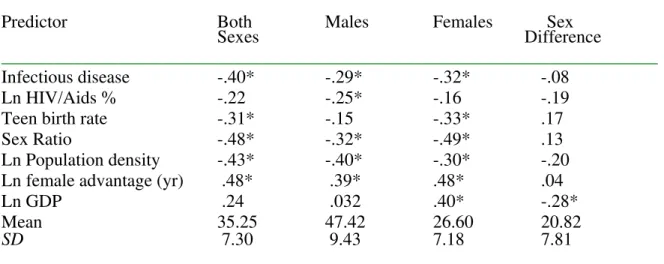
Table 1. Correlations between Sociosexuality Dependent Variables (with Means and SD’s) and Predictors. _________________________________________________________________________
Predictor Both Males Females Sex Sexes Difference
_________________________________________________________________________
Infectious disease -.40* -.29* -.32* -.08
Ln HIV/Aids % -.22 -.25* -.16 -.19
Teen birth rate -.31* -.15 -.33* .17
Sex Ratio -.48* -.32* -.49* .13
Ln Population density -.43* -.40* -.30* -.20
Ln female advantage (yr) .48* .39* .48* .04
Ln GDP .24 .032 .40* -.28*
Mean 35.25 47.42 26.60 20.82
SD 7.30 9.43 7.18 7.81
_________________________________________________________________________ Note: The correlations are for log-transformed variables but the means are not.
* p < .05
Table 2. Correlations Amongst Predictor Variables with Means and SD’s
___________________________________________________________________________
Ln Inf. HIV Teen SR Pop. F. GDP Dis. Birth Den. Adv.
____________________________________________________________________________
Infectious diseases -.72* -
Ln HIV/AIDS % -.36* -.56* -
Teen birth rate -.77* .61* .48* -
Sex ratio -.23 .27* -.21 .31* - Ln Population
Density .15 -.08 -.39* -.35* -.20 - Ln female
advantage (yr) .48* -.68* .47* -.48* -.56* .01 - Mean 9.47 1.35 -1.31 1.33 96.96 4.44 2.75 SD 0.98 0.90 1.40 0.61 4.23 1.53 0.18
_________________________________________________________________________ Note: The correlations and means are for log-transformed variables. Inf. Dis. = infectious diseases; SR = sex ratio; Pop. Den. = population density; F. Adv. = female advantage (in years of life expectancy). * p < .05
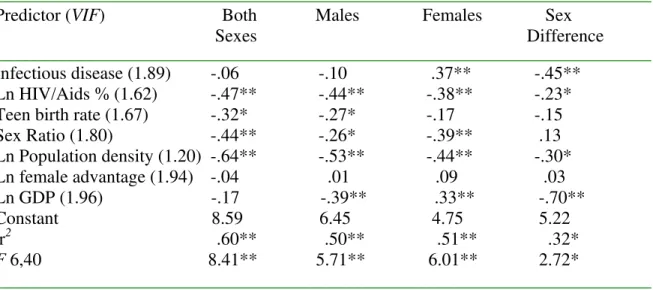
Of the control variables, the female advantage in life expectancy had no significant effect while the population density had a significant negative effect for both sexes together and for males separately and females separately. As the population density increased, the gender difference also declined. GDP had no significant effect for both genders together but male SOI declined with national wealth whereas female SOI increased with wealth, i.e., wealth interacted with gender in respect to SOI. The gender difference in SOI was also significantly smaller in wealthy countries.
Discussion
Table 3. Regression Analysis of Cross-National Differences in Sociosexuality (Standardized Regression Coefficients)
_________________________________________________________________________
Predictor (VIF) Both Males Females Sex Sexes Difference
_________________________________________________________________________
Infectious disease (1.89) -.06 -.10 .37** -.45**
Ln HIV/Aids % (1.62) -.47** -.44** -.38** -.23*
Teen birth rate (1.67) -.32* -.27* -.17 -.15
Sex Ratio (1.80) -.44** -.26* -.39** .13
Ln Population density (1.20) -.64** -.53** -.44** -.30* Ln female advantage (1.94) -.04 .01 .09 .03 Ln GDP (1.96) -.17 -.39** .33** -.70** Constant 8.59 6.45 4.75 5.22 r2 .60** .50** .51** .32* F 6,40 8.41** 5.71** 6.01** 2.72*
_________________________________________________________________________ Note: VIF = variance inflation factor.
* p < .05, ** p < .01, two-tail tests
This interpretation recalls a parallel explanation for the prevalence of polygynous marriage, namely that polygynous men provide enhanced disease resistance for offspring. Polygynous marriage is indeed more likely to occur in places with a high risk of infectious diseases and parasites (Barber, in press; Low, 1990) and analogous adaptive mechanisms apply to breeding systems of other species (e.g., birds, Hamilton and Zuk, 1982). Physical attractiveness is also more important in selecting a mate in countries suffering from a heavy parasite load (Gangestad and Buss, 1993) which would make sense if physical attractiveness was indicative of genetic quality (Barber, 1995). Gangestad, Haselton and Buss (2006) also reported that parasite prevalence increased female preferences for intelligent educated men which they interpreted as an indirect assessment of health and disease resistance.
As far as the social costs of unrestricted sexuality are concerned, SOI scores declined with the risk of teen births for both genders considered together as well as for males. The effect for females was in the predicted direction but failed to reach significance despite the significant negative correlation (Table 1). Given that the sex difference in SOI was not significantly predicted by teen birth rate, this should not be considered a theoretically meaningful failure to support the hypothesis for females. This effect partially replicates Schmitt’s (2005) zero-order correlation with control variables partialed out and with appropriate log-transformations to rule out spurious associations from data that depart from linearity.
In addition to suggesting that cross-national differences in SOI respond adaptively to varied costs (or benefits) of unrestricted sexuality, the present data highlight some intriguing gender differences in the pattern of results. To begin with, the regression analysis showed that whereas women’s SOI increases with economic development, there is a significant decline for males. Increased sociosexuality for women in developed economies is to be expected for various reasons having to do with the increased economic independence of women and concurrent diminishing importance of sexual reputation as a criterion of feminine marriageability. The delay in marriage as women get educated and established in careers, means that there is a larger pool of sexually active single women in the population (Barber, 2002; Goldin, 1995; Guttentag and Secord, 1983). Evidently male mating effort can be reduced in societies where females are more eager for uncommitted sexual encounters. Men’s marriages may also be threatened by casual relationships if these are a tactic whereby women attempt to supplant the existing spouse (Barber, 2002).
Men’s SOI was suppressed significantly more by the high rates of HIV/AIDS infection than was true of women. Whatever the reason, this was a small sex difference (standardized coefficients of -.44 for men compared to -.38 for women) produced in the context of substantial effects for both genders).
The largest predictor of sociosexuality for both genders was population density with male and female SOI scores declining substantially in countries having higher population density. This implies that proximity to more sexually attractive people does not increase interest in uncommitted sexual relationships. Indeed, the presence of large numbers of other people might well inhibit sexual expression if this requires a high level of privacy. Moreover, crowding is a known stressor that increases production of hormones such as epinephrine and cortisol that are antagonistic to sex hormones, specifically testosterone that affects sexual motivation, particularly for males but also for females (Archer, 2006; Evans and Wener, 2007). Population density suppresses male SOI significantly more than female SOI, possibly because testosterone, which is suppressed by crowding, is more important for male than for female sexual motivation.
Many methodological issues can be raised as this study incurs the weaknesses as well as the strengths inherent in the data source (Schmitt, 2005, and comments thereon). Although widely used as a measure of interest in casual sex, the SOI inventory is subjective and, arguably, should not be used without corroboration from more objectively available information. This is a reasonable criterion of good science but, rigidly applied, it would invalidate much, or most, of the published research in personality and social psychology. Perhaps such research is heuristically justified because it points the way to future work using more objective measures. For the moment, though, the SOI is defensible because it is validated by corroborating reports from sexual partners who would know something about the sexual behavior and interests of the subject, although there might be much that they do not know, if only because it is deliberately concealed from them to avoid jealousy. Schmitt (2005) also makes the case that the SOI is cross-nationally valid because it correlates with other questionnaire measures related to sexual behavior. Another criticism of SOI is that human sexual motivation encompasses both long-term and short term dimensions that are largely independent (Jackson and Kirkpatrick, 2007).
60% of the variance could be accounted for by such factors also indicates that the SOI is strongly and systematically related to objective measures of marriage and reproductive behavior.
One familiar problem in cross-national research of this kind is that many of the predictor variables tend to be highly correlated, however (Table 2), raising the problem of multicollinearity that may have the effect of distorting effect sizes. One way of ruling out multicollinearity is to calculate variance inflation factors (VIF) and this validated the regression model (Fox, 1991). If multicollinearity is present, another sign is instability in the error terms but there was no sign of any such instability. The regressions were thus free of multicollinearity problems despite some large correlations (Table 2).
To summarize the findings, cross-national differences in SOI scores are fairly highly predictable from the apparent fitness costs and benefits of extra-pair copulation. Both men and women are comparatively restricted in their sexuality in countries where the risks are high, whether from venereal diseases, unwanted pregnancy, or diminished marriage prospects. Women (but not men) are more unrestricted in their sexuality in countries where there is a high risk that their children will contract infectious diseases and parasites and this phenomenon can be explained as a strategy of obtaining heritable disease resistance in their offspring – an issue that is of greater importance for females on account of their larger obligatory investment in offspring.
In conclusion, modern populations are clearly sensitive to the fitness costs (and benefits) of unrestricted sexuality. Social and health costs reduce SOI scores in a country, for instance, and genetic benefits increase it (at least for women). To the extent that different factors affect fitness for men and women, one finds distinct gender differences in the factors influencing cross-national differences in SOI scores. Results are strengthened by controlling for various potentially confounding variables such as level of economic development, population density, and gender differences in longevity.
Of course, we do not fully understand the precise mechanisms through which such remarkable adaptive flexibility in sexual motivation occurs but these certainly merit further research. In this context, explanations in terms of genetically-determined individual differences are implausible because it seems unlikely that the residents of entire countries could differ systematically in genes affecting sexual motivation. A more promising approach would be to investigate the impact of varying levels of psychological stress on brain development. Converging strands of evidence from animal behavior and neuroscience indicate that a stressful early life predisposes the individual to an unrestricted sexual orientation (reviewed in Barber, 2007). Another important mechanism involves the impact of marriage markets on individual behavior, which underlies the effect of the sex ratio on SOI scores and reproductive behavior (Barber, 2000 a,b; 2001; 2005). Moreover, in respect to sexual behavior, as in other matters, parents train their children to behave in ways that promote social and biological success in their particular context (Barber 2000 c; Cronk, 2006; Low, 1989).
Acknowledgements: The author is grateful to David Schmitt and the anonymous reviewers for their thoughtful and helpful suggestions.
References
Archer, J. (2006). Testosterone and human aggression: An evaluation of the challenge hypothesis. Neuroscience and Biobehavioral Reviews, 30, 319-345.
Barber, N. (1995). The evolutionary psychology of physical attractiveness: Sexual selection and human morphology. Ethology and Sociobiology, 16, 395-424.
Barber, N. (2000a). The sex ratio as a predictor of cross- national variation in violent crime. Cross-Cultural Research, 34, 264-282.
Barber, N. (2000b). On the relationship between country sex ratios and teen pregnancy rates: A replication. Cross-Cultural Research, 34, 26-37.
Barber, N. (2000c). Why Parents Matter: Parental Investment and Child Outcomes. Westport, CT: Bergin and Garvey.
Barber, N. (2001). On the relationship between marital opportunity and teen pregnancy: The sex ratio question. Journal of Cross-Cultural Psychology, 32, 259-267.
Barber, N. (2002). The Science of Romance. Buffalo, NY: Prometheus. Barber, N. (2003). Parental investment prospects and cross-national differences in single
parenthood. Cross-Cultural Research, 37, 163-177.
Barber, N. (2005). Evolutionary explanations for societal differences in single parenthood. Evolutionary Psychology, 3, 133-165.
Barber, N. (2007). Evolutionary explanations for societal differences and historical change in violent crime and single parenthood. Cross-Cultural Research, 41, 123-148. Barber, N. (in press). Explaining cross-national differences in polygyny intensity: Resource
defense, sex ratio and infectious diseases. Cross-Cultural Research.
Brancato, G., Perucci, C.A., Abeni, D.D.C., Sangalli, M., Ippolito, G., and Massimo, A. (1997). The changing distribution of HIV infection: HIV surveillance in Lazio, Italy, 1985 through 1994. American Journal of Public Health, 87, 1654-1658. Central Intelligence Agency (CIA, 2006). World Factbook. Washington, D.C.: Author. Cronk, L. (2006). Behavioral ecology and the social sciences. In J.H. Barkow (Ed.). Missing the Revolution: Darwinism for Social Scientists (pp. 167-185). New York: Oxford University Press.
Evans, G.W., and Wener, R.E. (2007). Crowding and personal space invasion on the train: Please don’t make me sit in the middle. Journal of Environmental Psychology, 27, 90-94.
Fox, J. (1991). Regression Diagnostics. Beverly Hills, CA: Sage. Gangestad, S.W., and Buss, D.M. (1993). Pathogen prevalence and human mate
preferences. Ethology and Sociobiology, 14, 89-96.
Gangestad, S.W., Haselton, M.G., and Buss, D.M. (2006). Evolutionary foundations of cultural variation: Evoked culture and mate preferences. Psychological Inquiry, 17, 75-95.
Goldin, C. (1995). Career and family: College women look to the past. National Bureau of Economic Research, Working Paper # 5188.
Guttentag, M., and Secord, P.F. (1983). Too Many Women?: The Sex Ratio Question. Beverly Hills, CA: Sage.
Jackson, J.J., and Kirkpatrick, L.A. (2007). The structure and measurement of human mating strategies: Toward a multidimensional model of sociosexuality. Evolution and Human Behavior, 28, 382-391.
Li, X., Stanton, B., Fang, X., Lin, D., Mao, R., Wang, J., et al. (2004). HIV/STD risk behaviors and perceptions among rural-to-urban migrants in China. AIS Education and Prevention, 16, 538-556.
Kposowa, A., Breault, K.D., and Harrison, B.M. (1995). Reassessing the structural covariates of violent crime and property crime in the U.S.: A county level analysis. British Journal of Sociology, 46, 79-106.
Low, B. (1989). Cross-cultural patterns in the training of children. Journal of Comparative Psychology, 103, 311-319.
Low, B. (1990). Marriage systems and pathogen stress in human societies. American Zoologist, 30, 325-339.
Penton-Voak, I.S., Jacobson, A., and Trivers, R. (2004). Populational differences in attractiveness judgments of male and female faces comparing British and Jamaican samples.
Population Reference Bureau (2005). Women of our World. Washington, DC: Author. Schmitt, D.P. (2005). Sociosexuality from Argentina to Zimbabwe: A 48-nation study of
sex, culture, and strategies of human mating. Behavioral and Brain Sciences, 28, 247-311.
Simpson, J.A., and Gangestad, S.W. (1991). Individual differences in sociosexuality: Evidence for convergent and discriminant validity. Journal of Personality and Social Psychology, 60, 870-883.
United Nations (UN, 2004). World Population Prospects (2004 revision). Available at: