Atlas Journal of Biology 3 (2): 218–223, 2014 doi: 10.5147/ajb.2014.0136
Atlas J
our
nal of
Biolog
y - ISSN 2158-9151. Published By Atlas Publishing
, LP (www
.atlas-publishing
.org)
First Report on
Pseudomonas marginalis
Bacterium Causing Soft
Rot of Onion in Morocco
Achbani E. H.
1*, S. Sadik
1,2, R. El Kahkahi
3, A. Benbouazza
1, and H. Mazouz
21
Laboratory of Plant Protection URPP- INRA-Meknes Morocco;
2Laboratory of Plant Biotechnology and
Mo-lecular Biology, Faculty of Sciences, Meknes, Morocco;
3Faculty of Sciences, Kenitra, Morocco.
Received: November 18, 2013 / Accepted: October 31, 2014
__________________________________________________ * Corresponding author: [email protected]
Abstract
Pseudomonas marginalis is an important postharvest pathogen causing soft rot in a wide variety of harvested fruits and veg-etables. Isolated strains from rotten onion bulbs based on morphological characteristics, were tested for pathogenecity on tobacco. Pathogenic strains underwent a biochemical test which detected the presence of P. marginalis. Symptoms were reproduced by inoculating this species to onion leaves and bulbs. Based on ARN16S sequencing, reported associated species (Pantoea agglomerans, Pseudomonas luorescens, Klebsi-ella oxytoca) were also conirmed. This study reports for the irst time the presence of P. marginalis bacterium in Morocco causing the soft rot of onion bulb, in association with Pantoea agglomerans, Pseudomonas luorescens, and Klebsiella oxytoca.
Keywords: Pseudomonas marginalis, soft rot, onion, Morocco.
Introduction
In Morocco, the onion crop (Allium cepa L.) has a high eco-nomical importance, representing 11% of nationally produced vegetable crops (Anonyme, 2011). However this crop is exposed to many physiological and phytosanitary constraints (Conn et al., 2012), among which, the onion bulb soft rot represents the most serious post harvest disease.
For onion storage two methods used in France, storage in a traditional dryer and temporary storage under plastic tunnels, also storage methods affect the soft rot incidence (Gourc et al., 2007).
The Pseudomonas and Pectobacterium bacterial genus are considered as the main bacteria that caused the damages in USA during storage (Agrios, 2005).
By means of pectinolytic enzyme products (pectin lyase and pectate lyase) (Hayashi et al., 1997, Liao et al., 1997), P. mar-ginalis causes the post-harvest soft rot (Conn et al., 2012; Scor-tichini, 1994) of many harvested crops including: onion (Kim et al., 2002 ; Wright et al 1992 ; Dallaire, 2009), tomato (Ibe and Grogan, 1983), salad (Blancard et al., 2003), potato (Elumalai and Mahadevan, 1995), broccoli (Charron et al., 2002) and carrot (Godfrey and Marshall., 2002). P. marginalis is a foliar as well as a post-harvest disease (Conn et al., 2012; Scortichini, 1994). It’s a bacterium present in Europe, India, South American, USA, Japan, New Zealand and Austria, etc.
Development of the soft rot disease caused by P. marginalis is optimal at low temperatures (between 5 and 25°C), the bacte-ria develop at 0°C and it can induce the soft rot at 5°C on onion crop (Kim et al., 2002). In Morocco, no evidence of such bacteria causing soft rot on onion or another crop.
The main objective of this work was to isolate and identify the
(http://creativecom-our
nal of
Biolog
y - ISSN 2158-9151. Published By Atlas Publishing
, LP (www
.atlas-publishing
.org)
causal agent of the bacterial soft rot on onion bulbs in Morocco using biochemical, molecular and pathogenicity tests.
Materials and Methods
Isolation
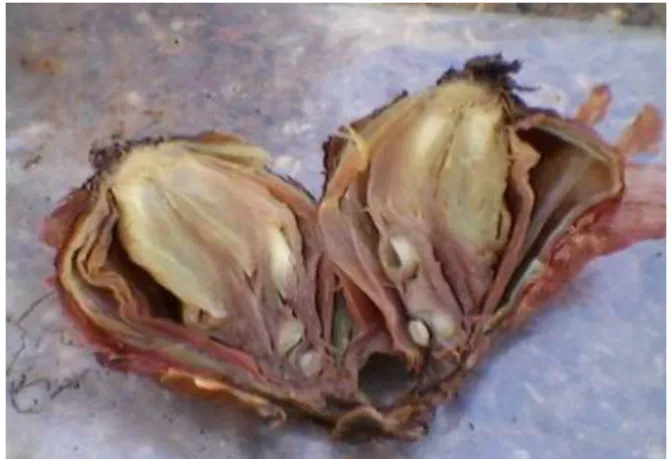
Onion bulbs showing soft rot symptoms (Fig. 1) were sampled in March 2012 from vegetables storage areas at Elhajjeb (N
33°41.45, W 5°22 00) (Meknes-Tailalt, Morocco).
Onion bulbs showing water-soaking or yellowish-brown rot were used for isolation. These were washed with tap water and cut longitudinally. The diseased scale tissues were cut into 5 mm cubes by using sterilized surgical blade. Three pieces of onion scale were ground in 1 ml of distilled water using a mortar and pestle. The suspension was streaked onto LPGA (yeast extract, 5g; peptone, 5g; glucose, 10g; agar, 18g; and distilled water, 1 l) and King B (proteose peptone, 20 g; K2HPO4•3H2O, 2.5 g ; MgSO4•7H2O, 6 g ; glycerol, 15 ml ; agar, 15 g; and
dis-tilled water, 1 l) mediums. Six bacterial isolates were identiied
by biochemical and physiological tests including Gram strain; LOPAT (Levan production, Oxidase reaction, Potato soft rot, Ar-ginine dishydrolase [ADH] and Tobacco hypersensitivity) test, Hydrolysis of Tween80, mobility test, Indole, Mannitol, Catalase, Hugh & Leifson (H.L), the bacteria development in low and high temperature (4 and 40°C), the salt tolerance (7 and 10% of NaCl) and API 20 gallery. All tests were repeated at last twice (Schaad et al., 2001).
Pathogenicity Test
Cultures of bacterial isolates obtained from onion bulbs, la-beled 2078-6-1, 2078-6-2, 2078-6-3, 2078-6-4, 2078-6-5, were used in a greenhouse pathogenicity experiment. In vivo, seven weeks old tomato plants grown in greenhouse and six-teen weeks old onion plants grow in nursery were inoculated. A suspension of tested bacterial isolate (1×10⁸ CFU/ml) in sterile distilled water from 24-h cultures was used as the inoculums; plants in one experimental variant were inoculated by injection of approximately 0.2 ml of inoculums into leaves of onion and
tomato plants. The plants were incubated in a greenhouse at 20°C to 25°C and 60–70% relative humidity. Sterile water was used as control (Kudela et al., 2010). In vitro, onion bulbs and leaves, and tomato leaves were inoculated by a suspension (108 CFU/ml) of 24-h bacterial culture; the vegetable material was
incubated in moist chamber at a temperature of 30°C, after ive
days of incubation symptoms were observed.
PCR Ampliication
To complete the biochemical results, a molecular identiication
by sequencing was performed. The extraction was made using
GenElute Mammalian Genomic Kit (Anonyme, 2010). Quantii -cation of DNA was performed using spectrophotometry.
Ampli-ication was performed with primers Fd1 (CAGAGTTTGATCCT -GGCTCAG) and RP2 (AGAGTTTGATCCT-GGCTCAG) at a PCR kit (Invitrogen). The PCR was carried out in a total volume of 25 µl of the following reaction mixture: 2.5µl 10X Buffer, 2µl dNTP (10mm), 0.125µl of each primer (100 µM), 0.75 µl MgCl2 (50 mM), 0.2µl Taq (5U/µl) and 5µl DNA. The PCR was per-formed using the following protocol: initial denaturation at 96°C for 4 min, followed by 35 cycles of denaturation at 96°C for 0.1min, annealing at 52°C for 0.4min, and a extension at 72°C for 2min, followed by an additional extension at 72°C for 4 min.
Electrophoresis was performed in 1.5% agarose gel. Puriica -tion of PCR products was carried using the enzyme EXO-SAT according to the following schedule: 37°C for 15min following by 80°C for 15min.
16S DNA Sequencing and Sequence Analysis
Selected PCR fragments, ampliied from the isolates tested
for pathogenicity, were sequenced in both strands, with the pA and pH’ primers, using the BigDye terminator cycle sequencing
ready reaction FS kit. So the sequencing of ampliication prod -uct was carried out in a total volume of 10µl of the following reaction mixture: 1µl BigDye, 3µl sequencing buffer x5, xµl primer (3.2-5pmol), (0.75-1.5) µl DNA matrice, (2.5-3.25) µl H2O (MiliQ). The sequencing was performed using the following protocol: initial denaturation at 96°C for 1 min, followed by 25 cycles of denaturation at 96°C for 10s, annealing at 50°C for 5s, and a extension at 60°C for 4min, followed by an additional extension at 72°C for 4 min.
Reading of sequencing results was done using NCBI-BLAST software (Altschul et al., 1997).
Results and Discussion
Bacterial colonies which were consistently isolated from
in-fected samples were luorescent on King’s medium B. All six
Atlas J
our
nal of
Biolog
y - ISSN 2158-9151. Published By Atlas Publishing
, LP (www
.atlas-publishing
.org)
(2002) results, representative isolates of the causal agent of
soft rot of onion bulbs in Morocco was identiied as P. marginalis, they also showed that strains can grow in a concentration of 7 and 10% of salt at 24°C with pH7. These results were differ-ent from those of Membre and Burlot (1994) who showed that, a lesser concentration of 2.5% of NaCl reduced P. marginalis
growth and inhibited pectinolytic enzyme production. The
con-licting results may be due to strains natures and isolation origins.
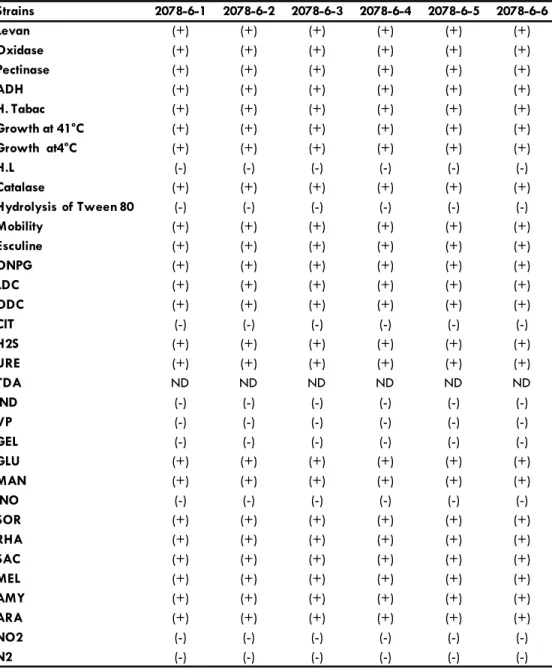
All of our strains were Catalase positive and capable of hydro-lyzing Esculin, but not Tween80 and Gelatin. None of the strains were able to produce Indole and reduce nitrate. However, all strains showed ability to utilize Arginine, Lysine (LDC), Ortnithine
Table 1. P. marginalis strains (2078-6-1, 2078-6-2, 2078-6-3, 2078-6-4, 2078-6-5,) behavior on gallery API20, classic biochemical tests and growth at different temperatures. (ONPG : determination of enzyme beta-galactosidase presence, ADH : transformation of arginine by dishydrolase argnine, LDC : transforma-tion of lysine by decarboxylase lysine, ODC : transformatransforma-tion of ornithine by decarboxylase ornithine, CIT : utilization of citrate as alone source of Carbone, H2S : production of hydrogen sulfate from thiosulfate, URE : liberation of ammoniac from urea by urease, TDA : formation of indolepyruvique acid from tryp-tophan by desaminase tryptryp-tophan, IND : formation of indole from tryptryp-tophan, VP : formation of acetone from sodium piruvate, GEL : liquefaction of gelatin, GlU : Glucose, MAN : Mannitol, INO : Inositol, SOR : Sorbitol, , RHA : Rhamnose, SAC : Sucrose, MEL : Melibiose, AMY : Amygdaline, ARA : Arabinose (formation of acid by utilization of carbon hydrate tests ) ((-): Negative; (+): Positive; ND: No determinate).
(-): Negative; (+): Positive; ND: Indeterminate
Strains 2078-6-1 2078-6-2 2078-6-3 2078-6-4 2078-6-5 2078-6-6
Levan (+) (+) (+) (+) (+) (+)
Oxidase (+) (+) (+) (+) (+) (+)
Pectinase (+) (+) (+) (+) (+) (+)
ADH (+) (+) (+) (+) (+) (+)
H. Tabac (+) (+) (+) (+) (+) (+)
Growth at 41°C (+) (+) (+) (+) (+) (+)
Growth at4°C (+) (+) (+) (+) (+) (+)
H.L (-) (-) (-) (-) (-) (-)
Catalase (+) (+) (+) (+) (+) (+)
Hydrolysis of Tween 80 (-) (-) (-) (-) (-) (-)
Mobility (+) (+) (+) (+) (+) (+)
Esculine (+) (+) (+) (+) (+) (+)
ONPG (+) (+) (+) (+) (+) (+)
LDC (+) (+) (+) (+) (+) (+)
ODC (+) (+) (+) (+) (+) (+)
CIT (-) (-) (-) (-) (-) (-)
H2S (+) (+) (+) (+) (+) (+)
URE (+) (+) (+) (+) (+) (+)
TDA ND ND ND ND ND ND
IND (-) (-) (-) (-) (-) (-)
VP (-) (-) (-) (-) (-) (-)
GEL (-) (-) (-) (-) (-) (-)
GLU (+) (+) (+) (+) (+) (+)
MAN (+) (+) (+) (+) (+) (+)
INO (-) (-) (-) (-) (-) (-)
SOR (+) (+) (+) (+) (+) (+)
RHA (+) (+) (+) (+) (+) (+)
SAC (+) (+) (+) (+) (+) (+)
MEL (+) (+) (+) (+) (+) (+)
AMY (+) (+) (+) (+) (+) (+)
ARA (+) (+) (+) (+) (+) (+)
NO2 (-) (-) (-) (-) (-) (-)
our
nal of
Biolog
y - ISSN 2158-9151. Published By Atlas Publishing
, LP (www
.atlas-publishing
.org)
The Sequence of Isolates strains (2078-6-1, 2078-6-2, 2078-6-3, 2078-6-4, 2078-6-5, 2078-6-6)
Sequence Identity/Similarity GenBank Accession
Numbers
GCCTAGGAATCTGCCTGGTAGTGGGGGA TAACGTCCGGAAACGGACGCTAATACCGC ATACGTCCTACGGGAGAAAGCAGGGGAC CTTCGGGCCTTGCGCTATCAGATGAGCCTA GGTCGGATTAGCTAGTTGGTGGGGTAATG GCTCACCAAGGCGACGATCCGTAACTGGT CTGAGAGGATGATCAGTCACACTGGAACT GAGACACGGTCCAGACTCCTACGGGAGG CAGCAGTGGGGAATATTGGACAATGGGC GAAAGCCTGATCCAGCCATGCCGCGTGTG TGAAGAAGGTCTTCGGATTGTAAAGCACTT TAAGTTGGGAGGAAGGGCCATTACCTAAT ACGTGATGGTTTTGACGTTACCGACAGAAT AAGCACCGGCTAACTCTGTGCCAGCAGCC GCGGTAATACAGAGGGTGCAAGCGTTAAT CGGAATTACTGGGCGTAAAGCGCGCGTA GGTGGTTTGTTAAGTTGGATGTGAAATCCC CGGGCTCAACCTGGGAACTGCATTCAAAA CTGACTGACTAGAGTATGGTAGAGGGTG GTGGAATTTCCTGTGTAGCGGTGAAATGC GTAGATATAGGAAGGAACACCAGTGGCG AAGGCGACCACCTGGACTGATACTGACAC TGAGGTGCGAAAGCGTGGGGAGCAAAC AGGATTAGATACCCTGGTAGTCCACGCCG TAAACGATGTCAACTAGCCGTTGGGAGCC TTGAGCTCTTAGTGGCGCAGCTAACGCATT AAGTTGACCGCCTGGGGAGTACGGCCGC AAGGTTAAAACTCAAATGAATTGACGGGG GCCCGCACAAGCGGTGGAGCATGTGGTT TAATTCGAAGCAACGCGAAGAACCTTACCA GGCCTTGACATCCAATGAACTTTCCAGAGA TGGATTGGTGCCTTCGGGAACATTGAGAC AGGTGCTGCATGGCTGTCGTCAGCTCGTG TCGTGAGATGTTGGGTTAAGTCCCGTAAC GAGCGCAACCCTTGTCCTTAGTTACCAGCA CGTGATGGTGGGCACTCTAAGGAGACTG CCGGTGACAAACCGGAGGAAGGTGGGG ATGACGTCAAGTCATCATGGCCCTTACGGC CTGGGCTACACACGTGCTACAATGGTCGG TACAGAGGGTTGCCAAGCCGCGAGGTG GAGCTAATCCCAGAAAACCGATCGTAGTC CTGATCGCAGTCTGCAACTCGACTGC
HE586394.1
Atlas J
our
nal of
Biolog
y - ISSN 2158-9151. Published By Atlas Publishing
, LP (www
.atlas-publishing
.org)
(ODC), Thiosulfate (H2S), Urea (URE), Glucose (GLU), Mannitol (MAN), Sorbitol (SOR), Rhamnose (RHA), Sucrose (SAC), Meli-biose (MEL), Amygdaline (AMY), Arabinose (ARA), but they did not use Citrate (CIT), Tryptophan (IND), Sodium Piruvate (VP), Gelatin (GEL), Inositol (INO) (Table 1).
The strains can grow at 4°C; low temperatures during this season (2011-2012) may have favored soft rot P. marginalis bacteria development. These results correlate with those of Kim et al. (2002), who showed that the optimal temperature devel-opment is 0°C. Also we have shown the develdevel-opment strains at 40°C.
Pathogenicity Test
The 2078-6-1, 2078-6-2, 2078-6-3, 2078-6-4, 2078-6-5 and 2078-6-6 strains gave a positive reaction in vitro (Fig. 3) and in planta. In vitro tests showed that there was development
of soft rot after ive days of incubation on onion bulbs by P. marginalis as indicated by chlorosis of infected area and ne-crosis development at onion and tomato leaves. In planta tests necrosis development was observed in onion and tomato leaves,
after ive days of incubation and after 14 days onion leaves
died. Dallaire (2009) and (Ibe and Grogan, 1983) show that P.
marginalis is a cause of onion and tomato decay.
Molecular Results
Result of DNA quantiication showed that the quantity of DNA was suficient for PCR (20.18 ng/µl). A band with 1550 bp size
was observed in agarose gel (Fig. 4). Analysis of the 16SrDNA sequence, by BLAST-NCBI, revealed that, the strains isolates (2078-6-1, 078-6-2, 2078-6-3, 2078-6-4, 2078-6-5and 2078-6-6) were identical (100% identity over 1208 nucleo-tides) and that they were most closely related to 16S rDNA se-quences from several strains of P. marginalis (LMG 2214) (Table 2). We also found the presence of associated bacteria namely: Pantoea agglomerans, Pseudomonas luorescens, and Klebsiella oxytoca. El-hendawy (2004) showed that Serratia marcescens
and Klebsiella oxytoca are associated bacteria with P. marginalis in onion crop.
Figure 3. In vitro symptoms induced by artiicial incubation.
(a) Yellowing of onion leaves. (b) Necrosis in tomato leaves. (c)
Soft rot in onion bulbs, after ive days of inoculation.
Figure 4. Electrophoritic proile of P. marginalis stains: (1) 2078-6-1. (2) 2078-6-2. (3) 2078-6-3. (4) 2078-6-4. (5) 2078-6-5. (6) 2078-6-6. (T+) P. marginalis reference strain. (T-) Negative control (H2O).
Figure 2. Pectinase test. Symptoms induced by artiicial inocu -lation of isolates of P. marginalis.
To our knowledge, this is the irst report of bacterial bulbs
soft rot of onion in Morocco. Because the soft rot of onion is the most danger disease during storage, this study is considered as a basic of others works that will target the P. marginalis ecologic and behaviors, to solve the soft rot problem by applying of a biological control. A development of a molecular method is very important for a rapid detection of P. marginalis in soft rot bulbs.
References
Agrios GN (2005) Plant pathology. Fifth edition, Elsevier academic press, 922p.
Altschul SF, Madden TL, Schaffer AA, Zhang J, Zhang Z, W Miller, and DJ Lipman (1997) Gapped BLAST and PSI-BLAST: a new genera-tion of protein database search programs. Nucleic Acids Res (25): 3389–3402.
Anonyme (2010) GenElute™ Mammalian Genomic DNA Miniprep Kit, User Guide, 16p.
Anonyme (2011) Ministère de l’agriculture et de la pêche maritime. Web site : http://www.marocagriculture.com.
Blancard D, H Lot, and B Maisonneuve (2003) Maladie des salades
Charron CS, CE Samsm, and CH Canaday (2002) Impact of glucosino-late content in broccoli (Brassica oleracea) on growth of Pseudomo-nas marginalis, a causal agent of bacterial soft rot. Plant Dis (86): 629-632.
Conn EK, JS Lutton, and SA Rosenberger (2012) Onion Disease guide. Plant Health, 72p.
Dallaire C (2009) La pourriture molle de l’oignon : levures ou bac-téries? Rien de mieux qu’un test de laboratoire! Fiche technique, Québuc, 4p.
El-Hendawy HH (2004) Association of pectolytic luorescent pseudo -monads with postharvest rots of onion. Phytopathol. Mediterr (43): 369–376.
Elumalai PP and A Mahadevan (1995) Characterization of pectate lyase produced by Pseudomonas marginalis and cloning of pec-tate lyase genes. Physiological and Molecular. Plant Pathology (46): 109-119.
Godfrey SAC and JW Marshall (2002) Identiication of cold-tolerant Pseudomonas viridilava and P. marginalis causing severe carrot
postharvest bacterial soft rot during refrigerated export from New Zealand. Plant Pathology (51): 155–162.
Gourc D, D Monnier, and JD Payet (2007) Oignon guide pratique, Ile
de la réunion, France. Fiche technique (www.armelhor.fr).
Hayashi K, Y Inoue, M Shiga, S Sato, R Tankano, K Hirayae, T Hibi, and S Hara (1997) Pectinolytic enzymes from Pseudomonas marginalis. maff03-01173 45 (7): 1359-1363.
Ibe SN and RG Grogan (1983) Effect of controlled oxygen and carbon
our
nal of
Biolog
y - ISSN 2158-9151. Published By Atlas Publishing
, LP (www
.atlas-publishing
.org)
dioxide atmospheres on bacterial growth rate and soft rot of to-mato fruits caused by Pseudomonas marginalis. Plant disease (67): 1005-1008.
Kim YK , SD Lee, CS Choi, SB Lee, and SY Lee (2002) Soft Rot of Onion Bulbs Caused by Pseudomonas marginalis Under Low Temperature Storage. Plant Pathology J 18 (4): 199-203.
Kudela V, V Krejzar, and I Pankova (2010) Pseudomonas corrugata
and Pseudomonas marginalis associated with the collapse of tomato plants in rockwool slab hydroponic culture. Plant Protect. Sci (46): 1-11.
Liao C-H, DE McCallus, WF Fett, and YG Kang (1997) Identiication of
gene loci controlling pectate lyase production and soft-rot pathoge-nicity in Pseudomonas marginalis. Can. J. Microbiol (43): 425-431. Membre JM and PM Burlot (1994) Effects of Temperature, pH, and
NaCl on Growth and Pectinolytic Activity of Pseudomonas margi-nalis. Applied and environmental microbiology 60 (6): 2017-2022. Schaad NW, JB Jones, and W Chun (2001) Laboratory Guide for
Iden-tiication of Plant Pathogenic Bacteria. 3rd Ed. APS Press, St. Paul, 373p.
Scortichini M (1994) Leaf spot and blight of Dieffenbachia amoena caused by Pseudomonas marginalis pv. Marginalis. Plant Pathology (43): 941-943.
Wright PJ, Rd Cronin, and CN Hale (1992) Aield andstorage rot of