Pieter Van Gorp, Louis M. Rose, Christian Krause (Eds.): Sixth Transformation Tool Contest (TTC 2013)
EPTCS 135, 2013, pp. 69–74, doi:10.4204/EPTCS.135.8
Grammars and eMoflon
Anthony Anjorin∗ Technische Universit¨at Darmstadt
Real-Time Systems Lab Merckstr. 25 64283 Darmstadt, Germany [email protected]
Marius Lauder∗ Technische Universit¨at Darmstadt
Real-Time Systems Lab Merckstr. 25 64283 Darmstadt, Germany [email protected]
After 20 years of Triple Graph Grammars (TGGs) and numerous actively maintained implementa-tions, there is now a need for challenging examples and success stories to show that TGGs can be used for real-world bidirectional model transformations. Our primary goal in recent years has been to increase the expressiveness of TGGs by providing a set of pragmatic features that allow a controlled fallback to programmed graph transformations and Java.
Based on theFlowgraphscase study [7] of the Transformation Tool Contest (TTC 2013), we present (i)attribute constraints used to express complex bidirectional attribute manipulation, (ii)
binding expressionsfor specifying arbitrary context relationships, and (iii)post-processing methods
as a black box extension for TGG rules. In each case, we discuss the enabled trade-off between guaranteed formal properties and expressiveness.
Our solution, implemented with eMoflon (www.emoflon.org) our metamodelling and model transformation tool, is available as a virtual machine hosted on Share [15].
1
Introduction and Motivation
Triple Graph Grammars(TGGs) [13] are a declarative, rule-based, bidirectional model transformation language and can be used to specify aconsistency relationover source and target models, with which various operational scenarios, such as a forward and backward transformation, can be automatically supported. As TGGs have been in use for about 20 years and numerous formal results based on algebraic graph transformation [8] have been established, it is now time to tackle convincingly realistic real-world case studies with TGGs.
In our opinion, based on practical experience with our TGG implementation in eMoflon [1], what is necessary is to increase the expressiveness of TGGs by providing a pragmatic set of features that allow a controlledfallbackto a general purpose (transformation) language such as standard Java or programmed graph transformations via, e.g.,Story Driven Modelling(SDM) [4].
Our contribution in this paper is to present a set of advanced TGG features that enable a controlled integration of SDM and Java code in TGG rules. These features are: (i)attribute constraints for com-plex bidirectional attribute manipulation in TGG rules, (ii)binding expressionsfor expressing complex, possibly recursive context relationships, and (iii)post-processing methodsthat allow for arbitrary post-processing after a TGG rule has been applied. Using the case-studyFlowgraphsof the TTC 2013 [7], we present each feature, explaining when it is necessary and discussing the involved trade-off between expressiveness and formal properties.
∗Supported by the ‘Excellence Initiative’ of the German Federal and State Governments and the Graduate School of
2
Solution With Triple Graph Grammars
TheFlowgraphscase study of the TTC 2013 is a text-to-model transformation involving the static anal-ysis of a small Java subset. The task is to transform a simple Abstract Syntax Tree (AST) for Java to a flowgraph, i.e., a model containing explicit information about the control and data flow in the program. In this context,bidirectionalityis a crucial requirement to reflect program manipulations (refactorings, quick-fixes), applied via model transformations, back in the code. To show that eMoflon supports us-ing TGGs directly with standard parser and unparser technology (includus-ing XML), we modify the case study slightly by using ANTLR [12] and StringTemplate [11] for parsing and unparsing Java code, re-spectively. Our TGG rules operate directly on the AST produced by ANTLR without a model parser such as EMFText [5].
A TGG consists of a set of rulesdescribing how source and target models evolve simultaneously. EachTGG ruleconsists ofelements (objects and links), typed according to the classes and references in the respective metamodels. The TGG ruleMethodRule(Fig. 1) creates the root element of the AST representing a class containing a single method (on the left hand side), and aMethod with an explicit Exitelement in the model (on the right hand side). As can be seen from the rule, the AST metamodel (not shown explicitly) consists basically of labelled nodes with children and attributes.
MethodRuleis referred to as an axiom as it only creates elements (green with a“++”markup) and does not require any context (precondition). Note howcorrespondenceelements such asnodeToBlock, depicted visually as hexagons, are created to connect AST elements (classNode) with model elements (method). These elements are used in other rules as traceability links and conform to a simple corre-spondence metamodel, connecting source and target metamodels. The triple of source, correcorre-spondence, and target metamodels is referred to as aTGG schema.
Simple attribute manipulation can be expressed asattribute assignmentssuch astxt = “Exit”in the exitelement. Note that this is automatically interpreted as an assertion for the backward transformation, where the model is parsed and the AST is created.
method : Method
++
methodNode : Node
name := "METHOD"
++
{addSuffix(name.value, "()", method.txt)}
name : Attribute
name := "METHOD_NAME"
++
exit : Exit
txt := "Exit"
++
statementsNode : Node
name := "STATEMENTS"
++
nodeToExit : NodeToExit
++
classNode : Node
name := "CLASS"
++
nodeToMethod : NodeToBlock
++
nodeToBlock : NodeToBlock
++
++ source
++ target
node ++ attribute
++ source parentNode
++ c hildren
++ target ++
source
c hildren ++
parentNode
v alue
++ ex it
++ target
txt
More complex attribute manipulation can be specified using bidirectionalattribute constraints, such as the constraint addSuffix(name.value, “()”, method.txt)in MethodRule, which expresses that the value of thenameattribute in the AST must be equal to thetxt attribute of themethodelement in the model, after adding “()” as a suffix. Attribute constraints such asaddSuffixare interpreted appropriately when compiling the TGG rule for each operational scenario (e.g., forward, backward) and can thus be expressed in a direction agnostic manner fitting to the rest of the TGG rule.
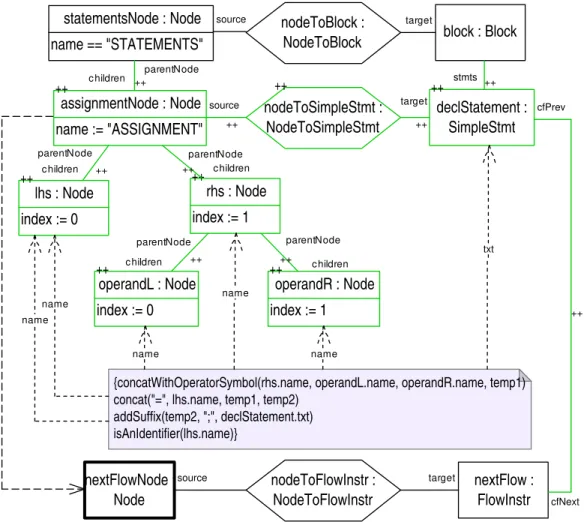
A second TGG ruleAssignmentWithExpRule(Fig. 2) handles, for example, statements of the form “a = b + 3;”represented in the AST as an assignment tree withlhs = “a”,rhs = “+”,operandL = “b”, andoperandR = “3”. To test the flexibility of the transformation language, the case study requires an embeddedmodel-to-texttransformation to transform the tree structure back to text and store it as the at-tribute value of theSimpleStmtelement in the model. This is accomplished inAssignmentWithExpRule with a set of attribute constraints, referred to as theattribute Constraint Satisfaction Problem (CSP)of the TGG rule. How this works is best explained using a concrete example; To handle“a = b + 3;”in the forward transformation, the set of constraints is sorted and solved as follows:
isAnIdentifier("a") => true
concatWithOperatorSymbol("+", "b", "3", temp1) => temp1 = "b + 3" concat("=", "a", "b + 3", temp2) => temp2 = "a = b + 3"
addSuffix("a = b + 3", ";", declStm.txt) => declStm.txt = "a = b + 3;"
The constraintsisAnIdentifierandconcatWithOperatorSymbolareuser defined constraintsand were implemented in Java specifically for the Flowgraphs case study. All other constraints arelibrary con-straintsand are directly available for use in our tool. In this way, the set of constraints can be seamlessly extended by the user, reused, and combined with other constraints in different TGG rules. The constraint isAnIdentifierensures that the rule is not applied for statements such as“int a = b + 3”, where“int a”is not an identifier and is handled with a different rule for declarations. The second user defined constraint concatWithOperatorSymbolis an extension of the normalconcatconstraint and is able to split expres-sions using a list of supported operators as potential characters for splitting/concatenation as required. The attribute CSP is sorted and solved differently but analogously for the backward transformation.
Formally, attribute CSPs serve asapplication conditionsfor TGG rules, and, as access is restricted to only attribute values, most formal results for TGGs still hold as we have shown in previous work [2]. Attribute constraints are implemented in Java and thus allow a controlled integration of Java code for complex attribute manipulation in TGG rules.
Note how the rule requires context elements (black without any markup) that must already exist and have been created by applying a different rule such as MethodRule. In the model, Assignmen-tWithExpRulerequires (i) the parentblockelement that is to contain the created assignment statement declStatement, and (ii) the succeeding elementnextFlowin the flowgraph.
block : Block nodeToBlock :
NodeToBlock statementsNode : Node
name == "STATEMENTS"
assignmentNode : Node
name := "ASSIGNMENT"
++
lhs : Node
index := 0
++
rhs : Node
index := 1
++
declStatement : SimpleStmt
++
nodeToSimpleStmt : NodeToSimpleStmt
++
operandL : Node
index := 0
++
operandR : Node
index := 1
++
{concatWithOperatorSymbol(rhs.name, operandL.name, operandR.name, temp1) concat("=", lhs.name, temp1, temp2)
addSuffix(temp2, ";", declStatement.txt) isAnIdentifier(lhs.name)}
nextFlow : FlowInstr nextFlowNode :
Node
nodeToFlowInstr : NodeToFlowInstr c hildren ++
parentNode
txt
name
name name
++ target
++
source cfPrev
++
cfNext parentNode
++ c hildren
parentNode ++ c hildren parentNode
++ c hildren
target source
++ stmts
parentNode
++ c hildren
name
source target
name
Figure 2: TGG ruleAssignmentWithExpRulefor creating assignment statements
Formally, binding expressions are equivalent to a separate pre-processing step in which all virtual links are created explicitly in an instance of an appropriately augmented metamodel. The TGG rules are then viewed as operating on this augmented metamodel. In practice, however, it is much more convenient to “find” these linkson-the-fly as required. In this manner, binding expressions allow the controlled integration of SDM or Java code in TGG rules to determine complex context relationships.
As a final feature, every TGG rule can invoke a post-processing method (implemented with SDM or Java) to perform some final tasks that are difficult or impossible to specify directly in the TGG rule. InAssignmentWithExpRule, the index of the createdassignmentNode has to be set correctly for the backward transformation, which requires a non-trivial recursive search in the tree structure due to if/else, loop, and return/break statements.
3
Related Work
Related approaches can be divided into three main groups: (i) Other ways of increasing the expressive-ness of TGGs, (ii) Other bidirectional approaches, and (iii) Achieving bidirectionality with unidirectional transformation languages.
(i) TGGs with a separated pre- and post-processing step: A justified question is if it is not better to use TGGs with a clearly separated pre-processing and post-processing step instead of our features for integrating auxiliary methods in the TGG rules. Our approach, however, avoids an extra traversal through the input and output models asbinding expressionscan be used as required to determine context relationships before a TGG rule is applied and apost-processing methodto complete the rule after appli-cation. In this way, the traversal strategy applied by the TGG control algorithm can be used foron-the-fly processing as required. Our practical experience is that users tend to regard TGGs as not being worth the effort if complex pre-processing and post-processing with a separate traversal is necessary. With our approach, the TGG is more in focus and is used to structure the transformation in an iterative manner. (ii) Other bidirectional languages and tools: For a detailed survey of bidirectional languages other than TGGs we refer to [14]. Compared to other bidirectional approaches, TGGs are advantageous as there exist multiple, actively maintained TGG implementations (interpretative, generative and hy-brid approaches) with different strengths and weaknesses. Furthermore, most TGG implementations are Ecore/EMF/Eclipse compatible and are thus suitable in an MDE context together with other EMF tools and infrastructure. In a different context, however, other tools are probably more suitable, e.g., for bidi-rectional XML manipulation [10] and for bidibidi-rectional string and tree manipulation [3]. Depending on the application scenario, it might be more appropriate to derive a backward transformation from a given forward transformation [6] as opposed to describing the simultaneous build-up of model triples.
(iii) Combination of unidirectional transformation languages:A combination of unidirectional trans-formation languages as an alternative to a bidirectional language is advantageous for obvious reasons: Unidirectional transformation languages are typically better established, stable, expressive and have bet-ter tool support. We, however, regard transformation languages with explicit support for bidirectionality as superior as they enable a high-level specification. In the case of TGGs, the specified consistency rela-tion can be used to automatically derive other usefuloperationaltransformations to support conformance testing, consistency checking and link creation for existing source and target models, and incremental model synchronization [9]. Supporting these scenarios and guaranteeing suitable formal properties [8] is quite challenging using separate forward and backward transformations.
4
Future Work
References
[1] Anthony Anjorin, Marius Lauder, Sven Patzina & Andy Sch¨urr (2011): eMoflon : Leveraging EMF and Professional CASE Tools. In:Proc. of Informatik 2011,LNI192, GI, p. 281.
[2] Anthony Anjorin, Gergely Varr´o & Andy Sch¨urr (2012): Complex Attribute Manipulation in TGGs with Constraint-Based Programming Techniques. In:Proc. of Bx 2012,ECEASST49, EASST.
[3] Aaron Bohannon, J.N. Foster, B.C. Pierce, Alexandre Pilkiewicz & Alan Schmitt (2008):
Boomerang: Resourceful Lenses for String Data. ACM SIGPLAN Notices 43(1), pp. 407–419, doi:10.1145/1328897.1328487.
[4] Thorsten Fischer, J¨org Niere, Lars Torunski & Albert Z¨undorf (2000):Story Diagrams: A New Graph Rewrite Language Based on the Unified Modeling Language and Java. In Hartmut Ehrig, Gregor Engels, Hans-J¨org Kreowski & Grzegorz Rozenberg, editors: Proc. of TAGT 1998,LNCS1764, Springer, pp. 296–309, doi:10.1007/978-3-540-46464-8 21.
[5] Florian Heidenreich, Jendrik Johannes, Sven Karol, Mirko Seifert & Christian Wende (2009): Derivation and Refinement of Textual Syntax for Models. In Richard F. Paige, Alan Hartman & Arend Rensink, editors: Proc. of ECMDA-FA 2009,LNCS5562, Springer, pp. 114–129, doi:10.1007/978-3-642-02674-4 9. [6] Soichiro Hidaka, Zhenjiang Hu, Kazuhiro Inaba, Hiroyuki Kato & Keisuke Nakano (2011): GRoundTram:
An Integrated Framework for Developing Well-Behaved Bidirectional Model Transformations. In Perry Alexander, Corina Pasareanu & John Hosking, editors: Proceedings of ASE 2011, IEEE, pp. 480–483, doi:10.1109/ASE.2011.6100104.
[7] Tassilo Horn (2013): The TTC 2013 Flowgraphs Case. In:Sixth Transformation Tool Contest (TTC 2013), EPTCSthis volume.
[8] Felix Klar, Marius Lauder, Alexander K¨onigs & Andy Sch¨urr (2010): Extended Triple Graph Grammars with Efficient and Compatible Graph Translators. In Andy Sch¨urr, C. Lewerentz, G. Engels, W. Sch¨afer & B. Westfechtel, editors: Nagl Festschrift,LNCS 5765, Springer, pp. 141–174, doi:10.1007/978-3-642-17322-6 8.
[9] Marius Lauder, Anthony Anjorin, Gergely Varr´o & Andy Sch¨urr (2012): Efficient Model Synchronization with Precedence Triple Graph Grammars. In Hartmut Ehrig, Gregor Engels, Hans-J¨org Kreowski & Grzegorz Rozenberg, editors:Proc. of ICGT 2012,LNCS7562, Springer, pp. 401–415, doi:10.1007/978-3-642-33654-6 27.
[10] Christian Nentwich, Licia Capra, Wolfgang Emmerich & Anthony Finkelstein (2002):Xlinkit: A Consistency Checking and Smart Link Generation Service.ACM Transactions on Internet Technology2(2), pp. 151–185, doi:10.1145/514183.514186.
[11] Terence John Parr (2004):Enforcing strict model-view separation in template engines. Proc. of WWW ’04, p. 224, doi:10.1145/988672.988703.
[12] Terence John Parr (2007): The Definitive ANTLR Reference: Building Domain-Specific Languages. The Pragmatic Bookshelf.
[13] Andy Sch¨urr (1994): Specification of Graph Translators with Triple Graph Grammars. In G. Tinhofer, editor: Proc. of WG 1994,Lecture Notes in Computer Science903, Springer, pp. 151–163, doi:10.1007/3-540-59071-4 45.
[14] Perdita Stevens (2008):A Landscape of Bidirectional Model Transformations. In Ralf L¨ammel, Joost Visser & Jo˜ao Saraiva, editors:Proc. of GTTSE 2007,LNCS5235, Springer, pp. 408–424, doi:10.1007/978-3-540-88643-3 10.