Topographical characteristics and evaluating water quality in
watershed management
Características topográficas y evaluación del agua en el manejo de cuencas
hidrográficas
Teresa Cristina Tarlé Pissarra1, Flavia Mazzer Rodrigues2, Christiano Luna Arraes3, João Antonio Galbiatti4 y
Maurício José Borges5
ABSTRACT
Topographical characteristics and water quality were evaluated at Hacienda Gloria, in Jaboticabal, São Paulo State, Brazil.
Un-derstanding the relief’s morphometric characteristics and the course of the streams in a small watershed supported the hypothesis
that land-use affects water quality and helps predict how changes in water-flow and the surrounding landscape occur; areas
protected by native forest and those dedicated to agriculture were considered. Water quality was sampled at six sites and physical
and chemical changes were analysed. Monthly water samples were collected from the streams on the same day of each month
during the course of a year; Horiba equipment was used for recording data. One-way analysis of variance (ANOVA) was used
for determining differences between the sites being investigated. Analysing the data revealed significant differences in pH, electric
conductivity, turbidity, dissolved oxygen and temperature. Topographical characteristics have been influenced by agricultural
activity, thereby having an environmental impact. Surface runoff was predominant on steep slopes, mainly in areas near the top
of the watershed. Land-use has had a significant impact on many physical parameters, including stream turbidity and
tem-perature which increased with deforestation. The results indicated the agricultural watershed’s fragility to pollutant exposure and/
or toxicity, mainly due to turbidity in the streams caused by soil erosion, waste discharge and runoff.
Keywords: relief, morphometric characteristics, watershed, environment, land-use management.
RESUMEN
Se evaluaron características topográficas y muestras de agua en un cauce de la hacienda Gloria, municipio Jaboticabal, São
Paulo, Brasil. Las características morfométricas del relieve y del agua fueron estudiadas en una pequeña cuenca hidrográfica,
considerando zonas protegidas con bosque nativo y aquellas que presentaban uso agrícola de la tierra para ajustar la hipótesis
de que el uso de ella afecta la calidad del agua y ayuda a predecir cómo se producen los cambios en este y en el local paisaje
circundante. La calidad del agua fue evaluada en seis sitios y se analizaron los cambios de los parámetros físicos y químicos. Las
muestras fueron recolectadas el mismo día de cada mes, durante un año, mediante un equipo de Horiba. Para determinar
dife-rencias entre los sitios estudiados se realizó el análisis de varianza (Anova). El análisis de los datos presentó difedife-rencias
significa-tivas de pH, conductividad eléctrica, turbidez, oxígeno disuelto y temperatura. Las características topográficas han sido
influen-ciadas por las actividades agrícolas, impactando el medio ambiente. La escorrentía superficial es predominante en las laderas
pronunciadas, sobre todo en las zonas altas de la cuenca. Los resultados indican la fragilidad de la cuenca agrícola a la
exposi-ción de contaminantes o agentes tóxicos, debido a la turbidez en el agua causada por la erosión de los suelos, la deposiexposi-ción de
residuos agrícolas y por la escorrentía superficial.
Palabras clave: características morfométricas, cuenca hidrográfica, medio ambiente, uso do solo.
Recibido: abril 15 de 2008 Aceptado: noviembre 4 de 2008
1 Ingeniera agrónoma. Profesora, FCAV/UNESP/Jaboticabal, São Paulo, Brasil. [email protected], [email protected]
2 Ingeniera agrónoma, FCAV/UNESP/Jaboticabal, São Paulo, Brasil. Vinculada, Departamento de Engenharia Rural - UNESP/Jaboticabal, São Paulo, Brasil. flamazzer@
hotmail.com
3 Ingeniero agrónomo, UFV Universidade Federal de Viçosa, Minas Geraisl, Brasil. Pós – Graduando, Departamento de Solos e Adobos - UNESP/Jaboticabal, São Paulo,
Brasil. [email protected]
4 Ingeniero agrónomo. Profesor, FCAV/UNESP/Jaboticabal, São Paulo, Brasil. [email protected]
5 Ingeniero agrónomo. Profesor, Instituto Taquaritinguense de Ensino Superior ITES, Taquaritinga, São Paulo, Brasil. [email protected]
Introduction
The study of the watershed’s natural characteristic, the catchment area’s morphology, the geological and hydrological conditions and the main anthropogenic factors affecting water quality (land-use) are becoming more and more important in watershed manage-ment developmanage-ment for sustainable agricultural activity. An impor-tant issue concerns how land-use and water quality is evaluated
and how the impact of management practices is assessed (Caruso, 2002; Arcova and Cicco, 1999).
Pissarra (2002) and Rodrigues (2004) have studied land-use in wa-tersheds and its relationship to topographical characteristics.
Monitoring water quality data regarding watersheds has been used for supporting a number of activities relating to agriculture and productive foresty systems in rural areas and for developing urban areas. A number of state and federal laws require ambient water quality monitoring (Braga et al., 2005; Hallock and Ehinger, 2003). The stated aim of the Brazilian National Water Agency (BNWA) is to implement and coordinate the integrated management of sha-red water resources and regulate access to water, promoting its sustainable use for the benefit of current and future generations.
Measuring water quality is an important parameter for monitoring rural area activity as deforestation has many significant ecological and biodiversity consequences which will change the degree of an ecosystem’s functionality or health.
Stream flow can be altered by human activity. The present study was aimed at analysing upstream water quality in two different catchment areas: a forested stream watershed and a deforested stream watershed. The influence of the relief’s morphometric cha-racteristics arising from upland erosion was also analysed, ups-tream with the spring protected by native forest and another area dedicated to agricultural activity. Comparisons were made bet-ween cropped area, pasture and native forest land-use in terms of erosion. The potential benefits of native forest and an improved understanding of the environmental factors and their influence on land degradation in watersheds are discussed; the foregoing can aid agricultural land owners seeking to minimise the extent, degree and rate of their land’s soil degradation.
Material and Methods
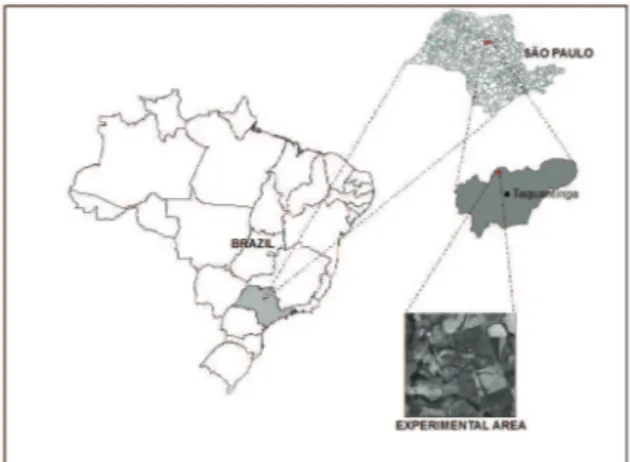
The experimental area was located in Córrego da Fazenda Glória watershed in the municipal district of Taquaritinga, São Paulo state, Brazil (21o 21'S, 48o 31'W.Gr) (Figure 1). The climate is
tropi-cal with 1,200 mm annual rainfall and temperature ranging from 22oC in summer to 18oC in winter (Köeppen Classification-Cw).
Al-titude varies between 578 and 722m. The major soil type is Red-Yellow Argisol, eutrophic text, sandy/medium, undulating relief, moderate A - oxysol (Oliveira et al., 1999).
Figure 1. Experimental area in the Córrego da Fazenda Glória watershed in the municipal district of Taquaritinga, São Paulo state, Brazil
Topographic factors were studied by photointerpretation based on the São Paulo state Aerophotographic Cover Survey (Politano and Pissarra, 1999). Photointerpretation techniques were used to draw the drainage network and respective captions for dimensional ana-lysis and evaluating the selected variables. Morphometric
charac-teristics must be evaluated for studying drainage basins and com-mon dimensions. The Strahler (1957) stream order system was u-sed. The drainage network was separated into components permi-tting quantitative measurement on how drainage networks and ba-sins were developed. The number of streams, area and contours were measured and the length of the upper and lower contours for each basin were related to relief. Altimetry amplitude (H) is the difference in elevation between the mouth and the highest point on the watershed divide in area-altitude analysis. Dividing the area of the contour by relative mean length gives a rough mean width (horizontal distance) for the belt. Dividing the contour interval by mean width can determine the ground’s mean slope within the particular contour belt. The vertical dimension of a basin whose relief is H may also be expressed as a simple function. The relief characteristics evaluated were: altimetry amplitude, relief ratio (the ratio of the difference in elevation between the basin mouth and the highest point on the basin perimeter to basin length), relative relief ratio (relating basin area to the square of basin length), roughness number (product of relief (H) and drainage density); and average basin slope (Strahler, 1958, Pissarra, 2002). Soil distribu-tion within the basin indicated the ratio in which the erosion occu-rred (Politano and Pissarra, 1999); dimensional analysis gave an es-timate of slope steepness in the watershed in question.
The spatial database consisted of land coverage maps of the drainage network, soil units, erosion and native and agricultural vegetation derived from the aerial photographs (scale 1:30.000) and field surveys. The maps were digitised into ARC/INFO and processed using a Geographic Information System-SPRING/INPE. Overlays were made between land-use, erosion and drainage network maps for analytical purposes, thereby generating a digital database and thematic map. States of erosion were evaluated re-ferring to the wearing away of the land surface resulting from agricultural activity and natural vegetation communities, as related to relief characteristics.
Accelerated erosion was established in 5 units as follows:
State (0): natural erosion (natural environmental conditions un-disturbed by man), erosion was not evident in natural cover on photographic images;
State (1): normal erosion (the gradual erosion of land used by man which does not greatly exceed natural erosion), the erosion was not evident in agricultural cover on photographic images;
State (2): rill erosion (erosion in which numerous small channels of only several centimetres depth are formed), erosion was slightly evident in cultivated soils on photographic images;
State (3): sheet erosion (the removal of soil from land surface by rainfall and surface runoff, often interpreted to include rill and in-ter-rill erosion), erosion was more evident in cultivated soils on photographic images;
State (4): deep rill or inter-rill erosion (the removal of a fairly uniform layer of soil due to raindrop impact and by shallow surfa-ce flow; the channels eroded into soil surfasurfa-ce by runoff which can still be filled and removed by tillage), erosion was more evident in soil preparation conditions and cultivated soils on photographic images;
evi-dent in soil preparation conditions and cultivated soils on photo-graphic images.
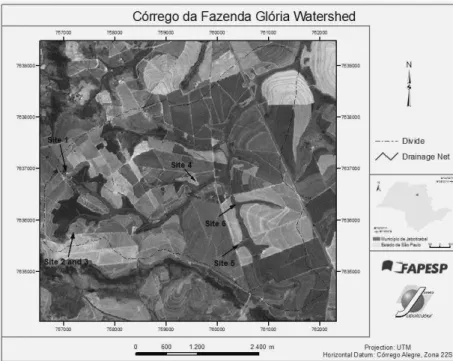
Physical parameters (temperature and turbidity) and chemical pa-rameters (pH, dissolved oxygen and water conductivity) were evaluated according to SMEWW/APHA (1995), using Horiba e-quipment for collecting data at six sites in the watershed’s ups-tream area and SPOT-4 satellite images. 10 meter resolution was used for visual image interpretation of land-use (Figure 2). Data was collected at each sample collection site. The statistical analysis determined the significant difference in physical parameters bet-ween native forest and agricultural land-use watersheds. One-way analysis of variance (ANOVA) was used for investigated sites.
Figure 2. Map of the study area with the location of stream patterns used for collecting water. SPOT satellite image.
Results and Discussion
Dimensional analysis used in combination with each basin’s length, width, height (relief) and area has many applications. The average of relief characteristics, altimetry amplitude (H=80.57), relief ratio (Rr=50.32), relative relief ratio (Rrl=19.04), roughness number (RN=26.35), the basin’s average slope (ASbas=12.72) and soil distribution within the basin indicated the ratio in which erosion was occurring. Such relief characteristics plotted the ba-sin’s elevation and the area above a contour of given height above sea-level. The topography revealed the presence of extensive land where the surface had a pronounced regional slope at sites 1, 2 and 3 when compared to the surface of sites 5 and 6 (Figure 2). Since the determined ratios introduced surface erosion, the main watershed stream and its tributaries’ elevation indicated the pro-cesses whereby rocks and sediments have become eroded. Erosion depended on the soil’s nature and position in the relief. Mapping analysis revealed the geomorphic and physiographic areas where there would conceivably be several kinds of delineation of erosion-nal topography quality. Sites 1, 2 and 3 had a higher surface than sites 5 and 6, differentiating the eroded surface.
The effects of erosion were observed in the natural and agricultural vegetation communities as follows: State 0: 67.95ha – 3.33% of total area; State 1: 12.78ha – 0.63% of total area; State 2: 457.2ha
– 22.42% of total area; State 3: 1208.88ha – 59.28% of total area; State 4: 292.5ha – 14.34% of total area. Areas of permanent crops and pasture presented more intense erosion (4), areas with citrus orchards and sugar-cane presented moderate erosion (2), with su-perficial and shallow furrows (3). These sites would be the most desirable areas for agricultural development.
Topography is related to relief characteristics and position on the landscape; topographical characteristics were thus used for separa-ting soil units and relief, stream patterns were used for collecsepara-ting water samples (Figure 2) and it was seen that land-use had been mainly influenced by agricultural activity (environmental impact).
Map analysis revealed the vegetative cover’s influence on soil degradation, this being the most important factor in reducing soil loss. Native vegetation just showed natural erosion; the influence of the land covering in its larger control of the erosion can sus-tain use with less degradation.
Evaluating land-use indicated the delineation of streams with and without protection. Each stream had sufficient influence on the vegetated landscape and was useful in differentiating forest and agricul-tural activity land-use. Most of the area on sites 1, 2 and 3 was covered by forest and sugar-cane on sites 4 and 5.
Stream pH ranged from 5.73 to 6.93 pH units, con-ductivity from 20 to 120 μmho/cm, turbidity from 1.30 to 20.51 n nephelometric turbidity units (NTU), dissolved oxygen from 4.42 to 8.77mg/L and temperature from 20.4oC to 26.12oC (Table 1).
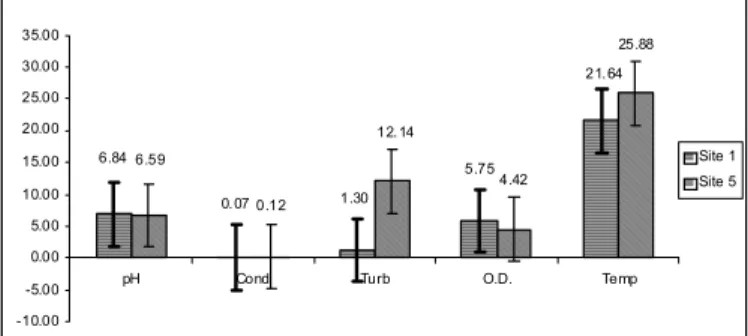
Average stream temperature in the native forest area was 21.64oC whilst being 25.88oC on
agricul-tural land. Temperature values were significantly lower at sites 1, 2 and 3 than sites 4, 5 and 6; this was due to less protection upstream and high inci-dent radiance at stream sites 4, 5 and 6.
Table. 1. Estimated average of the physical and chemical parameters of wa-ter samples taken during 2004 and 2005 years.
Site number pH μCond.
mho/cm Turb UTM
D.O.
mg/L T.
oC
1 Native forest 6.84 70 1.30 5.75 21.64
2 Native forest 5.98 20 6.96 5.12 26.12
3 Native forest 5.73 20 12.06 8.77 25.01 4 Agriculture land 6.34 110 9.70 4.88 20.40 5 Agriculture land 6.59 120 12.14 4.42 25.88 6 Agriculture land 6.93 120 20.51 4.81 21.46 pH: hydrogenionic potential; Cond: conductivity; Turb: turbidity; D.O.: dissolved oxygen and T: stream water temperature.
Soil movement-land-use was significantly correlated to physical and chemical analysis of water samples. Nascent water from the upstream watershed protected with native forest (site N.1), in-cluding hill-slope geometry and high elevation, was better compa-red to that from agricultural land (site N.5) (Figure 3).
Erosion depends on the soil’s nature and position in the relief. Such conditions, preventing land degradation and identifying such aspects will contribute towards determining the causes of specific soil degradation problems, improving effective actions for resolving agricultural and environmental problems.
N.5) meant that water bodies had a denser amount of particles in the water. Dissolved oxygen is necessary for good water quality in a natural stream. However, dissolved oxygen (DO) level in water from a stream surrounded by agricultural activity dropped below 5.0 mg.L-1; it was observed that aquatic life was put under stress
and no fish were observed.
6.84
0. 07 1.30
5.75 21. 64 12. 14 6.59 0.12 4.42 25.88 -10.00 -5.00 0.00 5.00 10.00 15.00 20.00 25.00 30.00 35.00
pH Cond Turb O.D. Temp
Site 1 Site 5
Figure 3. Estimated average pH, electric conductivity, turbidity, dissolved oxygen and temperature of nascent water protected by native forest (Site 1) and nascent water near agricultural activity sites (Site 2), Córrego da Fazenda Glória water-shed, S.P., Brazil
Land-use had a significant impact on the streams’ parameters; the same has been observed by Caruso (2002). Conductivity, turbidity and temperature were higher in the streams near agricultural land, confirming the impact by human activity. Stream conductivity in-creased with an increase in ion concentration, this being attributed to erosion and micronutrients leaching from the soil (Caruso, 2002). Sampling data was used to provide a snapshot of conditions and for detecting the effects present in surface water (Hallock and Ehinger, 2003).
The water samples from all the sites indicated that the soil had been removed from hill-slopes in the study area, reflecting the dy-namic impact of progressive tillage erosion upstream together with agricultural activity.
The complex relationship between the data evaluated and land-use suggested a need for management practices across the water-shed, reducing soil loss and groundwater pollution (Veseth and Miller, 1992). Conservation planning must be used in the area.
The results indicated the agricultural watershed’s exposure to pollutants and/or toxicity. The real significance of such variation was not fully elucidated by the present investigation. However, the study of the water in conjunction with soil will contribute to a mo-re compmo-rehensive pictumo-re of environmental pollution in water-sheds, representing a useful reference point for future anthropoge-nic impact assessment in these areas.
Land restoration alongside the streams is an essential tool in the campaign to protect, improve, and increase protected areas; topo-graphical characteristics have been influenced by agricultural acti-vity’s environmental impact.
These areas have retained their soil and hydrology characteristics, thereby allowing their natural functions to be reclaimed. Restora-tion is a complex process requiring planning, implementaRestora-tion, mo-nitoring and management. It involves renewing natural and histori-cal knowledge which has been lost or degraded and reclaiming their functions and values as vital ecosystems. Restoring our lost and degraded areas alongside the streams in their natural state is essential to ensure the health of the watershed being studied.
Conclusions
Characterising the watershed indicated that agricultural manage-ment activity affected stream water quality;
Watershed water quality upstream in a forested area was better than that in a deforested stream;
Turbidity was altered by human activity and analysing the data revealed significant differences in pH, electric conductivity, dissol-ved oxygen and temperature in upstream water protected by nati-ve forest and other land devoted to agricultural activity;
There was a predominant area of sheet and rill erosion on the ma-in basma-in slope; such conditions led to land degradation;
Topographical characteristics have been influenced by agricultural activity’s environmental impact. Land-use cover interpretation and the geographic information system used were an important tool for analysing the data; and
Monthly, seasonal or annual water quality monitoring and erosion evaluation (depending on the nature of the water resource and a watershed’s dimensional characterisation) indicates the ecological health and water chemistry for providing overall assessment of water quality. Future work aimed at monitoring chemical, physical and biological parameters is necessary for better urban develop-ment and expanding agricultural areas for minimising the impact on ground and surface water-flow.
Acknowledgements
We would like to thank FAPESP, UNESP/FCAV for supporting this investigation. The study was financed by FAPESP and CNPq.
Bibliography
Arcova, F. C. S., Cicco, V. de., Qualidade da água de micro-bacias com diferentes usos do solo na região de Cunha., Estado de São Paulo, Scientia Florestalis, Vol.56, 1999, pp.125–134. Braga, B.; Hespanhol, I.; Conejo, J. G. L., Introdução à
engenha-ria ambiental., 2a ed. São Paulo, Pearson Prentice Hall, 2005, pp. 318 p.
Caruso, B., A survey comparing streams from forested and defo-rested watersheds to assess impact of land use change on the northeast shore of Lake Tanganyika., Nyanza, Annual Report, 2002.
Hallock, D., Ehinger, W., Quality Assurance Monitoring Plan., Stream ambient water quality monitoring, Environmental Assess-ment Program, Washington State DepartaAssess-ment of Ecology, Olympia, Washington, 2003, pp.28.
Pissarra,T. C. T., Análise da bacia hidrográfica do Córrego Rico na sub-região de Jaboticabal., SP: Comparação entre imagens TM-Landsat 5 e fotografias aéreas verticais, 132f., tese apresentada à Universidade Estadual Paulista, Campus Jaboticabal, para obter a formação de Doutor, 2002.
Standard Methods for the Examination of Water and Wastewater., 19th edn, American Public Health Association/American Water Works Association/Water Environment Federation, Washington DC, USA, 1995, pp 1600.
quaritinga, S.P. Jaboticabal, tese apresentada à Universidade Estadual Paulista, Campus Jaboticabal, para obter a formação de Engenheiro Agrônomo, 2005.
Silva, L., Williams, D. D., Buffer zone versus whole catchment approaches to studying land use impact on river water quality., Water Research, Vol.35, No. 14, 2001, pp.3462-3472.
Strahler, A. N., Dimensional analysis applied to fluvially eroded
landforms., Bull. Geol. Soc. Am., Vol. 69, 1958, pp. 279-300. Tong, S. T. Y., Chen, W., Modelling the relationship between land
use and surface water quality., In: Journal of Environmental Ma-nagement, Vol. 66, 2002, pp.377-393.