GID
4, 515–531, 2014Auroral all-sky camera calibration
F. Sigernes et al.
Title Page
Abstract Introduction
Conclusions References
Tables Figures
◭ ◮
◭ ◮
Back Close
Full Screen / Esc
Printer-friendly Version Interactive Discussion
Discussion
P
a
per
|
Discus
sion
P
a
per
|
Discussion
P
a
per
|
Discussion
P
a
per
|
Geosci. Instrum. Method. Data Syst. Discuss., 4, 515–531, 2014 www.geosci-instrum-method-data-syst-discuss.net/4/515/2014/ doi:10.5194/gid-4-515-2014
© Author(s) 2014. CC Attribution 3.0 License.
This discussion paper is/has been under review for the journal Geoscientific Instrumentation, Methods and Data Systems (GI). Please refer to the corresponding final paper in GI if available.
Auroral all-sky camera calibration
F. Sigernes1,*, S. E. Holmen1,*, D. Biles2, H. Bjørklund1, X. Chen1,*, M. Dyrland1,*, D. A. Lorentzen1,*, L. Baddeley1,*, T. Trondsen3, U. Brändström4, E. Trondsen5, B. Lybekk5, J. Moen5, S. Chernouss6, and C. S. Deehr7
1
University Centre in Svalbard, Longyearbyen, Norway
2
Magnetosphere Ionosphere Research Lab, University of New Hampshire, New Hampshire, USA
3
Keo Scientific Ltd., Calgary, Alberta, Canada
4
Swedish Institute of Space Physics, Kiruna, Sweden
5
Department of Physics, University of Oslo, Oslo, Norway
6
Polar Geophysical Institute, Murmansk Region, Apatity, Russia
7
Geophysical Institute, University of Alaska, Fairbanks, USA
*
also at: Birkeland Centre for Space Science, University of Bergen, Bergen, Norway
Received: 8 August 2014 – Accepted: 26 August 2014 – Published: 1 September 2014
Correspondence to: F. Sigernes ([email protected])
GID
4, 515–531, 2014Auroral all-sky camera calibration
F. Sigernes et al.
Title Page
Abstract Introduction
Conclusions References
Tables Figures
◭ ◮
◭ ◮
Back Close
Full Screen / Esc
Printer-friendly Version Interactive Discussion
Discussion
P
a
per
|
Discus
sion
P
a
per
|
Discussion
P
a
per
|
Discussion
P
a
per
|
Abstract
A two-step procedure to calibrate the spectral sensitivity to visible light of auroral all-sky cameras is outlined. Center pixel response is obtained by the use of a Lambertian surface and a standard 45W tungsten lamp. Screen brightness is regulated by the distance between the lamp and the screen. All-sky flat-field correction is carried out
5
with a 1 m diameter integrating sphere. A transparent Lexan dome at the exit port of the sphere is used to simulate observing conditions at the Kjell Henriksen Observatory (KHO). A certified portable low brightness source from Keo Scientific Ltd. was used to test the procedure. Transfer lamp certificates in units of Rayleigh per Ångstrøm (R Å−1)
are found to be within a relative error of 2 %. An all-sky camera flat-field correction
10
method is presented with only 6 required coefficients per channel.
1 Introduction
During the last decades, numerous ground-based all-sky cameras have been installed in both hemispheres to monitor aurora and airglow. In the northern hemisphere, the field of view of these cameras overlap to cover large sections of the aurora oval (cf.
Aka-15
sofu, 1964). The desire to, for example, estimate and compare auroral hemispherical power as measured by satellites (cf. Zhang and Paxton, 2008), requires unified and accurate calibration routines (Brändström et al., 2012) to quantify the radiance in pho-tometric units (Hunten et al., 1956). This paper presents a two-step procedure to cali-brate in sensitivity the all-sky cameras at the Kjell Henriksen Observatory (KHO).
20
2 Experimental setup
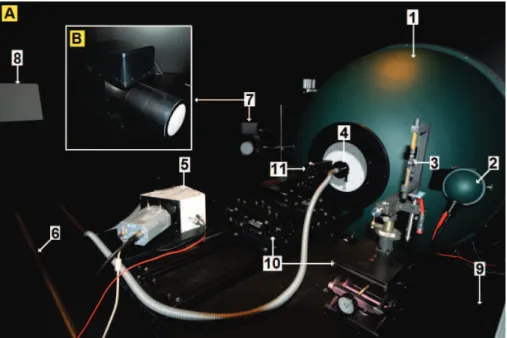
The calibration tools are shown in Fig. 1. The Fixed Imaging Compact Spectrograph (FICS) is mounted on a height adjustable table that moves on rails perpendicular to-wards the Lambertian screen. The entrance optics of FICS is a 22◦ field of view fused
GID
4, 515–531, 2014Auroral all-sky camera calibration
F. Sigernes et al.
Title Page
Abstract Introduction
Conclusions References
Tables Figures
◭ ◮
◭ ◮
Back Close
Full Screen / Esc
Printer-friendly Version Interactive Discussion
Discussion
P
a
per
|
Discus
sion
P
a
per
|
Discussion
P
a
per
|
Discussion
P
a
per
|
silica fibre bundle. The spectrograph is made by ORIEL (model 77443). It uses a con-cave holographic grating (230 grooves mm−1). The nominal spectral range is 4000–
11 000 Å, and the bandpass is approximately 80 Å with the 100 µm wide entrance-slit. The detector is a 16-bit dynamic range thermoelectric cooled CCD from the company Andor (model DU 420A-OE). Our main calibration source, the 45W tungsten lamp from
5
Oriel (s/n 7-1867), is also mounted on the table. The lamp is a traceable National In-stitute of Standards (NIST) source. The lamp certificate is listed in Table 1. Both the Lambertian screen (SRT-99-180) and the 1 m diameter integrating sphere (CSTM-LR-40) are made by the company Labsphere. Note that in Fig. 1, the spectrograph is set up to measure the output of the integrating sphere.
10
The integrating sphere is modified by including a transparent dome at the exit port and a baffle to block light from the source sphere. A sketch of the modifications is shown in Fig. 2. The dome is made of the same material (Lexan) and thickness (5 mm) as the domes at the KHO. The all-sky cameras should be inserted into the dome in order to fill the total field of view of 180◦. The ba
ffle acts as a moon blocker. The net result is
15
that observational and calibration conditions are the same for all optical instruments housed at the KHO.
The FICS is sensitivity calibrated by the use of the Lambertian screen and the 45W tungsten lamp. The distance and angle between the screen and the lamp reg-ulates the brightness of the screen. This well-known method of calibrating narrow field
20
of view instruments is described in detail by Sigernes et al. (2007).
3 Test and tuning of calibration tools
A mobile low light source made by the company Keo Scientific is used to test the new calibration method. The head unit of the Keo Alcor-RC low brightness source (s/n 10113) is visible in Fig. 1. It contains a 100W tungsten lamp, aperture wheels and
25
GID
4, 515–531, 2014Auroral all-sky camera calibration
F. Sigernes et al.
Title Page
Abstract Introduction
Conclusions References
Tables Figures
◭ ◮
◭ ◮
Back Close
Full Screen / Esc
Printer-friendly Version Interactive Discussion
Discussion
P
a
per
|
Discus
sion
P
a
per
|
Discussion
P
a
per
|
Discussion
P
a
per
|
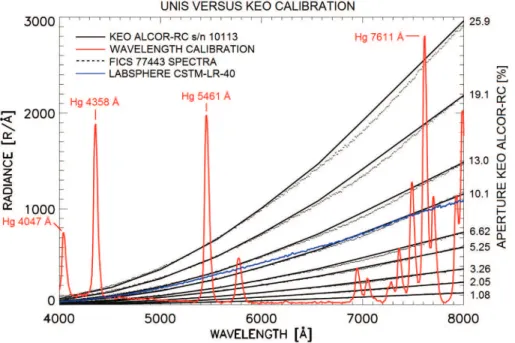
The FICS fiber probe is mounted head-on to the center of the output surface of the Keo-Alcor-RC source. The field of view of the probe is then within a 1 cm diameter spot size of the diffuse surface. The setup is compatible to the spectral irradiance measured by Gaertner (2013). Figure 3 shows the measured FICS spectra and the corresponding certified spectra from NRC, as a function of aperture setting. The Keo Alcor-RC
aper-5
ture is given in units of percentage. 100 % is maximum brightness, while 10 % means that the brightness is one tenth of maximum.
The percent of error between the measured integrated FICS spectra and the NRC certificate is used to quantify the relative difference in the calibrations. The results are listed Table 2 as a function of Keo aperture. Note that the relative errors are less than
10
or equal to 2 %.
Next step in the test is to move the FICS fiber probe to the center of the Labsphere integrating sphere output port, and tune the aperture of the source sphere down to a level that corresponds to the one tenth aperture brightness of the Alcor-RC source. The spectral radiance is then below a border of∼1 kR Å−1, which is close to the intensity 15
range of magnitude for auroras and airglow as indicated by the blue colored spectrum in Fig. 3.
4 Basic camera equations
This section derives the equations needed for calibration of multiple wavelength filtered all-sky cameras. The experimental setup is as sketched in Fig. 2 using the integrating
20
sphere as source. The type of filters used depends on center wavelengthλc, bandpass BP and transmissionT. The most traditional one is the Fabry–Perot filter design, where parallel transparent glass plates create interference due to multiple reflections between the plates.
GID
4, 515–531, 2014Auroral all-sky camera calibration
F. Sigernes et al.
Title Page
Abstract Introduction
Conclusions References
Tables Figures
◭ ◮
◭ ◮
Back Close
Full Screen / Esc
Printer-friendly Version Interactive Discussion
Discussion
P
a
per
|
Discus
sion
P
a
per
|
Discussion
P
a
per
|
Discussion
P
a
per
|
The raw data counts of the camera at pixel position (x,y) is given as an integral over wavelength
u= Z
B(λ)·S(λ)d λ, [cts] (1)
whereS is defined as the spectral responsivity andBis the source spectrum in abso-lute units. The wavelength dependency of the spectral responsivity is assumed to be
5
proportional to the transmission of the filter
S(λ) ≈ε·T(λ)
h
cts R−1i. (2)
If the sourceB, lens transmissions and detector sensitivity varies slowly in the wave-length interval∆λ, then Eq. (1) becomes
u=B(λc)·ε·
Z
T(λ)d λ =B(λc)·ε·A. (3) 10
Ais the area of the filter transmission curve. It is assumed that T is narrow and trian-gular in shape. Then
A= Z
T(λ)d λ≈Tm·BP. (4)
Tm is the peak transmission of the filter atλ=λ c. Furthermore, the spectral radiance
of a discrete auroral emission line at wavelengthλcis defined as
15
Ja(λ) ≡J ·δ(λ−λc) , h
R Å−1i (5)
whereδis the Kronecker delta. The number of auroral raw data counts is then
ua= Z
Ja(λ)·S(λ)d λ=
Z
J ·δ(λ−λc)·ε·T(λ)d λ
=J ·ε·
Z
T(λ)·δ(λ−λc)d λ=J ·ε·Tm. (6)
GID
4, 515–531, 2014Auroral all-sky camera calibration
F. Sigernes et al.
Title Page
Abstract Introduction
Conclusions References
Tables Figures
◭ ◮
◭ ◮
Back Close
Full Screen / Esc
Printer-friendly Version Interactive Discussion
Discussion
P
a
per
|
Discus
sion
P
a
per
|
Discussion
P
a
per
|
Discussion
P
a
per
|
Finally from Eqs. (3), (4) and (6)
J =ua×
B(λ c)·BP
u
[R]. (7)
Note that Eq. (7) only is valid when the transmission profile of the filter is narrow and triangular.
The (B/u) factor for each pixel in the all-sky image must be examined further. Let us
5
introduce the radial center pixel distance,R, of a point in the image plane defined as
R ≡
q
(x−xc)2+(y −yc)2. (8)
(xc,yc) are the center pixel coordinates. The relation betweenRand the zenith angleθ
is known as the radial mapping function. Table 3 lists typical fish-eye mapping functions. In a more general form, Kumler and Bauer (2000) suggested that circular image
fish-10
eye lenses have mapping functions equal to
R =k1·f ·sin (k2·θ) [mm]. (9)
For the hyperspectral all-sky camera at KHO named NORUSCA II (Sigernes et al., 2012) the coefficients aref=3.5 mm,k1=1.2 andk2=0.83 using known star positions
as input data.
15
The radianceBof the integrating sphere is per definition uniform in all directions ofθ, and (x,y)-points with equalRshould, due to symmetry, have the same raw data count rate ofu. As a consequence, it is useful to transform our (x,y) coordinates to (R,θ) coordinates by Eqs. (8) and (9). A functional fit to the data for each wavelength channel may then be found as
20
u=u(θ) ≈u(0)·a0cos (a1·θ)+a2
. (10)
A 3rd degree polynomial fit may also be used. The final form of Eq. (7) becomes
J =ua×
B(λ c)·BP
u(0)
×
1
a0cos (a1·θ)+a2
. (11)
GID
4, 515–531, 2014Auroral all-sky camera calibration
F. Sigernes et al.
Title Page
Abstract Introduction
Conclusions References
Tables Figures
◭ ◮
◭ ◮
Back Close
Full Screen / Esc
Printer-friendly Version Interactive Discussion
Discussion
P
a
per
|
Discus
sion
P
a
per
|
Discussion
P
a
per
|
Discussion
P
a
per
|
Note that the left bracket in Eq. (11) only requires center (θ=0) values of u, while the right bracket describes the off-axis (θ >0) behavior of the camera. It is known as flat-field correction of imageua.
Based on the above equations we propose the calibration to be undertaken in two steps. The first step is to find the coefficients a0, a1 and a2 by using the integrating
5
sphere. The second step is to measure the center pixel area counts ofu(0) by using the Lambertian screen setup instead of the integrating sphere. The screen to lamp distancezis very useful to regulate screen brightness to the same order of magnitude as that expected during sampling of the aurora. The exposure time and gain settings are identical for both the calibration and normal dark-sky operation of the cameras.
10
The latter also cancels out any effect due to nonlinear behavior of count levels versus exposure time. The spectral radiance of the screen is given as
B(λ) =
4ρ
106
×M0(λ)× z
0
z
2
×cosα [R Å−1]. (12)
M0(λ) is the known irradiance (certificate) of the lamp in units of [#pho-tons cm−2s−1Å−1], initially obtained at a distance ofz
0=0.5 m (see Table 1). The
dif-15
fuse reflectance factor ρ of the screen is nearly constant (ρ=0.98) throughout the visible and near infrared regions of the spectrum. The angleα is between the screen and the tungsten lamp (α=0).
5 Results
Three one second exposures at centre wavelengths 4861, 5577 and 6300 Å of the
20
integrating sphere were used to obtain the raw count ratio u(θ)/u(0) for the NOR-USCA II camera. The results are shown in Fig. 4. A functional LMFIT in IDL (Interactive Data Language) based on the Levenberg-Marquardt algorithm results in coefficients
a0=0.38, a1=1.29 anda2=0.63 (see Eq. 10). Note that in our case there is no sig-nificant difference in shape and level of the raw count ratio between the 3 wavelength
GID
4, 515–531, 2014Auroral all-sky camera calibration
F. Sigernes et al.
Title Page
Abstract Introduction
Conclusions References
Tables Figures
◭ ◮
◭ ◮
Back Close
Full Screen / Esc
Printer-friendly Version Interactive Discussion
Discussion
P
a
per
|
Discus
sion
P
a
per
|
Discussion
P
a
per
|
Discussion
P
a
per
|
channels. This leads to the conclusion that the off-axis effect of the NORUSCA II cam-era is the same for all wavelengths across the visible spectrum. Or in other words, flat-field correction is independent of wavelength. All parameters in the right bracket of Eq. (11) are now found.
The centre pixel calibration factors of the NORUSCA II camera [B(λc)·BP/u(0)] were 5
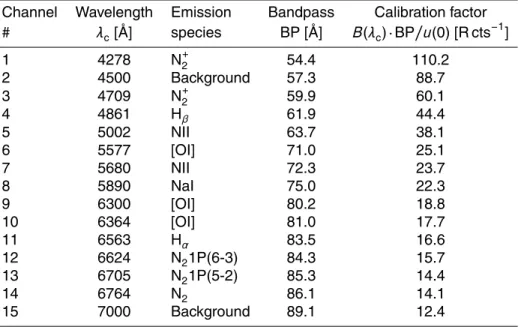
found by the method described by Sigernes et al. (2007). 15 wavelength bands were selected to cover the most prominent auroral emissions within the spectral range of the camera. Table 4 lists the origin of the emissions and the corresponding calibrations factors.
The net result is that the camera is sensitivity calibrated and flat-field corrected with
10
only 6 parameters per channel. For each pixel we obtain the radial center distanceR
by Eq. (8). Two parameters k1 and k2 are used in Eq. (9) to calculate the elevation
θ. Three more parametersa0,a1 and a2 in Eq. (10) are then used to correct for off -axis effects. The sixth parameter is the center pixel calibration factor [B(λc)·BP/u(0)] of Eq. (11).
15
The above procedure is fast to compute and ideal for real-time display of all-sky calibrated data.
6 Conclusions
A two-step method to calibrate and flat-field correct an all-sky camera is outlined. The center pixel spectral sensitivity is obtained and tested by a traditional method including
20
a flat Lambertian screen and a 45W tungsten lamp. Flat-field correction or off-axis response is conducted by the use of a modified 1 m diameter integrating sphere. The net result is that it is sufficient with only six parameters per channel to calibrate an all-sky camera.
GID
4, 515–531, 2014Auroral all-sky camera calibration
F. Sigernes et al.
Title Page
Abstract Introduction
Conclusions References
Tables Figures
◭ ◮
◭ ◮
Back Close
Full Screen / Esc
Printer-friendly Version Interactive Discussion
Discussion
P
a
per
|
Discus
sion
P
a
per
|
Discussion
P
a
per
|
Discussion
P
a
per
|
Acknowledgements. We wish to thank Arnold A. Gaertner at NRC for assistance and checking our calibration equations. This work is financially supported by The Research Council of Nor-way through the project named: Norwegian and Russian Upper Atmosphere Co-operation on Svalbard part 2 #196173/S30 (NORUSCA2).
References
5
Akasofu, S. I.: The latitudinal shift of the auroral belt, J. Atmos. Terr. Phys., 26, 1167–1174, 1964.
Brändström, B. U. E., Enell, C.-F., Widell, O., Hansson, T., Whiter, D., Mäkinen, S., Mikhaylova, D., Axelsson, K., Sigernes, F., Gulbrandsen, N., Schlatter, N. M., Gjendem, A. G., Cai, L., Reistad, J. P., Daae, M., Demissie, T. D., Andalsvik, Y. L., Roberts, O., Poluyanov, S., and
10
Chernouss, S.: Results from the intercalibration of optical low light calibration sources 2011, Geosci. Instrum. Method. Data Syst., 1, 43–51, doi:10.5194/gi-1-43-2012, 2012.
Gaertner, A.: Spectral radiance of low brightness source serial number 10113, Calibration re-port no. PAR-2012-3049, Institute for National Measurement Standards, National Research Council Canada, 1–11, 2013.
15
Hunten, D. M., Roach, F. E., and Chamberlain, J. W.: A photometric unit for the airglow and aurora, J. Atmos. Terr. Phys., 8, 345–346, 1956.
Kumler, J. J. and Bauer, M. L.: Fish-eye lens design and their relative performance, Proc. SPIE 4093, Current Developments in Lens Design and Optical Systems Engineering, 24 Oc-tober 2000, San Diego, CA, USA, doi:10.1117/12.405226, 2000.
20
Sigernes, F., Holmes, J. M., Dyrland, M., Lorentzen, D. A., Chernouss, S. A., Svenøe, T., Moen, J., and Deehr, C. S.: Absolute calibration of optical devices with a small field of view, J. Opt. Technol., 74, 669–674, 2007.
Sigernes, F., Ivanov, Y., Chernouss, S., Trondsen, T., Roldugin, A., Fedorenko, Y., Kozelov, B., Kirillov, A., Kornilov, I., Safargaleev, V., Holmen, S., Dyrland, M., Lorentzen, L., and Baddeley,
25
L.: Hyperspectral all-sky imaging of auroras, Opt. Express, 20, 27650–27660, 2012.
GID
4, 515–531, 2014Auroral all-sky camera calibration
F. Sigernes et al.
Title Page
Abstract Introduction
Conclusions References
Tables Figures
◭ ◮
◭ ◮
Back Close
Full Screen / Esc
Printer-friendly Version Interactive Discussion
Discussion
P
a
per
|
Discus
sion
P
a
per
|
Discussion
P
a
per
|
Discussion
P
a
per
|
Table 1.Oriel 45W tungsten lamp certificate (s/n 7-1867). The spectral irradiance values are measured at a distance ofz0=0.5 m.
Wavelength Irradiance Irradiance
M0(λ)λ[Å] M0(λ) [mW m− 2
nm−1] [#photons cm−2s−1Å−1]
4000 0.79670 1.60221×10¹⁰
4500 1.71388 3.87755×10¹⁰
5000 2.99143 7.51994×10¹⁰
5550 4.65315 1.29839×10¹¹
6000 6.04915 1.82478×10¹¹
6546 7.64049 2.51456×10¹¹
7000 8.76666 3.08530×10¹¹
8000 11.1985 4.50416×10¹¹
GID
4, 515–531, 2014Auroral all-sky camera calibration
F. Sigernes et al.
Title Page
Abstract Introduction
Conclusions References
Tables Figures
◭ ◮
◭ ◮
Back Close
Full Screen / Esc
Printer-friendly Version Interactive Discussion
Discussion
P
a
per
|
Discus
sion
P
a
per
|
Discussion
P
a
per
|
Discussion
P
a
per
|
Table 2.The difference in spectral calibration between UNIS-FICS and NRC of the Keo Alcor-RC low brightness source as a function of aperture. All numbers are in units of %.
Keo Alcor-RC aperture
25.9 19.1 13.0 10.1 6.62 5.24 3.26 2.05 1.08
GID
4, 515–531, 2014Auroral all-sky camera calibration
F. Sigernes et al.
Title Page
Abstract Introduction
Conclusions References
Tables Figures
◭ ◮
◭ ◮
Back Close
Full Screen / Esc
Printer-friendly Version Interactive Discussion
Discussion
P
a
per
|
Discus
sion
P
a
per
|
Discussion
P
a
per
|
Discussion
P
a
per
|
Table 3.Fish-eye mapping functions. f is effective the focal length of the lens, and θ is the angle to the optical axis.
Type Fish-eye mapping function
Linear scaled R=f×θ
Orthographic R=f×sin(θ)
Equal area R=2×f×sin(θ/2)
Stereographic R=2×f×tan(θ/2)
GID
4, 515–531, 2014Auroral all-sky camera calibration
F. Sigernes et al.
Title Page
Abstract Introduction
Conclusions References
Tables Figures
◭ ◮
◭ ◮
Back Close
Full Screen / Esc
Printer-friendly Version Interactive Discussion
Discussion
P
a
per
|
Discus
sion
P
a
per
|
Discussion
P
a
per
|
Discussion
P
a
per
|
Table 4.NORUSCA II all-sky camera center value calibration factors.
Channel Wavelength Emission Bandpass Calibration factor # λc [Å] species BP [Å] B(λc)·BP/u(0) [R cts−1]
1 4278 N+2 54.4 110.2
2 4500 Background 57.3 88.7
3 4709 N+2 59.9 60.1
4 4861 Hβ 61.9 44.4
5 5002 NII 63.7 38.1
6 5577 [OI] 71.0 25.1
7 5680 NII 72.3 23.7
8 5890 NaI 75.0 22.3
9 6300 [OI] 80.2 18.8
10 6364 [OI] 81.0 17.7
11 6563 Hα 83.5 16.6
12 6624 N21P(6-3) 84.3 15.7
13 6705 N21P(5-2) 85.3 14.4
14 6764 N2 86.1 14.1
GID
4, 515–531, 2014Auroral all-sky camera calibration
F. Sigernes et al.
Title Page
Abstract Introduction
Conclusions References
Tables Figures
◭ ◮
◭ ◮
Back Close
Full Screen / Esc
Printer-friendly Version Interactive Discussion
Discussion
P
a
per
|
Discus
sion
P
a
per
|
Discussion
P
a
per
|
Discussion
P
a
per
|
2
Figure 1.Experimental setup at the UNIS calibration lab.(a)(1) Labsphere 1m diameter low light level integrating sphere, (2) source sphere with tungsten lamp, (3) 45W tungsten lamp, (4) FICS fiber bundle probe, (5) FICS, (6) rail road, (7) Keo Alcor-RC low light source, (8) Lam-bertian screen, (9) height adjustable table on rails, (10) table jacks, and (11) rotary probe mount. (b)Keo Alcor-RC low light source.
GID
4, 515–531, 2014Auroral all-sky camera calibration
F. Sigernes et al.
Title Page
Abstract Introduction
Conclusions References
Tables Figures
◭ ◮
◭ ◮
Back Close
Full Screen / Esc
Printer-friendly Version Interactive Discussion
Discussion
P
a
per
|
Discus
sion
P
a
per
|
Discussion
P
a
per
|
Discussion
P
a
per
|
GID
4, 515–531, 2014Auroral all-sky camera calibration
F. Sigernes et al.
Title Page
Abstract Introduction
Conclusions References
Tables Figures
◭ ◮
◭ ◮
Back Close
Full Screen / Esc
Printer-friendly Version Interactive Discussion
Discussion
P
a
per
|
Discus
sion
P
a
per
|
Discussion
P
a
per
|
Discussion
P
a
per
|
Figure 3.Absolute and wavelength calibration of the FICS. The line spectrum in red is from a mercury vapour lamp supplied by Edmund Optics Ltd (SN K60-908). The solid black spectra are from the Keo Alcor-RC certificate. The corresponding black dotted lines are spectra measured by the FICS. The spectrum of the integrating sphere is plotted in blue.
GID
4, 515–531, 2014Auroral all-sky camera calibration
F. Sigernes et al.
Title Page
Abstract Introduction
Conclusions References
Tables Figures
◭ ◮
◭ ◮
Back Close
Full Screen / Esc
Printer-friendly Version Interactive Discussion
Discussion
P
a
per
|
Discus
sion
P
a
per
|
Discussion
P
a
per
|
Discussion
P
a
per
|
θ
0) θ=