Oficial Journal of the Brazilian Psychiatric Association Volume 35 • Number 1 • February/2013
Psychiatry
Revista Brasileira de Psiquiatria
Abstract
Objective: Summarize data on metabolic syndrome (MS) in bipolar disorder (BD). Methods: A systematic review of the literature was conducted using the Medline, Embase and PsycInfo databases, using the keywords “metabolic syndrome”, “insulin resistance” and “metabolic X syndrome” and cross-referencing them with “bipolar disorder” or “mania”. The following types of publications were candidates for review: (i) clinical trials, (ii) studies involving patients diagnosed with bipolar disorder or (iii) data about metabolic syndrome. A 5-point quality scale was used to assess the methodological weight of the studies. Results: Thirty-nine articles were selected. None
of studies reached the maximum quality score of 5 points. The prevalence of MS was signiicantly
higher in BD individuals when compared to a control group. The analysis of MS subcomponents
showed that abdominal obesity was heterogeneous. Individuals with BD had signiicantly higher
rates of hypertriglyceridemia than healthy controls. When compared to the general population,
there were no signiicant differences in the prevalence of low HDL-c in individuals with BD. Data on hypertension were also inconclusive. Rates of hyperglycemia were signiicantly greater in
patients with BD compared to the general population. Conclusions: The overall results point to the presence of an association between BD and MS, as well as between their subcomponents.
© 2013 Associação Brasileira de Psiquiatria. Published by Elsevier Editora Ltda. All rights reserved.
Bipolar disorder and metabolic syndrome: a systematic review
Letícia Czepielewski,
1Ledo Daruy Filho,
1Elisa Brietzke,
2,3Rodrigo Grassi-Oliveira
11Developmental Cognitive Neuroscience Research Group, Pontifícia Universidade Católica do Rio Grande do Sul, Brazil. 2Program for Recognition and Intervention for Individuals in At-Risk Mental States, Universidade Federal de São Paulo, Brazil. 3Interdisciplinary Laboratory of Clinical Neurosciences (LiNC), Universidade Federal de São Paulo, Brazil.
Received on April 7, 2012; accepted on July 9, 2012
DESCRIPTORS:
Bipolar Disorder; Cholesterol; Glucose; Insulin;
Metabolic Syndrome; Mood Disorders; Triglycerides.
REVIEW ARTICLE
Corresponding author: Rodrigo Grassi-Oliveira. Av. Ipiranga, 6681, prédio 11, sala 936. Porto Alegre, RS, CEP 90619-900, Brazil. Phone: +55 51 33202550. E-mail: [email protected]
© 2013 Associação Brasileira de Psiquiatria. Published by Elsevier Editora Ltda. All rights reserved.
Introduction
Bipolar disorder (BD) is a chronic disease characterized by extreme changes in mood polarity. Onset typically occurs between adolescence and early adulthood. BD is associated with impairments in social and neuropsychological development, resulting in a high level of overall impairment. BD is the sixth leading cause of disability in the world and has a global prevalence estimated at .8%.1
In addition to the psychiatric symptoms associated with BD, there is also evidence suggesting that BD patients are at increased risk for clinical diseases in comparison to healthy controls. A sedentary lifestyle, smoking, and an unhealthy diet are prejudicial factors, as are metabolic disorders and neurological/cardiovascular diseases.2 As
a result, patients with BD have a life expectancy that is reduced by 25 to 30 years.3
Among the clinical diseases that are comorbid with BD, there is evidence of a high rate of metabolic syndrome (MS) in bipolar patients. MS is collection of metabolic risk factors with an unknown etiologic basis and pathophysiological mechanisms that increases the chances of developing cardiovascular disease and type 2 diabetes.3
The prevalence of MS in the world population ranges from 6.0% to 70.3%, depending on variables such as diagnosis criteria, comorbidities, ethnic group and sex.4
In bipolar patients, MS comorbidity is associated with a more complex disease, a less favorable response to treatment, and adverse courses and outcomes, such as an increased risk for depressive symptoms and episodes, including the risk of suicide.5,6
Thus, the aim of this study is to summarize data on metabolic syndrome in patients with BD.
Methods
To identify studies that are relevant to the current study, a systematic review was conducted with the Medline, Embase and PsycInfo databases, using the keywords “metabolic syndrome”, “insulin resistance” and “metabolic X syndrome”, and cross-referencing them with “bipolar disorder” or “mania”. The search was conducted during May of 2012 and was limited to human studies published in English. Duplicated articles were excluded. The remaining paper titles and abstracts were used to determine whether the reference might be pertinent to the review. The following types of publications were candidates for review: (i) clinical trials, (ii) studies involving patients diagnosed with bipolar disorder, or (iii) data about metabolic syndrome.
To assess the methodological weight of the studies, a 5-point quality scale was used that included the following items: a sample with at least 100 BD patients, a standardized BD diagnostic measure, use of the NCEP National Cholesterol Education Program (NCEP) or the International Diabetes Federation (IDF) criteria for MS, and a central aim of evaluating MS in BD patients or of comparing BD patients to controls or data from the general population. This quality score was based on a similar scoring method that used for two other published review articles relevant to the current study.7,8
Results
Search results
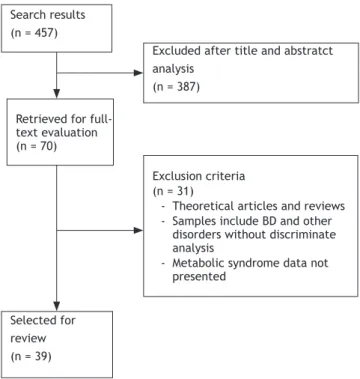
The literature search conducted using Medline, Embase and PsycInfo resulted in 457 articles. After the duplicate articles were excluded, 70 titles and abstracts were evaluated for pertinence. This process resulted in 39 references that were relevant to the present literature review. The search chart is shown in Figure 1, and the data extracted from these studies is available online as Supplementary Information.
Quality of studies
None of the studies reached the maximum quality rating of 5 points, mainly due to the lack of a structured BD diagnostic measure, the lack of a control group or general population comparison, or a sample size of less than 100 BD subjects.
Prevalence and demographic features
The prevalence of MS in BD patients was distributed according to different criteria, as presented in Table 1.
Patients with BD had a slightly higher rate of MS compared to the general population, but this difference failed to reach
signiicance.9-12 However, when compared to a control group, the prevalence of MS was signiicantly higher in BD patients.12-16
BD patients with MS were signiicantly older than BD
patients without MS.14,17-21 The risk of MS increased more than
3 times in BD subjects over 30 years old12,19 when compared to
a control group.15,16 However, one study showed no association
of MS with age.9 There were no signiicant differences in MS
rates according to gender.6,9,10,14-17,20-31
Search results (n = 457)
Retrieved for full-text evaluation (n = 70)
Excluded after title and abstratct analysis
(n = 387)
Exclusion criteria (n = 31)
- Theoretical articles and reviews - Samples include BD and other disorders without discriminate analysis
- Metabolic syndrome data not presented
Selected for review (n = 39)
Although some previous studies have found signiicantly
higher obesity rates in BD patients compared to the general population11 or healthy controls,12 others have found a signiicant difference only in women10 or no difference
at all.33 Data on the differences in gender prevalence are similarly conlicting; in two studies, female patients had signiicantly higher prevalence rates of abdominal obesity
when compared to men,21,22 whereas another study showed
no such difference.6
BD patients had significant higher rates of hypertri-glyceridemia than controls.12,14-16,33 When compared to
the general population, there was no significant differ-ence.10 Male BD patients had significantly higher rates
of hypertriglyceridemia when compared to female BD patients.6,22
Some studies presented signiicantly higher prevalence rates of low HDL-c in BD patients when compared to
controls,14-16,33 contrary to other reports that showed no signiicant difference.11,12 The prevalence of low HDL-c was
lower in BD patients compared to the general population,
but that was not signiicantly different.10 Women had higher rates of low HDL-c than did men, but this was not statistically signiicant.6,22 Women did have signiicantly higher HDL-c
ratios when compared to men.40
Data on hypertension were also contradictory. Although one study showed similar prevalence rates in patients with BD and the general population,10 another showed signiicant
higher prevalence in patients.11 When compared to controls, one study presented signiicantly higher rates of hypertension
in patients,14 whereas others reported similar prevalence
rates.12,15,16 Among BD patients, men had significantly
higher rates of hypertension than women,6,22 with signiicantly higher systolic blood pressures as well.40
D e s p i t e t h e s e l e c t i v i t y o f t h e c r i t e r i a u s e d ,
hyperglycemia rates were signiicantly higher in patients
with BD when compared to the general population.10 However,
when compared to controls, patients had a similar prevalence of hyperglycemia.12,14-16,33 Men and women had similar rates of
hyperglycemia.6,22
Obesity was higher in patients with BD than controls12,15,16
and the general population9,11 (except in one study that
found similar prevalence rates in both groups10). BD patients
were also reported to be more overweight than controls,
both signiicantly14 and non-signiicantly,12 and they were signiicantly more overweight than the general population.11 Patients with MS had signiicantly higher body mass index
(BMI) values than those without MS,18 and it was found that BMI was signiicantly associated with MS in a logistic
regression analysis.19
Discussion
Despite inding some contradictory results, we report on a
body of evidence that shows a higher prevalence of MS and its subcomponents in bipolar patients. MS was associated with a poor course of illness and prognosis in bipolar individuals, suggesting that this is still an important issue in clinical and psychiatric practice.
Table 1 Prevalence of metabolic syndrome in bipolar
disorder in each criterion deinition.
Criterion Prevalence References
NCEP ATP III 16.7%-50.0% 10; 12; 14-17; 19; 20; 22; 23; 25; 26; 28-32; 34; 36; 52; 53
IDF 25.7%-67.0% 12; 19; 20; 39; 51
NCEP ATP III: National Cholesterol Education Program Adult Treatment Panel IDF: International Diabetes Federation.
Course of disorder and clinical outcomes
Two studies of BD patients reported no signiicant differences in the age of onset of the irst episode in BD patients with
MS compared to those without MS.6,20 However, Guan et al.13 found that BD patients with MS had a signiicantly older mean age of onset of the irst episode compared to BD patients
without MS. Other studies showed that BD patients with MS
had a signiicantly later age of irst treatment for depression
and mania,6 a signiicantly longer illness duration20 and a signiicantly greater number of psychiatric hospitalizations,6
compared to those without MS.
Several studies found no association between psychotropic drug use or treatment strategy and elevated rates of MS.10,12,14,22,32-34 However, more of the subjects taking
olanzapine, clozapine, or lithium met criteria for MS than those who did not take these drugs.17,35 Patients taking only
antipsychotics had higher MS rates than patients taking only mood stabilizers.24
The rates of psychiatric comorbidity were not signiicantly
different between BD patients with and without MS,6,20 but BD patients did have signiicantly higher rates of psychiatric
comorbidities compared with healthy controls.16 Some studies showed no signiicant difference in the lifetime history of
suicide attempts between BD patients with and without MS,6,9,23,36 whereas others found that this was signiicantly
higher in BD patients with MS.36,37
With regards to clinical comorbidities, BD patients had higher overall comorbidity rates than healthy controls.15,16 BD patients with MS had signiicantly increased rates of
diabetes and cardiovascular disease compared to both BD patients without MS14,18,22 and to the general population.11
These patients also had a significantly greater risk of cardiovascular mortality and coronary heart disease when compared to patients without MS.38 Smoking was not
associated with the presence14,20 or risk of MS,39 except when
compared to controls or the general population.11,16 Bipolar patients with MS had signiicantly higher rates of alcoholism
than patients without MS,14 but they had similar alcoholism
rates as controls16 and signiicantly lower alcoholism rates
than other diagnostic criteria.35
Subcomponents of metabolic syndrome
The variance in results could be explained by differences
in the sample or could relect differences in the prevalence
of MS in the general population due to cultural differences in dietary habits, levels of physical activity and genetic
backgrounds. These factors may have inluenced the analysis
of the subcomponents as well. Indeed, the heterogeneity of
the criteria is a signiicant concern regarding MS diagnosis41
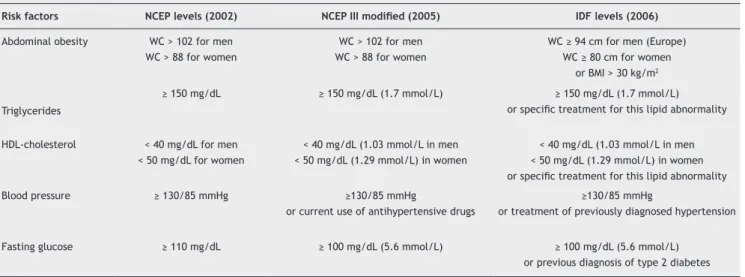
and could have affected the prevalence rates in the reviewed studies. The criteria by the NCEP ATP III and the IDF are the most widely used to diagnose MS, but there are some differences between them (Table 2). Moreover, there is a
large cluster of criteria modiications that makes clinical
diagnosis and research analysis challenging.
Although the use of psychotropic drugs provides a common-sense explanation of some of the components
of MS, studies that do not ind this association show that
medications are not a simple explanation. Most BD patients reported polypharmaceutical drug use or had used different types of medication during the course of their disease. Because antipsychotic polytherapy increases the prevalence of MS compared to monotherapy,42 the use of multiple
medications could aggravate the course of MS, resulting in a worse outcome.35 However, the co-occurrence of BD with
obesity and changes in glucose metabolism are observed even before the existence of these medications.11 A study with irst-episode psychotic patients showed increasing rates of
obesity, hyperglycemia and dyslipidemia after using atypical antipsychotics.43 Studies with irst-episode or drug-free BD
patients are required to clarify the role of medication in this association.
Mechanisms linking MS and bipolar disorder have been
largely unidentiied. Hypotheses have emerged positing that
both negative health behaviors, such as smoking, poor diet, overeating, and a sedentary lifestyle,44 and biological factors of MS, such as hypothalamic-pituitary-adrenocortical (HPA)
axis and sympathoadrenal hyperactivity, and abnormalities of the immunologic system,45 such as increased proinlammatory
cytokines,46 are correlated with BD.
Negative outcomes such as psychiatric and physical comorbidities could also be explained by the concept
of allostatic load (AL). AL results from an overload in
the allostatic processes due to the chronic overactivity or inactivity of the physiological systems (such as the hypothalamic-pituitary-adrenal axis) that are involved in the capacity to achieve stability through adaptation to internal and external demands (i.e., allostasis). Patients
with a higher AL were found to have an increased risk of
incidental cardiovascular disease and all-cause mortality, which is in accordance with the increased prevalence in found in BD patients of medical conditions such as diabetes, hypertension, ischemic heart disease and stroke.47 All of
those correlated factors, such as neuroendocrinal and
inlammatory abnormalities, the use of psychotropic drugs
and negative health behaviors, act like allostatic components
that reinforce the role of AL in BD-MS association.
Several limitations were noted during the review of the cited articles in the current study. First, differing experimental designs and sampling methodologies make formal comparison between studies difficult. Different criteria used to diagnose MS and the lack of a structured
diagnostic interview to conirm a bipolar diagnosis did
not allow for standardization of the results. Additionally, most of the studies were cross-sectional. Because of this limitation, a causal relationship between bipolar disorder and metabolic syndrome could not be established. The medication treatment regimen may also be a liability, evoking the need for longitudinal studies.
In conclusion, the association between MS and BD, although not clear, is important to consider, as BD patients have other risks factors for MS, such as increased rates of cardiovascular disease and diabetes. Because cardiovascular risk is increased in bipolar patients, and because of the negative impact of MS on general physical and psychological well-being and functioning, MS could contribute to a worse prognosis for BD and vice-versa. Therefore, psychiatrists should be aware of the risk factors involved in MS and should intervene as soon as possible to prevent metabolic
Table 2 NCEP and IDF deinitions for metabolic syndrome.
Risk factors NCEP levels (2002) NCEP III modiied (2005) IDF levels (2006)
Abdominal obesity WC > 102 for men WC > 88 for women
WC > 102 for men WC > 88 for women
WC ≥ 94 cm for men (Europe) WC ≥ 80 cm for women
or BMI > 30 kg/m2
Triglycerides
≥ 150 mg/dL ≥ 150 mg/dL (1.7 mmol/L) ≥ 150 mg/dL (1.7 mmol/L)
or speciic treatment for this lipid abnormality
HDL-cholesterol < 40 mg/dL for men < 50 mg/dL for women
< 40 mg/dL (1.03 mmol/L in men < 50 mg/dL (1.29 mmol/L) in women
< 40 mg/dL (1.03 mmol/L in men < 50 mg/dL (1.29 mmol/L) in women or speciic treatment for this lipid abnormality
Blood pressure ≥ 130/85 mmHg ≥130/85 mmHg
or current use of antihypertensive drugs
≥130/85 mmHg
or treatment of previously diagnosed hypertension
Fasting glucose ≥ 110 mg/dL ≥ 100 mg/dL (5.6 mmol/L) ≥ 100 mg/dL (5.6 mmol/L) or previous diagnosis of type 2 diabetes
abnormalities that could inluence the prognosis of bipolar
disorder. Such strategies include monitoring the patient’s lifestyle, eating habits and exercise routine.
Disclosures
Letícia Czepielewski
Employment: Developmental Cognitive Neuroscience Research Group, Post-Graduate Program in Psychology and The Biomedical Research
Institute of Pontíicia Universidade do Rio Grande do Sul, Porto Alegre,
Brazil.
Ledo Daruy Filho, M.D., M.Sc
Employment: Developmental Cognitive Neuroscience Research Group, Post-Graduate Program in Psychology and The Biomedical Research
Institute of Pontíicia Universidade do Rio Grande do Sul, Porto Alegre,
Brazil.
Elisa Brietzke, MD, PhD
Employment: Program for Recognition and Intervention in Individuals in
At-Risk Mental States, Department of Psychiatry, Universidade Federal
de São Paulo, São Paulo, Brazil; Interdisciplinary Laboratory of Clinical
Neurosciences (LiNC), Department of Psychiatry, Universidade Federal
de São Paulo, São Paulo, Brazil.
Rodrigo Grassi-Oliveira, MD, PhD
Employment: Developmental Cognitive Neuroscience Research Group, Post-Graduate Program in Psychology and The Biomedical Research
Institute of Pontíicia Universidade do Rio Grande do Sul, Porto Alegre,
Brazil.
The authors report no proprietary or commercial interest in any product mentioned or concept discussed in this article.
* Modest
** Signiicant
*** Signiicant. Amounts given to the author's institution or to a colleague for
research in which the author has participation, not directly to the author.
References
1. Ferrari AJ, Baxter AJ, Whiteford HA. A systematic review of the
global distribution and availability of prevalence data for bipolar disorder. J Affect Disord. 2011;134(1-3):1-13.
2. Brietzke E, Kapczinski F, Grassi-Oliveira R, Grande I, Vieta E, McIntyre RS. Insulin dysfunction and allostatic load in bipolar disorder. Expert Rev Neurother. [Review]. 2011;11(7):1017-28. 3. de Almeida KM, Moreira CL, Lafer B. Metabolic syndrome and
bipolar disorder: what should psychiatrists know? CNS Neurosci Ther. 2012;18(2):160-6.
4. Eberly LE, Prineas R, Cohen JD, Vazquez G, Zhi X, Neaton JD,
et al. Metabolic syndrome: risk factor distribution and 18-year mortality in the multiple risk factor intervention trial. Diabetes
Care. [Multicenter Study Research Support, N.I.H., Extramural].
2006;29(1):123-30.
5. McIntyre RS, Danilewitz M, Liauw SS, Kemp DE, Nguyen HT, Kahn LS, et al. Bipolar disorder and metabolic syndrome: an
international perspective. J Affect Disord. [Comparative Study Review]. 2010;126(3):366-87.
6. McIntyre RS, Woldeyohannes HO, Soczynska JK, Miranda A, Lachowski A, Liauw SS, et al. The rate of metabolic syndrome
in euthymic Canadian individuals with bipolar I/II disorder. Adv Ther. 2010;27(11):828-36.
7. Fisher HL, Hosang GM. Childhood Maltreatment and Bipolar
Disorder: A Critical Review of the Evidence. Mind Brain [serial on the Internet]. 2010.
8. Daruy-Filho L, Brietzke E, Lafer B, Grassi-Oliveira R. Childhood
maltreatment and clinical outcomes of bipolar disorder. Acta Psychiatr Scand. 2011;124(6):427-34.
9. Almeida K, Macedo-Soares M, Issler C, Amaral J, Caetano S, Dias R, et al. Obesity and metabolic syndrome in Brazilian patients with bipolar disorder. Acta Neuropsychiatrica. 2009;2:84-8.
10. Baptista T, Serrano A, Uzcategui E, ElFakih Y, Rangel N, Carrizo E, et al. The metabolic syndrome and its constituting variables in atypical antipsychotic-treated subjects: comparison with other
drug treatments, drug-free psychiatric patients, irst-degree
relatives and the general population in Venezuela. Schizophr Res. 2011;126(1-3):93-102.
11. Birkenaes AB, Opjordsmoen S, Brunborg C, Engh JA, Jonsdottir
H, Ringen PA, et al. The level of cardiovascular risk factors in
bipolar disorder equals that of schizophrenia: a comparative study. J Clin Psychiatry. 2007;68(6):917-23.
12. Lee NY, Kim SH, Cho B, Lee YJ, Chang JS, Kang UG, et al.
Patients taking medications for bipolar disorder are more prone to metabolic syndrome than Korea's general population. Prog Neuropsychopharmacol Biol Psychiatry. 2010;34(7):1243-9. 13. Guan N, Liu H, Diao F, Zhang J, Zhang M, Wu T. Prevalence of
metabolic syndrome in bipolar patients initiating acute-phase treatment: a 6-month follow up. Psychiatry Clin Neurosci. 2010;64(6):625-33.
14. Sicras-Mainar A, Blanca-Tamayo M, Rejas-Gutierrez J, Navarro-Artieda R. Metabolic syndrome in outpatients receiving antipsychotic therapy in routine clinical practice: a cross-sectional assessment of a primary health care database. Eur Psychiatry. 2008;23(2):100-8.
15. Sicras A, Rejas J, Navarro R, Serrat J, Blanca M. Metabolic syndrome in bipolar disorder: a cross-sectional assessment of
a Health Management Organization database. Bipolar Disord.
2008;10(5):607-16.
16. Cardenas J, Frye MA, Marusak SL, Levander EM, Chirichigno JW, Lewis S, et al. Modal subcomponents of metabolic syndrome
in patients with bipolar disorder. J Affect Disord. 2008;106(1-2):91-7.
17. Correll CU, Frederickson AM, Kane JM, Manu P. Metabolic syndrome and the risk of coronary heart disease in 367 patients treated with second-generation antipsychotic drugs. J Clin Psychiatry. 2006;67(4):575-83.
18. Garcia-Portilla MP, Saiz PA, Benabarre A, Sierra P, Perez J, Rodriguez A, et al. The prevalence of metabolic syndrome in patients with bipolar disorder. J Affect Disord. 2008;106(1-2):197-201.
19. Salvi V, Albert U, Chiarle A, Soreca I, Bogetto F, Maina G. Metabolic syndrome in Italian patients with bipolar disorder.
Gen Hosp Psychiatry. 2008;30(4):318-23.
20. van Winkel R, De Hert M, Van Eyck D, Hanssens L, Wampers
M, Scheen A, et al. Prevalence of diabetes and the metabolic syndrome in a sample of patients with bipolar disorder. Bipolar Disord. 2008;10(2):342-8.
21. Salvi V, D'Ambrosio V, Rosso G, Bogetto F, Maina G. Age-speciic
prevalence of metabolic syndrome in Italian patients with bipolar disorder. Psychiatry Clin Neurosci. 2011;65(1):47-54. 22. Vuksan-Cusa B, Sagud M, Jakovljevic M. C-reactive protein
and metabolic syndrome in patients with bipolar disorder compared to patients with schizophrenia. Psychiatr Danub. 2010;22(2):275-7.
23. Yumru M, Savas HA, Kurt E, Kaya MC, Selek S, Savas E, et al.
Atypical antipsychotics related metabolic syndrome in bipolar patients. J Affect Disord. 2007;98(3):247-52.
24. Correll CU, Frederickson AM, Kane JM, Manu P. Equally increased risk for metabolic syndrome in patients with bipolar disorder and schizophrenia treated with second-generation antipsychotics. Bipolar Disord. 2008;10(7):788-97.
25. D'Ambrosio V, Salvi V, Bogetto F, Maina G. Serum lipids, metabolic syndrome and lifetime suicide attempts in patients with bipolar disorder. Prog Neuropsychopharmacol Biol Psychiatry. 2012;37(1):136-40.
26. Ezzaher A, Haj MD, Mechri A, Neffati F, Douki W, Gaha L, et al. Metabolic syndrome in Tunisian bipolar I patients. Afr Health
27. Fiedorowicz JG, Palagummi NM, Forman-Hoffman VL, Miller DD, Haynes WG. Elevated prevalence of obesity, metabolic
syndrome, and cardiovascular risk factors in bipolar disorder. Ann Clin Psychiatry. 2008;20(3):131-7.
28. Grover S, Aggarwal M, Dutt A, Chakrabarti S, Avasthi A, Kulhara P, et al. Prevalence of metabolic syndrome in patients with schizophrenia in India. Psychiatry Res. 2012;200:1035-7. 29. Khatana SA, Kane J, Taveira TH, Bauer MS, Wu WC. Monitoring
and prevalence rates of metabolic syndrome in military veterans
with serious mental illness. PLoS One. 2011;6(4):e19298.
30. Salvi V, D'Ambrosio V, Bogetto F, Maina G. Metabolic syndrome in Italian patients with bipolar disorder: a 2-year follow-up study. J Affect Disord. 2012;136(3):599-603.
31. Vuksan-Cusa B, Jakovljevic M, Sagud M, Mihaljevic Peles A, Marcinko D, Topic R, et al. Metabolic syndrome and serum homocysteine in patients with bipolar disorder and schizophrenia treated with second generation antipsychotics. Psychiatry Res. 2011;189(1):21-5.
32. Elmslie JL, Porter RJ, Joyce PR, Hunt PJ, Shand BI, Scott RS.
Comparison of insulin resistance, metabolic syndrome and adiponectin in overweight bipolar patients taking sodium
valproate and controls. Aust N Z J Psychiatry. 2009;43(1):53-60.
33. Kemp DE, Calabrese JR, Tran QV, Pikalov A, Eudicone JM, Baker RA. Metabolic syndrome in patients enrolled in a clinical trial of aripiprazole in the maintenance treatment of bipolar I disorder: a post hoc analysis of a randomized, double-blind, placebo-controlled trial. J Clin Psychiatry. 2010;71(9):1138-44. 34. Teixeira PJ, Rocha FL. The prevalence of metabolic syndrome
among psychiatric inpatients in Brazil. Rev Bras Psiquiatr. 2007;29(4):330-6.
35. Fagiolini A, Frank E, Turkin S, Houck PR, Soreca I, Kupfer DJ.
Metabolic syndrome in patients with bipolar disorder. J Clin Psychiatry. 2008;69(4):678-9.
36. Fagiolini A, Frank E, Scott JA, Turkin S, Kupfer DJ. Metabolic
syndrome in bipolar disorder: indings from the Bipolar Disorder
Center for Pennsylvanians. Bipolar Disord. 2005;7(5):424-30. 37. Garcia-Portilla MP, Saiz PA, Bascaran MT, Martinez AS, Benabarre
A, Sierra P, et al. Cardiovascular risk in patients with bipolar disorder. J Affect Disord. 2009;115(3):302-8.
38. Garcia-Portilla MP, Saiz PA, Benabarre A, Florez G, Bascaran MT, Diaz EM, et al. Impact of substance use on the physical health of patients with bipolar disorder. Acta Psychiatr Scand. 2010;121(6):437-45.
39. Chang HH, Chou CH, Chen PS, Gean PW, Huang HC, Lin CY, et al. High prevalence of metabolic disturbances in patients with
bipolar disorder in Taiwan. J Affect Disord. 2009;117(1-2):124-9. 40. Correll CU, Frederickson AM, Kane JM, Manu P. Does
antipsychotic polypharmacy increase the risk for metabolic syndrome? Schizophr Res. 2007;89(1-3):91-100.
41. Assmann G, Guerra R, Fox G, Cullen P, Schulte H, Willett D, et al. Harmonizing the deinition of the metabolic syndrome:
comparison of the criteria of the Adult Treatment Panel III and the International Diabetes Federation in United States American and European populations. Am J Cardiol. 2007;99(4):541-8. 42. Katon WJ. Clinical and health services relationships between
major depression, depressive symptoms, and general medical illness. Biol Psychiatry. 2003;54(3):216-26.
43. Graham KA, Cho H, Brownley KA, Harp JB. Early
treatment-related changes in diabetes and cardiovascular disease risk
markers in irst episode psychosis subjects. Schizophr Res.
2008;101(1-3):287-94.
44. Joynt KE, Whellan DJ, O'Connor CM. Depression and cardiovascular disease: mechanisms of interaction. Biol Psychiatry. 2003;54(3):248-61.
45. Taylor V, MacQueen G. Associations between bipolar disorder and metabolic syndrome: A review. J Clin Psychiatry. 2006;67(7):1034-41.
46. Goldstein BI, Kemp DE, Soczynska JK, McIntyre RS. Inlammation
and the phenomenology, pathophysiology, comorbidity, and treatment of bipolar disorder: a systematic review of the literature. J Clin Psychiatry. 2009;70(8):1078-90.
47. Kapczinski F, Vieta E, Andreazza AC, Frey BN, Gomes FA, Tramontina J, et al. Allostatic load in bipolar disorder: implications for pathophysiology and treatment. Neurosci Biobehav Rev. 2008;32(4):675-92.
48. Correll CU, Druss BG, Lombardo I, O'Gorman C, Harnett JP,
Sanders KN, et al. Findings of a U.S. national cardiometabolic screening program among 10,084 psychiatric outpatients. Psychiatr Serv. 2010;61(9):892-8.
49. Taylor V, McKinnon MC, Macdonald K, Jaswal G, Macqueen GM.
Adults with mood disorders have an increased risk proile for cardiovascular disease within the irst 2 years of treatment.
Can J Psychiatry. 2010;55(6):362-8.
50. Centorrino F, Mark TL, Talamo A, Oh K, Chang J. Health and
economic burden of metabolic comorbidity among individuals with bipolar disorder. J Clin Psychopharmacol. 2009;29(6):595-600.
51. John AP, Koloth R, Dragovic M, Lim SC. Prevalence of metabolic
syndrome among Australians with severe mental illness. Med J Aust. 2009;190(4):176-9.
52. Vuksan-Cusa B, Marcinko D, Nad S, Jakovljević M. Differences
in cholesterol and metabolic syndrome between bipolar disorder men with and without suicide attempts. Prog Neuropsychopharmacol Biol Psychiatry. 2009;33(1):109-12. 53. McIntyre RS, Woldeyohannes HO, Soczynska JK, Miranda A,
Lachowski A, Liauw SS, et al. The rate of metabolic syndrome